Catalogue > Liste par artiste
Parcourez la liste complète des artistes présentés dans le cadre des Rencontres Internationales depuis 2004. Utilisez le filtre alphabétique pour affiner vos recherches.
Marcos Garcia
Catalogue : 2007MediaLab Madrid | 0 | 0 | | 0:0 | Espagne | 2007

Marcos Garcia
MediaLab Madrid
0 | 0 | | 0:0 | Espagne | 2007
Médialab a été fondé en 2002 par le Centre culturel Conde Duque et le Conseil des Arts de la ville de Madrid. C`est une structure conçue comme un espace d`exposition et un laboratoire ouvert en lequel prennent forme des recherches traitant de l`art et de la science reliés aux technologies de l`information et télécommunication. Par l`organisation de séminaires et de festivals s`y retrouvent créateurs et chercheurs de disciplines différentes. C`est un lieu qui souhaite favoriser les échanges et le partage des connaissances et des expériences quant aux formes artistiques émergentes.
Marco Garcia est un artiste média travaillant au sein de l`espace Médialab, département documentation et programmation éducative.
Dora Garcia
Catalogue : 2010Film (Hôtel Wolfers) | Vidéo | betaSP | couleur | 11:31 | Espagne | 2009
Dora Garcia
Film (Hôtel Wolfers)
Vidéo | betaSP | couleur | 11:31 | Espagne | 2009
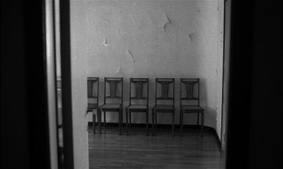
The camera?s eye tours through an abandoned house. Accurately it scans the walls, the window panes in their metal grooves and the light rooms. Its gaze slides over flaking paint. The outspoken architecture of this distinguished building ( Hôtel Wolfers in Brussels) is designed by Henry van de Velde. The soundless recordings, made in black and white on 35 mm film, the historical location and the chosen technique underline the story that is narrated by the voice-over. This story, a film script, dates back to 1965 but refers to 1929, the same era from which the building stems. There is no relation between the recordings of the space and the narration, although both sometimes seem to coincide. The house is a neutral space that is filled with the story written in 1965 by Samuel Beckett and bears the same mane as Dora Garcia?s work: ?Film?. Beckett was one of the first who emphasized the voyeuristic gaze of the viewer in cinema. He introduced the viewer into the story by letting him/her take the place of the camera. In the original version of ?Film?, Buster Keaton is the protagonist O. O is trying his best to remain unseen; his face is constantly turned away. People who do look into the camera and who are seen by it, shrivel with fear. After O has entered a house, he liberates each room from any gaze. Windows and mirrors are covered and portraits are taken from the walls. One gaze is overlooked: E?s ? the eye of the camera. In the confrontation, O and E appear to be the same person, symbolizing the viewer who is being confronted with his/her own gaze. In Dora Garcia?s piece it works in the same manner: the viewer?s position is investigated again through the camera, which accurately scans the space, looking for a clue or a story. The outward views are protected, nothing can be seen out of the windows. The wandering viewer eventually only meets himself.
L?artiste espagnole Dora García habite et travaille à Bruxelles. Dora García naît en 1965 à Valladodid dans le nord-ouest de l?Espagne. Son grand-père s?est battu dans la guerre civile en Espagne. Quant à son père, il exerce le métier d?avocat. Vu l?amour de ce dernier pour les voyages, la famille déménage beaucoup. Voilà pourquoi, pendant son enfance, Dora García vit un peu partout en Espagne. Dora García fait des études d?Arts Plastiques à l?université de Salamanca. Puis, elle suit des leçons aux Talleres del Círculo de Bellas Artes à Madrid. Là, des professeurs renommés tels que les artistes Richard Artschwager, Jiri Georg Dokoupil et Bruce McLean lui offrent une toute autre perspective de l?art. Ainsi, elle décide de quitter son pays natal pour aller découvrir d?autres horizons. Au début des années 90, García s?installe à Londres. Par cette voie, elle arrive à l?Académie des Beaux Arts d?Amsterdam où elle étudie de 1989 à 1991. Depuis 1992, l?artiste séjourne à Anvers grâce à une bourse d?études. En 1995, elle déménage à Bruxelles avec Manon de Boer, une artiste hollandaise avec laquelle Dora a étudié à Amsterdam. A présent, elle habite toujours à Bruxelles et y est professeur à l?école supérieure Sint-Lukas. L??uvre de Dora García se situe entre la performance, le texte et l?installation. Les rapports entre l?artiste, son ?uvre d?art et le spectateur occupent une place centrale. Son ?uvre est de nature conceptuelle. García utilise divers médias tels que le dessin, la photo, l?installation sur place, la performance, la vidéo, le son, le net.art et le texte. L?artiste travaille souvent dans l?espace public, comme le montre son ambitieux projet Inserts in real time (2001), une série de dix performances dans lesquelles les acteurs accomplissent ses instructions ?en temps réel?. En outre, le langage joue un rôle important, aussi bien comme moyen de communication que comme système de signes codé. L?impossibilité de communiquer clairement est un des thèmes clés de son ?uvre. De plus, l?artiste s?inspire souvent de textes littéraires. Dora García a participé à des manifestations d?art contemporain telles que Manifesta 1998, la Biennale d?Istanbul 2003 et Skulptur Projekte Münster 07. Elle a également exposé ses ?uvres au Musée d?Art Contemporain à Barcelone, au Stedelijk Museum à Amsterdam, au FRAC Lorraine à Metz, à la Galerie Michel Rein à Paris et au SMAK à Gand. En 2008, elle participera à la Biennale de Sydney et à d?autres expositions comme Double Agent, qui aura lieu à l?Institut d?Art Contemporain à Londres, et à Ne pas jouer avec des choses mortes à la Villa Arson à Nice
Serge Garcia
Catalogue : 2023A General Disappointment | Fiction expérimentale | 16mm | couleur | 24:0 | USA | 2022
Serge Garcia
A General Disappointment
Fiction expérimentale | 16mm | couleur | 24:0 | USA | 2022
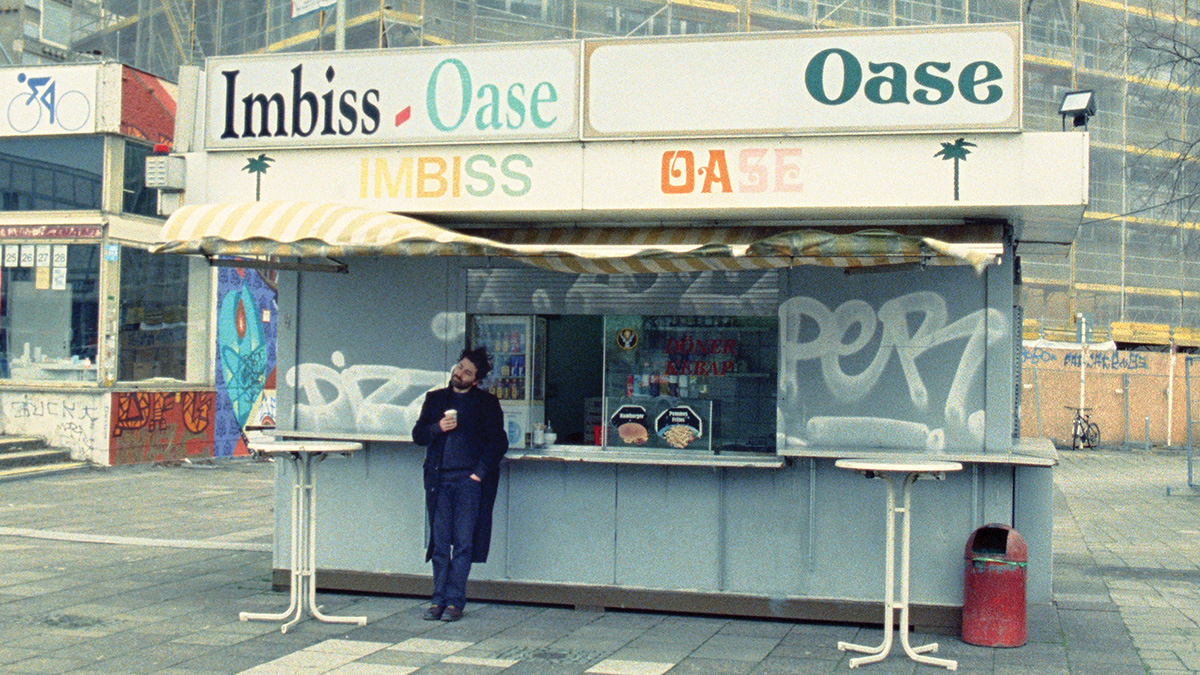
A General Disappointment bends the quotidian with ordinary scenes that are overlaid with stories told through text that wander through a night at a sex club, domestic duties at home, and the existential aftermath after a failed attempt to go on a date. The experience invites us to ponder over the systemic failures inherent to capitalist societies, and how vain their promises of happiness and self-fulfillment are.
Serge Garcia is a writer and filmmaker with a penchant for aimlessly wandering. His work emphasizes narratives that explore possibilities for agency. His films and documentaries have screened internationally
Dora García
Catalogue : 2022Si Pudiera Desear Algo | Doc. expérimental | hdv | couleur | 68:0 | Espagne, Belgique | 2021

Dora GarcÍa
Si Pudiera Desear Algo
Doc. expérimental | hdv | couleur | 68:0 | Espagne, Belgique | 2021
If I could wish for something takes its title from a Friedrich Holländer's Weimar song. The lyrics of ‘Wenn ich mir was wünschen dürfte’ are sung from the perspective of a woman who seeks to be happy, but not too happy, because sadness has become a refuge for her. This feeling is typical of the fraught ‘love story’ between feminism and socialism, between love and revolution. ‘The woman question’ has been tiptoed around by every revolutionary movement since the nineteenth century. These decades of disillusionment are part and parcel of feminist history.
Dora García lives and works in Oslo. She currently teaches at Oslo National Academy of the Arts, Norway. She has represented Spain at the Venice Biennale in 2011 and was present again in the Venice Biennale 2013. She took part in the 56th Venice International Art Exhibition, dOCUMENTA(13) and other international events such as Münster Sculpture Projects in 2007, Sydney Biennale 2008 and Sao Paulo Biennale 2010. Her work is largely performative and deals with issues related to community and individuality in contemporary society, exploring the political potential of marginal positions, paying homage to eccentric characters and antiheroes. These eccentric characters have often been the center of her film projects, such as The Deviant Majority (2010), The Joycean Society (2013) and Segunda Vez (2018).
Catalogue : 2019Segunda Vez | Doc. expérimental | hdv | couleur | 94:0 | Espagne, Belgique | 2018
Dora GarcÍa
Segunda Vez
Doc. expérimental | hdv | couleur | 94:0 | Espagne, Belgique | 2018
SYNOPSIS - Une phrase Segunda Vez se concentre sur la figure d’Oscar Masotta, dont les idées sur la psychanalyse, la politique et l’art a changé le paysage artistique du Buenos Aires des années 60 qui précédait la dictature. SYNOPSIS - Court Doria García mélange politique, psychanalyse et performance dans Segunda Vez (La deuxième fois). Ce faux documentaire se concentre sur la figure d’Oscar Masotta, un théoricien pivotante dans l’avant-garde argentine des années 50 aux années 70, sans pour autant se définir en tant que biopic. Le titre, Segunda Vez, puise son origine d’une histoire homonymique écrite par un contemporain de Masotta, Julio Cortazar, qui raconte le climat de psychose et d’incertitude causé par le trauma des disparitions en Argentine. SYNOPSIS - Long Doria García mélange politique, psychanalyse et performance dans Segunda Vez (La deuxième fois). Ce faux documentaire se concentre sur la figure d’Oscar Masotta, un théoricien pivotante dans l’avant-garde argentine des années 50 aux années 70, sans pour autant se définir en tant que biopic. Le titre, Segunda Vez, puise son origine d’une histoire homonymique écrite par un contemporain de Masotta, Julio Cortazar, qui raconte le climat de psychose et d’incertitude causé par le trauma des disparitions en Argentine. Dans Segunda Vez, García tisse une séquence de scènes d’apparences disparates qui se lient grace à l’acte de la répétition et de l’observation : des posters collés le long d’un mur annoncent leur propre transmission . Un message phantômatique dans une ville animée. Deux publics convergent à la cime d’une falaise, ils sont divisés dans leur connaissance du scénario auquel ils participent. Une personne, attachée de ses vêtements blancs et de cordes se voit être portée et laissée dans une forêt. La brève apparence d’un hélicoptère cause quelque peu d’excitation et de consternation. Un groupe de personnes pauvres et âgées est réuni sur un podium, payé pour enduré une lumière et du son violent pendant une heure pendant qu’un public les observe. Une bibliothèque réunit un groupe de lecteurs qui savent être observés. Suite à une série de convocations mystérieuses, des étrangers se parlent dans une salle d’attente, anticipant ce qu’il pourrait arriver. L’un d’entre eux vient d’être rappellé pour “la deuxième fois?.
Dora Garcià vit et travaille entre Barcelone et Oslo. Elle enseigne couramment à L’Académie Nationale des Arts d’Oslo et au HEAD de Genève, en Suisse. Elle est co-directrice des laboratoires d’Aubervilliers à Paris. Elle a représenté l’Espagne à la Biennale de Venise en 2011 et s’est représentée à nouveau en 2013 (évènements collatéraux). Elle a participé à la 56ème édition de l’Exposition Internationale d’Art de Venise, à la dOCUMENTA (13) et à d’autres évènements internationaux tels que le Münster Sculptur Projekts en 2007, la Biennale de Sydney de 2008 et la Biennale de Sao Paulo de 2010. Son travail est largement performatif et traite de questions relatives à la communauté et à l’individualité dans la société contemporaine. Elle explore le potentiel des positions marginales en rendant hommage à des personnages excentriques et à des anti- héros. Ces derniers ont souvent été au centre de ses projets cinématographiques, tels que The Deviant Majority (2010) et The Joycean Society (2013).
Dora García
Catalogue : 2025(Revolución, cumple tu promesa) Amor Rojo | Doc. expérimental | 4k | couleur | 95:0 | Espagne, Belgique | 2024
Dora García
(Revolución, cumple tu promesa) Amor Rojo
Doc. expérimental | 4k | couleur | 95:0 | Espagne, Belgique | 2024
Faites de votre amour une arme. Ce film propose une lecture des écrits de la révolutionnaire soviétique et activiste sexuelle Alexandra Kollontai sur la sexualité féminine et l'émancipation, sur l'abolition de la famille et la nécessité de « changer les cœurs et les esprits ». Cette lecture trace un réseau complexe de connexions entre le féminisme marxiste européen du XXe siècle et les transféminismes latino-américains du XXIe siècle, entre le deuil personnel et collectif, entre une myriade de façons de comprendre le féminin, et entre le regard mélancolique du désenchantement et la demande furieuse, tendre et impérieuse que la révolution, enfin, remplisse sa promesse. (Révolution, tiens ta promesse) Red Love (2024) est le film jumeau de Red Love (2023). Les sons et les images des séquences originales de Red Love ont été entièrement remontés, et un grand nombre de nouveaux documents d'archives ont été ajoutés, qui sont clairement empreints de l'urgence du militantisme tout en retraçant des généalogies historiques minutieuses. Ce film est le résultat de huit années de recherche, depuis les archives Engels-Marx-Lénine de Moscou jusqu'à de multiples archives personnelles, familières, historiques et militantes au Mexique et en Amérique latine. Il s'agit d'une œuvre collective réalisée par une équipe de chercheurs et d'artistes de différentes nationalités. Il veut s'inscrire dans l'urgence de la tradition du film militant tout en traçant des généalogies historiques minutieuses et en se projetant dans l'avenir.
Dora García vit et travaille à Oslo. Elle enseigne actuellement à l'Académie nationale des arts d'Oslo, en Norvège. Elle a représenté l'Espagne à la Biennale de Venise en 2011 et était à nouveau présente à la Biennale de Venise en 2013. Elle a participé à la 56e exposition internationale d'art de Venise, à dOCUMENTA(13) et à d'autres événements internationaux tels que Münster Sculpture Projects en 2007, la Biennale de Sydney en 2008 et la Biennale de Sao Paulo en 2010. Son travail est largement performatif et traite de questions liées à la communauté et à l'individualité dans la société contemporaine, explorant le potentiel politique des positions marginales, rendant hommage aux personnages excentriques et aux antihéros. Ces personnages excentriques ont souvent été au centre de ses projets cinématographiques, tels que The Deviant Majority (2010), The Joycean Society (2013) et Segunda Vez (2018).
Inés García
Catalogue : 2014LIFT | Vidéo | hdv | couleur | 1:13 | Espagne | 2012
Inés GarcÍa
LIFT
Vidéo | hdv | couleur | 1:13 | Espagne | 2012
Transit time where the inside and outside, the above and below are merged into one unit.
Bachelor of Fine Arts from the University of Barcelona, she won a scholarship to study for a year in Bali, on her return she decided to bet for the local context of Barcelona and Bilbao. She has participated in several exhibitions in Barcelona, in Bilbao (BilbaoArte, Espacio Abisal and Rekalde?s Art Space) in Madrid in Space Trapezio and Matadero through Curator?s Network, or Berlin in exhibitions such as The Secret Cabinet or Sans Soleil. Her videos have been shown at the Contemporary Art Center of La Conservera in Murcia, LOOP and SCREEN Festival in Barcelona. Last year she has participated in the Latino Video Art Festival of New York, or at the International Video art festival ( FIVA) in Buenos Aires among others.
Virginia García Del Pino
Catalogue : 2013EL JURADO | Doc. expérimental | hdv | couleur | 63:39 | Espagne | 2012
Virginia GarcÍa Del Pino
EL JURADO
Doc. expérimental | hdv | couleur | 63:39 | Espagne | 2012
A high angle extreme close-up shot of a woman?s face. So deeply focused she is biting her nails while listening. What is she listening to? Some voices being exchanged through microphones, pointing out a homicide case. As the title indicates, this is a trial, in which the woman is a juror. Virginia Garcia del Pino has us sitting at the top of a sophisticated triangle: we are watching someone listening to something, without seeing what she can see (magistrates, policemen, experts, etc.) although hearing everything the same way she does. We can hear the words while watching the effect they produce on someone else: we are both listening and surveying the listening process. She is our mirror image. The situation is even more critical as she is not a passive spectator. Her duty? To discern the significant facts and return a verdict. As we scrutinise her (a juror suddenly becoming the one being tried), a highly selective attention can be observed: a strain towards truth and justice. Finally, being bereft of what she can see, we will inevitably make it up: a mental film as a rival to the ongoing picture. The labyrinthine effect of the information we can hear is therefore increased: What image could match such and such word? What does this uncouth solicitor look like? What about the deep-voiced judge? Is the defendant in? Technical problems, mentioned during the hearing and failing to produce certain images and sounds, comically echo our own struggle to picture the scenes. A trial as an opportunity to obstruct the truth from being brought out: this is cinema teaching us a lesson.
Née en 1966, Virginia García del Pino est vidéaste. Après avoir étudié le cinéma à l?école des Beaux-Arts, elle se tourne vers le documentaire. Ses deux oeuvres les plus connues sont Pare de sufrir et Hagase tu voluntad qui ont reçu de nombreux prix.
Catalogue : 2010Mi hermana y yo | Doc. expérimental | dv | couleur | 10:0 | Espagne | 2009
Virginia GarcÍa Del Pino
Mi hermana y yo
Doc. expérimental | dv | couleur | 10:0 | Espagne | 2009
Por primera vez Virginia García del Pino bucea en la experiencia familiar para volver, desde una posición mucho más personal e íntima, sobre algunas de las cuerdas dramáticas que ya había pulsado en su obra anterior. En esta ocasión se trata de trazar en la pantalla sentimientos y estados de ánimo sin excusa narrativa. Relaciones descarnadas en un doble sentido: por que surgen sin argumento aparente que las organice y por que formalmente rompe cualquier tipo de continuidad entre la banda de sonido y la imagen que pueda servir de asidero para el espectador. Pieza oscura, como sus planos finales, que nos devuelve al siempre complejo y muchas veces tormentoso universo familiar, en un viaje interno que cada espectador debe realizar con sus propios fantasmas. Esos con los que es imposible pactar una tregua duradera.
Virginia García del Pino estudió Bellas Artes y cine en Barcelona, su ciudad natal. Sus creaciones como video-artista la acercan al género documental. Sus vídeos surgen de una tentativa de comprender el mundo desde una óptica menos dolorosa y es en ese intento de comprensión donde se despoja de todo artificio y opta por una contundente sencillez. Sus trabajos son muchas veces una manera de poner atención a las cosas que ya conoce hasta que le parecen del todo desconocidas. Es precisamente de esta mirada a lo conocido (lo cercano) como si no lo conociera, de donde parece emerger la profunda humanidad de sus vídeos y la dignidad de sus retratados: ya sean sirvientas en México (Hágase su voluntad, 2004) o trabajadores españoles cuyas profesiones están socialmente desprestigiadas (Lo que tú dices que soy, 2007). Ese mismo empeño por conocer se percibe también en su último trabajo, Mi hermana y yo (2009), en el que no trata de comunicar ideas, sino de plasmar sentimientos, de ahí que la pieza, se mantenga en un territorio difuso entre la experiencia intransferible y la capacidad de identificación. Y es este movimiento hacia el otro, este reconocimiento de y en las emociones ajenas, lo que aquí se pone en imágenes y en sonidos.
Albert García-alzórriz
Catalogue : 2025Die blaue Blume im Land der Technik | Documentaire | 4k | couleur | 75:0 | Espagne | 2023

Albert GarcÍa-alzÓrriz
Die blaue Blume im Land der Technik
Documentaire | 4k | couleur | 75:0 | Espagne | 2023
‘Health is life lived in the silence of the organs’, wrote French surgeon René Leriche in an Encyclopédie Française entry from 1936. Paradoxically, the closer we have got to this metaphorical silence, the more necessary an aesthetic synthesis, through increasingly complex and precise sounds and images, has become. The current paradigm of health technology, where bodies and their representations are sometimes indistinguishable, is the core of this film: an audiovisual study on the relationship between the human body and the latest hospital technology.
ALBERT GARCÍA-ALZÓRRIZ was born in Barcelona in 1992. His work has been exhibited at international events and festivals, including the 58th Biennale di Venezia, FID Marseille, FID Buenos Aires and Documenta Madrid, as well as at public and private institutions such as IVAM (Valencia), the Hong-Gah Museum (Taipei), the Louvre Museum (Paris), Haus der Kulturen der Welt (Berlin) and Cité Internationale des Arts (Paris).
Catalogue : 2021EYES / EYES / EYES / EYES | Doc. expérimental | 4k | couleur et n&b | 37:7 | Espagne | 2020
Albert GarcÍa-alzÓrriz
EYES / EYES / EYES / EYES
Doc. expérimental | 4k | couleur et n&b | 37:7 | Espagne | 2020
Des archives conservent les fragments de statues renversées. Dans un coin, un ventilateur berce l’atmosphère. L’air caresse les gestes mesurés des archivistes. Le vrombissement du moteur et l’interminable attente induisent le sommeil: Dans un rêve, militaires et civils sourient, inertes. (Tirs lointains, sifflement des balles et explosions). Dans un autre rêve, il n’y a que pierres, indifférence et oubli. (Rien de ce qui précède n’est réel, ni vrai)
Albert García-Alzórriz est né à Barcelone (Espagne) en 1992. Titulaire d'une Licence et d'un Master en architecture à la Universitat Politècnica de Catalunya, Barcelone (Espagne), et d'une Licence en beaux-arts de l'Université de Barcelone (Espagne), il suit actuellement un Master en cinéma contemporain et études audiovisuelles à la UPF - Université Pompeu Fabra, Barcelone (Espagne). Son travail d'artiste et de réalisateur a récemment été exposé dans divers événements et festivals internationaux, notamment à la 58e Biennale d’Art de Venise (Italie); à la 7e Taiwan International Video Art Exhibition, Taipei (Taïwan); au 31e FIDMarseille (France); au 8e Buenos Aires International Documentary Film Festival (Argentine); et à la 17e Documenta de Madrid (Espagne); ainsi que dans des institutions publiques telles que le IVAM – Insitut Valencià d’Art Modern, Valence (Espagne), et le ECCO – Espacio de Cultura Contemporánea de Cadiz, Cadix (Espagne).
Robert Gardner
Catalogue : 2006Screening Room with Robert Breer | Documentaire | betaSP | couleur | 75:0 | USA | 2005
Robert Gardner
Screening Room with Robert Breer
Documentaire | betaSP | couleur | 75:0 | USA | 2005
Au début des années 70, un groupe composé d'artistes idéalistes, d?avocats, de médecins et d?enseignants virent une occasion de changer la télévision commerciale de Boston et ses environs. Cette volonté allait nécessiter des années de procès jusqu'à la plus grande instance, la Cour Suprême. Mais ils gagnèrent le procès et la licence de Channel 5 fut attribuée à WCVB-TV. Screening Room faisait partie d'une des émissions diffusées dans le but de proposer un regard télévisuel alternatif. L'idée à l'origine de Screening Room était de donner l'occasion aux réalisateurs d'engager une réflexion sur leur ?uvre et de la montrer à un public urbain étendu. Près de cent émissions de quatre-vingt-dix minutes furent réalisées et diffusées sur les ondes entre 1973 et 1980. Depuis les années 50, l'animateur Robert Breer s'est distingué par ses films qui explorent la forme, la couleur, la perspective et le mouvement. Son ?uvre atteste d'une interprétation graphique et dramatique novatrice ainsi que de beaucoup d'esprit et d'humour qui ont inspiré des générations d'autres réalisateurs. Le parcours prolifique de Robert Breer en tant que peintre, sculpteur, animateur et réalisateur commence à Paris dans les années 50. Après des études d'ingénieur à l?Université de Stanford, ses centres d'intérêt évoluent vers la mécanique du film. Il fait des expériences avec des folio scopes et est influencé par les mouvements d'avant-garde européens, en particulier le Dadaïsme et le Cubisme. Il s'est illustré par ses dessins à la main sur des fiches de 5x10 cm qu'il anime dans la caméra. Son film s'arrête sur certains aspects de la poésie et la musique beat dans leur esthétique fragmentée, faite de collage. Il rassemble des scènes et des objets de la vie quotidienne par le biais de la répétition, du rythme et du mouvement. Ses dessins animés sont ludiques et comiques tout en explorant les plaisirs simples de la vie. Plus tard dans sa carrière, il s?essaie à l'animation commerciale. Aujourd'hui, Breer poursuit son exploration de la réalisation et de la sculpture chez lui, à Tappan, dans l'état de New York. Il est apparu récemment dans le Carnegie International à Pittsburgh, Pennsylvanie en 2004-2005. En complément de l?entretien, les films rassemblent sur le disque : A Man and His Dog Out for Air,69, Gulls and Buoys, Fuji, Rubber Cement.
Screening Room a été conçu et présenté par le réalisateur Robert Gardner qui était à l'époque Directeur du Harvard's Visual Arts Center et Président de son Visual and Environment Studies Department. Il a réalisé ses propres films tels que Dead Hearts (1981) et Forest of Bliss (1986). En complément de ses films classiques à caractère ethnographique, Gardner a aussi produit plusieurs documentaires personnels sur des artistes tels que Mark Tobey et Sean Scully. Un livre sur sa vie et son ?uvre doit paraître en juin prochain.
Catalogue : 2006Screening Room with Standish Lawder | Documentaire | betaSP | couleur et n&b | 74:0 | USA | 2005
Robert Gardner
Screening Room with Standish Lawder
Documentaire | betaSP | couleur et n&b | 74:0 | USA | 2005
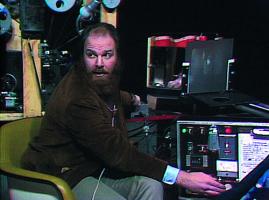
Au début de années 1970, un groupe d'idéalistes ? artistes, avocats, docteurs et enseignants ? a vu l'opportunité d'apporter un changement à la télévision, à Boston et aux alentours. Cela a entraîné des années de procès, notamment à la Cour Suprême, mais ils gagnèrent l'affaire et la licence de Channel 5 fut donnée à WCVB-TV. "Screening Room" a été l'une des émissions présentées dans le but d'offrir une programmation de télévision alternative. En créant "Screening Room", l'idée était de donner aux cinéastes indépendants l'opportunité de commenter leurs oeuvres et de les montrer à une vaste audience urbaine. Près de 100 programmes de 90 minutes ont été produits et diffusés entre 1973 et 1980. Professeur d'Histoire de l'art et de cinéma, photographe et inventeur, Standish Lawder a réalisé des films totalement expérimentaux en observant ce qu'une idée prédéterminée du contenu, de la structure ou de la technique, produisait quand elle était portée à l'écran ou sur photo. Lawder a enseigné à Harvard, Yale, UC San Diego, et à la Denver Darkroom dont il est le fondateur. Il est l'auteur du livre "The Cubist Cinema". Eminent philosophe et professeur à Harvard, Stanley Cavell venait de publier "The World Viewed", son premier livre sur le cinéma, lorsqu'il a participé à cette émission. Parmi ses écrits suivants sur le cinéma, on peut citer entre autres : "Pursuits of Happiness" et "Contesting Tears". Dans cet épisode de "Screening Room", Lawder présente les subtilités de sa tireuse optique maison et montre des exemples de ce que l'on peut accomplir en rephotographiant un film. Gardner, Lawder et Cavell débattent également des implications intellectuelles et psychologiques de ces manipulations. Leur commentaire direct se poursuit sur la copie test de Lawder d'"Intolerance" qu'il venait de recevoir du laboratoire, et que lui-même n'avait pas encore visionné. Lawder diffuse également "Necrology", "Color Film", et "Corridor".
"Screening Room" a été conçu et présenté par Robert Gardner, qui était, en ce temps là, Directeur du Centre des Arts Visuels de Harvard et président de son Département des Etudes Visuelles et de l'Environnement. Parmi ses propres films on peut citer "Dead Birds" (1964), "Deep Hearts" (1981), et "Forest of Bliss" (1986). Il a travaillé en collaboration sur de nombreux documentaires et a aussi produit une série de films personnels sur des artistes tel que Mark Tobey et Sean Scully. En juin 2006, il publiera un mémoire et rétrospective sur son oeuvre et sa vie.
Peter Garfield
Catalogue : 2009Fall | Art vidéo | dv | couleur | 1:9 | USA | 2008
Peter Garfield
Fall
Art vidéo | dv | couleur | 1:9 | USA | 2008
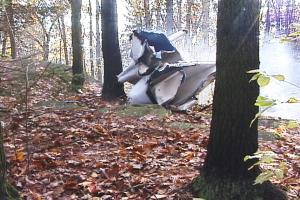
Un matin d'automne, dans une forêt du nord, la paix est troublée par un événement insolite.
Peter Garfield est un artiste interdisciplinaire qui travaille principalement dans le domaine de la photographie, la sculpture, la vidéo et la peinture. Il est diplômé du Dartmouth College (USA) et de l'Ecole Nationale Supérieure des Beaux-Arts de Paris. Il est maintenant basé à Brooklyn, New York. En 1993, Garfield a reçu une bourse de la National Endowment for the Arts pour son travail de peintre et, en 1999, une bourse de la New York Fondation for the Arts pour son livre d?art « Harsh Realty ». Il lui a également été attribué un certain nombre de bourses, notamment de la Edward F. Albee Fondation, du Blue Mountain Center, de la MacDowell Colony, de la Colony Millay for the Arts, ainsi que de Yaddo. Garfield a fait l?objet d?expositions individuelles et a participé à de nombreuses expositions collectives internationales.
Catalogue : 2008Deep Space 1 | Vidéo expérimentale | dv | couleur | 17:0 | USA | 2007
Peter Garfield
Deep Space 1
Vidéo expérimentale | dv | couleur | 17:0 | USA | 2007
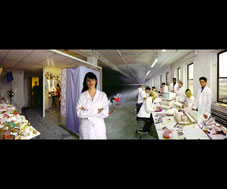
Three films play simultaneously, offering three perspectives of one story. Snow falls lightly on a garbage dump in near darkness. The headlights of a fuel truck rake across our view, animating the scene. A helicopter lifts off, into the flare of a floodlight and over a hangar, its blinking light receding and disappearing into a screen of pixels. The music swells as an awe-inspiring, snow-covered mountain range emerges in the moonlight. Or perhaps it is a miniature set made of paper maché and plaster. We are lulled into the beauty of this majestic landscape before being cast abruptly into a busy environment of people in lab coats at work on the sets for the film, or people resting between takes, or others applying makeup to an actor in preparation for the next action. The camera continues, flying over the trash and leftovers of a fast food lunch and then rises to take in the view of a vast warehouse space where workers concentrate on tasks along an almost endless work table. It soon becomes apparent, however, that this deep space is only half real, that the table ends in a wall on which is pictured the continuation of the table, the entire space and the workers. Inexplicably, one of the actors wields a power saw and cuts through this barrier, enters into the wall, staying briefly to complete some meaningless task, before being directed to continue through and into the nocturnal snowy landscape beyond. The camera studiously observes this actor's task and then follows as she disappears through the wall and into the wintry night. But we soon find that this wintry landscape is yet another façade as the walls begin to fall away before the camera, one after another like dominos, creating a scene of destruction that leads yet further into the distance. And finally, but inconclusively, one is high among mountain peaks again, but this time barely maintaining equilibrium as the camera movements become more jarring and anxious, until the three images begin to fade and blink out into blackness. And then we begin all over again in the lightly falling snow.
Peter Garfield is an interdisciplinary artist who works primarily in photography, sculpture, video, and painting. A graduate of Dartmouth College and the Ecole Nationale Supérieure des Beaux-Arts, Paris, he is now based in Brooklyn, NY. In 1993 Garfield was awarded a National Endowment for the Arts Fellowship grant for his work as a painter and in 1999 was awarded a fellowship grant by the New York Foundation for the Arts for his artist book "Harsh Reality". He has also been awarded a number of fellowships from The Edward F. Albee Foundation, Blue Mountain Center, MacDowell Colony, Millay Colony for the Arts and Yaddo. Garfield has had solo exhibitions in New York at Feigen Contemporary, Pierogi 2000, and the Queens Museum of Art; in Berlin, Germany at the Kapinos Galerie; and in Geneva, Switzerland at Art & Public. His work has been included in group shows throughout Europe and the United States and is in the collections at the Los Angeles County Museum of Art, San Francisco Museum of Modern Art, the M.I.T. List Visual Arts Center, and the F.R.A.C. Bourgogne in Dijon, France. Most recently Garfield was featured in a two-person show at MassMoCA in North Adams, Massachussets, and his video "Deep Space 1" was nominated for a Tiger Award in Short Film at the Rotterdam Fim Festival.
Tessa Garland
Catalogue : 2007Zombie | Vidéo expérimentale | dv | couleur | 3:5 | Royaume-Uni | 2006

Tessa Garland
Zombie
Vidéo expérimentale | dv | couleur | 3:5 | Royaume-Uni | 2006
Zombie est un court-métrage basé sur "La Nuit des Morts-Vivants", film-culte de George Romero (1960). L´action se situe dans le supermarché multinational Tesco. Le supermarché géant devient la toile de fond et le décor d´une scène structurée qui se déroule aux dépends des acheteurs qui ne se doutent de rien, lors une courte et prenante scène d´horreur. La bande-son a été mixée par Garland. Elle est composée de morceaux soigneusement choisis parmis les classiques du film d´horreur, afin de créer un son générique que le spectateur identifie immédiatement comme appartenant au genre. Le film a été tourné avec un téléphone portable. Les images basse résolution donnent à Zombie ses images vacillantes caractéristiques et cette sensation d´authenticité en temps réel. Parce qu´on remarque à peine la nature de la caméra, on a l´impression d´être piégés entre une atmosphère de contrôle et des caméras de surveillance. Cette oeuvre explore l´idée selon laquelle nos expériences quotidiennes sont structurées entre genre et répétition. Lors du montage, les clips collectés ont été adaptés au rythme de la musique. Son et image, travaillant ensemble, construisent et créent une situation réelle et imaginaire. À travers tout le film, cette scène du quotidien se déroule dans un espace de suspense et de mauvais augure, au sein d´un espace matériel de consommation. L´environnement est à la fois drôle et perturbant. L´approche que Garland choisit pour la réalisation de ses films explore les espaces narratifs. Dans le film Zombie, le spectateur est dérangé dans sa perception et identification du réel ou de l´irréel, qu´il soit mis en scène ou non. Le film recherche une construction libre, une aire de jeu et un espace d´expérimentation.
Tessa Garland est une artiste visuelle en activité basée à Londres. Elle expose de manière extensive depuis 1990 dans des expositions individuelles ou de groupe, au Royaume-Uni et internationalement. Depuis de nombreuses années elle développe et produit des travaux d´installation autour de l´image en mouvement. En 2002, elle reçoit un prix majeur de l´Art Council England qui lui permet d´approfondir son travail ; en conséquent, elle réalise plusieurs installations de films numériques interactifs qui feront ensuite partie d´expositions britanniques cotées. L´année dernière elle a réalisé une série de courts-métrages qui ont été bien reçus, dernièrement à la Whitechapel Art Gallery de Londres.
Mariah Garnett
Catalogue : 2016Full Burn | Doc. expérimental | hdv | couleur | 20:0 | USA | 2015
Mariah Garnett
Full Burn
Doc. expérimental | hdv | couleur | 20:0 | USA | 2015
Full Burn (20min, 2014), features U.S. war veterans who have all continued to test the limits of their physical abilities as civilians. Theses veterans, working as Hollywood stunt men, and one as massage therapist, describe relationships to the body, and how their experiences as soldiers have been carried back into their lives now. Named for the stunt restaged in the opening scene of this film, Full Burn pictures an ex-special ops marine set on fire in extreme slow motion, transforming the stunt into a ritualized reenactment of trauma. Full burn serves as a meditation on masculine duty and the emotional stakes of transcending fear. In 2014 it was exhibited as part of the Hammer Muesum`s Los Angeles Biennial, Made in LA, curated by Connie Butler and Michael Ned Holte. It was funded in part by The Hammer Museum and an FCA Emergency Grant.
Mariah Garnett mixes documentary, narrative and experimental filmmaking practices to make work that accesses existing people and communities beyond her immediate experience. Using source material that ranges from found text to iconic gay porn stars, Garnett often inserts herself into the films, creating cinematic allegories that codify and locate identity. Garnett holds an MFA from Calarts in Film/Video and a BA from Brown University in American Civilization. Her work has been screened internationally including: REDCAT (LA), White Columns (NY), SF MoMA (SF), Venice Bienniale (Swiss Off-site Pavillion), Rencontres Internationales (Paris, Madrid, Berlin, Beirut), Midway Contemporary Art (Minneapolis), Ann Arbor Film Festival (Ann Arbor), Kerstin Engholm Galerie (Vienna). In 2016 she has her first institutional solo show at the MAC in Belfast, Northern Ireland and her first solo show at a commercial art gallery in Los Angeles at ltd los angeles. In 2014, she was in residence at The Headlands Center for the Arts in Marin, and featured in Made in LA, the Hammer Museum`s biennial exhibition. The LA Times called her piece "Best in Show." She was awarded the Rema Hort Mann and CCF Emerging artist fellowships in 2014 and 2015.
Catalogue : 2014Signal | Film expérimental | 16mm | couleur | 7:0 | USA | 2012
Mariah Garnett
Signal
Film expérimental | 16mm | couleur | 7:0 | USA | 2012
The script for Signal, a 7-minute, 16mm film, attempts to narrativize a collection of spam emails gathered over a 3-year period, and is staged in or near ?sacred spaces?. The landscape of Pyramid Lake, on the Paiute Indian reservation is populated by 10,000-year-old rock formations, many of which are off limits to the public. They loom in the background as characters banter in the sometimes awkward, sometimes solicitous, sometimes nonsensical dialog of spam. The Black Rock Desert Playa, while vacant most of the year, is home to close to 60,000 people annually during Burning Man. These locations were chosen because they act as both mirror and foil for the internet - at once wastelands and gathering sites for millions of people, while maintaining an ancient physicality that transcends any inhabiting group.
Mariah Garnett is an experimental filmmaker and artist living and working in Los Angeles. Her work seeks to occupy a space between convention and experimentation - or, rather, to experiment with convention. The boundaries of adaptation, documentary and fiction are continually being drawn and re-drawn in her work. A big part of her practice involves finding people or thing out in the world to inhabit for a spell. For the most part, these figures are significant, though many times unknown, players in queer history. These twisted homages go so far as to ingest and regurgitate identities to the point where the maker?s motivation is called into question. Garnett holds an MFA from Calarts in Film/Video and a BA from Brown University in American Civilization. Her work has been screened internationally including the following venues: Venice Biennial (Swiss Offsite Pavillion), Rencontres Internationales (Paris, Madrid, Berlin, Beiruit), Outfest (Los Angeles), Midway Contemporary Art (Minneapolis), Mix NYC, Girl Monster (Hamburg). In 2012 she took part in a 2 person show Common Era at ltd los angeles. In 2011 she had a solo show at Human Resources Gallery in Los Angeles titled Encounters I May or May Not Have Had With Peter Berlin and has had work in group shows at Acuna Hansen Gallery (Los Angeles), Montehermoso Cultural Center (Vittoria, Spain) and Workspace Gallery (Los Angeles). She has collaborated with artists Guillermo Gomez-Pena, Zackary Drucker, A.L. Steiner and Chiara Giovando. She is represented by ltd los angeles.
Catalogue : 2013Picaresques | Doc. expérimental | 16mm | couleur | 20:0 | USA | 2011
Mariah Garnett
Picaresques
Doc. expérimental | 16mm | couleur | 20:0 | USA | 2011
Picaresques experiments with documentary and fictional structures, weaving portraits of three seemingly disparate protagonists together to ultimately create a film about the act of making something. The filmmaker sets out to make a movie about Catalina de Erauso, a nun-turned conquistador from the 16th century who wrote a memoir called Lieutenant Nun. She quickly becomes side-tracked, however, by a relationship she develops with a 10-year old through the process of casting, and the film turns in on itself. Multiple strategies and media are employed to challenge the binary notions of documentary and fiction.
Mariah Garnett is an experimental filmmaker and artist living and working in Los Angeles. Her work seeks to occupy a space between convention and experimentation - or, rather, to experiment with convention. The boundaries of adaptation, documentary and fiction are continually being drawn and re-drawn in her work. Garnett holds an MFA from Calarts in Film/Video and a BA from Brown University in American Civilization. Her work has been screened internationally including the following venues: Venice Biennial (Swiss Offsite Pavillion), Rencontres Internationales (Paris, Madrid, Berlin, Beiruit), Outfest (Los Angeles), Midway Contemporary Art (Minneapolis), Mix NYC, Girl Monster (Hamburg). In 2011 she had a solo show at Human Resources Gallery in Los Angeles titled Encounters I May or May Not Have Had With Peter Berlin and has had work in group shows at Acuna Hansen Gallery (Los Angeles), Montehermoso Cultural Center (Vittoria, Spain) and Workspace Gallery (Los Angeles). She has collaborated with artists Guillermo Gomez-Pena, Zackary Drucker, A.L. Steiner and Chiara Giovando.
Catalogue : 2011Garbage, The City, And Death | Vidéo expérimentale | dv | couleur | 7:31 | USA | 2010
Mariah Garnett
Garbage, The City, And Death
Vidéo expérimentale | dv | couleur | 7:31 | USA | 2010
Garbage, The City, And Death is an eight-minute, single-channel video. It consists of three scenes from a Fassbinder play of the same title, which was banned from the stage in Germany in 1985. My adaptation consists of the scenes between Roma, the prostitute and Franz, her boyfriend/pimp. I play Franz and my half-sister, Joanna Coleman, plays Roma. The couple bickers over money problems, her undying love for him, and his general disgust with her (produced by his latent homosexuality). The film moves from the city, where they are living in their car, to the Salton Sea, to a hot tub in the night. This project was born out of a month-long visit between long-lost sisters who did not grow up together. I use Fassbinder?s text as a means of exploring concepts relating to sibling-hood that do not exist in my actual relationship with my sister. Sibling rivalry is warped here into a lovers? quarrel. As Franz and Roma?s relationship deteriorates, their surroundings become progressively more intangible. They end in a vaccum, engulfed by the blackness of night, as they are drawn hopelessly closer together despite Franz? clear disdain for her and desire to get away from her.
Mariah Garnett, 30, lives and works in Los Angeles and is pursuing her MFA at Calarts in Film/Video. Often using markers from a multitude of genres, Garnett`s work addresses gender and performativity and blurs lines between "fiction" and "reality". She has worked with A.L. Steiner, Zackary Drucker, Peter Berlin, Wu Ingrid Tsang, Stanya Kahn, and Cheryl Dunye. Her work has shown internationally in festivals and galleries (Outfest, Los Angeles Film Festival, Rencontres Internacionales). She graduated with a BA in American Civilization from Brown University in 2003.
Catalogue : 2009You Will Never, Ever Be A Woman... | Fiction expérimentale | dv | couleur | 8:45 | USA | 2008
Mariah Garnett, Van BARNES, Zackary DRUCKER, A.L. STEINER
You Will Never, Ever Be A Woman...
Fiction expérimentale | dv | couleur | 8:45 | USA | 2008
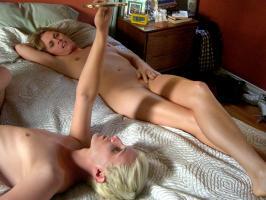
La performance vidéo « You Will Never, Ever Be A Woman... » montre une conversation entre deux personnes transsexuelles, Zackary Drucker et Van Barnes. La pièce traite des relations interpersonnelles entre les protagonistes, de leurs positions culturelles et politiques en tant que « femmes ».
L?artiste Zackary Drucker est âgé de 25 ans et vit à Los Angeles. Il infuse dans son ?uvre des éléments de l'installation, la performance, la photographie et la vidéo. Il est titulaire d'un MFA (Master of Fine Arts) du California Institute of the Arts (USA), et d?un BFA (Bachelor of Fine Arts) de la School of Viusal Arts.La cinéaste Mariah Garnett a 28 ans et vit à Los Angeles. Ses travaux vont de la musique vidéo aux films expérimentaux. Son travail emploie souvent l'absurde ou le grotesque, remplaçant le jeu de genre par un jeu de « gender ». A. L. Steiner utilise des constructions réalisées à partir de la photographie, la vidéo, l'installation, la collaboration, la performance ainsi qu?à partir d??uvres conservées, pour réaliser des assemblages séduisants canalisés à travers la sensibilité d'un androgyne féministe, étrange et cynique. Elle enseigne à la School of Visual Arts de New York (USA).
Mariah Garnett, Van BARNES, Zackary DRUCKER, A.L. STEINER
Catalogue : 2016Full Burn | Doc. expérimental | hdv | couleur | 20:0 | USA | 2015
Mariah Garnett
Full Burn
Doc. expérimental | hdv | couleur | 20:0 | USA | 2015
Full Burn (20min, 2014), features U.S. war veterans who have all continued to test the limits of their physical abilities as civilians. Theses veterans, working as Hollywood stunt men, and one as massage therapist, describe relationships to the body, and how their experiences as soldiers have been carried back into their lives now. Named for the stunt restaged in the opening scene of this film, Full Burn pictures an ex-special ops marine set on fire in extreme slow motion, transforming the stunt into a ritualized reenactment of trauma. Full burn serves as a meditation on masculine duty and the emotional stakes of transcending fear. In 2014 it was exhibited as part of the Hammer Muesum`s Los Angeles Biennial, Made in LA, curated by Connie Butler and Michael Ned Holte. It was funded in part by The Hammer Museum and an FCA Emergency Grant.
Mariah Garnett mixes documentary, narrative and experimental filmmaking practices to make work that accesses existing people and communities beyond her immediate experience. Using source material that ranges from found text to iconic gay porn stars, Garnett often inserts herself into the films, creating cinematic allegories that codify and locate identity. Garnett holds an MFA from Calarts in Film/Video and a BA from Brown University in American Civilization. Her work has been screened internationally including: REDCAT (LA), White Columns (NY), SF MoMA (SF), Venice Bienniale (Swiss Off-site Pavillion), Rencontres Internationales (Paris, Madrid, Berlin, Beirut), Midway Contemporary Art (Minneapolis), Ann Arbor Film Festival (Ann Arbor), Kerstin Engholm Galerie (Vienna). In 2016 she has her first institutional solo show at the MAC in Belfast, Northern Ireland and her first solo show at a commercial art gallery in Los Angeles at ltd los angeles. In 2014, she was in residence at The Headlands Center for the Arts in Marin, and featured in Made in LA, the Hammer Museum`s biennial exhibition. The LA Times called her piece "Best in Show." She was awarded the Rema Hort Mann and CCF Emerging artist fellowships in 2014 and 2015.
Catalogue : 2014Signal | Film expérimental | 16mm | couleur | 7:0 | USA | 2012
Mariah Garnett
Signal
Film expérimental | 16mm | couleur | 7:0 | USA | 2012
The script for Signal, a 7-minute, 16mm film, attempts to narrativize a collection of spam emails gathered over a 3-year period, and is staged in or near ?sacred spaces?. The landscape of Pyramid Lake, on the Paiute Indian reservation is populated by 10,000-year-old rock formations, many of which are off limits to the public. They loom in the background as characters banter in the sometimes awkward, sometimes solicitous, sometimes nonsensical dialog of spam. The Black Rock Desert Playa, while vacant most of the year, is home to close to 60,000 people annually during Burning Man. These locations were chosen because they act as both mirror and foil for the internet - at once wastelands and gathering sites for millions of people, while maintaining an ancient physicality that transcends any inhabiting group.
Mariah Garnett is an experimental filmmaker and artist living and working in Los Angeles. Her work seeks to occupy a space between convention and experimentation - or, rather, to experiment with convention. The boundaries of adaptation, documentary and fiction are continually being drawn and re-drawn in her work. A big part of her practice involves finding people or thing out in the world to inhabit for a spell. For the most part, these figures are significant, though many times unknown, players in queer history. These twisted homages go so far as to ingest and regurgitate identities to the point where the maker?s motivation is called into question. Garnett holds an MFA from Calarts in Film/Video and a BA from Brown University in American Civilization. Her work has been screened internationally including the following venues: Venice Biennial (Swiss Offsite Pavillion), Rencontres Internationales (Paris, Madrid, Berlin, Beiruit), Outfest (Los Angeles), Midway Contemporary Art (Minneapolis), Mix NYC, Girl Monster (Hamburg). In 2012 she took part in a 2 person show Common Era at ltd los angeles. In 2011 she had a solo show at Human Resources Gallery in Los Angeles titled Encounters I May or May Not Have Had With Peter Berlin and has had work in group shows at Acuna Hansen Gallery (Los Angeles), Montehermoso Cultural Center (Vittoria, Spain) and Workspace Gallery (Los Angeles). She has collaborated with artists Guillermo Gomez-Pena, Zackary Drucker, A.L. Steiner and Chiara Giovando. She is represented by ltd los angeles.
Catalogue : 2013Picaresques | Doc. expérimental | 16mm | couleur | 20:0 | USA | 2011
Mariah Garnett
Picaresques
Doc. expérimental | 16mm | couleur | 20:0 | USA | 2011
Picaresques experiments with documentary and fictional structures, weaving portraits of three seemingly disparate protagonists together to ultimately create a film about the act of making something. The filmmaker sets out to make a movie about Catalina de Erauso, a nun-turned conquistador from the 16th century who wrote a memoir called Lieutenant Nun. She quickly becomes side-tracked, however, by a relationship she develops with a 10-year old through the process of casting, and the film turns in on itself. Multiple strategies and media are employed to challenge the binary notions of documentary and fiction.
Mariah Garnett is an experimental filmmaker and artist living and working in Los Angeles. Her work seeks to occupy a space between convention and experimentation - or, rather, to experiment with convention. The boundaries of adaptation, documentary and fiction are continually being drawn and re-drawn in her work. Garnett holds an MFA from Calarts in Film/Video and a BA from Brown University in American Civilization. Her work has been screened internationally including the following venues: Venice Biennial (Swiss Offsite Pavillion), Rencontres Internationales (Paris, Madrid, Berlin, Beiruit), Outfest (Los Angeles), Midway Contemporary Art (Minneapolis), Mix NYC, Girl Monster (Hamburg). In 2011 she had a solo show at Human Resources Gallery in Los Angeles titled Encounters I May or May Not Have Had With Peter Berlin and has had work in group shows at Acuna Hansen Gallery (Los Angeles), Montehermoso Cultural Center (Vittoria, Spain) and Workspace Gallery (Los Angeles). She has collaborated with artists Guillermo Gomez-Pena, Zackary Drucker, A.L. Steiner and Chiara Giovando.
Catalogue : 2011Garbage, The City, And Death | Vidéo expérimentale | dv | couleur | 7:31 | USA | 2010
Mariah Garnett
Garbage, The City, And Death
Vidéo expérimentale | dv | couleur | 7:31 | USA | 2010
Garbage, The City, And Death is an eight-minute, single-channel video. It consists of three scenes from a Fassbinder play of the same title, which was banned from the stage in Germany in 1985. My adaptation consists of the scenes between Roma, the prostitute and Franz, her boyfriend/pimp. I play Franz and my half-sister, Joanna Coleman, plays Roma. The couple bickers over money problems, her undying love for him, and his general disgust with her (produced by his latent homosexuality). The film moves from the city, where they are living in their car, to the Salton Sea, to a hot tub in the night. This project was born out of a month-long visit between long-lost sisters who did not grow up together. I use Fassbinder?s text as a means of exploring concepts relating to sibling-hood that do not exist in my actual relationship with my sister. Sibling rivalry is warped here into a lovers? quarrel. As Franz and Roma?s relationship deteriorates, their surroundings become progressively more intangible. They end in a vaccum, engulfed by the blackness of night, as they are drawn hopelessly closer together despite Franz? clear disdain for her and desire to get away from her.
Mariah Garnett, 30, lives and works in Los Angeles and is pursuing her MFA at Calarts in Film/Video. Often using markers from a multitude of genres, Garnett`s work addresses gender and performativity and blurs lines between "fiction" and "reality". She has worked with A.L. Steiner, Zackary Drucker, Peter Berlin, Wu Ingrid Tsang, Stanya Kahn, and Cheryl Dunye. Her work has shown internationally in festivals and galleries (Outfest, Los Angeles Film Festival, Rencontres Internacionales). She graduated with a BA in American Civilization from Brown University in 2003.
Catalogue : 2009You Will Never, Ever Be A Woman... | Fiction expérimentale | dv | couleur | 8:45 | USA | 2008
Mariah Garnett, Van BARNES, Zackary DRUCKER, A.L. STEINER
You Will Never, Ever Be A Woman...
Fiction expérimentale | dv | couleur | 8:45 | USA | 2008
La performance vidéo « You Will Never, Ever Be A Woman... » montre une conversation entre deux personnes transsexuelles, Zackary Drucker et Van Barnes. La pièce traite des relations interpersonnelles entre les protagonistes, de leurs positions culturelles et politiques en tant que « femmes ».
L?artiste Zackary Drucker est âgé de 25 ans et vit à Los Angeles. Il infuse dans son ?uvre des éléments de l'installation, la performance, la photographie et la vidéo. Il est titulaire d'un MFA (Master of Fine Arts) du California Institute of the Arts (USA), et d?un BFA (Bachelor of Fine Arts) de la School of Viusal Arts.La cinéaste Mariah Garnett a 28 ans et vit à Los Angeles. Ses travaux vont de la musique vidéo aux films expérimentaux. Son travail emploie souvent l'absurde ou le grotesque, remplaçant le jeu de genre par un jeu de « gender ». A. L. Steiner utilise des constructions réalisées à partir de la photographie, la vidéo, l'installation, la collaboration, la performance ainsi qu?à partir d??uvres conservées, pour réaliser des assemblages séduisants canalisés à travers la sensibilité d'un androgyne féministe, étrange et cynique. Elle enseigne à la School of Visual Arts de New York (USA).
Garon
Catalogue : 2026POLARIS | Fiction expérimentale | 4k | couleur | 6:23 | France | 2023

Garon
POLARIS
Fiction expérimentale | 4k | couleur | 6:23 | France | 2023
Des personnages évoluent dans une étrange forêt : traque, errance ou déambulation? C’est une traversée nocturne âpre, là où les formes les plus archaïques et inconscientes peuvent surgir... Polaris est le nom de l’étoile polaire et désigne aussi le nom d’un missile…
Aurélie Garon est née et a grandi en Savoie. Elle vit actuellement à Paris. Après une classe préparatoire littéraire (Hypokhâgne et Khâgne), elle fait des études de philosophie à Paris 1 Panthéon-Sorbonne (D.E.A. mention Très Bien), puis entre à l’Ecole Nationale Supérieure de la Photographie à Arles (Major de promotion, Félicitations avec les Honneurs du jury). Elle développe là-bas un travail photographique puis vidéo et sonore qu’elle poursuit ensuite au Fresnoy à Lille (Mention spéciale du jury pour l’originalité de la recherche). Ses oeuvres ont été diffusées en France (Le Bal, Le 104...) et à l’étranger (Hollywood, New York, Los Angeles, Séoul, Montréal, Sydney, Rome, Madrid, Barcelone, Rio de Janeiro, Kassel, Bruxelles, Liège, Milan, Colombie, Bamako…), dans des Cinémas, Musées, Galeries, Biennales et Festivals. Elle fut également en résidence d’artiste à New York à l’International Center of Photography School, à Bamako au Conservatoire National des Arts et Métiers du Multimédia et à Madrid à la Casa de Velázquez. Son travail a été lauréat de nombreux Prix et Bourses. Elle a aussi participé par le passé à l’écriture d’ouvrages de philosophie. Elle est lauréate de la Bourse Ekphrasis (ADAGP et AICA): un texte de Véronique Terrier Hermann sur l’ensemble de ses oeuvres est publié dans Le Quotidien de l’Art. «Floaters», son 1er court métrage de fiction, a été sélectionné dans plus de 30 festivals de cinéma aux USA (New York, Hollywood, Los Angeles etc), à Séoul, Sydney & en Europe. Il a reçu 12 Prix à ce jour. En 2023 elle est parmi artiste invitée du Festival « L’Art dans les Chapelles » et a présenté sa nouvelle oeuvre «Here be dragons» (Installation visuelle et sonore, dérive fictionnelle : Film/ Peinture Bleu de Prusse/ Cercle acrylique noir brillant). Elle achève son 2ème court métrage «Polaris». Elle poursuit actuellement l’écriture de son prochain film et la création d’une nouvelle oeuvre «Psychic Landscapes» (sculptures psychiques en céramique et installation vidéo) pour lequel elle vient d’obtenir une aide à la post-production du Fresnoy. En 2025 elle sera artiste en résidence au Centre National d’Art Dramatique et Scénique de Kasserine (Tunisie)
Matthew Garrison
Catalogue : 2022Night Life | Vidéo | hdv | noir et blanc | 14:23 | USA | 2021
Matthew Garrison
Night Life
Vidéo | hdv | noir et blanc | 14:23 | USA | 2021
"Night Life" provides a glimpse into the behavior of wildlife after dark and serves as a reminder of the unwitting persistence of nature. For this piece a trail camera was moved periodically to capture various angles and shots at night throughout the seasons. The animals (mostly deer) were then framed within circles against a black background and choreographed into compositions that follow their relationships with one another while creating new interactions by compressing a year’s worth of footage into fourteen minutes. "Night Life" is a meditative portal through which a nocturnal world parallel to ours reveals the resolve of its inhabitants within an everchanging environment. In the process, our relationship to the rhythms of nature is linked to personal associations, memories and metaphors.
Matthew Garrison was born in Albany, NY, and grew up in Chicago. After living and working in New York City for eleven years, he moved to Pennsylvania to teach art and technology at Albright College. His work is exhibited and screened internationally including New York City, Korea, India, Panama, Brazil and Singapore. Garrison's art explores a dialog among intimate space, landscape and the environment.
Kuba Garscia
Catalogue : 2018Flora the Movie | Installation multimédia | hdv | couleur | 4:57 | Pologne | 2015
Kuba Garscia
Flora the Movie
Installation multimédia | hdv | couleur | 4:57 | Pologne | 2015
It is install_plantation or instant_plant or augmented plant. It is collection of objects and plants connected with moving mechanisms and multimedia devices like routers, usb hubs, lights, speakers. First, Im composing flora objects. Finding flowers, moss, bark, elements of nature and grow them in unusual pots, together with technology, electricity, lights. The goal is to create co-working life organism from different environments. Then, Im constructing kind of stage or altar from lost and found, DIY, elements, ready made objects, old fashion, destroyed furniture, audio-video recorders, computers etc. Next, Im adding projection mapping on interesting surfaces of composed objects (installation). Fitting animations to situations. Extending installation with another dimension and living structure - projection.
Born in 1988 in Krakow. He has graduated from Intermedia Department at Academy of Fine Arts in Krakow, Poland. Author of many multi-dimensional installations, immersive projects, install_plantations and digital flora. Works in the fields of postproduction, 3D mapping, interaction, objects collection, movement and design. Organizes, exhibitions and audio-visual performances. He marked the beginning of projection mapping movement in Poland and become influential and active person in new media community till now-days. He is trying to connect and explore all of the various codes of visual communication and their ability to process in order to apply them in specific urban spaces and/or exhibitions. Within the flexibility of visual language he creates multi-dimensional contemporary and site specific installations. Currently lives and works in Warsaw. His art was exhibited in galleries, festivals and other special events around Poland, Germany, Czech Republic, Slovakia, Israel, Great Britain, Sweden, Denmark. He is moderating audio visual experiences and animating people around visual art platform and gallery called K105K in Warsaw. He is co-founder of postproduction studio Locomotive.pl and flora and art lovers Project Utopia.
Julie Gasemi, Nicolas DUFRANNE
Catalogue : 2020Traunstein | Fiction expérimentale | 4k | couleur | 20:16 | Belgique | 2019
Julie Gasemi
Traunstein
Fiction expérimentale | 4k | couleur | 20:16 | Belgique | 2019
Claire découvre qu’elle apparaît dans un film de mauvaise qualité trouvé sur internet. Elle se voit à la fenêtre de sa maison, accompagnée d’un homme qu’elle ne connaît pas. Ils ont l’air amoureux. Elle décide de partir à la recherche de cet inconnu, vers Traunstein.
Julie Gasemi vit et travaille à Bruxelles. Originaire du Hainaut en Belgique.
Catalogue : 2008Julie et son modèle | Fiction | dv | couleur | 2:0 | Belgique | 2007
Julie Gasemi, Nicolas DUFRANNE
Julie et son modèle
Fiction | dv | couleur | 2:0 | Belgique | 2007
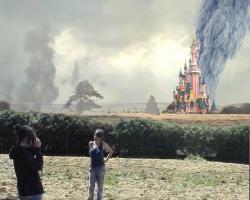
Ce jour là, la château de la belle au bois dormant était en feu. L`occasion était trop belle pour julie de prendre en photo son joli modèle avec son 24/36. Ce souvenir restera gravé dans son coeur pour l`éternité.
Je suis Julie Gasemi, j`ai 15 ans, je suis née en Belgique.
Julie Gasemi
Catalogue : 2020Traunstein | Fiction expérimentale | 4k | couleur | 20:16 | Belgique | 2019
Julie Gasemi
Traunstein
Fiction expérimentale | 4k | couleur | 20:16 | Belgique | 2019
Claire découvre qu’elle apparaît dans un film de mauvaise qualité trouvé sur internet. Elle se voit à la fenêtre de sa maison, accompagnée d’un homme qu’elle ne connaît pas. Ils ont l’air amoureux. Elle décide de partir à la recherche de cet inconnu, vers Traunstein.
Julie Gasemi vit et travaille à Bruxelles. Originaire du Hainaut en Belgique.
Catalogue : 2008Julie et son modèle | Fiction | dv | couleur | 2:0 | Belgique | 2007
Julie Gasemi, Nicolas DUFRANNE
Julie et son modèle
Fiction | dv | couleur | 2:0 | Belgique | 2007
Ce jour là, la château de la belle au bois dormant était en feu. L`occasion était trop belle pour julie de prendre en photo son joli modèle avec son 24/36. Ce souvenir restera gravé dans son coeur pour l`éternité.
Je suis Julie Gasemi, j`ai 15 ans, je suis née en Belgique.
Yosr Gasmi, Mauro Mazzocchi
Catalogue : 2018I Want to Go Mad, Raving Mad -L.E.N.Z.- | Fiction | hdv | noir et blanc | 379:19 | Tunisie | 2016
Yosr Gasmi, Mauro Mazzocchi
I Want to Go Mad, Raving Mad -L.E.N.Z.-
Fiction | hdv | noir et blanc | 379:19 | Tunisie | 2016
Une longue traversée des montagnes mène un inconnu chez une famille charitable. Le temps d`un séjour, l`étranger s`essaie à la vie, mais bientôt le chaos de la vie le rattrape. Je veux devenir fou, fou furieux -L.E.N.Z.- est une image-sonore née de la nouvelle de G.Bachner traitant de la schizophrénie de l`écrivain Lenz. Confronté à la folie du monde, une silhouette anonyme émerge pour traverser ce chaos. Elle trace une ligne de fuite qui ne cesse de se faire et se défaire. -L.E.N.Z.- est une histoire d`errance sans nom.
Mauro Mazzocchi, né en 1986 en Italie, est diplômé en philosophie et en théâtre. Dès l`âge de 15 ans, il réalise ses premiers moyens et courts métrages : La clarté transparente du cinéma, (Ach)ille, Artaud, etc,. Yosr Gasmi, née en 1984 en Tunisie, est une normalienne, diplômée en littérature françaises de l`Université Sorbonne Paris IV. Elle s`intéresse à l`image dans ses diverses expressions artistiques et scripturales. Les deux réalisateurs se considèrent comme une multiplicité technique et expressive. Ils travaillent ensemble dans la solitude de leur réflexion, s`occupant ainsi de tous les aspects de production, de réalisation et de postproduction cinématographiques. À partir de cette multiplicité technique se réalise l`expérimentation d`une création sans fragmentation des fonctions et sans hiérarchie, une expérimentation qui rend compte d`une anatomie hétérogène, d`une machine-cinéma dans son aspect le plus complet, avec la conscience des mouvements d`apparition et de disparition qui rythment discontinûment ses fonctions, à l`image d`un corps sans organe.
Lars Henrik Gass
Catalogue : 2007Oberhausen International Short Film Festival | 0 | 0 | | 0:0 | Allemagne | 2007

Lars Henrik Gass
Oberhausen International Short Film Festival
0 | 0 | | 0:0 | Allemagne | 2007
Die Kurzfilmtage haben sich im Verlauf von mehr als fünf Jahrzehnten zu einer der angesehensten Filmveranstaltungen der Welt entwickelt - ein Ort, wo FilmemacherInnen und KünstlerInnen wie Martin Scorsese, George Lucas, Roman Polanski, Alexander Kluge oder Werner Herzog, in jüngerer Zeit Ulrike Ottinger, Romuald Karmakar, Pipilotti Rist, Jean-Pierre Jeunet oder François Ozon ihre ersten Filme präsentiert haben. Bis in die Gegenwart hinein konnten die Kurzfilmtage immer wieder Filmemacher auf den Weg bringen und Trends setzen - sei es die frühe Anerkennung von Videos, die Beschäftigung mit Musikvideos, die Reflektion neuer digitaler Formate oder die Offenheit für die Interaktionen zwischen Kunst und kurzer Form. Durch ihre unkonventionelle Sicht des Kurzfilms entzogen die Kurzfilmtage sich immer mit großem Erfolg einer Festlegung auf ein bestimmtes Image, obschon durch das Festival viele politische und ästhetische Entwicklungen angestoßen wurden, wie etwa durch das Oberhausener Manifest, dem vielleicht wichtigsten Gruppendokument des deutschen Films. Durch sorgfältige Programmgestaltung und zukunftsweisende Themenwahl konnten die Kurzfilmtage ihre bemerkenswerte Alleinstellung in einem immer unüberschaubarer werdenden Markt ausbauen. Darüber hinaus konnten die Kurzfilmtage in Kooperation mit ihren Medienpartnern, ARTE, 3sat, Ki.Ka und INTRO dem Kurzfilm neue Zuschauerschichten erschließen. ARTE und 3sat kooperieren für ihre Kurzfilmprogramme seit Jahren mit den Kurzfilmtagen, MTV strahlte im Jahr 2001 insgesamt 25 Kurzfilme aus Programmen der Kurzfilmtage aus.
Lars Henrik Gass est directeur du Festival international du court-métrage d`Oberhausen. Son appréhension du cinéma se singularise par son exigence et son refus de considérer le film comme un bien de consommation. Sa perception de l`?uvre cinématographique en fait un sujet et non pas un objet pour une nouvelle économie consumériste. Le sens de l`?uvre cinématographique n`est pas dans l`image en mouvement dont on peut maîtriser le flux mais dans cet absolument autre qu`elle donne à voir, dans ce qui s`y dit et s`y montre et qui est passible d`ébranler le spectateur au plus profond de lui-même. L`expérience cinématographique doit demeurer une expérience de l`étrangeté.
Andrew Gaston
Catalogue : 2011PURGATORIUM | Vidéo expérimentale | dv | noir et blanc | 10:10 | Irlande, Royaume-Uni | 2010
Andrew Gaston
PURGATORIUM
Vidéo expérimentale | dv | noir et blanc | 10:10 | Irlande, Royaume-Uni | 2010
In a pattern matching of sequences, an ever-shifting multi-screen composition creates a momentum of unending suspense. Shadow filled rooms, corridors, doorways and staircases form an inescapable labyrinth of domestic interiors, in which each thread acts as an incomplete story. Unrelenting claustrophobia is contrasted with the continual threat from an unseen world. Is the intruder assassin or saviour? As the shadow persistently tries to visit - there is an absence of any denouement. In a failing chain of communication, the buzz of the intercom, the ring of the telephone, the knock at the door, cannot awake the dreamer.
Andrew Gaston is a video artist and creative director based in London. His art is regularly toured by the Visor Gallery, Valencia and he is currently directing commercials and music videos for some of the UK`s biggest production houses.