Catalogue > Liste par artiste
Parcourez la liste complète des artistes présentés dans le cadre des Rencontres Internationales depuis 2004. Utilisez le filtre alphabétique pour affiner vos recherches.
Michael Robinson
Catalogue : 2017Mad Ladders | Vidéo | hdv | couleur | 9:45 | USA | 2015
Michael Robinson
Mad Ladders
Vidéo | hdv | couleur | 9:45 | USA | 2015
A modern prophet’s visions of mythical destruction and transformation are recounted across a turbulent geometric ceremony of rising curtains, swirling set pieces, and unveiled idols from music television’s past. Together, these parallel cults of revelation unlock a pathway to the far side of the sun.
Michael Robinson (b.1981) is an American film, video and collage artist whose work explores the joys and dangers of mediated experience, riding the fine lines between humor and terror, nostalgia and contempt, ecstasy and hysteria. His work has shown in both solo and group shows at a variety of festivals, museums, and galleries including The 2012 Whitney Biennial, The International Film Festival Rotterdam, The New York Film Festival, The BFI London Film Festival, REDCAT Los Angeles, MoMA P.S.1, The Sundance Film Festival, The Walker Art Center, Anthology Film Archives, The Images Festival, The European Media Art Festival, and Whitechapel Gallery in London. Michael was the recipient of a 2014 MacDowell Colony Fellowship, a 2012 Creative Capital grant, a 2011-2012 Film/Video Residency Award from The Wexner Center for the Arts, a 2009 residency from The Headlands Center for the Arts, and his films have received awards from numerous festivals. He was featured as one of the “50 Best Filmmakers Under 50” by Cinema Scope magazine in 2012, and listed among the top ten avant-garde filmmakers of the 2000`s by Film Comment magazine. Michael holds a BFA from Ithaca College, and an MFA from the University of Illinois at Chicago. His work is distributed by Video Data Bank and represented by Carrie Secrist Gallery in Chicago.
Catalogue : 2015The Dark, Krystle | Fiction expérimentale | dv | couleur | 9:34 | USA | 2013
Michael Robinson
The Dark, Krystle
Fiction expérimentale | dv | couleur | 9:34 | USA | 2013
The cabin is on fire! Krystle can't stop crying, Alexis won't stop drinking, and the fabric of existence hangs in the balance, again and again and again. – MR "The Dark, Krystle brilliantly re-purposes the artificiality of stock gesture, allowing viewers to see its hollowness and to feel it recharging with new emotional power. Equal parts archival fashion show and feminist morality play, Robinson’s montage rekindles the unfinished business of identity, consumption, and excess in 1980s pop culture." - Carrie Secrist Gallery, Chicago
Michael Robinson (b.1981) is an American film, video and collage artist whose work explores the joys and dangers of mediated experience, riding the fine lines between humor and terror, nostalgia and contempt, ecstasy and hysteria. His work has shown in both solo and group shows at a variety of festivals, museums, and galleries including The 2012 Whitney Biennial, The International Film Festival Rotterdam, The New York Film Festival, The BFI London Film Festival, REDCAT Los Angeles, MoMA P.S.1, The Sundance Film Festival, The Walker Art Center, Anthology Film Archives, Kurzfilmtage Oberhausen, Viennale, and Whitechapel Gallery in London. Michael was the recipient of a 2012 Creative Capital grant, a 2011-2012 Film/Video Residency Award from The Wexner Center for the Arts, a 2009 residency from The Headlands Center for the Arts, and his films have received awards from numerous festivals. He was featured as one of the “50 Best Filmmakers Under 50” by Cinema Scope magazine in 2012, and listed among the top ten avant-garde filmmakers of the 2000`s by Film Comment magazine. His work is distributed by Video Data Bank and Carrie Secrist Gallery in Chicago.
Catalogue : 2008The General Returns From One Place to Another | Film expérimental | 16mm | couleur | 10:45 | USA | 2006
Michael Robinson
The General Returns From One Place to Another
Film expérimental | 16mm | couleur | 10:45 | USA | 2006
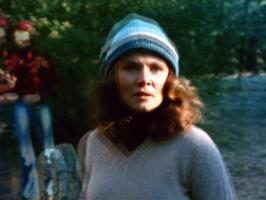
Apprendre à aimer à nouveau, tout en ayant peur, le film alterne entre le romantique et l'horrible, en donnant une forme tour à tour sceptique et indulgente à l'expérience du beau. Un monologue de Frank O'Hara (provenant d'une pièce de théâtre du même nom) tente de miner la sincérité du paysage, mais des forces plus puissantes font surface.
Depuis l'an 2000, Michael Robinson a réalisé un ensemble de films, vidéos et oeuvres photographiques qui explorent la poétique de la perte et les dangers du travail médiatisé. Son travail a été projeté au cours de représentations tantôt personnelles, tantôt collectives, à l'occasion de divers festivals, cinémathèques et galeries, dont le Festival International du Film de Rotterdam, le New York Film Festival, le Times BFI London Film Festival, Media City, Anthology Film Archives, Viennale, Cinematexas, le Wexner Center for the Arts, ICA London, Impakt, le Yerba Buena Center for the Arts, Chicago Filmmakers, PDX, et le Festival du Film International de San Francisco, d'Oberhausen, et de Hong Kong. Son film "You Don't Bring Me Flowers" a été élu "Meilleur Film International" au Festival de l'Image de Toronto en 2006, "Meilleur Film du Festival" à l'Underground Film Festival de Milwaukee en 2006, et Michael s'est vu attribuer le prix du "Meilleur Espoir de la Réalisation" à l'Ann Arbor Film Festival en 2007. Originaire du Nord de New York, Michael a obtenu un Bachelor of Fine Arts à l'Ithaca College, et un Master of Fine Arts à l'University of Illinois à Chicago. Il réside actuellement à Chicago.
Andrea Robles, Adriana BRAVO
Catalogue : 2007El Fish | Animation | dv | couleur et n&b | 4:7 | Mexique | 2008
Andrea Robles, Adriana BRAVO
El Fish
Animation | dv | couleur et n&b | 4:7 | Mexique | 2008
Cette animation nous plonge dans le monde quotidien de Benjamin. La bande-son a été créée en se basant sur son état émotionnel. Celle-ci est composée de sons qu?il émet lui-même ou bien de sons qui le fascinent. Les images de cette ?uvre tentent d?interpréter les perceptions et sensations de Benjamin.
Robles a obtenu une Licence en Communication Visuelle en 1999. Durant ses études, elle a participé à un atelier d?animation où elle a réalisé un spot publicitaire pour l?UNICEF. Celui-ci a reçu le premier prix du "Television and Video Festival ANUIES 2000" (National Association of Universities and Institutions for Education). En 2001, elle a créé le groupe dobleA (doubleA) en association avec Adriana Bravo. Depuis elles ont toujours travaillé ensemble sur leurs projets. En 2002, Robles a suivi un atelier donné par Jesse Lerner au Centro de la Imagen (Centre de l?Image) où elle a créé Mirada Perdida (Lost Sight) qui est une animation réalisée avec des objets. La même année, elle a produit Contemplación (Contemplation) et Experimento (Experiment). Elle a réalisé Anatomy of a Moth en 2004. Cette animation faite avec des dessins au crayon a gagné une bourse du "Consejo Nacional para la Cultura y las Artes" (Assemblée Nationale des Arts et de la Culture). La même année, elle a reçu la subvention Jóvenes Creadores 2004-2005 (Jeunes Artistes 2004-2005) du "Fondo National para la Cultura y las Artes" (Fond National pour les Arts et la culture). Pendant cette période, Robles a produit Microftalmía (Microphtalmie), animation expérimentale composée de peintures à l?huile sur verre.
João Pedro Rodrigues
Catalogue : 2014O corpo de Afonso | | | | 32:0 | Portugal | 0
João Pedro Rodrigues
O corpo de Afonso
| | | 32:0 | Portugal | 0
How would it look like, the body of Dom Afonso Henriques, first king of Portugal, tutelary figure, subject to successive mythifications throughout Portuguese history?
Born in Lisbon in 1966. Pedro Rodrigues attended the Lisbon Film School, in which he graduated in 1989. From 1989 to 1996 he worked as assistant director and editor with well-known names of the portuguese cinema, such as Teresa Villaverde. His short ?Parabéns!? (1997) participated at the Cinema Festival of Venice of 1997 and received a special distinction of the Jury. And his feature, ?O Fantasma?, of 2000, received the Award for the Best Foreign Feature Film at the Cinema Festival of Belfort in the same year. Recently he directed ?Odete?, Special Mention from Cinémas de Recherche in Cannes 2005, Director?s Fortnight .
Fundacion Rodriguez
Hector Rodriguez
Catalogue : 2025The Uncertainty Principle | Installation vidéo | hdv | couleur | 0:0 | Espagne, Hong Kong | 2018

Hector Rodriguez
The Uncertainty Principle
Installation vidéo | hdv | couleur | 0:0 | Espagne, Hong Kong | 2018
The Uncertainty Principle consists of videos and an interactive application about information and uncertainty in the domain of image analysis. The various elements of the work are produced by applying certain filters, known as 2D Gabor filters, to images. Gabor filters identify various kinds of edges -- horizontal, vertical, and diagonal – by responding to specific visual frequencies in an image.
Hector Rodriguez is a digital artist and theorist whose work explores the unique possibilities of computational technologies to reconfigure the history and aesthetics of moving images. His animation Res Extensa received the award for best digital work in the Hong Kong Art Biennial 2003. His 2012 video installation Gestus: Judex received an achievement award at the Hong Kong Contemporary Art Awards and was a jury selection of the Japan Media Art Festival. He received a commendation award from the Hong Kong Government for his contributions to art and culture in 2015. He was Artistic Director of the Microwave International Media Art Festival, and is now a member of the Writing Machine Collective. He currently teaches at the School of Creative Media, City University of Hong Kong. He has taught courses on art and science, game studies, generative art, software art, media art theory, contemporary art, and film history.
Catalogue : 2013INFLECTIONS | Vidéo | dv | noir et blanc | 3:0 | Espagne, Hong Kong | 2012
Hector Rodriguez
INFLECTIONS
Vidéo | dv | noir et blanc | 3:0 | Espagne, Hong Kong | 2012
INFLECTIONS is a real-time generative system that temporally rearranges video sequences based on mathematical equations. It explores the relationship between duration, simultaneity, and expectation. The technical concept of the work is based on the idea of a one-dimensional random walk: a mathematical representation of a journey along a linear path. The path contains several nodes or decision points. At each node along the path, the walker decides at random whether to go forward or backwards. In this work, the ?path? is the timeline of a movie clip. The program identifies a set of "inflection points" (or ?decision points?) along this timeline. An inflection point is a moment that contains no motion, where movement comes to a standstill. It is thus a good point to change direction. Imagine now the computer program walking along a movie timeline. When it reaches one of those inflection points, it makes a yes-no decision, either to go forward or move back. In this project, the walk is not random, because the program relies on some non-linear dynamical equation to make each decision. Inflections uses equations that exhibit chaotic behavior and for this reason can be used to simulate a random process.
Hector Rodriguez is a digital artist and theorist. His animation Res Extensa received the award for best digital work in the Hong Kong Art Biennial 2003 and has been shown in India, China, Germany, and Spain. His essays about film theory/history and digital art have been published in Screen, Cinema Journal, and Game Studies, and he has participated in various art and technology conferences. He was Artistic Director of the Microwave International Media Art Festival, where he has also taught workshops on Java programming and organized an exhibition on art and games, and is now a member of the Writing Machine Collective. He currently teaches at the School of Creative Media, City University of Hong Kong. He has taught courses on game studies, generative art, software art, media art theory, contemporary art, and film history.
Francisco Rodriguez Teare
Catalogue : 2025Octubre al mediodía | Doc. expérimental | 16mm | couleur | 12:0 | Chili | 2024
Francisco Rodriguez Teare
Octubre al mediodía
Doc. expérimental | 16mm | couleur | 12:0 | Chili | 2024
A spring afternoon on the San Cristobal hill, in downtown Santiago de Chile. Four friends and a sound engineer talk about the events seen and experienced during the popular revolt that began in 2019 in Chile. The film brings to the surface certain conversations related to any revolution: hope, disillusionment, fire, torture and police violence. The name of the film comes from the poem April Noon by Eileen Myles.
Francisco Rodríguez Teare is a Chilean artist and filmmaker based in France with a moving image practice working predominantly with film, video and installation. Since 2015 he has been creating works and exhibiting them both in film festival circuits and contemporary art contexts. He has directed the shorts Appels téléphononiques, Una luna de hierro, Why are they equipped with eyes ?, Octubre al mediodía, El oro y el pez. The video installations and performances Gois, Colored Procession, This dream is mine and the hybrid feature film Otro sol. Recently his work has been presented at film festivals and museums as New Directors/New Films at MoMA, Toronto FIlm Festival, 62 New York Film Festival, Centre Pompidou, Taipei Biennial, Stedelijk Museum, Cinémathèque Française, Mar del Plata IFF, CPH:DOX, Shanghai IFF, IndieLisboa, FID Marseille, Viennale.
Catalogue : 2022Gois | Vidéo | mp4 | couleur | 27:53 | Chili, France | 2020
Francisco Rodriguez Teare, Francisco Rodriguez Teare
Gois
Vidéo | mp4 | couleur | 27:53 | Chili, France | 2020
Avec Vanja et d'autres amis, nous allons nous baigner chaque été dans les rivières de Góis. Nous avons commencé à y aller en 2016, lorsque nous sommes arrivés en Europe et que nous cherchions un lieu qui nous rappellerait les montagnes du Chili, là où nous avons grandi. Chaque année, de nouveaux amants arrivent et de nouveaux couples se font ou se défont. Tout se remet à chaque fois en mouvement. Un après-midi de baignade, mon ami Rodrigo me raconte qu'il y a quelque temps, il a commencé à pratiquer une forme de fétichisme avec son copain : ils se font de petites entailles dans la peau avec des lames de rasoir et se sucent le sang l’un l’autre.
Francisco Rodríguez Teare is a Chilean artist and filmmaker based in France with a moving image practice working predominantly with cinema, video and installation. Since 2015 he has been creating film and video works and exhibiting them internationally both in film festival circuits and contemporary art contexts. His work explores the flow of power within fluid global networks and territories, opacity of violence, the traces of the dead in the world of the living, oral traditions and their intersection with personal memory and popular myths. Recently his work has been presented at Stedelijk Museum, Taipei Biennial, Film Society of Lincoln Center, VIDEONALE, FID Marseille, Collection Lambert, CPH:DOX, Shangai Film Festival, Courtisane, Doc Lisboa, Viennale, Palais des Beaux-Arts de Bruxelles, Govett-Brewster Art Gallery, Birkbeck Institute for the Moving Image. He has received awards at the Valdivia Film Festival, Festival Punto de Vista and the Fondation François Schneider, among others.
Francisco Rodriguez Teare, Francisco Rodriguez Teare
Catalogue : 2025Octubre al mediodía | Doc. expérimental | 16mm | couleur | 12:0 | Chili | 2024
Francisco Rodriguez Teare
Octubre al mediodía
Doc. expérimental | 16mm | couleur | 12:0 | Chili | 2024
A spring afternoon on the San Cristobal hill, in downtown Santiago de Chile. Four friends and a sound engineer talk about the events seen and experienced during the popular revolt that began in 2019 in Chile. The film brings to the surface certain conversations related to any revolution: hope, disillusionment, fire, torture and police violence. The name of the film comes from the poem April Noon by Eileen Myles.
Francisco Rodríguez Teare is a Chilean artist and filmmaker based in France with a moving image practice working predominantly with film, video and installation. Since 2015 he has been creating works and exhibiting them both in film festival circuits and contemporary art contexts. He has directed the shorts Appels téléphononiques, Una luna de hierro, Why are they equipped with eyes ?, Octubre al mediodía, El oro y el pez. The video installations and performances Gois, Colored Procession, This dream is mine and the hybrid feature film Otro sol. Recently his work has been presented at film festivals and museums as New Directors/New Films at MoMA, Toronto FIlm Festival, 62 New York Film Festival, Centre Pompidou, Taipei Biennial, Stedelijk Museum, Cinémathèque Française, Mar del Plata IFF, CPH:DOX, Shanghai IFF, IndieLisboa, FID Marseille, Viennale.
Catalogue : 2022Gois | Vidéo | mp4 | couleur | 27:53 | Chili, France | 2020
Francisco Rodriguez Teare, Francisco Rodriguez Teare
Gois
Vidéo | mp4 | couleur | 27:53 | Chili, France | 2020
Avec Vanja et d'autres amis, nous allons nous baigner chaque été dans les rivières de Góis. Nous avons commencé à y aller en 2016, lorsque nous sommes arrivés en Europe et que nous cherchions un lieu qui nous rappellerait les montagnes du Chili, là où nous avons grandi. Chaque année, de nouveaux amants arrivent et de nouveaux couples se font ou se défont. Tout se remet à chaque fois en mouvement. Un après-midi de baignade, mon ami Rodrigo me raconte qu'il y a quelque temps, il a commencé à pratiquer une forme de fétichisme avec son copain : ils se font de petites entailles dans la peau avec des lames de rasoir et se sucent le sang l’un l’autre.
Francisco Rodríguez Teare is a Chilean artist and filmmaker based in France with a moving image practice working predominantly with cinema, video and installation. Since 2015 he has been creating film and video works and exhibiting them internationally both in film festival circuits and contemporary art contexts. His work explores the flow of power within fluid global networks and territories, opacity of violence, the traces of the dead in the world of the living, oral traditions and their intersection with personal memory and popular myths. Recently his work has been presented at Stedelijk Museum, Taipei Biennial, Film Society of Lincoln Center, VIDEONALE, FID Marseille, Collection Lambert, CPH:DOX, Shangai Film Festival, Courtisane, Doc Lisboa, Viennale, Palais des Beaux-Arts de Bruxelles, Govett-Brewster Art Gallery, Birkbeck Institute for the Moving Image. He has received awards at the Valdivia Film Festival, Festival Punto de Vista and the Fondation François Schneider, among others.
Alberto Rodríguez Collía
Catalogue : 2018Ley Aurea (Golden Law) | Vidéo expérimentale | hdv | couleur | 7:4 | Guatemala, Brésil | 2014
Alberto RodrÍguez CollÍa
Ley Aurea (Golden Law)
Vidéo expérimentale | hdv | couleur | 7:4 | Guatemala, Brésil | 2014
This video speaks about the exploitation and its institutionalized discrimination (economic and racial) and slavery. The location is Brazil, because this one of the most unequal countries worldwide and was the last to declare slavery illegal (Aurea Act of 1898).
Lives and works in Guatemala. With his work tries to explore the historical memory, sordid aspects of the human being and the ridicule of the societies that are imposed over others. He graduated as Engraver from Art School no. 10 of Madrid, with his final project received the Honourable mention at Aurelio Blanco awards. He was awarded with the residencies of FONCA / CASA of Oaxaca, Mexico; Des.Pacio of San Jose, Costa Rica, Fundaçao Armando Alvarez Penteado in Sao Paulo, Brazil, and AIT in Tokyo, Japan. Also participated in 32nd. Biennial of Ljubljana, in the XVI and XVII Biennial of Guatemala and the VII Central American Biennial. In 2007 he co-founded the TEGG, the only engraving workshop in Guatemala, where he teached and organized exhibitions related to graphic arts. From 2010 to 2014 he was in charge of the Cinematographic Art Center of the CCEG, coordinating films screenings and workshops of cinema. Rodriguez also coordinated the Contemporary Film Festival (MUCA) and has worked for the human rights oriented film festival “ Memoria, Verdad, Justicia ” since 2013. He participated in the films "Even the Sun has spots" that won "Prix Espérance" and "Honourable Mention" in the FID of Marseille.
Camila Rodríguez Triana
Catalogue : 2026La Primera Vuelta De La Espiral | Doc. expérimental | 4k | couleur | 20:42 | Colombie | 2025
Camila RodrÍguez Triana
La Primera Vuelta De La Espiral
Doc. expérimental | 4k | couleur | 20:42 | Colombie | 2025
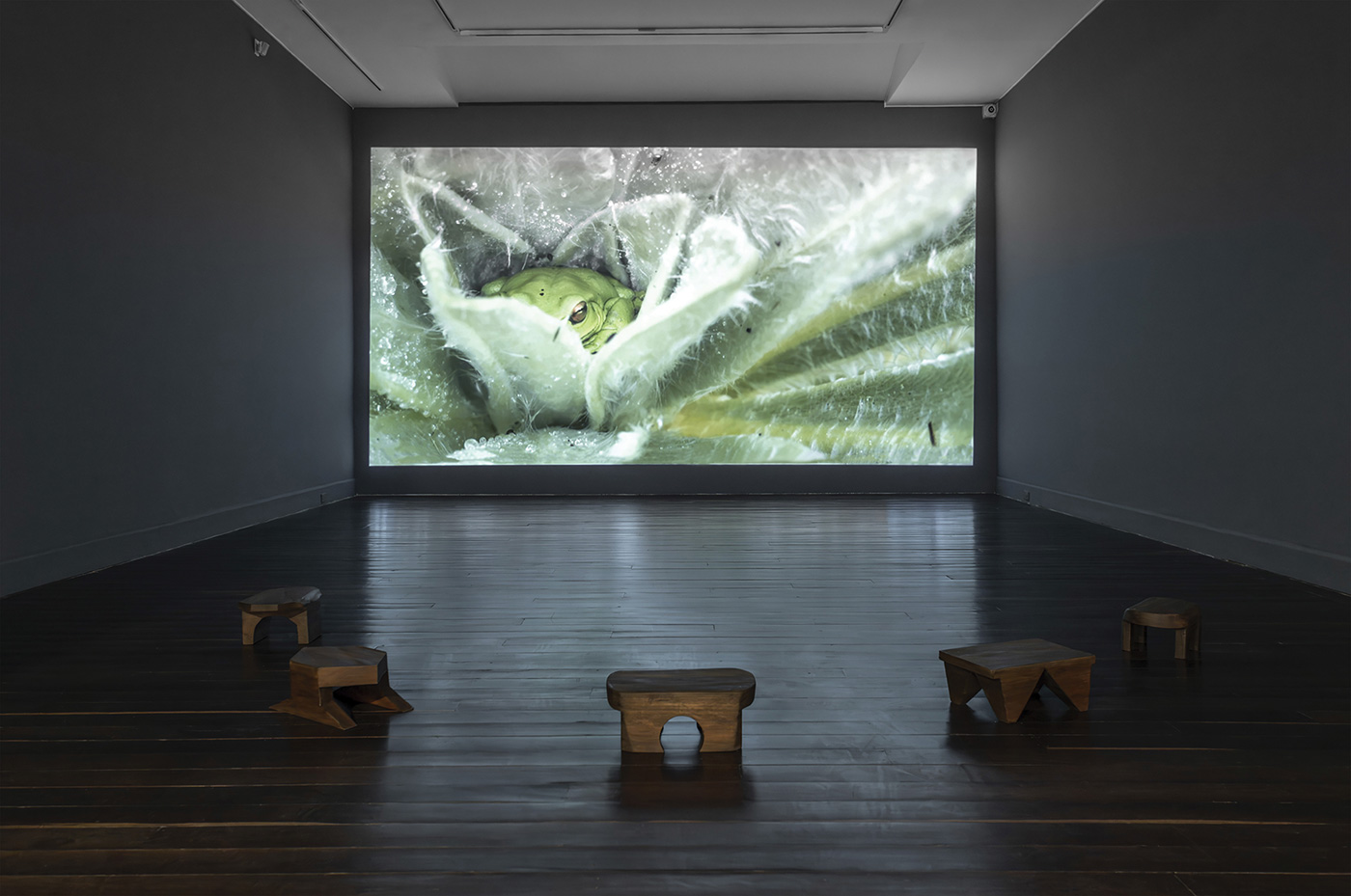
Le court métrage « Le premier tour de la spirale » est le résultat de mois de recherche théorique et ethnographique, d’un pèlerinage d’un an dans les lagunes sacrées qui composent le territoire de Mhuysqa, et de tout ce qui se passe sur les plans physique et spirituel lorsqu’on s’engage avec véhémence dans la recherche de son identité et de la lignée qui l’a précédée. Pour l’artiste, l’acte de se souvenir est une action qui implique la connexion du corps, de l’esprit (conscience) et du cœur, ce qui rend possible la création d’une identité. C’est pourquoi elle propose, à travers son travail, de « faire de la mémoire avec les pieds et avec les mains. Avec les pieds en parcourant le territoire, et avec les mains en retournant travailler les métiers ancestraux ».
Camila Rodríguez Triana (Cali, 1985). Artiste visuelle et cinéaste. Elle est diplômée de la Faculté des Arts Intégrés de l’Université del Valle (2008) en Colombie et a obtenu un Master Cinéma et Art Contemporain au Fresnoy – Studio National des Arts Contemporains (2019) en France, où elle a reçu le Prix des Amis du Fresnoy de la Meilleure Installation lors de Panorama 21. Au cours de sa carrière artistique, elle a reçu plusieurs distinctions, notamment la bourse de Protégée en Arts Visuels du programme Rolex Mentor and Protégé Arts Initiative, au sein duquel elle a travaillé avec l’artiste américaine Carrie Mae Weems (2020) ; le Prix d’Artiste Émergente des Rencontres Artistiques Carré sur Seine en France (2021) ; le Prix d’Artiste Émergente à Artecámara, ARTBO en Colombie (2020) ; le Prix National Colombo-Suisse de Photographie en Colombie (2008) ; ainsi que la nomination à la bourse pour Artistes Émergents de la Cisneros Fontanals Art Foundation aux États-Unis (2020). En tant que cinéaste, elle a également été récompensée par plusieurs prix, dont le Prix du Meilleur Film Ibéro-Américain au Festival de Cinéma Lima Independiente au Pérou (2018) ; le Prix du Meilleur Documentaire au Lisbon International Film Festival – Spring Edition au Portugal (2017) ; et le Prix Renaud Victor de la Compétition Internationale au FIDMarseille en France (2016), entre autres. Son œuvre a été présentée dans divers lieux tels que le Musée National d’Art Contemporain à Athènes, Grèce (2023) ; Brown University, États-Unis (2023) ; Galerie BAQ, Paris, France (2023) ; POUSH, Paris, France (2023) ; PS122 Gallery / The National Academy of Design, New York, États-Unis (2022) ; BAM Fisher, Brooklyn, New York, États-Unis (2022) ; le 65e Salon de Montrouge, France (2021) ; et le Festival PROYECTOR, Espagne (2020), entre autres. Ses films ont été sélectionnés par de prestigieux festivals tels que le Festival International du Film de Karlovy Vary (KVIFF), EnergaCAMERIMAGE – Directors’ Debuts Competition, FIDMarseille, DocLisboa et Visions du Réel, entre autres.
Camila Rodríguez Triana
Till Roeskens
Catalogue : 2010Vidéocartographies : Aïda, Palestine - Un tour à Beer Sheva | Doc. expérimental | dv | noir et blanc | 4:39 | Allemagne, Palestine | 2008
Till Roeskens
Vidéocartographies : Aïda, Palestine - Un tour à Beer Sheva
Doc. expérimental | dv | noir et blanc | 4:39 | Allemagne, Palestine | 2008
J?ai demandé aux habitants du camp Aïda à Bethléem d?esquisser des cartes de ce qui les entoure. Les dessins en train de se faire ont été enregistrés en vidéo, de même que les récits qui animent ces géographies subjectives. À travers six chapitres qui forment autant de courts-métrages potentiellement indépendants, vous découvrirez pas à pas le camp de réfugiés et ses environs, vous suivrez les trajets d`hommes, de femmes et d`enfants et leurs tentatives aventureuses de composer avec l?état de siège sous lequel ils vivent. Un hommage à ce que j?appellerai résistance par contournement, à l?heure où la possibilité même de cette résistance semble disparaître.
Till Roeskens, né en 1974 à Freiburg (Allemagne), vit à Marseille. Amateur de géographie appliquée, Till Roeskens appartient à la famille des artistes-explorateurs. Son travail se développe dans la rencontre avec un territoire donné et ceux qui tentent d?y tracer leurs chemins. Ce qu?il ramène de ses explorations, que ce soit sous la forme d?un livre, d?un film vidéo, d?une conférence-diaporama ou autres formes légères, ne se voudrait jamais un simple rapport, mais une invitation à l?exercice du regard, un questionnement permanent sur ce qu?il est possible de saisir de l?infinie complexité du monde. Ses « tentatives de s?orienter » s?élaborent avec le souci récurrent de toucher un public non averti et de rendre les personnes rencontrées co-auteurs de l??uvre. A exercé entre autres au Plateau à Paris, à la Forteresse de Salses, à la Villa Saint-Clair à Sète, au Musée d?Art Moderne et Contemporain et au CEAAC à Strasbourg (Bourse de la Ville de Strasbourg), à Langage Plus (Québec), au Musée d?Art Moderne de Collioure (Prix Collioure), aux divers FRAC : Alsace, Languedoc-Roussillon et PACA où il élabore actuellement un premier long métrage documentaire. A récemment remporté le Grand Prix de la compétition française au FID (Festival International du Documentaire de Marseille) 2009.
Axel Roessler
Catalogue : 2010it's a small world | Film expérimental | | couleur | 2:0 | Allemagne | 2009
Axel Roessler
it's a small world
Film expérimental | | couleur | 2:0 | Allemagne | 2009
Die Idee zum Clip "It`s a small world" entstand, als ich in auf einem Flohmarkt in Los Angeles ein Fotoalbum kaufte, in dem alte Polaroidfotografien einer amerikanischen Familie zu sehen sind. Der kurze Film ist eine Art Hommage an das längst vergangene Südkalifornien der sechziger Jahre und stellt die Reise nach, die die fotografierten Personen damals unternomen haben.
Biographie Axel Rössler: - geboren 1966 in Langenhagen / Hannover - 1986 Abitur, danach Zivildienst - bis 1995 Studium an der Johann Wolfgang Goethe Universtät Frankfurt am Main, Diplomabschluß als Sprachsoziologe - parallel seit ca. 1990 verstärkt Interesse an Graphiksoftware, diverse Jobs die zum Glück ausreichend Zeit für die autodidaktische Aneignung allermöglichen Sound- und Graphikprogramme erlauben, Betrieb eines Schallplattenlabels für Singles (?Stetzer?) - 1998 Gründungsmitgleid von saasfee*, einem Label für Medien, Design, Kunst und elektronische Musik, dabei Schwerpunkt Animationen und 3D sowie Musiklabelarbeit - seit 2000 diverse Musikvideos, Auftragsarbeiten und Experimentalfilme, Ausstellungen u.a. in Genf, Basel, Turin, München, Hamburg und Frankfurt - seit 2006 verstärkte Arbeit an www.countrytrouble.com zusammen mit Ellen Wagner - seit längerem befreundet mit Bertram Ritter, der hier die Musik beigesteuert hat. Bertram ist aktiv in diversen Frankfurter Bands, aktuell als Schlagzeuger bei ?Das grüne Hemd?, ?Perfumed Chambers? und ?Nachttierhaus?. Auch als Solokünstler aktiv.
Alicja Rogalska
Catalogue : 2023Dark Fibres | Vidéo expérimentale | 4k | couleur | 5:16 | Pologne, Georgie | 2021
Alicja Rogalska
Dark Fibres
Vidéo expérimentale | 4k | couleur | 5:16 | Pologne, Georgie | 2021
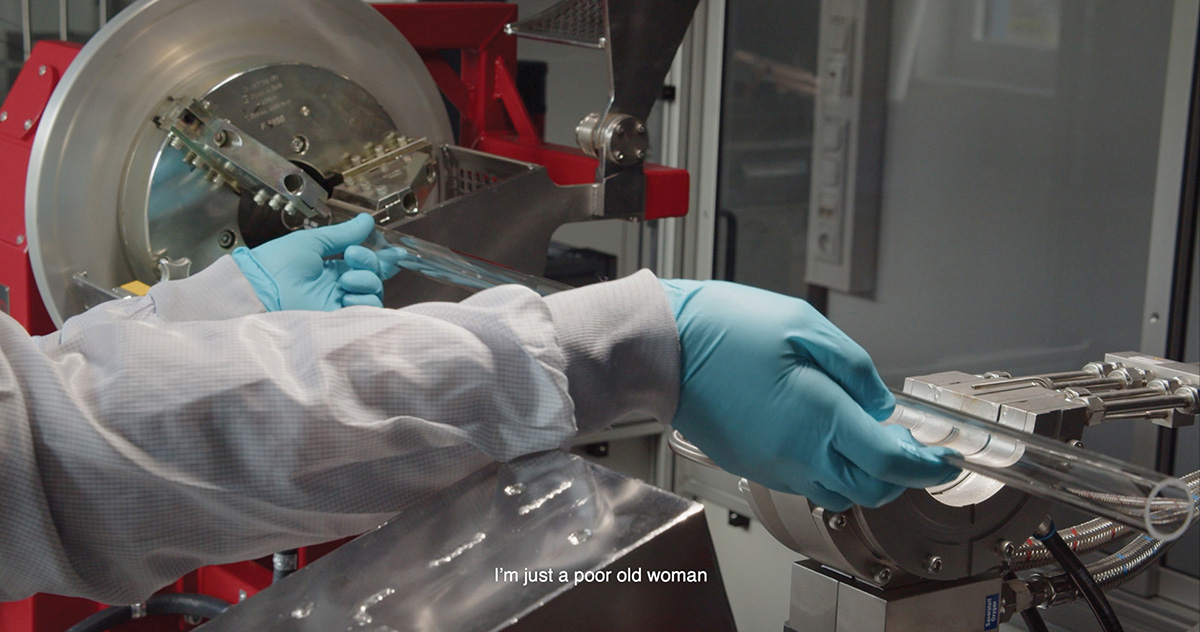
A song about scavenging, economic exploitation and post-internet reality performed by a Georgian polyphonic choir and based on a story of Hayastan Shakarian - an elderly, illiterate woman from the village of Armazi near Mtskheta, who in 2011 allegedly cut the internet cable connecting Georgia and Armenia whilst looking for scrap metal to sell. The story became global news though Shakarian denied any involvement, famously saying she had never heard of the internet, and many people disputed its veracity. The lyrics were sung to the tune of Chakrulo, a medieval Georgian song about peasants preparing for armed rebellion against their feudal master. The song was sent into space in 1977 on Voyager 2.? Commissioned by Arts Territory for Myth exhibition, Artisterium Festival, Tbilisi (song), filmed at Fraunhofer Institute for Applied Optics and Precision Engineering IOF and supported by the DAAD Artists-in-Berlin program (video).?
Alicja Rogalska's practice is research-led and focuses on social structures and the political subtext of the everyday; she mostly works in specific contexts making situations, performances, videos and installations in collaboration with other people to collectively search for emancipatory ideas for the future. She recently presented her work at National Gallery of Art (Vilnius, 2023), Scherben, Berlin Art Prize (2022, winner), Manifesta 14 (Prishtina, 2022), Temporary Gallery (Cologne, 2021-22), Kunsthalle Bratislava (2021), Kunsthalle Wien (Vienna, 2020-21), OFF Biennale (Budapest, 2020-21), Art Encounters Biennale (Timis?oara, 2019), Tokyo Photographic Art Museum (2019), Biennale Warszawa (2019), Museum of Modern Art (Warsaw, 2019), Kyoto Art Centre (2019) and Muzeum Sztuki (?ódz?, 2019). Rogalska was a fellow of the DAAD Artists-in-Berlin program (2020-21), and took part in residencies at City of Women Festival (Ljubljana, 2019), Stuart Hall Library (London, 2019), Paradise AIR (Matsudo, 2018), Museums Quartier (Vienna, 2018) and IASPIS (Stockholm, 2017), amongst others.
Catalogue : 2018What If As If | Vidéo expérimentale | hdv | couleur | 13:31 | Pologne, Royaume-Uni | 2017
Alicja Rogalska
What If As If
Vidéo expérimentale | hdv | couleur | 13:31 | Pologne, Royaume-Uni | 2017
What if As If explores legal fictions in international immigration law in collaboration with refugees, asylum seekers and immigrants based in the UK who trained as lawyers in their countries of origin. The video was filmed in a former courtroom and greenscreen, a device for filmic fiction, is used throughout. Legal fictions are used in legal reasoning when something is believed or assumed to be true - they allow for the law to be applied, without changing its text. For example, a refusal to accept an inheritance is legally possible if the inheritor is declared dead and having died before the person who left the legacy; another example is corporate personhood - i.e. treating companies as if they were persons. Immigration law is full of such artificial constructions: legal fictions of sovereignty, political community, the concept of entry, as well as fictions in welfare and employment law, and finally - citizenship and its terms and conditions. The lawyers` expertise and legal imagination combined with their personal, embodied experience of being exposed to the inherent contradictions and absurdities of immigration law, influences the way they see law in society. Legal fictions are used in the video as a vehicle for questioning existing legal structures, a tool for creative lawmaking and exploring speculative legal frameworks as possible resistance.
Alicja Rogalska is a multidisciplinary artist based in London and Warsaw and working internationally. She graduated with an MFA in Fine Art from Goldsmiths College and an MA in Cultural Studies from the University of Warsaw. In 2017 she was an artist in residence at KulturKontakt in Vienna and IASPIS - Swedish Arts Grants Committee`s International Programme in Stockholm. She was also a recipient of 2016-17 Artsadmin Bursary in London. Exhibitions include: For Beyond That Horizon Lies Another Horizon, Edith-Russ-Haus für Medienkunst (Oldenburg, 2017), Gotong Royong. Things We Do Together, Centre for Contemporary Art Ujazdowski Castle (Warsaw, 2017), Dreams and Dramas. Law as Literature, nGbK (Berlin, 2017), Social Design for Social Living, National Gallery (Jakarta, 2016), All Men Become Sisters, Muzeum Sztuki (Åódź, 2016); No Need For References, Kunsthalle Exnergasse (Vienna, 2015); Critical Juncture, Kochi-Muziris Biennale (Kochi, 2014); A Museum of Immortality, Ashkal Alwan (Beirut, 2014), IMS Project, Flat Time House (London, 2013); Melancholy In Progress, Hong-Gah Museum (Taipei, 2012); Jour de Fête, The Private Space Gallery / LOOP Festival (Barcelona, 2011); To Look is to Labour, Laden Für Nichts (Leipzig, 2010) and No Soul For Sale, Tate Modern (London, 2010).
Sophie Roger
Catalogue : 2018Les vagues | Doc. expérimental | hdv | couleur | 18:0 | France | 2017
Sophie Roger
Les vagues
Doc. expérimental | hdv | couleur | 18:0 | France | 2017
On connait cet art du détour que Sophie Roger pratique pour nous mener par des chemins inattendus avec l’amitié comme fil, déplié avec Le point aveugle (fiD 2012) ou Les Jardiniers du petit Paris (fiD 2010). ici ce sera, tissée tout en délicatesse à l’écran, l’amitié avec Mohamed, réfugié soudanais au Havre. faite de partage, d’attention, d’écoute et de rire, et de vagues en vagues, celles du texte éponyme de Virginia Woolf qu’elle lui lit, à celle de Courbet au musée du Havre, qu’il animera de son regard. (NF)
Catalogue : 2016C'est donc un amoureux qui parle et qui dit : | Film expérimental | hdv | couleur | 6:15 | France | 2015
Sophie Roger
C'est donc un amoureux qui parle et qui dit :
Film expérimental | hdv | couleur | 6:15 | France | 2015
Pages arrachées du Fragment d`un discours amoureux de Roland Barthes dans un grenier de montagne. La réalisatrice regarde et dessine les paysages qu`elle voit au travers des planches ajourées. Un papillon la suit jusque dans la neige.
Depuis plusieurs années, le travail de Sophie Roger fait dialoguer dessin et vidéo, lectures et quotidien. Cinéma d`essayiste, elle travaille seule et prend le temps. Ses films arpentent ses territoires les plus intimes (maison, jardin) tout en gardant comme horizon une pensée de l`autre et de l`ailleurs.
Catalogue : 2013Le point aveugle | Doc. expérimental | hdv | couleur | 30:0 | France, Chili | 2012
Sophie Roger
Le point aveugle
Doc. expérimental | hdv | couleur | 30:0 | France, Chili | 2012
Synopsis Dans l`espace clos d`un jardin normand, on observe de très près un monde végétal et animal. Les gestes de la cinéaste-jardinière sont précis: elle plante et déplace les végétaux, égraine, protège. Elle soigne aussi régulièrement son oeil malade. Le territoire quotidien devient un jardin hanté : par un ailleurs (Le Chili) et un passé (la dictature) qui insistent, une atmosphère de catastrophe rodant autour, insinuant son inquiétude dans l`intime le plus apparemment protégé. Gestes de soin, aux plantes et à soi, pour panser des plaies qui restent mystérieuses, que l`on devine partagée avec l`autre, l`amie qui passe comme un fantôme, le temps d`un double portrait. On ne saura rien de l`origine du désir mais il sera présent dans les fleurs de courge et de gunnera, de rose et d`artichaut.
Note biographique rédigée Sophie Roger réalise depuis de nombreuses années une oeuvre libre et singulière, hors des feux de l`actualité et du commerce parisiens. Dessins ou films, son oeuvre s`ancre dans son territoire le plus familier, ce coin du Pays-de-Caux, au nord de son Havre natal, où elle vit et travaille à la campagne, non loin de la falaise. Depuis ce territoire intime, son travail ne cesse d`interroger l`ailleurs, la relation à l`autre, quel qu`il soit : amis, voisins, peuples lointains, habitants du passé, malades d`aujourd`hui. En 2010, son film Les Jardiniers du Petit Paris (en lisant Tristes tropiques, de Claude Lévi- Strauss) est une des révélations du Festival International du Documentaire de Marseille. De derrière sa fenêtre, Sophie filme ses voisins cultivant un potager collectif au fil des saisons, tout en lisant des passages de Tristes tropiques, quittant régulièrement son poste d`observation pour entrer dans le champ, rencontrer ses voisins, leur demander de poser pour de magnifiques portraits filmés. La rigueur et la simplicité du dispositif filmique produit la plus émouvante et universelle des pensées : qu`est-ce qu`un voisin ? Qu`est-ce que le proche, qu`est-ce que le lointain ? En 2011, Sophie Roger réalise le bouleversant Contre-Jour, dans le cadre d`une résidence dans un hôpital de sa région, avec des malades du sida. Là aussi, elle sait trouver le dispositif juste pour recueillir les récits de vie et instaurer un échange avec des patients qui acceptent de se confier tout en voulant rester anonymes. Le Point Aveugle prolonge ces deux films, en renouant plus précisément avec les questionnements des Jardiniers du Petit Paris. En resserrant le point de vue : il s`agit de son jardin, de ses plantes et de sa maison, filmés comme le lieu intime d`où une pensée du monde est possible. Ses films sont des essais, dans la haute tradition de Montaigne : Sophie se met à l`essai, essaie de se penser, elle face au monde, elle en rapport à l`autre, à l`opposé de toute forme de narcissisme ou de complaisance. Si elle se met en scène, c`est sur un mode burlesque ou inquiet, toujours à distance, avec rigueur et un grand sens de l`auto-dérision. Extrait d`une note de production écrite par Cyril Neyrat
Graeme Roger, Kevin REID
Catalogue : 2006Critique of Styrofoam Villians at Chris' art Farm | 0 | dv | | 10:0 | Royaume-Uni, USA | 2004
Graeme Roger, Kevin REID
Critique of Styrofoam Villians at Chris' art Farm
0 | dv | | 10:0 | Royaume-Uni, USA | 2004
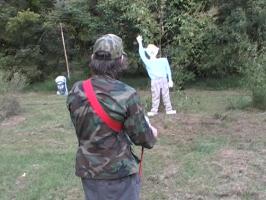
Critique de Stryofoam Villians à Chris?s Art Farm. Par Graeme Roger & Kevin Reid.Alors qu?ils ont des projets de résidence à Memphis et New York en 2004, ROGER & REID ont pris l?habitude d?ouvrir leur chemin dans le monde des libres à coup de canon à patate haute puissance. Dans cette ?uvre, ils détruisent des méchants crées par des étudiants de la Memphis School of Art.Ils s?entraînèrent davantage au tir sur cible au Musée d´art Moderne PS1 de New York, où le groupe de rock The Prairie Oysters, formé pour l?occasion, joua à la gloire de la panse de brebis farcie et de la gelée, accompagnés par le dieu du Rock ?Justice?
Graeme Roger & Kevin Reid ont étudié au Duncan of Jordanstone College of Art de Dundee, Ecosse, & ont travaillé en groupe depuis 2002. Ils ont exposé leurs ?uvres en Europe et aux Etats-Unis.
Joyce Rohrmoser
Catalogue : 2011Surviving in China | Vidéo | dv | couleur | 19:0 | 0, Chine | 2007
Joyce Rohrmoser
Surviving in China
Vidéo | dv | couleur | 19:0 | 0, Chine | 2007
Surviving in China DVD 19 min, 2007 Ich lerne seit nunmehr 4 Jahren chinesisch. Seit gutem einem Jahr mache ich für eine italienische Firma Modefotos und Videos in China. In meiner Freizeit versuche ich das Leben dort zu meistern. Dafür habe ich eine Strategie entwickelt: Videominiaturen, in denen ich jeweils unterschiedliche Rollen übernehme. Es sind Situationen, die mir als Frau aus dem Westen fremd sind. Die Unterschiede zwischen meinem Tun als Darstellerin und Videomacherin, zwischen mir als Subjekt und Objekt, zwischen Bild und Abbild, werden beseitigt. Dieser Vorgang ist eine Anlehnung an die Praxis der Performance-Künstlerinnen der 70er Jahre. Ein Umstand, der mir hilft, meine Auseinandersetzung mit China kritisch und humorvoll zu hinterfragen.
JOYCE ROHRMOSER 1954 Geboren in Mailand, Italien AUSBILDUNG: 1972-74 Studium der Photographie im Istituto Europeo del Design, Mailand, und London College of Printing, London 1982 Doktorat in russischer Literatur und Kunstgeschichte Workshops bei Nan Goldin, Verena von Gagern, Dieter Appelt Lebt als freischaffende Foto- und Videokünstlerin in Salzburg 2006 Beginn der Auseinandersetzung mit der chinesischer Sprache und Kultur. Längere Aufenthalte in China.
Billy Roisz, dieb13
Catalogue : 2020TWIXT | Performance multimédia | 4k | couleur | 45:0 | Autriche | 2019
Billy Roisz, dieb13
TWIXT
Performance multimédia | 4k | couleur | 45:0 | Autriche | 2019
TWIXT is the brand new duo-project of Billy Roisz and Dieter Kova?i? a.k.a. dieb13, bringing together their works as film directors and their activities as live musicians. Over the years, the two have directed and produced several experimental short films dealing with classical film genres like western, horror film or road movie. The films explore the inner mechanisms of well established cinematic conventions and turn them into an immediate sensual experience. TWIXT uses re-arranged footage of these short films as a score for a live soundtrack and fuses abstract and concrete imagery and sounds into a synaesthetical and synecstatical media-meltdown.
Billy Roisz and Dieter Kova?i? have been active in Vienna’s electronic, improvised, noise music and experimental film scene since the 1990s. Billy Roisz’s work focuses on the links and gaps between visual and auditive perception, using various electronic instruments, electric bass guitar, cathode ray tube TVs, video projectors, synchronators and sometimes computer to generate sound and image. Dieter Kova?i? aka dieb13, best known for his turntable music activities and as founder of the experimental music platform klingt.org uses turntables, self-cut vinyls and self written software for his musical works in many different fields. His film works include photo films (‘schnitzel’) as well as abstract digital and analogue works. Their collaborative film works have been shown at Berlinale, Karlovary Film Festival, IFF Rotterdam, Hongkong Film Festival, Edinburgh Film Festival and SXSW Texas, a.o.. They performed their audio visual projects live at Bienal São Paulo, Nya Perspektiv (Västeras), 25FPS (Zagreb), BAWAG Foundation (Vienna), FBI (Osaka), Suoni Per Il Popolo (Montreal), Sonic Acts (Amsterdam), Transmediale (Berlin), Sonica (Ljubljana), Unconsciuos Archives Festival (London) a.o..
Miguel Angel Rojas
Catalogue : 2008Border Panic | Installation vidéo | dv | couleur | 4:33 | Colombie | 2007
Miguel Angel Rojas
Border Panic
Installation vidéo | dv | couleur | 4:33 | Colombie | 2007
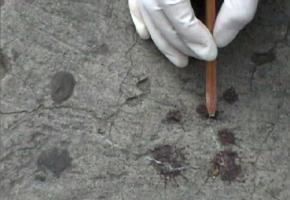
?Walking through downtown Bogotá it is common to find blood traces, witnesses of the violence that the lives in the city?s party nights, when excesses come next to crime. Border of Panic in the record of a trace left by someone who was injured, who probably ran in panic away from death. I wanted to exorcise those terrible moments going through the same path, slowly and continuously drawing from one blood drop to the other, turning this morbid happening into a plastic event. In the meanwhile I thought that by doing this I synthesized the efforts to reinterpret reality through art, that have oriented my work y the work of many other artists worried by this environment so distant from the utopias of balance and justice. ?
Born in 1946, Rojas made his first works on sexual difference during the eighties, long before the topic was introduced in the international sphere of the arts. Throughout the nineties, the artist left photography and personal themes aside to arrive to more universalizing themes, such as drug trafficking, the third world and uneven concentrations of power, amongst others. The work of Miguel Ángel Rojas, as a whole, has the stamp of an artist that has kept certain distance with the art market, has worked with vast creative independence and has grown to be a decisive referent in the history of Colombian art. Printmaking and photography have been relevant in the process of academic formation that Rojas took at the National State Univesity. Photography is precisely one of the media with which the artist has experimented the most, working with fragmentary enlargements, reductions to minimal scales and partial developments, that cast the referent for his most recognized works: ?Subjetivo,? an installation that recreates the atmosphere of the bathrooms in the ?Faenza Theatre? using sound, printmaking and drawing; and ?Grano / Grain,? an installation made with soils and vegetal coal powders over a floor that has been covered with paper, defined by the artist as both the construction of an urban ground with the dirt and soil of the countryside and a metaphorical expression of displacement. The work of Miguel Ángel Rojas has been extensively shown and acquired by different institutions, among others: The Sao Paulo and Havana Biennials. Museum of Modern Art (New York); Daros-Latinamerica Collection (Zurich) Ludwning Museum; Whitney Museum of American Art (New York); ?La Caixa? (Barcelona).
Celeste Rojas Mugica
Karina Rojas Sandoval
Catalogue : 2017Descomposición Aleatoria | Vidéo | hdv | couleur et n&b | 4:51 | Chili | 2015
Karina Rojas Sandoval
Descomposición Aleatoria
Vidéo | hdv | couleur et n&b | 4:51 | Chili | 2015
Family archives around the figure of Lucila. She had Alzheimer`s and was my grandmother. Corruption of the material as the manifestation of a degenerative disease, set in a visual decomposition process based on the destruction of memory. Dismantled and fragmented memories, unified by the soundtrack.
Karina Rojas Sandoval born in 1992, in Santiago, Chile. Bachelor in Audiovisual Communication, Film and Television Degree (2016), by Universidad de Chile. Exhibits and works regularly in video art since 2015. She works mostly in experimental videos and documentaries, where she organizes her work around found footage and the manipulation and intervention of archive materials as a part of her narrative and artistic research. Her work has been selected in Festivals, Exhibitions, Shows and Contests in Chile, Colombia, Finland, Indonesia, Mexico, Portugal, United States and Venezuela. Major and recent exhibits events: ‘Comic Unity’ Exhibition, Flux factory, NY, USA, 2017; 6th Edition of Samples-Mexico: Transvideo: Borderless Image, Mexico-Finland, 2016; 3rd edition Festival Internacional de Video Experimental "Proceso de Error", Valparaiso, Chile, 2016; 12th FONLAD International Videoart & Performance Festival, Coimbra, Portugal, 2016; 2nd edition Festival Video Arte NodoCCS, Caracas, Venezuela, 2016 and 5th Concurso Nacional de Video Arte Universitario (Universitary National Video Art Contest) ‘Visiones del Arte’, Category ‘International Selection’, Mexico City, Mexico. At the last mentioned two she gets the first place with her video ‘Descomposición aleatoria’.
Stéphanie Roland
Catalogue : 2023Le cercle vide | Documentaire | hdv | couleur et n&b | 19:0 | Belgique, France | 2022
Stéphanie Roland
Le cercle vide
Documentaire | hdv | couleur et n&b | 19:0 | Belgique, France | 2022
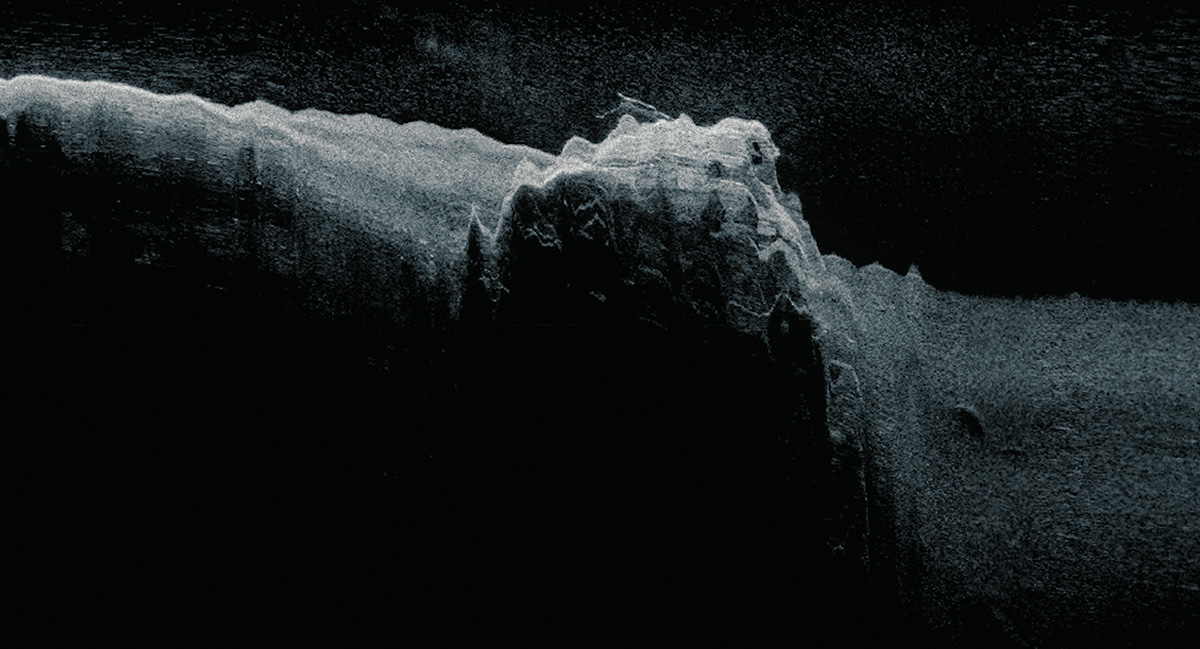
Rien ne survit vraiment ici. Le fond est si profond qu’aucune lumière n’y pénètre jamais. Très peu de bateaux y passent. On ne sait pas quand les chutes auront lieu. Ce documentaire expérimental dresse le portrait d’un objet spatial et sa chute jusqu’aux ténèbres d’un cimetière spatial, une scientifique nous dévoile son attachement pour cet objet et l’absence d’images documentant ce lieu mystérieux. Voyage de Science-Fiction inversé, cet essai mélange archives réelles et fictives pour nous guider, tel un stalker, aux périphéries d’un lieu invisible.
Stéphanie Roland est une artiste visuelle et réalisatrice, basée à Bruxelles. Elle réalise des films et des installations qui explorent, entre le documentaire et l’imaginaire, les structures invisibles du monde occidental, les larges échelles du temps et les hyperobjets. ?Son travail est régulièrement présenté au niveau international, ses projets ont été inclus dans des expositions d'institutions majeures parmi lesquelles la Biennale de Venise, le Centre Pompidou, le musée du Louvre, le musée Benaki, la Biennale internationale d'art de Kampala, l’ISELP et le Wiels, entre autres.
Catalogue : 2019Deception Island | Vidéo | 4k | couleur | 14:0 | Belgique | 2017
Stéphanie Roland
Deception Island
Vidéo | 4k | couleur | 14:0 | Belgique | 2017
L’expédition antarctique belge (1897-1899) a été un épisode audacieux de l’exploration du continent blanc. Après avoir approché de nouvelles terres et fait de nombreuses découvertes scientifiques, le bateau se retrouve coincé dans les glaces, pendant près de treize mois. Durant cet hivernage forcé, le manque de lumière de la nuit polaire a causé des maladies, des dépressions et même des cas de démences, au sein de l’équipage. "Deception Island" est une oeuvre multidisciplinaire - entre performance, film et installation - qui explore la face invisible d’un mythe de l’exploration belge et développe la narration d’un non-voyage paradoxal. Cet épisode, amputé de l’histoire officielle, est rejoué silencieusement par des acteurs dans le site industriel du "New Belgica", qui est le projet de construction d’un nouveau bateau, réplique à l’identique du "Belgica" (le bateau original de l’expédition s’est échoué dans les fonds marins). A la fois source d’inspiration du projet, espace de performance et décor du film, ce squelette de bateau peut être considéré comme une métaphore de la reconstitution historique, toujours en évolution, fragmentée et incomplète. L’usage exclusif du travelling tout au long du film immerge physiquement le spectateur dans un univers flottant et hypnotique.
Diplômée de l’ENSAV - La Cambre en communication visuelle, Stéphanie Roland (1984, Bruxelles) a également étudié les arts des médias à l’UDK-Universität der Künste, dans la classe d’Hito Steyerl. De nombreux prix et bourses lui ont été attribués, notamment la bourse de la Fondation de la Vocation, le Prix Médiatine (public) et le Full Contact Award du festival international de photographie SCAN de Tarragone. Elle a aussi été nominée pour le Prix HSBC Photographie, le prix Oskar Barnack Leica, Le Grand Prix Images du festival de Vevey et le Salomon Foundation Award. Elle expose régulièrement son travail à un niveau international. D’Amsterdam à Buenos Aires, de Berlin à Los Angeles, ses projets ont été présentés dans des institutions majeures telles que le Musée Benaki, le Botanique, la Biennale Internationale d’Art de Kampala et le Bozar. Breda Photo, Belfast Photo Festival, Manifesto, Encontros da Imagem, MOPLA et Unseen font partie des festivals dédiés à la Photographie auxquels elle a pris part. En 2017, elle est sélectionnée dans l’exposition de groupe du Pavillon de l’Antarctique pour la 57ème Biennale de Venise. Elle y expose son installation vidéo "Deception Island".