Catalogue > Search
Results for : Tout le catalogue

Stefan Roloff
LINDEN HOTEL
Video installation | dv | color | 27:0 | Germany | 2010
LINDEN HOTEL, Video Installation by Stefan Roloff The phenomenon of political imprisonment is timeless. Yet, its victims can only speak to us from the past. It is its nature to be silenced in the present. The group of former Stasi- prisoners I interviewed have never before spoken on tape or in public. To remove the boundaries of time I have interviewed them as silhouettes. At first glance, this gives them an air of illegality. The viewer gets the impression that they can?t reveal their identity. Faces can be misleading. Beauty, gender, age, race or other categories disappear when we view a silhouette. What remains is the tone of their voice and their body- language, keys to their subconscious. It is my goal to bring the experiences of former political prisoners into the present and communicate the immediacy they feel. Though they were released from jail decades earlier, their trauma continues to haunt them and - as many of the interviews show ? it extends into the lives of their children. Initially, I projected the talking silhouettes of nine former prisoners on to the walls of their former cells at the Stasi- prison in Potsdam.
Stefan Roloff is an independent artist and film maker, working in New York and Berlin. In 1984, he was invited to experiment on prototypes of digital video and imaging computers at the New York Institute of Technology. Here, he created ?Face?, his first Moving Painting which, produced by Peter Gabriel, was the predecessor of his video ?Sledgehammer?. Subsequently, he continued to combine his paintings and videos in collaborations with musicians. (?Zaar? with Gabriel, ?Dominic Christ? with Suicide, ?Big Fire? with Jazz musician Andrew Cyrille.) From 1989 to 1999, he worked on the documentary film ?Seeds?. Traveling through remote areas of West Virginia, he followed the story of a 22- year old woman who committed suicide in 1981 in an isolation cell at the State Prison for Women. The film was combined with an installation, ?Pence Springs Resort?, a life-size three-dimensional photographic rendering of the isolation cell which the viewers could physically enter. His second documentary film ?The Red Orchestra?, is a portrait of his late father, Helmut Roloff, a resistance fighter against the Nazis. It was nominated best foreign film 2005 by the Women Critics Circle. Currently, Stefan Roloff is preparing "Cafe Holland", his first feature film, with Carola Stabe, a former GDR dissident.

Peter Rose
A Sign of the Times
Experimental video | hdv | color | 1:46 | USA | 2021
A veiled metaphor for the instabilities of our times shot with a low-res Flip Camera
Peter Rose’s works in film, video, installation, and performance have received extensive national and international exhibition, including shows at the Whitney Museum, the Museum of Modern Art, the Centre Pompidou, the Yokohama Museum of Art, and more recently at the Fabric Workshop and Museum, the Rotterdam International Film Festival and the Film Society of Lincoln Center. Rose is concerned with new forms of vision, improvisations in fictitious languages, and the pleasures of obscure journeys. The work is included in several major international collections.
Peter Rose
Journey to Q'xtlan
Video | dv | color | 7:30 | USA | 2009
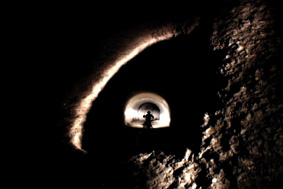
For several years I have been experimenting with a tactic I call ?transfalumination,? I venture at night into the marginal geographies of the city and perform peculiar ceremonies with light, hoping to bring back images that appeal to some deep sense of the mysterious. ?Journey to Q?xtlan? is a journey, an opera, and a koan that presents some of the results of this research. It?s a kind of dream.
Peter Rose?s works in film, video, installation, and performance have received extensive national and international exhibition, including shows at the Whitney Museum, the Museum of Modern Art, the Centre Pompidou, the Yokohama Museum of Art, the Fabric Workshop and Museum, the Rotterdam International Film Festival and the Film Society of Lincoln Center. Rose is concerned with new forms of vision, the structures of language, and the pleasures of obscure journeys. His work is included in several major international collections.
Peter Rose
Odysseus in Ithaca
Experimental video | dv | color | 5:15 | USA, Ireland | 2004
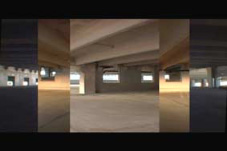
Odysseus moors his boat in an alien architectural machine, a labyrinth with echoes of De Chirico and Escher- a place of mystery and power where the rules of visual perspective are transformed and other spaces emerge.
Peter Rose?s films, videos, and installations have been exhibited internationally and are in several major collections. He has been the recipient of significant grants and fellowships and has presented his work widely. Concerned with new forms of vision and the structures of language, his work nevertheless manages to offer a range of comic, sensual, and poetic pleasures.
Peter Rose
Odysseus in Ithaca
Experimental video | dv | color | 5:15 | USA | 2006
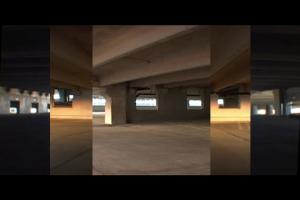
Odysseus moors his boat in the midst of an alien architectural machine, a labyrinth with echoes of De Chirico and Escher, a place of mystery and power where the rules of perspective are challenged and other spaces emerge. The video takes us on a dizzying, exhilarating swoop of a journey through the manifolds of a parking garage, down spiraling ramps into a deep interior space; it is a descent into the depths and it is a lament. Odysseus remembers the sea.
Peter Rose?s works in film, video, installation, and performance have received extensive national and international exhibition, including shows at the Whitney Museum, the Museum of Modern Art, the Centre Pompidou, the Yokohama Museum of Art, the Rotterdam International Film Festival, and the Film Society of Lincoln Center. Rose is concerned with new forms of vision, the structures of language, and the pleasures of obscure journeys. His films and videos are included in several major international collections and he has lectured widely on his work. More is available at www.peterrosepicture.com
Peter Rose
Dimensional Excursions (Oculis)
Experimental VR | hdv | color | 17:15 | USA | 2018
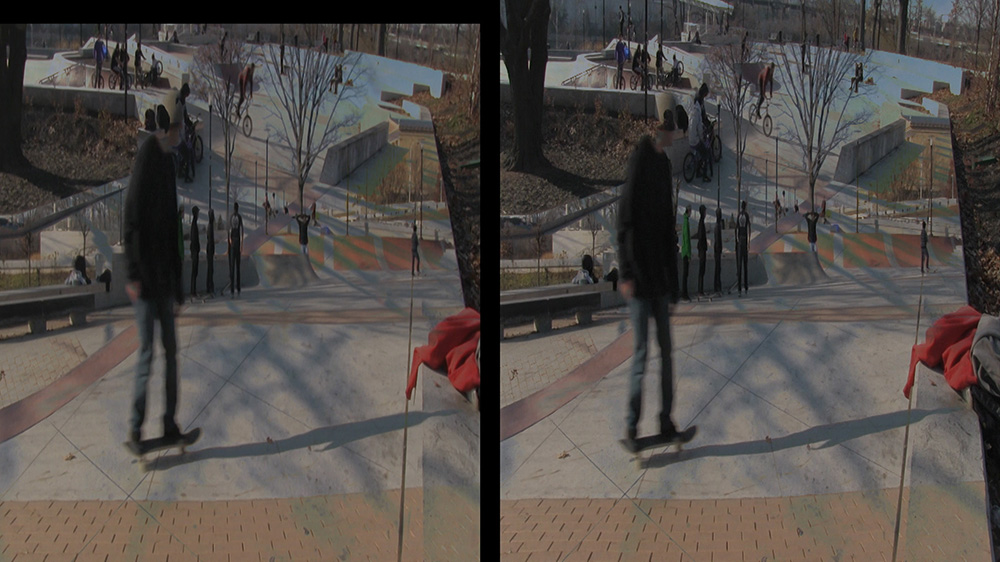
A suite of multi-dimensional riffs that use topological, performative, metapoetic, spatiotemporal, architectonic, kinaesthetic, choreographic, and observational strategies to conjure new forms of vision.
Since 1968 Peter Rose has made over thirty films, tapes, performances and installations. Many of the early works raise intriguing questions about the nature of time, space, light, and perception and draw upon Rose?s background in mathematics and on structuralist filmmaking. He subsequently became interested in language as a subject and in video as a medium and generated a substantial body of work that played with the feel and form of sense-a kind of intellectual comedy. Recent projects have involved a return to the landscape as subject and the mechanics of perception. His films, videos, installations, and performances have received extensive national and international exhibition, including shows at the Whitney Museum and the Museum of Modern Art, the Centre Pompidou, the Yokohama Museum of Art, and exhibition at the Fabric Workshop and Museum, the Rotterdam International Film Festival and the Film Society of Lincoln Center. His works have drawn support from an impressive roster of sources, including the National Endowment for the Arts, the Pennsylvania Council on the Arts, the Guggenheim, Independence and Pew Foundations, and have been the subject of a number of articles on contemporary media art. His work is included in several major international collections.
Peter Rose
Studies in Transfalumination
Experimental video | dv | color | 5:30 | USA | 2008
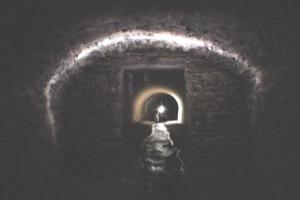
Studies in Transfalumination (5:30, 2008) exploits modified flashlights and stripped down video projectors to explore the visual complexities of the ordinary world: a tunnel, a clump of grass, a discarded table, the underside of a bridge, fog, a piece of rock, and a tree. All images were shot in real time- there is no animation. The video is the third in a series of works that explore light and darkness.
Since 1968 Peter Rose has made over thirty films, tapes, performances and installations. Many of the early works raise intriguing questions about the nature of time, space, light, and perception and draw upon Rose`s background in mathematics and on structuralist filmmaking. He subsequently became interested in language as a subject and in video as a medium and generated a substantial body of work that played with the feel and form of sense-a kind of intellectual comedy. Recent projects have involved a return to the landscape as subject and the mechanics of perception. His films, videos, installations, and performances have received extensive national and international exhibition, including shows at the Whitney Museum and the Museum of Modern Art, the Centre Pompidou, the Yokohama Museum of Art, and exhibition at the Fabric Workshop and Museum, the Rotterdam International Film Festival and the Film Society of Lincoln Center. His works have drawn support from an impressive roster of sources, including the National Endowment for the Arts, the Pennsylvania Council on the Arts, the Guggenheim, Independence and Pew Foundations, and have been the subject of a number of articles on contemporary media art. His work is included in several major international collections.
Elske Rosenfeld
Ein bisschen eine komplexe Situation
Experimental doc. | hdv | color | 14:44 | Germany, Austria | 2014
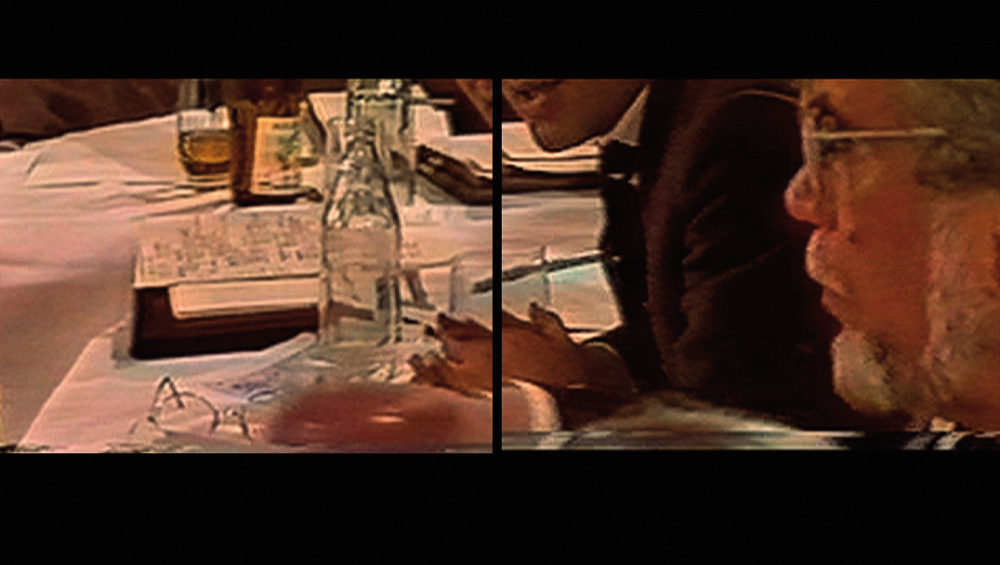
Content Summary/ Accompanying Info: This video is an intervention into footage from the first meeting of the Central Round Table of the GDR. The meeting took place on December 7th 1989 in East Berlin, two months after the beginning of mass demonstrations across the country. The Round Table was set up to bring together members of the established political parties and the newly formed oppositional groups on equal terms. A few hours into the meeting, proceedings are interrupted as a noisy demonstration approaches outside. In the ensuing 10-minute scene, participants try to decide on a collective response. Sounds from the demonstration can be heard ebbing and swelling outside the window, while the participants inside debate. The demonstrators are never seen, only heard. The 2-channel video shows the scene in its entirety. It unfolds as a series of interventions into the material that are themselves based on motions and gestures taken from the footage: pans, zooms, the shaking of the camera, the gestures and movements of the participants, the different qualities and sources of sound. These are amplified, repeated, looped, in order to confront and confound notions of inside and outside, language and body, representation and embodiment.
Biography: Elske Rosenfeld (b. 1974 in Halle/S., GDR) uses a variety of media to rework archival materials from the history of state socialism in Eastern Europe and to relate them to contemporary political forms. Recent works in the formats video, performance, and writing have focussed on the physical, gestural content of archival documents from situations of revolution or protest (Paris 1968, East Berlin 1989, Cairo 2011) – to address the body as a site and archive of political events. Various abstracted interventions into and around these materials reactivate political energies that were set loose in these instances and continue to reverberate into the present day. Rosenfeld lives and works in Berlin and Vienna. She holds a PhD-in-Practice from the Academy of Fine Arts in Vienna. Her work has been presented internationally at institutions including Forum Stadtpark/Steirischer Herbst 2015, Graz; Berlin Art Week 2014; Sarai Reader 09/Devi Art Foundation, Delhi; Vienna Art Week 2011; BAK, Utrecht; Shedhalle, Zürich; mumok kino, Vienna; Kunsthalle Exnergasse, Vienna; GfzK, Leipzig; tranzit, Cluj, Romania; the Education Programme of documenta13. She has taken part in international residencies, including the Visual Arts Residency at the Banff Centre for the Arts, Canada. Her texts have been published in/on eipcp.net, Reviews in Cultural Theory, Springerin – Hefte für Gegenwartskunst, and in a number of books and collections. She has been awarded a DOC-Fellowship of the Austrian Academy of Sciences, and project funding from the Programme for Arts-based Research/FWF, Austria. www.elskerosenfeld.net
Catherine Ross
Trilling
Art vidéo | dv | color | 3:52 | USA | 2006
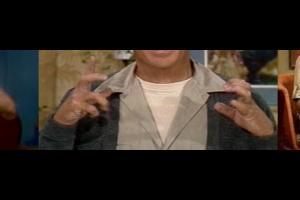
NOUVEAU SYNOPSIS 09/04/08: Trilling scrolls right to left across the screen, recombining footage from the early 80s television program "Three's Company" into a sequence of traveling gestural loops. Trilling is about physical humor. It emerged out of a curiosity about my childhood obsession with the well-known sitcom "Three's Company". The show was written for adults, but through the actor?s performances it conveyed a humor that enabled anyone (including children) to laugh out loud. The physical comedy became the vehicle for the narrative, expressing the humor of the show in a way that words could not. Unlike verbal comedy, which needs time to register and be translated before we recognize its wit, physical humor is immediate; awkward bodily movement can trigger an uncontrollable hysterical response. By excerpting and reformatting physical gestures from the actors in the show, I constructed a new narrative in collaboration with Trumpeter Taylor Haskins. Haskins composed the music spontaneously, creating a unique improvised response to each clip that fold together into a unified whole. ANCIEN SYNOPSIS: Trilling recombines footage from the early 80s sitcom "Three`s Company" into a sequence of travelling gestural loops. Trumpeter Taylor Haskins collaborated on the audio track, creating a unique improvisational response to each clip.
Catherine Ross works in video and photography, framing gestures of performances that often go unnoticed in their original context. Isolating the movements of humans and/or objects, her videos create new musical sequences that reveal an inseparable relationship between motion and sound. Here she finds that movement reveals an inherent awkwardness, a humor that echoes our own vulnerabilities. Her work has been presented in exhibitions and festivals internationally, including venues in Brazil, Finland, Ireland, England, Canada and the United States. Ross attended the Skowhegan School of Painting & Sculpture in 2002, the Atlantic Center for the Arts in 2003 and received a 2005-06 residency from The Marie Walsh Sharpe Art Foundation. Ross was recently awarded "Best International Short Award" at the 2006 Darklight Festival (Dublin, IRELAND). She received her BA in studio art from Dartmouth College in 1994. Catherine Ross lives and works in Brooklyn, New York.
David Ross
Théodolitique
Experimental doc. | 35mm | color | 15:10 | Canada | 2015
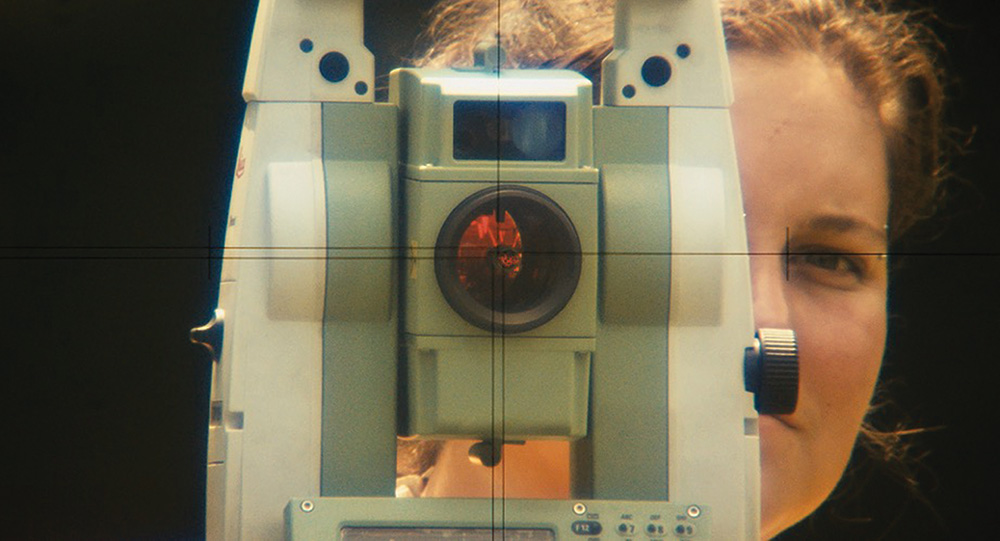
Théodolitique (2015) merges the geodetic and the filmic, linking the very long history of land surveying with the comparatively new technologies of film-making. Connecting these two methods of visual observation and recording, Théodolitique documents student surveyors from the école des Métiers du Sud-Ouest-de-Montréal as they take an outdoor exam over the course of a single day. The project utilizes a wide range of filmic and acoustic techniques ? including a parabolic microphone to capture distant audio, and a custom built ?theodocam? to provide a surveyor?s eye view ? to reflect and mimic how the students move, think and learn their trade. Recorded on a designated practice field adjacent to the école des Métiers, Théodolitique is a film that is both chorographic and choreographic.
The works of David K. Ross are concerned with the processes and activities which enable infrastructural monuments, cultural institutions, and architectural structures to exist. Using photography, film and installation to carry out these inquiries, he examines the performative capacities of un-scripted activities, along with the relationships that exist between the recorded event and its re-presentation in physical space. These inquires have been applied to various projects including a study of the enigmatic activities of student land surveyors, the uncanny and oneiric qualities of a series of rooms at the Art Institute of Chicago, the nuanced and poetic movements of dancers about to perform, the mythic and sublime qualities of an urban lighting fixture in Montréal, the quietude of artists’ storage spaces, and a close examination of colour coded art shipping crates.
Douglas Ross
UN
Video installation | dv | color | 7:7 | USA | 2004
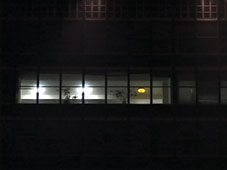
The United Nations building in New York at night. Douglas Ross films an architecture void of animation, except for the intermittent flickering lights.
Douglas Ross was born in Brockton, MA, USA, in 1969. He lives and works in New York City. His work has been exhibited at the Miami Contemporary Art Museum; at the Rotterdam Film Festival; in Turin; at the KW Contemporary Art Institute in Berlin; the PS1 Contemporary Art Centre; and MoMA, the Walker Art Centre. He has also completed artist residencies and exchange programs in Japan.
Maxime Rossi
Real Estate Astrology
Video | hdv | color | 21:0 | France | 2015
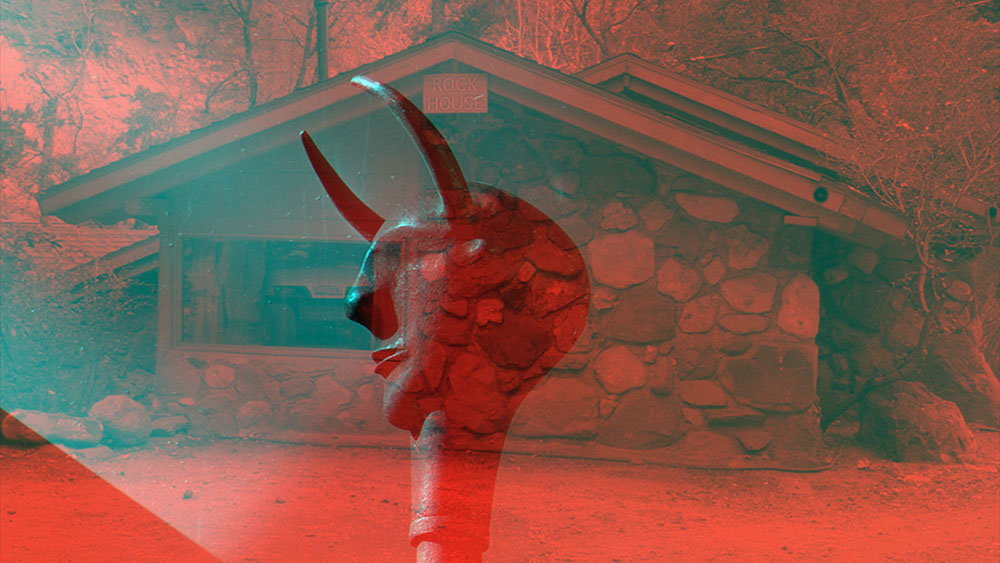
Appréhendées comme un voyage mental, visuel et sonore proche de l’esprit surréaliste, les images se succèdent au rythme de l’énonciation mystique du thàme astral de Ersnt dressé par un astrologue de Sedona, également saxophoniste, qu’il a lui-même dressé après avoir constaté une erreur dans l’heure de naissance de celui commandé par Breton en 1930. Sa voix off accompagne le spectateur. à la fois atmosphère sonore et piste narrative, elle parait guider cette chasse au fantôme - probablement celui de l’esprit de Max Ernst qui, partout, imprègne les lieux. Tandis que la mélodie rappelle les bandes sonores de méditation disponibles dans les boutiques de souvenirs de la ville, la désynchronisation répétée des rushes dans le temps évoque, tel ce chat dont le corps se dédouble, le “voyage astral” cher aux surréalistes, l’expèrience de hors corps, la sensation de flottement. Dans son film Real Estate Astrology (2015), Maxime Rossi développe une réflexion à facettes pour portraiturer un lieu. Il confronte deux états de narration entre lesquels le spectateur peut osciller, du diagnostic des traces objectives d’une quète, real estate, au pronostic à valeur prédictive d’une vie dressé d’après l’interprètation stellaire, astrology.
Le travail de Maxime Rossi contourne les limites de genre prédéfini comme de style pour puiser ses formes et son inspiration dans de multiples sources : l’histoire de l’art, l’ethnographie ou la littérature. L’impressionnant éventail des registres provoque une étrange narration, que l’artiste utilise pour dévoiler des vérités en portant un nouveau regard sur des sujets que nous pensions connaître avec certitude. À travers le prisme kaléidoscopique d’une pratique complexe et hétéroclite mêlant la sculpture, l’installation, la performance, la scénographie et la vidéo, Maxime Rossi ignore l’idée même de catégories et propose une discipline singulière qui convoque la « beauté convulsive » chère aux surréalistes. Maxime Rossi est né en 1980, il vit et travaille à Paris, France. Son travail a fait l’objet de projections au Centre Pompidou, Paris et au MUMOK, Vienne (Autriche). Il a notamment été montré dans le cadre d’expositions personnelles et collectives au Palais de Tokyo, Paris, à l’Emba / Galerie Édouard-Manet, Gennevilliers, à la Fondation François Schneider, Wattwiller, à La Halle des bouchers, Vienne, à la 19e Biennale de Sydney, au S.M.A.K. de Gent ou au Musée d’Ethnographie de Genève, Suisse.

Clement Roussier
MYRNINEREST
Experimental doc. | hdcam | color | 14:16 | France | 2025
A woman performs Butoh alone in her bedroom; a foreigner wanders the buzzing streets of Tokyo; a poet speaks of rivers, pity and ghosts.
Clément Roussier was born in 1984. He is the author of two poetry collections (Now It Is Always Three O’Clock and Fondane), published in 2025 by Derrière la salle de bain, as well as a novel, Sullivan and the Fiery Skies of the Savannah Evenings, published in 2020 by L’École des Loisirs. In Silence and clamour, his first film, won the Grand Prize of the French Competition at FID Marseille 2023.
Philippe Rouy
MACHINE TO MACHINE
Experimental doc. | web | color | 32:0 | France, Japan | 2013
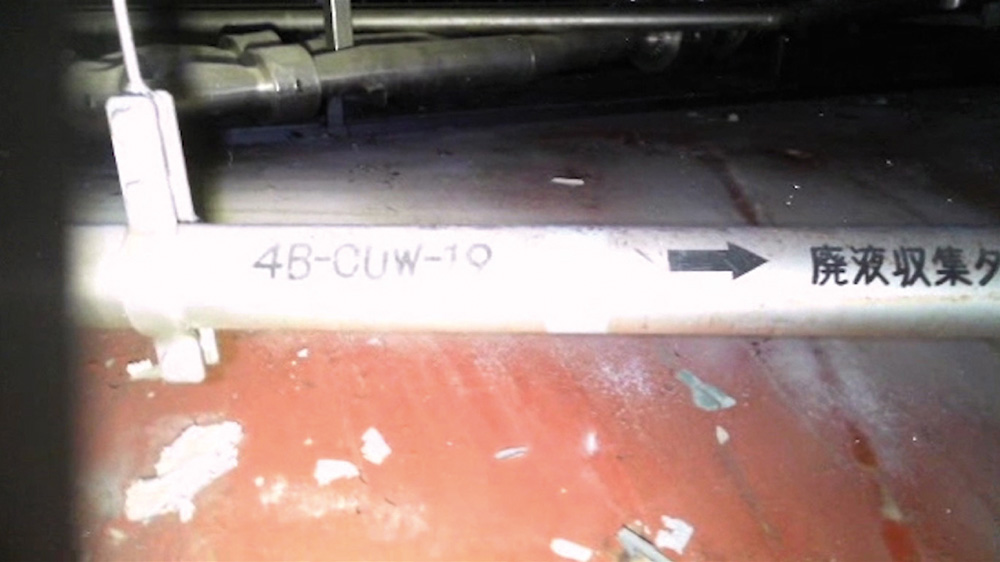
À Fukushima daiichi, le ventre de la centrale nucléaire effondrée maintient pour encore très longtemps les humains à distance. Seules d’autres machines peuvent s’en approcher. Elles filment pour les hommes ce qu’ils ne peuvent plus voir. Entre mouvements pendulaires lancinants et pénétrations gyroscopiques, ces images annoncées par l’exploitant comme des explorations scientifiques rigoureuses s’avèrent être des plongées chaotiques et hallucinées au cœur d’un magma radioactif irréductible.
Philippe Rouy vit et travaille à Paris. Ses films sont montrés dans des festivals et des lieux de diffusions tels que FIDMarseille, Torino Film Festival, Rotterdam IFF, Jihlava IFF, UnionDocs New York, Cinéma Spoutnik de Genève, Cinema Nova de Bruxelles, etc...
Vincent Roven
Logologo
Fiction | 16mm | color | 7:30 | France, Brazil | 2005
"After the bridge, starts the land of ghosts" (Dracula - Bram Stocker)
Vincent Royen was born in May 1968. He studied in Marseilles´s Fine Arts School- Luminy. He obtained his superior studies diploma in plastics arts in 1994. Since 1995, he has been living and working in Sao Paulo, Brazil, and took part in the realization of several AV/cinema works among which: - "Kyrie ou le début du Chaos" (fiction, 35mm, 15 min., 1998): filmmaker assistant/artistic director: - "Jusqu´à 120 ans" (documentary, digital, 70 min., 2002): co-direction - ULALAPA (fiction/doc - digital, 12 min., 2003): co-direction, editing, sound - LOGOLOGO (fiction - digital, 7 min., 2005): realization, editing, sound and photography He also develops activities linked with plastic arts and has realized many group and solo exhibitions among which: 2001 - "Medodanóia" - solo exhibition realized at "Centro Cultural São Paulo" - São Paulo - Brazil 2000 - "SUNSET" - solo exhibition realized at the "FUNARTE" (Fondation Nationale des Arts) - São Paulo - Brazil
Paul Rowley, Phillips/Rowley
Commonwealth
Art vidéo | dv | color | 4:30 | Ireland | 2007
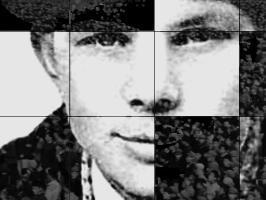
Commonwealth examines ideas of social progress through re-visiting the Soviet Space program of the 1960`s, in particular Yuri Gagarin`s orbit of the earth in 1961. The presentation of the public events in shaping perceptions of what is good for a society, uplifting the spirit of a community, is examined in relation to the role of the individual figurehead, selected from the masses to represent a society internationally. Inspired in part by Hobbes` writings on the Body Politic, and writings on the history of science, the piece examines ideas of governance and community, and the use of division in social models to create order. A rich collection of visual references are brought together in building the piece; for example, Ambrogio Lorenzetti`s Allegories of Good Government: The Effects of Good Government in the City and Country, Soviet mosaic murals, the iconography of the space race, the visual language of progress, and the utopian architectures and designs of the World Fairs of the late 1960s and early 1970`s.
Dublin born Paul Rowley and Memphis born David Phillips currently work primarily with film, video and sound, exhibiting their work in galleries, museums and festival screenings. Some recent exhibitions include Re:mote at the Photographers? Gallery, London, Your chance to live at 300m3 in Gothenburg, the Kunst Film Biennial in Cologne, Fricción, at the Museum of Contemporary Art in Mexico City, Videonale at the Bonn Kunst Museum, and Bambi at the ICA in Philadelphia. Recent festival screenings include the Impakt festival in Holland, and retrospectives at the Darklight Digital Festival in Dublin and Prog:ME, the Rio de Janeiro Festival of Media Arts. Their exhibition Intrusion was at Bischoff/Weiss Gallery in London in July. In 2000 they were awarded the Glen Dimplex Artists? Award, the Irish Museum of Modern Art?s annual contemporary art prize and seen as the Irish equivalent of the Turner Prize. Their short video Suspension was awarded a Golden Spire at the San Francisco International Film Festival and they were the recipients of the New Langton Arts Award for video. Paul recently won the Irish American Arts Awards, in both the under 35 category and the overall prize. Paul was artist in residence at the Atlantic Center for the Arts in Florida with Gillian Wearing, and has received many awards from the Irish Arts Council for his work since 1997. He was a fellow at the Macdowell Artist Colony in New Hampshire, and recently to traveled to Italy to work on a new series of videos at the Bogliasco Foundation. He was awarded a residency at the Experimental television Center in New York in 2005, which recently led to a grant from NYCSA, the New York State Council for the Arts. Paul and David have just completed a collection of films to accompany a live performance of John Cage?s Sonatas and Interludes, premiered at The Stone in New York this July in collaboration with pianist Emily Manzo. Paul is currently finishing a feature length documentary shot in the former Butlin`s holiday camp at Mosney, which is now used as a holding center for asylum seekers. They are also currently shortlisted to produce a new multi-screen video work for LAX airport in Los Angeles, to be announced in 2007.
Paul Rowley
DMC-13
Experimental video | dv | color | 9:22 | Ireland | 2013
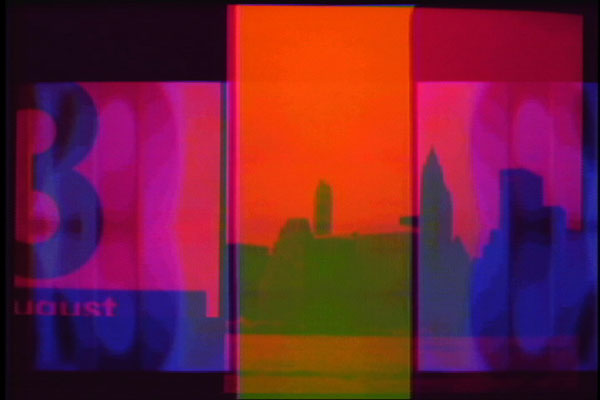
DMC-13 is a short video produced on analog video synthesisers at the Experimental Television Center in New York. The film uses images from a documentary on John DeLorean - the ill fated automobile manufacturer - who opened his luxury sports car factory in Belfast at the height of the troubles in the north of Ireland. As the US car industry collapsed, and DeLorean was arrested for alleged cocaine smuggling, his dream of `affordable luxury`, which had spent over £100 million of taxpayers money, also perished.
Paul Rowley is a visual artist and filmmaker. He first began making films in 1995. Since then he has completed over 30 shorts, feature films, video installations, and documentaries. The works are shown both in galleries and film festivals. Previous screenings include - Centre Pompidou Paris, Hammer Museum Los Angeles, Forum Expanded at the Berlin Film Festival, Photographers` Gallery, London, Rencontres Internationales Paris/Berlin/Madrid, Museum of Modern Art Dublin. He recently completed a 60 screen permanent installation at Los Angeles International Airport.
Paul Rowley, David PHILLIPS
Gravity Loop
Experimental video | dv | color | 3:0 | Ireland, USA | 2006
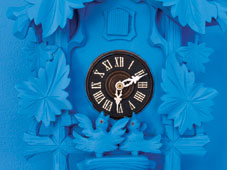
"Gravity Loop" is a series of photographs and video works which reconfigure a single image in order to present multiple approaches to viewing time. Taking its starting point in relativity, the series moves to consider recent movements in Theoretical Physics and String Theory, which discuss the possibilities of time as a non-continuous dimension, that is, that at the quantum level there may be gaps in time. Much as the model of the atom as a solid sphere of matter was replaced in the early Twentieth century with a model that describes the atom as almost empty space, the work uses similar ideas to illustrate possible models of timekeeping in a non-continuous time. One way to imagine this concept visually is to consider the use of clocks to tell time. Instead of a single clock that displays the passing of time continuously, we must imagine an infinite number of identical clocks, each of which come into existence for the tiniest fraction of a second, display the time, and then disappear. In between the appearance of these clocks is nothing, a gap in time where no matter or movement exists.
Dublin born Paul Rowley and Memphis born David Phillips currently work primarily with film, video, and sound, exhibiting their work in galleries, museums and festival screenings. Some recent exhibitions include: "Re:mote" at the Photographers' Gallery, London; "Your chance to live at 300m3 in Gothenburg", the Kunst Film Biennial in Cologne; "Fricción", at the Museum of Contemporary Art in Mexico City; "Videonale" at the Bonn Kunst Museum; and "Bambi" at the ICA in Philadelphia. Recent festival screenings include the Impakt festival in Holland, retrospectives at the Darklight Digital Festival in Dublin and Prog:ME, and the Rio de Janeiro Festival of Media Arts. Their exhibition "Intrusion" was at Bischoff/Weiss Gallery in London in July. In 2000 they were awarded the Glen Dimplex Artists' Award, the Irish Museum of Modern Art's annual contemporary art prize seen as the Irish equivalent of the Turner Prize. Their short video "Suspension" was awarded a Golden Spire at the San Francisco International Film Festival and they were the recipients of the New Langton Arts Award for video. Paul recently won the Irish American Arts Awards in both the under 35 category and the overall prize. Paul was artist in residence at the Atlantic Center for the Arts in Florida with Gillian Wearing, and has received many awards from the Irish Arts Council for his work since 1997. He had a fellowship at the Macdowell Artist Colony in New Hampshire, and recently travelled to Italy to work on a new series of videos at the Bogliasco Foundation. He was awarded a residency at the Experimental Television Center in New York in 2005, which recently led to a grant from NYCSA, the New York State Council for the Arts. Paul and David have just completed a collection of films to accompany a live performance of John Cage's Sonatas and Interludes, premiered at The Stone in New York this July in collaboration with pianist Emily Manzo. Paul is currently finishing a feature length documentary shot in the former Butlin's Holiday Camp at Mosney, which is now used as a holding center for asylum seekers. They are also currently shortlisted to produce a new multi-screen video work for LAX airport in Los Angeles, to be announced in 2007.
Paul Rowley, David PHILLIPS
Latent Heat
Experimental video | betaSP | color | 3:30 | Ireland | 2004
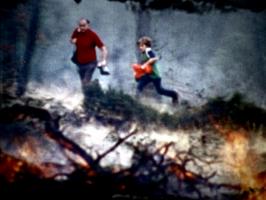
In classical physics, the energy of a system in which matter changes from one state to another seems to plateau as we approach the critical temperature. Taking simple observations from Physics, the piece examines how structural change and associated intermediary states can be applied to sociological readings. Examining societies in times of crisis, and looking at the operation of flash-points as catalysts of accelerated social change, the piece ties elements of social and physical sciences together aesthetically to examine what a society might look like in a moment of extreme unrest.
Dublin born Paul Rowley and Memphis born David Phillips currently work primarily with film, video, and sound, exhibiting their work in galleries, museums and festival screenings. Some recent exhibitions include: "Re:mote" at the Photographers' Gallery, London; "Your chance to live at 300m3 in Gothenburg", the Kunst Film Biennial in Cologne; "Fricción", at the Museum of Contemporary Art in Mexico City; "Videonale" at the Bonn Kunst Museum; and "Bambi" at the ICA in Philadelphia. Recent festival screenings include the Impakt festival in Holland, retrospectives at the Darklight Digital Festival in Dublin and Prog:ME, and the Rio de Janeiro Festival of Media Arts. Their exhibition "Intrusion" was at Bischoff/Weiss Gallery in London in July. In 2000 they were awarded the Glen Dimplex Artists' Award, the Irish Museum of Modern Art's annual contemporary art prize seen as the Irish equivalent of the Turner Prize. Their short video "Suspension" was awarded a Golden Spire at the San Francisco International Film Festival and they were the recipients of the New Langton Arts Award for video. Paul recently won the Irish American Arts Awards in both the under 35 category and the overall prize. Paul was artist in residence at the Atlantic Center for the Arts in Florida with Gillian Wearing, and has received many awards from the Irish Arts Council for his work since 1997. He had a fellowship at the Macdowell Artist Colony in New Hampshire, and recently travelled to Italy to work on a new series of videos at the Bogliasco Foundation. He was awarded a residency at the Experimental Television Center in New York in 2005, which recently led to a grant from NYCSA, the New York State Council for the Arts. Paul and David have just completed a collection of films to accompany a live performance of John Cage's Sonatas and Interludes, premiered at The Stone in New York this July in collaboration with pianist Emily Manzo. Paul is currently finishing a feature length documentary shot in the former Butlin's Holiday Camp at Mosney, which is now used as a holding center for asylum seekers. They are also currently shortlisted to produce a new multi-screen video work for LAX airport in Los Angeles, to be announced in 2007.

Paul Rowley, David PHILLIPS
Microfiche:diamond trade
Art vidéo | dv | color | 5:0 | Ireland | 2004
On the night of the 27th of April, 1974, members of an armed IRA gang stole nineteen paintings from Russborough House worth a total of £8 million, including works by Gainsborough, Vermeer, and Velásquez. The gang demanded the return of Irish republican prisoners from England as well as £500,000 in ransom money. The authorities responded by offering a £100,000 reward for information and mounting a massive nationwide search. Ten days after the robbery, the police recovered the paintings in a house in Co. Cork. A wealthy Englishwoman, Dr. Rose Dugdale, was charged and convicted. She was also convicted of involvement in an earlier IRA operation, a hijacked helicopter attack on an RUC station. Rose Dugdale received a total of 18 years in prison, and served 9 of them. In this work, the genealogy of this event is traced using the now outdated library microfiche image archiving system. Shots from national news reports of the time are re-photographed from the internet, and edited together in a sequence of pairings that enable the viewer to piece together the event anew. Of interest here in this exercise in spectatorship is the series of exchanges that are presented. The Beit family fortune, which was initially used to buy these paintings, was accumulated by Alfred Beit in partnership with Cecil Rhodes as the De Beers Consolidated Mines in South Africa, which in 1891 owned 90% of the world?s diamond production. These profits were used to buy paintings, which were stolen from Russborough house a total of four times over the last thirty years. The sequence of exchanges is what is interesting here; where African diamonds become Western European art masterpieces, swapped for political prisoners, and later bargaining chips used by organized crime gangs in negotiations with the Irish state.
David Phillips (Memphis, Tennessee 1970) and Paul Rowley (Dublin, Ireland 1971) have been working together collaboratively since 1998, primarily with film, video installation and sound. In 2000, they won the Glen Dimplex Artists? Award, the Irish Museum of Modern Art?s annual contemporary art prize, seen as the Irish equivalent of the Tate?s Turner prize. Their short video Suspension was awarded a Golden Spire at the 1999 San Francisco International Film Festival. In the same year they were the recipients of the New Langton Arts Bay Area Award for video. Recent exhibitions include Re:mote at the Photographers? Gallery, London, Videonale at the Bonn Kunst Museum, and Bambi at the ICA in Philadelphia. Their work was recently selected by New Museum?s senior curator Dan Cameron to participate in the annual ev+a exhibition in Limerick, Ireland, this spring. Recent festival screenings include the Impakt festival in Holland, special mention at the Zemos:98 festival in Sevilla, and retrospectives at the Darklight Digital Festival in Dublin and Prog:ME, the Rio de Janeiro festival of Media Arts. Paul has been artist in residence at the Atlantic Center for the Arts, Florida, with Gillian Wearing, and a fellow at the Macdowell Artist Colony in New Hampshire. He has received numerous awards from the Irish Arts Council for his work.

Paul Rowley, David PHILLIPS
Security Fugue
Art vidéo | super8 | color | 4:0 | Ireland | 2004
Contrasting the promise of rescue with threats of captivity and injury, ?Security Fugue? examines personal responses to crisis in the current arena of ubiquitous security. Images of a rescue helicopter move across the screen in exaggerated slow motion, while on a second screen, the camera tracks over aeriel views of a hospital and rescue crew on the ground below. In the audio track, stuttering confessions and dislocated murmurs echo in unison with the constant rhythm of chopping helicopter blades which fills the space. Sources for the piece are varied; a small excerpt of a 35mm Hollywood trailer from the early 1970`s, a 16mm educational film about psychological responses to disasters, taped recordings of phone calls made by Patty Hearst from captivity in 1974, interviews with Hearst from 2003 describing her revisited experiences of captivity, and original sound compositions by the artists. The memory lapse of the amnesiac is taken as a starting point from which to investigate the process of forgetting, remembering and rewriting of recent memories. These editorial patterns of amnesia are juxtaposed visually with images of physical constraint that parallel the collective mental state of a society in a state of siege. Musically, the imitative polyphonic compositional structure of the fugue in which a theme is stated successively in several voices is used both to determine the editing structure of the work and for its references to pursuit and flight. In psychiatry, the fugue is described as a condition of pathological amnesia during which one is apparently conscious of one`s actions, but has no recollection of them after returning to a normal state. This condition, usually resulting from severe mental stress, is of interest in describing a trauma that is experienced both individually and collectively. In installation, the piece is presented as two side-by-side large-scale projections with a surround sound audio mix. A single channel version is also available for cinema and festival screenings.
Artists David Phillips (Memphis, Tennessee 1970) and Paul Rowley (Dublin, Ireland 1971) have been working together collaboratively since 1998, primarily with film, video installation and sound. In 2000, they won the Glen Dimplex Artists? Award, the Irish Museum of Modern Art?s annual contemporary art prize, and seen as the Irish equivalent of the Tate?s Turner prize. Their short video Suspension was awarded a Golden Spire at the 1999 San Francisco International Film Festival. In the same year they were the recipients of the New Langton Arts Bay Area Award for video. Recent exhibitions include Re:mote at the Photographers? Gallery, London, Videonale at the Bonn Kunst Museum, and Bambi at the ICA in Philadelphia. Their work was recently selected by New Museum?s senior curator Dan Cameron to participate in the annual ev+a exhibition in Limerick, Ireland. Recent fesitval screeings include the Impakt festival in Holland, special mention at the Zemos:98 festival in Sevilla, and retrospectives at the Darklight Digital Festival in Dublin and Prog:ME, the Rio de Janeiro festival of Media Arts. Paul has been artist in residence at the Atlantic Center for the Arts, Florida, with Gillian Wearing, and a fellow at the Macdowell Artist Colony in New Hampshire. He has received numerous awards and bursaries from the Irish Arts Council for his work.