Catalogue > Search
Results for : Tout le catalogue
Markus Renvall
Demonstration
Video | dv | color | 4:0 | Finland | 2006

Rachel Reupke
10 Seconds or Greater
Experimental video | | color | 15:0 | United Kingdom | 2010
10 Seconds or Greater by Rachel Reupke is shown as a single screen installation at Picture This. The film was made during the third in a series of residencies based at Picture This supported by Film London. Formally based on the production of royalty-free stock footage, 10 Seconds or Greater maps the logical progression of a director through a check list of popular scenarios designed to illustrate such commercially lucrative concepts as ?communication', ?relaxation' and ?healthy life-style'. With an original R&B score by Simon and Matt Ward
Jean-françois Reverdy
Matière Première
Experimental doc. | hdv | color | 26:2 | France, Mauritania | 2015
The journey proceeds on desertic lands. Starting with the laborers quarrying red dirt at open-air mines, it follows the iron ore all the way to the ocean, aboard the world`s longest train. At the end, the wrecks scattered on the beach announce the voyage`s end. Meanwhile, bound for prosperous countries, the cargo of valuable ore is heaped into the holds of ships at the dock. This film uses the age-old camera obscura device, one of the earliest ways of capturing reality. The technique yields an unusual perception of the desert`s geology, light, machines, and men.
Reynold Reynolds
Letzter Tag der Republik
Video | 16mm | color and b&w | 8:0 | USA, Germany | 2009
The Palast der Republik (Palace of the Republic) Opened in 1976 as a meeting place for the East German people and an emblem of the future. The unique modern building made of distinctive golden-mirrored windows was home to not just the East German Parliament but auditoriums, art galleries, five restaurants, concert halls, and even a bowling alley. The building`s dazzling public lobby, surrounded by several tiers, was once the center of social life in East Berlin with thousands of sparkling lamps filling the open space of the lobby`s grand staircase. Many Berliners recall attending a play in one of the theaters or dancing the night away in the underground disco, others seeing their first rock concert, or being married. Later, thousands of citizens demonstrated against the planned demolition and hoped the building would be protected against historical censorship, but alas, one day, twenty years after the fall of the Berlin wall, the Palace completely disappeared. This day was the: Last Day of the Republic. Letzter Tag der Republik. Written by Gerhard Falkner Ich hatte einst ein schönes Vaterland das Weiß-nicht-mehr wuchs dort so schön das Weiß-nicht-mehr Weißt du noch wo du warst, als Troja fiel? Bist du in deinem Alter noch der Mensch. Der vor Karthago stand? Na siehst du: ceterum censeo. Sind die Wolken die einzigen Mauern die nicht fallen weil sie fahren. Die einzigen Mauern, die Posaunen nicht einreißen. Die fließenden Mauern. Ich bin immer noch nicht da, wo ich war, wenn ich weg bin. Ich stehe nach Abschluss der Arbeiten nun kurz vor der Beseitigung. Es wird schwer sein, mich zu vergessen, jetzt wo ich nicht mehr da sein werde. Meine Anwesenheit in der Abwesenheit wird nachklingen. Ein Koloss aus Beton, Geschichte und Zeit, der geht nicht, - ohne dass etwas bleibt, was noch verschwindet, wenn alles längst vorbei ist. Karthago ist auch nicht an einem Tage zerstört worden. Es wird bleiben ein Loch in der Luft, so groß wie ein Schloss. Mit oben lauter antike Figuren. Und unten lauter Figuren mit keine Ahnung von Antike. Das Schloss wird sich schließen um den versunkenen Bau und die Zeit wird im Schloss den Schlüssel umdrehen! Bis der Schlüssel (mit der Zeit) das Schloss umdreht. Und immer so weiter. die Philosophen haben die Welt nur verändert heute geht es darum, sie verschieden zu interpretieren am Besten pro Mann eine Meinung zu Allem dann bleibt unterm Strich alles offen und, wenn alles gut geht, kein Stein auf dem andern Bleiben werden: das Wasser über der Spree und die Wolken unter dem Schloss Alles andre muss fallen. Erst wenn die Wolken ins Gras beißen, wird dieses Stück Geschichte gegessen sein.
Reynold Reynolds was born in 1966 in Central Alaska. During his undergraduate schooling at the University of Colorado, Boulder, Reynolds initially studied physics receiving a bachelor`s degree under the professorship of Carl Wieman (Physics Nobel Laureate 2001). Changing his focus to studio art he remained two more years in Boulder to study under experimental film maker Stan Brakhage. Reynolds then finished an M.F.A. in New York City at the School of Visual Arts. Influenced early on by philosophy and working primarily with 16mm and Super 8mm film as an art medium he has developed a common film grammar based on transformation, consumption and decay. Reynolds` depictions frequent disturbed psychological and physical themes, increasingly provoking the viewer`s participation and dismay. In 2003 Reynold Reynolds was awarded the John Simone Guggenheim Memorial Foundation Fellowship and in 2004 he was invited to The American Academy in Berlin with a studio at Kunstlerhaus Bethanien for one year. In 2007 he received the German Kunstfonds support to develop two projects in Berlin in 2008. In 2010 he will have a eight month residency at Akademie Schloss Solitude (Germany).
Alex Reynolds
NUEVE SEGUNDOS DE NEGRO
Video | dv | color | 1:39 | Spain | 2009
The testimony of a patient as he is going through an eye operation serves as a starting point to talk about a working process that involves a slow search for meaning and concision.
Reynold Reynolds
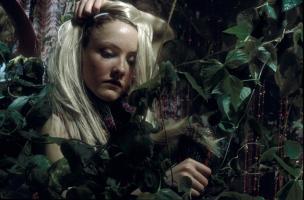
Secret Life
Video installation | 16mm | color | 5:0 | USA, Germany | 2008
Secret Life is the first from a three-part cycle exploring the unperceivable conditions that frame life. In Secret Life, a woman is trapped in an apartment that experiences a collapse of time. While time is perceived as linear, the space is a clock machine that runs circular and repetitive. New durations come into the normal rhythm of life and the apartment suffers an explosion of activity. Without the certainty of time, the occupant of the apartment is unable to keep her location, and her mind neglects the organization of the experience, leaving her only with sensations. The thoughts escape from her and grow like plants out into the space around her, living, searching, overtaking her apartment, wild threatening her; then dieing and decaying like animals.
Reynold Reynolds is an American born in Alaska. For ten years he has been working primarily with 16mm and Super 8mm film as an art medium. He has created installations, documentaries, found footage works, made narrative and experimental films, and developed a common film grammar based on transformation, consumption and decay. Reynolds` depictions frequent disturbed psychological and physical themes, increasingly provoking the viewer`s participation and dismay. He has participated in numerous art exhibitions, including the 4th Berlin Biennale for Contemporary Art, Into Me/ Out Me at P.S.1 Contemporary Art Center and Kunst-Werke Berlin Institute for Contemporary Art, Focus Istanbul at Martin Gropious Bau and Destroy, She Said at Julia Stoschek Collection. His works have been shown in many international film festivals and have won numerous awards including from the Black Maria Film Festival, the South by Southwest Film Festival and the Sundance Film Festival. In 2003 Reynold Reynolds was awarded the John Simone Guggenheim Memorial Foundation Fellowship and in 2004 he was invited to The American Academy in Berlin with a studio at Kunstlerhaus Bethanien that enabled him to start working in Berlin. Reynold Reynolds lives in New York City and in Berlin, Germany.
Louis-cyprien Rials
Mene, Mene, Tekel, Upharsin
Video | hdv | color | 5:45 | France, Iraq | 2015
Mene, Mene, Tekel, Upharsin est une vidéo tournée en 2015 en Irak, à Kirkouk, à quelques kilomètres de l’Etat Islamique. Dans le champs pétrolier majeur de Baba Gurgur, un feu éternel brûle, celui du Livre de Daniel, duquel Dieu sauve trois enfants juifs jetés dans les flammes par le roi Nabuchodonosor car ils ne vénéraient pas ses idoles. Cette succession de plans fixes montre à la fois les installations pétrolières, menaçants monstres de métal perdus dans le désert, et ce feu sacré inscrit dans un cercle, mythique punition d’une idolâtrie, et devenu lui-même idole et objet de toutes les prédations contemporaines. Des gros plans de flammes, semblent sortir des voix, des choeurs, comme si le gaz et la chaleur déformant l’image voulaient rendre cette dystopie mélodieuse. Discrètement mêlées à la bande son, des choeurs de femmes en araméen, priant, enregistrées pendant plusieurs mois dans des camps de réfugié du Nord de l’Irak apportent la voix nécessaires des victimes les plus immédiates des conflits, donnant la profondeur biblique, archéologique et spirituelle que nécessite à la fois un tel lieu et le sentiment menaçant, quasiment apocalyptique qui se dégage de ces flammes et que révèle le titre : Pesé, Pesé, Compté, divisé.
Né en 1981 à Paris, Louis-Cyprien Rials à étudié le théâtre en France avant de découvrir la photographie au Japon, oui il a vécu plusieurs années. En 2007, il entreprends un voyage sur les traces du peintre Hiroshige pour livrer une analyse comparative du paysage japonais dans le temps. Depuis son retour du Japon, en 2008, il vit entre Paris, Bruxelles et Berlin, tout en continuant ses voyages souvent dans des pays non-reconnus internationalement ou dans des zones interdites au public qu’il voit comme des « parc naturels involontaires ». Parallèlement à son oeuvre photographique, il travaille sur le minéral et la relation que l’humain entretient avec les « pierres à images », livrant dans de grands tirages photographiques des paysages tirés des pierres, que l’humain se plait à associer à d’autres formes, par le phénomène de paréidolie. Le travail sur le paysage, sa profondeur, et l’interprétation que nous avons de ses représentations est une partie importante du travail de l’artiste, que ce soit dans des installations de projecteurs de dispositives générant des peintures-paysages, ou sa trilogie de vidéo sur le Désert et la violence, terminée en 2015 en Irak.

Louis-cyprien Rials
Faith Rocks
Experimental doc. | 4k | color | 18:0 | France, Ethiopia | 2019
Louis-cyprien Rials
Polygon
Video | 4k | color | 12:39 | France, Kazakhstan | 2016
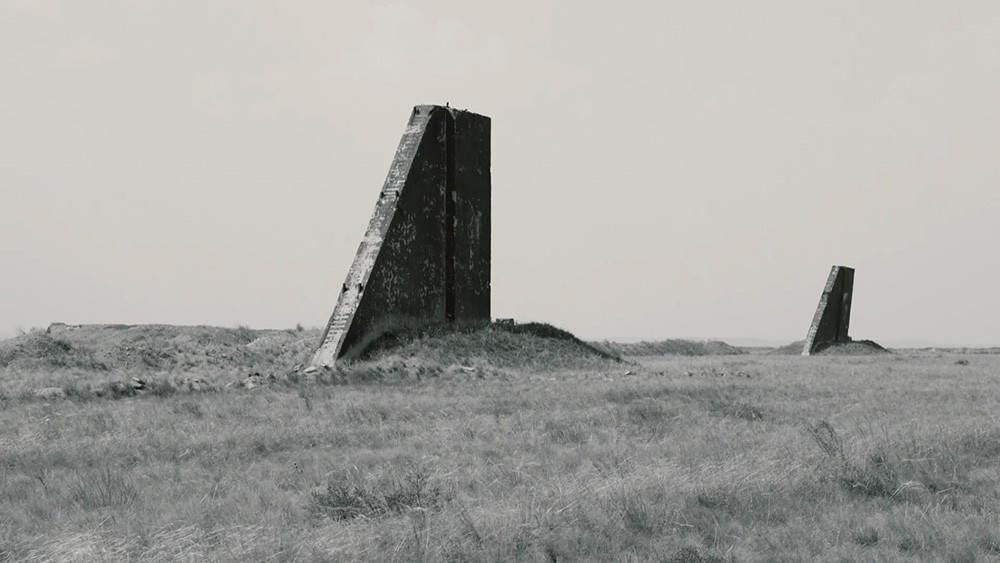
Polygon est une vidéo de douze minutes, tournée dans le Polygone nucléaire de Semipalatinsk au Kazakhstan en 2016. Il vient comme une suite naturelle du film tourné en Irak par Rials, Mene, Mene, Tekel, Upharsin où l’auteur avait filmé un cercle de flammes éternelles dans un champ pétrolifère de Kirkouk. C’est un cercle d’eau, de 400 mètres de diamètres, qui a retenu l’attention cette année, de l’artiste. Creusé par une bombe atomique en 1965, ce lac est empli d’une eau, radioactive, presque plus brûlante que le feu lui-même. Inspiré par La Jetée de Chris Marker, et Stalker de Tarkovski, la vidéo est composée de diaporama photographiques, de traveling satellitaires, de plans vidéo au sol ou pris avec un drone. Polygon est aussi une introduction à la première performance filmée de Rials. Les voix en Russe autant que la musique, écrite par Romain Poirier guident le spectateur vers une contemplation référencée, glissant d’une partie documentaire à une oeuvre presque science-fictionnelle, pourtant terriblement humaine et contemporaine. Pour reprendre un propos de Mark Twain, “ La vérité est parfois plus éloignée de nous que la fiction ” et il est donc plus facile, parfois, d’utiliser la fiction pour révéler une pénible vérité.
Né en 1981 à Paris, Louis-Cyprien Rials pratique la photographie et la vidéo. Après des études de théatre au conservatoire, son aspiration à des modes de création indépendants l’ont incliné vers les choix qui ont marqué sa carrière d’artiste. En 2005, il est parti vivre trois ans à Tokyo et y a organisé sa première exposition, Koban . Depuis son retour du Japon, il vit entre Paris et Berlin. Il y poursuit ses recherches. En 2010, il est parti pour un premier voyage à moto qui l’a conduit à Tchernobyl et en Europe de l’Est. L’année suivante, il est reparti pendant plusieurs mois : Il a alors parcouru l’ex-Yougoslavie, la République Turque de Chypre du Nord, l’Irak, la Géorgie, l’Arménie, la République du Haut- Karabagh, la Crimée, en documentant aussi bien des formes et des paysages que des zones entières, fermées, qu’il voit comme des “ parcs naturels involontaires “ En 2012, il a terminé sa première fiction expérimentale, le western déshumanisé Nessuno . Résident au Centre des Arts Photographiques de Bahrain de mars à mai 2014, il y a exposé à la maison Jamsheer, a donné des enseignements et entamé plusieurs projets, notamment, avec l’aide du chercheur Pierre Lombard sur les restes de la civilisation, Dilmun . En décembre de la même année il a été invité a réaliser son projet d’icônes ainsi que le projet documentaire Russia America en résidence à Kronstadt par le NCCA. ( National Center of Contemporary Art ) Il s’investit de plus en plus dans la création de vidéos à mi-chemin entre l’art et le documentaire contemplatif, avec les projets Holy Wars , Dilmun Highway ( Bahreïn, 2014 ), Mene, Mene, Tekel, Upharsin ( Irak, 2015 ), Polygon ( Kazakhstan 2016 ) et Résistances ( Lituanie et Liban 2017 )

Louis-cyprien Rials
Babel
Experimental video | 4k | color | 12:18 | France, Iraq | 2023
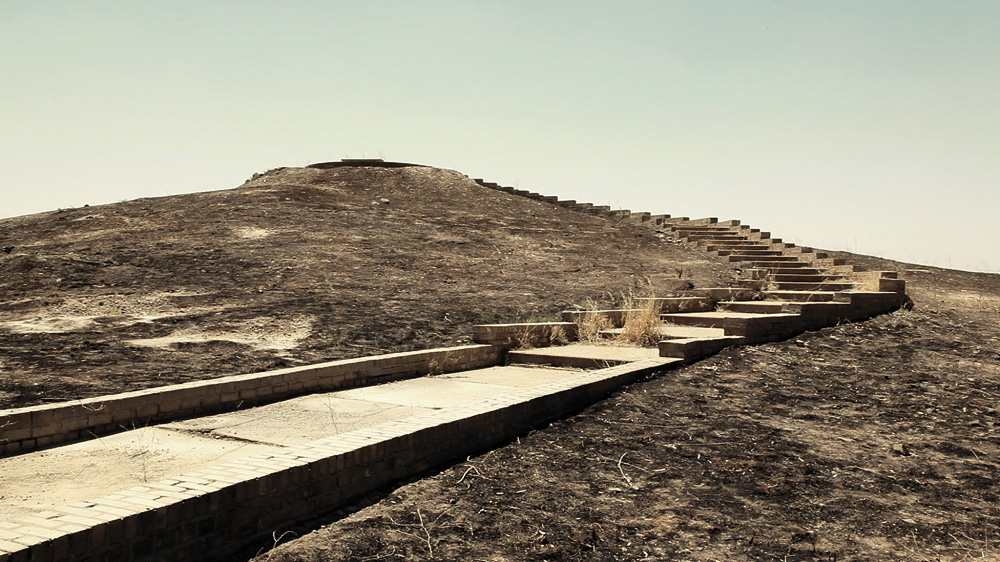
Babel is a drone shot centered on the Ziggurat of Borsippa, which was long considered to be the remains of the Tower of Babel before a more likely location for the edifice was found. Our imaginations have been nourished by the story of Genesis, which popularized this construction as excessive as the pride of the people who built it. It marked mankind’s inability to reach the heavens, despite its efforts to build a monument of unprecedented elevation. And the contemporary situation of Babylon, the cosmopolitan capital of an empire that then covered the entire Near East, was a good illustration of the diversity of languages that was the consequence of the failure of the attempt. In the soundtrack, a composition by Romain Poirier and excerpts from Genesis are translated and read by two artificial intelligence programs (DeepL and ElevenLabs), redefining the permanent link between humanity’s attempts to rebuild – this time virtually – the Tower of Babel through artificial intelligence and transhumanism, and humanity’s constantly renewed errors.
The Middle East, countries that are not internationally recognized, radioactive or forbidden zones considered as “involuntary natural parks” are all territories that Louis-Cyprien Rials has traveled or inhabited. The artist, born in Paris in 1981, uses video and photography to present a silent, sometimes mystical image of these areas marked by past violence or agitated by major conflicts. These moving pictures composed of fixed shots, often long and devoid of human presence, tell of the impossibility of capturing these abandoned and transformed spaces, impregnated with beliefs and strewn with stigmata.
Charles Richardson
Nothing Found
Experimental doc. | hdv | color | 10:54 | United Kingdom | 2013
Nothing Found 2013 ?Nothing Found? takes place in a transition period between Valencia and London, seemingly occupying both places simultaneously in a pensive mood. The spaces in the film interlace and disorientate our perception of time and place and are imbued with a sense of stasis ? an unknown and empty anticipation ? that is quite contradictorily connected throughout by incessant movement. It is a visual study that reveals spectatorship?s impossible empathy, or perhaps spectatorship as a form of innocuous voyeurism. On the other hand, it is a sensitive insight into the impossibility of finding oneself in reflection - as it is in reflection that we find more questions rather than answers.
Charles Richardson is currently studying an MA in Fine Art Media at The Slade School of Art, London. Before studying his MA he lived 8 years in Spain where he did his BA in Malaga and Valencia. He also studied a year in Helsinki at the Aalto school of Innovation. Charles began as a painter and over his BA studies worked in many mediums ranging from performance to photography and sculpture. At the moment he is focusing on video as he finds it the most appropriate for his particular language of thought.
Norman Richter
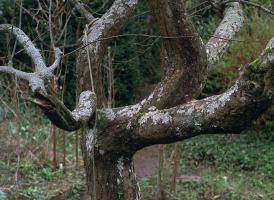
HEIDELBERG
Experimental doc. | 35mm | color | 34:40 | Germany | 2008
Each time he visits his grandmother, the film's author walks slowly into the room and looks at has changed and what has not changed. Each time, he walks into the garden following the small path just at the end of the hill: there, he turns around and looks at the house. The film sequences were shot in March 2007.
Norman Richter was born in 1979. He studied directing at the HFF "Konrad Wolf" in Potsdam-Babelsberg. He works in the area of documentary and experimental film and video art. His films have been preseneted at various international filmfestivals and exhibitions.
Norman Richter
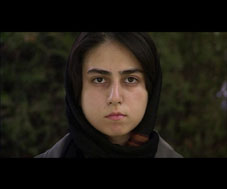
Vali Asr - Juli 2006
Experimental doc. | 0 | color | 13:47 | Germany, Iran | 2007
This film was shot in seven days in July 2006 in Tehran, capital of the Islamic Republic of Iran. The shooting took place on the Vali Asr, the longest and oldest street of Tehran. It runs over 24 kilometres from North to South through the centre of the city, and shows a picture of very different social classes and ideologies. The name "Vali Asr" means "Ruler of Ages" and refers to the Imam Muhammad al-Mahdi. According to the Shiite dogma, Imam Mahdi is the twelfth and last direct successor of the Prophet. It is said he has been living in secrecy for centuries, out of public sight. The Constitution of the Islamic Republic of Iran of 1979 designates the twelfth Imam as the Head of State. The Islamic religious scholars, the Ayatollahs, are only ruling as the Imam's representatives until his return from secrecy. Twelve faces are shown. One personal object is assigned to each of the twelve people, except for the last one, a young girl. The people had these objects with them when they were filmed.
Norman Richter was born in Heide in 1979. He has been studying directing at the "Konrad Wolf" Hochschule für Film und Fernsehen in Potsdam-Babelsberg. He works above all in the area of documentary and experimental film and video art. His film, "Sun in an Empty Room" was shown at the European Media Art Festival in Osnabrück along with "lobenden Erwähnung", from the German Filmkritik collective in the experimental film category. The film "Vali Asr - July 2006" filmed in Tehran was shown during the International Short Film Days in Oberhausen. Norman Richter's works have been exhibited in various international film and media art festivals, including: International Short Film Days, Oberhausen, 2007; European Media Art Festival, Osnabrück, 2005/2007; 25fps - International experimental Film and Video Festival, Zagreb, 2006; and the Ausstellung zum Marler Video-Kunst-Preis, 2006.
Julia Charlotte Richter
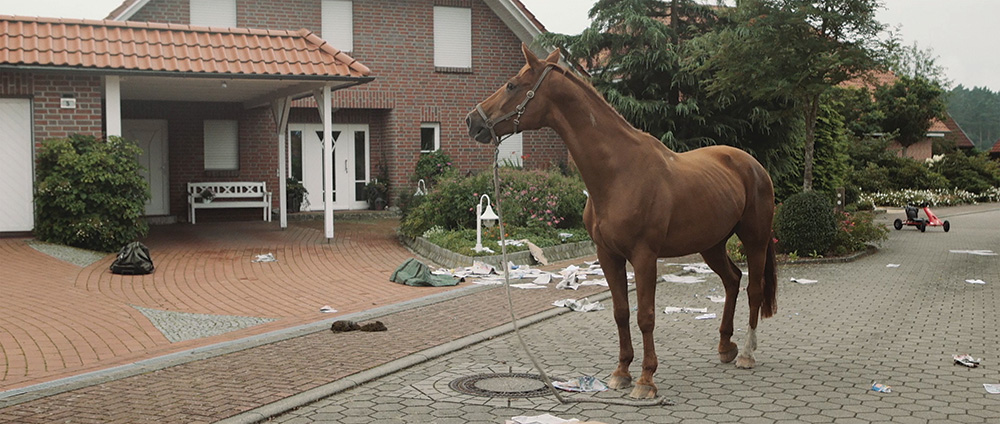
You Are the Center of the World
Experimental fiction | 4k | color | 16:45 | Germany | 2015
“And all, all, all was nice and good” is the last sentence sung by a chorus of middle aged men that opens “You are the Center of the World”. A horse walks around, the hooves clatter in the courtyard of a pretty detached house. The three young men look around, wander through the deserted streets. Finally, they find themselves in a living room and remain in there. All they can do is wait and listen to the silence. Where are all the other people? Out there, something is wrong, for sure. The small town becomes a stage for the three local teenagers, who are looked at by the camera and „act acting“. Explicitly cinematic visual references are created, where the characters move and perform in.
Julia Charlotte Richter (*1982 in Gießen, Germany) is a video artist. She studied Fine Art in Kassel (Germany), Portsmouth (UK) and Braunschweig (Germany). Julia Charlotte Richter’s works have been shown internationally in numerous screenings and exhibitions, including Museum Folkwang Essen, Manege Moscow, Georgian National Museum Tbilisi, Goethe Institute Chicago, Toronto, Ankara etc., Filmfestival “Max-Ophüls- Preis” Saarbrücken and the “B3 Biennial of the Moving Image” Frankfurt. She received different scholarships such as the residency “Young Art in Essen” (Kunstring Folkwang/Kunsthaus Essen) in 2012 or a working grant by the Stiftung Kunstfonds in 2014. Her film “You are the Center of the World” (2015) was funded by the Bösenberg-Foundation. In 2017 she received a project grant by the Kunststiftung NRW as well as a travel grant by the Hessische Kulturstiftung.

Mykola Ridnyi
The Battle over Mazepa
Video | 4k | color | 26:43 | Ukraine | 2023
The Battle Over Mazepa conceptualises the historical significance and contemporary perception of Ivan Mazepa, a political and military leader of the Zaporizhian Sich and Left-bank Ukraine in the late-17th and early-18th century. Addressing codes of hip-hop culture, Ridnyi borrows the popular form of a rap battle to collide two great works of world literature associated with this historical figure: Mazeppa by Lord Byron in 1819 and Poltava by Alexander Pushkin in 1828–29. While Byron envisions Mazepa as a romantic hero, seized by love, Pushkin portrays him as a traitor in accordance with the colonial attitude of the Russian Empire. Highlighting the confrontation of these two texts, Ridnyi invited four rappers from different national and cultural backgrounds to write and perform their response to the poets’ lyrics.
Mykola Ridnyi (born in Kharkiv, Ukraine) is an artist, filmmaker and educator. He lives and works in Berlin where he holds a guest professorship in the Lensbased class at the Berlin University of the Arts (UdK). His works reflect social and political realities by drawing on the contrast between fragility and resilience of individual stories and collective histories. The body of his work created within the last decade address the question of how to talk about violence and war but not multiply its brutality in the visual language. Ridnyi's works has been shown internationally including the Schinkel pavilion, Transmediale and DAAD gallery in Berlin, Albertinum in Dresden, Museum of Modern Art in Warsaw, Bonniers Konsthall in Stockholm, the 56-th Venice Biennale, The Kyiv Biennale and other venues and events.
Janet Riedel, Katja Pratschke, Gusztáv Hámos
FIASKO
Experimental fiction | 35mm | | 30:0 | Germany | 2010
Photographic Essay based on the eponymous novel by Imre Kertész ? Steinig did survive his own death. Stranded at an unfamiliar nameless airport of a big though strangely familiar city, he is looking for a way to ensure his survival in a system which condemns everyone who has not yet lost faith in individuality and freedom.
Janet Riedel (1978) ist Fotografin und Grafikerin. Seit 2003 als freie Fotografin, Redakteurin und Herstellerin für Magazine (Du, corso), Werbeagenturen (JVM, Grabarz & Partner), Verlage (Carlsen, Rowohlt) und Theater (Kampnagel) tätig. Realisierung von Buch- und Ausstellungskonzepten. 2005 Gründung des Netzwerks für Neue Subjektive Fotografie ABSAGE AN DIE WIRKLICHKEIT; dreijährige Ausstellungstour durch Deutschland, nach Sydney, Hanoi. 2004?2007 Aufbaustudium für Visuelle Kommunikation/Medien an der HfBK Hamburg. 2008?2010 entstand der Fotoessayfilm FIASKO nach dem Roman von Imre Kertész in Zusammenarbeit mit Katja Pratschke/Gusztáv Hámos. Gusztáv Hámos (1955) und Katja Pratschke (1967)sind Medienkünstler. Ihre künstlerische Praxis umfasst Arbeiten mit Fotografie, Film, Video, Installation, interaktiven Skulpturen, wie auch die Kuration von Ausstellungen, Symposien, Filmreihen, und die Herausgabe von Publikationen. Aktuelle Ausstellungen und Projektionen: Tate Modern, Arsenal Berlin, Muzéum Ludwig Budapest, ZKM. Seit 2000 experimentieren sie mit dem Stillbild im kinematografischen Kontext - im Kino wie im Ausstellungsraum - untersuchen das Verhältnis von Stillstand und Bewegung. Seit 2006 kuratieren sie die Filmreihe VIVA FOTOFILM, die u.a. im Arsenal Berlin,in der Cinémathèque Quebeocoise Montreal, dem Múzeum Ludwig Budapest und der Tate Modern London zu sehen war. Parallel dazu initiierten und organisierten sie vier Symposien, dessen Ergebnisse in der Publikation »VIVA FOTOFILM bewegt/unbewegt«, 2010 veröffentlicht wurden.
Astrid Rieger, Zeljko VIDOVIC
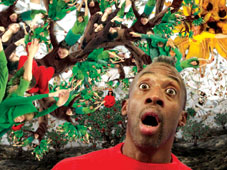
Apple on a tree
Art vidéo | dv | color | 4:50 | Germany | 2006
He`s an apple on a tree, happily dangling among other apples, enjoying the sun and letting the wind caress his body. But there is one thing intriguing him: he wants to find out what it?s like to be a man.
Astrid Rieger was born in 1979 in Kronstadt, Romania. She´s been living in Germany since 1990. In 1999 she started her studies at the Hochschule für Gestaltung (design School) in Offenbach, specializing in "visual communication". She passed her diploma in 2006. Zeljko Vidovic was born in 1975 in Livno (Croatia): He´s been studying at the Hochschule für Gestaltung in Offenbach since 1998.

Elli Rintala
Väylä
Experimental doc. | 16mm | color | 25:5 | Finland | 2008
An oil tanker is navigating along the Gulf of Finland. After the open sea the vessel changes its course towards an oil refinery on the coast. In this passage man, technology and nature confront each other.
Elli Rintala was born in Helsinki, Finland in 1978. She studies documentary directing in University of Art and Design Helsinki, since 2004. She also holds an MA in Film and Television Studies from the University of Turku, Finland. I

Simon Ripoll-hurier
Age of Heroes
Documentary | hdv | color | 18:30 | France | 2020
East of Skopje there is a small quiet square where you can sometimes hear the trace of orchestral music. If you follow these sounds, they lead you into a large studio. The "Film & Music Ensemble" (FAME's project) in Skopje specialises in music for film. The hundred or so musicians, sound engineers, etc., who're part of it come every day to record scores from all over the world. The composers usually attend the sessions by teleconference. On the same day, you can move from a French TV drama to a Bollywood production. Following a smooth-running mechanism, the orchestra continuously produces music to support images and to give them their emotional tones. On the small square next to this large studio, life follows its course in a quiet indifference.
Coming from visual arts and developing a practice on the edge of music, radio and cinema, Simon Ripoll-Hurier (born 1985) tracks down situations of listening. Between 2014 and 2017, he developed Diana, a research project that includes film, video, performance and radio. He is now working on a film connecting today’s Silicon Valley with old CIA parapsychological experiments. His work has been presented in festivals, biennials, museums, galleries, and broadcasted on the radio. He also plays with Les Agamemnonz, an instrumental surf band, and co-founded *DUUU, an artist-run webradio.
Dominik Ritszel
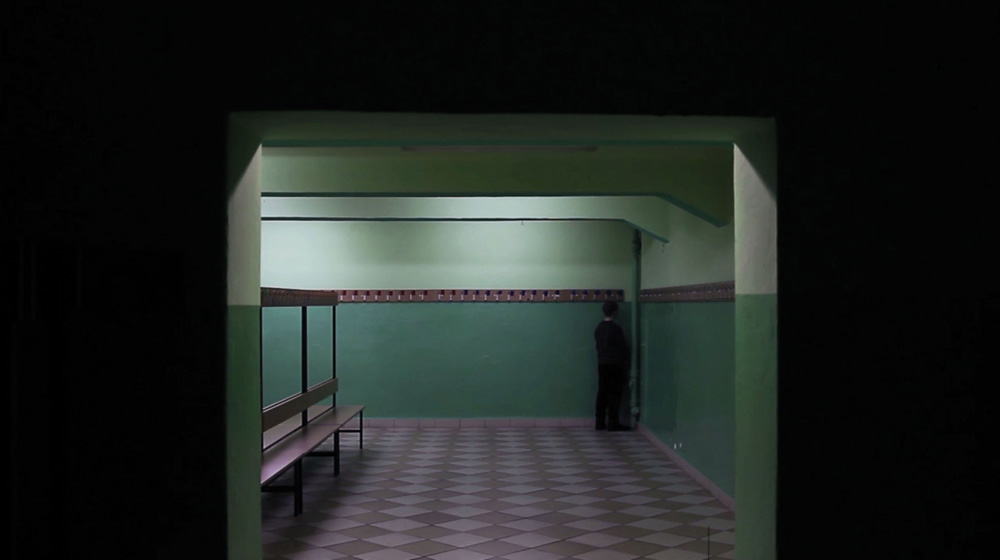
Film o szkole
Experimental fiction | hdv | color | 8:59 | Poland | 2014
The video was recorded in primary school, which I graduated in 2003. This work is inspired by architectural elements in space of the school. I am mainly interested about functionality of certain spaces of the school, for example halls, passages, gyms, dressing room and also how institutional rules and statutes can take a form of game.
Dominik Ritszel was born in 1988 in Rybnik. He studied at the Faculty of Graphics in the Institute of Arts at the University of Silesia in Cieszyn and at the Academy of Fine Arts in Katowice, where he did graphic arts. His works were exhibited, among others, at international video art festivals Les Rencontres Internationales (Gaîté Lyrique, Palais de Tokyo, Paris) and Video Art Review THE 02 Spaces as a tool for shaping social attitudes. He participated in group exhibitions - in the Show Off Section at the Krakow Photomonth Festival (2013), Curators Network in the Museum of Contemporary Art (MOCAK) in Krakow (2012), Mum, I just really need to focus on my art right now in the Arsenał Gallery in Poznan (2012), among others, and in a joint exhibition presenting works of young Silesian artists Mleczne Zęby (Milk Teeth) in the BWA Contemporary Art Gallery in Katowice (2013). He had individual exhibitions in the Centre for Contemporary Arts Kronika in Bytom and in the Silesian Museum in Katowice. He was chosen among the three finalists of the Talenty Trójki 2013 contest in the Visual Arts category, he was short-listed for the Grey House Foundation Prize. In 2014 he was granted the Young Poland Programme scholarship. In spring 2014 as an artist in residence he stayed in the A-I-R Laboratory in the Centre for Contemporary Art Ujazdowski Castle where he produced Versus, showed in Ujazdowski Castle in Bank PEKO Project Room (Warsaw).
Dominik Ritszel
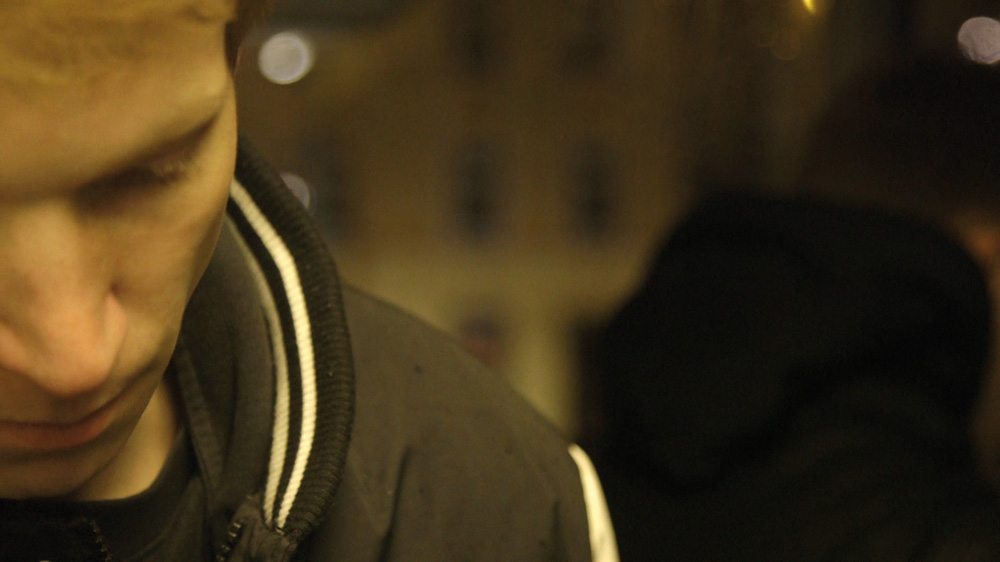
Pogłos
Video | hdv | color | 14:30 | Poland | 2015
Ritszel in his movie Reverb cleans view of audial perception. He introduce the viewer to his laboratory, spread through whole city. Process of the civilization has been reverse and for a moment, receiver gain privilege of sharpen hearing,. Sounds act on the same rules as they act in horror movies. They grow from what is known. They grow stronger and stronger, minute after minute. They become powerful and than they spread. Dynamic of the horror movie shows, that what scarry the most are not perfectly design monsters but minor, accumulative sounds. Creak of slowly opening wordrobe doors,expending floor planks under footsteps, TV which swich on itself, scraping, grating, crashing, and the most, sudden, ominous, dead silent.
Dominik Ritszel was born in 1988 in Rybnik. He studied at the Faculty of Graphics in the Institute of Arts at the University of Silesia in Cieszyn and at the Academy of Fine Arts in Katowice, where he did graphic arts. His works were exhibited, among others, at international video art festivals Les Rencontres Internationales (Gaîté Lyrique, Palais de Tokyo, Paris), Proyector, International Video Art Festival (Spain, Italy, Portugal) and Video Art Review THE 02. He participated in group exhibitions - in the Show Off Section at the Krakow Photomonth Festival (2013), The increased Difficulty od Concretation in Prague (2015), What’s Hidden in National Gallery of Art (2015), Curators Network in the Museum of Contemporary Art (MOCAK) in Krakow (2012), Mum, I just really need to focus on my art right now in the Arsenał Gallery in Poznan (2012), among others, and in a joint exhibition presenting works of young Silesian artists Milk Teeth in the BWA Contemporary Art Gallery in Katowice (2013). He had individual exhibitions in the Centre for Contemporary Arts Kronika in Bytom, in Grey Gallery in Cieszyn, Grey House Gallery in Krakow and in the Silesian Museum in Katowice. He was chosen among the three finalists of the Talenty Trójki 2013 contest in the Visual Arts category, he was short-listed for the Grey House Foundation Prize. In 2014 he was granted the Young Poland Programme scholarship. In spring 2014 as an artist in residence he stayed in the A-I-R Laboratory in the Centre for Contemporary Art Ujazdowski Castle where he produced Versus, showed in Bank Pekao Project Room in Warsaw. In 2015 he participated in group exhibition Waiting for better times Curatorated by Magda Kardasz (Zachęta Project Room, Warsaw). During of the 8th edition of Biennale of Young Artists RYBIE OKO his video Reverb received special award. He has been crowned the 2015 winner of the Young European Artist Trieste Contemporanea Award. His next individual exhibition will take place in Studio Tomaseo (Italy) 26th of March.