Catalogue > Search
Results for : Tout le catalogue
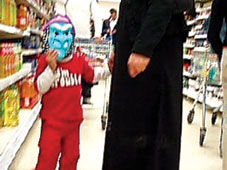
Tessa Garland
Zombie
Experimental video | dv | color | 3:5 | United Kingdom | 2006
"Zombie" is a short film based upon George Romero?s 1960?s cult film "Night of the Living Dead". It is set in the multi-national supermarket Tesco?s. In it, this giant supermarket becomes a backdrop and a film set to a constructed scene that unfolds upon everyday and unsuspecting shoppers in a short and climatic horror sequence. The soundtrack was mixed by Garland and carefully composed from a number of classic horror films to create a generic sound that the viewer immediately identifies with this genre. The film was shot on a mobile phone camera. These low grade resolution images gives "Zombie" its distinctive flickering picture quality and that sense of real-time authenticity. It is because of the barely visible nature of this camera that the film is able to create both a sense of being caught on CCTV cameras and an atmosphere of surveillance. This work explores the idea that our daily experiences are structured through genre and repetition. In the edit the collected film clips have been rhythmically timed to the music. Together the sound and imagery both construct and create a real and imagined situation. Throughout the film this everyday situation unfolds into a space of suspense and foreboding in a consumer and material world. The environment is both comic and disturbing. Garland?s approach to film making examines narrative spaces. In this film the viewer is displaced by the disruption of their placement and perception of the real or unreal, staged or un-staged. It seeks a freedom of construction, a site for play, and an area of experimentation.
Tessa Garland is a practicing visual artist based in London. She has exhibited extensively, in solo and group exhibitions, in the UK and Internationally since 1990. For many years she has been developing and producing installation work that encompasses the moving image. In 2002 she received an Arts Council England major award to develop her work further; it resulted in her producing several interactive digital film installations which were included in well-profiled national exhibitions. Over the past year she has produced a series of short artist films which have been well received, most recently at the Whitechapel Art Gallery in London.
Mariah Garnett
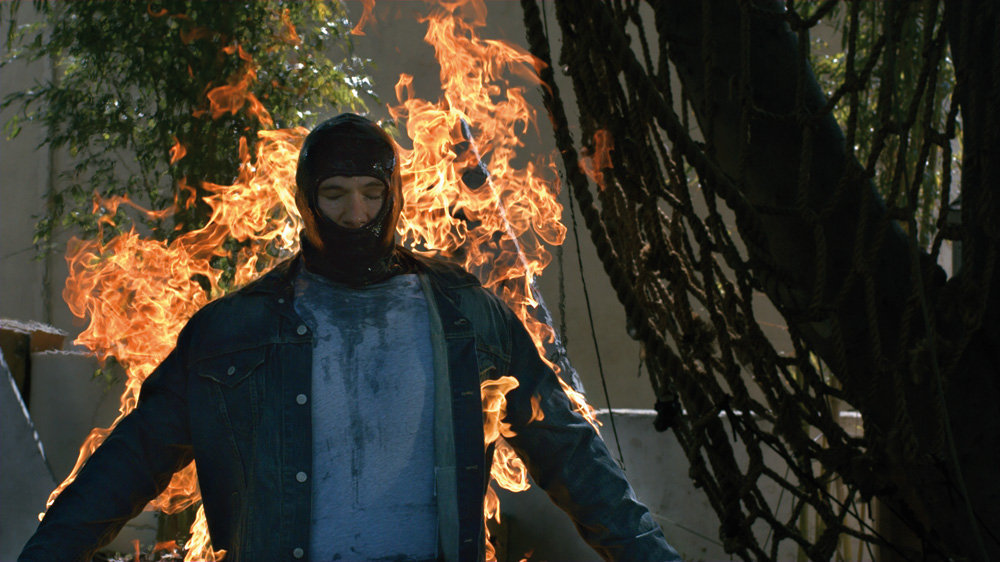
Full Burn
Experimental doc. | hdv | color | 20:0 | USA | 2015
Full Burn (20min, 2014), features U.S. war veterans who have all continued to test the limits of their physical abilities as civilians. Theses veterans, working as Hollywood stunt men, and one as massage therapist, describe relationships to the body, and how their experiences as soldiers have been carried back into their lives now. Named for the stunt restaged in the opening scene of this film, Full Burn pictures an ex-special ops marine set on fire in extreme slow motion, transforming the stunt into a ritualized reenactment of trauma. Full burn serves as a meditation on masculine duty and the emotional stakes of transcending fear. In 2014 it was exhibited as part of the Hammer Muesum`s Los Angeles Biennial, Made in LA, curated by Connie Butler and Michael Ned Holte. It was funded in part by The Hammer Museum and an FCA Emergency Grant.
Mariah Garnett mixes documentary, narrative and experimental filmmaking practices to make work that accesses existing people and communities beyond her immediate experience. Using source material that ranges from found text to iconic gay porn stars, Garnett often inserts herself into the films, creating cinematic allegories that codify and locate identity. Garnett holds an MFA from Calarts in Film/Video and a BA from Brown University in American Civilization. Her work has been screened internationally including: REDCAT (LA), White Columns (NY), SF MoMA (SF), Venice Bienniale (Swiss Off-site Pavillion), Rencontres Internationales (Paris, Madrid, Berlin, Beirut), Midway Contemporary Art (Minneapolis), Ann Arbor Film Festival (Ann Arbor), Kerstin Engholm Galerie (Vienna). In 2016 she has her first institutional solo show at the MAC in Belfast, Northern Ireland and her first solo show at a commercial art gallery in Los Angeles at ltd los angeles. In 2014, she was in residence at The Headlands Center for the Arts in Marin, and featured in Made in LA, the Hammer Museum`s biennial exhibition. The LA Times called her piece "Best in Show." She was awarded the Rema Hort Mann and CCF Emerging artist fellowships in 2014 and 2015.

Mariah Garnett
Garbage, The City, And Death
Experimental video | dv | color | 7:31 | USA | 2010
Garbage, The City, And Death is an eight-minute, single-channel video. It consists of three scenes from a Fassbinder play of the same title, which was banned from the stage in Germany in 1985. My adaptation consists of the scenes between Roma, the prostitute and Franz, her boyfriend/pimp. I play Franz and my half-sister, Joanna Coleman, plays Roma. The couple bickers over money problems, her undying love for him, and his general disgust with her (produced by his latent homosexuality). The film moves from the city, where they are living in their car, to the Salton Sea, to a hot tub in the night. This project was born out of a month-long visit between long-lost sisters who did not grow up together. I use Fassbinder?s text as a means of exploring concepts relating to sibling-hood that do not exist in my actual relationship with my sister. Sibling rivalry is warped here into a lovers? quarrel. As Franz and Roma?s relationship deteriorates, their surroundings become progressively more intangible. They end in a vaccum, engulfed by the blackness of night, as they are drawn hopelessly closer together despite Franz? clear disdain for her and desire to get away from her.
Mariah Garnett, 30, lives and works in Los Angeles and is pursuing her MFA at Calarts in Film/Video. Often using markers from a multitude of genres, Garnett`s work addresses gender and performativity and blurs lines between "fiction" and "reality". She has worked with A.L. Steiner, Zackary Drucker, Peter Berlin, Wu Ingrid Tsang, Stanya Kahn, and Cheryl Dunye. Her work has shown internationally in festivals and galleries (Outfest, Los Angeles Film Festival, Rencontres Internacionales). She graduated with a BA in American Civilization from Brown University in 2003.
Mariah Garnett
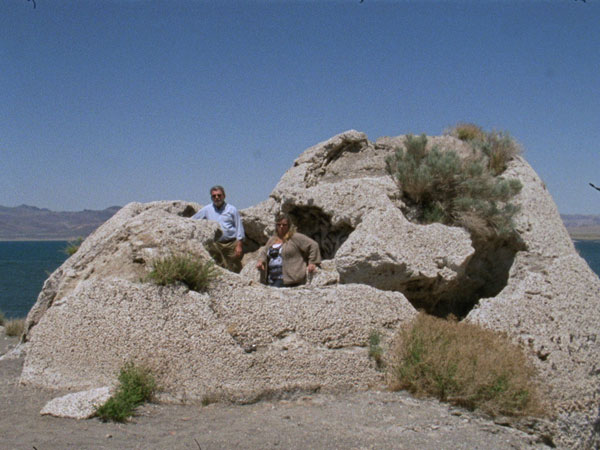
Signal
Experimental film | 16mm | color | 7:0 | USA | 2012
The script for Signal, a 7-minute, 16mm film, attempts to narrativize a collection of spam emails gathered over a 3-year period, and is staged in or near ?sacred spaces?. The landscape of Pyramid Lake, on the Paiute Indian reservation is populated by 10,000-year-old rock formations, many of which are off limits to the public. They loom in the background as characters banter in the sometimes awkward, sometimes solicitous, sometimes nonsensical dialog of spam. The Black Rock Desert Playa, while vacant most of the year, is home to close to 60,000 people annually during Burning Man. These locations were chosen because they act as both mirror and foil for the internet - at once wastelands and gathering sites for millions of people, while maintaining an ancient physicality that transcends any inhabiting group.
Mariah Garnett is an experimental filmmaker and artist living and working in Los Angeles. Her work seeks to occupy a space between convention and experimentation - or, rather, to experiment with convention. The boundaries of adaptation, documentary and fiction are continually being drawn and re-drawn in her work. A big part of her practice involves finding people or thing out in the world to inhabit for a spell. For the most part, these figures are significant, though many times unknown, players in queer history. These twisted homages go so far as to ingest and regurgitate identities to the point where the maker?s motivation is called into question. Garnett holds an MFA from Calarts in Film/Video and a BA from Brown University in American Civilization. Her work has been screened internationally including the following venues: Venice Biennial (Swiss Offsite Pavillion), Rencontres Internationales (Paris, Madrid, Berlin, Beiruit), Outfest (Los Angeles), Midway Contemporary Art (Minneapolis), Mix NYC, Girl Monster (Hamburg). In 2012 she took part in a 2 person show Common Era at ltd los angeles. In 2011 she had a solo show at Human Resources Gallery in Los Angeles titled Encounters I May or May Not Have Had With Peter Berlin and has had work in group shows at Acuna Hansen Gallery (Los Angeles), Montehermoso Cultural Center (Vittoria, Spain) and Workspace Gallery (Los Angeles). She has collaborated with artists Guillermo Gomez-Pena, Zackary Drucker, A.L. Steiner and Chiara Giovando. She is represented by ltd los angeles.
Mariah Garnett, Van BARNES, Zackary DRUCKER, A.L. STEINER
You Will Never, Ever Be A Woman...
Experimental fiction | dv | color | 8:45 | USA | 2008
"You Will Never, Ever Be A Woman...," a video performance, features a conversation between two trans-identified people, Zackary Drucker and Van Barnes. Utilizing a coded language of bitchiness, resistance, and understanding, the syncopated language is as assaultive as it is poetic. Including vernacular "reads," candid dialogue, and improvised conversation, the piece addresses the characters? inter-personal relationship, and their cultural and political positions as ?women.? While performative, the 8 minute video presents an authentic arc of feelings experienced in a romantic relationship; the characters vacillate between love, affection, desire, identification, protectiveness, defensiveness, disdain, contempt, and finally, understanding. Punctuated with hostile antagonism, the piece utilizes a communication technique called ?reading;? a back-and-forth series of insults hurled from one queen to another. When a queen ?reads? a bitch she is demonstrating her wit, her ability to think quickly, and ultimately, her power. Often misperceived by an illegible audience as a genuine attack, ?reading? is a playful sub-cultural exercise of resistance. It is the ability to say and hear the most painful things a person could say, to prepare one for a larger, more dangerous, culture of intolerance. The title of the piece is articulated in the form of a mantra repeated between the characters: ?You will never be a woman. You must live the rest of your days entirely as a man and will only grow more masculine with every passing year. There is no way out.? The phrase acts as both an embrace and a condemnation, an abject acknowledgement of the characters? greatest fear and their potential reality. They are preparing on all fronts. As the characters occupy multiple roles (predators, chasers, exhibitionists, studied academics, nasty sluts looking for equitable romance), they ultimately propose ?kyky love? (trans-on-trans romance) as an alternative to fetishistic objectification. The view is an altogether novel exploration of trans-identity that attempts to subvert traditional documentary and often-exploitative methods of representation. The narrative is about ways of seeing, identity construction, and cultural celebration.
Zackary Drucker is a 25 year-old Los Angeles-based artist. Originally from upstate New York, Drucker holds a MFA from the California Institute of the Arts, and a BFA from the School of Visual Arts. Infusing elements of installation, performance, photography, and video, Drucker?s work has been included in the recent group exhibitions Artstar at Deitch Projects, in New York, Brave New World at Lizabeth Oliveria Gallery, 25 Bold Moves at the House of Campari, Powder Room at Track 16, Summer Guests at Acuna-Hansen Gallery, and has performed at the UCLA Hammer Museum, WILDNESS, and Bitches Rule, all in Los Angeles. Mariah Garnett, 28, is a Los Angeles based filmmaker. Her work often employs the absurd or the grotesque substituting genre-play for gender-play. Ranging from music videos to experimental films, her works have been screened at the Fruit Farm Film Festival (Portland, OR), SiteLA (Los Angeles, CA) Coney Island Film Festival (NYC), MVPA Directors Cuts (Los Angeles, CA) and Movies with Live Soundtracks (Providence, RI). A.L. Steiner uses constructions of photography, video, installation, collaboration, performance and curatorial work as seductive tropes channeled through the sensibility of a cynical queer eco-feminist androgyne. Her work has been featured at Taxter & Spegemann (USA), Centro Cultural Montehermoso (SPN), Tel Aviv Museum of Art (ISR), John Connelly Presents (USA), Contemporary Museum/Baltimore (USA), Nicole Klagsbrun Gallery (USA), The Kitchen (USA), Museo Nacional Centro de Arte Reina Sofía (SP), White Columns (USA), Exit Art (USA), Centre Pompidou (FR), Yvon Lambert/Paris (FR), Derek Eller Gallery (USA), Los Angeles Contemporary Exhibitions (USA), Performance Space 122 (USA), Aspen Museum of Art (USA), Kyoto Museum of Contemporary Art (JPN), Art Cologne (GER) and P.S.1 Contemporary Art Center (USA), among others. Steiner is a collective member of Chicks on Speed, the co-editor/curator of Ridykeulous and collaborates with numerous visual and performing artists. She is an instructor at the School of Visual Arts in New York City and is represented by Taxter & Spengemann, NYC. Van Barnes is an unstoppable tour-de-force, career-woman, model/muse, inspiration source, and flawless beauty. Her life approach seamlessly integrates art and performance into every aspect of daily practice, and her fierce white-girl realness has been documented by Steven Ashmore, Zackary Drucker, Eve Fowler, Adolfo Gallela, Greer Lankton, Gilles Larrain, Thairin Smothers, and John Wellington.
Matthew Garrison
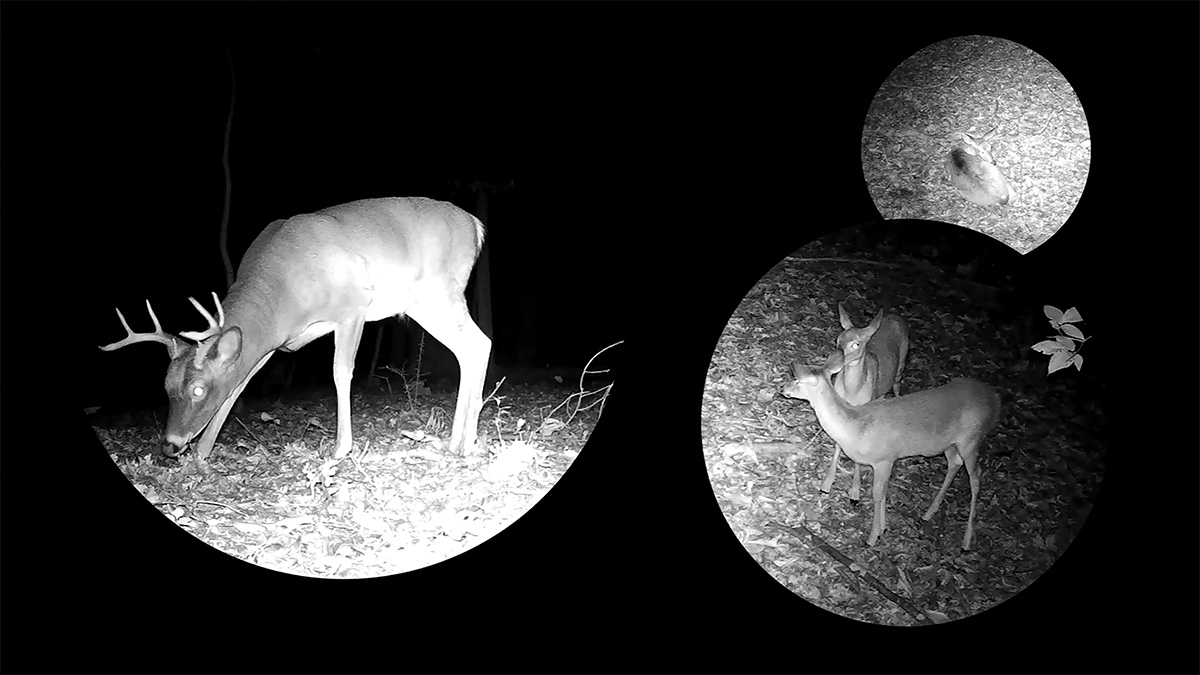
Night Life
Video | hdv | black and white | 14:23 | USA | 2021
"Night Life" provides a glimpse into the behavior of wildlife after dark and serves as a reminder of the unwitting persistence of nature. For this piece a trail camera was moved periodically to capture various angles and shots at night throughout the seasons. The animals (mostly deer) were then framed within circles against a black background and choreographed into compositions that follow their relationships with one another while creating new interactions by compressing a year’s worth of footage into fourteen minutes. "Night Life" is a meditative portal through which a nocturnal world parallel to ours reveals the resolve of its inhabitants within an everchanging environment. In the process, our relationship to the rhythms of nature is linked to personal associations, memories and metaphors.
Matthew Garrison was born in Albany, NY, and grew up in Chicago. After living and working in New York City for eleven years, he moved to Pennsylvania to teach art and technology at Albright College. His work is exhibited and screened internationally including New York City, Korea, India, Panama, Brazil and Singapore. Garrison's art explores a dialog among intimate space, landscape and the environment.

Kuba Garscia
Flora the Movie
Multimedia installation | hdv | color | 4:57 | Poland | 2015
It is install_plantation or instant_plant or augmented plant. It is collection of objects and plants connected with moving mechanisms and multimedia devices like routers, usb hubs, lights, speakers. First, Im composing flora objects. Finding flowers, moss, bark, elements of nature and grow them in unusual pots, together with technology, electricity, lights. The goal is to create co-working life organism from different environments. Then, Im constructing kind of stage or altar from lost and found, DIY, elements, ready made objects, old fashion, destroyed furniture, audio-video recorders, computers etc. Next, Im adding projection mapping on interesting surfaces of composed objects (installation). Fitting animations to situations. Extending installation with another dimension and living structure - projection.
Born in 1988 in Krakow. He has graduated from Intermedia Department at Academy of Fine Arts in Krakow, Poland. Author of many multi-dimensional installations, immersive projects, install_plantations and digital flora. Works in the fields of postproduction, 3D mapping, interaction, objects collection, movement and design. Organizes, exhibitions and audio-visual performances. He marked the beginning of projection mapping movement in Poland and become influential and active person in new media community till now-days. He is trying to connect and explore all of the various codes of visual communication and their ability to process in order to apply them in specific urban spaces and/or exhibitions. Within the flexibility of visual language he creates multi-dimensional contemporary and site specific installations. Currently lives and works in Warsaw. His art was exhibited in galleries, festivals and other special events around Poland, Germany, Czech Republic, Slovakia, Israel, Great Britain, Sweden, Denmark. He is moderating audio visual experiences and animating people around visual art platform and gallery called K105K in Warsaw. He is co-founder of postproduction studio Locomotive.pl and flora and art lovers Project Utopia.
Julie Gasemi, Nicolas DUFRANNE
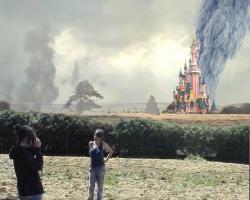
Julie et son modèle
Fiction | dv | color | 2:0 | Belgium | 2007
Ce jour là, la château de la belle au bois dormant était en feu. L`occasion était trop belle pour julie de prendre en photo son joli modèle avec son 24/36. Ce souvenir restera gravé dans son coeur pour l`éternité.
Je suis Julie Gasemi, j`ai 15 ans, je suis née en Belgique.

Julie Gasemi
Traunstein
Experimental fiction | 4k | color | 20:16 | Belgium | 2019
Claire découvre qu’elle apparaît dans un film de mauvaise qualité trouvé sur internet. Elle se voit à la fenêtre de sa maison, accompagnée d’un homme qu’elle ne connaît pas. Ils ont l’air amoureux. Elle décide de partir à la recherche de cet inconnu, vers Traunstein.
Julie Gasemi vit et travaille à Bruxelles. Originaire du Hainaut en Belgique.

Lars Henrik Gass
Oberhausen International Short Film Festival
0 | 0 | | 0:0 | Germany | 2007
Die Kurzfilmtage haben sich im Verlauf von mehr als fünf Jahrzehnten zu einer der angesehensten Filmveranstaltungen der Welt entwickelt - ein Ort, wo FilmemacherInnen und KünstlerInnen wie Martin Scorsese, George Lucas, Roman Polanski, Alexander Kluge oder Werner Herzog, in jüngerer Zeit Ulrike Ottinger, Romuald Karmakar, Pipilotti Rist, Jean-Pierre Jeunet oder François Ozon ihre ersten Filme präsentiert haben. Bis in die Gegenwart hinein konnten die Kurzfilmtage immer wieder Filmemacher auf den Weg bringen und Trends setzen - sei es die frühe Anerkennung von Videos, die Beschäftigung mit Musikvideos, die Reflektion neuer digitaler Formate oder die Offenheit für die Interaktionen zwischen Kunst und kurzer Form. Durch ihre unkonventionelle Sicht des Kurzfilms entzogen die Kurzfilmtage sich immer mit großem Erfolg einer Festlegung auf ein bestimmtes Image, obschon durch das Festival viele politische und ästhetische Entwicklungen angestoßen wurden, wie etwa durch das Oberhausener Manifest, dem vielleicht wichtigsten Gruppendokument des deutschen Films. Durch sorgfältige Programmgestaltung und zukunftsweisende Themenwahl konnten die Kurzfilmtage ihre bemerkenswerte Alleinstellung in einem immer unüberschaubarer werdenden Markt ausbauen. Darüber hinaus konnten die Kurzfilmtage in Kooperation mit ihren Medienpartnern, ARTE, 3sat, Ki.Ka und INTRO dem Kurzfilm neue Zuschauerschichten erschließen. ARTE und 3sat kooperieren für ihre Kurzfilmprogramme seit Jahren mit den Kurzfilmtagen, MTV strahlte im Jahr 2001 insgesamt 25 Kurzfilme aus Programmen der Kurzfilmtage aus.
Lars Henrik Gass est directeur du Festival international du court-métrage d`Oberhausen. Son appréhension du cinéma se singularise par son exigence et son refus de considérer le film comme un bien de consommation. Sa perception de l`?uvre cinématographique en fait un sujet et non pas un objet pour une nouvelle économie consumériste. Le sens de l`?uvre cinématographique n`est pas dans l`image en mouvement dont on peut maîtriser le flux mais dans cet absolument autre qu`elle donne à voir, dans ce qui s`y dit et s`y montre et qui est passible d`ébranler le spectateur au plus profond de lui-même. L`expérience cinématographique doit demeurer une expérience de l`étrangeté.
Andrew Gaston
PURGATORIUM
Experimental video | dv | black and white | 10:10 | Ireland, United Kingdom | 2010
In a pattern matching of sequences, an ever-shifting multi-screen composition creates a momentum of unending suspense. Shadow filled rooms, corridors, doorways and staircases form an inescapable labyrinth of domestic interiors, in which each thread acts as an incomplete story. Unrelenting claustrophobia is contrasted with the continual threat from an unseen world. Is the intruder assassin or saviour? As the shadow persistently tries to visit - there is an absence of any denouement. In a failing chain of communication, the buzz of the intercom, the ring of the telephone, the knock at the door, cannot awake the dreamer.
Andrew Gaston is a video artist and creative director based in London. His art is regularly toured by the Visor Gallery, Valencia and he is currently directing commercials and music videos for some of the UK`s biggest production houses.
Lorenzo Gattorna
Marshy Place Across
Experimental doc. | 16mm | color and b&w | 4:36 | USA | 2012
The title signifies the Native American name for Assateague Island, a national seashore and natural landmark located off the coast of Maryland. A passive bay and pristine beach compose the barriers of this subtle yet stunning passage. Distractions amongst the dunes awaken development of the ecological and departure of the artificial. The film culminates in close proximity to a small band of feral horses that share a common territory and domesticated ancestry.
Lorenzo Gattorna is a filmmaker and programmer originally from New York now residing in Baltimore. He received a BFA from Tisch School of the Arts at NYU in 2007. His short films have screened in exhibitions associated with ARKIPEL, Artsfest Film Festival, Baltimore City Paper, CCNY, Chicago Underground Film Festival, Colour out of Space, EMP Collective, Haverhill Experimental Film Festival, LMAKprojects, Maryland Film Festival, Maysles Cinema, Microscope Gallery, Onion City Experimental Film and Video Festival, Plug Projects, Rencontres Internationales, Sonic Circuits, Spectacle Theater, TULCA Festival of Visual Arts, UnionDocs, Utopia Film Festival, VIDEOMEDEJA and Views from the Avant-Garde at the New York Film Festival. He has programmed screenings for NYC microcinemas Maysles Cinema, Spectacle Theater and UnionDocs as well as Antimatter [Media Art] in Victoria, BC. Recently he received the 2012 Creative Alliance Media Makers` Fellowship for Falling Out and was selected as a Semi-Finalist for the 2013 Janet & Walter Sondheim Artscape Prize for Coupled Vision. Currently Lorenzo is running a roaming monthly screening series in Baltimore called Sight Unseen cofounded by Kate Ewald and Meg Rorison and supported by the 2012 MICA LAB Award.

Bertrand Gauguet
CHANTIER 3 - Pascal Battus-Bertrand Gauguet-Eric La Casa
Experimental doc. | hdv | color | 25:27 | France | 2017
Musiciens, Pascal Battus, Bertrand Gauguet et Eric La Casa engagent des sessions improvisées sur des sites de chantier depuis 2010. Ces sessions ne sont pas destinées à être données devant un public, elles se caractérisent plutôt comme des instants de recherche intuitifs avec le milieu dans lequel ils se trouvent alors. Jouant avec la rumeur des espaces, avec les multiples sons des machines qui tournent, avec les gestes produits par les ouvriers et les paroles entendues, ils suivent une ligne indéfinie qui peut pencher d’un côté ou de l’autre de l’approche acousticienne, psycho-acousticienne, du paysage sonore, de la musique ou encore (mais plus rarement) de l’anthropologie. Ils espèrent ainsi concevoir un dispositif d’attention à partir duquel intervenir. En 2013, ils ont exploré le site de la Philharmonie Cité de la musique à Paris. S’écartant d’une approche documentariste, le film Chantier 3 déplie davantage une cartographie subjective donnant à voir et à entendre des moments de “ présence discrète ”. Ou comment, en ouvrant des interactions avec une architecture en devenir, l’écoute et l’improvisation sont à même de proposer d’autres seuils perceptifs du chantier.
Bertrand Gauguet chemine dans une pratique impliquant sans hiérarchie le sonore et le musical : comme saxophoniste improvisateur, comme compositeur de musique électronique et comme collecteur de sons. Il est engagé depuis 2010 dans une recherche intuitive aux côtés d’Eric La Casa et Pascal Battus en conduisant des sessions improvisées sur des sites de CHANTIER. Ces sessions ne sont pas destinées à être données devant un public, elles se caractérisent plutôt comme des instants d’improvisation avec le milieu dans lequel les trois musiciens se trouvent alors. En 2018, deux albums (Chantier 1 et Chantier 4), un texte (Chantier II) et un film (Chantier III) constituent les marqueurs cartographiques de ce projet.
Stefanie Gaus, Volker SATTEL
Beyond Metabolism
Experimental doc. | hdv | color | 40:0 | Germany | 2014
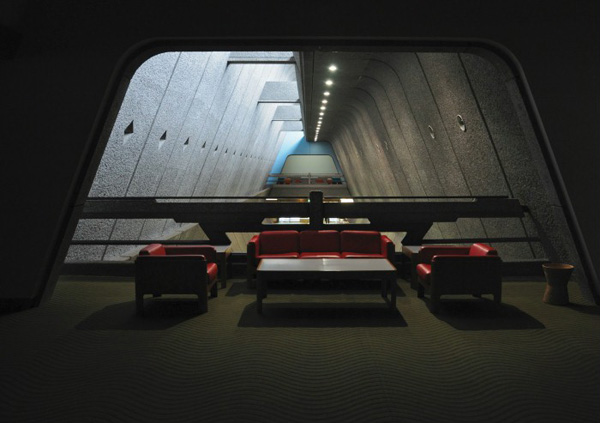
First triangles, then hexagons, the hexagon as the geometric DNA of an erratic architectural structure with an eerie lack of scale. Slowly, in the succession of hallways, apertures, views, and spaces, an enormous construction is disclosed. Already in its first images, Beyond Metabolism conveys a fascination for an utopia of architecture that imagines life in future societies in flexible, large structures, expandable at will. We find ourselves in the interior of the International Conference Center in Kyoto, which was built in 1966 by the Japanese architect Sachio Otani, a student of the famous Kenzo Tange. Fragments of documentary archive material recall what may be the most significant event ever to occur at this place, the 1997 World Climate Change Conference. What remains in the memory is Al Gore, environmental activist and filmmaker, who almost become the American president. The heart of the film, however, is made up of interviews conducted in situ and observations on the preparations and operations of such conferences. For instance, a simultaneous interpreter with a peaceful voice remembers the difficulties of that huge environmental conference with participants and observers from over 158 countries. She had accompanied the course of the meeting in small booths hidden in the walls, equipped with hexagonal windows. The conference ended with the decision on the first and to date only treaty under international law on climate protection, the so-called Kyoto Protocol. Otani died in 2013 at the age of 89. The spiritual optimism of his generation has gotten lost. Calm, clear shots finally show the building from the outside, harmoniously integrated despite its monumental size into a landscape that couldn't be more ideal. (Maria Morais/Thorsten Klooster)
The filmmaker Stefanie Gaus studied at Academy of Media Arts in Cologne. Her interest in poltical and socio-cultural impacts, also seen as matter of representation, and her distinctive view on architectural dimensions, are already evoked in her essayistic documentary End of an Elephant (2006) or Laufhaus (2006), both works shown at many international film festivals including Visions Du Réel, Nyon, Kurzfilmtage Oberhausen, Vancouver International Film Festival or Duisburger Filmwoche. She is currently teaching at the University of the Arts, Berlin. Volker Sattel is a filmmaker, writer, and cameraman who studied at Baden-Württemberg Film Academy in Ludwigsburg. He has made various films, which have been shown at festivals, on television and in exhibition spaces, eg. Unternehmen Paradise (2003) or the documentary Unter Kontrolle ? Eine Archäologie der Atomkraft (2011), premiered at the Forum of the Berlinale, followed by many festivals worldwide and winning several prices. He also collaborated on projects with the artist Olaf Nicaolai and Daniela Klein, musician Tim Elzer (don't dolby/Cologne) and author Mario Mentrup/ on several experimental features, or lately with Stephan Geene (b-books) doing cameraworks for Umsonst (2014). Their common work "Beyond Metabolism" was developed and shot during a residency at Villa Kamogawa, Goethe Institut Kyoto in 2013. They both work and live in Berlin.
Jakob Gautel
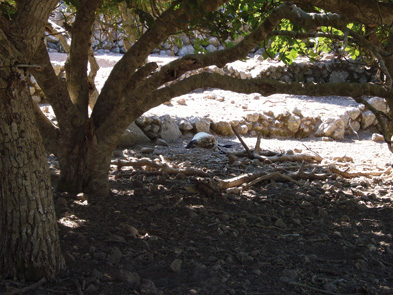
Et in Arcadia ego
Video | super8 | color | 5:24 | Germany, Greece | 2011
Et in Arcadia ego Video, filmed on a Greek island, Summer 2011 "Et in Arcadia ego" - The literal word-for-word translation of the Latin phrase is "I too (was there) in Arcadia". It is usually interpreted as a memento mori. It most famously appears as the title of two paintings by Nicolas Poussin (1594-1665).
Jakob Gautel, born in 1965 in Karlsruhe, Germany, lives and works in Paris, although not exclusively. He works with photography, video, installation, projections, books, work in public space etc. His principal concern, and one which is visible throughout his work, is not a specific subject or technique, but rather an ongoing research into the narrow line between reality and fiction, between the world of appearances and what is hidden, between being and seeming, between the exterior and the interior. For more information : jakob.gautel.net
Jakob Gautel
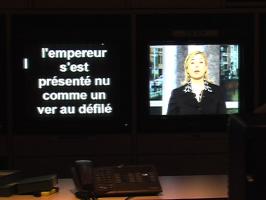
Flash Info (Les habits neufs de l'empereur)
Experimental fiction | dv | color | 1:12 | Germany, France | 2008
More than 170 years ago, Hans Christian Andersen wrote ?The Emperor?s new clothes?, a tale which is universally known today. It is question of vanity, power, deception, manipulation and truth. This tale was already based on an older version from Juan Manuel: ?El Conde de Lucanor?, from 1335. The author puts the question of the effect such a history could produce nowadays, retransmitted by our media. Thanks to the complicity of ARTE, he tried to answer it.
Jakob Gautel, born in 1965 in Karlsruhe, studied in Paris at the École Nationale Supérieure of Art. He soon starts to exhibit, in France and abroad, and to try out forms of art out of agreed spaces. He takes part in exhibits in galleries, museums and art centers, as well as in artistic spaces and associations, he takes part in urban projects and seeking to redefine his relationship as an artist with his public. He carries out works of art in public spaces, with the help of others artists (in particular Jason Karaïndros, and the choreographer Sandra Martinez) and craftsmen. He left, between 1995 and 1997, he spent six months in Indonesian, looking for his grandmother, and 1999 to 2000 the Médicis Villa in Rome (Italy). He works with drawing, photographs, video projections, editing, books, etc, choosing each time the most appropriate technique for his subject.
Jakob Gautel
Ville nouvelle ?
Experimental doc. | dv | color | 23:13 | Germany, France | 2010
New Town ? Video installation, Jakob Gautel 2010 An urban intervention for the artis?cité programme, coordinated by ?Le 19?, the regional contemporary art centre of Montbéliard. Cultural project, part of the ANRU urban restructuring programme, led by the Communauté d?Agglomération du Pays de Montbéliard, with support from the City of Valentigney. In 1961, Philippe Bardinet produced a film commissioned by Peugeot, about the new Les Buis area, a model town in Valentigney, near Montbéliard, built to house the thousands of new workers and employees arriving from Italy, Spain or Algeria to work at the Peugeot factory in Sochaux. Though this film was a commission, it asked questions about the real nature of that kind of housing project that are still pertinent today: « Will the children and parents manage to adapt to such new conditions ? Is it just a housing project or a real town ? » « But man needs more than just to sleep and to eat. He needs ? He needs ? ». It questions the younger generation?s position, integration, the role played by commerce, and has great cinematographic qualities. In the meantime the area has changed a lot. The population has diminished, unemployment has increased, and there is a danger of ghettoisation. The Ideal City of 1961 seems distant. 50 years on, for the area?s anniversary, I produced a « mirror-film », to be projected opposite the original film, opposing the former imageswith those of today, showing run-down buildings or those about to be demolished, closed shops, b also the social life in the area, the children and youngsters, and images of spectators watching the film during the three public projections organised by the social and cultural service MJC. These projections were followed by discussions, mediated by Guy Vandeneeckhoute. Special thanks to Maxime Fraissinet for his precious assistance.
Jakob Gautel, born in 1965 in Karlsruhe, Germany, came to Paris to study at the Ecole nationale supérieure des Beaux-Arts, where he worked on drawing, graphic arts, photography and installation with Christian Boltanski. He lives and works in Paris, although not exclusively. Very soon he began to show his work in France as well as internationally, and to experiment with art forms outside traditional art spaces : posters, actions, perfomances, interventions ? He has participated in numerous exhibitions in galleries and art centres as well as artist-run and collective spaces, and has participated in international art biennials in France, and elsewhere. He has created actions within urban settings, interventions within cities and local areas, and worked on projects or interventions attempting to redefine the relationship between artist and public. He has also worked with stage directors and choreographers, and on projects with children. He produced works of art in public spaces and for commissions, collaborating with artisans, and then, from 1995 to 1997, left to Indonesia for six months, and from 1999 to 2000 to the Villa Medici in Rome. In 2008 he was nominated Chevalier de l?ordre des Arts et des Lettres. He works with photography, video, installation, projections, books etc., each time choosing the most appropriate technique for his subject. His principal concern, and one which is visible throughout his work, is not a specific subject or technique, but rather an ongoing research into the narrow line between reality and fiction, between the world of appearances and what is hidden, between being and seeming, between the exterior and the interior. Since 2001 he has also taught at architectural schools, first in Versailles, and now at la Villette in Paris, on undergraduate and postgraduate courses, with lectures on ?Art, Scenography and Architecture?.

Philippe-aubert Gauthier, Tanya St-Pierre
La production fantôme
Video | hdv | color | 4:0 | Canada | 2016
"La production fantôme - The Phantom Production" is a video-based piece presented as a diptych. A double screen shows simultaneously a real filmed video and a synthetic video. Inspired by the cultural idea of photorealism (how markers or signs of camera increase the realism of synthetic images), it is the camera movement that is here investigated as a specific cultural sign of photorealism. With this diptych piece, the tension between the filmed sequences and the synthetically generated sequences proposes an interrupted cinematographic production workflow, leaving this open work as an entrance to a cultural and critical reflection on photorealism in the digital age.
Philippe-Aubert Gauthier is a sound and digital artist, junior mechanical engineer and a researcher in acoustics (spatial sound reproduction). He holds an MSc and PhD in acoustics, and is currently a researcher for the Groupe d'Acoustique de l'Université de Sherbrooke (Canada). His artist's statement is at the crossroads of the arts, sciences, technology and culture. Gauthier has received grants from the Canada Council for the Arts, Conseil des arts et des lettres du Québec, Natural Sciences and Engineering Research Council of Canada, Fonds de Recherche Nature et Technologie Québec and other organizations. Tanya St-Pierre is a Graduate in visual arts from UQTR (Université du Québec, Trois-Rivières, Qc, Canada). Native of Gatineau (Québec, Canada), she currently lives and works at Sherbrooke City (Qc, Canada). St-Pierre's work have been supported by the CALQ and was shown in divers contexts in Canada, United States, Mexico, Morocco and in the United Kingdom. Also member of the performance duet NOÏZEFER CWU, since 2004, she participated in divers performance art and experimental music events.

Philippe-aubert Gauthier, Tanya St-Pierre
Dans une sorte de rêve éveillé - L'invitation
Experimental film | 4k | color | 75:0 | Canada | 2023
"Dans une sorte de rêve éveillé - L'invitation" is a computer-generated animation about the domestication of nature in our homes, based on Tanya St-Pierre's handmade collages. The starting point for the project was the desire to transpose St-Pierre's handmade collage practice into computer-generated images, but not only by integrating collages into 3D scenes, but rather by approaching collage work as a method for creating 3D environments. The first influence for this work was the collage series "Espaces intérieurs" (2019 -2020): a reflection on the theatricality of nature in the interior spaces of our daily lives. The origin of this series of over 150 collages lies in the discovery of a stack of interior design magazines published in the 70s and 80s. To these magazine pages are added a few fragments of gardening magazines from the '80s, The Space Issue (National Geographic Society, 2017), the book En El Espacio (Time Life Editions, 1984) and the illustrated dictionary Natural Wonders of the World (Reader's Digest Selection, 1977). A strong feature in these interior design magazines was this constant narrative tension between the elements of nature and domestic, controlled, organized interior spaces. This series of collages takes an archaeological and architectural look at a theatrical era of interior decoration. An era that seems to desire the domestication of these natural elements through their representation in our homes. Like an attempt to convince ourselves that we dominate and possess these natural elements. An attempt that exposes an almost unresolved fictional tension between, on the one hand, the modern comforts constructed and edified by the thundering economy and, on the other, the muted threat of nature, the changing climate and their implied cataclysmic forces. ? ?
Tanya St-Pierre is a Graduate in visual arts from UQTR (Université du Québec à Trois-Rivières, Qc, Canada). Philippe-Aubert Gauthier is a digital and sound artist, musician, engineer, Ph.D. in acoustics, and a professor at the School of Visual and Media Arts at UQÀM. Both artists presently work and live in Montréal Québec, Canada. Each artists have a solo practice but they also combine their specializations for large-scale visual and sound installations. Gauthier and St-Pierre have been working as a duo since 2003. Their respective interests are addressed in exchanges that lead to hybrid artistic proposals, results of self-critical contests and inventions in tandem. Works have been supported by the CALQ and CAC and shown in divers contexts in Canada, the United States, Maroc, Mexico, United Kingdom, Germany, France and Japan.
Fabienne Gautier
Night Walk
Experimental video | super8 | color | 6:55 | France | 2004
A spontaneous walk through Paris at night.
Fabienne Gautier is an artist who lives in Paris. She works with several forms of media, such as photography, video, and film. Born in 1967, she graduated with a degree in Fine Arts in 1991 in Dijon, France. She collaborated with Tom Jarmusch on several projects. Her work has been exhibited internationally: in the new Museum of Contemporary Art NYC, The Kitchen NYC, Locarno, Rotterdam, Clermont-Ferrand Videoformes, Media City Canada, Rencontres Internationales Paris/Berlin, Revelation Perth Australia, and the New York underground festivals, among many others.
Maria Del Pilar Gavilanes
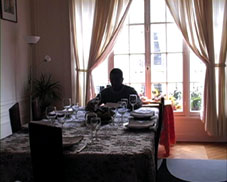
de sol a sol
Documentary | dv | color | 18:43 | Ecuador | 2004
The video diptych de "sol a sol" builds up the portrait of Antonio Preciado, an Ecuadorian poet. His poetry is strongly related to his country and more particularly to his birthplace, Esmeraldas. In 2003, he was the ambassador of Ecuador in Paris. This video tells the story of somebody who is displaced, of an individual living away from his habitual context. Landscapes of his city Esmeraldas are shown on the left screen, while the right screen presents fragments of an interview carried out in his Parisian residence. The images bring closer two spaces of life of a same man. A broader context takes shape through the specificity of an individual: the history of the black community of his city Esmeraldas and his experience as ambassador representing his country in France, may be perceived through Antonio Preciado's story, told with images of his private life, the account of his childhood and his becoming poet.
I was born in Quito, Ecuador. I have lived in France for 8 years and I speak French, English and of course Spanish. I studied at the School of Art at the Central University of Ecuador and also at the Higher Institute of Art at The Havana, Cuba. I continued my studies at the Higher National School of Arts of Cergy-Paris, where I obtained the DNSEP with the congratulations of the jury. I took part last year in the program of the Post-diploma at the National School of Fine Arts of Lyon and I currently carry out a Master at the UFR Arts, Philosophy and Aesthetics at the University Paris VIII.