Catalogue > Search
Results for : Tout le catalogue
Mónica Martins Nunes
Na cinza fica calor (The Ashes Remain Warm)
Experimental doc. | hdv | color | 20:52 | Portugal, Cape Verde | 2016
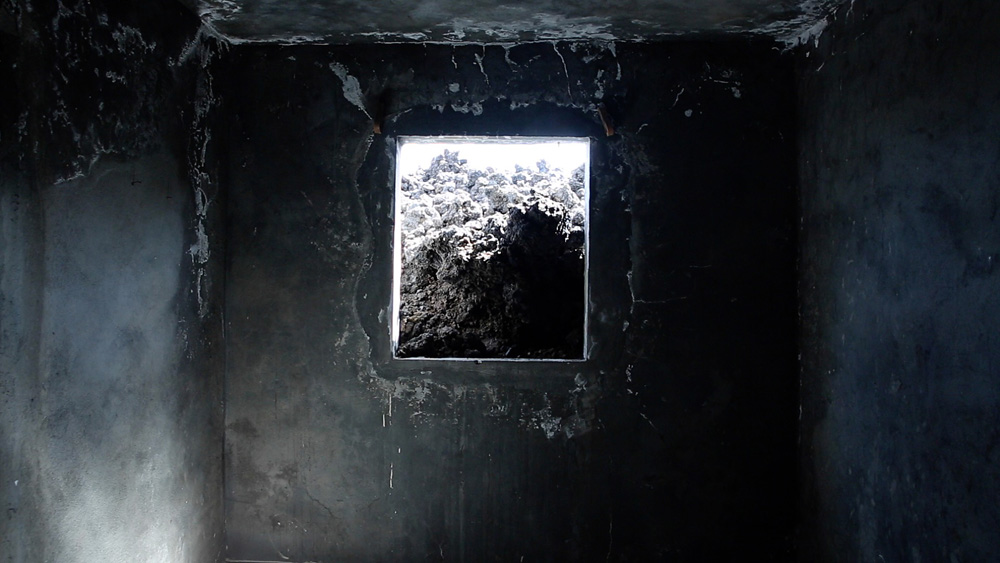
“ Every morning when I go out of the door, he is the first one I see. He is the first to tell me good morning. ” “ He is a father. Although he is destroying us, he does not kill us. ” The villages of “ Chã das Caldeiras ” lie inside the caldera of the “ Pico do Fogo ” volcano in Cabo Verde. After losing everything they own on the last eruption, its inhabitants are forced to reconstruct their lives. A subjective visual tale on real loss, a symbiotic relationship and the possibility of the eternal return.
Monica Martins Nunes (1990, Lisbon) is a portuguese visual artist living and working in Berlin. After studying Sculpture in Faculdade de Belas-Artes - Lisbon University, she graduated in Fine Arts from the Universitat der Künste Berlin. In 2016 she became a Meisterschüler in the same institution and was subsequently awarded the Elsa-Neumann-Stipendium from the city of Berlin. "The Ashes Remain Warm" is her first moving image work and won the Golden Dove - International Competition Short Documentary at DOK Leipzig 2017.

Gohar Martirosyan
The Mount A
Animation | 4k | color | 8:35 | Armenia, France | 2024
A dialogue between Mount Ararat and René Daumal's Mount Analogue contemplates the paradox of their visible yet unreachable presence as inland mountains. It reflects on how mountains, serve not only as physical landmarks but also as metaphysical constructs that shape our sense of self. Through this lens, the boundaries between personal biography and geography dissolve, revealing the intricate ways in which our identities are intertwined with the landscapes we inhabit. Mount Ararat, its 5,137-meter volcanic peak visible on the horizon, stands as a poignant symbol—permanently in sight, yet inaccessible due to the intractable forces of geopolitical struggle.
In her filmic practice, Gohar Martirosyan investigates the complex interplay of influences that contribute to the formation of an individual or identity, whether these influences arise from historical events, cultural practices, social ties, or relationships with various forms of life. Through the use of archival footage and technological processes, her video installation facilitates a dialogue between once-inhabited, now inaccessible geographies, which are deeply connected to the artist's own biography. Gohar studied at Le Fresnoy, was born in Gyumri (Armenia), and is currently based in Paris.

Miriam Martín
La espada me la ha regalado
Experimental doc. | hdv | color | 18:6 | Spain | 2019
The Casa de Campo is one of the largest public parks in the world, a real forest. For centuries it was only for kings and queens, a royal forest. In the images, its 2019: the green of the earth shining anew for us or the remains of trenches as if asleep or the children's unexpected use of bridges and ponds. In the sounds, its 1936, the forest torn in two, the defence of Madrid: "buzzes and explosions, clattering of machine guns, dry crackling of rifles" or the artillery fire that massacred the city from the hills or the words of those who invented a revolution and a taste for good life in the midst of all that turmoil.
Miriam Martín has dedicated her entire adult life and part of the previous one to cinema. First as a spectator, then as a programmer in several institutions. And organizing, from November 2012 to July 2018, the Chantal film club, a weekly aesthetic and political experiment.
Lukas Marxt, Marcel Odenbach
Fishing Is Not Done on Tuesdays
Video | hdv | color | 15:0 | Austria, Ghana | 2017
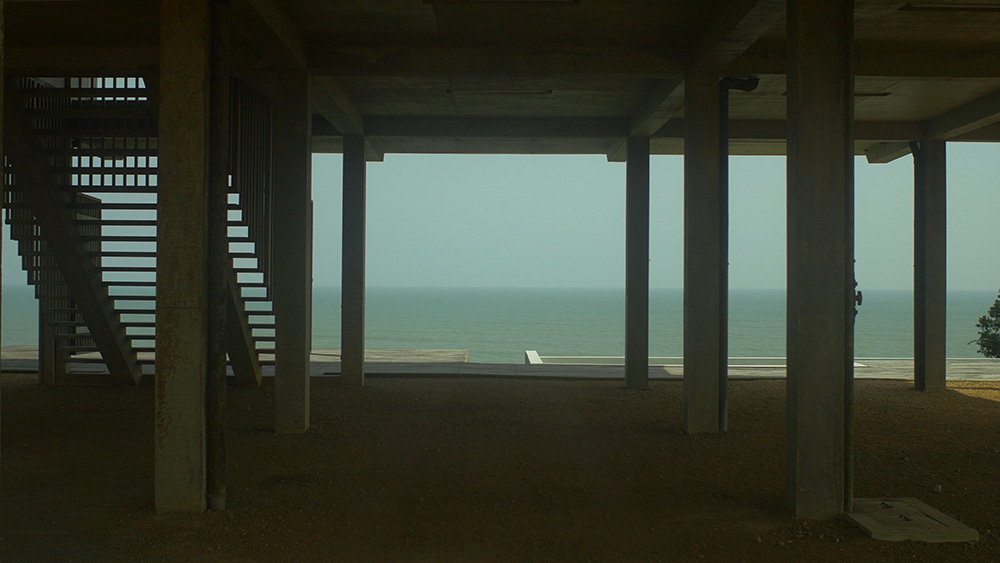
Landscape is a question of distance. Patterns and formations become recognizable from a distance revealing the landscape as a fabrication, a result of natural and historical movements. Fishing is not done on Tuesdays takes variously distanced, moving and focused looks at a location on the coast of Ghana. The first building block of a grid that threads its way through the entire film is indicated by a rotating bird´s eye view of a densely woven canopy of trees intersected by an uneven wall. The vertigo of this circular motion shifts into a gradual glide along untreated cement pylons. Their verticality intersects with the horizon line visible in the distance, to be ruptured only by the turbulence of approaching waves. Constructed lines produce visual axes and visual slits, dividing and lending rhythm to an apparently wild growth of abundant vegetation. These lines and grids do not divide the interior and exterior but rather create openings and passageways. Over and over again views are seen that refute these clear geometries, vibrating and unstable, brought near by binoculars but at the same time strangely far removed. Fisherman on their boats, at prayer before the workday begins; two boys with toy guns in search of an invisible adversary. Smoke condenses; silhouettes become blurred. Are these everyday scenes or the distant echoes of disturbing memories? There is no fishing on Tuesdays. Loudspeaker systems are the domain of Christian agitators on Sundays. The everyday rhythms of this place are overlaid with the drumming of rotors, the swelling and waning of music and the ocean. Their intersection is marked by this house on stilts, this perch from which an interior grid merges with the exterior as landscape. (Katrin Mundt)
Born in the Steiermark region of Austria in 1983, he studied geography and environmental system sciences in Graz until 2004. He then switched to audiovisual design at the University of Art and Design Linz. From 2007 to 2008 he studied art and multimedia at the Faculdade de Belas-Artes in Lisbon, Portugal. In 2009 he took up a postgraduate degree at the Academy of Media Arts Cologne and a masters at the Academy of Fine Arts (HGB) in Leipzig. Following the short film Fishing is not done on Tuesdays, co-directed with Marcel Odenbach, this marks the second outing for their collaborative work in competition in the Berlinale Shorts. He lives and works in Cologne and Vienna.
Lukas Marxt
Nella Fantasia
Experimental doc. | hdv | color | 55:0 | Austria, Norway | 2012
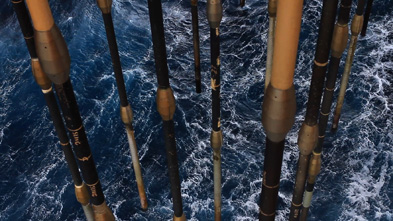
Nella Fantasia was created in December 2011 on the offshore oil rig Snorre A situated in the middle of the North Sea off the coast of Norway. After successfully passing a number of health tests and safety trainings, Lukas Marxt travelled to the platform and spent around 10 days collecting visual and acoustic impressions amid the loneliness of wind storms and huge waves. The result is a visual description of the oil rig microcosm which does not focus on technical processes and ongoing work on the platform but, instead, attempts to create a location which excludes obvious associations of the surroundings such as corridors, curtains, the horizon, the lapping of waves and a melancholic sigh at the end of a shift. The quiet and long shots of the film form a sort of inner monologue which the viewer can feel and experience - disconnecting people and machine. "Nella Fantasia" lasts roughly 55 minutes and is part documentary and part experimental art film.

Lukas Marxt
Valley Pride
Video | 4k | color | 12:51 | Austria, USA | 2023
The seemingly extraterrestrial camera eye floats upside down through a palm grove planted in a strictly rectilinear manner. Nature is literally upside down and existing in an artificial order as a business game. Only at the crescendo of the strange, vibrantly smoldering soundtrack by Jung an Tagen does the gaze slowly turn clockwise. Then, cut: quietness, open space. At some point the logo “Valley Pride” can be read in the middle of the California desert, on oversized corrugated iron sheets, designating one of the most important commercial areas of US industrial agriculture. It’s an inhospitable place, whose increasingly bizarre unnaturalness is conveyed through Lukas Marxt’s unmistakable approach. Visually stunning, the monocultural agrarian symmetry and its ballet of irrigation testify to man’s self-extinction in the service of constant profit orientation – even if the necessarily anonymous workers return to the picture in this, Marxt’s fourth visual examination of the Imperial Valley. Under the sword of Damocles of unclear residence status and a US immigration policy that ranges from rigid to ignorant, the personal destinies and stories behind them must remain untold. The people are the smallest cog in the wheel of work in the gigantic agricultural machine trimmed for optimization, as it buries ecological and ethical standards under the relentless shoveling and plowing equipment. In front of endless rock formations and dancing mirages caused by the heat, they fertilize, harvest, and pack lettuce in a quasi-automated routine. In near-astonishment, the camera eye observes this hustle and bustle as it occurs in a leafy place where no greenery was intended. This is a place where fertility and death collide mercilessly and the threatening catastrophe – social, economic, ecological – is inscribed in every image, no matter how innocent. Here, beauty meets decay and exploitation as a man-made dystopia. That, too, is Valley Pride – a pride with an expiration date. (Sebastian Höglinger)
Lukas Marxt (*1983, Austria) is an artist and a filmmaker living and working between Cologne and Graz. Marxt´s interest in the dialogue between human and geological existence, and the impact of man upon nature was first explored in his studies of Geography and Environmental Science at the University of Graz, and was further developed through his audio visual studies at the Art University in Linz. He received his MFA from the Academy of Media Arts Cologne, and attended the postgraduate programme at the Academy of Fine Arts Leipzig. Marxt has been sharing his research in the visual art environment as well as in the cinema context. His works have been featured in numerous solo and group exhibitions, most recently at the Torrance Art Museum (Los Angeles, 2018), at The Biennial of Painting, Museum Dhondt-Dhaenens (Belgium, 2018), and at the Museum of Modern and Contemporary Art Rijeka (Croatia, 2018). His films have been presented in numerous International Film Festivals including Berlinale (Germany, 2017 and 2018), Curtas Vila do Conde (Portugal, 2018), and the Gijón International Film Festival where he receiced the Principado de Asturias prize for the best short film (Spain, 2018). Since 2017, Marxt has spent a considerable amount of time in Southern California, where he has researched the ecological and socio-political structures surrounding the Salton Sea.
Lukas Marxt, Vanja Smiljanic
AMONG THE PALMS THE BOMB or: Looking for reflections in the toxic field of plenty
Experimental doc. | mov | color | 85:0 | Austria, Germany | 2024
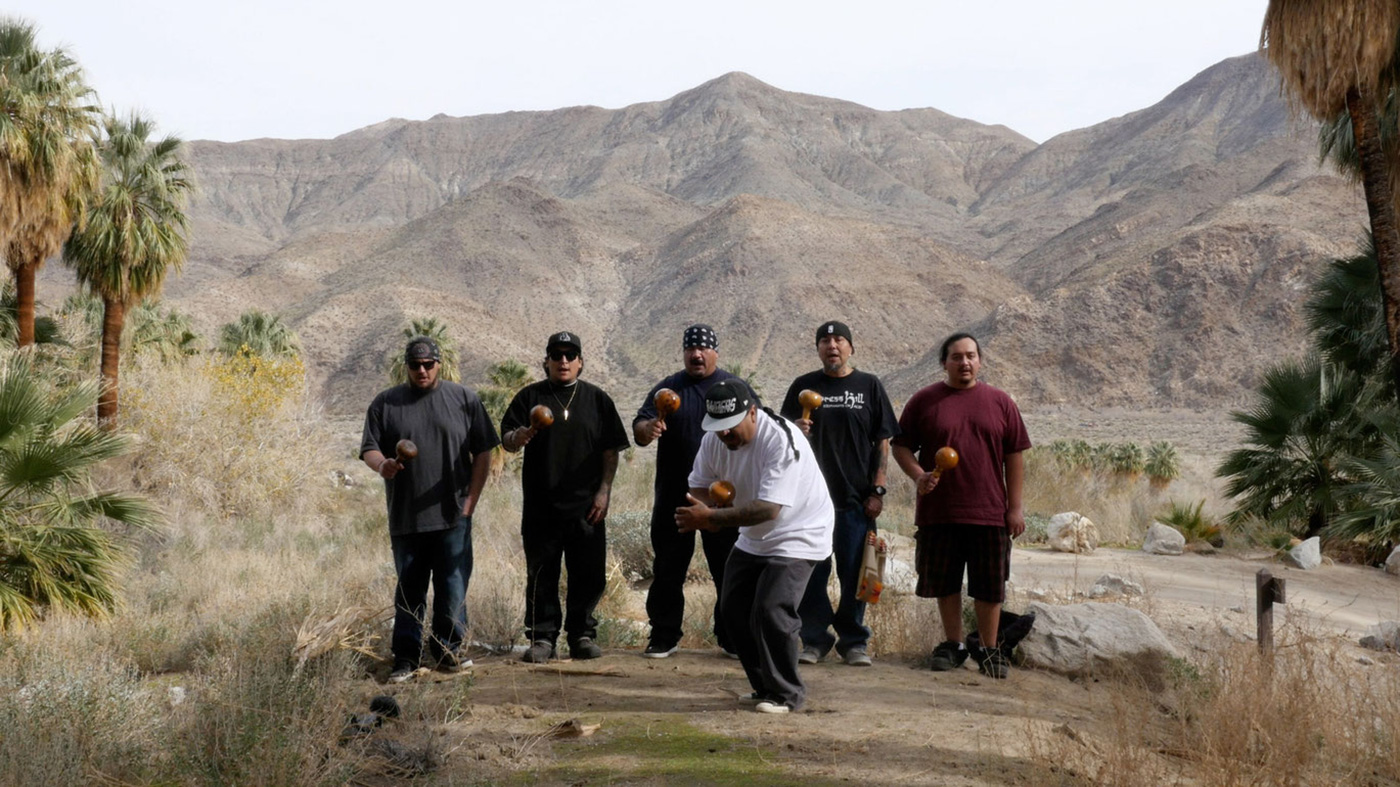
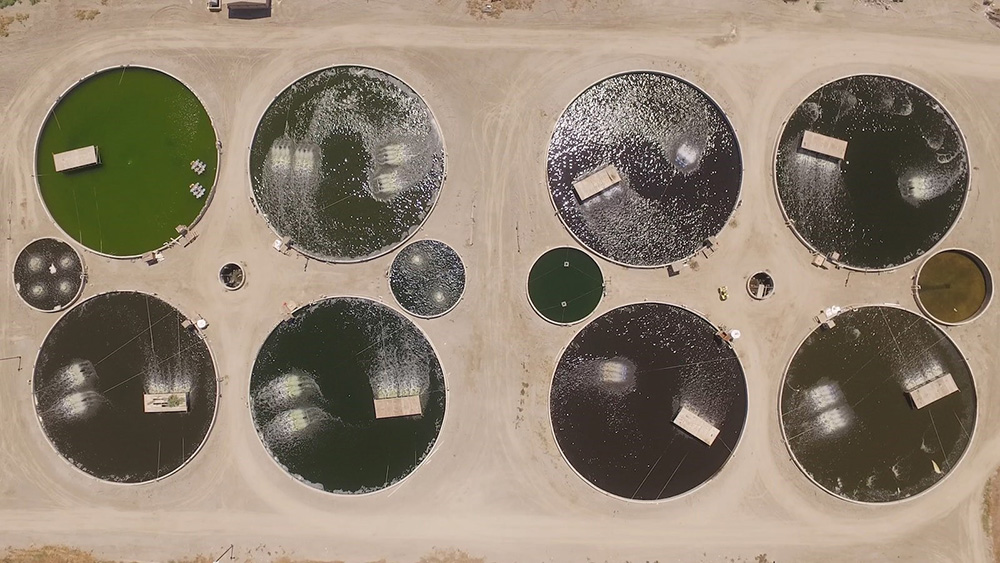
The Salton Sea in southern California is a unique ecosystem. In just four years, the water level has fallen by a good half a meter, and with a maximum depth of ten meters you can calculate when it is expected to dry out. And that’s just the global aspect, which has to do with global warming and changes in the local climate. The Salton Sea is also special because the United States tested numerous atomic bombs here in the final phases of World War II and the Cold War – initially in preparation for the Hiroshima and Nagasaki bombings, later as training for missions that fortunately never took place. In AMONG THE PALMS THE BOMB, Lukas Marxt and Vanja Smiljani? are particularly interested in this aspect of regional history. The film begins in Utah, where the planes took off and then found their destination in the supposedly secluded area around the Salton Sea. There is a museum in Wendover where you can also see models of “Fat Man” and “Little Boy”, the only two atomic bombs ever used in war, along with a loading pit where the planes were loaded, to which Marxt dedicated a shorter film in 2019. For many years he has been dealing with the situation in southern California, which can be described as extreme in many respects. Intensive agriculture, which relies radically on monocultures, has cast a spell over everything there. Marxt and Smiljani? find out that an alliance has been formed against this backdrop: illegal harvest workers from Latin America seek refuge in Native American reservations. AMONG THE PALMS THE BOMB has local experts explain the landscape and history, and the director is looking for dissenting voices, especially among the tribe of the Torres Martinez Desert Cahuilla Indians, who were victims of genocide in the 19th century. Their survivors now recall how many plants that had healing powers and were part of a life with nature once grew around the salty water of the Salton Sea. Now the area belongs to the salt bushes, and beneath the surface ticks the uranium of a Cold War that is about to return. Scary times, someone says. (Bert Rebhandl)
Lukas Marxt (*1983, Austria) is an artist and a filmmaker living and working between Cologne and Graz. Marxt´s interest in the dialogue between human and geological existence, and the impact of man upon nature was first explored in his studies of Geography and Environmental Science at the University of Graz, and was further developed through his audio visual studies at the Art University in Linz. He received his MFA from the Academy of Media Arts Cologne, and attended the postgraduate programme at the Academy of Fine Arts Leipzig. Marxt has been sharing his research in the visual art environment as well as in the cinema context. His works have been featured in numerous solo and group exhibitions, most recently at the Torrance Art Museum (Los Angeles, 2018), at The Biennial of Painting, Museum Dhondt-Dhaenens (Belgium, 2018), and at the Museum of Modern and Contemporary Art Rijeka (Croatia, 2018). His films have been presented in numerous International Film Festivals including Berlinale (Germany, 2017 and 2018), Curtas Vila do Conde (Portugal, 2018), and the Gijón International Film Festival where he receiced the Principado de Asturias prize for the best short film (Spain, 2018). Since 2017, Marxt has spent a considerable amount of time in Southern California, where he has researched the ecological and socio-political structures surrounding the Salton Sea. Vanja Smiljani? (Belgrade, 1986) is a visual and performance artist living and working between Lisbon and Cologne. She concluded the post-master in Artistic research at A.pass, Brussels (2015), MFA at the Dutch Art Institute (DAI), Arnhem (2012), and Kunsthochschule für Medien Köln (2019) and got a degree in Fine Arts at the Faculdade de Belas Artes de Lisboa (2009). In her practice she often utilizes the model of performance-lecture as a way to bridge fictitious and experiential universes, comprising technical apparatus, diagrams and sci-fi povera sculptures. Connecting otherwise unparalleled reality systems, Vanja's work attests the foundation of ideologies as alienated regimes, recurring to her own body as a vessel for narration, often shifting between the position of oracle and storyteller.
Lukas Marxt
Imperial Valley
Experimental doc. | hdv | color | 13:58 | Austria, USA | 2018
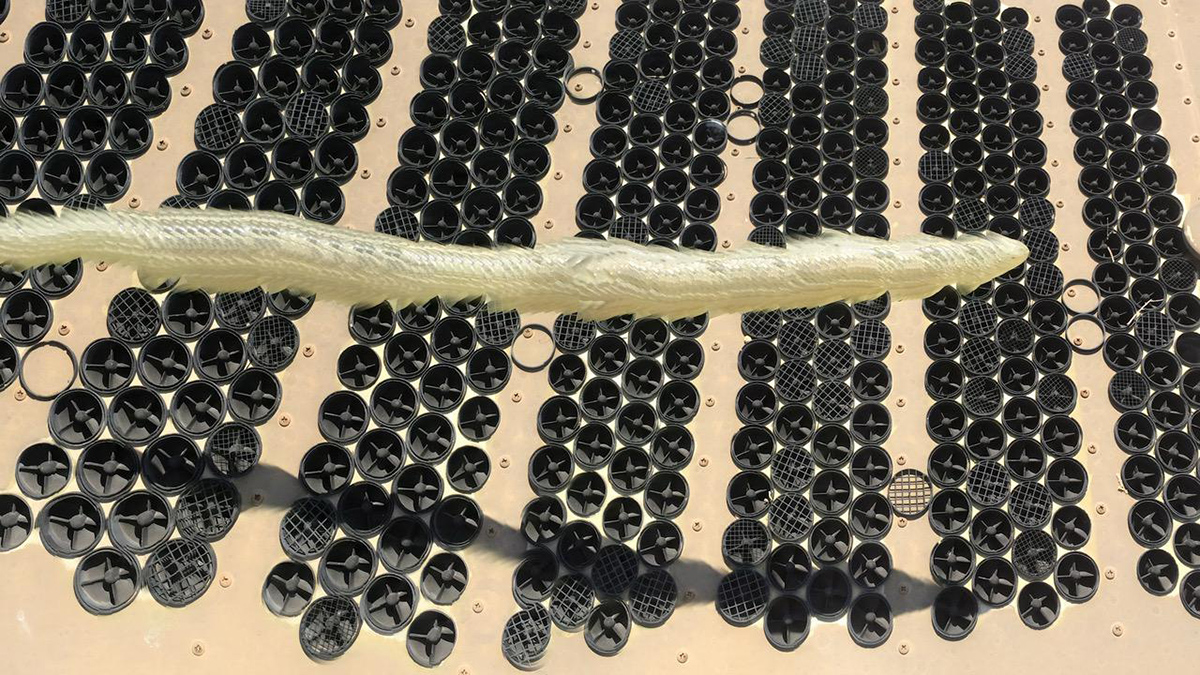
The Imperial Valley represents one of California´s most important regions of industrial agriculture. Corporate agricultural production interests have been able to successfully cultivate and exploit this geological part of the Sonora desert through a gigantic irrigation system fed by the Colorado River, as well as the All-American Canal specifically engineered for this purpose and which attained sad notoriety through the Mexican migration movement. The system´s run-off flows through pipes, pumps and canals leading to the Salton Sea, an artificial lake that is approaching ecological as well as economic disaster, just as bordering regions of Mexico. With Imperial Valley (cultivated run-off) Lukas Marxt approaches this problem in a very ingenious way. He begins with a bird´s eye view of an irrigation canal coursing through a desert landscape. A drone camera flies the length of the canal, subsequently flying over Imperial Valley landscapes from the same perspective. Initially appearing as nothing more than spectacular documents of agricultural monocultures, the shots become increasingly abstract additionally heightened through the accompaniment of an electronic score. Is this an actual or artificially simulated landscape? This ambiguity is precisely the point: The Imperial Valley is becoming the "Uncanny Valley", a place that is not yet or no longer natural and thereby appears eerie. A landscape post landscape (or its medial representation) is a geometric concept of lines, surfaces, points and color spots, regardless whether of an animate or lifeless nature. Although manmade, it is not a place for people anymore, neither ontologically nor in reality. The post-apocalypse is not a matter of the future, we are already in the thick of it. (Claudia Slanar)
Born in the Steiermark region of Austria in 1983, he studied geography and environmental system sciences in Graz until 2004. He then switched to audiovisual design at the University of Art and Design Linz. From 2007 to 2008 he studied art and multimedia at the Faculdade de Belas-Artes in Lisbon, Portugal. In 2009 he took up a postgraduate degree at the Academy of Media Arts Cologne and a masters at the Academy of Fine Arts (HGB) in Leipzig. Following the short film Fishing is not done on Tuesdays, co-directed with Marcel Odenbach, this marks the second outing for their collaborative work in competition in the Berlinale Shorts. He lives and works in Cologne and Vienna.
Lukas Marxt
Imperial Irrigation
Video | 4k | color | 20:4 | Austria, USA | 2020
Finding access to the deeper levels and truths of a stretch of land via the surreal, the digitally alienated. Thus is the aim behind Lukas Marxt’s Imperial Irrigation, whereby digital surrealism is anchored in an experimental documentary intent, while text and sound levels snarl the multiple layers of action thus continually decentering the narrative. Starting point for this complex and vibrant territorial study is California’s Salton Sea; close to where Marxt’s Imperial Valley (cultivated run-off) already led. The visual approach to this slowly drying up lake and its highly checkered past takes place through various types of images—most of which have been implanted with elaborately placed, willful moments of alienation. As though the intangibility of the scenery offered could not possibly be encountered via veristic means, the shots are digitally chopped, extended by time stops, permeated by undefinable MacGuffins—and tremble erratically owing to air reflections that arise when filming from a great distance. Marxt does not exclude himself from this quasi-colonial inspection of a landscape. His cowboy boots, his snakeskin hat, and his hanging out at slot machines or in the car repeatedly intervene as idiosyncratic presences in the flow of images. The artist Julia Scher emphatically narrates a history of Salton Sea based on a text by William L. Fox recapitulating various discursive anchoring moments. At the same time, subtly woven sound elements, most notably insistent passages by the musician Jung An Tagen, for their part, “alter-medially” outdo the “insane sense” of the events. What emerges is a disturbing portrait of a bit of the Anthropocene, whose ongoing catastrophic course, the film sums up nicely. (Christian Höller)
Lukas Marxt (*1983, Austria) is an artist and a filmmaker living and working between Cologne and Graz. Marxt´s interest in the dialogue between human and geological existence, and the impact of man upon nature was first explored in his studies of Geography and Environmental Science at the University of Graz, and was further developed through his audio visual studies at the Art University in Linz. He received his MFA from the Academy of Media Arts Cologne, and attended the postgraduate programme at the Academy of Fine Arts Leipzig. Marxt has been sharing his research in the visual art environment as well as in the cinema context. His works have been featured in numerous solo and group exhibitions, most recently at the Torrance Art Museum (Los Angeles, 2018), at The Biennial of Painting, Museum Dhondt-Dhaenens (Belgium, 2018), and at the Museum of Modern and Contemporary Art Rijeka (Croatia, 2018). His films have been presented in numerous International Film Festivals including Berlinale (Germany, 2017 and 2018), Curtas Vila do Conde (Portugal, 2018), and the Gijón International Film Festival where he receiced the Principado de Asturias prize for the best short film (Spain, 2018). Since 2017, Marxt has spent a considerable amount of time in Southern California, where he has researched the ecological and socio-political structures surrounding the Salton Sea.
Masbedo
2.59
Video | hdv | color | 3:0 | Italy | 2013
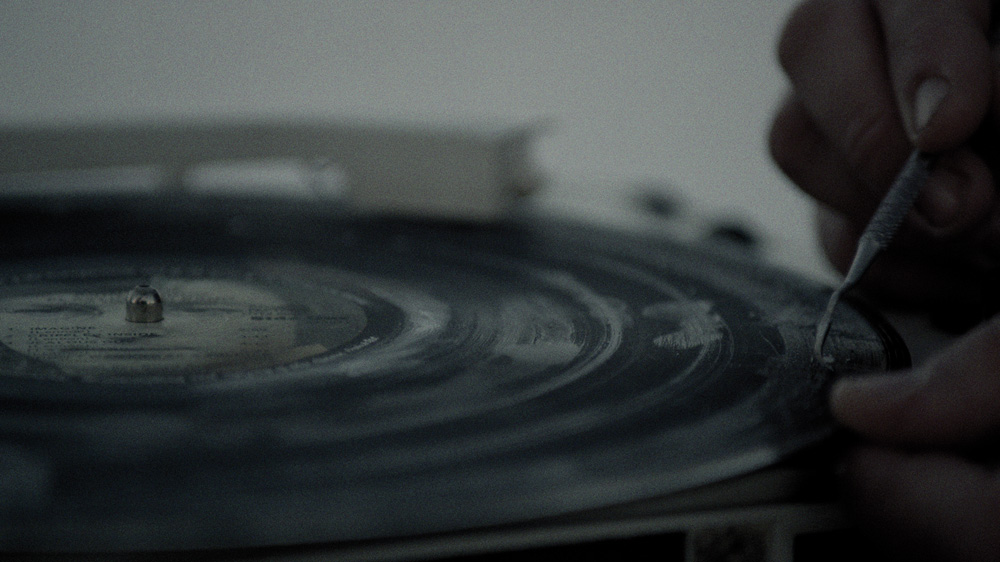
A small dramatic gesture cancels any possible remains of hope in 2.59 (2014). A dental drill scrapes the grooves of a vinyl record playing John Lennon’s Imagine– whose playing time is actually two minutes and 59 seconds – as the needle ultimately and stridently squeaks, while snowflakes start to fall. Dreams are no longer possible, as our society has completely denied them.
MASBEDO are Nicolò Massazza (1973) and Iacopo Bedogni (1970). They live and work in Milan. The two artists have worked together since 1999. They express themselves through the language of video, in different forms such as performance, theater, installation, photography and recently cinema. In Italy they are recognized among the most important video artists and innovators in the field of contemporary art: thanks to their unique feature of re-union of different arts: the multiplicity of languages becomes a single chorus. In fall 2014 a major solo exhibition will be showed at the Fondazione Merz, anticipated by the presentation of their first film The Lack at the Venice Film Festival. In 2013 the Leopold Museum Wien presented the video-installation “Ash” and they exhibited in Pinacoteca Nazionale Bologna a solo show with videos and a video performance. In 2012 they held video performances in several museums of contemporary art and in particular locations such as the Italian Embassy in Berlin during 7th Art Biennial. With the very special participation of Fanny Ardant they present at Teatro Strehler in Milan and Teatro Palladium in Rome an audio video performance from Le Remède de Fortune of Guillaume de Machaut. They participate with the doc-film Tralalà at the 69th Venice Film Festival and at the Reykjavik International Film Festival. Other very important shows in their career are Art Basel Unlimited, MAXXI and MACRO Museum in Rome and the 53. Venice Biennial Of Art. Other museums such the Center for Contemporary Art Uajzdowsky Castle in Warsaw, the CCCB Centro de Cultura Contemporanea in Barcelona, the DA2 Museum in Salamanca, Castello di Rivoli Museo d’arte contemporanea in Turin, the OK Offenes Kulturhaus in Linz, the Tel Aviv Art Museum and the Centro Atlantico de Arte Moderno in Las Palmas de Gran Canaria hosted in the past years their artworks. Other Film Festivals in their career: Bellaria, Tremblay en France, Novi Sad, United Nation World Forum in Rio De Janeiro, Locarno, Rome, Istanbul, Lisbon, Athens, Miami and Trieste. They have always participated with video-art projects. They worked with French writer Michelle Houellebecq with which they write The world Is Not A Panorama, a video art movie with the precious collaboration with Oscar Winning actress Juliette Binoche and exhibit the premiere at the Gran Palais, Paris.
Masbedo
Fragile
Video | hdv | color | 7:46 | Italy | 2016
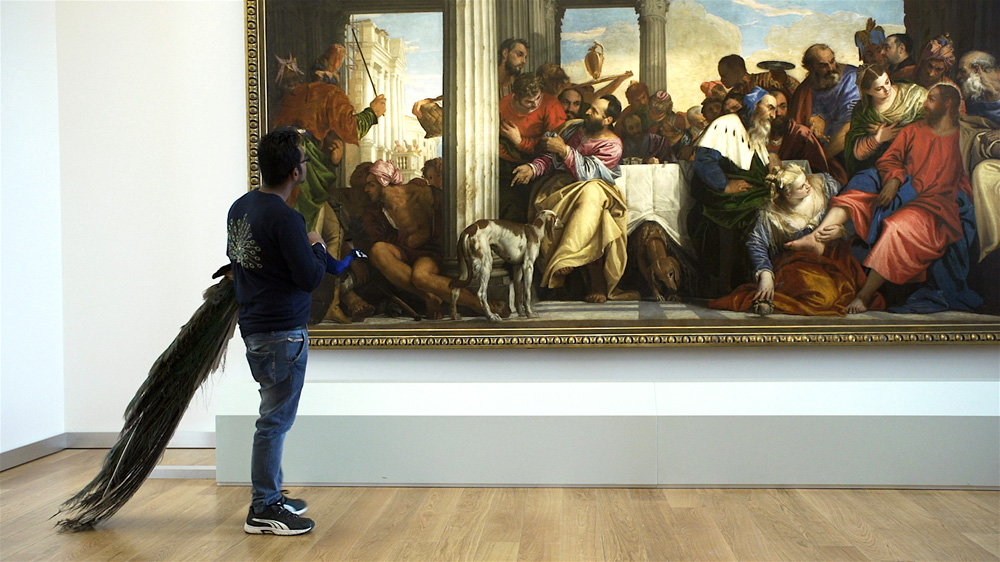
The video, Fragile (2016) produced by the Museo Reale Galleria Sabauda in Turin, staged a young man`s visit to the gallery halls in the presence of a peacock. Walking among the masterpieces of antiquity, symbolic objects of archetypal beauty, the presence of the peacock underlines the essential precariousness of the living animal and its impairment that renders it inapt to represent its nature. The image is highly suggestive because it’s made even more dramatic due to the emptiness of the halls, facing the perpetual immobility of the painted characters. The main theme of these works is the concept of "cure": the old animal, object of the care of its master, is a metaphor of the combination of a faded vanity and the eternal journey into beauty, a trip defined by Rainer Maria Rilke as "the tremendous at its beginning." The fragility of art, to which the title of the work refers to, engages the observer`s gaze and warns of the necessity to provide protection of art and cultural heritage. A metaphor that reminds us of the need to preserve and care for our artistic and cultural heritage as a form of resistance to time and carelessness of man. In 2018, when Europe dedicates itself to Cultural Heritage, encouraging public institutions to celebrate their relevance and value for the cultural development of society, the artistic discourse by Masbedo is consistently aligned with this theme, showing how contemporary artists relate themselves with the art of the past and how history of art can be a source of inspiration for new generations.
MASBEDO (Nicolò Massazza, 1973, Milan - Iacopo Bedogni, 1970, Sarzana) started their journey in 1999, focusing on the potential of video art and video installation. Developed around the theme of incommunicability in contemporary society, their research has produced both, intimate works and more socio-political and anthropological-cultural productions. Their aesthetic approach presents pictorial aspects and the realization of their videos pursues the goal of involving the viewer in the space created by the moving images through immersive installations. Their work, in fact, is a synthesis of theatre, performance, space, architecture and video / cinema. They have been included in solo shows in important museums and foundations both in Italy and abroad, as well as in various film festivals, and their works are included in relevant private and public collections: MART, Rovereto, Italy; Fondazione Merz in Turin, Italy; GAM - Galleria d’Arte Moderna in Turin, Italy; MACRO - Museo di Arte Contemporanea in Rome, Italy; DA2 - Centro de Arte Contemporáneo, Salamanca, Spain; CAAM Centro Atlántico de Arte Moderna, Las Palmas, Spain; CAIRN Centre d’Art, Digne-les-bains, France; Tel Aviv Museum of Art, Israel.

Masbedo
Pantelleria
Video | digital | color | 20:0 | Italy | 2022
Between 9 May and 11 June 1943, the island of Pantelleria was violently bombarded by the Allied troops in the first operation to reconquer Italian soil. Residents recall that, after the surrender, some of the buildings were blown up for the cameras of a propaganda combat film. Pantelleria traces the memories of this event in the local collective consciousness and looks at the contemporary implications of an episode that took place in the shadow of official history. Through a two-years long participatory process with the residents, the film explores the tension between the truth and its ideological distortion, and between the reality of the bombs and their telling through images. The Nervi hangar, a symbol of Mussolini’s militarisation of the island, is now shown empty and inhabited by a magical animal presence. Extracts from the combat film are projected onto the buildings of today’s Pantelleria, while the camera travels through the bunkers dug by the Italian army. The voiceover, written and read by writer Giorgio Vasta, gives expressive form to the island’s stories, while the sound by GUP Alcaro and Davide Tomat distorts the recordings of the local orchestra Spata, finding in dance music a space for the reactivation of the past, and liberation in the present.
MASBEDO is an artistic duo formed by Nicolò Massazza and Iacopo Bedogni. They have been working together since 1999 and they currently live in Milan and Piacenza (Italy). Different artistic languages such as video, installation, cinema, performance, theater, and sound design coexist in their work. They are interested in emotional and intense narratives that delve into the depths of human relationships and the complex subjectivity of the contemporary individual. They have identified the relationship between cinema and art as a preferred area of investigation, which they approach with an attentive gaze to both socio-anthropological elements and the most intimate and poetic ones. MASBEDO’s works have been exhibited in international institutions such as: Manifesta 15 Barcelona; Centre Pompidou-Metz; CCCB Centre de Cultura Contemporània de Barcelona; Fondazione ICA Milan; MAMM Multimedia Art Museum Moscow; Manifesta12 Palermo; Hong Kong Arts Centre; Fondazione Merz; Leopold Museum Wien; MAXXI Rome; Centre Pompidou/Forum des Images Paris. Among others, their short and feature films have been shown at: Venice International Film Festival; Locarno Film Festival; CPH:DOX; FIFA – Festival International du Film sur l’Art Montréal; Villa Medici Film Festival Rome; Sharjah Film Platform; Walter Reade Theater, Film Society of Lincoln Center, New York; Lo schermo dell’arte, Florence, IFFR-International Film Festival Rotterdam.

Masbedo
Condivisione di un ricordo
Video | mp4 | color | 13:13 | Italy | 2020
The major video screening set up echoes the documentary Condivisione di un ricordo: this work presents the operation which concerned Bergamo and the municipalities of the Val Seriana over the summer, in which numerous posters portraying Pellizza’s painting were displayed, thanks to the involvement of people encountered by the artists.
The two artists have worked together since 1999, focusing on video art and installations. They express themselves through the language of video, and in different forms such as performance, theater, installation, photography and recently cinema. In Italy they are recognized among the most important video artists and innovators in the field of contemporary art. Their artistic research has focused on the theme of incommunicability, highlighting the paradox of our communication society. This has led them to produce very intimate pieces alongside work with a greater anthropological, social, and political feel. They strive to engage their audience by using the moving image as an immersive installation. MASBEDO have also worked with video-performances to engage their audience within the creative space and gestures created by the video itself
Monika Maslon
Control Negative
Experimental VR | 0 | color | 40:0 | Poland | 2022
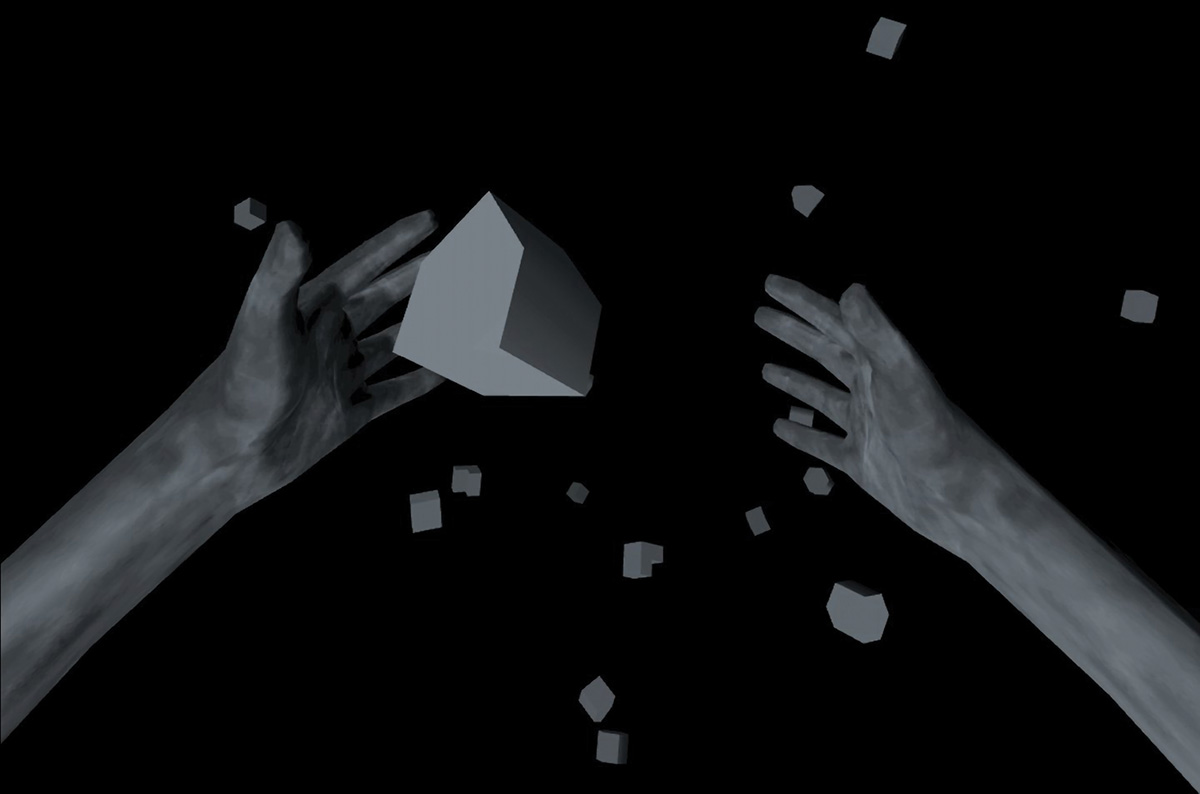
The CONTROL NEGATIVE experience is an exercise in a loss. Using VR technology, author Monika Mas?o? situates the viewer in an emotional state where frustration, helplessness, anger, and sadness are used to reveal basic human assumptions, including the illusory conviction of being fully in control of one's own life. The unreal world of the experience — a negative version of the real world — is a training space where you can better understand yourself and your emotions. The user is guided through seven chapters, which gradually move from physical activity to contemplation.
Dr. Monika Maslon (born 1982) - visual artist and art educator. She graduated from the Academy of Fine Arts in ?ód? and Ph.D. studies at the Film School in ?ód?, where she completed her Ph.D. thesis entitled “Do zobaczenia” (See you), under the supervision of Prof. Józef Robakowski. She is a lecturer at the University of Leipzig and the Maria Grzegorzewska University in Warsaw where she conducts classes with the students of the department of Arts education in fine arts. In 2014 she stayed at an artistic residence in Singapore, where she made an artistic project called “Comfort of Long-Distance Perceiving”. In 2016 she implemented the project “Template - a tool to learn how to use an image”, as a part of a scholarship awarded by the Ministry of Culture and National Heritage. The scope of her art activities is manifested mainly through realizations based on audiovisual material. She participated in numerous exhibitions and shows. She is the author of the VR experience - CONTROL NEGATIVE.
Valérie Massadian
America
| | | 6:57 | France | 0
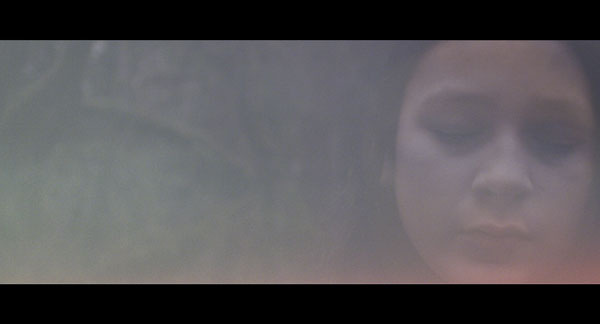
One Place One Boy One Day One Shot One Wheel of Film
Valérie Massadian
Nana
Experimental fiction | hdv | color | 68:0 | France | 2011
Nana is 4 years old and lives in a stone house beyond the forest. Back from school, a late afternoon, all she finds is silence in the house. A journey into the night of her childhood.
It's through photography, and notably her collaboration with Nan Goldin, that Valerie Massadian came to image-making,Creating slide- show screenings (The Link, Mary Go Round, Journal de Bord), exhibited in Tokyo, London and Porto. What she has retained from photography is its freedom and the rigor of frontal contact. She has taken this same approach, committing to a project from concept to completion, in her collaborations with several film directors. From there came the need of her own film, NANA, which won the Price for Best First Feature Film at the Locarno Film Festival 2011, as well as the Price for Best International Feature Film at the Festival Internacional de Ciné de Valdivia.

Guy Massaux
La selva oscura
Experimental fiction | 4k | color | 19:0 | Belgium, Italy | 2018
La Selva oscura (La forêt obscure) film/vidéo, texte de Dante Alighieri, La Comédie, L’Enfer, Chant treizième (XIII) Préambule: Dans la forêt des suicidés, Dante et Virgile croisent deux formes humaines qui fuient devant eux, arrachant tout sur leur passage et brutalisant ainsi elles-mêmes leur chair jusqu’à ce que des chiennes faméliques (Harpyes) les rejoignent et les dépècent. Tel est le châtiment de ceux qui ont péché contre eux-mêmes par dissipation. Synopsis: Par une nuit obscure, A. et D. progressent, séparément, dans une forêt où nul sentier n’indique le chemin à suivre, où aucune issue ne se présente à eux. Ils se sont égarés, la forêt les retient. Ils surgissent de l’obscurité, débusqués par les éclairages qui les aveuglent. Un face-à-face s’installe entre eux et la forêt, à la présence des arbres répondent leurs propres regards et voix. A. s’est levé, D. de même, résonnent en eux les aboiements d’une meute de chiens qui progressivement se rapproche. Une course-poursuite est engagée où toute issue leur sera fatale.
Guy Massaux est artiste visuel, curateur d’exposition, professeur d’art à l’Académie des beaux-arts de Bruxelles. Après avoir consacré son travail d’artiste principalement à la peinture, il oriente, depuis plusieurs années, ses préoccupations de création autour de l’image en mouvement par l’écriture cinématographique, notamment à travers des dispositifs de vidéo-installations. Il a réalisé plusieurs courts métrages en langue italienne, La Selva Oscura (2018), Il Rifugio (2014) et "B.", film en cours de post-production (2020). Il partage ses principales activités et son emploi du temps entre l’Italie et la Belgique. Il collabore régulièrement avec Mirco Mencacci ingénieur du son. Créateur des univers sonores de films italiens tels que « Le Regard de Michel Ange (Lo Sguardo di Michelangelo) » de Michelangelo Antonioni, « Nos meilleures années (La Meglio gioventu)» de Marco Tullio Giordana ou encore «La Fenêtre d’en face» (Facing Windows) de Ferzan Ozpetec. Pour ses créations, il travaille sur une nouvelle manière de diffuser le son et développe le système du « son sphérique », utilisé pour la première fois dans le film « Le Regard de Michel Ange ».

Agnieszka Mastalerz
Nodes
Video | digital | black and white | 3:16 | Poland | 2023
Nodes is a project analyzing spells as an example of control over another being. I focused on the violence of persuading somebody to fall in love. I have been considering casting a spell as an influential but not direct act for which specific tools or gestures might be needed. I chose orchids whose roots were used to influence another person, both when it comes to feelings and sexual activity. In the areas of today’s Poland and Italy, dried wild orchid roots were hidden under somebody’s clothes, or an orchid-based powder was added to goat milk which was supposed to help sexual arousal. On the contrary, nowadays, in a huge industrial space, hundreds of almost identical orchids run through a commercial line. Although the production is highly mechanized and managed by technology, the final sculptural touch on every flower goes through the working hands of females — they manually shape this organic material by adding artificial backbones and cutting off the rotten parts. The women use this intimate act to fit the normalized aesthetics. With Nodes, I am bringing attention to the powerful operations both in private and industrial environments by looking at the human element in them.
Female visual artist based in Warsaw. Graduate of the Studio of Spatial Activities by Miroslaw Balka at the Academy of Fine Arts in Warsaw (BA, MA, 2018), former student of Candice Breitz and Eli Cortiñas at the HBK in Braunschweig (Deutscher Akademischer Austauschdienst (DAAD) Scholarship for 2019/2020), and a guest by Adam Broomberg and Oliver Chanarin at the HFBK in Hamburg (2017/2018). She also obtained her BA in Cultural Studies at the University of Warsaw (2013). Currently participant of the Autumn Intensive at the Malmö Art Academy. She exhibited with Catinca Tabacaru Gallery at the Goethe Institut in Bucharest (2024), NS-Dokumentazionszentrum in Munich (2023), MOCAK – Museum of Contemporary Art in Krakow, Manifesta 14 Prishtina, eastcontemporary gallery in Milan (2022), Fabbri Schenker Projects in London, MAXXI – National Museum of 21st Century Art in Rome, Center for Contemporary Art Luigi Pecci in Prato (2021), Wschód gallery in Warsaw (2020), Palazzo Strozzi in Florence, Starak Family Foundation in Warsaw (2019), Deichtorhallen in Hamburg, Fondation Hippocrène in Paris (2018), Museum of Modern Art in Warsaw (2017 – laureate of the Hestia Artistic Journey Competition), and TRAFO Center for Contemporary Art in Szczecin (2016). Art fairs include NADA Villa Warsaw (2024), Artissima, and Arco Madrid (2021). Agnieszka Mastalerz was a resident of Hospitalfield in Scotland (2022), Muzeum Susch in Switzerland, the Artist Development Program at the EIB Institute in Luxembourg (2021), and Futura gallery in Prague (2020, Visegrad Fund). She participated in the Lucy Art Residency public program in Kavala (2022) and in the School of Expressions in PLATO Ostrava (2019). She is a laureate of M?oda Polska scholarship for 2024. Works of her are in Fondazione in Between Art Film by Beatrice Bulgari, Ergo Hestia Group, European Investment Bank, and Warsaw Ghetto Museum collections, as well as in private ones. Since 2021, Mastalerz is represented by eastcontemporary gallery in Milan.

Jonas Matauschek, Culurgioni, Emerson
Leuna
Experimental doc. | hdv | color | 13:0 | Germany | 2013
In the course of one day, the flm follows various characters in their local environment, which is infuenced by the presence of an industrial plant. Their individual sights tell about the relation between human being and industry.
Jonas Matauschek 1987 born in Dresden, Germany 2007 – 2014 studies of photography at the Academy of Visual Arts, Leipzig since 2015 Meisterschüler in the class of Prof.Peter Piller, Academy of Visual Arts, Leipzig Emerson Culurgioni 1986 born in Munich, Germany 2007-2009 studies of visual communication at the Free University of Bolzano 2010 - 2014 studies of media art at the Academy of Visual Arts, Leipzig currently Meisterschüler in the class of Prof. Clemens von Wedemeyer, Academy of Visual Arts, Leipzig
Ramon Mateos
HERRAMIENTAS DE CONSTRUCCION NACIONAL I
Video | | color | 1:59 | Spain | 2009
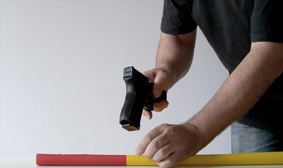
We live in a globalized world where national and supranational identity has been subsumed by the value and brand image; A world in which politics is written in capital letters on the desks of major companies and ends endorsed in the areas of representation of popular will: the parliaments, with the essential and necessary support of the media, which, in turn, are part of the fabric of these same corporations. However, it is a historical reality, the search for differentiation with respect to the other, from a political and socio-cultural. Today we can hardly distinguish the discourse of national identity distinct of riots, revolts and terrorism, for the sake of a flawed and corrupt information that is confusing the part with the whole in a universal metonymy, and that is where this project address. NATIONAL BUILDING TOOLS is formalized in video format that work as a manual that relates ideological instruments and tools, used to reaffirm a hypothetical national identity, using the techniques and applications specific to the media.
Ramón Mateos. (Madrid1968) Works and lives in Madrid. Graduated from the Faculty of Fine Arts ofthe Complutense University, Madrid. He has participated in numerous solo and group, nationals and internationals exhibitions, and his work is in major public and private collections. Founder and component, until its dissolution in 2006, of the ?EL PERRO? art collective. He has participated in: PROYECTO JUAREZ. Ciudad Juarez, Mexico (2007-2009); INTERFERENCIAS, PhotoEspaña 2008, Casa de America, Madrid, 10 th Istanbul Biennial, Istanbul (2007); FRECUENCIAS in 2008 and 2009 for the Cervantes Institute in Morocco
Mateo Maté
Thanksgiving turkey
Experimental film | dv | color | 5:30 | Spain | 2006
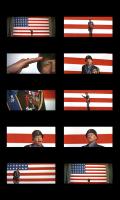
The concept of camouflage has seeped into virtually all the human social activities. Over the past century, the companies have developed acquiring a power that is even greater than that of the countries and they have invented the science of marketing that camouflages objects in dreams. All humans use the different brands, like a second skin to integrate ourselves into the social group of the sheet to which we want to belong; the products that we use do not project what we are; they project what we want to be or just want to appear. The economic power has kidnapped the sense of sight that was until recently a ?notarial act of the truth?. Polyespan, Photoshop and plastic surgery have turned our surroundings into a theme park in which the objects, messages and bodies are false. The eternal sentence ?if I hadn?t seen it with my own two eyes, I would not believe it? no longer has any meaning. However we continue believing it because we are all actors on the same stage; with leading or supporting roles, but accomplices in different degrees. Currently, the military look has spread throughout the social strata. The large clothing chains offer us every day garments for going to school or work that are camouflaged; the houses on the new estates acquire the presence of unassailable bunkers in the same style as the kibbutz?s in the ?occupied territories?; even the vehicles have been contaminated by the armour plating appearance of the Empire?s war ships. With the total militarization of all our borders, implanted with the excuse of security, we are all ready for a general mobilisation. We do not know when or where the conflict will arise, but we must be ready for it. In "Thanksgiving Turkey" a general harangues to his troops. Following his precise instructions, the soldiers will conquer his guests, during a memorable dinner, with a delicious and magisterial recipe of the "Thanksgiving Turkey". Mateo Maté, 2007
MATEO MATÉ Born in Madrid (Spain), 1964. Lives and works in Madrid (Spain) www.mateomate.com m.mate@mateo mate.com SOLO EXHIBITIONS 2007-?Paisajes uniformados?. Centro de Arte de Burgos, CAB. Spain. -?Nacionalismo Doméstico?. Galería Llucià Homs. Barcelona. Spain. -"Thanksgiving Turkey". Galería Trinta, Santiago de Compostela. España. 2006-?Cartografías personales?. Sala CAI Luzán. Zaragoza. Spain. -?Nacionalismo Ibérico?. Fundación Encosta, Lisboa. Portugal. -?Fronteras interiores?. Casa de España, Lima. Perú. 2005 -?Delirios de Grandeza?. Galería Grita Insam. Viena. -?Nacionalismo Doméstico?. Galería Oliva Arauna, Madrid. Spain. 2003 -?Desubicado?. Galería Oliva Arauna. Madrid, Spain. -?Desubicado?. Galerie Six Friedrich & Lisa Ungar, Munich. Germany.