Catalogue > Liste par artiste
Parcourez la liste complète des artistes présentés dans le cadre des Rencontres Internationales depuis 2004. Utilisez le filtre alphabétique pour affiner vos recherches.
Bryan Boyce
Catalogue : 2006America's Biggest Dick | Vidéo expérimentale | dv | couleur et n&b | 4:0 | USA | 2004

Bryan Boyce
America's Biggest Dick
Vidéo expérimentale | dv | couleur et n&b | 4:0 | USA | 2004
Le vice-président des Etats-Unis Dick Cheney dit enfin la vérité.
L'indien de San Francisco Bryon Boyce est un réalisateur-vidéaste dont les oeuvres ont parcouru le monde entier mais aussi dans des lieux tels que le Sundance, NY Underground, Cinematexas, RESfest, MTV et le Pacific Film Archive.
Velibor Bozovic
Catalogue : 2016My Prisoner | Vidéo | hdv | couleur | 21:41 | Canada, Bosnie-Herzégovine | 2014
Velibor Bozovic
My Prisoner
Vidéo | hdv | couleur | 21:41 | Canada, Bosnie-Herzégovine | 2014
My Prisoner is a video work that reconstructs the event that occurred on 3 April 1994 in war-torn Bosnia by intermixing archival footage with contemporary reimagining of the occasion. It shows a young man being escorted by an army intelligence officer to visit his imprisoned father. As the men travel side-by-side in the back seat of a car Shine on You Crazy Diamond by Pink Floyd begins to play on the car radio. The young man acknowledges the music and tries to make conversation but the officer does not even recognize the track. A composite of autobiography, documentary and fiction, My Prisoner navigates through the space where the historical, the personal and the fictional simultaneously interfere with and enhance one another.
Velibor Božović grew up in Sarajevo, Bosnia-Herzegovina. When he was in his twenties, the country of his youth became a war zone and he spent the duration of the siege of Sarajevo honing his survival skills. In 1999, Velibor moved to Montréal where he worked, for eight years, as an engineer in aerospace industry until he gave up his engineering career to devote his time fully to art practice. Subsequently, Velibor completed a Master of Fine Arts degree in Studio Arts at Concordia University. He is the recipient of the Claudine and Stephen Bronfman Fellowship in Contemporary Art (2015), Concordia International Mobility Award (2014), the Bourse de Maîtrise en Recherche from FRQSC - Fonds de recherche sur la société et la culture Quebec (2012) and Roloff Beny Foundation Fellowship in Photography (2011). His work has been exhibited in the United States, Cuba, Canada, and Bosnia-Herzegovina. His images appeared in The New York Times, The Paris Review, Descant, International Herald Tribune, Chicago Tribune, Granta, BH Dani and others.
Tomas Bozzato
Catalogue : 2011Avant l'horizon | Documentaire | betaSP | couleur | 61:0 | Italie, France | 2010
Tomas Bozzato
Avant l'horizon
Documentaire | betaSP | couleur | 61:0 | Italie, France | 2010
Igor Bošnjak
Catalogue : 2023Memory Gate | Film expérimental | 4k | couleur | 8:39 | Bosnie-Herzégovine | 2023
Igor BoŠnjak
Memory Gate
Film expérimental | 4k | couleur | 8:39 | Bosnie-Herzégovine | 2023
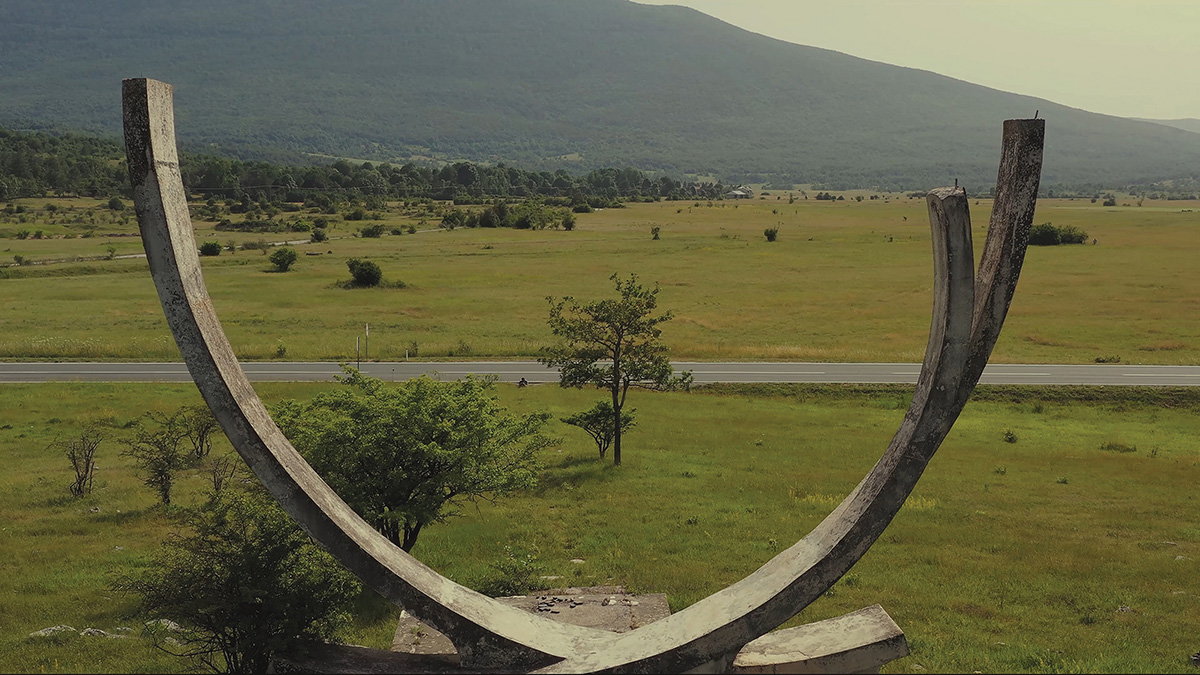
Memory Gate shows desolated Herzegovinian landscape with a forgotten monument dedicated to pilots of Yugoslav National Army during the Second World War. Critical deserted landscape followed by weird sound and music called ganga* which is typical for that region of the south part of Bosnia and Herzegovina. This video confronts utopian modernistic Yugoslavian architecture with a traditional sound and landscape, creating a very disturbing and eerie cinematic experience. *Ganga - stands for old traditional folk music and singing which is usually played by a group of old men.
Igor Bošnjak (b. 1981 in Sarajevo, Yugoslavia) lives and works in Trebinje (Bosnia & Herzegovina). As an interdisciplinary artist, he works on visual, cinematical, geographical and documentary research addressing archives, maps, migrations, monuments, history and image-time relations as key refference in the experience of contemporary society. He is mainly working within the media fields of contemporary art: moving images, video, 3d animation, installation, objects, drawing & photography. In 2005 he finished Academy of Visual Arts (BA) in Trebinje, Department of Painting. From 2007 to 2008 he finished (MA) Interdisciplinary studies, Theory of Art & Media Department at the University of Arts in Belgrade, Serbia. From 2006 to 2016 he was founder and curator of namaTRE.ba project biennial. From 2009 works as a professor at Academy of Visual Arts in Trebinje, University of East Sarajevo on courses of Intermedia art, Video art, Digital art. From 2019 to 2021 he was working as visiting lecturer on Faculty of Fine Arts, Cetinje, University of Montenegro.
Catalogue : 2022Future Repeats Itslef More Than History Used To | Fiction expérimentale | 4k | noir et blanc | 13:49 | Bosnie-Herzégovine | 2020
Igor BoŠnjak
Future Repeats Itslef More Than History Used To
Fiction expérimentale | 4k | noir et blanc | 13:49 | Bosnie-Herzégovine | 2020
An attempt on aesthetic-technological-ideological objectivity in non-objective reality. How can we see today, the monuments of the NOB (National Liberation War), what they represent to us in the context of the new division of fashion as well as changes in paradigm and ideology in the former Yugoslavia. Is a new reading possible without a nostalgic undertone? How to think about architectural and concrete structures in the 2000s? What is the relationship between monument and human, what is the relationship between monument and unbridled nature. What is the relationship between monuments and contemporary technology and contemporary art today? How much contemporary and how much tech addiction? How to reinterpret the artifacts of the anti-fascist struggle, but so that the monument of the NOB remains at the denotative level of meaning of the monument, that new meanings do not endanger the given basic meaning, the one that is. Creating narratives as a new reading and a new "seeing" and seeing of monuments and creating new visual realities.
Igor Bošnjak (b. 1981 in Sarajevo, Yugoslavia) lives and works in Trebinje (Bosnia & Herzegovina). He is mainly working within the fields of contemporary art: moving images, video, installation, objects, drawing & photography. From 2009 works as a professor at Academy of Visual Arts in Trebinje, University of East Sarajevo on courses Intermedia art, Video art, Digital art. From 2019 works as visiting lecturer on Faculty of Fine Arts, Cetinje, University of Montenegro.
Catalogue : 2014Hotel Balkan | Film expérimental | | couleur | 10:25 | Bosnie-Herzégovine | 2013
Igor BoŠnjak
Hotel Balkan
Film expérimental | | couleur | 10:25 | Bosnie-Herzégovine | 2013
?It is not the literal past that rules us, it is images of the past...? George Steiner Hotel Balkan is meditative and ambiental video which defines borders between futuristic memory of past and present thinking of future. I?ve been wondering about something: Why is it that images from the past - the actual past - often feel more futuristic than our current images of an imagined future? But if the future doesn?t look much like the future, the past often does. There are pictures from the past that, while you immediately recognize them as being from the past, nevertheless feel futuristic. It?s as though there?s something in your brain that wants to read them as images from the future. In this concept there is an idea that Tito?s nuclear bunker is equivavelnt for some kind of motel, or maybe even a hotel. Nowadays, Tito?s nuclear bunker wants sunshine instead of fluorescent lights, the sound of wind blowing through trees instead of the dull noise of its massive air-conditioning unit. It looks forward to the chatter of people and the sound of their footsteps instead of the noise produced by the closing of its steel antinuclear doors.
Born 1981 in Sarajevo, former Yugoslavia. Lives & work in Trebinje, Bosnia & Herzegovina. He is mainly working within the fields of film, video, concept, installation & photography. Also works as a video curator & freelance theoretician. Curently works as a asistant professor at Academy of Visual Arts in Trebinje. Education 2005 Academy of Visual Arts (BA) in Trebinje, Department of Painting 2006 Founder and the curator of the international namaTREba project biennial 2008 Interdisciplinary master (MA) studies at the University of Arts in Belgrade, Theory of Art & Media Department 2011 Interdisciplinary (PhD) studies at the University of Arts in Belgrade / Theory of Art & Media Department His works shows and exhibited at Kunsthal Charlottenborg, Copenhagen, Moscow Museum of Modern Art, Moscow, Atopia Film & VideoKunst Gallery, Oslo, CAM Casoria, Contemporary Art Museum, Naples, Kunst Museum, Bonn, Galleria d? Arte Moderna Palazzo Forti, Verona, Museum of Contemporary Art RS, Banja Luka, Point Ephemere, Paris, Contemporary Music Centre, Dublin, Espacio Center Canarias, Tenerife, Fabbrica del Vapore, Milan, Center of Contemporary Art, Plovdiv, Budapest Art Fair Mucsarnok, Budapest, Spazio Monitor, Museum of Contemporary Art, Rome, Tapetenwerk Halle C, Leipzig, A+A Galerie, Art Verona, Venice, Gallery Remont, Belgrade... more info: www.igorbosnjak.com
Brigitta Bödenauer, Miguel CARVALHAIS
Catalogue : 2006Can I have two minutes of your time? | Vidéo expérimentale | dv | couleur | 2:0 | Autriche | 2005

Brigitta BÖdenauer, Miguel CARVALHAIS
Can I have two minutes of your time?
Vidéo expérimentale | dv | couleur | 2:0 | Autriche | 2005
Commençant avec un plan séquence de deux minutes sur le cadran d?une horloge, la vidéo a été réalisé en temps réel, dans un environnement conçu pour la vidéo. Les cadres furent imprimés individuellement sur papier et postérieurement redessinés, images par images au fusain et à la peinture à l?huile, scannées à nouveau, pour être enfin animées dans la vidéo finale. Cette vidéo a été commandé pour la compilation "Essays on Radio : Can I have 2 minutes of your time?" produite par le label media Crónica et qui proposa à tous les artistes de l'audio et du visuel de refléter la technologie et la culture de la radio dans le début de la pellicule 21ème siècle. Le but de cette vidéo fut ensuite d?explorer l?idée de temps dans l?analogie croisant les techniques digitales : en commençant en deux minutes, réduisant la vidéo à 6 images et les étirant à nouveau sur deux minutes, restaurant la perte de qualité induite par le procédé de recréation numérique/mécanique et par l?utilisation de diverses recréations analogues/manuelles dans chaque image, discrète. À la fin, la représentation symbolique du temps n?est plus lisible, mais les mécanismes qui le représentent et le capturent se font sentir tout au long du morceau.
Née en 1972, elle travaille et vit à Vienne, en Autriche où elle est étudiante en critique du théâtre et des médias mais aussi artiste et photographe. Videojockey et DJ, elle enseigne pour le moment la manipulation vidéo dans l?école multimédia privée de Vienne. En 1999, son travail est exposé pendant 3 mois, par "Cinemasonic-Lounge", un festival de vidéos expérimentales. Elle met de côté la photographie analogique pour se tourner vers la vidéo numérique. Avec son travail elle repense la géométrie et l?anatomie qui dominent les images de collection en un processus de composition récursif qui utilise un ensemble de vidéos. Avec ses vidéos elle essaie de produire des séquences émotionnelles provenant d?images fixes rassemblées (photographies, images, graphiques, sketches, etc..) en des trajectoires animées derrière leur contexte original.
S()fia Braga, Matthias Pitscher, Fabricio Lamoncha
Catalogue : 2023ASMR for Earthly Survival | Vidéo expérimentale | mp4 | | 10:0 | Italie, Autriche | 2020
S()fia Braga, Matthias Pitscher, Fabricio Lamoncha
ASMR for Earthly Survival
Vidéo expérimentale | mp4 | | 10:0 | Italie, Autriche | 2020
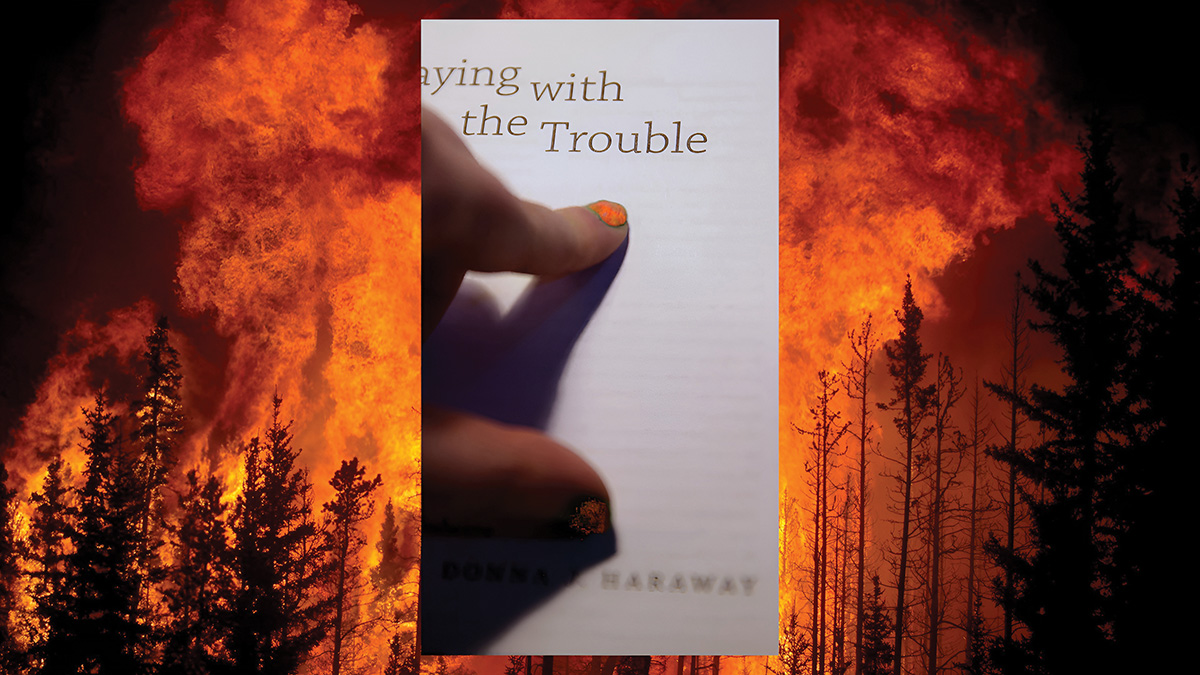
Soft voices and soothing sounds will take the audience on a sensory audiovisual journey through a dystopian near future. The resulting work is based on the collaborative composition and exploration of intimate fears and tribulations related to current climate change narratives, and represented through the implementation of the experimental ASMR methods presented at the “ASMR for earthly survival” workshop held by the artists. “ASMR for Earthly Survival” explores the potential of ASMR (Autonomous Sensory Meridian Response) as a tool for the creation of intimate science fiction storytelling narratives.
S()fia Braga is an Italian transmedia artist who lives and works between Vienna and Linz, conducting artistic research that combines digital and post-digital practices. Her work is focused on exploring new technologies to create speculative fabulations that delve into themes such as transhumanism, human and non-human collaboration and non-human agency. S()fia’s identity constantly changes and goes hand in hand with the narratives she creates: over the last years she has been an artist, a transhumanist entrepreneur, an AI auteur, a cyberstalker, and has mutated several times into a monstrous creature. Matthias Pitscher works as an artist, designer, meditation teacher, barista, researcher, entrepreneur and bad influencer. The artifacts he produces deal with the constant changes we face in our transition to a technologically connected society. Analytical yet humorous, he demonstrates how digital media transforms our perception of reality. Fabricio Lamoncha is an artist, designer and researcher from Spain, currently based in Austria. Since 2018 he is lecturer and PhD researcher at the Kunstuniversität Linz. Also member of the Art|Sci Center at UCLA (Los Angeles) and co-founder and organizer of the Leonardo Laser Talks Linz. His practices explore the entanglements of media ecology and bioethics.
Marco Brambilla
Catalogue : 2011Civilization (MEGAPLEX) | Vidéo | dv | couleur | 3:22 | Italie | 2008
Marco Brambilla
Civilization (MEGAPLEX)
Vidéo | dv | couleur | 3:22 | Italie | 2008
Sebastian Brameshuber
Catalogue : 2016Of Stains, Scrap & Tires | Documentaire | 16mm | couleur | 20:0 | Autriche, France | 2014
Sebastian Brameshuber
Of Stains, Scrap & Tires
Documentaire | 16mm | couleur | 20:0 | Autriche, France | 2014
Of Stains, Scrap & Tires is a calm, documentary miniature that chooses the auto export business of three young Nigerians in the Erzberg region as a point of association and departure for formulating something more fundamental about the first and third worlds, movement and standstill, business, space, and freedom.
Sebastian Brameshuber studied scenography at the Vienna University of Applied Arts and contemporary arts at Le Fresnoy - Studio National des Arts Contemporains in France. His earlier films are in the tradition of Austrian avant-garde cinema and examine the nature of the moving image. In his documentary works, he maintains a strong interest in form, while emphasising human relationships and sociopolitical issues. His work has been presented at major film and media art festivals such as the Berlinale, Viennale, FID Marseille, BAFICI, Karlovy Vary Film Festival, Sarajevo Film Festival, EMAF Osnabrueck, Impakt Utrecht, Media Art Friesland, etc. He currently lives and works in Vienna.
Robert Bramkamp, Susanne Weirich
Catalogue : 2025Die Ausstattung der Welt | Doc. expérimental | 0 | couleur | 99:0 | Allemagne | 2023

Robert Bramkamp, Susanne Weirich
Die Ausstattung der Welt
Doc. expérimental | 0 | couleur | 99:0 | Allemagne | 2023
Nicolás Branca
Catalogue : 2007Las Nuevas Aventuras de Tom y Jerry | Fiction expérimentale | dv | couleur | 17:50 | Uruguay | 2005
Nicolás Branca
Las Nuevas Aventuras de Tom y Jerry
Fiction expérimentale | dv | couleur | 17:50 | Uruguay | 2005
La relation qu'entretiennent Tom et Jerry n'est pas claire. Sont-ils amis, ennemis, ou forment-ils un couple ? Peu importe, la vidéo montre l'amour, la haine, la tristesse et la tendresse qui existent dans leur relation si particulière.
Nicolas Branca Rosse est un artist visuel, un photographe, un artiste vidéo et un réalisateur né en 1972 à Montevideo en Uruguay. Parmi ses oeuvres les plus récentes on trouve "OVNI", une fiction de 21 mn, réalisée en 2002-2003. "Panamericano" est une oeuvre expérimentale, une boucle d'une minute exposée au Centre Culturel d'Espagne de Montevideo en 2004. En 2005 il fait "Victima", une oeuvre expérimentale de trois minutes exposée au Bar Tasende, une entreprise artistique. Il réalise également "Las Nuevas Aventuras de Tom y Jerry" (les nouvelles aventures de Tom et Jerry), une vidéo expérimentale de 18 mn montrée au Festival de Cine y Video Latino de Buenos Aires en 2005 où elle remporte le premier prix dans la catégorie "expérimental". En 2006, il est sélectionné pour l'exposition Zemos98 au Festival ACCION PARALELA et il réalise "El Teorico", une installation vidéo composée d'une boucle de 2 mn et exposée au Centre Culturel Ex Teresa, à Mexico au Mexique.
Martin Brand
Catalogue : 2021Causality and Meaning | Vidéo expérimentale | mov | couleur | 9:17 | Allemagne | 2020
Martin Brand
Causality and Meaning
Vidéo expérimentale | mov | couleur | 9:17 | Allemagne | 2020
"Causality and Meaning" consiste en une séquence rapide de 635 fichiers images, qui - isolés sur fond blanc - montrent des logos, des symboles, des graphiques, des mèmes Internet, des illustrations et des images de produits. Sur le plan du contenu, cette œuvre questionne des sujets tels que le transhumanisme, la culture de droite liée à Internet et aux mèmes, le suprémacisme blanc, l'antiféminisme et le mouvement pour les droits des hommes, la culture machiste et le chauvinisme, des stéréotypes de masculinité ininterrompus, la consommation néolibérale et la culture du divertissement axée sur la violence. Sur le plan sonore, on peut entendre une composition du tromboniste et musicien expérimental originaire de Cologne Matthias Muche, accompagnée de mots du compositeur britannique Anthony Moore. Les sons produits par le trombone, combinés avec la voix masculine de Moore, distordue et parfois incompréhensible, semblent commenter la séquence d'images ou même en illustrer le contenu; parfois les sons y opposent à leur manière une résistance et s'affirment comme une partie autonome de l'œuvre.
Martin Brand est né à Bochum (Allemagne) en 1975, et a étudié l'art et la philologie allemande à Bochum et Dortmund (Allemagne) jusqu'en 2002. Il vit et travaille à Cologne. Dans son œuvre, il traite de questions sociales et politiques, qu'il explore par le film et la photographie. Le point de départ est souvent un phénomène qu'il trouve dérangeant, irritant et déstabilisant, mais qui, dans le même temps, l'attire et le fascine. À partir de la surface, il tente de révéler liens et structures, de regarder derrière la façade et, finalement, de confronter le spectateur à sa contrepartie, le mettant au défi d'une analyse critique. Des thèmes tels que la jeunesse et les subcultures, la quête d'identité, la violence, les stéréotypes de genre, le fait de s’orienter d’après des modèles, l'influence des médias et de la publicité, les hiérarchies et mécanismes de groupe sont au cœur de son travail. Ses œuvres ont été présentées dans de nombreuses expositions et festivals et font partie de diverses collections d'art telles que la collection Goetz à Munich (Allemagne), celle du musée Ostwall à Dortmund (Allemagne) ou celle du Hessisches Landesmuseum Darmstadt (Allemagne). Il a reçu des bourses de projet et des bourses d’étude, et a été récompensé à plusieurs reprises pour son travail.
Charlotte Brathwaite
Catalogue : 2023FORGOTTEN PARADISE: DREAM THE OTHER SIDE OF THE RIVER | Vidéo expérimentale | hdv | couleur | 13:18 | Sénégal | 2022
Charlotte Brathwaite
FORGOTTEN PARADISE: DREAM THE OTHER SIDE OF THE RIVER
Vidéo expérimentale | hdv | couleur | 13:18 | Sénégal | 2022
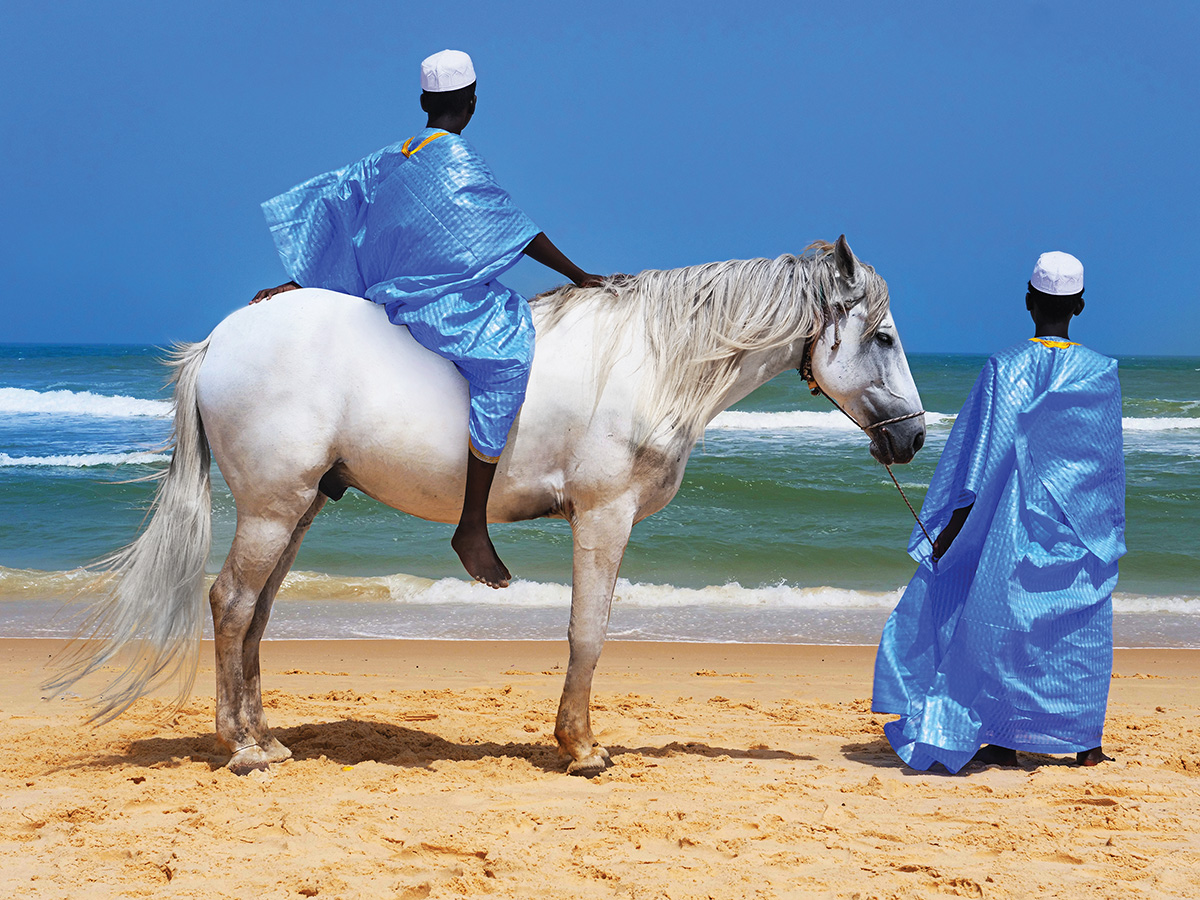
Rien ne se perd, rien ne se crée – tout se transforme. L’héritage de l’esclavage dépouille ceux pris dans son cauchemar étouffant de la plénitude d’une vie. A travers des images tantôt en mouvement, tantôt statiques, la réalisatrice Charlotte Brathwaite en collaboration avec le photographe Malick Welli imagine les rêves et les cauchemars de l’érudit fait esclave Omar ibn Said. A travers des projections en mouvement et des photographies en grand format, l'œuvre se déploie comme une mélodie fantôme du cinéma. Elle fait le lien entre l’esprit volé de Said et la présence vivante de ses ancêtres, traversant l’océan, traversant le temps et l’espace. FORGOTTEN PARADISE transforme les ténèbres de la captivité en lumière : celle de la liberté, et d’une famille aimante.
Creator/Director CHARLOTTE BRATHWAITE is the recipient of a Doris Duke Award, Art Matters Award, Creative Capital Award, Pew Center for Arts & Heritage Fellowship Grant, a United States Artist Fellowship, multiple Map Fund Awards and the Princess Grace George C. Wolfe Award amongst others. Brathwaite’s genre-defying work illuminates the realities and dreams of marginalized people; people whose stories have been silenced, disappeared, and ignored. Dealing with subject matter from the historical past to the distant future, her work brings to light issues of social justice, race, power, and the complexities of the human condition. A director of classical texts, multimedia, site-specific works, dance performances, operas, concerts, film, and installations - her trans-disciplinary inquiry manifests in spectacles of color and music. Her works – presented across the globe from North and South America, Europe, Africa, Asia and Australia – live in the deep time of aural/oral history and create an immersive experience for audience and performer alike which offers new perspectives in both form and content. MFA from Yale School of Drama and BA Amsterdam School for the Arts (the Netherlands). As an educator, she has taught and mentored at several institutions including the University of Fortaleza (Brazil), Barbados Community College (the Caribbean), Massachusetts Institute of Technology, Amherst College, New York University, Stanford University amongst others. www.charlottebrathwaite.com ________________ Malick Welli is a Senegalese visual artist who lives and works in Dakar, Senegal. His work addresses themes of duality, spirituality, history and the restitution of memory, pedagogy and displaced identity. Welli is interested in the convergence of religion and material influences, economics and power dynamics, and how these elements shape visual culture. There's a quest for ecology and interdependence, and how seemingly independent events coincide and influence each other. Welli contrasts these material concerns of the community with individual spiritual needs. Welli's work has been collected and exhibited worldwide: "In Brilliant Light" at the Afrika Museum in Berg en Dal and MuseumVolkenkunde in Leiden, Netherlands (2023-2024); "Insistent Presence: Contemporary African Art from the Chazen Collection" at the Chazen Museum of Art, Wisconsin, USA (2023); 1.54 Contemporary Art Fair, New York, USA (2023); "Sur le fil... " at 19M in Paris (2023) ; 1-54 African Contemporary Art Fair , Marrakech, Morocco (2023) ; Art x Lagos, Nigeria (2022), "Lightness of Being" a solo exhibition at Galerie Atiss Dakar (2022) ; "Les Invincibles" at the Biennale de Dakar (2022) ; Blackstar Film Festival, Philadelphia, USA (2022); 1- 54 Contemporary African Art Fair, New York (2021); EXPO CHGO, Chicago, USA (2019); Cairo Biennale, Egypt (2019); "Saint-Louis to St Louis", Barret Barrera projects, Missouri, USA (2019); AKAA: Also Known As Africa fair, Paris, France (2018); "Pour les Noirs et pour les Blancs , Hierro Desvilles Gallery, Lille, France" (2016).
Ulu Braun
Catalogue : 2025Gerhard-Trailer | Vidéo | hdv | couleur | 2:0 | Allemagne | 2024
Ulu Braun
Gerhard-Trailer
Vidéo | hdv | couleur | 2:0 | Allemagne | 2024
An ecstatic biopic about the world's most successful living painter. In vivid images, this AI hybrid film sheds light on the social role of painting in the field of tension between creativity, capital investment and spirituality. We are currently in the middle of the transition phase from analog to artificial reproducibility. Gerhard's unique painting techniques, especially squeegeeing, have triggered a worldwide hype. His techniques and ideas are being adapted, refined and improved by global “protagonists” and then flooded the markets (+social media). The myth of the “genius” writes itself into the DNA of an increasingly uncontrollable chain of creation as a fabulous and controversial homage.
Ulu Braun (1976) lives in Berlin and Finland. Between 1996 - 2005 he studied painting and film in Vienna, Helsinki, and Berlin. He has been using the medium of video to explore the field between the visual arts and auteur cinema since 1997 and he is one of the key figures who have transferred painting into video art. His works are regularly shown at film festivals and exhibited in art institutions.
Catalogue : 2023SATURNE | Film expérimental | mov | couleur | 74:0 | Allemagne | 2022
Ulu Braun
SATURNE
Film expérimental | mov | couleur | 74:0 | Allemagne | 2022
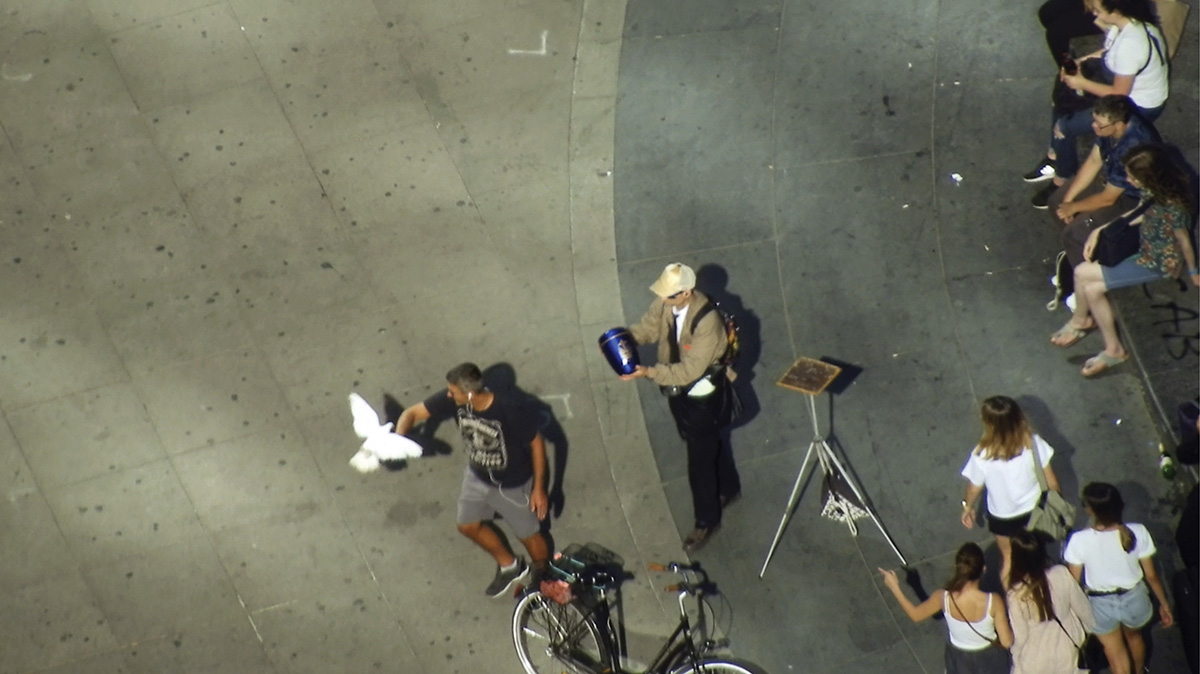
The magical-realist camera follows the trials and encounters of Jonathan as he attempts to fulfill his mother’s final wish: that her ashes be laid to rest at Alexanderplatz, Berlin. Carrying her blue urn and searching for a suitable location, he attempts to gain permission, assistance, and sometimes merely empathy from his fellow citizens. From bridges to construction sites, electronics megastores to public fountains, encountering a nun, an artist, and various figures he traces circles around the concrete epicenter of the busy metropolis, revealing a place where commerce, branding, bustle, and tourism overshadow historical landmarks and personal relations. The private pathos of a son mourning his mother encounters the cold and normalized absurdity of hypercapitalism, history, and everyday city life.
Ulu Braun (1976) lives in Berlin and Lieksa. Between 1996 - 2005 he studied painting and film in Vienna, Helsinki, and Berlin. He has been using the medium of video to explore the field between the visual arts and auteur cinema since 1997 and he is one of the key figures who have transferred painting into video art. His works are regularly shown at film festivals and exhibited in art institutions.
Catalogue : 2010WESTCOAST | Vidéo | | couleur | 7:20 | Allemagne | 2009
Ulu Braun
WESTCOAST
Vidéo | | couleur | 7:20 | Allemagne | 2009
Westcoast is a panorama-video consisting of interweaved scenes mounted on a coastline - somewhere between Rotterdam and Sydney. Starting from a bubbling primordial soup the view pans along a waterfront in the style of a late transnational financial eclecticism and passes mystical spots such as a giant hippo eating carrots and hectically spinning rubber boats. After a dark spiritual waterway recalling Hieronymus Bosch atmospheres, the panorama ends in a cave with refuse-Jacuzzi in which a white woman gazes about herself melancholically.
Ulu Braun (1976) is belonging to a new generation of artists that entered the field of digital film with a background in visual arts and street art. In his works he integrates various production methods to form sceneries that play between Hollywood, Prado and periphery. In most of his works he observes the tragic of reality from different angles. Braun exhibits internationally including recent solo shows in Germany, Belgium, USA and group shows in Germany, Spain, France, Finland, Estonia and Greece. His works have been screened at the major experimental Film and Media Art Festivals. Collaborations with Roland Seidel as BitteBitteJaJa and finnish artist group YKON. He is currently living in Berlin. www.ulubraun.com
Ulu Braun
Catalogue : 2008Südwest | Art vidéo | | couleur | 1:45 | Allemagne | 2006
Ulu Braun
Südwest
Art vidéo | | couleur | 1:45 | Allemagne | 2006
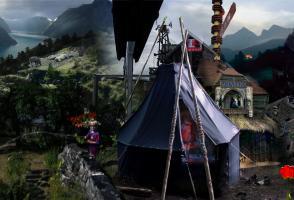
Südwest est une construction détaillée et utopique d'un paysage, qui unit des aspects de la tradition et de la globalisation. La vidéo combine des scènes idylliques de la culture européenne avec les promesses cataloguées de l'industrie du tourisme moderne pour créer un panorama qui recréé la mystique poétique de choses pourtant si courantes à nos yeux.
Bio: geboren 1976 in Schongau. Lebt in Berlin und Helsinki. 1996-2000 Studium der Malerei und Grafik an der Universität für angewandte Kunst in Wien. 2001-2006 Filmstudium an der HFF-Potsdam 1999 & 2007 Stipendium am Time & Space Department, University of Fine Arts Helsinki, seit 1997 Zusammenarbeit mit Roland Seidel als BitteBitteJaJa.
Adriana Bravo, Ivanna Terrazas
Catalogue : 2018Beso de chola (Chola Kiss) | Vidéo | hdv | couleur | 4:0 | Bolivie | 2016
Adriana Bravo, Ivanna Terrazas
Beso de chola (Chola Kiss)
Vidéo | hdv | couleur | 4:0 | Bolivie | 2016
On connait cet art du détour que Sophie Roger pratique pour nous mener par des chemins inattendus avec l’amitié comme fil, déplié avec Le Point aveugle (FID 2012) ou Les Jardiniers du petit Paris (FID 2010). Ici ce sera, tissée tout en délicatesse à l’écran, l’amitié avec Mohamed, réfugié soudanais au Havre. Faite de partage, d’attention, d’écoute et de rire, et de vagues en vagues, celles du texte éponyme de Virginia Woolf qu’elle lui lit, à celle de Courbet au musée du Havre, qu’il animera de son regard. (FIDMarseille)
Pamela Breda
Catalogue : 2026Synthetic Dreams | Doc. expérimental | 4k | couleur | 70:0 | Italie, Islande | 2025
Pamela Breda
Synthetic Dreams
Doc. expérimental | 4k | couleur | 70:0 | Italie, Islande | 2025
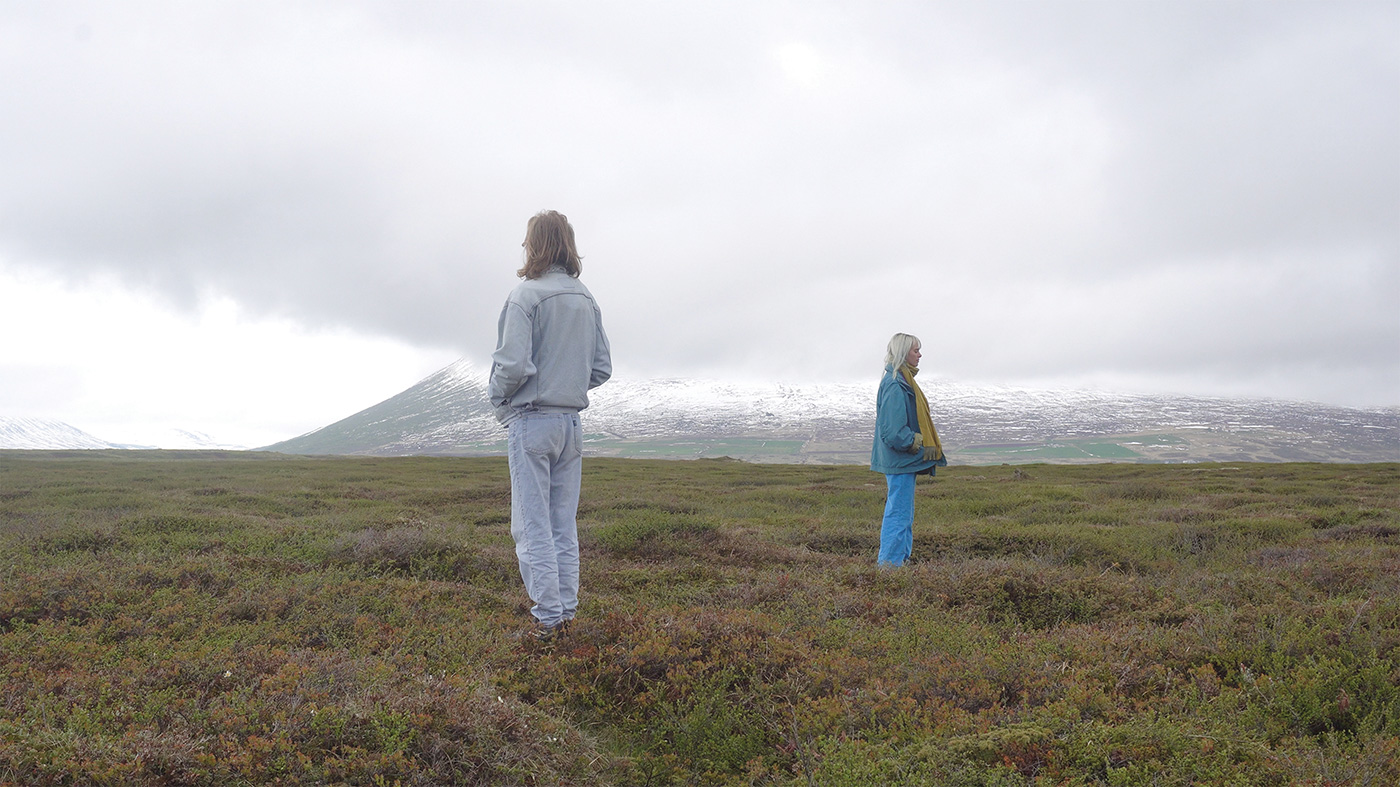
Set against remote European landscapes, this experimental documentary explores the evolving relationship between humans and artificial intelligence. Drawing on the theories of futurologists Max Tegmark, Ray Kurzweil, and Kevin Kelly, the film envisions speculative futures shaped by advancing technology, probing the ethical, existential, and emotional dimensions of our coexistence with AI. At the center are two actors engage spontaneously with selected excerpts from these thinkers’ writings forms the core of the narrative. Without preparation or direction, their unfiltered responses transform abstract ideas into emotional exchanges, bridging philosophy and lived experience. The landscapes themselves become metaphors for the uncharted territories of consciousness and creation, where human thought meets artificial intelligence. Blending theoretical inquiry with improvisation, the film unfolds as a reflective dialogue between the human and the speculative. It invites viewers to contemplate the uncertain balance between fear and hope, control and surrender, that defines our approach to intelligent machines—and ultimately asks: what kind of future are we bringing into being?
Pamela Breda is an artist, filmmaker, and researcher based in Vienna. She has been appointed as an artist and fellow in residence at several prestigious international institutions, including Villa Medici - Accademia di Francia (Rome), Cité Internationale des Arts (Paris), and Pratt Institute (New York, USA). Her films have been screened at renowned festivals and art venues worldwide, including Sheffield DocFest (UK), ECRA Film Festival (Rio de Janeiro, Brazil), Revolutions Per Minute Festival (Boston, USA), Visions du Réel Film Festival – Media Library (Nyon, Switzerland), and Hazel Eye Film Festival (Tennessee, USA). Her interdisciplinary research focuses on the visual tropes and cultural traditions that shape contemporary image-making. She explores critical themes such as the impact of digital imagery on perception, the evocation of an absent or dematerialized body, and the interplay between duration, dormancy, and memory. Her work engages with memetics and the generative processes of recollection, examining how personal and collective histories are constructed, archived, and transformed over time. Through her films and installations, she investigates the evolving relationship between human vision, technological mediation, and artistic authorship in the digital age.
Catalogue : 2023The Shape of Things to Come | Fiction expérimentale | hdv | couleur | 25:0 | Italie, France | 2022
Pamela Breda
The Shape of Things to Come
Fiction expérimentale | hdv | couleur | 25:0 | Italie, France | 2022
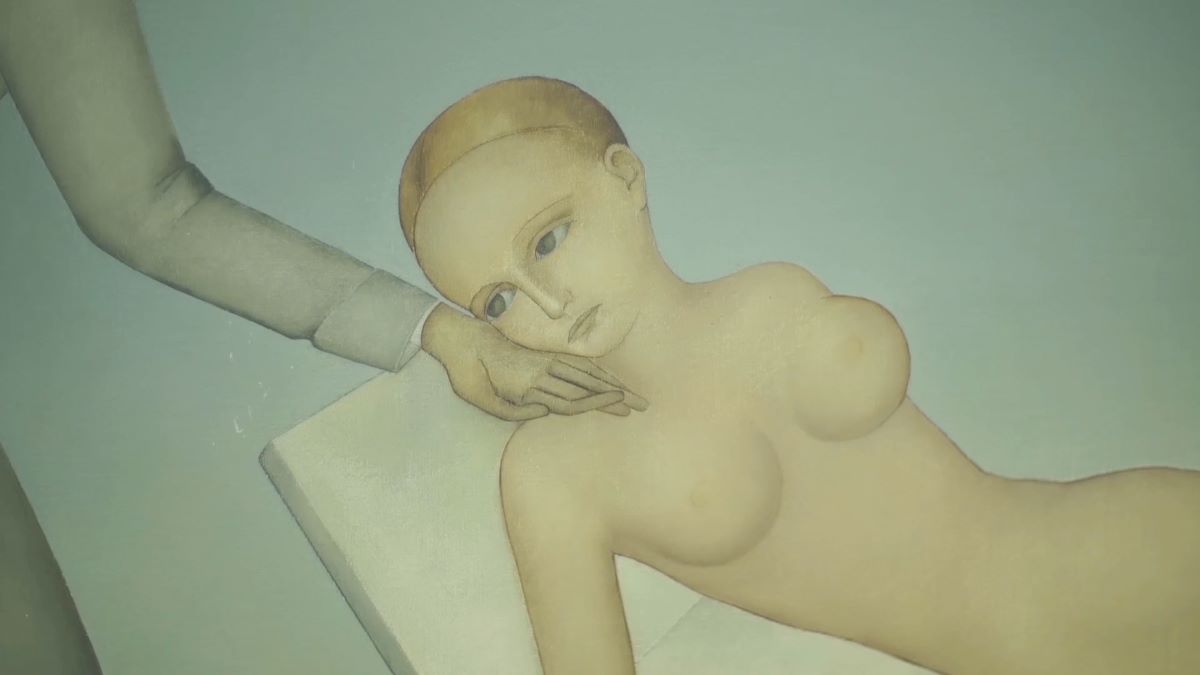
What is the future of life in a world ever more dominated by Artificial Intelligence Can we develop a sense of connection and empathy towards highly elaborated machines? In a time when the lines between humanity and technology blur, "The Shape of Things to Come" takes audiences on a journey of human-AI interaction that challenges our perceptions of identity, love, and ethics. The film follows the activities of a team of pioneering researchers pushing the boundaries of AI technology, seeking to develop an AI with the capacity to feel and understand emotions. As they delve deeper into the mysteries of human emotions, they confront ethical dilemmas, technical challenges, and unforeseen consequences. Tensions rise as the project advances. Some believe that bestowing AI with emotions could revolutionize healthcare, therapy, and human-AI partnerships, while others fear the potential risks and moral implications. " The Shape of Things to Come " explores profound questions about the nature of consciousness, the essence of humanity, and the ethical responsibilities that come with playing the role of creator. As the project's success seems within reach, the researchers must confront their own humanity and the consequences of their ambition.
Pamela Breda is an artist, filmmaker and researcher living between Turin and Vienna. She holds a MA in Visual Arts from IUAV University (IT) and a PhD in Visual Arts from Kingston University (UK). She was appointed artist and fellow in residence at several international art institutions, including Max Planck Institute For Empirical Aesthetics (Frankfurt, DE), Pratt Institute (New York, USA), Cité Internationale Des Arts (Paris, F), PROGR (Bern, CH) Botin Foundation (Santander, E). She was recipient of several art awards and fellowships, including IMèRA Fellowship (Marseille, F), Cantica 21 (MibaC, IT), Italian Council Award (MibaC, IT), Kingston University Phd Scholarship (Kingston, UK), Moving’Up (Turin, IT), JRC, Joint Research Center, European Commission (Ispra, IT), ‘Love Me Tender’, Stonefly Production Prize (Fabbrica del Vapore, Milano, IT), Italian Institute of Culture (Moscow, RU), Photography Award, IED, European Institute of Design (Venice, IT). Her film research explores the intersections of visual imaginaries, narratives, and stories that often remain on the fringes of mainstream consciousness. With a deep passion for shedding light on the voices and experiences of marginalized communities, her work dives into the complex web of human existence, particularly focusing on the clash between old and new technologies that shape worldviews.
Catalogue : 2021April | Vidéo expérimentale | dcp | couleur | 13:21 | Italie | 2020
Pamela Breda
April
Vidéo expérimentale | dcp | couleur | 13:21 | Italie | 2020
"April" est un film court expérimental inspiré par la vie d'April Ashley, l'une des premières Britanniques à avoir subi une chirurgie de réattribution sexuelle, réalisée à Casablanca (au Maroc) le 12 mai 1960 par le docteur Georges Burou. Après son retour en Grande-Bretagne, elle a commencé à utiliser le nom d'April Ashley, et a eu du succès comme mannequin, apparaissant dans des publications telles que Vogue (photographié par David Bailey), et a décroché un petit rôle dans le film "The Road to Hong Kong" de Norman Panama. Après qu'un ami ait vendu son histoire aux médias, en 1961, sous le titre "'Her' secret is out", le Sunday People a révélé qu'Ashley était une femme transgenre. Elle est au centre de l’attention et de la controverse, et son nom est instantanément supprimé du générique. Le scandale la contraint à vivre à l'étranger pendant plusieurs années. Ce n’est qu’en 2006 qu’elle a été reconnue légalement comme femme.
Pamela Breda est artiste et cinéaste. Elle vit entre Londres (Royaume-Uni) et New York (USA). Elle a reçu plusieurs prix et bourses d'art, dont la bourse Sirovich Family Fellowship, au Pratt Institute, New York (USA), le Simultan Art Prize (Pologne); le Cantica21 (Italie); le prix du Conseil italien (Italie); le prix Moving'Up (Italie); et le prix Italian Institute of Culture (Russie). Ses films ont été projetés à l’international, et présentés dans divers festivals et lieux d’art notamment au ECRÃ Film Festival, Rio de Janeiro (Brésil); au Revolutions Per Minute Festival, Boston (USA); à la Digital Film Library; au Festival international du court métrage de Clermont-Ferrand (France); à la Cité Internationale Des Arts, Paris (France); à Vision Du Réel, Nyon (Suisse), au Hazel Eye Film Festival, Nashville (USA); au The Bomb Art Factory Film Festival, Londres (Royaume-Uni); au Sohonya Art Center, Bangalore (Inde); à la Francesco Fabbri Foundation for Contemporary Art, Pieve di Soligo (Italie); et à la Fondation Bevilacqua La Masa, Venise (Italie).
Karolina Bregula
Catalogue : 2022Dust | Fiction expérimentale | mov | couleur | 21:45 | Pologne, Taiwan | 2021
Karolina Bregula
Dust
Fiction expérimentale | mov | couleur | 21:45 | Pologne, Taiwan | 2021
Dust is a story about two women living in an old district earmarked for demolition. Since their building is due to be demolished soon, all the neighbours have already left. Yet, the women decide to stay in their flat. The protagonists spend time in the abandoned multi-storey building and observe through the window bulldozers working around. Four out of five films were made in collaboration with Ms. Zou and Ms. Huang from Daguan in Taipei. When the project was in production, their houses in Daguan were bound for demolition while Ms. Zou, Ms. Huang together with their neighbours kept fighting against the evictions in the district. The first two films are a fictive story staged with Ms. Zou and Ms. Huang in an empty building awaiting demolition in central Taipei. I entered the building, cleaned up and furnished one chosen flat to turn it into a friendly liveable space and used it as a film location. Another two films are a conversation between Ms. Zou and Ms. Huang, Ms. Huang singing a sad song which reminds her of home and an image of a Daguan streets. The last film is a documentation of the demolition of the house where the first two films were made. One month after the films were done, Ms. Zou and Ms. Huang were forced to move away and Daguan was demolished.
Karolina Bregu?a (b. 1979) is a visual artist, a graduate of the National Film School in ?ód?. She creates films, photographs, installations and performance. Her work explores the problems of the status of the artwork and the materiality of art objects. She critically scrutinises contemporary art and its reception. She creates stories about art and architecture, which are a field of her anthropological and sociological observations. She is interested in the connection between art and reality – the favourable and detrimental effect of artists’ work, the remedial and destructive force of artistic activity, rituals connected to art and art’s social role. Many of her works are co-created with their protagonists and participants, blurring the border lines between professional and amateur artistic activity. Her works have been exhibited at institutions such as National Museum in Warsaw, Jewish Museum in New York and MOCA Taipei and at international events such as Venice Art Biennale and Singapore Biennale. She is the winner of the second prize in the Views 2013 Deutsche Bank Foundation Award, the third Samsung Art Master 2007 award and the 2016 Golden Claw at the Gdynia Film Festival. Her works are included in collections such as Tokyo Photographic Art Museum, Zach?ta National Gallery of Art, Wroclaw Contemporary Museum and ING Polish Art Foundation. She is an associate professor at Academy of Art in Szczecin, she collaborates with lokal_30 Gallery. She lives in Warsaw.
Catalogue : 2017Wieza | Fiction expérimentale | hdv | couleur | 78:0 | Pologne | 2016
Karolina Bregula
Wieza
Fiction expérimentale | hdv | couleur | 78:0 | Pologne | 2016
`The Tower` is an opera musical about a group of people who live in the same concrete block of flats and who plan building a sugar tower together. Full of absurd and anxiety, the story of the utopian project is addressing the history of post war housing architecture analysing it from the position of its user, the inhabitant of a modernist city. The dreams and desires are juxtapositioned with difficult reality of life in the blocks and contradictions inscribed in the modernists` plans.
Karolina Bregula(born 1979) is a visual artist and filmmaker. She has performed and exhibited in places such as “the VeniceArt Biennale” the Jewish Museum in New York and the National Museum in Warsaw.She has received numerous awards including The Golden Claw at Gdynia Film Festival, the Views 2013 and Videobrasil 2015. She has been awarded multiple scholarships including the Polish Ministry of Culture Scholarship, the Visegrad Scholarship and the UNESCO scholarship. She lives and works in Warsaw.
Dietmar Brehm
Catalogue : 2023Hylo - Vision - Plus (Version 1) | Vidéo expérimentale | 0 | couleur | 3:18 | Autriche | 2023
Dietmar Brehm
Hylo - Vision - Plus (Version 1)
Vidéo expérimentale | 0 | couleur | 3:18 | Autriche | 2023
Dietmar Brehm's Hylo-Vision-Plus. Version 1 is a minimalistic study of ecstatic moments and it is named after eye-drop medicine.
born in 1947 in Linz 1967-72 studied painting at the University of Fine Arts/Linz. Professor at the University of Fine Arts/Linz. Drawing + painting, experimental films and photography. Numerous filmscreenings and exhibitions at home and abroad. 1974-1989: 74 Super8 films since 1990: 16mm films since 2000: video
Dietmar Brehm
Catalogue : 2019Inside - The Color Version | Vidéo | hdv | couleur | 5:0 | Autriche | 2017
Dietmar Brehm
Inside - The Color Version
Vidéo | hdv | couleur | 5:0 | Autriche | 2017
It hisses, it blinks. A virtual, two-dimensional anaglyph flickers in red and green, unfolding a visual space true to the Brehmian aesthetic. Concentratedly condensed collisions occur between everyday life and the world, being and performing, symbols and icons. A human skull, human bodies, Castle Grafenegg as an architectonic stand-in for the uncanny … Sex and crime, art and pop culture flicker at pixilated speed – the stuff of dreams – most penetrating however brief. The mundane alternates with the fetish, glimpsed in the blink of an eye, intersected by a long drag on a Chesterfield cigarette while the full-bodied, tube-amped slow-motion reverb sound of a guitar swings in the background.
Dietmar BREHM Born in 1947 in Linz. 1967-72 studied painting at the Academy of Fine Arts/Linz professor at the Academy in Linz. Since 1973 teaches at the Academy in Linz. Drawing + painting, experimental films and photography. Numerous filmscreenings and exhibitions at home and abroad, various awards for his work.
Catalogue : 2017Hallo Mabuse | Film expérimental | hdv | couleur | 5:0 | Autriche | 2016
Dietmar Brehm
Hallo Mabuse
Film expérimental | hdv | couleur | 5:0 | Autriche | 2016
First, a view of nature: an overcast sky, the chirping of birds. This plays the part of a colorful overture, still open to the world. Steps and the sound of a pushbutton telephone lead acoustically into one of Dietmar Brehm’s "intrusion films": Hallo Mabuse. Here, arriving at the other end of the line, intruding into the image means reversing polarity to negative and concentrating on the schematic through a type of circular aperture. A man’s profile and facial features lose their contours in the heavy light-dark contrasts, yet also emerge expressively. A dialogue of cryptic gestures unfolds. The source: several scenic miniatures from The Testament of Dr. Mabuse, Fritz Lang’s famous crime film about hypnosis and terror created in the interwar period. Brehm already included this material once before, in a shorter version, in tape 14 of the Praxis series; now he presents it as an autonomous member of the series; decelerated, with a new editing sequence, and also additional pictorial motifs. Hallo Mabuse captivates through its reduction, in which a conspiratorial narrative takes place, but even more so, the images themselves appear ambiguous, obscure, untrustworthy. A nod of the head, which seems treacherous in its mechanical repetition, meets the profile of a bearded man who does not appear to react at all in a suggested counter shot. The slight flickering of the image further intensifies the impression of an illicit agreement, of witnessing a crooked handshake. The ringing of the unseen telephone and the constant ticking of a clock lend the events a limited temporality. Something is running out, and in doing so, is also already reaching its end, a ghostly final act, which is anticipated by an explosion and breaks off with the sound of a falling guillotine. (Dominik Kamalzadeh)
Dietmar Brehm is born in 1947 in Linz 1967-72 studied painting at the University of Fine Arts/Linz. Professor at the University of Fine Arts/Linz. Drawing + painting, experimental films and photography. Numerous filmscreenings and exhibitions at home and abroad.
Andreas Brehmer
Catalogue : 2014La Reprise. a description | Vidéo | dv | couleur | 16:35 | Allemagne, France | 2010
Andreas Brehmer
La Reprise. a description
Vidéo | dv | couleur | 16:35 | Allemagne, France | 2010
/Users/andbrehm/Dropbox/Private/_Lebenslauf/140216_abrehmer_CV_ganz-kurz.txt
Michele Bressan
Catalogue : 2014fifth,sixth and seventh floor | Documentaire | dv | couleur | 4:27 | Roumanie | 2010
Michele Bressan
fifth,sixth and seventh floor
Documentaire | dv | couleur | 4:27 | Roumanie | 2010
The block across the street, or mirror block, has been for the past 17 years my immediate landscape, a modular display of my closest reality, one I often avoided, as familiar images get skipped, distancing into the background. It happens because repetition eventually subsides the identification process. I chose to recognize the occurrences nearby and regard my quotidian landscapes as a view, put together by architecture and space boundaries, which also cause an involuntary voyeurism to appear.
Michele Bressan (b.1980) in the last few years his works were exhibited in several solo and group exhibitions, including Museum fur Photographie Braunschweig (2013), Centre Wallon d`Art Contemporain (2012), ViennaFair The New Contemporary (2012), Les Rencontres d`Arles photo festival (2011), Musée d`Art Moderne Saint Etienne (2011), Gate11 international departures, Fondazione Fotografia Modena (2011), Biennale di Venezia, Padiglione Italia nel Mondo (2011), Mois de la Photo (2010), National Museum of Contemporary Art Bucharest (2009/2010), Performance Art Institute San Francisco (2010), ESSL Museum Wien (2009), Neuen Museum/ Bauhaus Universitat Weimar (2009). In 2010 he won the Constantin Brabcusi fellowship at the Cité Internationale des Arts Paris. In 2009 he recived the ESSL award for photography, in the same year was nominee for the Henkel award.