Catalogue > Faire une recherche
Résultats pour : Tout le catalogue
Julien Loustau
Sub
Doc. expérimental | dv | couleur | 45:0 | France, Chine | 2006
Le lac Vostok est prisonnier sous les glaces de l?Antarctique, isolé du reste du monde depuis des millions d?années. Cet environnement exceptionnel, privé de lumière, soumis à des températures et des pressions extrêmes, abrite peut-être des formes de vie inconnues.La seule technologie qui permettrait d?atteindre le lac sans risquer de le contaminer serait le Cryobot, une sonde conçue par la Naza pour l?exploration d?oceans subglaciaires sur Mars et sur Europe. En Chine, dans la région des Trois Gorges, on finit de construire le plus grand projet hydroélectrique du monde. Le barrage a déja noyé 600km de vallées, entraînant la disparition de centaines de villes et le déplacement de 1,8 millions de Chinois. Le long d?un voyage nocture sur le fleuve Yangtze, dans l?exploration distante de ses berges en sursis, le film envisage l?odyssée solitaire du cryobot à travers les glaces jusqu?au lac Vostok.
Julien Loustau est né en 1971 à Salies-de-Béarn. Il vit et travaille à Paris.

Ariane Loze
Nein weil wir
Vidéo | hdv | couleur | 18:11 | Belgique, Allemagne | 2019
La conscience collective s'est forgée à travers les siècles, mais le navivre de la société vogue à toute allure sur les mers de la mondialisation. Des voix parfois très anciennes nous mettent en garde sur les risques qu'encourent les hommes, livrés à la démesure. Le film fait entendre des fragments de ces discours, qui de génération en génération, ont porté la ferveur et l’espérance citoyenne, devant une salle vide, symbole de notre désertion devant les réalités, signe de notre capitulation progressive, expression de notre renoncement. Dehors, il pleut de plus en plus et un vent terrible se lève. Le changement climatique est à l'horizon... Augmentez la vitesse!
Ariane Loze, Belgique 1988. Vit et travaille à Bruxelles, Belgique Ariane Loze étudie le développement d’une narration à partir d’images apparemment sans rapport. Dans cette série de vidéos, elle joue tous les rôles : elle est tour à tour actrice, réalisatrice et camera woman. Par le montage, ces images mettent en relation deux (ou plusieurs) personnages et l’architecture. Les videos d’Ariane Loze proposent au spectateur de prendre part à la création de la narration grâce aux principes du montage cinématographique: le champ / contre-champ, la continuité de mouvement, et la suggestion d’une narration psychologique. Le tournage de ces vidéos a été rendu public devenant donc une performance. Ariane Loze a étudié la mise-en-scène au RITCS de Bruxelles et a participé à a.pass (Advanced Performance And Scenography Studies) à Bruxelles. Elle était résidente au HISK (Institut Supérieur des Beaux-Arts) à Gand en 2016-17. Les expositions récentes incluent Videoformes Clermont-Ferrand (2015), Traverse Vidéo Toulouse FRAC Midi-Pyrénées (2015), Medienwerkstatt Berlin (2016), S.M.A.K. Etcetera Gand (2016), Fondation Boghossian Bruxelles (2016), De Appel "You are such a curator !" Amsterdam (2016), "Kunst om de lijf" Emergent Veurne, New York Anthologie Film Archive AXW projection (2017), Watch this space Biennale # 9 Lille-Bruxelles (2017), "Gemischte Gefühle" Tempelhof Berlin (2017), Salon de Montrouge Paris (2018), RIBOCA Riga Biennial of Contemporary Art (2018), Moscow Biennial of Young Art (2108) KANAL Centre Pompidou Brussels (2018), solo exhibition au Centre d’Art Contemporain Chanot, Paris, exhibition at Gallery Michel Rein Paris (2019, Urbane Künst Ruhr – Ruhr Ding : Territorien, commissaire Britta Peters Oberhausen (2019), Solo exhibition De Vereniging S.M.A.K., Ghent (2019), Solo exhibition Gallery Michel Rein Brussels (2019). Les vidéos d'Ariane Loze ont été sélectionnées pour le Prix Movimenta Video Art à Nice (2017) et le Prix Médiatine Brussels (2016) et récompensées au Art Contest Brussels (2015), par la Art For All Society de Macau (2016), Côté Court Festival Pantin (2017), Watch this Space Biennale #9 (2017) and Salon de Montrouge (2018) Ariane Loze sera résidente au ISCP New York sur l’invitation de la Foundation Salomon de janvier à juin 2020.
Gabriela Löffel
Nous n’avons pas besoin de nous connaître à l’avance
Installation vidéo | hdv | couleur | 20:15 | Suisse | 2024
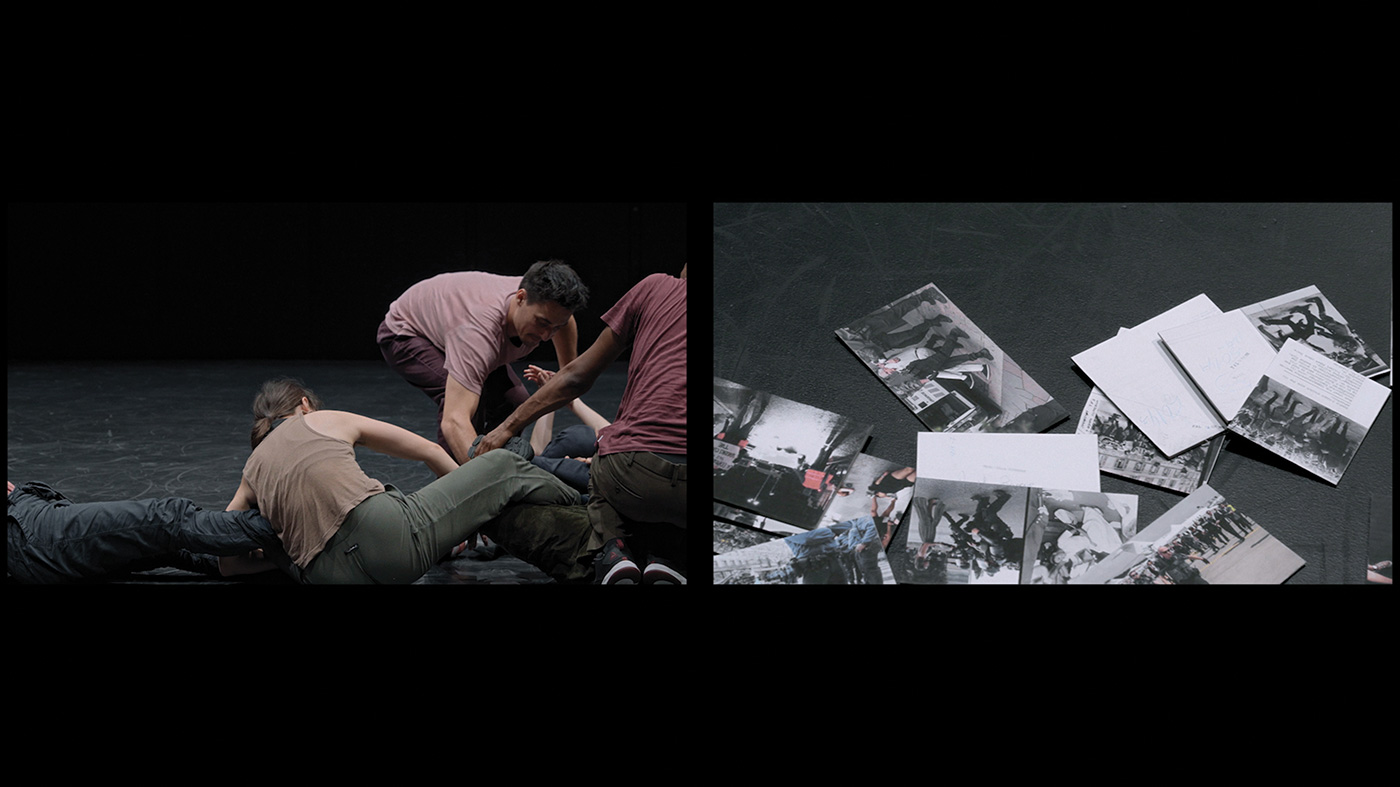
« Nous n’avons pas besoin de nous connaître à l’avance » est une œuvre vidéo hybride, qui alterne des moments de performance dansée, des images d'archives et des citations textuelles. Gabriela Löffel s'appuie sur l'aspect politique de l'espace public pour construire sa réflexion et développe un essai visuel qui met en scène la "performativité des corps dans cette zone d'action politique". En puisant dans l'œuvre écrite de Judith Butler, philosophe et théoricienne du genre états-unienne qui a travaillé sur la question du corps et de sa représentativité normée dans nos sociétés contemporaines, Löffel donne véritablement une corporéité aux questions soulevées par l'auteure. Les citations issues de l'œuvre de Butler sont données à voir en parallèle aux éléments dansés et archivistiques de la vidéo. La caméra presque fixe permet d'examiner en détail les gestes lents et précis des danseur·euse·s. Les déplacements de l'appareil sont presque imperceptibles, tant ils sont subtils. L'artiste et le chorégraphe Cédric Gagneur ont étroitement collaboré afin de définir les divers mouvements qui composent la chorégraphie : ils proposent une abstraction des gestes de résistance ou de révolte, tirés des images d'archives issues de la collection des Archives contestataires de Genève. La lenteur et le silence habitent la pièce et donnent suffisamment d'espace au corps pour qu'il puisse se déployer de manière individuelle ou en collectivité. L'œuvre propose ainsi une dialectique du potentiel de revendication dans l'espace public. Œuvre coproduite par le Fonds cantonal d'art contemporain, Genève, avec le Fonds d'art contemporain de la Ville de Genève pour le programme MIRE.
Gabriela Löffel travaille principalement avec des médias temporels et se concentre sur les zones grises des structures politiques et financières, ainsi que sur les infrastructures. Le déplacement et la traduction de l’immédiat documenté vers les champs de l’interprétation et de la mise en scène sont des stratégies qu’elle utilise dans son processus de travail. Une méthode qui donne souvent lieu à des projets à long terme et lui permet de créer des espaces de questionnement et de proposer des ruptures avec les récits linéaires. Elle s’intéresse à l’obliquité du sujet et de son contexte. C’est dans ce décalage, induit par sa manière d’aborder les sujets, que son travail ouvre des réflexions sur le sens de la compréhension d’un monde lorsque l’on prend conscience de la fragmentation de nos connaissances. Son travail a été présenté dans des institutions et des galeries dont MAST Bologne, Aargauer Kunsthaus, EMAF Osnabrück, Galería Metropolitana Santiago, Dazibao Montréal, la Biennale Kochi-Muziris et autres. Gabriela Löffel est lauréate du Swiss Art Award, du Lewis Baltz Research Fund, de la bourse Landis+Gyr, ainsi que d'autres.
Birgit Ludwig
The Partition
Fiction expérimentale | hdv | couleur | 21:21 | Luxembourg, Royaume-Uni | 2018
Blake awakes from a comatic episode for which there doesn't seem to be any explanation. Set in London, the film interweaves his and other characters' discontinued journeys marked by peculiar moments and encounters. At once sober and enigmatic, "The Partition" reflects on singularity, alienation and intangible windows in the wider context of a shifting techno-capitalist environment.
Birgit Ludwig (b. Luxembourg) is a filmmaker and artist based in London. Her films take the form of unconventional dramas or documentaries, interweaving realism and a poetic uncanny. She is a graduate of Central Saint Martins School of Art (BA Fine Art/Phoebe Llewellin Smith Scholarship Award) and Kingston University (MA Experimental Film).
Immo Luedemann
Estate
Doc. expérimental | dv | couleur | 9:34 | Allemagne, USA | 2005
La vidéo est composée de scènes qui décrivent une matinée dans une banlieue de Sud-Californie. Des vues subjectives et observatrices de l'espace et des détails établissent le lieu. Les images et le montage suggèrent un développement narratif fermé du film. Rapidement après qu'il semble qu'un personnage devient établi, une coupure intervient. Les images montrant des opinions subjectives changent l'on peut entendre trois marines US répondre sur leurs conditions de vie en Iraq pendant que les images, elles, restent en banlieue.
Immo Lüdemann wurde 1975 in Düsseldorf geboren und studierte bis zum Jahr 2005 an der Universität der Künste Berlin und dem California Institute of the Arts, Los Angeles, bei Heinz Emigholz, Harun Farocki und James Benning. Seine Arbeiten beschäftigen sich mit strukturellen Problemen des filmischen Erzählens und mit Fragen der narrativen Beziehungen von Bildern. Er lebt und arbeitet in Berlin und Hamburg. Immo Lüdemann was born in Düsseldorf in 1975. Until 2005 he studied at the University of the Arts Berlin and the California Institute of the Arts, Los Angeles, with Heinz Emigholz, Harun Farocki and James Benning. His works deals with structural problems of cinematic storytelling and with questions of narrative relations between images. He lives and works in Berlin and Hamburg.
Stephan Lugbauer
About Me
Vidéo | hdv | couleur | 10:3 | Autriche | 2011
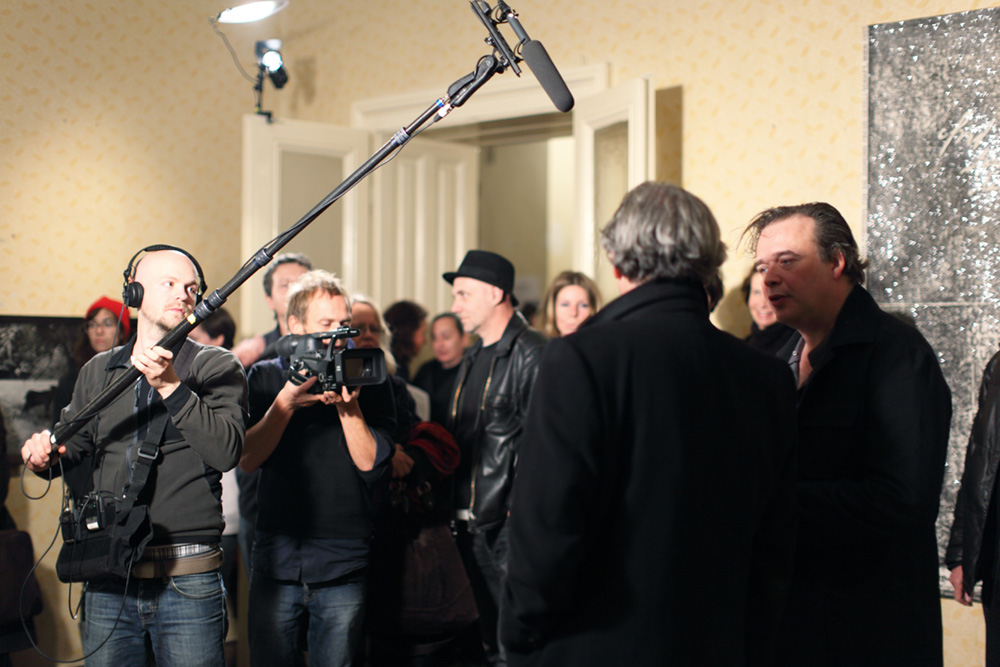
This work interlinks filmic, installative and performative layers. Joseph Kosuth?s compiled collection of contemporary art in the Freud Museum in Vienna is used as a filmset. Accompanied by a cameraman and sound technician a journalist interviews an artist pacing through the exhibition. The takes of this scene discuss conditions of myths of biographical narration and are being repeated over and over for about 50 minutes. The spectators transform into extras.
born 1976 in Feldkirch (Aut), lives and works in Vienna and Lower Austria 1994 Studies Architecture at the Technical University Vienna. 1996-2003 Studies at the Academy of Fine Arts Vienna. since 2008 Saprophyt, Projectspace (Co-founded with Barbara Kapusta), Webgasse 29, Vienna.
Stephan Lugbauer
The Mackeys
Film expérimental | hdv | couleur | 23:0 | Autriche | 2010
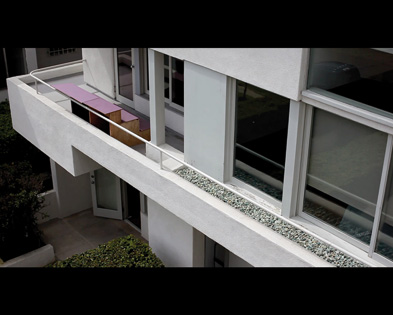
THE MACKEYS evolved out of a six months residency during the MAK Schindler Program in Los Angeles. The Movie A filmic collage on Los Angeles based on former residents?s memories, diary entries, references to art, literature and film. It starts with a young woman talking about a confusion of two movies with nearly identical titles - L.A. Plays Itself and Los Angeles Plays Itself. Subsequently follows a remake of the opening titles to Thom Anderson?s Los Angeles Plays Itself. A couple of minutes later we hear the sound of an helicopter taken from the opening sequence of Robert Altman?s Short Cuts while the camera pans in bird?s-eye view across the hedge?s and front yard of R.M. Schindler?s Mackey Apartment House. A voiceover recites a passage from Memoirs of My Nervous Illness by Daniel Paul Schreber: ?To make myself at least somewhat comprehensible I shall have to speak much in images and similes, which may at times perhaps be only approximately correct. For the only way a human being can make supernatural matters, which in their essence must remain incomprehensible, understandable to a certain degree is by compairing them with known facts of human experience.?
Stephan Lugbauers Arbeiten verbinden filmische, installative und performative Momente. Stephan Lugbauer (geb. 1976 in Feldkirch) lebt und arbeitet in Wien. Studium der Architektur an der Technischen Universität in Wien und Diplom an der Akademie für bildende Kunst Wien. Atelier Residency des BMUKK in Mexiko und MAK-Schindler Stipendium in Los Angeles, Ausstellungen und Performance- Projekte in Wien, Peking, Hong Kong, Los Angeles, Bern, New York, Köln, Las Palmas, Sofia etc. Mitbegründer des SAPROPHYT Project Space in Wien. www.stephanlugbauer.net www.saprophyt.net
Margit Lukacs, Persijn Broersen
Lion's Court
Vidéo | 0 | couleur | 20:0 | Pays-Bas | 2025
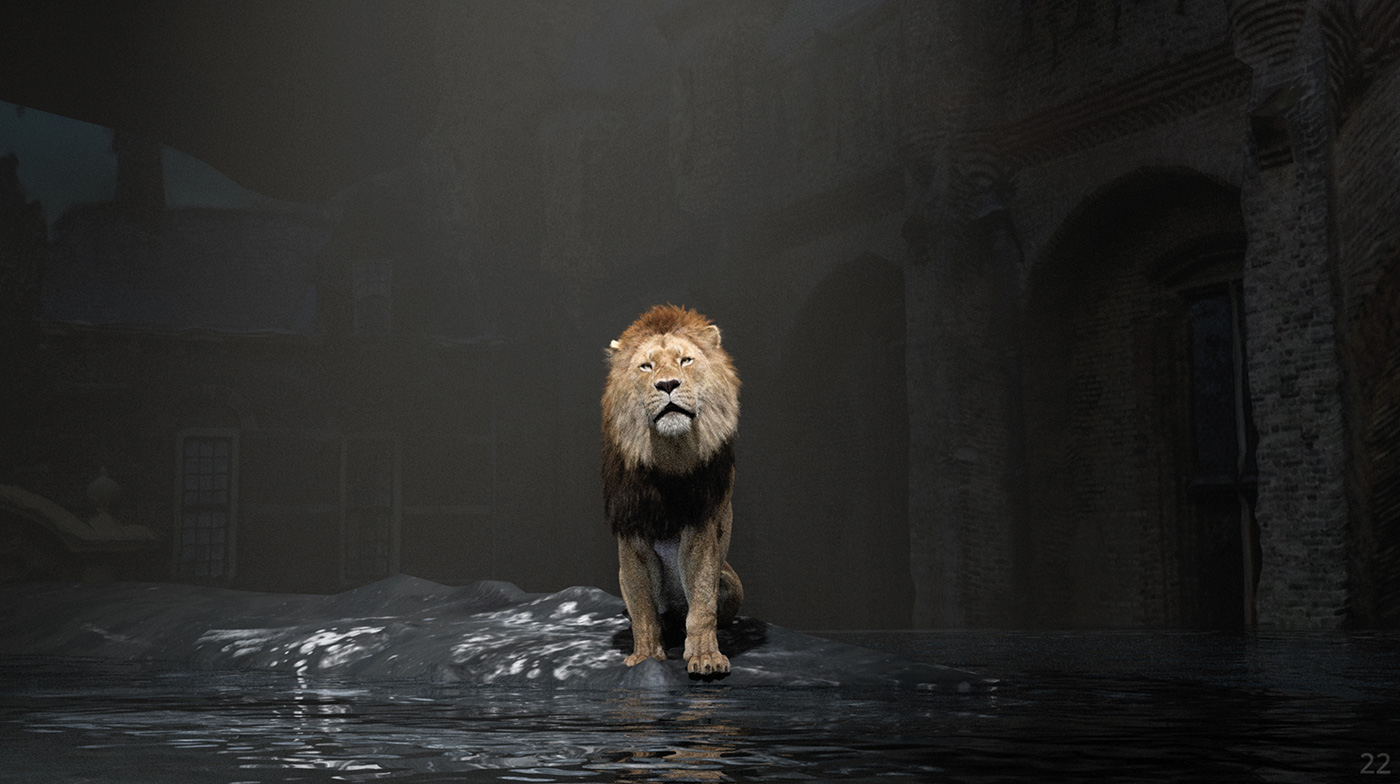
Lion’s Court est un court opéra cinématographique dans lequel le Binnenhof — siège du Parlement néerlandais à La Haye — est réimaginé comme une scène virtuelle où l’histoire se dissout dans le mythe. Inspirés par la découverte de restes de lions datant du XIV? siècle sur le site, et par la figure des baleines échouées interprétées comme des présages, Lukács & Broersen ont collaboré avec le compositeur et politologue Bram Kortekaas pour réinterpréter la vision goethéenne de la rédemption dans Faust. Au centre de cette œuvre se tient le lion Faust, interprété par le baryton Michael Wilmering — un despote en quête d’une liberté qui se dévore elle-même, miroir d’une ambition impériale au bord de l’effondrement. Les artistes se sont également appuyés sur les écrits de 1650 de Johan de Witt, Grand Pensionnaire républicain, dont les mots sont portés par la baleine (alto-mezzo Carina Vinke), surgissant des fondations inondées du Binnenhof. De Witt soutenait qu’une véritable république ne doit pas être gouvernée selon les caprices d’un seul, mais fondée sur les principes de liberté et d’égalité — les bases mêmes de la démocratie. Dans Lion’s Court, un hortus conclusus numérique se déploie : un monde fluide et clos où pouvoir, morale et prophétie convergent, et où les mythes du passé résonnent au cœur des politiques du présent.
Margit Lukács et Persijn Broersen sont un duo d’artistes basé à Amsterdam, qui explore les enchevêtrements entre nature, culture et technologie. Leur travail comprend des films, des animations numériques et des installations spatiales qui interrogent la manière dont les médias façonnent notre perception du monde naturel. Diplômés du département de design graphique de la Gerrit Rietveld Academie, ils ont poursuivi un MFA au Sandberg Institute et ont été artistes en résidence à la Rijksakademie d’Amsterdam. La pratique de Broersen & Lukács s’ancre dans la théorie des médias, l’histoire de l’art et la mythologie. S’appuyant sur des sources cinématographiques, scientifiques et historiques, ils réinventent paysages et phénomènes naturels au travers d’environnements numériques stratifiés. Leur travail réfléchit souvent aux politiques de représentation et à l’appropriation de la nature, reconfigurant les récits dominants par des formes de narration fragmentées et multiperspectivistes. Leurs installations et leurs films ont été largement exposés à l’international, notamment au Stedelijk Museum Amsterdam (NL), au Centre Pompidou (FR), à FOAM (NL), au MUHKA (BE), au Centraal Museum (NL), au MacKenzie Art Gallery (CA), à la WRO Biennale (PL), à la Biennale de Sydney (AU), aux Rencontres Internationales (HKW Berlin, Louvre/Grand Palais/CWBP, Paris) et à la Biennale de Wuzhen (CN). En 2024, ils ont représenté les Pays-Bas à la Biennale de Gwangju. Leur film I Wan’na Be Like You a été nommé pour le Tiger Award/IFFR 2024.

Ausra Lukosiuniene
JUODA
Doc. expérimental | 4k | noir et blanc | 20:0 | France, Lituanie | 2024
Valdas is a talented architectural visionary who left his life unexpectedly ten years ago, and who did not fit into the standard architectural frameworks. As the architect of many of the Centre for Contemporary Art's exhibitions, he spent a large part of his life at the museum. It is here that the artist's daughter Elena walks, having to unload the artist's legacy from the museum. The visit becomes a tender farewell and a touch of her father's work, as well as the projects that were never realised. Dark matter is not only the title of the film, but also the title of the architect's last phase of work: a black as a hole in space sadness and Ozarinskas own words: "We haven't done anything more".
Graduated Russian Institute of Theatre, Music and Cinematography, directing. 1987m. 13 years as a director and producer for national TV. For many years worked in Lithuania as an executive producer for cultural events, film festivals, fashion days. Manager and shareholder of Impar reklama, advertising company, Commercial Director of radio station RADIOCENTER. In 2018 she founded Vegele Films. Lives in Europe.
Armando Lulaj
Recapitulation
Film expérimental | hdv | couleur et n&b | 13:0 | Albanie, Italie | 2015
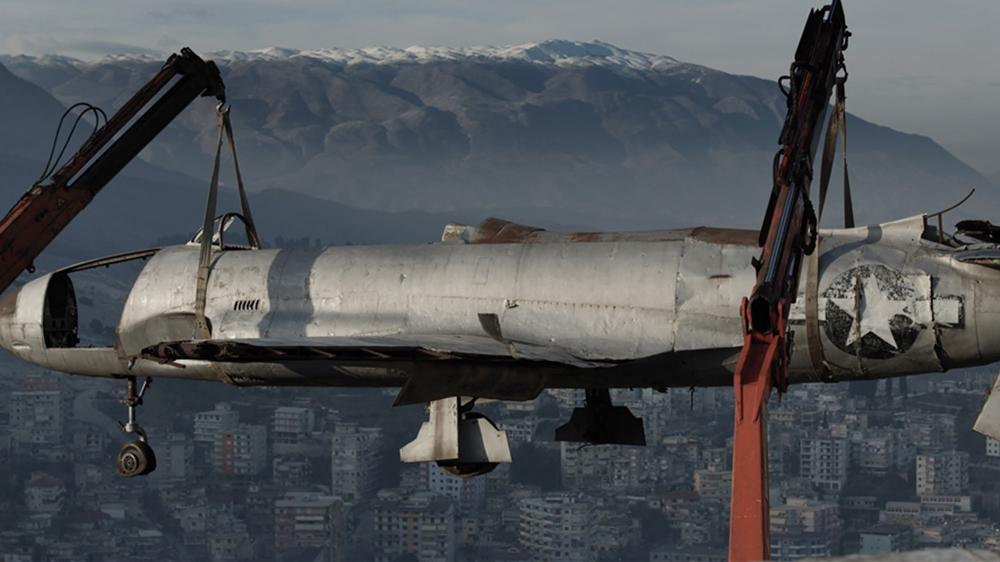
On December 23, 1957, at 11:10 AM, a US Lockheed T-33 Shooting Star aircraft flown by Major Howard J. Curran left Chateauroux, France, heading for Naples, Italy. Above Turin, the aircraft radio failed and after hitting bad weather with strong winds, the plane veered off its flight path to end up, by mistake, in the sovereign airspace of the People`s Republic of Albania. At 1:28 PM, the intruder was intercepted by the Albanian Air Force Command, which instantly ordered two MiG-15 fighter jets to take off and identify it. By 3:50 PM, the fighters reported that they had spotted the intruder in the area around Rinas Airport, flying at 500-650 km/hr at an altitude of 150-200 m. Prompt countermeasures were taken. The airplane was forced to land and, to keep it from taking off again, the airport was locked down.
Born in 1980 in Tirana, Albania, Armando Lulaj is a writer of plays, texts on risk territory, film author, and producer of conflict images, orientated toward accentuating the border between economical power, fictional democracy and social disparity in a global context. Exhibitions include the Prague Biennial (2003; 2007), Tirana Biennial (2005), 4th Gothenburg Biennale (2007), the 6th Berlin Biennial (2010), the 63rd Berlinale International Film Festival (2013) and the 56th Venice Biennale - Albanian Pavilion (2015).
Henrik Lund Jörgensen
The Recruitment (And Escape) Of A Plastic Soldier
Vidéo | 4k | couleur | 10:15 | Danemark, Suède | 2015
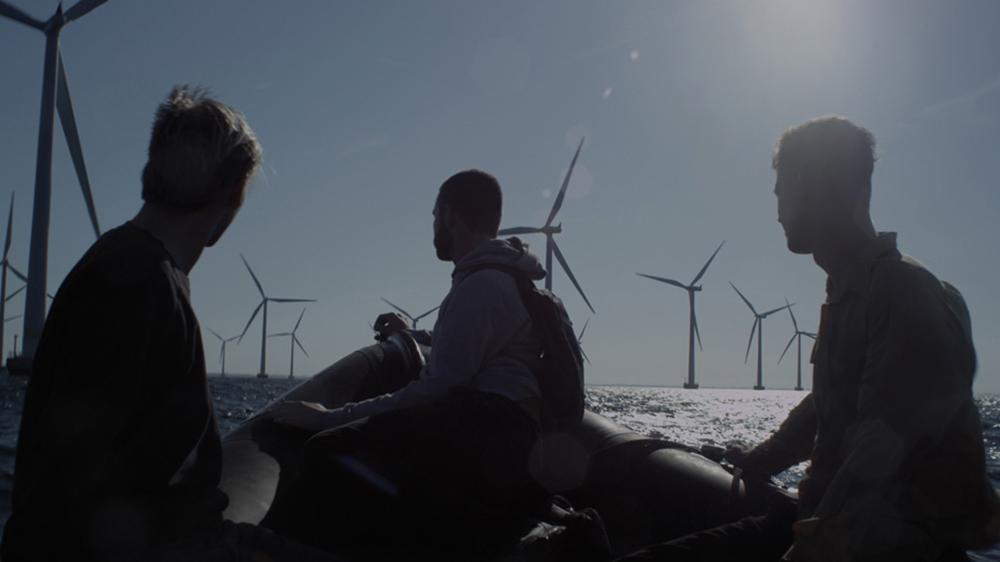
With references to landscape painting from the Romantic era and to silent film Henrik Lund Jørgensen draws inspiration from the works of the Danish film maker Carl Th. Dreyer in the making of his new video The Recruitment (And Escape) Of A Plastic Soldier (2015). In a cinematic language a narrative arises that exchange concepts as recruitment and flight and for whom it concerns.
Henrik Lund Jørgensen received his Master’s degree in Fine Arts in 2005 at the Malmö Art Academy, where he also lives and works today. In addition, he has a Bachelor’s degree in photography and a Master’s degree in film. In recent years, he has taught in the Master’s Programme Cinematic processes at Valand Academy of Film at Gothenburg University. Lund Jørgensen has exhibited both in Sweden and internationally, including at the Kunstmuseum Bonn, Kunsthalle Rostock, Museum Kunst der Westküste (DE), Kiasma (Helsinki), Norrtälje Konsthall, Scandinavia House (New York), The Hirschsprungske Collection (Copenhagen) and at the Atelier Nord ANX (Oslo) and was recently a grant holder at the Iaspis program in Stockholm.
Cecilia Lundqvist
Area of Use
Animation | dv | noir et blanc | 5:12 | Suède | 2009
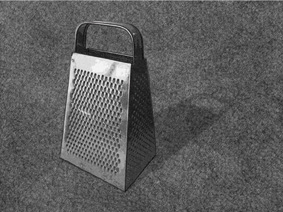
The video Area of Use is an illustration of a housewife?s inner thoughts about alternative ways of using her most common working tools. It is also a manifestation of a sealed existence that exposes a mind which gives a sense of being trapped in a treadmill.
Born 1971 in Eskilstuna, Sweden. Currently living and working in Stockholm, Sweden. Artistic education: 1999-00 Royal University Collage of Art, Postgraduate, Stockholm, Sweden 1994-99 University Collage of Arts, Crafts and Design, Art Department, Stockholm, Sweden Artist specializing in animation and since 1994 working almost exclusively with videos, which have been screened at numerous museums, galleries and festivals worldwide. Around 25 videoworks have been created between 1994 and 2009, works that generally are narrative and deal with issues like domestic violence, power structures and human behaviours. Represented with videoworks at several art institutions, among them Moderna Museet in Stockholm and Centre Georges Pompidou in Paris.

Cecilia Lundqvist
Eternal Start
Art vidéo | | couleur | 3:16 | Suède | 2010
The video is a description of two people who are situated in an constant state of present, where the past is continuously fading and the future seems unreachable. It appears as if the woman and the man are unaware of their situation, which amplifies the sense of meaninglessness. "Eternal Start" illustrates a relationship where everything is routine, and every day is the same. Eternity becomes a reflection of a life without meaning, in which they are unable to change their accustomed behaviour. They converse like a record that is stuck, and never gets the chance to develop. The video highlights and gives insight to the importance of having the ability to make new memories, so that life can go on.
Born 1971 in Eskilstuna, Sweden. Currently living and working in Stockholm, Sweden. Artist specializing in animation and since 1994 working almost exclusively with videos, which have been screened at numerous museums, galleries and festivals worldwide. Around 30 videoworks have been created between 1994 and 2010, works that generally are narrative and deal with issues like domestic violence, power structures and human behaviours. Represented with videoworks at several art institutions, among them Moderna Museet in Stockholm and Centre Georges Pompidou in Paris.

Cecilia Lundqvist
En av dem (One of them)
Animation | hdv | couleur | 1:53 | Suède | 2017
v
Working almost exclusively with animated art, mostly as single channel videos. Through animating my own drawings, I am mediating tales of human relationships and not shying away from life’s darker and more destructive sides. Since 1994 I’ve created over 30 videos, works that generally are narrative and deal with issues like domestic violence, power structures and human behaviours. My works have all been screened at numerous occations worldwide and I’m represented at several art institutions, among them Moderna Museet in Stockholm and Centre Georges Pompidou in Paris.
Cecilia Lundqvist
Making Pancakes
Animation | dv | noir et blanc | 4:58 | Suède | 2005
Making Pancakes est une vidéo d'animation qui montre un homme et une femme engagés dans une relation totalement déséquilibrée. Parfois, on assiste à ce qui ressemble à des événements ordiaires, et d'autres fois ils sont dans des situations plus menaçantes. L'homme se complaît dans l'autosatisfaction et pourtant il émane de lui une incertitude et un désir de reconnaissance. La femme est comme engourdie par la routine et fait tout ce qu'elle peut pour maintenir les apparences. En renversant la situation et en transposant les violences domestiques à l'extérieur du domicile, où elles sont visibles, alors qu'à l'intérieur du domicile il s'agit de maintenir une apparence parfaite, on montre l'absurdité de ce comportement. Les erreurs insignifiantes que la femme commet en préparant le dîner agissent comme un catalyseur des actes de violence, elles sont les gouttes d'eau qui font déborder le vase.
Cecilia Lundqvist
Oh, I'm So Happy
Art vidéo | dv | noir et blanc | 3:7 | Suède | 2008
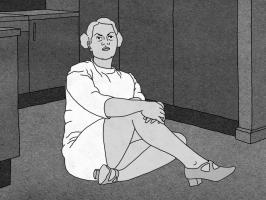
« Oh, I'm So Happy » est une vidéo d?animation où nous rencontrons une femme d'âge moyen qui vit dans un isolement total et, par conséquent, dans une extrême solitude. La femme récite un monologue, dans lequel elle fait de son mieux pour nous convaincre qu?elle est heureuse et contente de sa situation actuelle. Cependant, sa tentative est totalement superficielle et transparente.
Cecilia Lundqvist est née en 1971 à Eskilstuna (Suède) ; elle vit et travaille actuellement à Stockholm (Suède). Durant son éducation artistique, elle a fréquenté l'Université des Arts de Stockholm (Département de l?Artisanat, du Design et de l?Art, 1994-99) et l?Université Royale des Arts de Stockholm (troisième cycle, 1999/00). Elle se spécialise aujourd?hui dans l'animation et, depuis 1994, elle a travaillé presque exclusivement avec la vidéo. Ses ?uvres vidéo ont été projetées dans de nombreux musées et galeries, ainsi que dans des festivals du monde entier comme le Centre Pompidou ou le Moderna Museet de Stockholm.
Cecilia Lundqvist
Power Play
Art vidéo | dv | noir et blanc | 10:55 | Suède | 2004
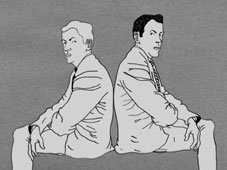
Power Play est une vidéo d'animation, comprenant dix différentes scènes dans lesquelles deux hommes se font compétition, à travers leur virilité, qu'ils exagèrent, et l'utilisation de différents attributs, dans une série d'actes sans queue ni tête.La vidéo commente et ridiculise clairement les stéréotypes que les deux personnages emploent dans leur conversation d'homme à homme, les coutumes qui sont généralement établies dans la culture occidentale. Le film s'intéresse à ce jeu d'actes, pour montrer clairement au spectateur à quel point ce comportement est dépourvu de sens.Quand l'?uvre est présentée en galerie, un contrepied, spectateur de la vidéo, est installé. Dans cette autre vidéo, qui contient seulement une scène, une femme complètement, qui s'ennuie profondément, regarde les hommes dans leur performance.
Cecilia Lundqvist est née à Eskilstuna en Suède. À la base ingénieur, elle a changé de carrière en 1991 pour s?orienter dans les arts et depuis 1994, elle travaille sur des vidéos animées qui furent projetées à plusieurs occasion partout dans le monde. Elle est représentée, par exemple, au Museum of Art de Stockholm et au Centre G?rges Pompidou de Paris avec de ses ?uvres vidéos. Sa formation artistique commence dès 1991, où elle va à la Gotland Art School jusqu?en 1993. L?année suivante elle suivra des cours au Birkag?rden Art Department de Stockholm. Pendant cinq ans, jusqu?en 99, Cecilia Lundqvist étudie au University College off Arts, dans le département de Crafts and Design et Art à Stockholm. Elle parachève ensuite da formation au Royal College of Art, dans le département vidéo. Aujourd?hui, elle travaille et vit à Stockholm et à Londres.
Cecilia Lundqvist
The Quiet Game Starts Now
Vidéo | hdv | couleur | 5:47 | Suède | 2012
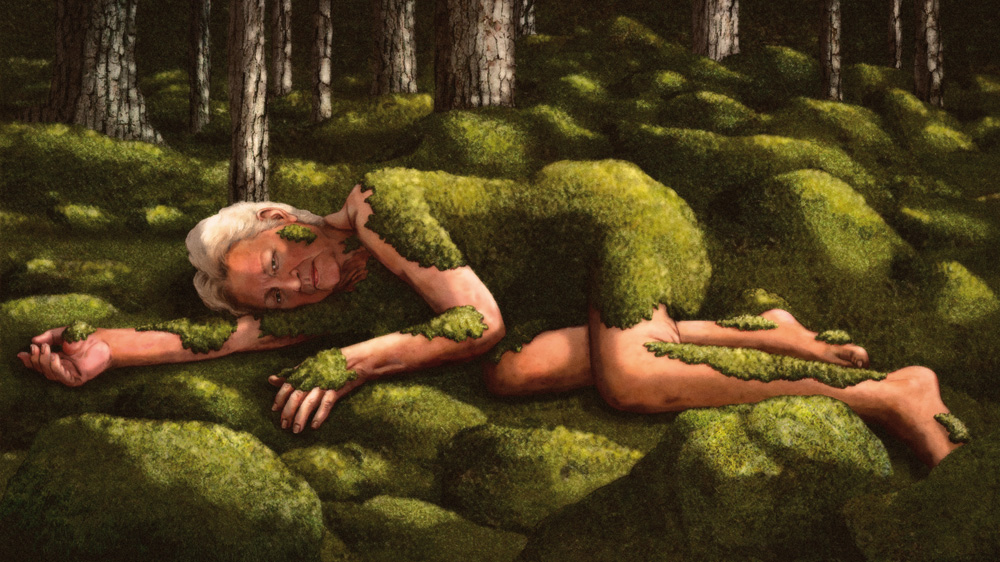
The animated video The Quiet Game Starts Now (Tysta leken börjar nu) is a satire about the current escalation of self-absorption. Two women meet in a conversation, which from the start is a one-way communication, with one dominating party. After a while there is a shift in power and the silence grows stronger and starts to speak.
Born 1971 in Eskilstuna, Sweden. Currently living and working in Stockholm, Sweden. Artist specializing in animation and since 1994 working almost exclusively with videos, which have been screened at numerous museums, galleries and festivals worldwide. Over 30 videoworks have been created between 1994 and 2014, works that generally are narrative and deal with issues like domestic violence, power structures and human behaviours. Represented with videoworks at several art institutions, among them Moderna Museet in Stockholm and Centre Georges Pompidou in Paris.
Cecilia Lundqvist
Tilt
Animation | hdv | couleur | 5:6 | Suède | 2014
The animated video "Tilt" describes a deep relation that is abruptly broken up and as a result, the existing life is turned into ruin. The video is a contemplation of a human being’s inability to comprehend its own transience.
Working almost exclusively with animated art, mostly as single channel videos. Through animating my own drawings, I am mediating tales of human relationships and not shying away from life’s darker and more destructive sides. Since 1994 I’ve created over 30 videos, works that generally are narrative and deal with issues like domestic violence, power structures and human behaviours. My works have all been screened at numerous occations worldwide and I’m represented at several art institutions, among them Moderna Museet in Stockholm and Centre Georges Pompidou in Paris.
Felix Luque Sanchez, Nicolas Torres
Junkyard I
Fiction expérimentale | 4k | couleur | 6:43 | Espagne, Belgique | 2019
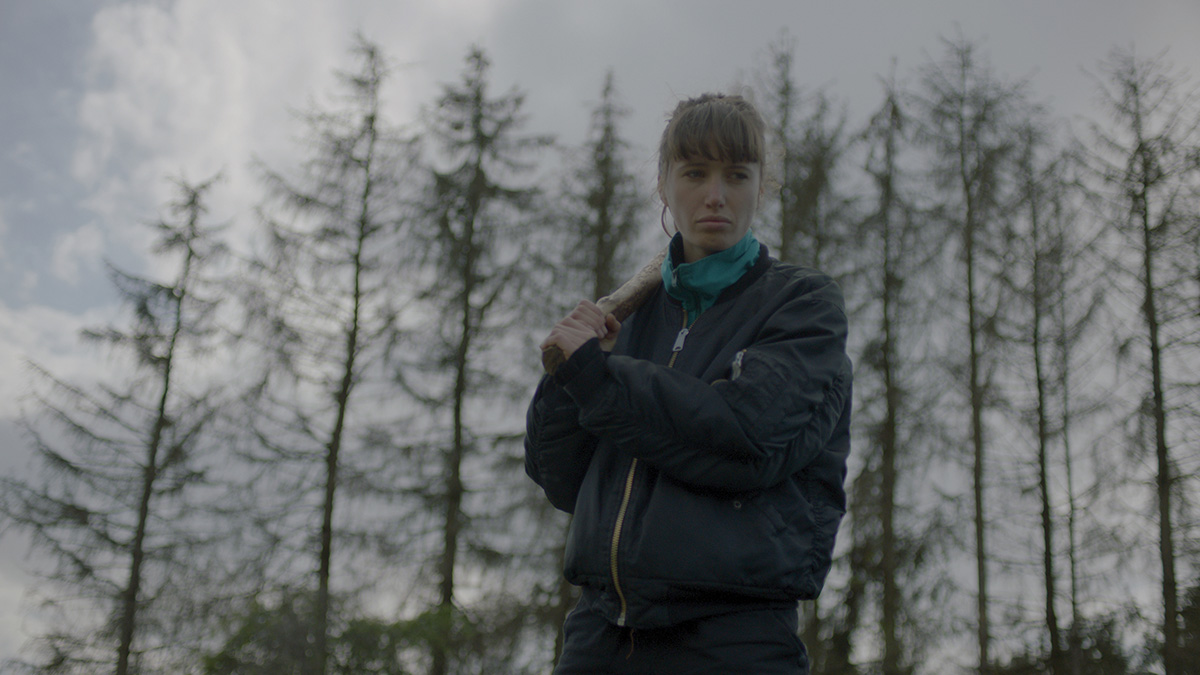
“… Junkyard explores the accumulated car wrecks as archeological remains for the future - a future that is undergirded by the consumptive cultures of petroleum, rare earth minerals and metals of which the car is emblematic. Paul Virilio’s argument about the relationship of technology and accidents is illuminating in this sense: "every time that a new technology has been invented,” he writes “a new energy harnessed, a new product made, one also invents a new negativity, a new accident.”[1] In this sense, the easy conclusion would say that the people who invented the car also invented the car accident. But what happens, when we think about not individual accidents but the industry as a whole as an extended scale of a systematic accident that leaves traces of wrecks as the memory of past archaeological periods, whether that pertains to chemicals, metals or residual traces of media of past automobile cultures? In other words, what if we think that the whole industry, with production, distribution, excavation and use, and what it has been doing to the earth’s “resources,” the organisation of labour and gender roles, an historical accident that undermines the viability of organised human existence? – the car industry as the accident of the fossil fuel culture” …
Felix Luque Sánchez (Oviedo, Spain, 1976) is an artist whose work explores how humans conceive their relationship with technology and provides spaces for reflection on current issues such as the development of artificial intelligence and automatism. Using electronic and digital systems of representation, as well as mechatronic sculptures, generative sound scores, live data feeds and algorithmic processes, he creates narratives in which fiction blends with reality, suggesting possible scenarios of a near future and confronting the viewer with her fears and expectations about what machines can do. Luque’s installations are configured as autonomous and uncontrollable systems in which each element plays a role in both their functional and visual design. The machines are thus conceived not only in terms of the processes they carry out, but also as objects of aesthetic contemplation. Each artwork is divided into different parts or sections, that can be read as chapters of the same narrative, constitutive elements of a system, or attempts at exploring a single subject. This fragmentation counters the apparent oneness of the piece and the seemingly perfect operation of the machine. Failure and vulnerability are present in the way that these devices are forced to maintain delicate balances, pursue nonsensical dialogues, generate incomplete renderings of reality, and finally express themselves by means of a sound score that results from their own activity and the physical processes involved in it. The artist consciously plays with the contradictory perception of technology as purely functional while at the same time imbued with a mysterious purpose, and the fear that machines may replace humans. Inspired by science fiction, he draws from its aesthetic and conceptual foundations the tools to elaborate speculative narrations and address the spectator using preconceptions about technology in popular culture. The outcome is a series of artworks that fascinate by their technical elegance and intriguing opacity, at the same time attracting and distancing themselves from the viewer.
Johann Lurf
Embargo
Vidéo | hdv | | 10:0 | Autriche | 2014
Born in 1982 in Vienna Johann Lurf has studied at the Academy of Fine Arts in Vienna and the Slade School of Art in London. He graduated from Harun Farocki’s film class in 2009. He received the State Grant of Austria for Video- and Media Art and participated in the Artist-in-Residence Programs at the MAK Center for Arts and Architecture in Los Angeles 2011 and at the SAIC in Chicago 2015. His works have been internationally shown and awarded in numerous exhibitions and festivals.