Catalogue > List by artist
Browse the entire list of Rencontre Internationales artists since 2004. Use the alphabetical filter to refine your search. update in progress
Javier Fernández Vázquez
Catalogue : 2021Anunciaron tormenta | Experimental doc. | mov | color | 87:50 | Spain | 2020
Javier FernÁndez VÁzquez
Anunciaron tormenta
Experimental doc. | mov | color | 87:50 | Spain | 2020
In 1904, Ësáasi Eweera, the last native Bubi leader who opposed the Spanish rule at the current island of Bioko (Equatorial Guinea) was detained by colonial guards and forcefully taken to Santa Isabel, the colony's capital. Imprisoned and fatally wounded, Ësáasi Eweera died three days later. His home village was burned down and most of its inhabitants disappeared. An incomplete record of those events is classified in Spain's General Administration Archive. File by file, handwritten reports and letters show several accounts of what allegedly happened and expose the progressive operations of concealment carried out by colonial institutions. Meanwhile, some native oral accounts have survived and opposed Spanish official version, confronted the permanent risk of oblivion and attempted to contribute to a sort of emancipated collective memory. By reenacting written texts through voiceovers, taping and studying native Bubi oral accounts and identifying historically charged sites, A storm was coming tries to reflect on the gaps, silences, contradictions and falsehoods that colonial history is usually built upon.
Javier Fernández Vázquez is a filmmaker, anthropologist and visual culture researcher. In 2007 he directed his first short film Señales de Indiferencia / Marks of Indifference, which received the award to the best international short film in the Valdivia International Film Festival (Chile). In 2008, he founded with Luis López Carrasco and Natalia Marín Sancho the experimental and documentary film collective, Los Hijos. Their first feature-length film, Los materiales / The Materials (2010), won the Jean Vigo award to the best direction in Punto de Vista Pamplona International Film Festival 2010 and a special mention in FID Marseille 2010. Their next feature-length films as well as several shorts and video installations were selected by international film festivals and exhibited in contemporary art centres. Their work has also received special retrospective sections in Mar del Plata International Film Festival (Argentina) or Distrital (Mexico). In 2015, Javier Fernández Vázquez began an academic career in Film Studies and Visual Culture that has led him to research on issues related to history, memory, colonialism, visual culture and object theory. Anunciaron tormenta / A storm was coming (2020) is his first solo feature-length film. It was premiered at Berlinale Forum 2020.
Ferrandes Ferrandes
Catalogue : 2013BERG | Experimental doc. | hdv | color | 11:59 | United Kingdom, Germany | 2011
Ferrandes Ferrandes
BERG
Experimental doc. | hdv | color | 11:59 | United Kingdom, Germany | 2011
Teufelsberg is an artificial hill in the outskirts of Berlin. It was built by the American Allies with the rubble of a city destroyed by World War II in the 20 years that followed its end. Created out of debris on Grunewald?s plateau, Teufelsberg became the highest viewing point in Berlin and a favourable location for military observation of the city. Due to the evident vantage point it could offer, in the late 50s a permanent listening station for short-wave frequencies and encrypted messages, was built on Teufelsberg, to be run by the National Security Agency until the fall of the Berlin wall. With the end of the Cold War, the listening station became redundant, it was closed down and its equipment removed. ?Berg? investigates a historical site through an alternate shift between documentary and fictional representation. A soundscape produced from samples from a series of mainstream Spy Movies overlaps a carefully edited selection of classic shots, inspired by the most repetitive cinematic clichés to be found in the ?espionage genre?. If visuals and sound have a linear continuity in certain sections of the film, as the video unfolds, it becomes clearer that the voiceover belongs to a less recognizable past ? more or less fictional - whilst the location, Teufelsberg is depicted in its current condition.
Valentina Ferrandes is an Italian artist currently living and working in Berlin. Using video, photography and sound, she investigates possible relations between collective memory, social behaviour and geographic and architectural sites. She graduated from Bologna University in Disciplines of Art, Music and Drama, before enrolling in a BA Fine Art at Chelsea College of Art and Design, London, where she graduated in 2009. In 2008 she was selected to take part in a Recidency in the New Media Art department of China Academy of Art. Since 2009 her works have been shown internationally in private galleries, experimental video festivals and museums. Exhibitions include The Museum of Contemporary Art in Rome, the European Media Art Festival, Celeste Prize, Eastern Bloc Centre for New Media and Interdisciplinary Art in Montreal, Canada, Athens Video Art Festival.
Catalogue : 2012The Oyster Effect | Experimental video | hdcam | color and b&w | 12:51 | United Kingdom, Italy | 2010
Ferrandes Ferrandes
The Oyster Effect
Experimental video | hdcam | color and b&w | 12:51 | United Kingdom, Italy | 2010
Using as a starting point parts of archive footage shot by the anthropologist De Martino?s whilst researching the phenomenon of Tarantism, ?The Oyster Effect? develops into a collage of historical references as narrating voices over a visual journey. In the film, the portrayal of women and hysteria is shown as a series of parallels between built environments, architectural spaces, landscape and their narration. The viewer travels through foreign languages and non-descriptive locations, in a journey that challenges linearity and historicity. The attempt to bridge the specific representations of women?s subjectivity as products of their cultural environments, in the north and southern Europe, is persistently negated by the conflicting relation between image and narrating voice.
Valentina Ferrandes is a London based, Italian artist. She studied Disciplines of Art, Music and Drama at Bologna University. She gained a BA Fine Art at Chelsea College of Art, where she graduated in 2009. In 2008 she was selected to take part in a residency programme at China Academy of Art. Since 2008 her work has been shown internationally in galleries and film festivals, including the European Media Art Festival Osnabrueck, Director`s Lounge, Berlin, the Eastern Bloc Centre for New Media & Interdisciplinary Art, Montreal and the Museum of Contemporary Art, Rome, as part of the Biennale du Mediterranee.
Chris Ferrantello
Catalogue : 2007The Pope's Hat | Animation | dv | color | 10:30 | USA | 2006
Chris Ferrantello
The Pope's Hat
Animation | dv | color | 10:30 | USA | 2006
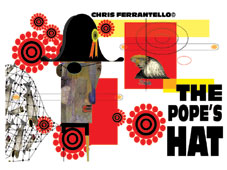
People go crazy for the Pope's line of Hats but fights break out over who has the best hat. So there will no more Pope Hats. Is there a line of Pope Shoes in the future?
Chris Ferrantello's animation work has been shown at Sundance 2002 and 2004, Krakow 43 and 44, SeNef 2004 and 2005, Bitfilm 2003, the Viper 21 and 22 festivals, Streaming Cinema 2.0., Adobe.com, The Bit Screen and The Future Cinema show at the ZKM in Germany, and the Kiasma Museum in Helsinki. A few of his films are now distributed by RIFF (Rome Independent Film Festival). He is also a painter and editorial illustrator whose clients include Esquire magazine, MS. magazine, Travel and Leisure magazine, Sony Entertainment, The Progressive, and The New York Times, to name a few. His work has been printed in illustration annuals published by the Society of Illustrators and the design publication "Print".
Marco Ferrazza
Catalogue : 2019Parallel | Multimedia concert | mov | color | 20:0 | Italy | 2018
Marco Ferrazza
Parallel
Multimedia concert | mov | color | 20:0 | Italy | 2018
"Parallel" is the result of an audiovisual performance where electro-acoustic music meets the experimental video. Natural and sound landscapes are digitally reworked to research new narrative configurations. All sounds and video have been processed in real-time by the performer. Therefore, at the base of the work there are concrete sounds and landscape shots (or human artifacts in relationship with the landscape). Human being is part of nature but, at the same time, affirms its otherness respect to it, not only in creative (or destructive) terms, but also as the development of Consciousness towards goals free from the simple instinctual finality. If its destiny runs parallel to that of the universe, it is nevertheless bound to the destiny of the same existence.
Marco Ferrazza is a sound artist, composer of electroacoustic tracks and performer in experimental music. His pieces have been performed in various international electronic music festivals and then released on CD. In his work he constantly investigates the relationships between electronic arts and concrete music, field recordings and digital manipulation of sound, improvisation and new technologies. Visual imaginary collected in abstract tales: this is perhaps the emerging aspect from his last explorations in the field of sound, researches in which the continuous re-codifications of signs is drawn at the same time from the temptation of unlimited semiosis and the structural coherence of the musical composition.
Isabelle Ferreira
Catalogue : 2007Parade | Experimental video | dv | color | 1:49 | France, USA | 2005
Isabelle Ferreira
Parade
Experimental video | dv | color | 1:49 | France, USA | 2005
"Parade" is a silent dialogue between two mechanisms.
Patrice Ferreira
Catalogue : 2006Septikbioethik | Experimental video | dv | color | 12:0 | France | 2003
Patrice Ferreira
Septikbioethik
Experimental video | dv | color | 12:0 | France | 2003
Certain of having nothing more to do in this society, a man is wandering in subways of Tokyo. His aim : to find someone who could help him to break free out of his lot. Corridors are opening. Stations are slowly filling up. A first train is arriving. The man is walking, he looks determined. He asks to somebody : -?Excuse me, can you push me... -What do you want? I push you in a train. -No...No under...? Death could become a right, please...
Luca Ferri
Catalogue : 2021si | Experimental doc. | dcp | color | 19:0 | Italy | 2020
Luca Ferri
si
Experimental doc. | dcp | color | 19:0 | Italy | 2020
A middle-aged man in his living room is watching the creation of the cosmos through a gallery of encyclopedic images where the human being is never present, except for some of his works, ruins or activities. He falls asleep, lulled by the vision of an advertisement that features a woman, and finds himself in an awful nightmare where he witnesses the hunting of some polar bears by arctic hunters. All the while, two pieces of contemporary music by the composer Dario Agazzi and a text inspired by a childhood memory of the director related to a suicidal event, suggest us to “write once, erase twice”.
Luca Ferri (Italy, 1976), self-taught, since 2011 has been dedicating to the writing, photography and direction of films presented to italian and international festivals, such as Atlanta Film festival, Biografilm festival, Documenta madrid, Didocs, Gent film festival, indielisboa, punto de vista, pesaro film festival, poff, queer lisboa, taipei film festival, thessaloniki documentary festival, vilnius short film festival, and in museums and art galleries, such as spazio forma meravigli (Milan), mambo (Bologna), Macro (Rome) and schusev state museum of architecture (Moscow). In 2013 the national film library of Rome organized a retrospective of his works. His first feature film abacuc, released in 2015, was presented at the Torino film festival and Mar del Plata. The film Colombi was presented at the 73rd Venice festival in the Orizzonti section. In 2018 his work dulcinea was selected at 71st locarno film festival in competition in the section signs of life while pierino was presented at 61st dok leipzig. In 2020 the house of love is presented at 70th berlinale in the section forum, selected to take part in the competition berlinale documentary award and receives the mention to 34th teddy awards; his last work sì is presented at 77th Venice international Film Festival
Luca Ferri
Luca Ferri
Catalogue : 2022Thousand Cypresses | Experimental doc. | 0 | color | 13:0 | Italy | 2021
Luca Ferri
Thousand Cypresses
Experimental doc. | 0 | color | 13:0 | Italy | 2021
A man, inside his kitchen, is preparing his packed lunch. He has decided to visit The Brion Tomb, a monumental funeral complex, designed and built by the Venetian architect Carlo Scarpa, commissioned by Onorina Brion Tomasin, to honour the memory of the deceased and beloved relative Giuseppe Brion, founder and owner of the Brionvega company, located in the small cemetery of San Vito, in the hamlet of Altivole in the province of Treviso. Placed the food inside a polka dot plastic bag, we will find it walking inside the cemetery, observing with meticulous care the details designed by the Venetian architect, while in its silent head will resound the precious words pronounced by the architect in a conference held in the summer of 1978.
Luca Ferri (Bergamo, italy, 1976), self-taught, since 2011 has been dedicating to the writing, photography and direction of films presented to italian and international festivals, such as atlanta film festival, biografilm festival, curta cinema, documenta madrid, fidocs, filmmaker, gent international film festival, indielisboa, queer lisboa, punto de vista, pesaro film festival, cinemambiente, poff, taipei film festival, thessaloniki documentary festival, vilnius short film festival, filmer le travail, videoex and in museums and art galleries, such as spazio forma meravigli (milan), mambo (bologna), macro (rome) and schusev state museum of architecture (moscow). In 2013 the national film library of Rome organizes a restrospetictive of his works. his first feature film abacuc, released in 2015, was presented at torino film festival and mar del plata festival de cine. In 2016 colombi was presented at 73rd venice festival in the orizzonti section. In 2018 his work dulcinea was selected at 71st locarno film festival in competition in the section signs of life while pierino was presented at 61st dok leipzig. In 2020 the house of love is presented at 70th berlinale in section forum, selected to take part in the competition berlinale documentary award and receives the mention to 34th teddy awards; his work sì is presented at 77th venice international film festival, orizzonti section. In 2021 his last work a thousand cypresses was presented at 67th international short film festival Oberhausen and at the 57th mostra internazionale del nuovo cinema di pesaro. won the award for best film at the 46th laceno d'oro in the section "eyes on the city."
Mehryl Ferri Levisse
Catalogue : 2023untitled | 0 | 0 | | 0:0 | France | 2023
Mehryl Ferri Levisse
untitled
0 | 0 | | 0:0 | France | 2023
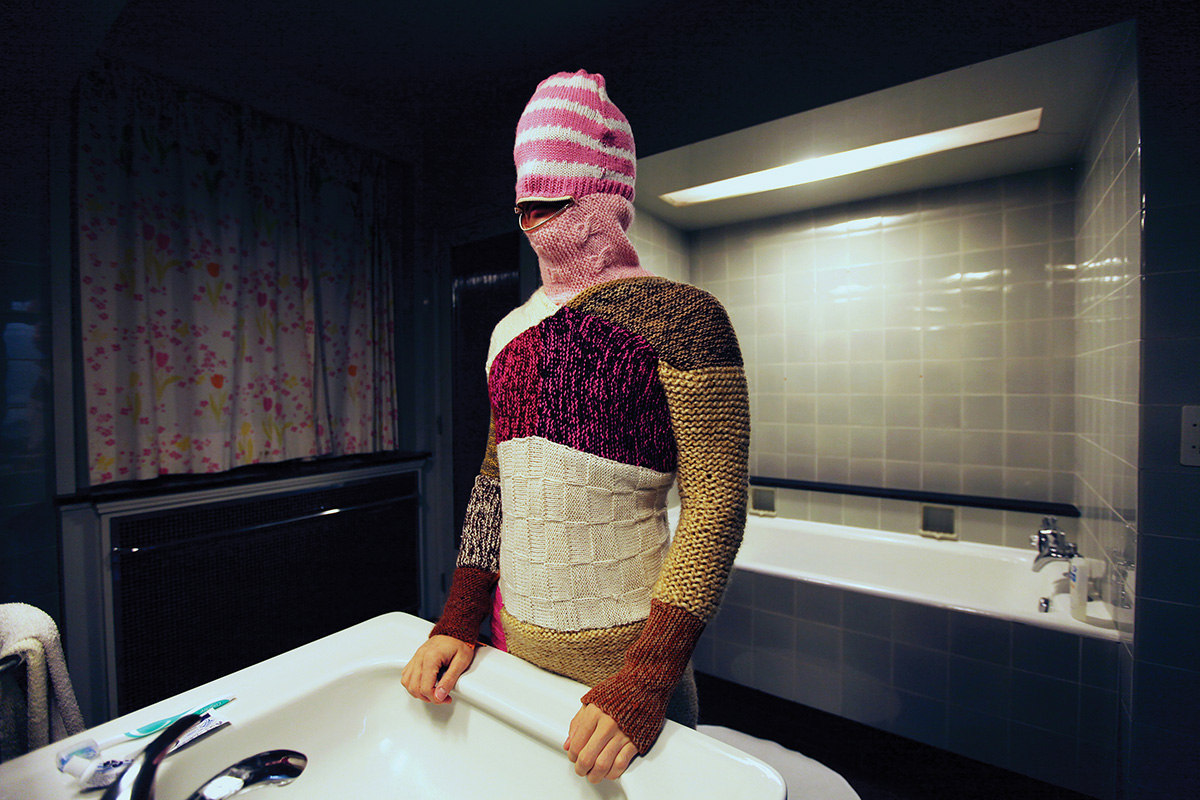
"L'Esprit du tricot" est l’aboutissement d’une résidence de création et médiation au Centre d’art Camac (Marnay sur seine - France) dans le cadre du projet Culture à l'hôpital, par Mehryl Ferri Levisse qui se situe dans une démarche de réminiscence de techniques de tricot apprises avec sa grand-mère puis oubliées avec le temps. Pour ce travail de souvenance, il s’est alternativement positionné comme médiateur, apprenant et participant au sein d’un groupe de femmes dans deux maisons de retraite qui n’avaient plus pratiqué cette activité depuis des années. A raison de quatre interventions par semaine pendant un mois, ce groupe transgénérationnel a tricoté pièce par pièce deux combinaisons sadomasochistes (SM) avec la complicité de l'artiste. Ces dernières sont présentées comme œuvres ainsi que mises en scène dans le premier film du plasticien. Tricoter pour oublier le souvenir sadomasochiste du corps intime. La sexualité des seniors est profane dans une société où les corps ont une date de péremption. Orgiaquer en tricotant constitue le cadre de ce projet créatif dont les acteurs ignorent la finalité de leur implication – la finalité de leur vie. Le masochisme de la vieillesse s’inscrit dans le sadisme de notre jeunesse. Le travail de ces femmes représente le fatalisme de l’obsolescence programmée de notre sexualité passée dans un Alzheimer naïf et innocent.
La pratique multiforme de Mehryl Ferri Levisse explore les notions de subjectivité et d'identité liées à l'expérience Queer. Utilisant des symboles et des images genrés associés à l'apparat, la mascarade et le cabaret, l'artiste produit un langage visuel extravagant qui interroge les conceptions communément acceptées de la masculinité et de la féminité. Les performances et installations de Ferri Levisse agissent comme des scènes sur lesquelles le genre est remixé et obscurci. Maître de cérémonie, l'artiste orchestre l'espace pour interroger les limites du corps et les codes sociétaux qui constituent nos comportements. Tout son travail utilise le motif, convaincu que l’ornement n’est jamais neutre, qu’il est toujours le véhicule de normes et de valeurs, Mehryl Ferri Levisse se l’approprie et le retravaille pour en subvertir les idéologies sous-jacentes. Mehryl Ferri Levisse (vit et travaille entre Casablanca et les Ardennes) est un artiste franco-italien. Ferri Levisse a exposé ses œuvres dans des musées, des galeries et des biennales internationales, dont le Centre Pompidou (Paris), le Musée des Arts Décoratifs (Paris), la Biennale Internationale de Casablanca, le Musée Arthur Rimbaud (FR), l'International Center of Photography (New York ), l'Institut Français de Casablanca (Maroc), Catinca Tabacaru Gallery (New York), Bertrand Grimont Galerie (Paris), la Biennale Internationale de la Marionnette (FR), la Biennale Internationale de Poésie (FR), Bienalsur (Buenos Aires, Argentine) , CDA Gallery (Casablanca) la Cité Internationale de la Tapisserie d'Aubusson (FR), le SCAD Museum of Art (Savannah, USA), le FRAC Alsace (Sélestat), le Musée de Picardie (Amiens), l'Institut Français de Madrid (ES), le Musée des Beaux-Arts de la Chaux-de-Fonds (CH), Biennale BISO, (Burkina Faso), ; et Yango II (Biennale Internationale de Kinshasa, République Démocratique du Congo), La Vilette (Paris), Nuit Blanche (Paris), le Mo.Co Hôtel des collections (Montpellier), BPS22 Musée d'Art Contemporain (BE), Luxembourg Art Week Art Fair ( LU), 1.54 Marrakech Art Fair (Maroc), le Musée des Antiquités (Rouen), le Château Dufresne (QC). Les œuvres de Ferri Levisse font partie de différentes collections privées et publiques comme le SCAD Museum, le FRAC Alsace, le Musée de la Chasse et de la Nature, la collection de livres d'artistes du MoMA ou la bibliothèque du Metropolitan Museum Thomas J.Watson. Activiste et militant, Ferri Levisse est engagé dans la lutte pour les droits de la communauté LGBTQIA+. En 2018, il crée le Travball, un jeu inclusif joué par les drag queens et le public pour déconstruire et lutter contre l'homophobie dans le sport. En 2021, il obtient la bourse de la DILCRAH, Délégation interministérielle à la lutte contre le racisme, l'antisémitisme et la haine anti-LGBT pour le Travball.
Aurèle Ferrier
Catalogue : 2016INFRASTRUCTURES | Video | hdv | color | 22:38 | Switzerland, Iceland | 2014
Aurèle Ferrier
INFRASTRUCTURES
Video | hdv | color | 22:38 | Switzerland, Iceland | 2014
This film involves a journey through a landscape of infrastructures that are common to an everyday reality of routine. Yet here we find these environments are deserted. This allows attention to focus instead on the design and spatial arrangements of the objects, we find the features of these landscapes – which would not usually bear noticing – become centrally present. Infrastructures involves a series of seven tracking shots. A steady flow of objects in various contrived arrangements passes by the eye. The sound design incorporates the subtle noises given off by these ready-to-use sites devoid of users.
Biography Aurèle Ferrier, *1975 in St.Gallen (Switzerland), lives in Zurich. He attained an MA in Fine Arts at Zurich University of the Arts. His video works, actions and interventions explore the limits and connections between nature and civilization. His cinematic works display a calm contemplation and visual precision. Recent shows 2016 Slamdance Film Festival, South Park (US) 2016 Sluice Screens Prize, London (UK) 2015 24th Berkeley Video and Film Festival, Berkeley (US) 2015 Der entfesselte Raum, Gewerbemuseum, Winterthur (CH) 2015 Arquitectura Film Festival, Santiago de Chile (CL) 2015 Reykjavik International Film Festival, Reykjavik, (IS) 2015 Currents, Intlernational New Media Fesival, Santa Fe (US) 2015 Arkipel, Documentary and Experimental Film Festival, Jakarta (ID) 2015 Great Lakes International Film Festival, Erie (US) 2015 Athens Digital Arts Festival, Athens (GR) Studies 2014 MA Fine Arts, Zurich University of the Arts 2004 BA Leading Artist Theatre, Zurich University of the Arts 2003 Experimental Theatre Exchange, Tisch School, NYU Awards 2015 Winner Berkeley Video and Film Festival, Best Foreign Experimental Film, Berkeley (US) 2015 Winner IndieFEST Film Awards, Award of Merit: Experimental Film, La Jolla (US) 2015 Nominated Sluice Screens Prize, Video Art, Southwark London, (UK) 2010 Studio scholarship, Cité Internationale des Arts, Paris (FR)
Aurèle Ferrier
Catalogue : 2019Transitions | Video | 4k | color | 12:48 | Switzerland | 2017
Aurèle Ferrier
Transitions
Video | 4k | color | 12:48 | Switzerland | 2017
TRANSITIONS is a journey from the civilizing void of the desert to a maximal urban, capitalistic and hedonistic density, which in the case of Las Vegas assumes some bizarre expression. The film is a contemplation without any people or moving machines in it, focussing on the built and designed.
Aurèle Ferrier (*1975 in St.Gallen, CH) lives in Zurich. With his video and cinematic works, actions and interventions he explores the margins of civilization. His works have been presented in more than 30 countries and won, among others, a Grand Jury Award at Slamdance Film Festival.
Aurèle Ferrier
Catalogue : 2026Claws | Experimental doc. | 4k | color | 18:27 | Switzerland, China | 2025
Aurèle Ferrier
Claws
Experimental doc. | 4k | color | 18:27 | Switzerland, China | 2025
CLAWS is a moving-image essay of gliding takes through rapidly expanding cities, drifting from peripheral terrains into dense cores before opening back to the horizon. In largely unpopulated frames, architecture, materials and sound turn urban expansion into a field of perception—where geometry persists, intention falters, and the land remembers.
Aurèle Ferrier is a Swiss visual artist working with film, exploring built environments and urban peripheries. CLAWS concludes his trilogy on human-made landscapes. His moving-image works have been shown at the Hiroshima City Museum of Contemporary Art (Hiroshima), IDFA (Amsterdam), Rencontres Internationales (Paris/Berlin), Open City Documentary Festival (London), Anthology Film Archives (New York) and Image Forum (Tokyo).
Simohammed Fettaka
Catalogue : 2015Iqraa | Experimental film | hdv | color | 27:5 | Morocco | 2013
Simohammed Fettaka
Iqraa
Experimental film | hdv | color | 27:5 | Morocco | 2013
A donkey loaded with whitewashed stones climbs to the top of a mountain ; on the heights of the hillside, masses of these stones trace in gigantic letters three words, very famous in Morocco as they constitue the last line of the national anthem «Allah Alwatan, Almalik» («God, Country, King»). The violence of this Trinitarian figure, devouring the landscape and overlooking men, is revealed in highlighting the brutal archaism of its «back-world» : the labor of the donkey that brought it into being. This installation questions the perpetuation of an established order that ignores the suffering of those who have no voice, be they animals or men.
Simohammed Fettaka is a multidisciplinary artist, born in 1981. He currently lives and works between Tangier and Paris. Simohammed studied Philosophy and Signal Processing in Morocco and later trained in filmmaking at La Femis, Paris. He founded and continues to direct the yearly Tangiers film festival Cinema Nachia.
Lorraine Féline
Catalogue : 2025La main vide | Video | hdv | color | 11:40 | France | 2023
Lorraine FÉline
La main vide
Video | hdv | color | 11:40 | France | 2023
The title of this video, La Main vide, comes from the etymology of the word karate, composed of the Japanese words kara (“empty”) and te (“hand”). Shot in a Parisian karate club in the 13th arrondissement, the video follows the training of karatekas. We watch as they learn, perfect their technique and strive to master their gestures, making sure they're right and well placed. The camera captures these different movements, isolated or intersecting with others, forming a kind of choreography.
Lorraine Féline creates films, performances, drawings and paintings. Her work is observational: she observes, with a minimum of intervention, gestures and bodies in movement, captured on the spot. She draws and photographs her surroundings, then paints snapshots of everyday life. She also makes films that are portraits of people at work. Her videos are short-format, independently produced, and shot in small teams to immerse herself in the site, as close as possible to the people being filmed.
Markus Fiedler, Stanley Edward, Nanna Katrine Hansen, Thomas Elsted
Catalogue : 2020Cast Away Souls | Documentary | hdv | color | 34:14 | Germany | 2019
Markus Fiedler, Stanley Edward, Nanna Katrine Hansen, Thomas Elsted
Cast Away Souls
Documentary | hdv | color | 34:14 | Germany | 2019
Cast Away Souls looks at the political structures behind the conditions at the deportation centre Sjælsmark, as well as at the controversial methods used to push the centre's residents to leave Denmark voluntarily. Some call the methods inhumane, while others call them necessary. Through a conversation between the Sjælsmark unit manager Niels Johannessen and one of the residents, Stanley Edward, the film talks about everyday life under constant pressure and about a life where human rights and international conventions are put to the test. Cast Away Souls hits squarely home in one of today's great political discussions, not just about the conditions that children live in at Sjælsmark, but also more generally about human compassion and human rights at centres such as Sjælsmark.
Markus Fiedler, born 1972 in Hamburg/Germany, successfully completed his Studies of Psychology at the University of Hamburg in 2001. In addition he started the Studies of Visual Communication at the University of Fine Arts Hamburg (HfbK) between 1998 and 2003. From 2007 to 2011 he he completed the Postgraduate Studies of Audio-Visual Media / Film & TV at the Academy of Media Arts (KHM) in Cologne/Germany with his graduation film 'Elif's Boys', a 99min documentary about the story of three generations of men of a turkish-kurdish family who migrated to Germany. Since 2002 Fiedler is working as an independent filmmaker, mainly in the field of narrative documentaries. He has been working as screen printer, graphic artist and billsticker.
Andrej Filatow
Liliia Filina
Catalogue : 2026INNER IMMIGRATION | Experimental film | 35mm | color | 3:36 | Russia | 2025
Liliia Filina
INNER IMMIGRATION
Experimental film | 35mm | color | 3:36 | Russia | 2025
In a nameless Eastern European city, few young people, finds themself trapped between silent resistance and passive complicity as their country descends into war. The city’s streets, once familiar, become a landscape of fear. Shot in stark, observational style, Inner emigration is a haunting portrait of a generation suspended in stillness, forced to navigate a crumbling reality that no longer offers clear choices.
Lily Filina is an artist and director, born in Kaluga, Russia, 1999. A graduate of the Rodchenko Art School, class of Sergei Bratkov, she works as an advertising director and develops independent projects at the intersection of cinema and video art. In 2024, Liliya's film participated in the program of the Rotterdam Film Festival. In 2024, Liliya's project "Internal Emigration” was supported by the Yandex360 program.
Catalogue : 2023MAGIC & PROPAGANDA | Experimental film | 16mm | color | 6:6 | Russia | 2022
Liliia Filina
MAGIC & PROPAGANDA
Experimental film | 16mm | color | 6:6 | Russia | 2022
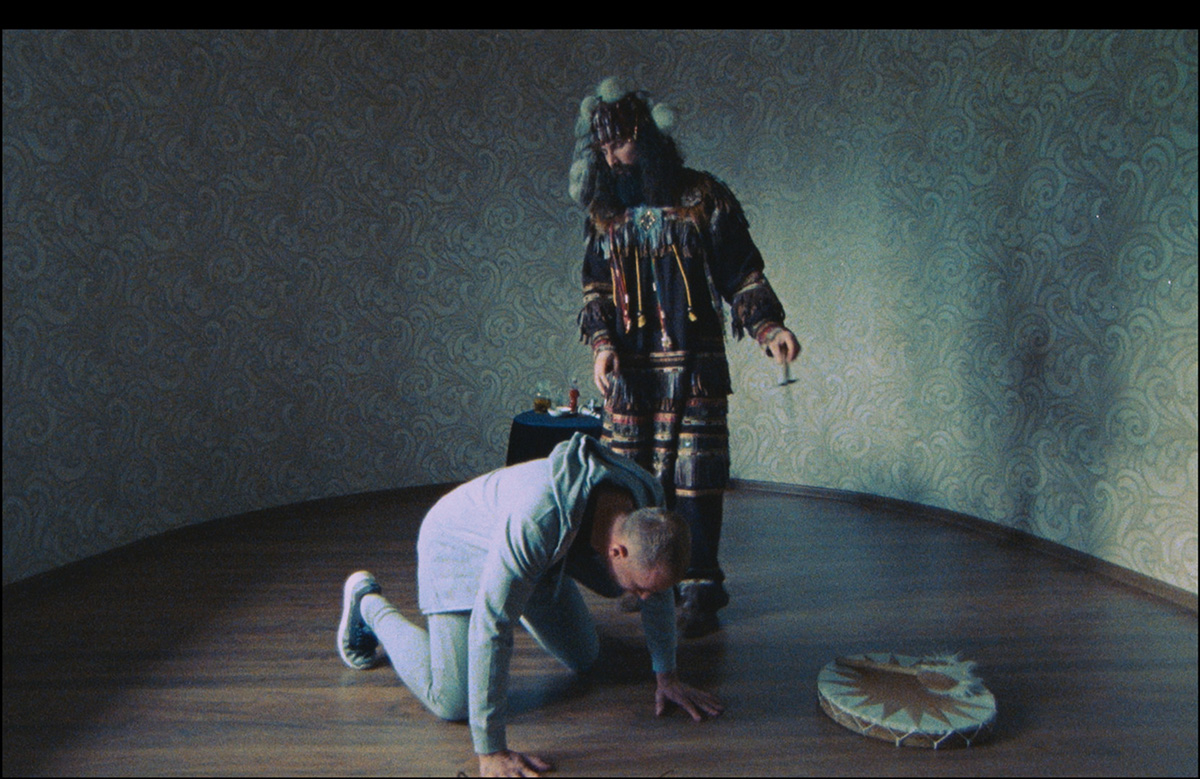
Film plot based on marginal conspiracy theory that russian political elites are practising magic rites in Siberia to empower. This theory gained traction from 2021 to 2022 across Russian online platforms, mostly through Telegram chanels and investigative publication of opposition journalist. With lack of documentation, author decide to re-imagine this events, and make a film reconstruction of one of the rites. Alchemy, occultism and magic rites become the object of the author's research, forming a semantic contradiction with the everyday image of casual life
Lilia Filina is an artist filmmaker, whose work is situated on the uncertain thresholds of the perceptible and the communicable, organism and environment, and knowledge regimes and power, at the intersection of media and the history of political thought. Born in Kaluga, Russia, 1999, she now lives and works in Istanbul, Turkey. Alumni of the Rodchenko art school, Sergey Bratkov class, she works as director and develops independent project on edge of film and videoart.
Lina Filipovich
Catalogue : 2022So Blue | Video | mp4 | black and white | 2:26 | Belarus, France | 2021
Lina Filipovich
So Blue
Video | mp4 | black and white | 2:26 | Belarus, France | 2021
Created in collaboration with IRCAM, « So Blue » represents a false documentary on the trip of Elvis Presley to Minsk, Belarus in the 1960s. The basis and the main element of this video is a song created by me using the sound collage technique. I used a dozen fragments from different Elvis songs, changing the key, working with tempo and harmony to recreate his « unreleased song ». The lyrics were composed by the same method, using archetypal words and phrases, typical for songwriting of the 50 - 60s. The video also presents a collage made from fragments of the fictional film "I'm 20" by Marlen Khutsiev and from frames of documentary films about Minsk. This technique allowed me to create a video mystification about Elvis’s fictional travel to my hometown (Minsk). The cross between fictional and documentary cinema, between a sound collage and a false composition generates a hybrid work that provokes feelings of strangeness, deceiving the viewer about credibility of this work. This confusion gives place to the questioning from the part of the viewer concerning the documentary representation.
Lina Filipovich is an artist and musician based in Paris, France. Her works explore the relationship between audio and visuals and span a variety of media, including found footage films, experimental electronic music, painting, silkscreening and performance. Working with samples and loops, Lina Filipovich uses techniques of sound collage, musical montage, cut-up and appropriation.
Nikolay Filippov
Catalogue : 2018Bulba | Experimental doc. | hdv | color | 3:50 | Russia | 2017
Nikolay Filippov
Bulba
Experimental doc. | hdv | color | 3:50 | Russia | 2017
In "Bulba", a group of people is eating in KFC. The camera is a Peeping Tom now staring at everyday unseen: we will see the story of the whole process told by tonal shifts given in change-of-state glances and expressions. Under the rolling sound of spoken lines from "Taras Bulba", en epic novella by Nikolay Gogol, the figures are delicately melting in the expanded cultural background, the background always being neutral. Such projections are about to touch the constraints of natural perception, where the cultural mechanism is the editor-in-chief.
Nikolay Filippov was born and lives in Moscow. During his studies in theoretical and applied linguistics at Lomonosov Moscow State University he got involved in fieldwork project in Northern Udmurtia, studying beserman (a small ethnic group) language and contributed to the creation of beserman grammar and thesaurus. He also studied history and theory of cinema at the High School of Art Practices in RSUH. Being particularly interested in the philosophy of natural language, he has been developing a logical approach to cinematographic means since his debut "The Herbage", foÑusing on fresh and raw areas of habitual speech and dramatic performance.
Filmsaaz
Catalogue : 2026And How Miserable is the Home of Evil | Video | 4k | color | 7:30 | Iran | 2023

Filmsaaz
And How Miserable is the Home of Evil
Video | 4k | color | 7:30 | Iran | 2023
A dictator says his last words in front of his followers before spending the last seconds of his life sitting on a chair as people break into his house to kill him.
Saleh Kashefi also known as Filmsaaz (1999, Tehran) is an audiovisual artist whose works bring a bold lens upon contemporary youth culture, making ‘no-budget’ films which have gone on to be screened with international acclaim. They have been part of festivals like Cannes, Berlinale, Venice, Locarno, Visions du Réel, IDFA and FID. A recipient of Prince Claus Seed Awards, l'Abri associated artist, Master ECAL/HEAD alumni and currently enrolling in Le Fresnoy, Saleh has made 16 short films which have been included in over 200 film festivals around the world and have won 40 awards.