Catalogue > List by artist
Browse the entire list of Rencontre Internationales artists since 2004. Use the alphabetical filter to refine your search. update in progress
Jennifer T Reeves
Catalogue : 2025The Gloria of your Imagination | Multimedia performance | 16mm | black and white | 96:20 | USA | 2024

Jennifer T Reeves
The Gloria of your Imagination
Multimedia performance | 16mm | black and white | 96:20 | USA | 2024
Sixty years ago, a 30-year-old waitress and single mother, was persuaded to engage in psychotherapy sessions on film, with three of the most influential Theorist-Psychologists of the 20th century. Reeves newest dual-projection film breaks down and expands this widely viewed work “Three Approaches to Psychotherapy” with an intricate superimposed montage of scenes from Gloria’s unguarded sessions and numerous film artifacts of her lifetime: newsreels, home movies, commercials, a beauty pageant, cold war propaganda, and educational films from the 1930s-1970s. Sixty years ago, a 30-year-old waitress and single mother, was persuaded to engage in psychotherapy sessions on film, with three of the most influential Theorist-Psychologists of the 20th century. Reeves newest dual-projection film breaks down and expands the seminal film series Three Approaches to Psychotherapy with an intricate superimposed montage consisting of material from Gloria’s unguarded sessions and numerous film artifacts of her lifetime: newsreels, home movies, commercials, a beauty pageant, cold war propaganda, and educational films from the 1930s-1970s. The Gloria of your Imagination immerses audience members in an unabashed patriarchal, nationalistic era which many U.S. conservatives are working tirelessly to recreate. Social and legal limitations of that era, which formed Gloria and the struggles of her generation, remain unacknowledged in the sessions. While the therapists seem progressively non-judgmental about Gloria’s active sex life, there is no mention that contraceptives are actually illegal for her to take. Reeves’ original intertitle script fills in missing context and introduces Gloria’s greater life and self: from her Polish-Catholic upbringing to marriage straight from high school to an ever-evolving single parent on a spiritual journey, living by her own principles, until an untimely death at 45 years of age.
New York-based film artist Jennifer Reeves (b. 1971, Sri Lanka) has independently made 25+ film-works to date, from avant-garde shorts to multiple projection performances with live music, and experimental features. Reeves’ visceral 16mm film works immerse viewers in intricate, unfamiliar cinematic territory. They investigate themes of mental health and recovery, feminism and sexuality, and the beauty and decay of the natural world. Reeves premiered her dual-projection film THE GLORIA OF YOUR IMAGINATION (97 min) at Berkeley Art Museum Pacific Film Archive in October 2024. With support from residencies at Atelier 105 in Paris and Yaddo in New York, Reeves wrote, directed, edited and sound designed this one-of-a-kind experimental documentary. Reeves has also completed shooting her in-progress YANQUIS GO SOUTH, an experimental feature supported by a Princess Grace Awards Special Project grant. Since 1992, Reeves’ acclaimed work has been screened extensively, from the Berlinale, Curtas Vila do Conde, Sundance and Science New Wave Film Festivals, to the Museum of Modern Art and numerous art cinemas and universities worldwide. Reeves started making films in 1990, and has been doing her own writing, cinematography, editing and sound design ever since. Her works expand the boundaries of cinematic expression through optical-printing and direct-on-film techniques. For many of her projects, Reeves has collaborated with celebrated composers including Marc Ribot, Elliott Sharp and Zeena Parkins. Her feature-length 16mm dual-projection WHEN IT WAS BLUE was performed live with composer, performer Skúli Sverrisson, at venues including Toronto International Film Festival, the Sydney Opera House, Berlinale, and RedCat in Los Angeles.
Mika Taanila
Catalogue : 2017Mannerlaatta | Experimental fiction | 35mm | black and white | 73:13 | Finland | 2016
Mika Taanila
Mannerlaatta
Experimental fiction | 35mm | black and white | 73:13 | Finland | 2016
A camera-less lettrist film about fear of flying, security checks and time zones. After returning from a trip to Tokyo, the protagonist is stuck at a hotel nearby the Helsinki airport. The use of various technical devices, slivers the time-management and modifies the jet-lagged consciousness.
Mika Taanila (s. 1965) is a filmmaker and visual artist based in Helsinki, Finland. He works with documentaries, experimental film and visual arts. Human engineering, utopias, failures and man-machines are recurring themes in his films and installations. Taanila’s works have been shown at major international group shows, such as Aichi Triennale (2013), dOCUMENTA (2012), Shanghai Biennale (2006), Berlin Biennale (2004), Manifesta (2002) and Istanbul Biennial (2001). Solo shows include the Museum of Contemporary Art Kiasma in Helsinki (2013’14), Contemporary Art Museum St. Louis (2013), TENT, Rotterdam (2013) and Galleria Heino, Helsinki (2010). Taanila’s short films have been screened altogether at more than 300 international film festivals and special events. In 2015, Taanila was awarded with the prestigious Ars Fennica Award, the biggest Finnish art award.
Mika Taanila
Catalogue : 2025Failed Emptiness | Experimental fiction | 4k | black and white | 66:0 | Finland | 2024

Mika Taanila
Failed Emptiness
Experimental fiction | 4k | black and white | 66:0 | Finland | 2024
A three-week vacation in the middle of a heatwave. Failed Emptiness describes the familiar experience of emptiness when responsibilities end.
Taanila’s works have been shown at major international group shows, such as Venice Biennale (2017), Aichi Triennale (2013), Documenta (2012), Shanghai Biennale (2006) and Berlin Biennale (2004). Solo shows include Padiglione de l'Esprit Nouveau, Bologna (2020), STUK Leuven (2018), La Neomudéjar Madrid (2018), Balzerprojects, Basel (2016), Kiasma Helsinki (2013–14), CAM St. Louis (2013), Badischer Kunstverein (2008) and Migrosmuseum, Zurich (2005). His films have been screened at several international film festivals and special events, such as Toronto International Film Festival, IFFR Rotterdam, CPH:DOX, International Short Film Festival Clermont-Ferrand, Karlovy-Vary Film Festival, Midnight Sun Film Festival, IDFA Amsterdam, Berlinale and Kurzfilmtage Oberhausen. Taanila has received numerous awards, both in Finland and internationally. Taanila was awarded the prestigious Ars Fennica prize in 2015.
Mónica Taboada-tapia
Catalogue : 2022Two-Spirit | Documentary | 4k | color | 15:35 | Colombia | 2021
Mónica Taboada-tapia
Two-Spirit
Documentary | 4k | color | 15:35 | Colombia | 2021
For Georgina, an indigenous transgender woman, life in the desert is lonely and cruel. In her small village, no one understands who she is.
Mónica Taboada-Tapia is a Colombian Anthropologist and a Filmmaker. Her short film FIDEL was screened at numerous film festivals. She is currently working on three feature documentaries, SOUL OF THE DESERT, FIGHTERS OF THE HOOD, and MY LIFE, MY BODY. She has participated in Tribeca Film Institute, Torino Film Lab, DocsMX, ChileDoc, Talents Buenos Aires, DocMontevideo Pitch, DocSP Brazil, Docs Barcelona, MiradasDoc, The New York Times Op-Docs, Pulitzer Center, and Tribeca Film Institute International Pitch
Marko Tadic
Catalogue : 2022Dogadjaji za zaboraviti | Animation | 16mm | color | 6:0 | Croatia | 2020
Marko Tadic
Dogadjaji za zaboraviti
Animation | 16mm | color | 6:0 | Croatia | 2020
Filmed on 16mm film, this visual expression is rooted in archival materials and based on a poem by Hans Magnus Enzensberger. It speaks of forgotten people, their lives and their deeds. These two Archives were found at a flea market in Zagreb. One is of a famous architect and the other of a famous composer. The film ponders on this occurrence, as well as on the vanishing and forgetfulness of humans.
Marko Tadic (1979) studied painting at the Accademia di Belle Arti, Florence. His artistic practice focuses on drawing, installation and animation. He has won numerous art prizes. His films have been shown at many international animation and experimental film festivals. His works have been exhibited in many solo and group exhibitions around the world. In 2017, he represented Croatia at the 57th Venice Biennale, along with Tina Gverovic. He participated in residential programs in Helsinki, New York, Los Angeles, Frankfurt and Vienna. He works at the Academy of Fine Arts in Zagreb, Croatia.
Maryam Tafakory
Catalogue : 2022Nazarbazi | Experimental film | 35mm | color | 19:54 | Iran | 2021
Maryam Tafakory
Nazarbazi
Experimental film | 35mm | color | 19:54 | Iran | 2021
Nazarbazi [the play of glances] is a film about love and desire in Iranian cinema where depictions of intimacy and touch between women and men are prohibited.
Maryam Tafakory is an artist filmmaker based between London and Shiraz. Her work has been exhibited internationally including MoMA Doc Fortnight; IFF Rotterdam; Edinburgh EIFF; Melbourne MIFF; True/False festival; Zurich Film Festival; Whitechapel Gallery; Pergamon Museum; M HKA; and Anthology Film Archives amongst others. She has received several awards including, the Ammodo Tiger Short at 51st IFFR, the First Jury Prize at DocumentaMadrid, the Best Short Film at Festival de Cine Lima Independiente, and she was the 2019 Flaherty/Colgate Distinguished Global Filmmaker in Residence, NY. Her work has appeared at Criterion's The Daily, the Sight&Sound magazine, Filmmaker Magazine, and Senses of Cinema.
Maryam Tafakory
Catalogue : 2026Razeh-Del | Experimental doc. | mov | color | 27:47 | Iran | 2024
Maryam Tafakory
Razeh-Del
Experimental doc. | mov | color | 27:47 | Iran | 2024
In 1998, two schoolgirls sent a letter to Iran's first-ever women’s newspaper. While they waited to be published, they considered making an impossible film. Using citations and image intervention, Razeh-del journeys through parallel histories of war on images of women.
Maryam Tafakory, born and raised in Iran, works with film and performance. Solo screenings of her work include MoMA, BOZAR, NGA, Washington DC, and Academy Museum, among others. Selected group events include Tate Modern, Cannes’ Directors Fortnight, New York Film Festival, Locarno Film Festival, Toronto International Film Festival. She was awarded the Gold Hugo at the 58th Chicago Int’l Film Festival, Tiger Short Award at the 51st IFFR, and Best Experimental Film at the 70th and 71st MIFF. She was the 2024 winner of the Film London Jarman Award.
Theodore Tagholm
Catalogue : 2015Plain Sight | Video | hdv | color | 1:29 | United Kingdom | 2013
Theodore Tagholm
Plain Sight
Video | hdv | color | 1:29 | United Kingdom | 2013
Hiding in plain sight, the photograph skims across the skin of reality. The work plays with the surface of the photographic image. Looking at how perceptual attention affects the surface of the image, revealing fractures on the infra slim surface.
Theodore Tagholm is a London based artist who has been working with time based media for over 15 years. Trained at Chelsea School of Art and Middlesex University.
Catalogue : 2010Conversations with Walt Whitman | Experimental fiction | | color | 5:50 | United Kingdom | 2009
Theodore Tagholm
Conversations with Walt Whitman
Experimental fiction | | color | 5:50 | United Kingdom | 2009
Conversations with Walt Whitman explores belief and its context. Through flickering lights and morse code Walt Whitman has got in touch from beyond the grave to recite poetry to our protagonist. It turns out the Walt had previously got in touch with his grand mother with a spirit writer. Is he really in touch or is this some form of escape from the banalities of suburban existence.
Theodore Tagholm is an artist based in London. Working primarily in video he was recently shortlisted for the Jerwood Moving Image Awards.
Catalogue : 2010Turner came to me in a dream and told me cyprien g | Video | | color | 1:29 | United Kingdom | 2009
Theodore Tagholm
Turner came to me in a dream and told me cyprien g
Video | | color | 1:29 | United Kingdom | 2009
Young-jun Tak
Catalogue : 2025Love Your Clean Feet on Thursday | Experimental film | digital | color | 18:53 | Germany | 2023
Young-jun Tak
Love Your Clean Feet on Thursday
Experimental film | digital | color | 18:53 | Germany | 2023
This second film from Young-jun Tak's on-going choreographic film series challenges the conventional binarity of gender presentations through queer male bodies and movements. It juxtaposes the hypermasculinity and hyperfemininity. The former is presented by Spanish Legion soldiers’ spectacular annual Maundy Thursday ritual carrying the life-sized crucifix in Malaga during the Holy Week that leads to the Easter Sunday. The latter can be found in Kenneth MacMillan’s ballet “Manon” (1974) where numerous male dancers worship the eponymous female protagonist in Act 2 Scene 1 by constantly lifting up and carrying her in the air. In spite of the two situations’ obvious difference, the glorification of two gender displays surprisingly reveals their similarity, for instance, in the lifted bodies’ open arms. In this regard, a new choreography, inspired by the specific scene of “Manon”, is commissioned to choreographer Jamal Callender—including himself as lead dancer—with five other gay male dancers, and a few preconditions were given to him: Manon should be male; his barefoot should never touch the dirt on the ground; and the choreography should be performed in Berlin’s popular gay cruising forest Grunewald. Throughout this film, the Spanish soldiers’ public ritual and the six male dancers’ choreography alternate while their bodies and movements, exposed to either crowded audience’s eyes on streets or hidden lustful gazes in bushes, try to fill the gap between the polarized gender presentations.
Young-jun Tak (born 1989, in Seoul, South Korea) is visual artist and filmmaker, and he lives and works in Berlin, Germany. Tak’s practice examines socio-cultural and psychological mechanisms that shape belief systems, ranging from simple objects of worship to sophisticated forms of religions. Blurring the lines between media, techniques, and subject matters, his films and sculptures pursue obfuscation as a tool of critique, and the human body is often exposed in the context of polarizing norms and conventions. Recent solo exhibitions include PHILIPPZOLLINGER (Zurich, 2024); COMA (Sydney, 2024); Atelier Hermès (Seoul, 2024); Julia Stoschek Foundation (Berlin, Dusseldorf, 2023); palace enterprise (Copenhagen, 2023); Wanås Konst (Knislinge 2023); O—Overgaden (Copenhagen, 2023); SOX (Berlin, 2022); and Efremidis (Berlin, 2022). He has participated in numerous international group exhibitions such as at St.Moritz Art Film Festival (2024); Bangkok Art Biennale (2024); the High Line (New York, 2023); Chicago Architecture Biennial (2023); Lyon Biennale (2022); Perrotin (Paris, 2022); KINDL Center for Contemporary Art (Berlin, 2022); Berlin Biennale (2020), Seoul Museum of Art (2019); and Istanbul Biennial (2017). Tak won the “Love at First Sight Prize” at the 3rd St.Moritz Art Film Festival and the “TOY Berlin Masters Award” at the 9th Berlin Masters. He studied English Language and Literature, as well as Cross-Cultural Studies at Sungkyunkwan University in Seoul.
Young-jun Tak
Catalogue : 2022Wish You a Lovely Sunday | Experimental doc. | hdv | color | 18:38 | Korea, South, Germany | 2021
Young-jun Tak
Wish You a Lovely Sunday
Experimental doc. | hdv | color | 18:38 | Korea, South, Germany | 2021
The video boldly combines and juxtaposes two distinctive spatial settings—a church and a queer club. For this filmic work, two choreographers and two dancers were paired up to create a new choreography, for the church “Kirche am Südstern” and the queer club “SchwuZ” in Berlin respectively. Each pair was assigned to a different Bach piano piece for four hands. After days of rehearsals and when the choreography was complete, their designated venues were then swapped. The participants did not know the exact location they would perform in until the actual day of filming, and, therefore, they had to reprogram their choreographies according to the new architectural features and atmosphere of the changed location. Although churches and queer clubs seem to function for starkly different purposes, both spaces share intriguing similarities as they both require specific rituals, behavioral norms and attitudes closely linked to the space and its role. In the film, the continuous change of scenes between the two kind of spaces with the dancer’s bodily presence, their movements and dialogues, aims at achieving a sort of almost impossible mergence or coexistence of religious practice on one side and club culture on the other side.
Young-jun Tak (born in 1989 in Seoul, South Korea) lives and works in Berlin, Germany. His solo exhibition took place at SOX (Berlin, 2022) and Fragment Gallery (Moscow, 2021). His works have been exhibited at the 9th Berlin Masters (2021), Gabriele Senn Galerie (2021, Vienna), the 11th Berlin Biennale (2020), Hall Art Foundation / Schloss Derneburg Museum (2020), Diskurs Berlin (2019), Seoul Museum of Art, SeMA Bunker (2019), Brandenburgischer Kunstverein Potsdam (2018), PS120 (2018, Berlin), the 15th Istanbul Biennial (2017), König Galerie (2016, Berlin) among others. He won “TOY Berlin Masters Award” (2021) and grants for International Exchange Program from Arts Council Korea (2021, 2020, 2017, 2016). He was Managing Editor for the 13th Gwangju Biennale (2021) and the 9th Busan Biennale (2019), and Editor for the South Korean monthly art magazine "Art in Culture" (2021–2015).
Naoko Takahashi
Catalogue : 2006Good Morning At Night | Experimental doc. | dv | color | 10:46 | Japan, United Arab Emirates | 2005
Naoko Takahashi
Good Morning At Night
Experimental doc. | dv | color | 10:46 | Japan, United Arab Emirates | 2005
There are so many men standing around on the streets in down town. They are here to work and send money to their families back home. There is a square where they wait for a job to come in for the day each morning. In the evening, they sit around having chat, drinking tea and playing cards. There is no woman walking around on her own at night. If you walk alone at night in town, if you are not wearing certain kind of clothes when you go out, you could be treated as the one at the bottom of the society. You could easily get lost, confused, Isolated and humiliated. The film was shot on mini DV, colour with voice over in English and Arabic subtitles.
Artist working with text, time based media, installation and live art. Lives and works in London Born in Nigata, Japan 1973 Since moving to UK in 1992, Takahashi has been using second language and living in between two cultures. Her works focuses on the notion of dislocation, re-location, foreignness and representation in multi cultural, multi lingual society and ideas of national and individual identity. Over the past few years, she has been interested in site specific and culturally specific works that engage with the surrounding area and people. Takahashi exhibits her artworks and performs live at various venues in UK and abroad. In addition to the previous artist in residencies, she has recently participated in Sharjah Biennial 7?s Artist-In-Residence-program. Her video works have been selected and screened at numerous festivals internationally including 24th Uppsala International Short Film Festival Sweden, About Time Nordyllands Kunstmuseum Denmark, Beck`s Futures 2 film & Video UK and BBC British Short Film Festival 2000. Her awards are the organiser?s award, Outvideo, Ekaterinburg, Russia, video and performance award, Vizura Aperta/Momiano, Momian, Croatia.
Pilvi Takala
Catalogue : 2021If Your Heart Wants It (Remix) | Video | hdv | color | 15:21 | Finland, USA | 2002
Pilvi Takala
If Your Heart Wants It (Remix)
Video | hdv | color | 15:21 | Finland, USA | 2002
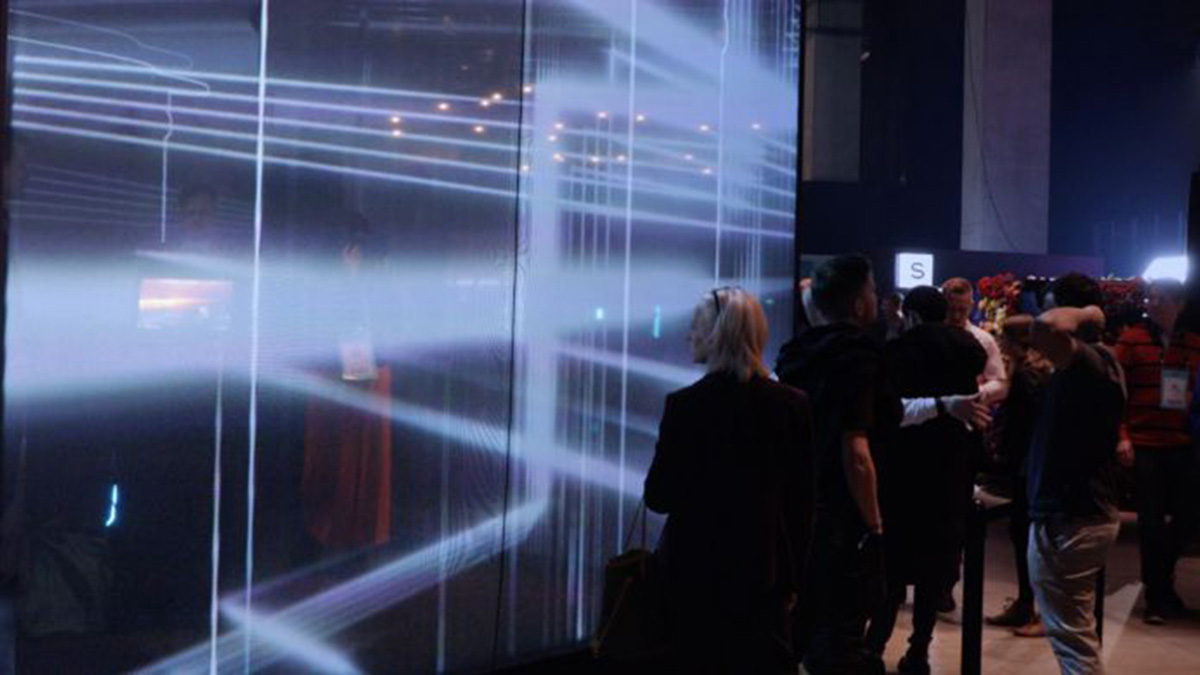
Taking place annually in Helsinki, SLUSH is a three-day super event that aims to invigorate the tech-startup community by bringing together entrepreneurs with venture capitalists in a party-like environment. If your heart wants it (remix) is grounded in research Takala conducted at the 2018 edition of SLUSH. Together with an interdisciplinary team and camera crew, they fabricated a startup in order to gain entry.
Pilvi Takala (b. 1981) lives and works between Berlin and Helsinki. Her video works are based on performative interventions in which she researches specific communities in order to process social structures and question the normative rules and truths of our behaviour in different contexts. Her works show that it is often possible to learn about the implicit rules of a social situation only by its disruption. Her work has been shown in MoMA PS1 and New Museum, Kiasma, Palais de Tokyo, Kunsthalle Basel, Manifesta 11, Witte de With, and the 9th Istanbul Biennial. Takala won the Dutch Prix de Rome in 2011 and the Emdash Award and Finnish State Prize for Visual Arts in 2013.
Pilvi Takala
Catalogue : 2009Kuuluttaja | Video | | color | 5:50 | Finland | 2007
Pilvi Takala
Kuuluttaja
Video | | color | 5:50 | Finland | 2007
Ho Tam
Catalogue : 2006In the Dark | Experimental video | dv | black and white | 6:0 | Canada | 2004
Ho Tam
In the Dark
Experimental video | dv | black and white | 6:0 | Canada | 2004
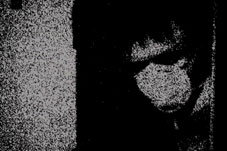
Made in the year after SARS crisis, the video re-visits the images collected from the Toronto media. For the record, Toronto (Canada) was the only non-Asian city that was significantly affected by the epidemic. The city was stigmatized by some isolated cases that began from a carrier back from a visit in Asia. Through all black and white re-photographed pictures, all we can see is the darkness of a time passed, a city under attacks and assaults, politicians scrambling for words of comfort, citizens living in a state of fear, distrust, paranoia and shame. How are we to make from those few months that seemed to last forever? As if we were in the dark ages, at the time we thought we would never come out of it again. The video, by referencing the weaknesses within human nature, indirectly refers to the problematic media attention in a world we have created. If the media is the message, the video questions its biases and truthfulness? In order to re-create this uncomfortable time, the mediated and degraded images and the audio purposely resonate each other to reveal the sense of self-doubt, disgust and the feeling of almost approaching a state of abjection. The project was shot in low light situation using a consumer camcorder and therefore creating the resulting unstable signals that the camcorder was set to detect and contain (unsuccessfully in this case). In such a way, the video almost parallels the medical scientific process in the present day bacterial warfare. Using video technology in the production process but referencing the languages of experimental films, In the dark also pays homage to the avant-garde filmmaker Stan Brakhage (1933 - 2003), who passed away about the same time as the SARS outbreak.
Ho Tam was born in Hong Kong and educated in Toronto, Canada and worked in advertising firms and community psychiatric facilities before turning to art. He works in a diverse mix of disciplinary including painting, video, photography, print and public art and has exhibited in various cities across North America. His first video, The Yellow Pages, was commissioned by the public arts group PUBLIC ACCESS for an installation/projection at the Union Station of Toronto in 1994/95. Since then Tam has produced over 15 experimental videos. His work is included in the traveling exhibition Magnetic North: Canadian Experimental Video organized by Walker Art Center, Minnesota. Tam currently teaches at the University of Victoria. He is a graduate of Whitney Museum Independent Studies Program, Bard College (MFA) and recipients of various fellowships and artist`s grants.
Marion Tampon-lajarriette
Catalogue : 2020Natura Naturata | Video | hdv | color | 8:34 | France, Switzerland | 2018
Marion Tampon-lajarriette
Natura Naturata
Video | hdv | color | 8:34 | France, Switzerland | 2018
With this film, the artist continues to unfold her body of works held in the context of Art, Archeology or Natural History Museums, where their visitors and their collections are moved to another genre often inspired by Sci-Fi or Fantasy. In Natura Naturata, she filmed a pluri-generational group of gymnasts in the Museum of Natural History of Geneva, moving and resting among the collections of crystals, animals and corals. In the soundtrack composed by Leo Hofmann, voices are whispering or singing fragments of the text Monadology and Sociology by 19th century french philosopher and sociologist Gabriel Tarde. So the film proposes to give an unstable shape and rhythm to this Tarde conception of the « universal phenomena across cosmic, natural and social worlds » where « The whole is always smaller than its parts ». All the images were filmed in the permanent galleries of the Museum of Natural History of the city of Geneva. Thanks for the support and participation.
Marion Tampon-Lajarriette (b.1982 in Paris) lives and works in Geneva. She received an MFA from the École Nationale Supérieure des Beaux-Arts de Lyon (France) in 2007 and an MA in Arts and New Media from the Haute École d’Art et de Design de Genève (HEAD) in 2008. She has had numerous solo exhibitions, including: Museo Villa Pia (Lugano, 2019); Les Brasseurs (Liège, 2015); Mois de la Photo Festival (Paris, 2012); Loop Art Fair (Barcelona, 2008). Her work has also been shown at the Palais de Tokyo, Paris; MAMCO, Geneva; Swiss Institute, New York City; Capture Photography Festival, Vancouver; and is part of the permanent collection at MAMCO, Geneva; MEP, Paris; NMNM, Monaco; the Francois Pinault Foundation; among others. In 2016-2017 she was awarded a residency at the Swiss Institute in Rome, and took part in the Swiss Art Awards in Basel. In 2013, she was awarded the Société des Arts grant and the FCAC-Geneva grant and residency in New York City. The artist’s second monograph, Echos, will be edited in March 2020 by Casa Grande (331 pages, texts by Mark Lewis, Lucille Ulrich, Valeria Venditti). She is represented by Galerie Laurence Bernard in Geneva.
Catalogue : 2007Une Histoire déjà racontée | Experimental video | dv | color | 6:0 | France | 2005
Marion Tampon-lajarriette
Une Histoire déjà racontée
Experimental video | dv | color | 6:0 | France | 2005
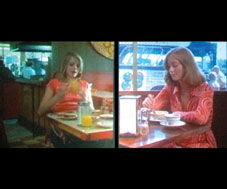
The artist's activity mainly consists of revisiting great movies, the ones that are very present in our collective memory, acting on the unity of their image or their temporal linearity (here : to substitute and entirely re-record the original soundtrack; to have the two secondary female roles meet; to stay in a place unrelated to the action ... ). In the already existing movie's well defined setting, she tries to open other possible space-times and other logics in the very interstices of its narrative progression, and to find other ways to enter and navigate inside one precise tale, on paths that would look more like that of the passerby who walks with no set aim in a Universe void of meaning or order, void of landmarks and limits. This activity of re-appropriation is therefore based on the artist's position of "receiver", reacting to a "Great Tales Cinema" which displays a very powerful representation of the World as an orderly, hierarchic territory, where Good and Evil as well as Right and Wrong are still told apart, where History moves only one-way (the figure of the hero, destiny, the scenario ... ). Here protagonists themselves explore fiction as they explore life, groping their way through because there isn't just one way but an infinite number...
Marion Tampon-Lajarrirtte was born sometime during the 80´s. Somewhere else she studied arts at the Villa Arson. Still elsewhere she started a series of eloquent video portraits and mute postcards, thanks to a scholarship from the Medialab-Centro Cultural Conde Duque. Later she continued her studies at the Fine Arts School of Lyon and elsewhere a Masters in New Media at the HEAA, Geneva. She shoots or re-appropriates film, writes or blends, makes photographs or reframes.
Fiona Tan
Catalogue : 2008A Lapse of Memory | Experimental video | 35mm | color | 27:10 | Indonesia, Netherlands | 2007
Fiona Tan
A Lapse of Memory
Experimental video | 35mm | color | 27:10 | Indonesia, Netherlands | 2007
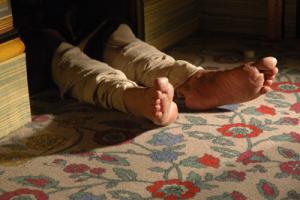
A confused, old man - Henry - lives alone in a deserted building which looks a lot like a palace. He has not been outside in years. His days pass as if removed from time, in voluntary exile from the rest of the world. The camera registers his simple daily routine and his careful but eccentric rituals. As much he resembles to a large extent the building which he occupies. Indeed Henry is only one of the protagonists of this film. The second protagonist is the building itself: the Royal Pavilion in Brighton (UK). In a spoken monologue a play unfolds between reality and fiction. Word and image, movie and documentary entangle and point beyond the boundaries of ?East? and ?West?.
Fiona Tan (1966) was born in Indonesia and lives in The Netherlands. She studied at the Rietveld Academie and the Rijksakademie in Amsterdam. Her film and video installations and photographic works have gained international acclaim and have been exhibited all over the world. Presentations of her work have included at the Venice Bienniale, at Documenta 11, the Yokohama Triennale, the Berlin Biennale and also at the Istanbul Biennial and the Sydney Biennial. Her work is included in collections such as the Tate Modern, Stedelijk Museum Amsterdam, the Don Rubell Collection, Schaulager and the Goetz Sammlung.
Ryan Tan
Tsuneko Taniuchi
Catalogue : 2006Marianne Tsuneko /Tsuneko Marianne | Art vidéo | dv | color | 3:50 | France | 2002
Tsuneko Taniuchi
Marianne Tsuneko /Tsuneko Marianne
Art vidéo | dv | color | 3:50 | France | 2002
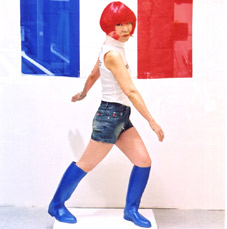
Micro-event n°18 / Marianne Tsuneko / Tsuneko Marianne : The video realized during the performance of ?Marianne Tsuneko / Tsuneko Marianne?, in Window, Paris 2002. I was in the window of ?Window?, dressed with a white shirt on which was written ?Marianne?, on the front side, and Tsuneko on the back side. Instead of the Phrygian hat, I had a red wig and blue boots. On the wall, behind me, was hanging the French flag. And I was dancing on the Marseillaise. In the street, were bystanders and artistic faith procession exhibition audience which happened during the presidential election, before April 27th, 2002.
French plastic artist form Japan, she?s born in Hyogo, Japan. She lives and works and Paris since 1987 exploring visual arts, notably interactive performance, named ?Micro?évènement?. She creates also videos, installations and photography. By these ?Micro-évènements?, Tsuneko Taniuchi is attached to present the social conditioning, the status of excluded, the feminine condition and the nature of the contemporary exchanges.
Antti Tanttu
Catalogue : 2023Noli Timere | Animation | 0 | black and white | 6:29 | Finland | 2022
Antti Tanttu
Noli Timere
Animation | 0 | black and white | 6:29 | Finland | 2022
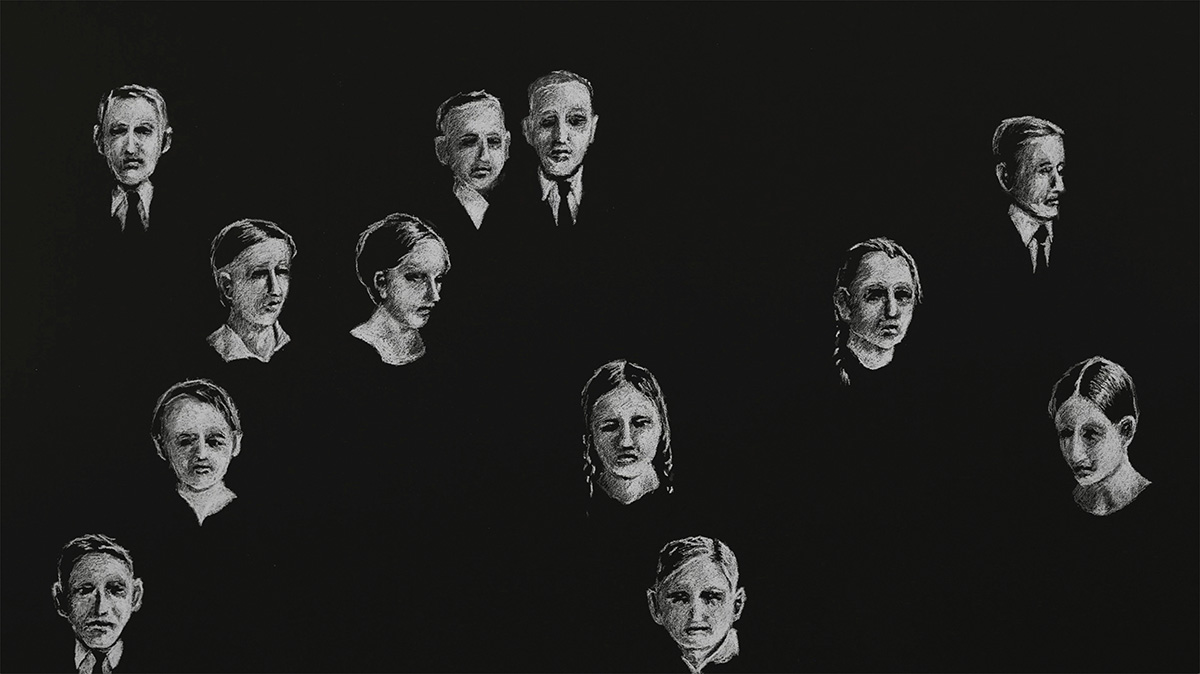
Noli Timere is a work about the experience and emotion of fear or anxiety. What is common or private in those feelings and what do they have in common? The work contemplates on the collective fear and its elements. ?
Antti Tanttu was born in Malaga, Spain and currently lives and works in Helsinki. He studied at the Academy of Fine Arts in Helsinki between 1984–89. His works often deal with issues such as solitude, absence and longing. Tanttu has participated in solo and group exhibitions since 1986 in e.g. Gallery Heino in Helsinki, Sara Hildén Art Museum in Tampere, Finland and Norrtälje Kunsthalle in Sweden, as well as in festivals and events around the world.
Rebecca Taouk
Catalogue : 2026Au Fil de l'Eau | Documentary | dcp | color | 22:45 | Lebanon | 2024
Rebecca Taouk
Au Fil de l'Eau
Documentary | dcp | color | 22:45 | Lebanon | 2024
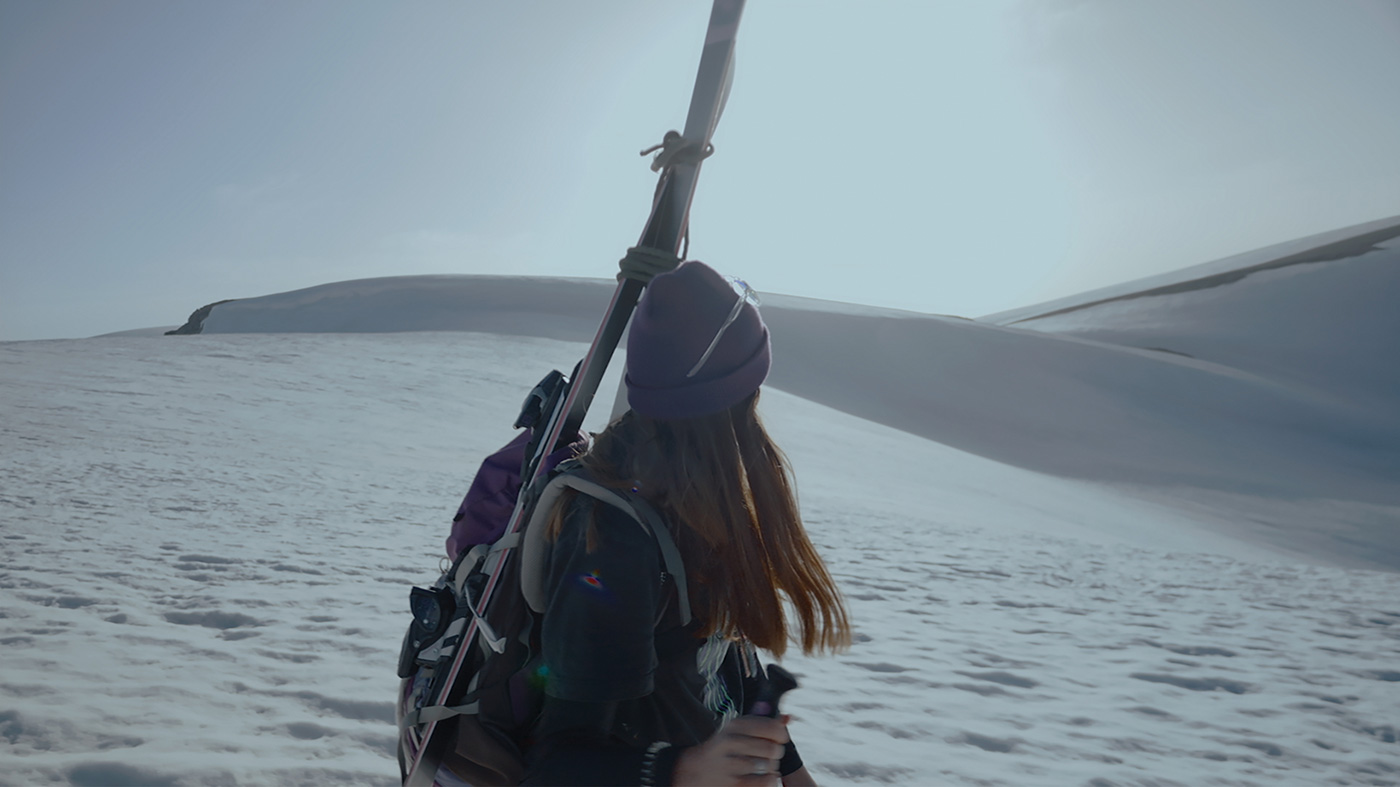
Flowing from Lebanon’s highest peak to the sea, water carries stories of connection and transformation. Along the Water takes a contemplative journey through the lives of Samir, Hisham, Antoine, and Ghiwa, whose bonds with nature, through the sea, rivers, and mountains, reflect a shared need to protect it. Through a transformative lens, the film captures the profound sensibility of their relationships with the natural world.
Rebecca is a Belgian-Lebanese filmmaker based in Brussels. She holds a master’s degree in documentary filmmaking from Docnomads (2020). Her cinematographic research explores themes of body, grief, identity, and connection. Her latest project, Au Fil de L’eau, emphasizes the importance of protecting nature and water through a contemplative journey, following the flow of water.
Julian Tapprich
Catalogue : 2013Coming Soon | Video | hdv | color | 7:30 | Switzerland, Austria | 2011
Julian Tapprich
Coming Soon
Video | hdv | color | 7:30 | Switzerland, Austria | 2011
Julian Tapprich?s video work Coming Soon is based on the trailer for Michael Haneke?s film, ?La pianiste (The Piano Teacher)?. Tapprich examines the referentiality of trailers. The trailer to "La pianiste" does not only refer to a story but also contains a self-referential element. In a scene with a Schubert soundtrack the pianist (Isabelle Huppert) announces a letter which arrives immediately and is once again read out to her. Tapprich picks up this closed circuit: the letter is repeatedly announced and continually extended by new literary texts. By mixing the literary texts with those of the trailer the mood and tone of voice of the narrator are in a state of permanent change ? a form of disassociation that refers to the abbreviated nature of image, text and sound in trailers.
Julian Tapprich, born 1982 in Zurich, Switzerland. Since 2003 studies of comparative literature in Vienna and Paris. Since 2007 studies of photography at the university of applied arts in Vienna.