Catalogue > List by artist
Browse the entire list of Rencontre Internationales artists since 2004. Use the alphabetical filter to refine your search. update in progress
Aisling O' Beirn
Catalogue : 2007and other storeys | Animation | 0 | color | 11:55 | Ireland | 2006
Aisling O' Beirn
and other storeys
Animation | 0 | color | 11:55 | Ireland | 2006
This recent work is derived from a body of research into various informal accounts of places. The research takes the form of a constantly expanding collection of urban myths, anecdotes, landmarks, place nicknames, and hand drawn maps gathered from various cities. The interest in these unofficial accounts stems from a concern regarding the politics of how a place is described at a local, unofficial level. Recent installations and site specific projects mark an attempt to bring together some of this seemingly disparate information in a non-linear fashion through sculptural and site specific means. The animation "...and other storys...", tells a of series of vernacular stories relating to various landmarks, from a range of cities and sites. These stories, often humorous, illustrate the contested nature of each of the sites, whilst also serving to show how disparate geographical locations can often be linked through their ordinariness.
O? Beirn is based in Belfast, producing work for both gallery and site specific contexts. She has exhibited both nationally and internationally. She is an Associate Lecturer of Sculpture at the University of Ulster. O? Beirn is represented by The Third Space Gallery, Belfast. Recent exhibitions include: "The Nature of Things: A Long Weekend" at the Venice Bienniale; Artists from Northern Ireland at the 51st Venice Biennale, curator H. Mulholland Oct 2005; :City/Observer", hosted on Rhizome, curator Yukie Kamiya; ?RISK? Group show and Workshop/Residency CCA Glasgow, curator Ele Carpenter; "The Belfast Way", Herzeliya Museum of Contemporary Art, Tel Aviv, Israel, March 2005, curator S. Edelsztein; "Two Person Show with R. Buchannen", Ards Arts Centre, curator Fully Formed Projects, 2006; "Space Shuttle" 2006, Lr Garfield Street and PS2, Belfast curator P. Muschler; "Obscured by Architecture", South Dublin Co. Council, curator M. Dewmpsey; and "Dogs Have No Religion", The Czech Museum of Fine Arts, Prague, curator R. Drury, 2006. One person shows include "...And Other Storeys", Void, Derry, curators C.Darke and M. O? Boyle, 2006, and "A Small Urban Inventory", Golden Thread Gallery April 2005.
Mark O'connell
Catalogue : 2006All Broke Up | Art vidéo | dv | color | 3:58 | USA | 2004
Mark O'connell
All Broke Up
Art vidéo | dv | color | 3:58 | USA | 2004
"What? Torture!?! I didn`t see any torture. Did you see some torture? Nobody saw any torture....."
Mark O`Connell probes and pushes the emerging representational, juxtapositional possibilities afforded by today`s expanding range of digital media. After a score of years in music--as a performer, composer, and producer--he now works with a variety of media: still images, video, film, music and text; all manipulated as digital information. The finished pieces are generally delivered via videotape or Quick Time computer files. His work has been exhibited in a wide range of venues.
Alison O'daniel
Catalogue : 2007Deep Woods | Experimental video | dv | color | 5:30 | United Kingdom | 2005
Alison O'daniel
Deep Woods
Experimental video | dv | color | 5:30 | United Kingdom | 2005
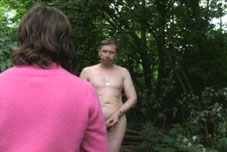
A woman's back, somewhat to the left of centre, fills the image. She is standing straight in front of the camera, which now and then registers a glimpse of the man who is standing face to face with her at a few metres' distance, somewhere in a forest. Camera, man, and woman are barely moving, while the voice-over clarifies the context of what is happening. The voice probably belongs to the man, of whom we have just seen enough to be able to decide that he must be an elderly gentleman. He explains that he is always looking for new challenges, experiences and boundaries. He is wondering how it will affect him, whatever it is he is going to do later, and about which the viewer can still only take a guess. The voice-over appears to be based on a conversation or correspondence that took place between him and the woman before the recording. He admits that he feels embarrassed and uncomfortable with the situation and with the idea that he is going to do something like that in her presence, and in that of the camera crew and eventually, of an audience. Then, as the camera moves along, we see how he calmly starts to undress. He hands his clothes to the woman. How will his body respond in these circumstances, will it cooperate gracefully, or will it embarrass him? He is not a model or an actor, he says. He looks alternately at the woman or just past her into the camera, or sideways and upwards. Very calmly he carries out the agreed action, and within a few moments it is done, upon which she hands him a cloth and his clothes.
Nick O'dwyer, Rachel BLISS
Catalogue : 2006Village Life | Documentary | dv | color | 60:45 | United Kingdom | 2005
Nick O'dwyer, Rachel BLISS
Village Life
Documentary | dv | color | 60:45 | United Kingdom | 2005
Botton Village - tucked away high on England`s north Yorkshire moors - is part soap opera ; part Village of the Damned. It`s a bold social experiment where 136 special needs `villagers` with learning difficulties live in a commune with 100 `co-workers`. Partly because of its isolation, Botton is a place of high emotion where outbursts of bizarre behaviour are part of the routine and are benignly tolerated. Landmark Films was given remarkably free access to Botton and VILLAGE LIFE - filmed over a cold winter - is a truly extraordinary mix of conflict, emotion and weirdness. The film tracks a group of villagers through emotionally difficult events in their lives. It`s an unusually `pure` documentary and unfolds in a series of observed scenes, allowing special needs people to speak for themselves, unmediated by experts or educational therapists. The result is a film which is raw, direct, honest and provocative.
Channel 4- The Strangest Village in Britain 50? TX tbc 2005 Dsr 570 A unique special needs community in north Yorkshire BBC1 ? Rat attack 40? TX September 2003 Digibeta Of rats and men. 2002 - ITV ? The Angriest Men in Britain 50? TX July,16mm Male rage - ITV ? The Strongest Men in Britain 50? TX July, 16mm Big men in little pants - ITV ? The Unluckiest Faces in Britain 50? TX August, 16mm Living with bad looks. - ITV ? The Campest Men in Britain 50? TX August, 16mm The men who would be queens. - ITV ? The Tartiest Men in Britain 50? TX August, 16mm Three men: 350 one-night-stands. - ITV ? The Sexiest Girls in Britain 50? TX September, 16mm How to win at the sexy game. 2001 - Channel 4 ? Fat Blokes 50? TX date late October, C4 Digibeta Men and their tummies. Belly laughs. - ITV Real Life ? The Fattest Men in Britain - 50? TX date October, ITV 16mm Darkly comic contest of two fifty stone men slugging it out for the title. Shortlisted for Grierson Most Entertaining Documentary. - C4 Cutting Edge ? Worst Journey in Britain - 50? TX date March, C4 mini DV A team of transport sadists inflict seven days of public transport hell on Observer journalist John Sweeney. It wasn?t enough. 2000 - C4 Dayshift Nightshift 15? TX date Dec C4 16mm A black comedy of male aggression mediated through machinery: a film with looks, grunt, smiles, music but no dialogue. - ITV Real Life ? A Good Night Out 50? TX date August, ITV 16mm Three pairs of friends out on the razz in Doncaster on a boozy Friday night. Nominated by ITV for RTS Best Single Documentary 1999 - C4 Cutting Edge - Shot - 50? TX date March C4, 16mm The moment of the firing of a gun. Dramatic testimony from both sides of the exchange between shooter and shot. 1998 - C4 Secret History - The Chair - 50? TX date June C4 16mm and 8mm The bloody and disreputable origins of the most barbaric means of judicial execution - the electric chair. - Seattle Human Rights Film Festival 1999. New York Underground Film Festival 1999. BBC Modern Times - Bystanders 50` TX date November 1997 BBC 2 16mm and 8mm The moment of decision in a human dilemma - whether or not to intervene on another`s behalf. BBC Modern Times - Dog Trouble 50` 13 November 1996 BBC2 16mm A fast, funny and furious romp through the social mayhem wrought by canis familiaris. BBC Modern Times - Tracy and Joey 50` TX March 1996 BBC2 16mm and 8mm Love and betrayal - how a young mother was burned to death by killers looking for her drug-dealing husband. BBC Modern Times - Bogus Callers 50` TX November 1995 BBC2 16mm. The cruel, hidden and violent world of the bogus caller criminal. BBC Modern Times - Open Prison 50` TX April 1995 BBC2 16mm. The genteel life of the white collar fraudsman at H.M. Prison Ford. BBC Inside Story Ireland season - Written in Blood BBC2 50` TX August 1994 BBC2 16mm. The rise and bloody history of paramilitary violence in northern Ireland. Winner, Golden Gate award, San Francisco Film Festival 1995. BBC Taking Liberties - Not for 222 BBC2 30` TX April 1994 BBC2 16mm How hospital doctors make secret decisions about who is to be offered resuscitation and who is to be left to die. BBC Taking Liberties Special - An Acceptable Level of Death BBC2 40` TX January 1994 BBC2 16mm. How the neglect of a British multinational condemned thousands to die needlessly. And how the same company then lied to the British courts to deny its victims compensation and keep its past hidden.
Doireann O'malley
Catalogue : 2023New Maps of Hyperspace | VR 360 video | 4k | color | 6:44 | Ireland | 2020

Doireann O'malley
New Maps of Hyperspace
VR 360 video | 4k | color | 6:44 | Ireland | 2020
The work is a parable on Alan Turing’s technological disembodiment, drawing on concepts from Terrence McKenna’s Hyperspace, an undoing of the matter of consciousness and technologies empty promises of liberation and progress. Imagining a future self calls for a dreaming of the kind Terence McKenna evokes in his essay New Maps of Hyperspace (1989) and from which this work formed the research. For McKenna the dream is “zero time” and “outside of history.” It is analogous to the speculative experience of hyperspace, a scifi term given to the space-time continuum in which it is possible to travel faster than light. In both states, time appears to stand still (Einstein’s theory of relativity tells us that the closer an object travels to the speed of light the slower time becomes). Dreaming can quickly turn to nightmare however, and the episodic repetition of history-as-nightmare can, at times, feel like farcical simulation. Finally this work touches on the yawning gaps between our wish for escape, human connection and approval — and our seemingly Sisyphean task of achieving any of it. Hyperspace is a notion from science fiction of a superluminal method of travel. It is typically described as an alternative “sub-region” of space co-existing with our own universe which may be entered using an energy field or otherdevice. In most fiction, hyperspace is described as a physical place that can be entered and exited. Whereas in the VR work the viewer is essentially trapped in blue screen of death, unable to escape. (Text by Thomas Butler)
Doireann O’Malley (born 1981 in Limerick, IE) is a multidisciplinary artist based in Berlin. Their research-led practice unites collaborative methodologies, healing and reparative movement, writing, and theory, with a strong technological emphasis on new media, virtual Reality, 3Dand film installation. O’Malley holds an MFA from University of Ulster in Belfast, UK. From 2021- 2022 held the position of Professor of Gender & Space at Akademie der bildenden Künste Wien. They were a research fellow at the Berliner Förderprogramm Künstlerische Forschung (2020-2021) and a participant of the BPA// Berlin programme for artists (2019-2020). They acted as a guest mentor on the The Live Arts MA / AdBK Nuremberg (2001) Their exhibitions, talks and screenings have been presented at IMMA, Dublin, IE; Art Institute, Basel, CH; Biennale Zielona Góra, PL; Goethe-Institut Montreal, CA; Goethe-Institut, NY, USA; Neuer Berliner Kunstverein (n.b.k.), Berlin, DE; National Sculpture Factory/Cork Film Festival, Cork, IE; GöteborgInternational Biennial for Contemporary Art, SE; Rencontres Internationales, Forum des Archives, Paris, FR & HKW, Berlin, DE; Mumok Kino, Vienna, AT; Dublin City Gallery, Dublin, IE; KW Institute for Contemporary Art, Berlin, DE; Berlin Art Prize, 2018, Berlin, DE; Edith-Russ-Haus für Medienkunst, Oldenburg, DE.
Doireann O'malley
Catalogue : 2019Prototype I: Quantum Leaps in Trans* Semiotics through Psycho-Analytical Snail Serum | Video | 4k | color | 36:35 | Ireland, Germany | 2018
Doireann O'malley
Prototype I: Quantum Leaps in Trans* Semiotics through Psycho-Analytical Snail Serum
Video | 4k | color | 36:35 | Ireland, Germany | 2018
In Prototypes the viewer is guided sonically and visually through various dream- and land-scapes, observing psychoanalytic references to both shamanistic pasts and speculative futures that evoke alternate modes of existence. We meet the protagonists who interact with undefined technologies and it appears ambiguous as to whether they are rendering themselves in a virtual world, a potential future, or creating their present. In fact, throughout Prototypes there is little to distinguish between “the symbolic, the imaginary, and the real”. Psychoanalytic sessions emphasise a transgression of boundaries. The viewer becomes increasingly disoriented between the physical and dream worlds, where the psyche presents symbols as metaphors for psychological obstacles to overcome. Working with a cast of almost entirely non-professional actors in a collaborative process was integral to the work. Several of whom attended a dream workshop and shared their own dreams, which were then, too, woven into the script. In an exquisite corpse of unconscious connection, one protagonist’s dream depicts a tongue, abstracted and contrasted against the director’s own dream of tentacles growing from a stomach. One of the protagonists, Pol, professes that the experience of taking testosterone feels like being in a science fiction movie. Through an experiential understanding of the pliant body made available through bio-hacking, the protagonists begin to sense a form of liberation, a way to indirectly denounce systems of control. They experience an expanded potentiality to create for themselves new meanings and languages, new architectures. Pol’s analogy concretes what is alluded to throughout the film, that this depicted version of reality is one formerly unimaginable, consequently allowing us to further speculate on an abundance of potential futurities. A gay cruising scene suggests that the result of Pol’s bio-hacking allows him access into this formerly unimaginable reality.
Doireann O’Malley, born Limerick, Ireland 1981. Lives and works in Berlin, Germany. Prototypes was the winner of The Berlin Art Prize 2018 and has been exhibited in The Hugh Lane Gallery, Dublin, Edith Russ Haus für Medienkunst, Oldenburg and has been screened in Bobs Pogo Bar, KW, Berlin. Doireann is currently participating on The Berlin Program for Artists and has upcoming shows in Mexico City and the Göteborg Biennial.
Chris Oakley
Catalogue : 2007Sight/Seeing | Experimental video | dv | color | 6:0 | United Kingdom, Germany | 2005
Chris Oakley
Sight/Seeing
Experimental video | dv | color | 6:0 | United Kingdom, Germany | 2005
"SIGHT/SEEING" explores our relationship with notions of wilderness in a globalized era. Part dystopic travelogue and part wildlife documentary, the piece explores our relationship with the natural environment, based on received notions handed down by the mass media. Tourism has created a process of commoditization of the natural world, typified by the modern safari, based upon experience as spectacle, consumed through the lens of the domestic camcorder. The video explores a phenomenon where spectacle undermines experience, and seeing becomes secondary to recording. Increasingly absurd photographic defects and the behind-the-lens presence of the tourist move us towards a position where the romantic tourist gaze is made concrete in the recorded image; a world seen through an experiential filter that cannot be removed.
An artist working with video and digital imaging, Chris Oakley's concerns are focused on mediated experience in its many forms, including mainstream media, amateur photography, mass communications, and augmented reality. In a critical analogy to the methods employed by mass media, he utilises processes of fictionalizing material captured from life in an attempt to define a space between actuality and representation; the point at which the white noise of lived experience is made to conform to strict linear narrative. In the past 3 years, Oakley's works have received widespread media attention within Europe and beyond. His works have been shown alongside those of Tony Oursler, Jozef Robakowski, and Pipilotti Rist. His recent achievements have included exhibition at a number of major international media arts festivals and exhibitions; these include Transmediale .05 in Berlin; exhibition of work at the Museum of Contemporary Art, Los Angeles, and via video billboards on Sunset Strip; and a prize win at the Media Forum of the Moscow International Film Festival in 2005. He is also the first video artist to sell his work via Internet downloads.
Catalogue : 2006The Catalogue | Art vidéo | dv | color | 5:42 | United Kingdom | 2004
Chris Oakley
The Catalogue
Art vidéo | dv | color | 5:42 | United Kingdom | 2004
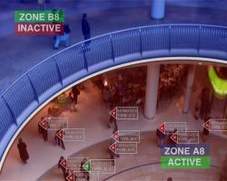
"The Catalogue" explores the codification of humanity on behalf of corporate entities within the consumer environment. As consumers, our lifestyles have become the object of corporate scrutiny. The loyalty card, RFID (Radio Frequency Identification) chip, and facial recognition software as means of corporate data harvesting have achieved real-time tracking capabilities. Data brokers can show where we are, what we are buying, and what our wants will be. The potential already exists to extend this data beyond our purchasing habits and lifestyle choices to our very fabric, with predictions of our future health prospects made en masse via analysis of the data from our weekly shop. The Catalogue offers an analogue to this process, forcing the viewer into the position of a remote and dispassionate agency, observing humanity as a series of units, whose value is defined by their spending capacity and future needs.
Chris Oakley?s concerns span the mass media, amateur photography, mass communications, data harvesting, and the influence of these disparate phenomena upon our behaviours, interactions, and our relationship with our bodies themselves. For Oakley, the domestic camcorder, the CCTV camera and the television documentary are seen as parallel phenomena; both provide a point of view representing a mediated world, a limited reality without veracity. In a critical analogy to the processes employed by elements of the mass media, he is fascinated by a process of fictionalising material captured from life, attempting to define the space between actuality and representation, the point at which the white noise of lived experience is made to conform to strict linear narrative. Influenced at an early stage by process art and the Structuralist and Materialist filmmakers in particular, he has developed a vocabulary combining a process-oriented approach with broader cultural references. Appropriating techniques from the television newsroom and film production and combining these with a vérité viewpoint, the process is as much about framing the viewer as the subject. In the past 2 years, Oakley?s works have received widespread media attention within Europe and beyond. His works have been shown alongside those of Tony Oursler, Jozef Robakowski, Kutlug Ataman and Pipilotti Rist. His recent achievements have included exhibition at a number of major international media arts festivals and exhibitions; these include the EXIT festival in Paris, Transmediale .05 in Berlin, exhibition of work at the Museum of Contemporary Art, Los Angeles and via video billboards on Sunset Strip, and a prize win at the Media Forum of the Moscow International Film Festival in 2005. Biography 1971 Born in Chester 1988 - 1990 North East Wales Institute 1990-93 School of Art & Design, University of Wolverhampton 1993-95 Kent Institute of Art & Design
Chris Oakley
Catalogue : 2010Half-Life | Video | dv | color | 14:42 | United Kingdom | 2009
Chris Oakley
Half-Life
Video | dv | color | 14:42 | United Kingdom | 2009
Half-life? looks at the histories of Harwell, birthplace of the UK nuclear industry, and the development of fusion energy technology at the Culham facility in Oxfordshire. Produced with the cooperation of both these organisations, the film examines nuclear science research through a historical and cultural filter. Drawing on archive footage of the sites, alongside contemporary materials, the work takes structural clues from nuclear physics, exploring the heritage of nuclear energy from the roots of the technology that drove the industrial revolution. The relationship between nature, and our reliance on mineral energy resources, and the portrayal of the often-mundane realities of nuclear research seek to ?normalise? the subject. With the recent widespread acceptance of the reality of climate change driven by carbon dioxide emissions, the work explores the realities and myths surrounding the nuclear sciences.
An artist working with video and digital imaging, Chris Oakley?s concerns are focused on mediated experience, including mainstream media, amateur photography, and mass communications. In a critical analogy to the methods employed by the mass media, he utilises processes of fictionalising material captured from life, which explore the increasingly uniform treatment of the fictional and the factual in the mass media. Current works explore the fluid nature of history and ?media memory? and the re-authoring of narratives of the past.
Damir Ocko
Catalogue : 2017The Third Degree | Video | hdv | color | 10:30 | Croatia | 2015
Damir Ocko
The Third Degree
Video | hdv | color | 10:30 | Croatia | 2015
The Third Degree is a single scene film exploring a close-ups of skin scars resulting from third degree burns filmed through an installation of broken mirrors reflecting the crew and the whole background process while filming the scars, thus integrating the subject of the camera with the process of filming itself. The Third Degree was made as a response to questions that emerged due the particularly violent way the previous film TK was filmed. The term "Third Degree" has an ambiguous meaning in the English language: it is a way to classify a burn of a very strong degree, but it can also signify a process of extorting a confession under violence. Set in motion by such violent interpretations and perspectives, film tries to critically, yet poetically, cut through the collective haze that blurs relations between means of production, control and the subject itself, giving rise to alternative methods of understanding as a reflection determined at the same time by social, political and aesthetic parameters.
Damir Očko was born in 1977 in Zagreb, where he lives and works. A graduate from the Academy of Fine Arts in Zagreb. Očko has exhibited on solo exhibitions at DAZIBAO, Montreal, Palais de Tokyo in Paris, Künstlerhaus Halle für Kunst und Medien in Graz and Kunsthalle Dusseldorf, Temple Bar Gallery and Studios in Dublin among other places. He participated in numerous group exhibitions internationally with institutions such as, MUDAM in Luxembourg, FRAC le Plateau, Württembergischer Kunstverein Stuttgart, Germany, Kunsthalle Vienna, among others. His works can be found in the collections of Louis Vuitton Foundation for Creation and CNAP – Centre national des arts plastiques in Paris or at the MUDAM in Luxembourg. Damir Očko was representing Croatia in the 56th Venice Biennale with a solo exhibition "Studies on Shivering / The Third Degree.
Damir Ocko
Catalogue : 2025The Dawn Chorus | Video | 4k | color | 17:43 | Croatia | 2023
Damir Ocko
The Dawn Chorus
Video | 4k | color | 17:43 | Croatia | 2023
"The Dawn Chorus" is an outbreak of birdsong at the start of a new day, depicted in the film as the inspiration for a dream-like gathering of the artists local queer community in Zagreb. This joyous celebration of queer bodies pays homage to the kingdom of birds through voguing, dancing, drag and costumes. It is a transposition that imagines the potential in the intersection between our own identities and the inclusive spaces that are open for other species. Filmed without the predictable popular electronic beats typically associated with ballroom, the film solely features the sounds of bodies in motion, the rhythmic impact of dancing, resounding percussive noises created by bodies, and chanting. These elements are accompanied by polyphonic sounds of birdsong onomatopoeias, sourced from ornithological manuals and sung by ”Le Zbor” a lesbian-antifascist choir from Zagreb accompanied by subtle gravity-like pedal tones played on Organ.
Damir Ocko (b. 1977, Zagreb) Graduate from the Academy of Fine Arts in Zagreb, O?ko has exhibited on solo exhibitions at Kunsthalle Krems, Museum of Contemporary Art Zagreb, Jeu de Paume, Paris, National Gallery in Prague, Museum of contemporary Art Bordeaux, Museo Amparo, Mexico, DAZIBAO, Montreal, Palais de Tokyo in Paris, Yvon Lambert Gallery in Paris, Künstlerhaus Halle für Kunst und Medien in Graz, Kunsthalle Dusseldorf, Temple Bar Gallery and Studios in Dublin, Kunstverein Leipzig among other places. He participated in numerous group exhibitions internationally with institutions such as, OFF Biennale Budapest, MUDAM in Luxembourg, FRAC le Plateau, Württembergischer Kunstverein Stuttgart, Kunsthalle Vienna, Louis Vuitton foundation among others. Damir O?ko represented Croatia in the 56th Venice Biennale with a solo exhibition "Studies on Shivering / The Third Degree. His works are included in many public and private collections such as FRAC le Plateau, Foundation Louis Vuitton, CNAP – Centre national des arts plastiques in Paris, MUDAM in Luxembourg and Museum of contemporary Art in Zagreb, among others.
Damir Ocko
Catalogue : 2016TK | Experimental film | 4k | color | 19:46 | Croatia | 2015
Damir Ocko
TK
Experimental film | 4k | color | 19:46 | Croatia | 2015
Departing form an eight part poem the artist constructs a complex polyphonic work in which poetry meets movements, sounds, silences, bodies, and ¬endurability in order to project the ideas behind the work. Several topics constantly reoccurring through out the work are brought forward by a meticulously scored narration, in which pause and silence are equally important as the spoken or written word. Poem itself depicts on various images, starting as a morning song in which a question of a routine and a rotation turns the engine on for work to move towards more difficult imagery. People gather in dangerous constellations to act in violence, to observe silently, or to setup the false feeling of tranquillity which is constantly turned upside down by the various mechanisms of the film itself. Heavy things get stuck in the throat, stones used as tools and voices come to unrest.
Damir Očko (b. 1977, lives and works in Zagreb) is one of the most prominent Croatian artist of his generation. His videos, films, poetry and works on paper have been exhibited recently in Temple Bar Gallery in Dublin (2014), KM - Künstlerhaus Halle für Kunst & Medien in Graz (2014), Yvon Lambert gallery in Paris (2013), Palais de Tokyo in Paris (2012), Galleria Tiziana Di Caro in Salerno (2012), and Kunsthalle Dusseldorf (2011). He participated in numerous collective exhibitions with institutions such as MUDAM, Luxembourg, FRAC Le Plateau in Paris, Kunsthalle Wien, and Museum of Contemporary Art in Zagreb among others. His works are part of many public and private collections around the world.
Damir Ocko
Catalogue : 2008The Boy with a magic Horn | Art vidéo | dv | color | 16:0 | Croatia | 2007
Damir Ocko
The Boy with a magic Horn
Art vidéo | dv | color | 16:0 | Croatia | 2007
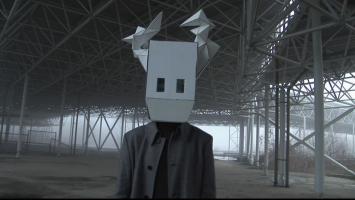
?Great dream was about to be built, But something happened while we were awakening.? Through the transition period Croatia has left behind one of the biggest projects ever to be built in this hemisphere, University hospital that would occupy almost 250000m2. Hospital was planed out in the late 70`s and was being built through the 80`s, but was never finished. Now days these empty halls, concrete walls, labyrinths of unmarked rooms and nature invading the whole environment might seem like random construction but the knowledge of what this place should be is twisting this reality into an almost melodramatic experience. Being stuck in the place and time, somewhere between what it was, what it should be and what it is. Romantic vision of transition brings us inside the ghost architecture and we participate in the journey thru adopted Wagnerian plot, where fiction fits into reality, changed and lost in a place where hero comes to late. Extracted from Wagner synopsis plot becomes a dreamy and hallucinogenic game that characters play in order to describe their new social and emotional displacement, a place that exist somewhere between hope and oblivion. But than again it is told that the magic horn has such an effect that one who hears it will believe almost anything.
Damir Očko was born in 1977 in Zagreb, Croatia and studied at the Academy of Fine Arts, Zagreb. He was a resident artist at Tirana Institute of contemporary art, Tirana, Albania and Kulturkontakt Vienna, Austria. He also received a Academie schloss solitude fellowship. He is working in diverse medias, like video, installation, site specific projects and music. His recent solo exhibitions include: Why does Gravity make things fall?, Tirana Institute of Contemporary Art, Tirana, Albania, The Missing Mountain, Barutana, Osijek, Croatia, Compositions, Museum of Contemporary Art, Zagreb, Croatia. Recent group exhibitions include: The post Cinema experience, Australian centre for photography, Sydney, Australia, New revelations, Spectrum project space, Perth, Australia, Heroes in Transition, Angel Row Gallery, Nottingham, UK, and 2WP at Art Point Gallery Vienna, among others. His films where recently screened at Chavoul cinema, Sydney, Australia, 52nd Venice Biennale as part of a video program selected by Edi Muka on the PS1&PAN boat and International center for culture Arbnori, Tirana, Albania among others. Currently he is living and working in Zagreb.
Christoph Oertli, Ahmad El-Sawy
Catalogue : 2020Sensing Bodies | Experimental doc. | 4k | color | 48:0 | Switzerland | 2019
Christoph Oertli
Sensing Bodies
Experimental doc. | 4k | color | 48:0 | Switzerland | 2019
‚Sensing Bodies‘ deals with the use of our bodies in a perfectly structured and built environment. The film takes a look at a highly organized society and explores questions of active body experience versus the static state of the virtual experience. How far from nature can humans live their lives?
1962* Winterthur/Switzerland, lives and works in Basel/Switzerland. education ZHdK Zürich, Graphic design; Swiss Television Zürich, stage design; FHNW Basel, audiovisual design. from 1995: videotapes, video installations, documentary videos, video for dance and theater. Works 1995-97 on cruise-ships around the world, lives 1998-2000 in Montréal/Canada and 2002-07 in Paris, 2008-16 in Brussels. 2000-02 lecturer for video Fachhochschule Vorarlberg/Austria. from 2004 guest lecturer HSLU Lucerne/Switzerland.
Catalogue : 2015Tension Box | Experimental doc. | hdv | color | 16:22 | Switzerland | 2014
Christoph Oertli
Tension Box
Experimental doc. | hdv | color | 16:22 | Switzerland | 2014
Two young Ethiopians tell about their lifes as students of Addis Ababa University; they focus on the sharing of a small room in the dormitory and the reality of a multi-ethnic country like Ethiopia. The observing camera shows the dormitory, as it were a stage, consisting of bunk beds, built-in cupboards and a corridor. Eight young men share this narrow space, where they sleep, eat, study or pray. They are Christians or Muslims, communicate in one of the many local languages or help themselves with English in order to understand each other. What may look like a refugee camp allows us actually to gain an insight into a community of young people, who prepare their future in a promising African country.
* Winterthur/Switzerland, lives and works in Basel/Switzerland and Brussels/Belgium education ZHdK Zürich, Graphic design; Swiss Television Zürich, stage design; FHNW Basel, audiovisual design. from 1995: videotapes, video installations, documentary videos, video for dance and theater. Works 1995-97 on cruise-ships around the world, lives 1998-2000 in Montréal/Canada and 2002-07 in Paris, then moves to Brussels. 2000-02 lecturer for video Fachhochschule Vorarlberg/Austria. 2004-14 guest lecturer HSLU Lucerne/Switzerland.
Catalogue : 2013Monsieur René | Video | hdv | color | 11:11 | Switzerland, Belgium | 2012
Christoph Oertli
Monsieur René
Video | hdv | color | 11:11 | Switzerland, Belgium | 2012
The camera is invading an over-stuffed apartment, floating through an almost surreal material world. There is a presence of the real tenant, supposedly an old man, who we don?t get to see. Instead, a younger man in search of a place to rest is wandering about. The rooms reveal the standstill of a lonley person, who has separated himself from life and the outside world by pileing up consumer objects. A glance out of the window shows a formerly fancy boulevard in Brussels, ruled today by Moroccan traders and African immigrants.
1962* Winterthur/Switzerland, lives and works in Basel/Switzerland and Brussels/Belgium HGK Zürich, Graphic design; Swiss Television Zürich, stage design; HGK Basel, audiovisual design. videotapes, video installations, documentary videos. Works 1995-97 on cruise-ships around the world, lives 1998-2000 in Montréal/Canada and 2002-07 in Paris, then moves to Brussels. 2000-02 lecturer for video Fachhochschule Vorarlberg/Austria. From 2004 guest lecturer HGK Lucerne/CH.
Catalogue : 2012The ground is moving | Video | hdv | color | 10:30 | Switzerland, Belgium | 2010
Christoph Oertli
The ground is moving
Video | hdv | color | 10:30 | Switzerland, Belgium | 2010
1962* Winterthur/Schweiz, lebt und arbeitet in Basel und Brüssel. HGK Zürich, Grafik; Schweizer Fernsehen Zürich, Bühnenbild; HGK Basel, Audiovisuelle Gestaltung. ab 1995: Videobänder, Videoinstallationen, Dokumentarfilme. Fährt 1995-97 auf Schiffen rund um die Welt, lebt 1998-00 mehrheitlich in Kanada, ab 2002 in Paris, ab 2007 in Brüssel. 2000-02 Dozent für Video an Fachhochschule Vorarlberg/Oesterreich. 2004/06/11 Gastdozent HSLU Luzern.
Catalogue : 2011Come on into the continents | Video | dv | color | 5:50 | Switzerland | 2009
Christoph Oertli
Come on into the continents
Video | dv | color | 5:50 | Switzerland | 2009
Outside of Luxor the eye moves in a slow circle. People are standing in the desert, alone or in groups. Tourists descend from the sky in a large red balloon. The camera?s perspective corresponds to the gaze of a foreigner having a look around. A couple of details sail past, without for all that rendering the situation as a whole perceptible. The eye wanders on across the surface of the desert. Urban settlements come into view. An arrival is summed up in one long, slow pan, a touchdown on a strange planet, recounted from a horizontal perspective only gradually closing the gap between itself and its object.
* Winterthur/Switzerland, lives and works in Basel/Switzerland and Brussels/Belgium education: HGK Zürich, Graphic design; Swiss Television Zürich, stage design; HGK Basel, audiovisual design. Author of videos, video installations, documentary videos.
Catalogue : 2010Sinbad - new voyages | Video | dv | color | 43:0 | Switzerland | 2009
Christoph Oertli, Ahmad El-Sawy
Sinbad - new voyages
Video | dv | color | 43:0 | Switzerland | 2009
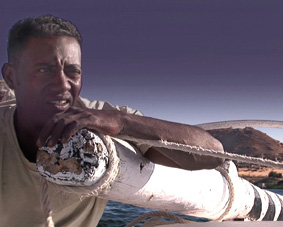
This project consists of a musical live-performance by Ahmad El-Sawy (oud/voice/electronics) with a video-projection by Christoph Oertli. Starting point is the legend of Sinbad and his journeys on the sea. What would Sinbad get to see if he?d be travelling nowadays? This interrogation should produce images and music, which juxtapose past realities and myths with the actual situation of the Arab World. The cooperation of the Egyptian musician and the Swiss video artist combines different medias and view points: Ahmad El-Sawy has transferred Arabic poems into music. Some of those texts can be read as comment about our times dispite the fact that they originate from past centuries. The writers talk about the loss of values and most importantly about the loss of the own culture. Christoph Oertli has shot video images during two longer stays in Egypt and compressed these images into a visual strand, which resembles a journey through different centuries: landscapes, urban scenes and ultramodern building complexes slowly drift past the camera. A young man embodies todays? Sinbad; occasionally he?s travelling within his own country, but he undertakes as well virtual journeys at his computer, since means and possibilities are missing for travelling abroad.
1962* Winterthur/Switzerland, lives and works in Basel/Switzerland and Brussels/Belgium education: HGK Zürich, Graphic design; Swiss Television Zürich, stage design; HGK Basel, audiovisual design. Works as video artist, produces videotapes, video installations, documentary videos.
Catalogue : 2007Cairo | Experimental video | dv | color | 11:0 | Switzerland | 2006
Christoph Oertli
Cairo
Experimental video | dv | color | 11:0 | Switzerland | 2006
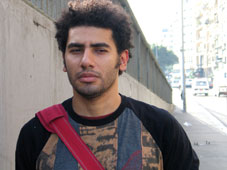
The video focuses on the paths walked in this city. The paths that everyone has to walk, for themselves, alone among the others. In real everyday life, this constitutes a dense and permanent displacement of the masses, so they can find housing and a job. People from Cairo have to find their way around in this huge city. The video shows a young man who is walking very slowly. He takes on nine different faces and his way covers a whole area of Cairo districts. All around him is noise and many other people. Then he suddenly finds himself alone, but continues to walk slowly, not giving attention to this fact. He comes across several solitary people with along his path.
Christoph Oertli was born in 1962*. He lives in Basel and Paris. His studies include graphic design Swiss television at HGK Zurich, and stage and audiovisual design at HGK Basel.
Catalogue : 2006Come, heavy sleep | Experimental video | dv | color | 8:0 | Switzerland, France | 2004
Christoph Oertli
Come, heavy sleep
Experimental video | dv | color | 8:0 | Switzerland, France | 2004
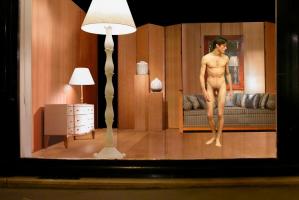
A living room at night, selectivley furnished. No trace of inhabitants. A naked young man repeatedly crosses the space. He lies down on a sofa. He puts a dish on the table. He acts like a stranger who has crept into the house. Furniture trembles, appears, disappears as if moved by an invisible hand. The intimacy and nearness to the man?s body contrasts sharply with the view seen from outside; we are actually looking through a shop window.
*Winterthur/Switzerland, lives in Basel and Paris Studies: HGK Zurich, Graphic design Swiss Television, Stage design HGK Basel, Audiovisual arts
Christoph Oertli
Catalogue : 2020Sensing Bodies | Experimental doc. | 4k | color | 48:0 | Switzerland | 2019
Christoph Oertli
Sensing Bodies
Experimental doc. | 4k | color | 48:0 | Switzerland | 2019
‚Sensing Bodies‘ deals with the use of our bodies in a perfectly structured and built environment. The film takes a look at a highly organized society and explores questions of active body experience versus the static state of the virtual experience. How far from nature can humans live their lives?
1962* Winterthur/Switzerland, lives and works in Basel/Switzerland. education ZHdK Zürich, Graphic design; Swiss Television Zürich, stage design; FHNW Basel, audiovisual design. from 1995: videotapes, video installations, documentary videos, video for dance and theater. Works 1995-97 on cruise-ships around the world, lives 1998-2000 in Montréal/Canada and 2002-07 in Paris, 2008-16 in Brussels. 2000-02 lecturer for video Fachhochschule Vorarlberg/Austria. from 2004 guest lecturer HSLU Lucerne/Switzerland.
Catalogue : 2015Tension Box | Experimental doc. | hdv | color | 16:22 | Switzerland | 2014
Christoph Oertli
Tension Box
Experimental doc. | hdv | color | 16:22 | Switzerland | 2014
Two young Ethiopians tell about their lifes as students of Addis Ababa University; they focus on the sharing of a small room in the dormitory and the reality of a multi-ethnic country like Ethiopia. The observing camera shows the dormitory, as it were a stage, consisting of bunk beds, built-in cupboards and a corridor. Eight young men share this narrow space, where they sleep, eat, study or pray. They are Christians or Muslims, communicate in one of the many local languages or help themselves with English in order to understand each other. What may look like a refugee camp allows us actually to gain an insight into a community of young people, who prepare their future in a promising African country.
* Winterthur/Switzerland, lives and works in Basel/Switzerland and Brussels/Belgium education ZHdK Zürich, Graphic design; Swiss Television Zürich, stage design; FHNW Basel, audiovisual design. from 1995: videotapes, video installations, documentary videos, video for dance and theater. Works 1995-97 on cruise-ships around the world, lives 1998-2000 in Montréal/Canada and 2002-07 in Paris, then moves to Brussels. 2000-02 lecturer for video Fachhochschule Vorarlberg/Austria. 2004-14 guest lecturer HSLU Lucerne/Switzerland.
Catalogue : 2013Monsieur René | Video | hdv | color | 11:11 | Switzerland, Belgium | 2012
Christoph Oertli
Monsieur René
Video | hdv | color | 11:11 | Switzerland, Belgium | 2012
The camera is invading an over-stuffed apartment, floating through an almost surreal material world. There is a presence of the real tenant, supposedly an old man, who we don?t get to see. Instead, a younger man in search of a place to rest is wandering about. The rooms reveal the standstill of a lonley person, who has separated himself from life and the outside world by pileing up consumer objects. A glance out of the window shows a formerly fancy boulevard in Brussels, ruled today by Moroccan traders and African immigrants.
1962* Winterthur/Switzerland, lives and works in Basel/Switzerland and Brussels/Belgium HGK Zürich, Graphic design; Swiss Television Zürich, stage design; HGK Basel, audiovisual design. videotapes, video installations, documentary videos. Works 1995-97 on cruise-ships around the world, lives 1998-2000 in Montréal/Canada and 2002-07 in Paris, then moves to Brussels. 2000-02 lecturer for video Fachhochschule Vorarlberg/Austria. From 2004 guest lecturer HGK Lucerne/CH.
Catalogue : 2012The ground is moving | Video | hdv | color | 10:30 | Switzerland, Belgium | 2010
Christoph Oertli
The ground is moving
Video | hdv | color | 10:30 | Switzerland, Belgium | 2010
1962* Winterthur/Schweiz, lebt und arbeitet in Basel und Brüssel. HGK Zürich, Grafik; Schweizer Fernsehen Zürich, Bühnenbild; HGK Basel, Audiovisuelle Gestaltung. ab 1995: Videobänder, Videoinstallationen, Dokumentarfilme. Fährt 1995-97 auf Schiffen rund um die Welt, lebt 1998-00 mehrheitlich in Kanada, ab 2002 in Paris, ab 2007 in Brüssel. 2000-02 Dozent für Video an Fachhochschule Vorarlberg/Oesterreich. 2004/06/11 Gastdozent HSLU Luzern.
Catalogue : 2011Come on into the continents | Video | dv | color | 5:50 | Switzerland | 2009
Christoph Oertli
Come on into the continents
Video | dv | color | 5:50 | Switzerland | 2009
Outside of Luxor the eye moves in a slow circle. People are standing in the desert, alone or in groups. Tourists descend from the sky in a large red balloon. The camera?s perspective corresponds to the gaze of a foreigner having a look around. A couple of details sail past, without for all that rendering the situation as a whole perceptible. The eye wanders on across the surface of the desert. Urban settlements come into view. An arrival is summed up in one long, slow pan, a touchdown on a strange planet, recounted from a horizontal perspective only gradually closing the gap between itself and its object.
* Winterthur/Switzerland, lives and works in Basel/Switzerland and Brussels/Belgium education: HGK Zürich, Graphic design; Swiss Television Zürich, stage design; HGK Basel, audiovisual design. Author of videos, video installations, documentary videos.
Catalogue : 2010Sinbad - new voyages | Video | dv | color | 43:0 | Switzerland | 2009
Christoph Oertli, Ahmad El-Sawy
Sinbad - new voyages
Video | dv | color | 43:0 | Switzerland | 2009
This project consists of a musical live-performance by Ahmad El-Sawy (oud/voice/electronics) with a video-projection by Christoph Oertli. Starting point is the legend of Sinbad and his journeys on the sea. What would Sinbad get to see if he?d be travelling nowadays? This interrogation should produce images and music, which juxtapose past realities and myths with the actual situation of the Arab World. The cooperation of the Egyptian musician and the Swiss video artist combines different medias and view points: Ahmad El-Sawy has transferred Arabic poems into music. Some of those texts can be read as comment about our times dispite the fact that they originate from past centuries. The writers talk about the loss of values and most importantly about the loss of the own culture. Christoph Oertli has shot video images during two longer stays in Egypt and compressed these images into a visual strand, which resembles a journey through different centuries: landscapes, urban scenes and ultramodern building complexes slowly drift past the camera. A young man embodies todays? Sinbad; occasionally he?s travelling within his own country, but he undertakes as well virtual journeys at his computer, since means and possibilities are missing for travelling abroad.
1962* Winterthur/Switzerland, lives and works in Basel/Switzerland and Brussels/Belgium education: HGK Zürich, Graphic design; Swiss Television Zürich, stage design; HGK Basel, audiovisual design. Works as video artist, produces videotapes, video installations, documentary videos.
Catalogue : 2007Cairo | Experimental video | dv | color | 11:0 | Switzerland | 2006
Christoph Oertli
Cairo
Experimental video | dv | color | 11:0 | Switzerland | 2006
The video focuses on the paths walked in this city. The paths that everyone has to walk, for themselves, alone among the others. In real everyday life, this constitutes a dense and permanent displacement of the masses, so they can find housing and a job. People from Cairo have to find their way around in this huge city. The video shows a young man who is walking very slowly. He takes on nine different faces and his way covers a whole area of Cairo districts. All around him is noise and many other people. Then he suddenly finds himself alone, but continues to walk slowly, not giving attention to this fact. He comes across several solitary people with along his path.
Christoph Oertli was born in 1962*. He lives in Basel and Paris. His studies include graphic design Swiss television at HGK Zurich, and stage and audiovisual design at HGK Basel.
Catalogue : 2006Come, heavy sleep | Experimental video | dv | color | 8:0 | Switzerland, France | 2004
Christoph Oertli
Come, heavy sleep
Experimental video | dv | color | 8:0 | Switzerland, France | 2004
A living room at night, selectivley furnished. No trace of inhabitants. A naked young man repeatedly crosses the space. He lies down on a sofa. He puts a dish on the table. He acts like a stranger who has crept into the house. Furniture trembles, appears, disappears as if moved by an invisible hand. The intimacy and nearness to the man?s body contrasts sharply with the view seen from outside; we are actually looking through a shop window.
*Winterthur/Switzerland, lives in Basel and Paris Studies: HGK Zurich, Graphic design Swiss Television, Stage design HGK Basel, Audiovisual arts
Christoph Oeschger, Waltenspül/Schulze
Catalogue : 2021Unlearning Flow | Documentary | hdv | black and white | 11:9 | Switzerland | 2019
Christoph Oeschger, Waltenspül/Schulze
Unlearning Flow
Documentary | hdv | black and white | 11:9 | Switzerland | 2019
“Machining of Steel”, “Mating of Two Males”, “Dumdum Bullet Effect” and “String Figures” played by the Inuit, the Krahô or the Taulipang in Guyana exemplify that the Institute for Scientific Film (IWF) in Göttingen aimed at capturing all the movement processes of the world on celluloid. The scientific films that the IWF produced, archived and distributed were supposed to be “documents of reality”. Without using commentary, they should make movements visible, storable and re-analyzable at any time. Can there be pictures that are more real than others? The essay film “unlearning flow” examines both National Socialist prehistory and the legacy of the IWF. It reveals the ideology of the distant, objectifying camera view and also the active white washing of the Institute’s history after World War II. With their film, filmmaker Christoph Oeschger and the historians of media and knowledge, Sarine Waltenspül and Mario Schulze, touch only the tip of the iceberg: (war) research with film, the (re-)production of colonial power relations and the creation of (a lack of) knowledge through film.
Christoph Oeschger (1984*) lives in Zurich as an artist, photographer and publisher. In 2014 he founded the book publisher cpress an in 2020 cpressfilms an agency for artist films together with Christof Nüssli. He works with various forms of the documental. His work has been shown in various museums including Fotomuseum Winterthur (CH), Zentrum für Kunst und Medientechnologie , Karlsruhe (DE), Centre de la Photographie Geneve (CH). Mario Schulze (*1986, Halle/Saale) is a cultural scientist and scientific researcher who works on the history of exhibitions, object theories and scientific films. His doctoral thesis is due in 2017 under the title "How things learned to speak. A History of the Museum Object 1968-2000". He has taught at the universities of Leipzig, Berlin, Zurich and Frankfurt as well as at the Zurich Art Academy. Sarine Waltenspül (*1986, Basel) works as a media historian on scientific films. In 2018, she received her doctorate on cinematographic models in films. She co-directs the SNSF research project Aerial Photographs/Light Images and the DFG network Lens On! Furthermore, she has been involved in various functions in the conception and production of music videos, theatre documentaries and feature films and was head of the "Hungerkünstler Verlag".
Martin M. Oesterheld
Catalogue : 2014LA MULTITUD | Documentary | hdcam | color | 60:0 | Argentina | 2012
Martin M. Oesterheld
LA MULTITUD
Documentary | hdcam | color | 60:0 | Argentina | 2012
In the margins of the city, two lots sharing coincidences are placed in a dialogue. They were both locations for entertainment built by different dictatorships: The Sport City of La Boca, and the Interama amusement park. Today both places are in ruins and their surroundings harbor settlements and shanty towns where thousands of families live, many of them migrants and in extreme poverty. Through a thorough investigation, the documental shows the transit of those characters as they frequently pass though these places, and it depicts the present day over the tracks history left on the urban landscape. The result is a Buenos Aires City seen from its ends with perplexity, beauty, emotion and a neutral eye. The film combines densities with an analytical storytelling that is yet deeply atmospheric and transforming through the reality it manages to capture.
Born in 1974, Martín M. Oesterheld is a visual artist with a scholarship from the UBA / CC Rojas Research Lab for Arts Parctices. His most recent work includes the documentary "La Multitud" (Crowd), the video shorts ?Tránsito? (Transit), and ?Para la Defensa? (To the defense) made together with Julián D?Angiolillo and premiered in the Tecnopolis Exhibition.
Barbara Oettinger, Sabatini Pedro
Catalogue : 2021Sombra | Animation | mp4 | color | 8:12 | Chile | 2020
Barbara Oettinger, Sabatini Pedro
Sombra
Animation | mp4 | color | 8:12 | Chile | 2020
One of the great concerns that we have had in times of pandemic, has undoubtedly been how much it would affect us physically and mentally to be confined, not being able to see our loved ones. Under this concern, and reviewing some articles on the web, we found an experiment carried out by Donald Hebb in the 1950s where he decided to isolate a number of volunteers (separated from each other) in a space that was completely devoid of stimuli. Under these extreme conditions, volunteers began to experience multiple auditory and visual hallucinations over time. Sombra is a video that was made under confinement due to quarantine, where we have also been deprived of significant human contact. Hence, Shadow explores in a metaphorical sense, about the effects of isolation in relation to our sense of body, time and space. As mentioned above, our sensory perception can be affected as a result of confinement, causing our minds to create a science fiction world, questioning the idea of authenticity or whether what we see or hear is real or not. In the realization of Sombra, we have used a video game platform, in which we re-use scenarios and characters that have been previously created / simulated, modifying certain functionalities and aesthetic elements typical of these video games, and reorganizing them within the virtual scenario, with the objective to produce a cinematographic short film under what is known as Machinima. Characters and fictional worlds are digitally cloned, multiple versions of a trapped and duplicated character an endless number of times, which sometimes manages to "escape" from her mind by projecting her body onto more simulated information, generating various layers of representations. *Project in collaboration with Pedro Sabatini.
Bárbara Oettinger (Santiago, 1981) has a Bachelor's degree in Fine Arts at the University of Chile and a Master of Arts degree from the Catholic University of Chile. She has participated in various exhibitions and screenings in cultural centers, galleries and museums in Chile, Perú, Bolivia, Argentina, Uruguay, Brazil, U.S., India, Indonesia, Ukraine, Slovenia, Spain, France, Portugal, Korea and Taiwan. Currently, she holds a Master of Fine Arts in Integrated Practices degree from Pratt Institute, New York, U.S, funded by the chilean government / CONICYT. My current projects are encounters with dialogues, with a focus on testimonies that retain historical meaning, while telling of the psychological experience. Testimonies not only based on the supposed immediacy and accuracy of the historical source, but also on the subjective construction of different narratives. Pedro Sabatini (Santiago, 1979) has a Bachelor’s degree in Cinema. During these last 3 years he have been working on advertising film production. He has experience in adapting to all kinds of budgets while remaining competitive. His contributions are linked to the fascination for independent cinema and the search for new languages. His work has been recognized as best fiction short film UNIACC (Santiago, Chile), best international documentary ARCOS (Santiago, Chile), and official selection in Festival Biarritz Amérique Latine (France).
Dietmar Offenhuber, Sam AUINGER
Catalogue : 2006Heinz weiss (naredmanet) | Experimental video | dv | color | 4:0 | Austria | 2005
Dietmar Offenhuber, Sam AUINGER
Heinz weiss (naredmanet)
Experimental video | dv | color | 4:0 | Austria | 2005
Some time ago, a moving company cleared out the residence of the retired Heinz k. (name changed). Among his belongings were a tape recorder including a 90-minute tape. Heinz K. spent the last 5 years of his retirement spying on his neighbors and recording his thoughts and observations. The Munich based record label ?bodensatz? came into possession of the tapes, which they kindly made available to us as raw material for our film.
Dietmar Offenhuber, born 1973, graduated in Architecture and has been working since 1994 in animation, interactive environments and digital architecture. Between 2002 and 2004 Dietmar worked as key researcher in the Interactive Space departement at the Ars Electronica Futurelab. Since Fall 2004 he is Professor for animation and interactive media at the University of Applied Sciences in Hagenberg / Austria.
Anna Ogden Smith
Catalogue : 2012The Lie | Video | | color | 2:40 | Lebanon | 2008
Anna Ogden Smith
The Lie
Video | | color | 2:40 | Lebanon | 2008
Catalogue : 2012The Dream | Video | | color | 2:10 | Lebanon | 2008
Anna Ogden Smith
The Dream
Video | | color | 2:10 | Lebanon | 2008
Anna Ogden-smith
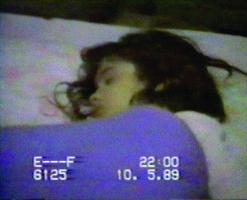
Catalogue : 2009The Dream (VHS: 1989-1994) | 0 | dv | color | 4:20 | Lebanon | 2008
Anna Ogden-smith
The Dream (VHS: 1989-1994)
0 | dv | color | 4:20 | Lebanon | 2008
While stumbling across a collection of home made videos my mother recorded from 1989 up until 1994, I became very interested in how VHS archives serve the process of filtration of our memory. Can I alter this registered memory by re appropriating these records and infiltrating them? How do the recorded and the remembered intersect and collide?
Born in Beirut, Lebanon, in 1984, Anna Ogden-Smith graduated with a BA in Graphic Design from the American University of Beirut in June 2006. Since then, she has mainly worked as a freelancer in print design and has pursued her vocation as a contemporary dancer in London and Beirut. More recently, she started exploring different mediums of which these two auto fictions, "The Lie" and "The Dream", are a result.
Senem Gökce Ogultekin, Levent Duran
Catalogue : 2025Void | Experimental film | digital | color | 16:57 | Turkey, Germany | 2024
Senem Gökce Ogultekin, Levent Duran
Void
Experimental film | digital | color | 16:57 | Turkey, Germany | 2024
While the shade of a tree is being stolen away, bodiless organs sit in the enormous gaps of the drained earth. Under the constant noise of unseen machines, disjointed body parts touch the drying soil and breaths are only audible to insects. In this quiet, distorted world, old songs of goodwill are sung: “Future times of vain sorrow do not disturb our gentle sleep...” While we are waiting for the miracle to come the sand continues to fly.
SENEM GÖKCE OGULTEKIN work spans the disciplines of choreography, performance, vocal work and film. In 2019, "Dun/Home" was chosen for Artist´s Film International, an international event initiated by Whitechapel Gallery in London and was shown at various museums and galleries of the world. In 2020, Senem Gökce Ogultekin was awarded the Allbau Foundation Culture Prize and was appointed to the Young College by the North Rhine-Westphalian Academy of Sciences and Arts in 2021. LEVENT DURAN is a multidisciplinary artist and writer. They studied sociology at Istanbul University and film at the Fine Arts University of Hamburg, where they obtained their master's degree. Their writings have been published in major magazines and newspapers in Turkey, and their visual creations (video, painting, sculpture, installation) have been exhibited internationally. Their film project "Murmuring Draft Dodgers" received the Courageous Citizen Award from the European Cultural Foundation.