Catalogue > List by artist
Browse the entire list of Rencontre Internationales artists since 2004. Use the alphabetical filter to refine your search. update in progress
Horacio G, Longina
Catalogue : 2006OIDAR | Experimental video | dv | color | 2:0 | Spain | 2005

Horacio G, Longina
OIDAR
Experimental video | dv | color | 2:0 | Spain | 2005
______
_____
Paul Gabel
Catalogue : 2007For Safekeeping (Scissions, Sutures and Naming) | Experimental doc. | dv | color | 44:22 | USA | 2006
Paul Gabel
For Safekeeping (Scissions, Sutures and Naming)
Experimental doc. | dv | color | 44:22 | USA | 2006
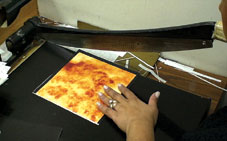
A collection of public picture is recorded and chronicled to draw attention to how the archivist, the act of archiving, and the archive itself affect one another through the techniques and practices that develop and maintain the resulting archived content. By suspending at the very beginning of the study the following quote by Jacques Derrida: "There is no archive without a place of consignment, without a technique of repetition, and without a certain exteriority. There is no archive without outside", an investigation into the conditions by which archiving and the archive are able to exist, is set in motion. As the camera shifts its attention from passers-by on the streets to the collection's interior, archivists are seen searching and selecting pictures and illustrations for the catalogue by severing them page-by-page from their books of origin. Illustrations then pass through a series of procedures that will see them re-shaped, catalogued, and re-classified before they are finally filed for public browsing. As illustrations of astronautical, historical, archaeological, and anthropological content are seen on record, being torn, cropped, and inscribed upon, the historic power of the content is metaphorically reduced and stripped away as it becomes an assimilated and transformed item in the collection?s vast history. In a scene that brings to the brink the limits behind classification directives, a grinning man?s portrait is caught between an archivist?s decision to classify it under "disease", or "skin", due to the picture?s emphasis on the subject?s condition with vitiligo. In the final sequence, the pictures, now fully integrated into the collection, fall under a new set of selecting eyes, this time while in the hands of patrons, as they choose the images for their own objectives. The study is brought full circle as a patron is seen leaving the building with his pictures and then disappearing amongst the passers-by. Departing with him is not only an infinitely small portion of the collection but (as the video was set out to record) a testament of performative acts brought forth through procedures, a living piece of the archivist?s hands, and a history of its very own.
Paul Gabel received a BFA from Binghamton University (1994-1998) for his work in drawing and printmaking. During his training, Gabel was a courtroom illustrator for a local television station in Binghamton, covering the murder cases Pennsylvania v. Dr. Stephen Barry Scher (1997), and New York v. Guiseppe Cataldo (1998). Afterwards, Gabel went on to work for The Metropolitan Museum of Art, The Drawing Center, and the Whitney Museum of American Art. In 2001, he was hired on to help develop The New York Public Library Art Collection and, since 2005, The New York Public Library Picture Collection. Paul Gabel was born in Kingston, Pennsylvania, in 1976 and brought up in Binghamton, New York. Today he lives and works in New York City. Paul Gabel?s video projects (which have explored themes concerning cognition, remembrance, faith, authority, presence, absence) have gained visibility through publication, group exhibitions, and international video art festivals. The Journal of Motion and Sound highlighted "The Impossibility of Remaining" (2003) in their first DVD compilation of 40 international artists. Distribution rights for "The Impossibility of Remaining", 2004?s "The Seen and Unseen" and 2005?s "I will always wait, It will never be" (Gabel?s latest video piece on the possibility of mourning against the current state of Ground Zero), are held by The Film-maker?s Cooperative, the largest archive of independent and avant-garde films in the world. Gabel continues to seek new venues for these projects and for his latest video study "For Safekeeping (Scissions, Sutures and Naming)". For Safekeeping is an experimental documentary that chronicles the procedures behind an image archive to offer a view on how origin, history, and authority are formed, ordered, and sustained. After recently having its first Canadian screening, at the Bibliothèque Nationale du Québec in September 2006, Gabel?s video piece "I will always wait (It will never be)" is now showing at PULSAR CARACAS 2006, Encuentro Internacional de Multimedia, from October 1st to November 18th.
Catalogue : 2006I will always wait (It will never be) | Video | dv | color | 8:56 | USA | 2005

Paul Gabel
I will always wait (It will never be)
Video | dv | color | 8:56 | USA | 2005
A film that captures Wall Street at a point between deconstruction (the shrouded Deutsche Bank) reconstruction (7 World Trade Center) and destruction (the absent Trade Towers), the phrases "I will always wait" and "It will never be" make possible a lamentation for the tragic September 11th event, at a time when its physical indications are in the midst of upheaval by urban renewal and the flow of progress.
Paul Gabel was born in 1976. He received a BFA from Binghamton University (1994-1998) for his work in drawing and printmaking. During his training, Gabel was a courtroom illustrator for a local television station in Binghamton covering the murder cases Pennsylvania v. Dr. Stephen Barry Scher (1997) and New York v. Guiseppe Cataldo (1998). Afterwards, Gabel went on to work for The Metropolitan Museum of Art, The Drawing Center and the Whitney Museum of American Art. In 2001, he was hired on to help develop The New York Public Library Art Collection and, since 2005, The New York Public Library Picture Collection. Paul Gabel was born in Kingston, Pennsylvania, in 1976 and brought up in Binghamton, New York. Today he lives and works in New York City. Paul Gabel?s video projects (which have explored themes concerning cognition, remembrance, faith, authority, presence and absence) have gained visibility through publication, group exhibitions and international video art festivals. The Journal of Motion and Sound highlighted The Impossibility of Remaining (2003) in their first DVD compilation of 40 international artists. Distribution rights for The Impossibility of Remaining, 2004?s The Seen and Unseen and 2005?s I will always wait, It will never be (Gabel?s latest video piece on the possibility of mourning against the current state of Ground Zero) are held by The Film-maker?s Cooperative, the largest archive of independent and avant-garde films in the world. While Gabel continues to seek new venues for these films, he is also at work on his upcoming project titled, For Safekeeping (scissions, sutures and naming), a video study that follows the processes behind an image archive. I will always wait (It will never be) was recently shown at The Hull 4th International Short Film Festival in the United Kingdom and the Luksuz Film Festival in Slovenia.
Leo Gabin
Catalogue : 2019No panic baby | Video | hdv | color | 31:30 | Belgium | 2017
Leo Gabin
No panic baby
Video | hdv | color | 31:30 | Belgium | 2017
An eerie whispering voice tries to comfort anxious souls while the sky is invaded by fake objects. The female protagonist resembles a school shooter with Kylie Jenner-like lips and eyebrows. An American landscape of nearly bankrupt casinos and desolated neighborhoods. Heartache and burning baseball caps. A plane hangs still in mid-air as someone tells us â€Do not believe what you thinkâ€... NO PANIC BABY, by artists trio Leo Gabin, is an evocative love story steeped in anxiety and extreme paranoia. The film captures the inner sense of irreality, as emblematic of an era as it takes its last gasp.
Leo Gabin is a trio of Belgian artists, who have worked together since 2000. Their practice includes painting, installation, sculpture & film. They take inspiration from the proliferation of user generated media on the internet and the until now undefined space straddling the public and private realms. Work by Leo Gabin has been exhibited and screened at museum Dhondt-Dhaenens (Deurle), Schirn Kunsthalle (Frankfurt), White Cube (London), Museum M Wood (Beijing), CPH:DOX (selected New:Vision award), Nowe Horyzonty (selected Grand Prix), IFFR (Critics’ Choice), Torino Film Festival, CineMarfa, among others.
Gints Gabrans
Catalogue : 2020SAN FOOOD office Towers Paris | 0 | 0 | | 0:0 | Latvia | 2019
Gints Gabrans
SAN FOOOD office Towers Paris
0 | 0 | | 0:0 | Latvia | 2019
The whole Paris is covered by a GPS-based large scale virtual object “SAN Foood office Paris”, that can be seen using the augmented reality app SAN (download - san.lv). At the center of the object, 25-kilometer-high SAN towers are located near the Eiffel Tower. Foood office based on the idea: UN estimates that by 2050 the number of world’s population will reach 9 billion, therefore it will be necessary to produce by 70 per cent more food. Unlike the tendency to think how to produce more and more, the FOOOD project proposes genetically modified human metabolic bacteria that have been endowed with the ability to synthesise enzymes that break down cellulose. Cellulose, a simple sugar glucose polymer, makes up a significant part of plant biomass. In the ordinary human metabolism, cellulose is indigestible and totally without nutritional value. That is why these enzymes that break down cellulose would allow the use of everyday food products from the vegetable world with almost a third more efficiency. They would also allow the more effective use of completely new types of food resources for example, cellulose rich wood and paper. If we managed to create a complete process to break down cellulose then humans would obtain 11% more kilocalories from 100 grams of paper than from 100 grams of bread (400 kilocalories from paper and 355 from bread).
Gints Gabr?ns (b. 1970, Valmiera, Latvia) works mainly with installations and new media art. From 2016 to 2020, he developed the augmented reality mobile application SAN. Solo exhibitions include: Transreality Zirgu Street, Riga (SAN, 2018); Out of Nowhere, Société d'encouragement pour l'industrie nationale, Paris (2015); The Bright Sky, Watermans New Media Gallery, London (2010); Paramirrors, Latvian Pavilion, 52nd Venice Biennale (2007); Invisible. Special Effects of a Parallel World, Contemporary Art Centre, Vilnius (2005); and STARIX, 26th Sao Paulo Biennial (2004). Group exhibitions include: 2019 "The Coming World: Ecology as the New Politics 2030–2100, Garage Museum, Moscow Obvious and Incredible, Gallery 427, Riga (2018); New Eden, Arctic Biennial, Sølvberget Galleri, Stavanger, Norvay (2016); Science Inspires Art: Food, New York Hall of Science, New York (2016); Visionary Structures. From Johansons to Johanson, Bozar Art Centre, Brussels (2015); and the 4th Moscow Biennale of Contemporary Art (2011). He lives and works in Riga.
Gints Gabrans
Catalogue : 2008PARAHYPNOSIS | Experimental video | dv | color | 6:0 | Latvia | 2007
Gints Gabrans
PARAHYPNOSIS
Experimental video | dv | color | 6:0 | Latvia | 2007
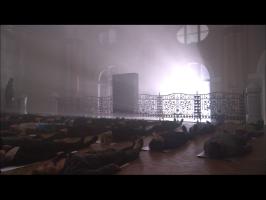
It is a documentation of the collective hypnosis session at a full moon night. During the session, hypnotist is telling that a bright daylight is breaking in and with the manipulation with artificial light the night is turning night into day. When hypnotized people wake up, they really see a light day. The viewer can follow the transformations of the space and perception or he can be hypnotized and become a participant of the imaginary happening.
Gints Gabrāns Born in 1970 in Valmiera, lives in Riga, Latvia. 1989 - Liepāja Secondary School of Applied Art 1989 - Latvian Academy of Art, Department of Scenography Fields of activity: installations, objects, videoart, painting, stage design.
Catalogue : 2006Starix | Experimental doc. | betaSP | color | 26:0 | Latvia | 2004
Gints Gabrans
Starix
Experimental doc. | betaSP | color | 26:0 | Latvia | 2004
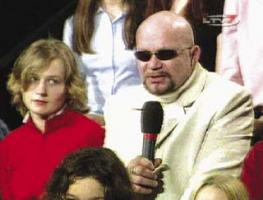
"By transforming a vagrant from Riga railway station into a media star, Gabrans attempts to unmask the mechanisms inherent in media strategies. For the project Gabrans founded Neostar advertising company. `Starix` is mixing meanings of the English word `star` thet inevitably reminds the viewer of popular culture, and of the similarly sounding Russian word meaning simply `old man`, in this case somebody who is homeless but in the context of an art project might become a star." source: kiasma
Tonci Gacina
Catalogue : 201022:22 Split-Zagreb | Video | dv | color | 4:8 | Croatia | 2008
Tonci Gacina
22:22 Split-Zagreb
Video | dv | color | 4:8 | Croatia | 2008
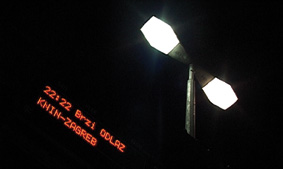
On the eastern side of the Railway station in the town of Split, just beside the railway track, people are living in houses built long ago for railway personal. This short documentary follows them in one short moment, which represents their whole lives.
Tonći Gaćina was born in Split in 1983. In 2007 he turned into the Academy of Fine Arts in Split, at the Film and Video department. He is currently working in visual arts and film. Since 2006 he made a couple of experimental films, and "22:22 Split - Zagreb" is his first documentary.
Kevin Gaffney
Catalogue : 2016The mirror is dark and inky | Video | hdv | color | 5:38 | Ireland, Iran | 2015
Kevin Gaffney
The mirror is dark and inky
Video | hdv | color | 5:38 | Ireland, Iran | 2015
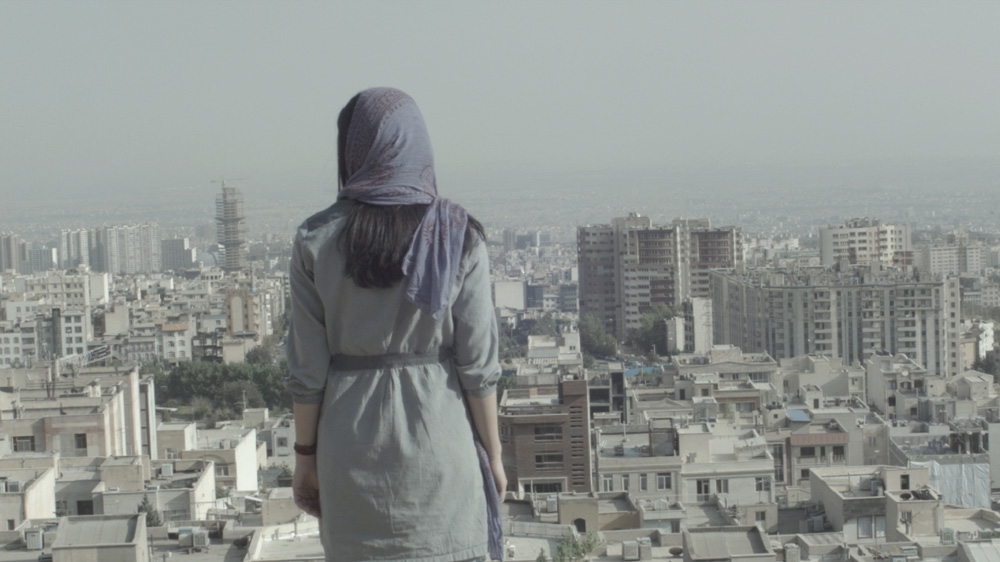
`The mirror is dark and inky` is comprised of images of daily life in Iran- driving through the city in the afternoon, playing board games with friends- alongside the narration of a neighbour concerned about a whale living in a bath in her apartment building. As the film progresses, we leave the city behind and move into the forest in northern Iran, where the narration turns inwards to a “feeling that does not come from my brain, it more erupts and descends like a fog, barely perceptible until it is enveloping, with a similar cold, dewy feeling.” The whale is the mirror and the mirror is dark and inky. Filmed on location in Tehran and northern Iran, two participants narrate the film and perform the roles.
Kevin Gaffney is a visual artist working in film and photography, living and working in Dublin. He graduated from the Royal College of Art`s MA Photography & Moving Image in 2011, and received an Honorary Mention from the Startpoint Prize for Emerging Artists. He was awarded a Sky Academy Arts Scholarship for the development of a new body of work (2015); was an UNESCO-Aschberg laureate artist in residence at the National Museum of Modern and Contemporary Art’s Changdong Residency in South Korea (2014); and received a Film Project Award from the Arts Council of Ireland for the creation of a new film while artist in residence at the Taipei Artist Village, Taiwan (2014). His work is part of the Irish Museum of Modern Art`s collection and has been shown in exhibitions and film festivals internationally, including: Out There, Thataway at CCA Derry~Londonderry (2015); the Alchemy Film & Moving Image Festival (Scotland, 2015); We at Catalyst Arts (Belfast, 2012); Abandon Normal Devices at Cornerhouse (Manchester, 2012); and solo exhibitions at the Contemporary Art Institute CAI02 (as part of the Sapporo International Art Festival, Japan, 2014); the Galway Arts Centre (2013); and RUA RED South Dublin Arts Centre (2011).
Dominic Gagnon
Catalogue : 2025Space Down | Experimental doc. | digital | color | 78:0 | Canada | 2023

Dominic Gagnon
Space Down
Experimental doc. | digital | color | 78:0 | Canada | 2023
Space Down is a feature-length collage film made with amateur footage retrieved on the Internet. It documents the bootstrap of an astronaut community here on Earth who migrates to space in the confines of their homes. The film is a detournement of the COVID-19 lockdowns that renders visible the Earth momentarily as one of the biggest space analogues in history.
In his ongoing quest to explode the film frame, Dominic Gagnon’s flurry of internet collage films not only cull the lonely, shocking margins of YouTube to captivate us with pixelated self-representations of despair, anger, and survivalism, they also challenge and question the definition of what constitutes cinema. (Text: J.P. Sniadecki)
Simon Gaillot
Catalogue : 2025L'Affaire Bajazet | Fiction | hdv | color | 121:55 | France | 2024
Simon Gaillot
L'Affaire Bajazet
Fiction | hdv | color | 121:55 | France | 2024
L'Affaire Bajazet is an open-air, costumed adaptation of Racine's play of the same name, in which the passions of the heart and the stakes of power clash in early 17th-century Byzantium. Love, pain and death are just words here.
Simon Gaillot is a young filmmaker. At the age of twenty, he decides to shoot an open-air film every summer based on a play. In keeping with Jean Cocteau's belief that cinematographic art is above all a craft, he works, with a constant concern for to establish a relationship of proximity and necessity between a text, a face, a body and a landscape. He has thus been able to adapt, with great freedom, works by Julien Gracq (Le Roi pêcheur), Heinrich von Kleist (Penthesilea), Jean Racine (Bajazet), Robert Walser (Aschenbrödel), Oscar Wilde (Salomé), Fernando Pessoa (O Marinheiro), William Shakespeare (The Winter's Tale), Torquato Tasso (Aminta) and Charles Péguy (Ève).
Aslan Gaisumov
Catalogue : 2017People of No Consequence | Video | 4k | color | 8:34 | Russia | 2016
Aslan Gaisumov
People of No Consequence
Video | 4k | color | 8:34 | Russia | 2016
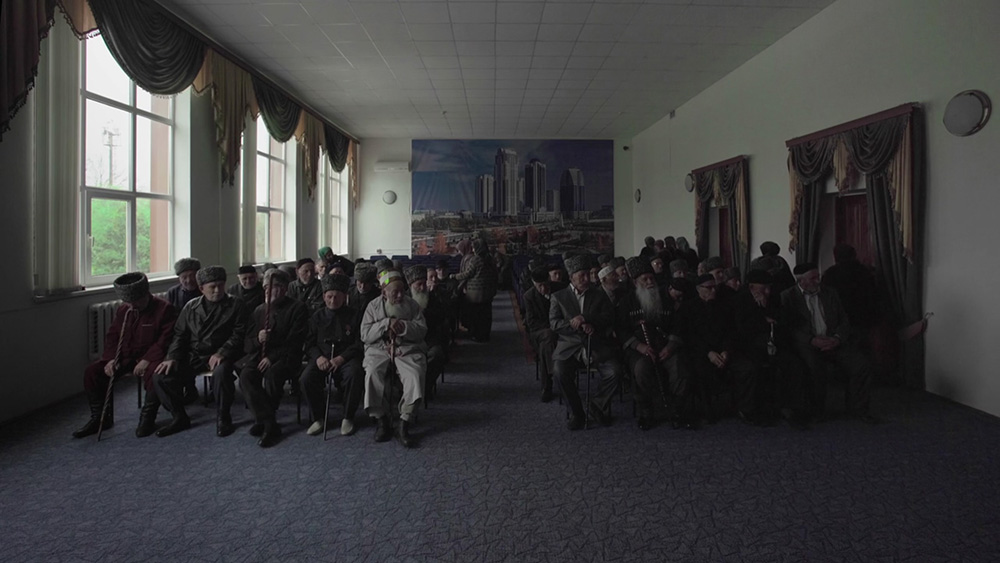
Aslan Gaisumov développe une œuvre qui se nourrit de mémoire personnelle et collective, mais les transforme et les transcende aussi. Son travail se situe entre l’immédiateté visuelle et le commentaire social, entre le momentané et le monumental. Si elle se compose surtout de vidéo et d’installations incluant des objets trouvés ou confectionnés spécifiquement pour la pièce, Gaisumov expose parfois des photographies et des œuvres sur papier aussi. People of No Consequence est le titre que Gaisumov a choisi pour cette installation vidéo : un plan séquence de la première rencontre d’un groupe de personnes âgées qui ont toutes vécu la déportation de la totalité du peuple tchétchène vers l’Asie centrale en 1944, il y a 72 ans. Il réutilise le titre pour sa constellation de trois œuvres récentes, incluant la vidéo Volga (2015) et l’œuvre tridimensionnelle Household (2016).
Aslan Gaisumov :son parcours relève presque du miracle : aujourd’hui âgé de 25 ans, l’artiste a grandi dans le nord du Caucase tchétchène, région marquée par la guerre civile et le terrorisme, et vécu sept ans dans un camp de réfugiés avec sa famille. A travers ses oeuvres marquantes, Aslan Gaisumov trouve le moyen de traiter son traumatisme et d’attirer l’attention sur la situation en Tchétchénie.
Catalogue : 2017Volga | Video | 4k | color | 4:11 | Russia | 2015
Aslan Gaisumov
Volga
Video | 4k | color | 4:11 | Russia | 2015
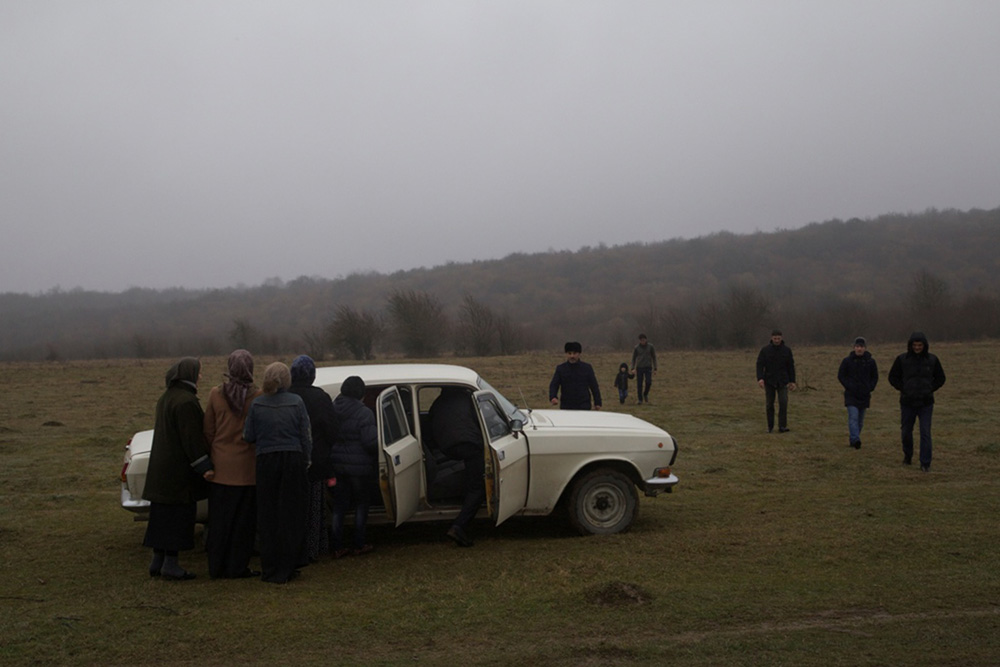
Dans cette vidéo faisant preuve d’une simplicité des plus efficaces, l’artiste de 24 ans Aslan Gaisumov nous plonge dans le conflit tragique auquel est confrontée sa Tchétchénie natale. Ce document, en partie autobiographique, montre comment les familles tentent de fuir le pays en s’entassant par douzaines dans de minuscules voitures. Le langage intuitif et poétique de Gaisumov vise à signifier les conséquences de la guerre, associées à la perte des traditions et des repères d’identité. Lorsque la survie devient une nécessité, les constructions fragiles comme le langage, les contes de fée et les symboles disparaissent. La mémoire et les histoires familiales se font rares et sont la plupart du temps perdues à jamais. Mais ceux qui parviennent à fuir, tel Gaisumov, représentent une nouvelle génération. On observe alors un nouveau leitmotiv, où le passé et le présent s’entremêlent pour créer de nouveaux symboles et métaphores perpétuant la continuité d’un peuple.
Aslan Gaisumov son parcours relève presque du miracle : aujourd`hui âgé de 25 ans, l`artiste a grandi dans le nord du Caucase tchétchène, région marquée par la guerre civile et le terrorisme, et vécu sept ans dans un camp de réfugiés avec sa famille. A travers ses oeuvres marquantes, Aslan Gaisumov trouve le moyen de traiter son traumatisme et d`attirer l`attention sur la situation en Tchétchénie.
Fernando Galan
Rafael Gallar
Catalogue : 2007Infinitos monos | Experimental video | dv | color | 6:0 | Spain | 2006
Rafael Gallar
Infinitos monos
Experimental video | dv | color | 6:0 | Spain | 2006
"Infinitos monos" is a plastic interpretation of the Theorem of infinites monkeys, which states that a monkey touching keys at random on a keyboard will be able to, in all safety, finally write any book that is situated in the national library of France. The film demonstrates that it is extremely improbable that this could happen, but even this way it would be more improbable than the laws of the statistics that were violated.
Rafael Gallar was born in Alicante in 1969. He began as a industrial photographer in Alicante, a career that he developed for four years. In 1998, Rafael moved to Madrid to work as assistant of several photographers. Three years later he started collaborating as a freelance photographer with several magazines and realizing advertising campaigns. He exhibited photography in Photoespaña-02, and in the festival BAC-03, in the CCCB. Gallar's work with video began in 2004, exposing two pieces in the same year in the FEM-04. He exhibited "Infinities Monkeys" in FEM-05, and "I'd prefer to borrow someone else's interpretation" in FEM-06.
Inti Gallardo
Catalogue : 2022Mnemoc(y)ne | Experimental VR | super8 | color | 0:0 | Argentina, Chile | 2019
Inti Gallardo
Mnemoc(y)ne
Experimental VR | super8 | color | 0:0 | Argentina, Chile | 2019
In a black cubic space of virtual reality based on panels of ATLAS MENOSYNE created by Aby Warburg, the user will be able to activate different fragments of a personal memory filmed in Super8mm, generating his own montage and relations between the sequences that are projected in the space. The exterior limit of the physical space is defined by the same films exposed in their original materiality. The project pretends to expand with time, adding images to an atlas in motion, that reports Nomadic life of the fragmented time-space and the no existence of digital borders. Programer: Lucian A. Meister. Sound design: Sonoscopia.
Inti Gallardo has a degree in Cinema (University of Córdoba), and a Master in Media Art (University of Chile / Polytechnic University of Valencia). It is part of the ANCORA AV work cooperative and the CEIS8 group (Experimentation in analog film formats). Her work is linked to the use of materialities, archives, memory and the crossing between analog and digital media in different aesthetic and political configurations.
Inti Gallardo
Christophe Gallois
Catalogue : 2025L'écoute vagabonde | Documentary | 4k | color | 23:18 | France | 2024
Christophe Gallois
L'écoute vagabonde
Documentary | 4k | color | 23:18 | France | 2024
Le monde de Dominique Petitgand est celui de l’écoute. Depuis trois décennies, l’artiste crée des pièces sonores qu’il diffuse à travers des disques, à la radio, lors de séances d’écoute se déroulant dans l’obscurité, selon le principe d’un « cinéma pour l’oreille », ou encore sous la forme d’installations déployées dans l’espace, dans des lieux d’exposition. Dans son travail de montage, des fragments de voix sont découpés, isolés, détachés de leur contexte, et associés à d’autres éléments vocaux, sonores ou musicaux. Ses œuvres portent attention au potentiel narratif que recèlent ces fragments de réel autant qu’aux « liens invisibles » qui les relient entre eux. Comment prolonger, à l’écran, l’expérience de ses œuvres ? Comment filmer l’écoute ? C’est à partir de ces interrogations que sont restitués trois moments de création et de diffusion : une séance d’écoute présentée au Musée des Beaux-Arts de Nancy ; un temps de travail autour de la table de montage, dans l’atelier de l’artiste ; une installation sonore, Les heures creuses, créée pour les espaces du T2G – Théâtre de Gennevilliers.
Christophe Gallois est, depuis 2007, curateur au Mudam Luxembourg. Il a été le commissaire de plusieurs expositions collectives d’envergure, parmi lesquelles « The Space of Words » (2009) et « L’Image papillon » (2013), et d’expositions personnelles d’artistes tels que Guillaume Leblon (2009), John Stezaker (2011), Sanja Ivekovic (2012), Fiona Tan (2016), Su-Mei Tse (2017), Jeff Wall (2018), Katinka Bock (2018), David Wojnarowicz (2019), LaToya Ruby Frazier (2019), Zoe Leonard (2022), Tacita Dean (2022) et Dayanita Singh (2023). Un nombre important de ces projets ont été développés en collaboration avec des institutions telles que le Taipei Fine Arts Museum, le Aargauer Kunsthaus, la Whitechapel Gallery à Londres, le Musée d’Art Moderne de Paris, le MCA Australia à Sydney, la Kunsthalle Mannheim ou encore le Whitney Museum of American Art à New York. Consacré au travail de Dominique Petitgand, « L’écoute vagabonde » est son premier court-métrage documentaire. Pensé comme un prolongement de sa pratique curatoriale, celui-ci poursuit un dialogue entamé avec l’artiste au milieu des années 2000 dans le cadre de plusieurs expositions de groupe et d’une exposition personnelle, ainsi que de la rédaction de textes et des entretiens.
Sophia Lorena Gamboa Huamán
Catalogue : 2026I thought about leaving traces | Experimental film | mov | color | 5:10 | Germany | 2025
Sophia Lorena Gamboa HuamÁn
I thought about leaving traces
Experimental film | mov | color | 5:10 | Germany | 2025
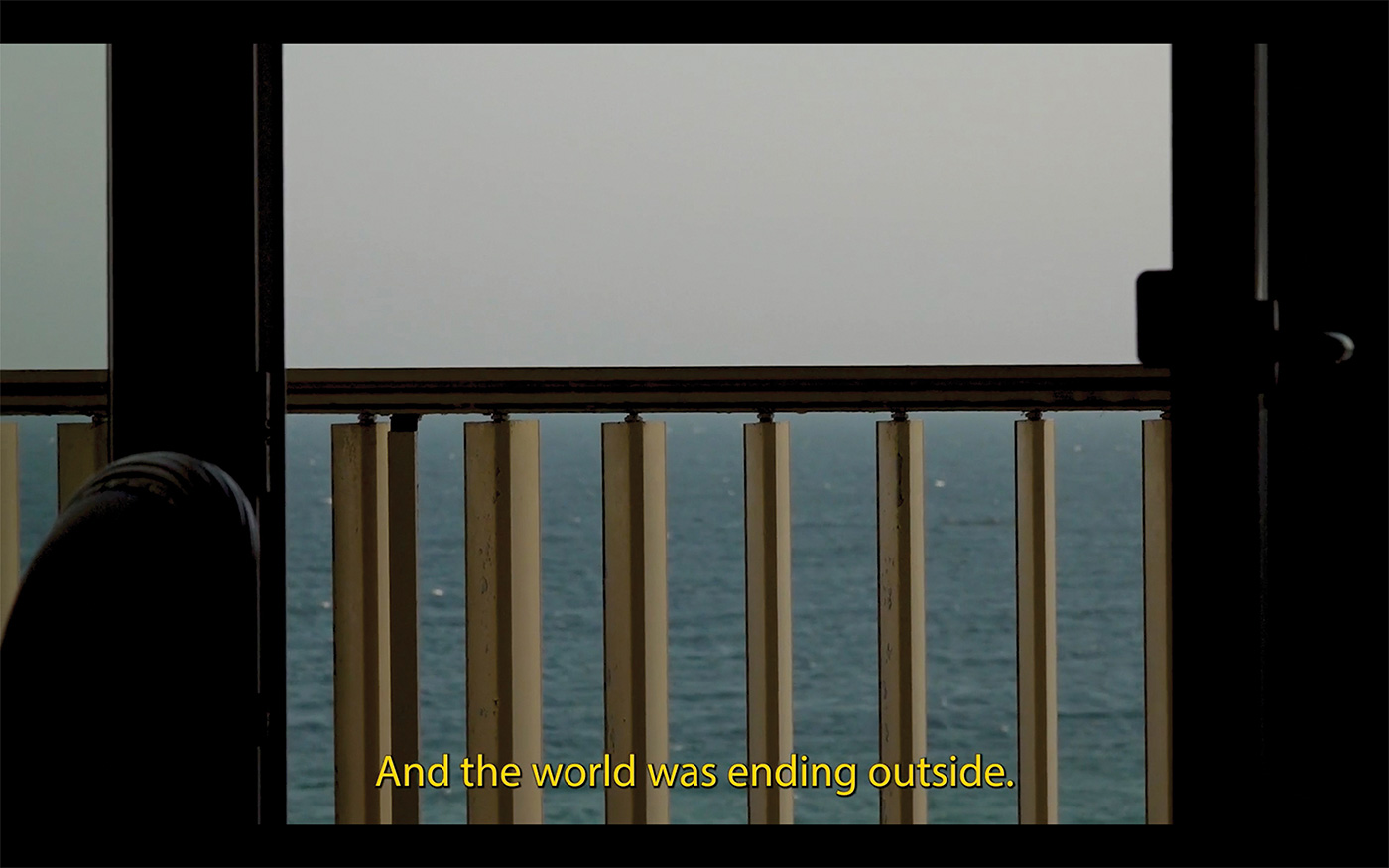
A silent, dreamlike monologue by an invisible figure. Past, present and future intermingle - are we watching or being watched? Fear of the future seeps through fragments of recollection, where truth shifts like light on water. Beneath the silence lies a quiet reclusion — a retreat from others, yet a yearning for connection.
She studied Media Arts at the Academy of Media Arts Cologne, followed by studies in Archaeology and Musicology. For the past ten years, the filmmaker has worked in various roles including as an editor and producer. As such, and as a director, her short and feature films have been screened at festivals including Oberhausen Short Film Festival, the Max Ophüls Prize Film Festival, Hof International Film Festival, the Cannes Film Festival, and others.
Christina Gangos
Catalogue : 2012HAMMER TO BELL | Experimental doc. | dv | color | 40:0 | United Kingdom, Ireland | 2011
Christina Gangos
HAMMER TO BELL
Experimental doc. | dv | color | 40:0 | United Kingdom, Ireland | 2011
"Hammer to bell" is set in Limerick, a city on the West coast of Ireland known for its brutal gang land wars, branded as the ?murder capital of Europe?. Through careful observation, Christina Gangos travels into the core of this brutalized part of the world, watching the unobserved, mesmerized by the ordinary other. Inspired by the work of US Pulitzer prizewinning poet Robert Hass, "Hammer to bell" takes us on an extraordinary journey from boxing children to greyhounds, marvelous landscapes to chatting anglers and a land of raging bells.
Director Christina Jane Gangos is an independent documentary filmmaker based in Limerick, Ireland (since 2006). She studied journalism and history in Athens and then went on to do a Master in Documentary by Practice at Royal Holloway, University of London. Her work has been exhibited in different forms, from video installation like Sundance to experimental documentaries like Lettuce and Peppers and Attaché. Christina has been awarded the Arts Council New Work award as well as the Create award for Community Arts. She is currently funded by the Irish Film Board. She has been exhibited at London's National Portrait Gallery and the IFI amongst other places.
Moise Ganza
Catalogue : 2023Muzunga | Experimental fiction | mov | color | 16:57 | Rwanda | 2021
Moise Ganza
Muzunga
Experimental fiction | mov | color | 16:57 | Rwanda | 2021
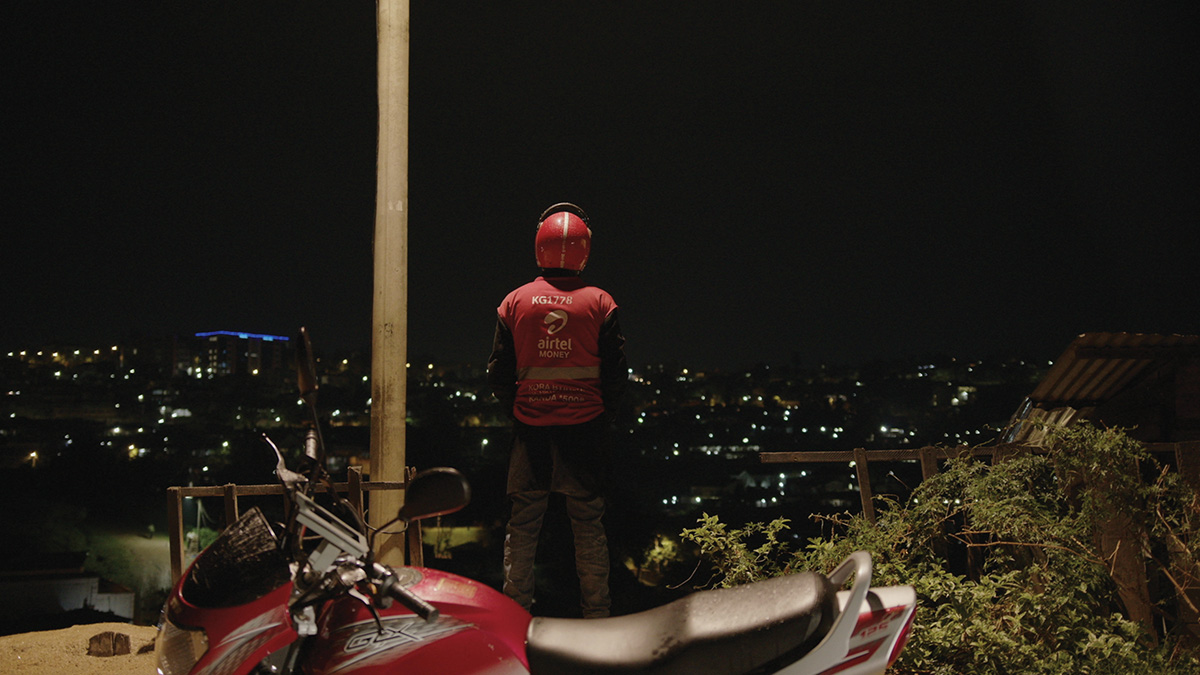
An opinionated moto driver’s sanity is pushed to the edge when a total lockdown confronts him with the void in his life.
Ganza Moise is a published author and independent filmmaker based in Kigali, Rwanda. He is also the co-founder of Kiruri MFN, an independent production company based in Kigali, Rwanda. To date he has directed more than 8 short films, Like Sukut and Limbo which screened in various film festivals worldwide including; Cascade Festival of African Films, the AfrYKamera film festival, Signos de Noite, Ishango Encounters, Africa In Motion, Moscow International Experimental Film Festival, ZIFF and Exhibitions Like “International Digital Kunst Festival” and “The factory of Dreams” by Maison Beaulier. His film “Sensory Overload” won the jury’s special mention for the 67th Oberhausen. His latest film MUZUNGA premiered at the 2022 Oberhausen international film festival. Films he produced like IMUHIRA by Birara Miriam and From Here by Remy Ryumugabe among many others, have screened at prestigious festivals like the Locarno film festival and Oberhausen international short film festival.
Wei Gao
Catalogue : 2023Lightness | Experimental film | 16mm | color | 3:16 | China, Korea, South | 2022
Wei Gao
Lightness
Experimental film | 16mm | color | 3:16 | China, Korea, South | 2022
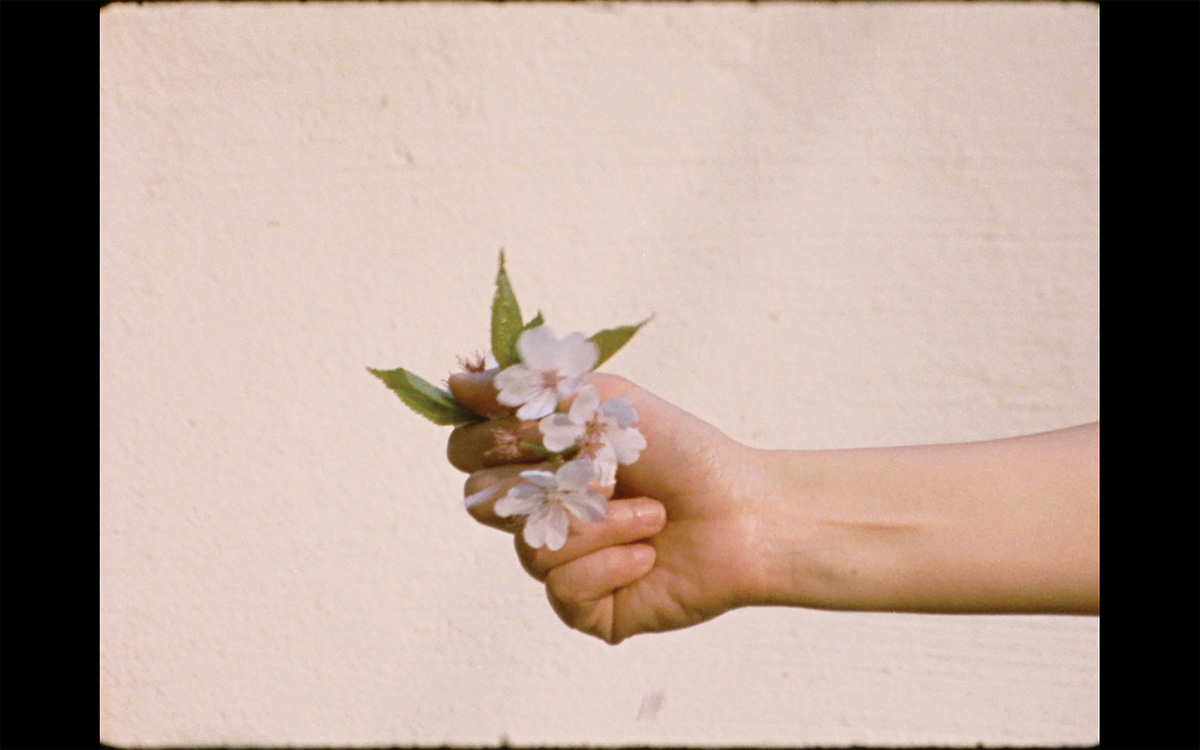
Cherry blossoms are fragile, beautiful and light. Grasping flowers with hands symbolizes a desire to grasp something beautiful, fragile but perishable in life. When the flowers fall, when the opportunity comes, some are caught and some are lost. Those caught are only temporary possessions. Trying to catch flowers, trying to catch something good but easy to lose. During the Covid pandemic, filmmaker Wei Gao started planting and gardening. Taking care of plants every day, she discovered that humans are as fragile as plants. We try to catch things in life, some succeed, some miss. “The unbearable lightness of being.”
Gao Wei is an independent photographer and filmmaker, living and working between Seoul and Paris. She graduated from the School of Photography, Beijing Film Academy, China. She previously worked in the media industry in Beijing. Currently, her artistic practice is mainly created through still and moving images. Practices involve multiple media such as photography, super 8mm, 16mm film, video and image experiments. She held solo exhibitions in Paris, France and Seoul, South Korea in 2022. One of her films was selected in the 2023 Rotterdam International Film Festival, and several of her films were screened at art festivals and institutions in New York, Seoul, Paris and Chengdu.
Mindaugas Gapsevicius
Catalogue : 2009Bookshelf | Multimedia installation | 0 | color | 99:99 | Lithuania | 2006
Mindaugas Gapsevicius
Bookshelf
Multimedia installation | 0 | color | 99:99 | Lithuania | 2006
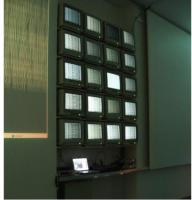
Rapid flow of letters and numbers on the monitors has nothing to do with chaos theory which can cause big disruptions in our world. It has also nothing to do with hacker?s world as one would like to say. Monitors placed on a wall shelf become a contemporary bookshelf containing in itself endless digitized textual and visual material. The Bookshelf represents a network traffic translated into descriptive form, so the unseen side of "networking" would be understandable or at least readable. In technical terms the flow of letters and numbers on the monitors would sound like `tcpdump`, a common computer network debugging tool. The Bookshelf was exhibited in various shapes and contexts. A Memex Wall installation, conceptualized in cooperation with superfactory.biz, was shown within a context of a "memory extender" game, the term of which was used to call a proto hypertext computer system influencing the development of subsequential hypertext and intellectual augmenting computer systems.
Mindaugas Gapsevicius aka mi_ga was born in 1974 in Lithuania, he lives and works in Berlin and Vilnius, Lithuania. Having studied visual arts in Academy of Arts in Vilnius, Lithuania and in Muthesius-Hochschule in Kiel, Germany, he obtained an MA degree in painting and painting restoration in Vilnius. Following that, he participated in a number of exhibitions and conferences concerning arts and digital culture, Re-Approaching new Media (RAM) workshops in Tallinn and Vilnius, Interfiction conference in Kassel. Gapsevicius exhibited his work in contemporary art galleries, among them in Vilnius Contemporary Art Center in 2002, Moscow National Center for Contemporary Arts in 2004, Kunstraum Kreuzberg/Bethanien, in Berlin, in 2006. He is one of the initiators of o-o institutio media which was established in 1998 (www.o-o.lt) and a co-author of net.art projects asco-o (www.asco-o.com) and carpet art (www.triple-double-u.com)
Nicolás Garcés
Catalogue : 2025Réplicas | Experimental fiction | hdv | color | 13:49 | Colombia | 2024
Nicolás GarcÉs
Réplicas
Experimental fiction | hdv | color | 13:49 | Colombia | 2024
In a land of musical rivers and omens coming from the heart of the jungle, a young man overhears a bird's song as a message of his fate. A dream-like contemplation of a man dissolving into a large common body.
Nicolás Garcés was born in Pasto, Colombia, and holds a degree in Filmmaking from the Universidad Nacional de Colombia. His work focuses on ethnographic explorations and experimental practices in audiovisual media, and has been screened in festivals such as MIDBO, Festival du Nouveau Cinéma de Montreal, FICCI, among others.