Catalogue > List by artist
Browse the entire list of Rencontre Internationales artists since 2004. Use the alphabetical filter to refine your search. update in progress
Hans Op De Beeck
Catalogue : 2016Night Time (extended) | Animation | hdv | black and white | 19:18 | Belgium | 2015
Hans Op De Beeck
Night Time (extended)
Animation | hdv | black and white | 19:18 | Belgium | 2015
"Night Time (extended)" - Hans Op de Beeck 2015 Full HD video, black and white, sound, 2015 (19 minutes 20 seconds) ‘Night time (extended)’ is a dark, enigmatic animation without text based on a large series of monumental monochrome watercolours which Op de Beeck steadily realised over the past five years, in between all his other multidisciplinary projects. All the watercolours were painted by the artist at night in complete solitude and concentration.This nightly atmosphere is a tangible presence in the metropolitan landscapes, the images of nature, the buildings, interiors and characters which the artist brings to life in the film. "Night time (extended)" is conceived as a mysterious dream in which all proportions, perspectives and environments are fictitious. In this way, intimate close-ups are made to alternate with sweeping images; every image clearly and visibly the product of deliberate construction. The film is comforting and soothing, yet also exudes a sense of dormant danger and derailment, just as in the film noir tradition. Here, Op de Beeck brings together an anachronistic whole of both classical and distinctly contemporary themes into an effortless blend of both highly cultivated and more visceral subcultural elements.
Hans Op de Beeck produces large installations, sculptures, films, drawings, paintings, photographs and texts. His work is a reflection on our complex society and the universal questions of meaning and mortality that resonate within it. He regards man as a being who stages the world around him in a tragi-comic way. Above all, Op de Beeck is keen to stimulate the viewers’ senses, and invite them to really experience the image. He seeks to create a form of visual fiction that delivers a moment of wonder and silence. Over the past fifteen years Op de Beeck realized numerous monumental ‘sensorial’ installations, in which he evoked what he describes as ‘visual fictions’: tactile deserted spaces as an empty set for the viewer to walk through or sit down in, sculpted havens for introspection. In many of his films though, in contrast with those depopulated spaces, he prominently depicts anonymous characters. Hans Op de Beeck was born in Turnhout in 1969. He lives and works in Brussels and Gooik, Belgium. Op de Beeck has shown his work extensively in solo and group exhibitions around the world. He had substantial institutional solo shows at the GEM Museum of Contemporary Art of The Hague, The Hague, NL (2004); MUHKA Museum of Contemporary Art, Antwerp, B (2006); Centraal Museum, Utrecht, NL (2007); the Smithsonian’s Hirshhorn Museum and Sculpture Garden, Washington DC, US (2010); KunstmuseumThun, CH (2010); Centro de Arte Caja de Burgos, Burgos, ES (2010); Butler Gallery, Kilkenny, IRL (2012); Kunstverein Hannover, D (2012); Tampa Museum of Art, Tampa, USA (2013); the Harn Museum of Art, Gainesville, FL, USA (2013); FRAC Paca, Marseille, F (2013); MIT List Visual Arts Center, Cambridge, Boston MA, US (2014); MOCA Cleveland, OH, US (2014); Sammlung Goetz, Munich, D (2014), … Op de Beeck participated in numerous group shows at institutions such as The Reina Sofia, Madrid, ES; the Scottsdale Museum of Contemporary Art, AZ, US; the Towada Art Center, Towada, JP; ZKM, Karlsruhe, DE; MACRO, Rome, IT; the Whitechapel Art Gallery, London, GB; PS1, New York, NY, US; Musée National d’ArtModerne, Centre Pompidou, Paris, FR; Wallraf-Richartz Museum, Köln, DE; Hangar Bicocca, Milano, IT; the Hara Museum of Contemporary Art, Tokyo, JP; 21C Museum, Louisville, Kentucky, US; The Drawing Center, New York, NY, US; Kunsthalle Wien, Vienna, AT; Shanghai Art Museum, Shanghai, CN; MAMBA, Buenos Aires, AR; Haus der Kunst, Munich, DE; Museod’ArteModerna di Bologna, Bologna, IT; Kunstmuseum Bonn, Bonn DE, … His work was invited for the Venice Biennale, Venice, IT; the Shanghai Biennale, Shanghai, CN; the Aichi Triennale, Aichi, JP; the Singapore Biennale, Singapore, SG; Art Summer University, Tate Modern, London, GB; the Kochi-Muziris Biennale, IN, and many other art events.
Hans Op De Beeck
Catalogue : 2014Staging Silence (2) | Experimental video | | black and white | 20:48 | Belgium | 2013
Hans Op De Beeck
Staging Silence (2)
Experimental video | | black and white | 20:48 | Belgium | 2013
Hans Op de Beeck`s film `Staging Silence (2)` is based around abstract, archetypal settings that lingered in the memory of the artist as the common denominator of the many similar public places he has experienced. The video images themselves are both ridiculous and serious, just like the eclectic mix of pictures in our minds. The decision to film in black and white heightens this ambiguity: the theatre like approach of the video invokes the legacy of slapstick, as well as the insidious suspense and latent derailment of film noir. The title refers to the staging of such dormant decors where, in the absence of people, the spectator can project himself as the lone protagonist. Memory images are disproportionate mixtures of concrete information and fantasies, and in this film they materialise before the spectator`s eyes through anonymous tinkering and improvising hands. Arms and hands appear and disappear at random, manipulating banal objects, scale representations and artificial lighting into alienating yet recognisable locations. These places are no more or less than animated decors for possible stories, evocative visual propositions to the spectator. Op de Beeck`s film is accompanied by a score which, inspired by the images themselves, has been composed by composer-musician Scanner (UK).
Hans Op de Beeck Situating the artist and his oeuvre Visual artist Hans Op de Beeck lives and works in Brussels, where he has developed his career through international exhibitions over the past ten years. His work consists of sculptures, installations, video work, photography, animated films, drawings, paintings and writing (short stories). It is his quest for the most effective way of presenting the concrete contents of each work that determines the medium that the artist ultimately selects. The scale can vary from the size of a small watercolour to a large, three-dimensional installation of 300m2. The artist not only uses a very wide variety of media, but also deliberately employs a diversity of aesthetic forms, ranging from an economical, minimalist visual language to overloaded, exaggerated designs, always with the aim of articulating the content of the work as precisely as possible. Thematically, the work concentrates on our laborious and problematic relationship with time, space and each other. Op de Beeck shows the viewer non-existent, but identifiable places, moments and characters that appear to have been taken from contemporary everyday life, aiming thereby to capture in his images the tragicomic absurdity of our postmodern existence. Key themes are the disappearance of distances, the disembodiment of the individual and the abstraction of time that have resulted from globalisation and the changes to our living environment that developments in media, automation and technology have brought about. Hans Op de Beeck sometimes calls his works ?proposals?; they are irrefutably fictional, constructed and staged, leaving it up to the viewer whether to take the work seriously, as a sort of parallel reality, or immediately to put it into perspective, as no more than a visual construct. His work is nourished by a keen interest in social and cultural reflection. The artist also questions the difficult relationship between reality and representation, between what we see and what we want to believe, between what is and what we create for ourselves in order to make it easier to deal with our own insignificance and lack of identity. The visual output of that investigation often produces slumbering, insidious, melancholy and astonishing images.
Hans Op De Beeck
Catalogue : 2018The Girl | Experimental film | hdv | color | 16:0 | Belgium | 2017
Hans Op De Beeck
The Girl
Experimental film | hdv | color | 16:0 | Belgium | 2017
"The Girl" is a slow, suggestive, perception-oriented animated film in which the viewer is transported to the strange world of a silent, 14-year-old girl. The dreamy landscape images show a dark forest, a vast landfill, a gas station, a highway landscape, a meadow, a factory site and a mysterious lake. Amidst all this stands an old caravan. The scene seems to suggest that the protagonist leads a lonely life on these premises. For a further unspecified reason, she must at one time have left her parental home, which is presented to us at the beginning of the film, both in perfect condition, and later in a neglected, abandoned state. In a variety of different landscapes, we see the girl perform small acts such as gather usable waste or pick herbs. We often get to see her cargo bike; the vehicle she uses to gather the bear necessities in order to survive. Nighttime, breaking dawn, wind, rain, fog, cold and warming fire are present throughout the film. Occasionally, we get to see the girl “resting serenely” from up close, as if we were right beside her, and could feel her breath. At the end of the film we understand that she is resting on a raft in the lake, floating, passive, as a metaphor for surrender. An original soundtrack for the film was composed by Tom Pintens, on a text by the artist.
Hans Op de Beeck produces large installations, sculptures, films, drawings, paintings, photographs and texts. His work is a reflection on our complex society and the universal questions of meaning and mortality that resonate within it. He regards man as a being who stages the world around him in a tragi-comic way. Above all, Op de Beeck is keen to stimulate the viewer’s senses, and invite them to really experience the image. He seeks to create a form of visual fiction that delivers a moment of wonder and silence. Over the past twenty years Op de Beeck realized numerous monumental “ sensorial ” installations, in which he evoked what he describes as “ visual fictions ”: tactile deserted spaces as an empty set for the viewer to walk through or sit down in, sculpted havens for introspection. In many of his films though, in contrast with those depopulated spaces, he prominently depicts anonymous characters. Hans Op de Beeck was born in Turnhout in 1969. He lives and works in Brussels and Gooik, Belgium. Op de Beeck has shown his work extensively in solo and group exhibitions around the world.
Hans Op De Beeck
Catalogue : 2012Sea of Tranquillity | Video | | color | 29:50 | Belgium | 2010
Hans Op De Beeck
Sea of Tranquillity
Video | | color | 29:50 | Belgium | 2010
The medium-length film `Sea of Tranquillity` is a combination of live video recordings of actors and digitally-generated 3D environments in which the viewer makes a night-time visit to a mysterious, mythical cruise liner, the `Sea of Tranquillity`. This fictitious cruise liner has been designed by Hans Op de Beeck, following a short residence at Saint-Nazaire in France in 2008, during which the artist became intrigued by the remarkable Second World War story and postwar reconstruction of this harbour town, whose shipyards produce the worlds largest cruise liners. It seemed to the artist that the Queen Mary 2, then just completed, was, like the Burj Khalifa in Dubai (the highest building in the world), a suitable metaphor for our belief in spurious values and in such concepts as work, leisure time and luxury consumerism. We nowadays use such categories as the highest, the first and the biggest, but what do these terms say about the actual quality of things?
Visual artist Hans Op de Beeck lives and works in Brussels, where he has developed his career through international exhibitions over the past ten years. His work consists of sculptures, installations, video work, photography, animated films, drawings, paintings and writing (short stories). It is his quest for the most effective way of presenting the concrete contents of each work that determines the medium that the artist ultimately selects. The scale can vary from the size of a small watercolour to a large, three-dimensional installation of 300m2. The artist not only uses a very wide variety of media, but also deliberately employs a diversity of aesthetic forms, ranging from an economical, minimalist visual language to overloaded, exaggerated designs, always with the aim of articulating the content of the work as precisely as possible. Thematically, the work concentrates on our laborious and problematic relationship with time, space and each other. Op de Beeck shows the viewer non-existent, but identifiable places, moments and characters that appear to have been taken from contemporary everyday life, aiming thereby to capture in his images the tragicomic absurdity of our postmodern existence. Key themes are the disappearance of distances, the disembodiment of the individual and the abstraction of time that have resulted from globalisation and the changes to our living environment that developments in media, automation and technology have brought about. Hans Op de Beeck sometimes calls his works "proposals"; they are irrefutably fictional, constructed and staged, leaving it up to the viewer whether to take the work seriously, as a sort of parallel reality, or immediately to put it into perspective, as no more than a visual construct. His work is nourished by a keen interest in social and cultural reflection. The artist also questions the difficult relationship between reality and representation, between what we see and what we want to believe, between what is and what we create for ourselves in order to make it easier to deal with our own insignificance and lack of identity. The visual output of that investigation often produces slumbering, insidious, melancholy and astonishing images.
Catalogue : 2010Staging Silence | Video | dv | black and white | 22:0 | Belgium | 2009
Hans Op De Beeck
Staging Silence
Video | dv | black and white | 22:0 | Belgium | 2009
?Staging Silence? is based around remembered spaces; not any specific sites, but the abstract, archetypal settings that lingered in my memory as the common denominator of the many similar public places I have visited and experienced. The video images themselves are both ridiculous and serious, just like the eclectic mix of pictures in our minds. The decision to film in black-and-white heightens this ambiguity: the amateurish quality of the video invokes the legacy of slapstick, as well as the insidious suspense and latent derailment of film noir. But perhaps gravity and menace ultimately prevail. The title, ?staging silence?, refers to the staging of such dormant decors where, in the absence of people, the spectator can project himself as the lone protagonist, unhindered by others. Memory images are disproportionate mixtures of concrete information and fantasies, and in this film they materialize before the spectator?s eyes through anonymous tinkering and improvising hands. Arms, like those of faceless puppeteers, appear and disappear at random, manipulating banal objects, scale representations and artificial lighting into alienating yet recognizable locations. These places are no more or less than animated decors for possible stories, evocative visual propositions to the spectator. The film is accompanied by a score which, inspired by the images themselves, has been composed and performed by composer-musician Serge Lacroix.
Visual artist Hans Op de Beeck lives and works in Brussels, where he has developed his career through international exhibitions over the past ten years. His work consists of sculptures, installations, video work, photography, animated films, drawings, paintings and writing (short stories). It is his quest for the most effective way of presenting the concrete contents of each work that determines the medium that the artist ultimately selects. The scale can vary from the size of a small watercolour to a large, three-dimensional installation of 300m2. The artist not only uses a very wide variety of media, but also deliberately employs a diversity of aesthetic forms, ranging from an economical, minimalist visual language to overloaded, exaggerated designs, always with the aim of articulating the content of the work as precisely as possible. Thematically, the work concentrates on our laborious and problematic relationship with time, space and each other. Op de Beeck shows the viewer non-existent, but identifiable places, moments and characters that appear to have been taken from contemporary everyday life, aiming thereby to capture in his images the tragicomic absurdity of our postmodern existence. Key themes are the disappearance of distances, the disembodiment of the individual and the abstraction of time that have resulted from globalisation and the changes to our living environment that developments in media, automation and technology have brought about. Hans Op de Beeck sometimes calls his works "proposals"; they are irrefutably fictional, constructed and staged, leaving it up to the viewer whether to take the work seriously, as a sort of parallel reality, or immediately to put it into perspective, as no more than a visual construct. His work is nourished by a keen interest in social and cultural reflection. The artist also questions the difficult relationship between reality and representation, between what we see and what we want to believe, between what is and what we create for ourselves in order to make it easier to deal with our own insignificance and lack of identity. The visual output of that investigation often produces slumbering, insidious, melancholy and astonishing images.
Catalogue : 2008The stewarts have a party | Experimental video | dv | color | 4:19 | Belgium | 2007
Hans Op De Beeck
The stewarts have a party
Experimental video | dv | color | 4:19 | Belgium | 2007
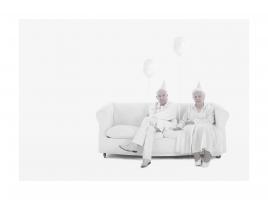
?The Stewarts? are a fictitious and carefully cast family. The various family members appear and disappear in an empty white room, like life-sized marionettes dressed in white. As is customary in this subgenre of marionette theatre, they are manipulated by puppeteers dressed in black; consisting in this case of the set entourage: production assistants, a makeup girl and a hair stylist. The family members are moved to spots in the space and tidied up for their performance. Finally the puppeteers/assistants strap balloons to ?The Stewarts? and place cardboard party hats on their heads. All of this takes place calmly and in complete silence, none of the Stewarts shows a sign of emotion.
Hans Op de Beeck (BE, 1969) studied at the Hogeschool Sint-Lukas, Brussels and the Rijksacademie, Amsterdam. As a multi-disciplinary artist he makes use of various media, like video, installations, sculptural work, photography, text, animation and sketches. He adapts his medium to the chosen thematic, always searching for some kind of parallel world, an ageless nowhere. The world as it is presented here is an uncanny no man?s land, in which there is hardly room for human beings. Op de Beeck is looking for a ?being in transit?, an in-between, seemingly reason-less entity: the unrestrained, the chaos of the undefi ned. Op de Beeck has exhibited at the Fondazione Bevilacqua La Masa (Venice), GEM (The Hague) and Xavier Hufkens (Brussels). In 2001 he won the Young Belgian Painting Award, in 2006 the Prize Eugène Baie.
Catalogue : 2008The Building | Art vidéo | dv | color | 4:19 | Belgium | 2007
Hans Op De Beeck
The Building
Art vidéo | dv | color | 4:19 | Belgium | 2007
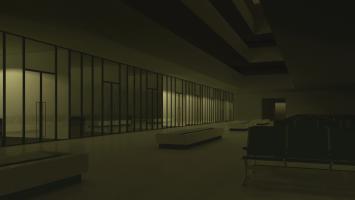
"The Building" is a digitally generated animation movie in which the artist sends the viewer on a virtual, nocturnal walking tour of a fictitious, megalomaniacal hospital complex. This hospital has the same mediocre, half-hearted, over-the-top architectural features as the hospitals, shopping malls, health clubs, and airports that have shot up like mushrooms all over the Western world. These buildings are designed to accommodate thousands of visitors. They radiate a mood of alienation and interchangeability. Strikingly enough, these impersonal hospital complexes usually form the backdrop to the most personal and essential moments in life: in a hospital one is born, suffers, comforts, heals, and dies. "The Building" does not follow a strict narrative line, rather it submerses the viewer in the slumbering, nocturnal machine, with the camera switching back and forth between a neutral, observational point of view and the subjective position of the patient.
Hans Op de Beeck (°1969, Turnhout, Belgium) Lives and works in Brussels (Belgium) www.hansopdebeeck.com SELECTION OF SOLO-EXHIBITIONS AND PROJECTS 2007 Hans Op de Beeck: Extensions M, Louvain Hans Op de Beeck: Extensions Centraal Museum, Utrecht Hans Op de Beeck: Merry-go-round (2) Art Unlimited, Basel Hans Op de Beeck: Extensions Galleria Continua, San Gimignano Hans Op de Beeck: All together now... Galerie Ron Mandos, Amsterdam 2006 Hans Op de Beeck: Family (scenes and scenery) Xavier Hufkens Gallery, Brussels Hans Op de Beeck: Tables... Galerie Krinzinger, Vienna Hans Op de Beeck: My Brother?s Gardens Fondazione Bevilacqua La Masa, Venice Hans Op de Beeck: Loss Viafarini, Milan 2005 Hans Op de Beeck: In their minds? Nicole Klagsbrun Gallery, New York Hans Op de Beeck: T-Mart MuHKA, Museum of Contemporary Art, Antwerp 2004 Hans Op de Beeck: Loss Galerie Les Filles du Calvaire, Paris Hans Op de Beeck: Location (5) Art Unlimited, Basel Hans Op de Beeck Galerie Ron Mandos, Rotterdam Hans Op de Beeck: Meanwhile? Museum of Contemporary Art, The Hague 2003 Hans Op de Beeck: My brother?s gardens Xavier Hufkens, Brussels 2001 Hans Op de Beeck Hales Gallery, London SELECTION OF GROUP-EXHIBITIONS 2008 Car Culture Scottsdale Museum of Contemporary Art, Arizona Discovering Slowness M?Ars - Centre of Contemporary Art, Moscow Variable Capital Bluecoat Arts Centre, Liverpool Towada Art Project (permanent installation of ?Location (5)?) Towada Art Center, Towada (JP) 2007 A Story of the Image: Visual Art as Visual Culture ICA, Singapore Dealing with Reality Museum of Modern Art, Arnhem (NL) La città che sale - We try to build the future ARCOS, Benevento (IT) - MACRO, Rome Imagination Becomes Reality (# 6) (Goetz Collection) ZKM, Karlsruhe (DE) Our Magic Hour ARARIO Gallery, Seoul The Leading Thread Centro de Arte Caja de Burgos (CAB), Burgos (ES) 2006 Rencontres Internationales Cinéma de l?Entrepôt, Paris - Cinema Babylon, Berlin - Circulo de Bellas Artes, Madrid Version Animée - Biennale des nouveaux médias Centre pour l?image contemporaine, Genève 6th Shanghai Biennale Shanghai Art Museum, Shanghai Fresh! Museum of Glass, Tacoma, Washington Animated Stories CaixaForum, Barcelona - Sala Rekalde, Bilbao - Le Fresnoy, Tourcoing (FR) Analog Animation 2006 The Drawing Center, New York 2005 NIGHT SITES Kunstverein Hannover, Hanover The MARTa Herford Collection MARTa, Herford En Attente Casino Luxembourg - forum d?art contemporain, Luxembourg Visionary Belgium (Harald Szeemann) Palais des Beaux-Arts, Brussels 2004 100 % Acid Free White Columns, New York All that useless beauty Whitechapel, Project Space, London 2003 Silent Wandering... Postbahnhof Am Ostbahnhof, Berlin Breaking Away P.S.1-MoMA, New York 2002 Printemps de Septembre (festival) Toulouse BIG Torino 2002, International Biennial of Young Art (Big Social Game) Torino
Catalogue : 2007All together now... | Experimental video | betaSP | color | 6:20 | Belgium | 2005
Hans Op De Beeck
All together now...
Experimental video | betaSP | color | 6:20 | Belgium | 2005
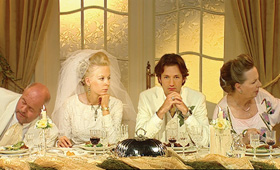
"All together now..." is a lively, tragicomic portrait of three groups of table-companions, portrayed on three different occasions: a group of people in their late seventies at a table, set rather soberly with coffee and cake after a funeral; a wistful bride and her bridegroom with their families in an over-decorated party center, and a birthday dinner for a well-to-do pater familias in an under-cooled design interior. These moments around a table may be some of clearest situations in which people gather together in a more or less artificial manner. Mutual grudges, unspoken feelings, and tensions between family members are hidden between the lines of the ritual. The camera slowly pans once along the people around the table. This six-minute choreography of actions in miniature, conversations, and knowing glances, clarifies the relationships around the table. Some of the characters are comic, others rather tragic or touching. Due to the slow-motion technique, every detail becomes outspokenly visible. "All together now..." is a contemporary portrait of human beings around the table, in which the sobering, post-party emptiness, can be sensed while the feast is still in progress.
The Belgian visual artist Hans Op de Beeck (Turnhout, 1969) creates huge, life-sized installations, imaginary urban sites on scale, video installations, sculptures, photos, drawings and animated films. He has for several years been involved in many individual projects and group shows in quick succession. His work has been shown throughout Europe and the United States. In 2002-2003 he was artist-in-residence at MoMA-PS. in New York. At Art Unlimited (Art Basel 2004) he showed a life-sized motorway restaurant, overlooking a nightly motorway. Recently he showed work at MARTa Herford, Kunstverein Hannover, MuHKA Antwerp, Casino Luxemburg, Shanghai Art Museum, PSK Brussels, GEM-Museum of Contemporary Art (The Hague), and The Drawing Center (New York).
Hans Op De Beeck
Catalogue : 2015Before the rain(a village) | Experimental doc. | hdv | color | 12:0 | Belgium, India | 2013
Hans Op De Beeck
Before the rain(a village)
Experimental doc. | hdv | color | 12:0 | Belgium, India | 2013
Before the Rain (A Village) shows us the daily events in this South Indian region, which combines a mineral, eroded landscape with rice fields, sheep herds and the impressive ruins of the Vijayanagara dynasty (1336-1565). During the rain season the artist stayed in the remote South Indian village, where humans and animals live together in small huts and sheds. He filmed only just before the onset of a new shower of rain—a time when the light becomes very diffuse and the sky becomes strangely, vaguely white. Oddly enough, as a result the Indian village bathes in a typically subdued, Western European light that is very unusual in the south of India. The film is constructed as a series of silent tableaux vivants that are filmed with a static, frontal camera on a tripod. Op de Beeck quite deliberately sought the small, everyday things we share beyond cultural borders, and consciously stayed away from the spectacular and that which is explicitly related to religion, mysticism or “being different”. Thus with this film he tried to create a sort of imaginary, universal village that speaks about how time silently passes in a small community, while avoiding the “exoticizing” glance of the idealizing idyll. The work invites a silent, sensory perception and reflection.
Hans Op de Beeck (° 1969 - Turnhout, Belgium) Lives and works in Brussels, Belgium Education/ Programs/ Awards 2009: Catholic University of Leuven Culture Prize 2009-2010 2006: Winner of the Prize Eugène Baie 2003-2005, Antwerp 2002-2003: Artist at the MoMA-P.S.1 Studio Program, New York 2001: Winner of the `Prix Jeune Peinture Belge 2001`, Palais des Beaux Arts, Brussels 1998-1999: Participant at the Rijksakademie, Amsterdam (post-MA) 1996-1997: Participant at The Higher Institute for Fine Arts-Flanders, Antwerp (post-MA) 1992-1996: Masters Degree in Visual Arts, Higher Institute Sint-Lukas, Brussels Situating the artist and his oeuvre Visual artist Hans Op de Beeck lives and works in Brussels, where he has developed his career through international exhibitions over the past ten years. His work consists of sculptures, installations, video work, photography, animated films, drawings, paintings and writing (short stories). It is his quest for the most effective way of presenting the concrete contents of each work that determines the medium that the artist ultimately selects. The scale can vary from the size of a small watercolour to a large, three-dimensional installation of 300m2. The artist not only uses a very wide variety of media, but also deliberately employs a diversity of aesthetic forms, ranging from an economical, minimalist visual language to overloaded, exaggerated designs, always with the aim of articulating the content of the work as precisely as possible. Thematically, the work concentrates on our laborious and problematic relationship with time, space and each other. Op de Beeck shows the viewer non-existent, but identifiable places, moments and characters that appear to have been taken from contemporary everyday life, aiming thereby to capture in his images the tragicomic absurdity of our postmodern existence. Key themes are the disappearance of distances, the disembodiment of the individual and the abstraction of time that have resulted from globalisation and the changes to our living environment that developments in media, automation and technology have brought about. Hans Op de Beeck sometimes calls his works "proposals"; they are irrefutably fictional, constructed and staged, leaving it up to the viewer whether to take the work seriously, as a sort of parallel reality, or immediately to put it into perspective, as no more than a visual construct. His work is nourished by a keen interest in social and cultural reflection. The artist also questions the difficult relationship between reality and representation, between what we see and what we want to believe, between what is and what we create for ourselves in order to make it easier to deal with our own insignificance and lack of identity. The visual output of that investigation often produces slumbering, insidious, melancholy and astonishing images.
Ana Opalic
Catalogue : 2010PISMO | Video | dv | color | 7:22 | Croatia | 2009
Ana Opalic
PISMO
Video | dv | color | 7:22 | Croatia | 2009
Mario Elias Opazo Cartes
Catalogue : 2011SECRETO | Multimedia installation | | color | 20:0 | Colombia, Chile | 2010
Mario Elias Opazo Cartes
SECRETO
Multimedia installation | | color | 20:0 | Colombia, Chile | 2010
?SECRET? 10 min.aprox. (bucle-loop) MARIO OPAZO COLOMBIA And the wind said: I want to arrive at the Lighthouse of the End of the World and to call to shouts since there to the disappeared persons. The author carry out to poetic performance in one of the End World lighthouse in the far south of Chile. The action evoke to thriller and to secret lost in the politic memory of the south of the continent. There he records with contact microphones the sigh of the wind, the voice of the wind brushing the lighthouse. The scream of the wind like to resistance and memory metaphor.
Mario Opazo / curriculum vitae / EDUCATION 1987-1991 BELLAS ARTES, UNIVERSIDAD JORGE TADEO LOZANO PROFESSIONAL EXPERIENCE DESDE 1991 al 2009 PROFESOR FACULTAD DE ARTES, UNIVERSIDAD JORGE TADEO LOZANO, BOGOTÁ DESDE 1997 al 2009 PROFESOR FACULTAD DE ARTES, UNIVERSIDAD DE LOS ANDES, BOGOTÁ 1998 PROFESOR FACULTAD DE ARTES, PONTIFICIA UNIVERSIDAD JAVERIANA, BOGOTÁ DESDE1999 PROFESOR FACULTAD DE ARTES, UNIVERSIDAD NACIONAL DE COLOMBIA, BOGOTÁ DESDE 2004 PROFESOR ESCUELA DE CINE BLAK MARIA., BOGOTÁ 2007 REALIZACIÓN Y DISEÑO DE LOS LABORATORIOS DE PENSAMIENTO CREATIVO, EN LA ORINOQUÍA- COLOMBIA, MINISTERIO DE CULTURA DE COLOMBIA. SOLO EXHIBITIONS 2009 ?AMARGO COMO LA VIDA? MATADERO, MADRID 2009 ?EXPULSIÓN DEL PARAÍSO?, GALERÍA SANTA FE, BOGOTÁ, COLOMBIA 2008 ?EXPULSIÓN, ECHOES OF ARTE POVERA?, THE UNIVERSITY OF WESTERN NOTARIO, CANADÁ 2008 ?AMARGO COMO LA VIDA? SALA LOS ACEVEDO, MUSEO DE ARTE MODERNO, BOGOTÁ, COLOMBIA 2008 ?AMARGO COMO LA VIDA?, EMBAJADA DEL RASD EN LA HABANA, CUBA. 2008 ?TERRITORIO FUGITIVO?, GALERÍA GABRIELA MISTRAL, SANTIAGO - CHILE 2007 ?CAJA NEGRA, CUBO BLANCO?, ARTEBA,07 (FERIA DE ARTE DE BUENOS AIRES) 2007 ?LUGARES DEL CUERPO?, GALERÍA VALENZUELA Y KLENNER, BOGOTÁ 2006 ?ICARO?, FUNDACIÓN GILBERTO ALZATE AVENDAÑO, BOGOTÁ 2005 ?VIDEO Y JULIETA?, LARGOMETRAJE EN VIDEO DIGITAL, 109 MIN. 2005 ?HACER NADA?, GALERÍA VALENZUELA Y KLENNER BOGOTÁ. 2004 ?REDUNDANCIAS?, ALIANZA FRANCESA, BOGOTÁ. 2004 ?REDUNDANCIAS?, MUSEO DE ARTE UNIVERSIDAD NACIONAL DE COLOMBIA. 2004 ?PERDER ES GANAR UN POCO?, SEMANA DOCUMENTAL ?SEGUNDO GÉNERO?, SALA LOS FUNDADORES BOGOTÁ, MUESTRA CURADA POR EL LATIN AMERICAN CINEMA FESTIVAL OF NEW YORK. 2004 ?SIN EQUIPAJE? (LARGOMETRAJE VIDEO DIGITAL, 60 MIN.), SALA LOS ACEVEDO, MUSEO DE ARTE MODERNO DE BOGOTÁ. 2003 ?PERDER ES GANAR UN POCO", SALA LOS ACEVEDO, MUSEO DE ARTE MODERNO DE BOGOTÁ 2003 ?PERDER ES GANAR UN POCO?, FESTIVAL DE CINE DE SANTA FE DE ANTIOQUIA, COLOMBIA. 2003 ?PERDER ES GANAR UN POCO?, MUESTRA ITINERANTE DE CINE Y DOCUMENTAL COLOMBIANO BLACK MARIA ESCUELA DE CINE, PATAGONIA Y ECUADOR. 2003 ?PERDER ES GANAR UN POCO?, FESTIVAL DE CINE LATINOAMERICANO, LONDRES. 2001 ?VENDO PERICO?. GALERÍA CARLOS ALBERTO GONZÁLES, BOGOTÁ 2000 ?SIMULACROS?. GALERÍA CARLOS ALBERTO GONZÁLES, BOGOTÁ 1995 ?UN PLANETA PARA GISELLE?. MUSEO DE ARTE MODERNO DE BOGOTÁ 1994 ?CAJA DE MÚSICA?. GALERÍA ARTE 19, BOGOTÁ 1993 ?DIBUJOS INSTALADOS POR EL CAPITÁN SCOTT?. GALERÍA ARTE 19, BOGOTÁ 1992 ?CASA, CAZA DE PESCADO?. GALERÍA SANTA FE, PLANETARIO DISTRITAL, BOGOTÁ GROUP EXHIBTIONS 2009 ?REENCONTRES INTERNATIONAL?, MUSEO NACIONAL REINA SOFÍA, MADRID ESPAÑA. 2009 ?X BIENAL DE ARTE DE LA HABANA?. CUBA 2009 ?BIRDS OF PASSAGE?, FIERA D?ARTE CONTEMPORANEA A MATERA, MATERA, ITALIA 2009 ?ESPACIO ENTER?, TEA TENERIFE ESPACIO DE LAS ARTES, CANARIAS, ESPAÑA 2008 ?TORONTO LATIN MEDIA FESTIVAL?, TORONTO LATIN MEDIA FESTIVAL 2008 ?REENCONTRES INTERNATIONAL?, BEAUX-ARTS DE PARIS, FRANCIA 2008 ?REENCONTRES INTERNATIONAL?, MUSEO NACIONAL REINA SOFÍA, MADRID ESPAÑA. 2007 ?PREMIO AL ARTE LATINOAMERICANO MOLAA?, MUSEO DE ARTE LATINOAMERICANO, LONG BEACH, CALIFORNIA, EE:UU: 2007 ?LA OTRA?, FERIA DE ARTE ALTERNATIVA DE BOGOTÁ 2007 ?52ª BIENAL INTERNACIONAL DE ARTE DE VENECIA?,, ITALIA 2007 ?REENCONTRES INTERNATIONAL?, CENTRO GEORGES POMPIDOU, PARÍS. 2007 ?CIUDAD?, GALERÍA C4ARTO NIVEL, BOGOTÁ, COLOMBIA 2006 ?ARTBO 06, FERIA DE ARTE DE BOGOTÁ?, BOGOTÁ, COLOMBIA 2006 ?147 MAESTROS? MUSEO UNIVERSIDAD NACIONAL DE COLOMBIA 2006 ?BORDES DEL DIBUJO?, MUSEO UNIVERSIDAD NACIONAL DE COLOMBIA 2006 ?SALÓN DEL FUEGO? FUNDACIÓN GILBERTO ALZATE AVENDAÑO, BOGOTÁ 2006 ?ENCHUFADO?, GALERÍA CUARTO NIVEL, BOGOTÁ 2006 ?40ª SALÓN NACIONAL DE ARTISTAS COLOMBIANOS?, BOGOTÁ 2005 ?SEÑALES DE HUMO?, FUNDACIÓN VALENZUELA Y KLENNER, BOGOTÁ 2004 ?REDUNDANCIAS?, DOS INTENTOS PARA DECIR LO MISMO. MUSEO DE ARTE UNIVERSIDAD NACIONAL DE COLOMBIA 2004 ?ES TU MUSEO?, MUSEO DE ARTE MODERNO DE BOGOTÁ 2003 ?KENT EXPLORA?., BOGOTÁ 2003 ?PRIMER SALÓN DE ARTE BIDIMENSIONAL?, FUNDACIÓN GILBERTO ALZATE, BOGOTÁ. 2003 ?90 DESPLAZAMIENTOS?, MAMBO, BOGOTÁ 2003 ?SALA VENTILADA?, BIBLIOTECA MUNICIPAL DE BUCARAMANGA, BUCARAMANGA. 2003 ?FRAGMENTOS DE UN VIDEO AMOROSO?, GALERÍA SANTA FE, SALA ALTERNA. 2002 ?EL MUNDO AL INSTANTE?. INTENDENCIA REGIONAL DE VALPARAÍSO, CHILE. 2001 ?FRAGMENTOS DE UN VIDEO AMOROSO?, SALA DE EXPOSICIONES ASAB, BOGOTÁ 2001 ?EL MUNDO AL INSTANTE?. LEÓN DE GREIFF, UNIVERSIDAD NACIONAL DE COLOMBIA, BOGOTÁ 2001 ?TIEMPO DE DIBUJANTES?. GALERÍA EL NOGAL, BOGOTÁ 2001 ?LUGAR DE RESIDENCIA?. GALERÍA SANTA FE, PLANETARIO DISTRITAL, BOGOTÁ 2001 ?EL OBJETO PARADÓJICO?. MUSEO DE ARTES, UNIVERSIDAD NACIONAL DE COLOMBIA, BOGOTÁ 2000 ?SALE?. CALLE VÍA DEL SOL, BOGOTÁ 2000 ?EL CARTEL?. ESCOBAR ROSAS, BOGOTÁ 2000 ?OTRA COSA ES ADENTRO?. CASA LABORATORIO PARA ARTISTAS, BOGOTÁ 2000 ?EN BLANCO?. ACADEMIA SUPERIOR DE ARTES DE BOGOTÁ 2000 ?TRÁNSITO?. MUSEO DE ARTES, UNIVERSIDAD NACIONAL DE COLOMBIA, BOGOTÁ 1999 ?II BIENAL DE MERCOSUR?. PORTO ALEGRE, BRASIL 1999 ?HITOS DEL ARTE JOVEN?. MUSEO DE ARTE CONTEMPORÁNEO DE BOGOTÁ 1999 ?PRIMEROS PREMIOS EN LOS SALONES NACIONALES?. MUSEO DE ARTE MODERNO DE BOGOTÁ 1999 ?PIEL QUE MIRA?. GALERÍA CARLOS ALBERTO GONZÁLES, BOGOTÁ 1998 ?ARTISTAS EN RESIDENCIA?. ESPACIO ALTERNATIVO, CASA DE LA CANDELARIA, BOGOTÁ 1998 ?PRIMER SALÓN DE ARTE?. CENTRO DE DISEÑO PORTOBELLO, BOGOTÁ 1998 ?EMERGENCIA?. MUSEO DE ARTES, UNIVERSIDAD NACIONAL DE COLOMBIA, BOGOTÁ 1998 ?LA CAJA BLANCA?. TALLER MAESTRO LUÍS ROLDÁN, BOGOTÁ 1998 ?XXXVII SALÓN NACIONAL DE ARTISTAS?. CORFERIAS, BOGOTÁ 1997 ?PLATFORM?. CANVAS INTERNATIONAL ART, AMSTERDAM, HOLANDA 1997 ?IMAGINACIÓN Y FANTASÍA?. MUSEO DE ARTE MODERNO ?LA TERTULIA?, CALI, COLOMBIA 1997 ?VIII SALÓN REGIONAL DE ARTISTAS?. ESTACIÓN DE LA SABANA, BOGOTÁ 1997 ?FERIA ARCO 97?. MADRID, ESPAÑA 1997 ?LIBRO OBJETO?. MUSEO DE ARTE MODERNO DE BOGOTÁ, BOGOTÁ 1997 ?PRIMER FESTIVAL INTERNACIONAL DE LA IMAGEN?. MANIZALES, COLOMBIA 1996 ?XXXVI SALÓN NACIONAL DE ARTISTAS?. CORFERIAS, BOGOTÁ 1996 ? V BIENAL DE ARTE DE BOGOTÁ?. MUSEO DE ARTE MODERNO DE BOGOTÁ 1995 ?UN CONTENDOR DE ESPACIO A FINALES DE SIGLO?. GALERÍA EL MUSEO, BOGOTÁ 1995 ?HAY PULSO?. GALERÍA CALOS ALBERTO GONZÁLES, BOGOTÁ 1995 ?ARTE Y TECNOLOGÍA?. CORFERIAS, BOGOTÁ 1995 ?ARTE PARA BOGOTÁ?. GALERÍA SANTA FE, PLANETARIO DISTRITAL, BOGOTÁ 1995 ?VII SALÓN REGIONAL DE ARTISTAS?. CORFERIAS, BOGOTÁ 1995 ?25 AÑOS DEL MAM?. MUSEO DE ARTE MODERNO DE BOGOTÁ 1995 ?III BIENAL DE ARTE MODERNO DE MÉRIDA?. VENEZUELA 1995 ?XXXV SALÓN NACIONAL DE ARTISTAS?. CORFERIAS, BOGOTÁ 1993 ?UN METRO CUADRADO DE ARTE CONCEPTUAL?. PONTIFICIA UNIVERSIDAD JAVERIANA, BOGOTÁ 1993 ?VER O REVERSO? MUESTRA DE ARTE JOVEN LATINOAMERICANO. EXPOSICIÓN ITINERANTE, BRASIL 1993 ?MELANCOLÍA?. MUSEO DE ARTES, UNIVERSIDAD NACIONAL DE COLOMBIA, BOGOTÁ 1993 ?VI SALÓN REGIONAL DE ARTISTAS?. CORFERIAS, BOGOTÁ 1992 ?PRIMER SALÓN DE PINTURA JOVEN?. GALERÍA SANTA FE, PLANETARIO DISTRITAL, BOGOTÁ 1992 ?ALTERNATIVAS EN PROCESO?. GALERÍA EL MUSEO, BOGOTÁ 1992 ?III BIENAL DE ARTE BOGOTÁ?. MUSEO DE ARTE MODERNO DE BOGOTÁ 1992 ?XXXIV SALÓN NACIONAL DE ARTISTAS?. CORFERIAS, BOGOTÁ 1992 ?II SALÓN DE ARTE JOVEN?. GALERÍA SANTA FE, PLANETARIO DISTRITAL, BOGOTÁ 1992 ?V SALÓN REGIONAL DE ARTISTAS?. CORFERIAS, BOGOTÁ 1992 ?EXPOSICIÓN EGRESADOS UNIVERSIDAD JORGE TADEO LOZANO?. GALERÍA EL TALLER, PEREIRA, COLOMBIA 1991 ?ÚLTIMA OBRA?. GALERÍA SANTA FE, PLANETARIO DISTRITAL, BOGOTÁ 1991 ?PRIMER SALÓN DE ARTE JOVEN?. GALERÍA SANTA FE, PLANETARIO DISTRITAL, BOGOTÁ 1991 ?PRIMER SALÓN DE ARTE UNIVERSITARIO?. UNIVERSIDAD JORGE TADEO LOZANO, BOGOTÁ 1990 ?VIII SALÓN DE ARTE UNIVERSITARIO ICFES?. GALERÍA SANTA FE, PLANETARIO DISTRITAL, BOGOTÁ 1989 ?VII SALÓN DE ARTE UNIVERSITARIO ICFES?. GALERÍA SANTA FE, PLANETARIO DISTRITAL, BOGOTÁ DISTINCTIONS HONORS AND AWARDS 2010 PREMIO LUIS CABALLERO, SECRETARÍA DE CULTURA DE BOGOTÁ, COLOMBIA. 2008 NOMINADO AL PREMIO LUIS CABALLERO, SECRETARÍA DE CULTURA DE BOGOTÁ, COLOMBIA. 2007 PRIMER PREMIO AL ARTE LATINOAMERICANO MOLAA, MUSEO DE ARTE LATINOAMERICANO, LONG BEACH, CALIFORNIA, EE:UU: 2007 SELECIONADO PARA REPRESENTAR A COLOMBIA EN LA 52ª BIENAL INTERNACIONAL DE VENECIA, ITALIA 2007, 2006 PREMIO JURADOS DEL SALÓN DE ARTE JÓVEN, BOGOTÁ 2006 MENCIÓN SALÓN DEL FUEGO, FUNDACIÓN GILBERTO ALZATE AVENDAÑO, BOGOTÁ 2003 PRIMER PREMIO, EXPOSICIÓN ?KENT EXPLORA?, BOGOTÁ 2003 PRIMER PREMIO , SALÓN DE ARTE BIDIMENSIONAL, BOGOTÁ 2000 NOMINACIÓN A LA BECA GUGGENHEIM, POR PAULO BRUSCKY, BRASIL 1997 MENCIÓN. VIII SALÓN REGIONAL DE ARTISTAS, BOGOTÁ 1996 PRIMER PREMIO. XXXVI SALÓN NACIONAL DE ARTISTAS, COLOMBIA 1993 MENCIÓN. VI SALÓN REGIONAL DE ARTISTAS, BOGOTÁ 1992 PREMIO JORGE TADEO LOZANO. UNIVERSIDAD JORGE TADEO LOZANO, BOGOTÁ 1992 MENCIÓN DE HONOR. III BIENAL DE ARTE DE BOGOTÁ 1992 PRIMER PREMIO. II SALÓN DE ARTE JOVEN, BOGOTÁ 1991 MENCIÓN DE HONOR. PRIMER SALÓN DE ARTE UNIVERSITARIO, BOGOTÁ 1991 MENCIÓN. PRIMER SALÓN DE ARTE JOVEN, BOGOTÁ
Catalogue : 2009PIEL | 0 | dv | color | 5:22 | Colombia, Algeria | 2008
Mario Elias Opazo Cartes
PIEL
0 | dv | color | 5:22 | Colombia, Algeria | 2008
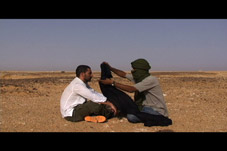
VIDEO REALIZADO EN LOS CAMPAMENTOS DE REFUGIADOS SAHARAUIS EN EL SUR OCCIDENTE DE ARGELIA, MUESTRA DOS ACCIONES PERFORMATIVAS REALIZADAS EN EL DESIERTO DEL SAHARA, LA PRIMERA ES UN RELATO DEL AUTOR EN EL QUE DESCRIBE COMO SU MADRE PROTEGIA SU VIDA ANVOLVIENDOLO EN LA BANDERA DE CHILE DURANTE EL GOLPE DE ESTADO DEL GENERAL PINOCHET, LUEGO PROCEDE A CUBRIR SUS OJOS CON LA BANDERA DE SU PAIS, LA SEGUNDA ACCION CONSISTE EN LA IMPOSICION DEL TURBANTE POR PARTE DE UNO DE LOS GUERREROS SAHARAUIS , AL AUTOR PARTICIPA DE ESTE RITUAL CONFIRMANDO SU APOYO Y LUCHA POR LA CAUSA SAHARAUI. ESTE VIDEO FORMA PARTE DE UN PROYECTO MAYOR QUE REUNE VARIAS ACCIONES Y VIDEOS INCLUYENDO UN LARGO METRAJE QUE SE ENCUENTRA EN ETAPA DE EDICI´ON Y QUE SE CONCLUIR´A EN EL MES DE DICIEMBRE DE ESTE AÑO. ESTAS ACCIONES PROPONEN AL CUERPO COMO UN ACTOR POLITICO DENTRO DE UNA OPERACION MICRO POLITICA Y SIMBOLICA, SON ACCIONES DE RESISTENCIA Y SEÑALAMIENTO EN EL PAISAJE , VISTO ESTE COMO ESCENARIO POLITICO, INTENTAN CORROER Y ATACAR LA INJUSTICIA DE NACIONES PODEROSAS SOBRE OTRAS MENORES.
Mario Opazo Tomé, Chile 1969 Artista plástico y realizador audiovisual de origen chileno, vive y trabaja en Bogotá, es profesor de la Universidad Nacional de Colombia. Actualmente su obra se orienta hacia las posibles relaciones entre lo preformativo, lo audiovisual y la palabra escrita. Su ánimo interdisciplinario lo ha llevado a proponer productos estéticos ?des generados? y fluctuantes entre el contenido y el medio, entre la narrativas tradicionales y experimentales, que ubican su lugar de configuración más en la conducta creativa que en las destrezas y habilidades disciplinares, acudiendo a una posible subversión de los límites y particularidades de los lenguajes estéticos. Diseña acciones de resistencia y gestos micro políticos que develan su posición y punto de vista crítico frente al mundo contemporáneo. Ha participado en importante eventos como la 50º Bienal Internacional de Arte de Venecia, el Premio al Arte Latinoamericano en el MOLAA, California EE.UU., donde obtuvo el Primer Premio, el Reencontres Internacional de Cine y Video Experimental en el Centro Georges Pompidou en París y en el Museo Nacional Reina Sofía en Madrid entre otros, a parte de exhibir su trabajo en exposiciones individuales y colectivas dentro y fuera del país, ha sido nominado a distintas becas y premios de creación, entre ellos se destacan la Nominación a la Beca Guggenheim por Paulo Bruscky en el año 2000 y al Premio Luis Caballero en el 2008. Se destaca su exhibición individual ?Territorio Fugitivo?, inaugurada en marzo del 2008 en Santiago de Chile. Entre otros premios importantes, ha recibido el Primer Premio en el 36º Salón Nacional de Artistas en Colombia, El Primer Premio en el salón de Arte Joven, en el Salón de Arte Bidimensional, en el Salón Kent Explora de la British American Topbaco e innumerables menciones y reconocimientos a su trabajo.. En este Momento la Curadora y académica Natalia Gutiérrez adelanta la escritura del libro dedicado a su trabajo, titulado, ?Mario Opazo, Boomerang? Algunas de sus últimas obras se concentran en exploraciones audiovisuales, desde el video arte hasta producciones más cercanas a lo documental y la ficción, cuenta con una videografía que se destaca por su tono poético y político, poniendo de relieve las solitarias pulsiones del hombre actual y el estado de desamparo del mundo contemporáneo.
Catalogue : 2008Olvido de area | Experimental video | dv | color | 8:0 | Colombia | 2006
Mario Elias Opazo Cartes
Olvido de area
Experimental video | dv | color | 8:0 | Colombia | 2006
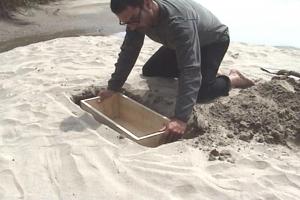
Video action based in the gesture of burry, and takes out again a crate, during the process; the crate is filling in the inner with sand and on it, is writing the world OLVIDO. The action was motivated after to go to a town carnival, where the childrens wear a die angels costume and they loaded on their shoulders boxes similar to a coffin. During the ?holiday? precession, the childrens paraded in the town streets in obedient attitude, in slow step, with black clothes and with the white face (they spread in their faces plane flour), with they, the mothers cried in choir.
Chilean visual artist and audiovisual producer, who lives in Colombia. Universidad Nacional de Colombia Teacher He had participated in more than 100 exhibitions in Colombia and other countries, his work is emphasized since 1991. Recognitions like: Frist prize in the XXXVI Salón Nacional de Artistas in 1996, Nominated to the Guggenheim Grant by the conceptual brasilean artist Paulo Bruscky in 1999. He had representated to Colombia in the 52ª Internacional Art Biennial of Venice, Italy 2007 with his proyect "Fugitive Territory". And this year he won the first prize to the latin american art MOLAA in USA.
Catalogue : 2008Triptico del odio | Experimental film | dv | color | 8:0 | Colombia | 2007
Mario Elias Opazo Cartes
Triptico del odio
Experimental film | dv | color | 8:0 | Colombia | 2007
?Light, Time and space exercises. A way to evacuate narratives to investigate in the pure structures of the image, the edition instrument as only apparatus, like space that betrays the system operator as an actor of the image, the edition process in relation to the preformative and the apropiation gesture, investigating in the relations etween cine and video "
Chilean visual artist and audiovisual producer, who lives in Colombia. Universidad Nacional de Colombia Teacher He had participated in more than 100 exhibitions in Colombia and other countries, his work is emphasized since 1991. Recognitions like: Frist prize in the XXXVI Salón Nacional de Artistas in 1996, Nominated to the Guggenheim Grant by the conceptual brasilean artist Paulo Bruscky in 1999. He had representated to Colombia in the 52ª Internacional Art Biennial of Venice, Italy 2007 with his proyect "Fugitive Territory". And this year he won the first prize to the latin american art MOLAA in USA.
Els Opsomer
Giorgio Orbi
Catalogue : 2019INTHEMOUNTAINS | Documentary | 4k | color | 26:26 | Italy | 2018
Giorgio Orbi
INTHEMOUNTAINS
Documentary | 4k | color | 26:26 | Italy | 2018
“Mountains look so beautiful that once you start looking at them you can’t stop. A glance lasts only a moment but it takes part of a whole metamorphosis” INTHEMOUNTAINS ponders over the role of the artist and the evolutionary dialogue with the mountain and its landscape; an essential role that welcomes the transformations of the contemporary mountain through the collective memory of underground dance music. Monte Pelmo is the starting point of the artist's journey of research. It was climbed by the first President of the London Alpine Club John Ball and witnessed the birth of alpinism in the Dolomites. The structure of the documentary has been progressively built through the vocal contributions of an on-air radio program over one year of broadcast on Radio Cortina, where Orbi invited guests in conversations about the landscape. Among many and different radio contributors, an artist Luigi Ontani, an astrologer Marco Pesatori, an editor Valerio Mannucci, an alpinist Pietro dal Prà and an architect Antonio de Rossi were selected by Orbi to feature as main characters in the documentary. The title of the project comes from “What the Thunder Said” the fifth section of The Waste Land by T. S. Eliot.
Giorgio Orbi (1977) is an Italian artist born in Rome. Before beginning to regularly exhibit his work in art spaces, he took part in the Italian underground music and art creative scene of the nineties. He is a writer, musician, filmmaker, photographer, visual artist and alpinist. In his work, Orbi has often related, through different media, with the concept of the mountain as both a natural and cultural “presence”.
Juan Pablo Orduñez Mawatres
Catalogue : 2016SANT ROMÁ DE SAU | Video | hdv | color | 3:50 | Spain | 2014
Juan Pablo OrduÑez Mawatres
SANT ROMÁ DE SAU
Video | hdv | color | 3:50 | Spain | 2014
Marika Orenius
Catalogue : 2007Polkuja | Video installation | dv | color | 7:17 | Finland, Sweden | 2005
Marika Orenius
Polkuja
Video installation | dv | color | 7:17 | Finland, Sweden | 2005
"Paths" is about societal, mental and psychological structures that control life. It emphasizes the unconscious and dreams as counterweights to the parameters of society through spaces without organized supervision like home, nature, or sleep.
Marika Orenius studied at the Academy of Fine Arts of Helsinki and Gothenburg, and at ENSBA, Paris. Orenius works with film, video, photos, performances, and new media.
John Orentlicher
Catalogue : 2007Sendas Huasteca | Experimental doc. | dv | color | 28:30 | USA, Mexico | 2006
John Orentlicher
Sendas Huasteca
Experimental doc. | dv | color | 28:30 | USA, Mexico | 2006
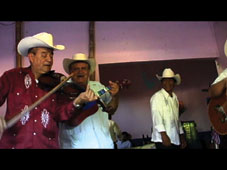
"Sendas Huastecas: Huapangos" was taped in various villages and towns in the Sierra Madre mountains west of Tampico on the Gulf of Mexico. Primarily an agrarian culture, the Huasteca region has produced this music in some form or other for centuries as dance music. Unique to the music is the rhythm created for dancing on a wood platform. Today the music survives as a way for the field hands to live in more urban areas with wages that are unattainable in manual labour. There are many comparisons with root music north of the border in the southeastern regions of the U.S. with the Huasteca region, but also very distinct differences. The tape was structured to allow for personal stories of the musicians with stylistic expression evident in performances. This project was self-financed by the author with technical support from Syracuse University?s Transmedia Department, College of Visual and Performing Arts.
John Orentlicher was born in Roanoke, Virginia, in 1943. He grew up in the Washington, DC area. In 1964, he joined the Peace Corps and spent two years in Chile. Orentlicher received a Bachelor of Arts from Goddard College and a Master of Fine Arts from the Art Institute of Chicago. In the late sixties and early seventies, he began to work in video. His range of work has developed around critical reflections on the interrelationships between technologies and culture. His experimental and documentary videos have dealt with medical, visual, and communication technologies as well as those of commodity exchange, and sexuality and pleasure. In 1991, Orentlicher began a series of tapes about Chile that explore the development of modern transportation and communication systems in its rural areas, the relation of landscape to history, personal histories, and Chile?s political transformations. The most recent work has dealt with the music of the Huasteca region in the mountains of Mexico. John Orentlicher?s work has been screened throughout North and South America as well as Europe and Japan. He has twice been a Fulbright Scholar, and has been awarded grants from the National Endowment for the Arts and the New York State Council for the Arts. He has served as juror for the Bienal of International Electronic Arts, Santiago, Chile, and the Biannual International Video Festival, Museo de Arte Moderno, Medellin, Colombia. Orentlicher is currently Chair and Professor of the Department of Transmedia, College of Visual and Performing Arts, Syracuse University, New York. His work is distributed through V Tape (Toronto), Montevideo (Amsterdam), London Video Arts (England), The Kitchen (New York), and The National Gallery, (Ottawa).
Sasa Oreskovic
Catalogue : 2014Dekompresija2013 | Documentary | hdv | color | 24:0 | Croatia | 2013
Sasa Oreskovic
Dekompresija2013
Documentary | hdv | color | 24:0 | Croatia | 2013
?Who do you love more, your mother or your wife?? ; ?Where is my money??- Four dalmatians philosophyze about risk, trust, family and life. 300 years ago a Greek priest came to a Croatian island and showed the population how to harvest the Sea for sponges. Our protagonists belong to the families who are still diving.
Born in 1974 in Zagreb, Croatia. Studied Media Art & Photography at University of Illinois in Chicago and directing at the German Film & TV Academy in Berlin, dffb. Works as filmmaker and tennis teacher.
Matthieu Orlean
Catalogue : 2013RESIDENCE DES LIMITES | Video | dv | color | 22:0 | France | 2011
Matthieu Orlean
RESIDENCE DES LIMITES
Video | dv | color | 22:0 | France | 2011
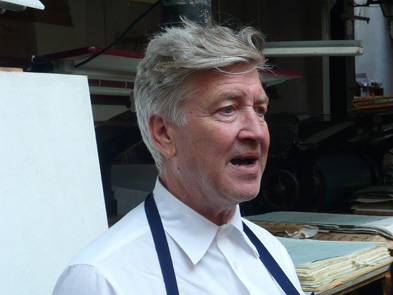
Résidence des limites est un film fait à partir de photographies numériques prises depuis 2005 à travers le monde, et en particulier à travers le cinéma, pour le cinéma, autour du cinéma. Les photographies sont spontanées, jamais mises en scène, mais leur agencement, leur montage dessine un nouvel axe de lecture, une infra-fiction, les signes d?un récit intime et exporté, exposé au regard de celui qui le découvre. C?est aussi un film sur le temps qui passe, les visages qui se métamorphosent, les coïncidences qui existent et qui se manifestent au bord du cadre. Et que la bande son rend visible. Une musique patchwork qui jaillit du début à la fin, sans discontinu, mix du cinéma tel qu?il existe (des symphonies cinétiques) et du cinéma en train de se faire (des ébauches sonores venues d?horizons différents, à peine sortis du Nagra, sans traitement). Résidence des limites est un peu la rencontre du cinéma des mythes et du cinéma en train de se faire. Matthieu Orléan Septembre 2012
Matthieu Orléan est collaborateur artistique à La Cinémathèque française, chargé des expositions temporaires depuis 2003. Il a été le commissaire des expositions ¡ Almodóvar Exhibition ! (2006) et Dennis Hopper et le Nouvel Hollywood (2008). Il a également co-dirigé les ouvrages Renoir/Renoir, ¡ Almodóvar Exhibition !, L?Image d?après (Prix du plus beau catalogue 2007) et Dennis Hopper et le Nouvel Hollywood. Il écrit depuis 1998 sur le cinéma et les arts plastiques pour la presse (Cahiers du Cinéma, Trafic, Vertigo, Synopsis, Purple, Numéro) et pour différents ouvrages (Chantal Akerman, Autoportrait en cinéaste et Raymond Hains, J?ai la mémoire qui planche aux éditions du Centre Pompidou ; Trésors Publics, 20 ans de création dans les Fonds régionaux d?art contemporain aux éditions Flammarion). En 2011, sort aux Editions de l??il son ouvrage consacré au cinéaste Paul Vecchiali, La Maison cinéma. En 2007, il a co-réalisé avec Christian Merlhiot Des Indes à la Planète Mars, présenté en Compétition officielle au FID et sorti en salles à Paris en avril 2008. Il a écrit les scénarios des deux derniers films de Philippe Terrier-Hermann : en 2009, La Dérive (sorti en salles à Paris), et en 2012 La Tétralogie américaine (présenté au festival Hors pistes).
Uriel Orlow
Catalogue : 2026Forest Futures | Experimental film | 4k | color | 28:0 | Switzerland, Italy | 2024
Uriel Orlow
Forest Futures
Experimental film | 4k | color | 28:0 | Switzerland, Italy | 2024
Forest Futures is a poetic and thought-provoking film that visits ancient forest ecosystems from the earth’s past, imagines future forests in the face of changing climate and shows the forest as a multi- species school, where children practice more-than-human co-existence. Forest Futures explores the forest as a site of deep time, ecological transformation, and interspecies learning. Set in the mountainous region of South Tyrol, the film traces a journey from ancient fossilized forests that thrived over 280 million years ago through to speculative visions of future forests in a rapidly warming world. Combining scientific research with imaginative storytelling, the film reimagine the forest as both a teacher and a protagonist.
Uriel Orlow is a Swiss-born artist who lives and works between Lisbon, London and Zurich. In 2023 he was the recipient of the prestigious Prix Meret Oppenheim/ Swiss Grand Prix of Art. Orlow’s work is presented widely in international survey shows including at Dunkerque Triennale, Kochi Biennale, 12th Berlin Biennale for Contemporary Art, Kathmandu Triennale, Manifesta 12, Palermo, 2nd Yinchuan Biennial, 13th Sharjah Biennial, 7th Moscow Biennial , EVA International, Limerick, 2nd Aichi Triennale, Nagoya , Bergen Assembly, Manifesta 9, 54th Venice Biennale and elsewhere. Recent solo exhibitions include Galeria Avenida da Índia, Lisbon (2025); MCBA, Lausanne (2024); Casa da Cerca, Alamada (2022); Kunsthalle Nairs, Scuol (2021); La Loge, Brussels (2020); Kunsthalle Mainz, Germany (2020); Privas Art Centre, France (2019); Les Laboratoires d’Aubervilliers, Paris (2018); Market Photo Workshop & Pool, Johannesburg (2018); Kunsthalle St Gallen (2018) and many others. Orlow’s films been screened at Tate Modern, London; the International Short Film Festival, Oberhausen; Tank.tv; Whitechapel Gallery, London; Locarno Film Festival; Videonale Kunstmuseum Bonn; BFI London; The BBC Big Screen, Manchester; Arnolfini Bristol; Espace Croisé CAC Roubaix; and at the Biennale of the Moving Image, Geneva, and others.
Carlos Ormeño Palma
Catalogue : 2023La distancia del Tiempo | Experimental fiction | mov | color and b&w | 19:27 | Peru | 2021
Carlos OrmeÑo Palma
La distancia del Tiempo
Experimental fiction | mov | color and b&w | 19:27 | Peru | 2021
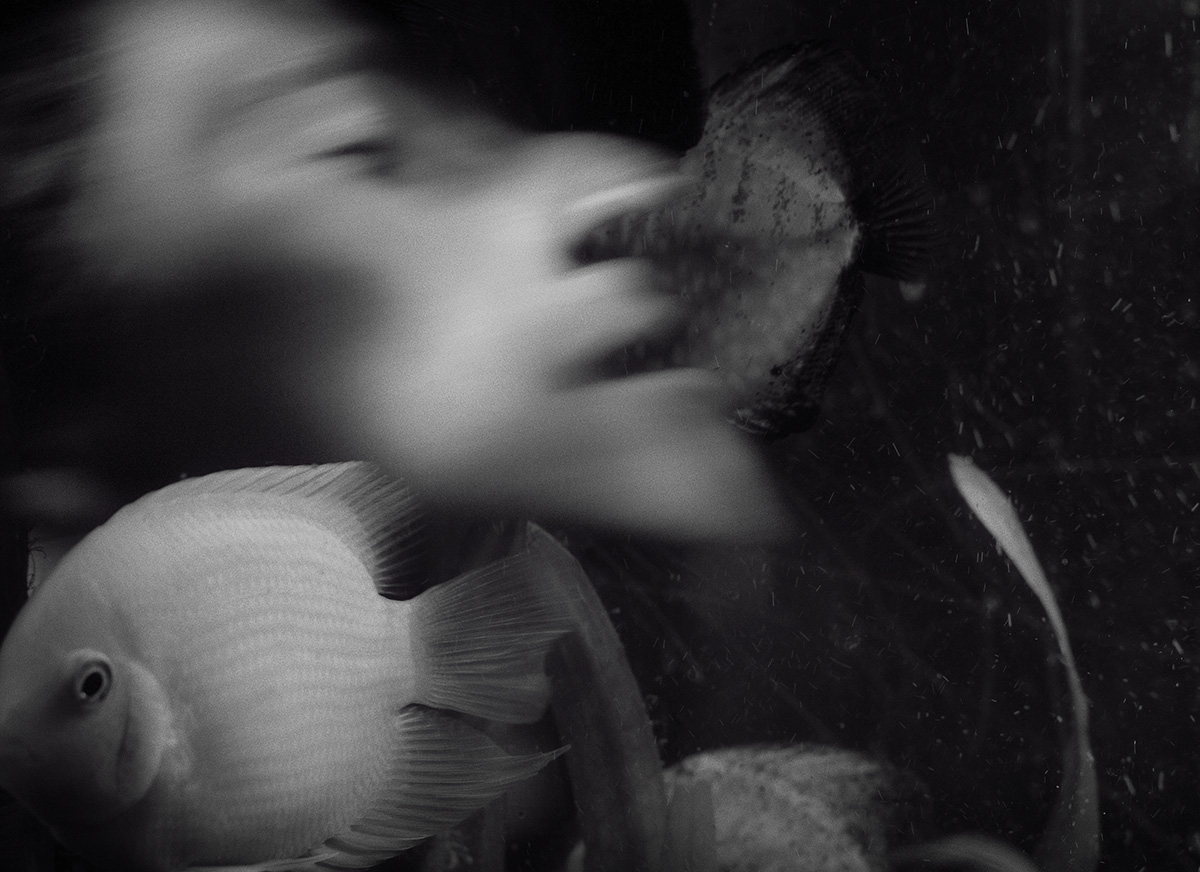
In a Peruvian city corroded by an eternal and indifferent winter, an androgynous man faces a future without his lover, who suffers from an unknown disease.
Peruvian filmmaker and alumnus of La Fémis - Université d'été, Berlinale Talents, Oberhausen Seminar, and Talents Buenos Aires. His passion as a filmmaker arose from the memories of his family, his identity as a member of the LGBTIQ+ community, and social justice. Since making films, Carlos has developed an interest in recreating different worlds within absence and faith. He’s currently developing his first hybrid feature film, The Scent of Walls (Moulin d’Andé Residency 2024). In 2023, he won the Mastercard Enablement Program Fellowship for the project TranStories at the 73° Berlin Film Festival. This project is a one-of-a-kind creative documentary lab for the trans community in Peru. ? His recent fiction short film, “The Distance of Time,” has been selected in over 20 film festivals, including Locarno, Oberhausen, and Raindance. His second fiction short, The Weight of Air (Greek Film Center Award), won the Peruvian National Fund and is currently in post-production. In 2019, he published “The borders of transsexuality in Latin American cinema,” an article about the representation of trans women in six Latin American films. For seven consecutive years, Carlos worked collaboratively in the production field of Song Without a Name by Melina León (51° Quinzaine des Réalisateurs).
Ed Osborn
Catalogue : 2008Wandering Eye Studies | Experimental video | dv | color and b&w | 5:0 | USA | 2006
Ed Osborn
Wandering Eye Studies
Experimental video | dv | color and b&w | 5:0 | USA | 2006
The Wandering Eye Studies is a series of video and sound pieces generated as part of the development for an interactive video installation entitled Wandering Eye. The installation produces images and sounds from video input gathered by an array of surveillance cameras and explores the visual language of electronic observation. The Studies explores some of the visual transformations brought about by focusing on particular aspects of the video imagery: motion is highlighted or isolated, edges of objects are detected and enhanced, and changes in luminance are used to generate the soundtrack. Though I share many of the typical concerns of the culture of surveillance, my interest here is in showing the lure of the image itself. While being in front of the lens is disquieting, the view from behind it is seductive. The oscillation of experience between the two is one of the most compelling aspects of surveillance imagery in the mediascape, one that draws the eye as it unsettles the mind.
Ed Osborn is a sound and media artist who has exhibited and performed worldwide. His artworks take many forms including installation, sculpture, radio, video, performance, and public projects. They demonstrate a visceral sense of space, aurality, and motion combined with a precise economy of materials. Ranging from rumbling fans and sounding train sets to squirming music boxes and delicate feedback networks, Osborn?s kinetic and audible pieces function as resonating systems that are by turns playful and oblique, engaging and enigmatic. Osborn has performed and exhibited at ZKM (Karlsruhe, Germany), the singuhr-hörgalerie (Berlin, Germany), the Berkeley Art Museum (Berkeley, CA), Yerba Buena Center for the Arts (San Francisco), Artspace (Sydney, Australia), Sonambiente Festival (Berlin, Germany), the Museum of Applied Arts, (Helsinki, Finland), Galerie DARE-DARE (Montréal, Quebec), LACE (Los Angeles, CA), MassMOCA (North Adams, MA), the Institute of Modern Art (Brisbane, Australia), the Auckland Art Gallery (Auckland, NZ), and the Sonic Arts Research Centre (Belfast, Northern Ireland). He has received grants and residencies from the Guggenheim Foundation, the Creative Work Fund, Arts International, and the DAAD Artists-in-Berlin Program. He is represented by the Catharine Clark Gallery in San Francisco and Galerie Haferkamp in Cologne. He is Assistant Professor of Media Art at the University of California at Santa Cruz and will join the faculty of the Visual Art Department of Brown University in 2008.
Sabrina Osborne
Catalogue : 2016Anmol Ghari | Video | hdv | black and white | 5:25 | India, United Kingdom | 2014
Sabrina Osborne
Anmol Ghari
Video | hdv | black and white | 5:25 | India, United Kingdom | 2014
This video was created in response to Joanne Wardrop’s curatorial project “Matrimonial rituals, gender studies and false facial hair”, an imaginative attempt to understand rituals, objects and customs found in the Pitt Rivers Museum’s Collection. In the video the artist re enacts a song from the Bollywood director Mehboob Khan’s movie “Anmol Gahri” released in 1946, just before India gained freedom from British rule in 1947. The film was a musical hit and is still remembered for its music by Naushaad and became the highest grossing film at the Indian Box Office in 1946. By re enacting the song the artist questions the status of women in 21st Century Indian patriarchal society, when India is on the brink of becoming one of the world economic powerhouses in the coming years. Although the translation of the song reads primarily as a sad romantic song but its connotations of a woman surrendering to a male dominated society can not be sidelined, especially as she is conditioned to take a man as the savior of her destiny and strongly believes in her annihilation without his protection. The superimposed artificial paper beard adds to this conundrum of identity. The project of which this video is a part was inspired by an artificial beard collected by Antoinette and Diana Powell-Cotton in Angola in the 1930s that is currently on display in the University of Oxford`s Pitt Rivers Museum. Such beards were worn by young Kwanyama girls as part of their marriage ceremonies, which the Powell-Cotton sisters filmed in the early 20th century.
Sabrina Osborne lives and works in London & New Delhi. She has her MA from Goldsmith London University. She has produced an extensive body of work – combining photography, installation and video. In her work she deals with the subjects of displacement, loss and identity. The theme underlying the work is trauma and how this is experienced through melancholia, solitude and alienation. Her projects have been exhibited widely including London Tate Britain, National Gallery Bangkok, Museum of Contemporary Art : Sofia, Belgrade Art Fair, Mine Gallery Istanbul, Espacio Enter: Tenerife Spain, Tenderfelix -Tenderpixle Gallery: London, Galerie Muller and Plate: Munich, Id Art Fest: International Dynamic Contemporary Art Museum : Macerata Italy, OED Gallery: Cochin India and Pitt Rivers Museum Oxford. In 2012, her video was short listed for Celeste Prize and at Culture Cloud at New Art Exchange Nottingham.
Catalogue : 2014Bird | Experimental video | dv | color | 5:25 | India, United Kingdom | 2012
Sabrina Osborne
Bird
Experimental video | dv | color | 5:25 | India, United Kingdom | 2012
In this particular work "Bird", I have negotiated with images of the journey towards the unknown and obscure destination. The image is put together with the sound of an echoing traditional Indian wedding Vidai songs sung at farewell ceremony to the bride by her family. Daughters are referred as birds in these traditional songs as they migrate to faraway unknown lands. The work also has subtly undertones of pathos brought in by issue around forced marriage and honor killings in South Asian patriarchal communities. My self-referential works are tinted with concerns of identity and memory with undercurrents of anxiety, fear, loss and belonging.
I was born in 1971 in a small northern Indian city called Aligarh .I moved to Delhi in 1990 to go to art school of Delhi University and did my BA & MA. I won international scholarship and lived in Mexico in 2000.Meanwhile, my works were shown in several national and international solo and group exhibitions. In 2007, I came to London to do my MA Art Practice. Since graduating from Goldsmiths, London University in September 2009, my works have been exhibited at London Tate Britain, National Gallery Bangkok, Museum of Contemporary Art : Sofia, Belgrade Art Fair, Espacio Enter: Tenerife Spain, Tenderpixle Gallery: London, Galerie Muller and Plate: Munich, Id Art Fest: International Dynamic Contemporary Art Museum : Macerata Italy, OED Gallery: Cochin India and Pitt Rivers Museum Oxford. As part of ?Time is Love- 6? video screenings my video work traveled to Tehran, New York and Norway. In 2012, my video was short listed for Celeste Prize and Culture Cloud at New Art Exchange Nottingham. I curated and organized six video screenings in India and Spain. I have been writing art exhibition reviews for established art magazines in India.
Yana Osman, Anton Khamchishkin
Catalogue : 2025Shared Univers | Video | hdv | color | 15:0 | Afghanistan, Russia | 2024

Yana Osman, Anton Khamchishkin
Shared Univers
Video | hdv | color | 15:0 | Afghanistan, Russia | 2024
This is a poetic contemplation on the state of the world, as well as a reflection of the times in the authors' homeland, when under the influence of censorship they are forced to seek an alternative language to discuss significant issues. In this work, diverse realms intertwine: the game setting, ancient Greek tragedy, social utopia, and our contemporary era. It is a shared universe, enriched by the voices of many authors.
Yana Osman, Anton Khamchishkin (Afghanistan, Russia) Filmmakers and audiovisual artists. Their artistic practice, including video, photography, sound, performance, and poetry, delves into how personal, social, and political documentary contexts become anentry point to the fantasy worlds we live. Their works have been exhibited at festivals, museums, and contemporary art spaces in Armenia, China, Finland, Germany, Hong Kong, India, Ireland, Italy, Kazakhstan, the Netherlands, Russia, Turkey, and even Antarctica, as well as in France, supported and showcased by CNC, Cité Internationale des Arts – Paris, Usage du Monde au 21ème siècle, Maison Européenne de la Photographie – Paris, Institut Français, Théâtre Nouvelle Génération (TNG) – Lyon, among other.
Yana Osman, Anton Khamchishkin
Catalogue : 2023Swallowtails | Experimental doc. | digital | color | 17:0 | Russia | 2022

Yana Osman, Anton Khamchishkin
Swallowtails
Experimental doc. | digital | color | 17:0 | Russia | 2022
SWALLOWTAILS 2022, experimental documentary, 17 min Authors: Yana Osman, Anton Khamchishkin Swallowtails in science fiction is the division of time into several streams, each of which has its own actions. In parallel time-space, the characters have different lives.
YANA OSMAN Filmmaker, audiovisual artist. Born into a multiethnic family: father - from Afghanistan, mother was from Ukraine. Spent her childhood between Afghanistan, Russia, Ukraine, and after remained to live in Russia. Participated in international film labs, markets and pitches: DOK Co-Pro Market of DOK Leipzig (Germany), Rendez-vous Industry of Festival de Cannes (France), East West Talent Lab of GoEast (Germany); B2B Doc (Sweden), IDFF Artdocfest (Latvia), Clermont-Ferrand Short Film Market (France), Chimeres (France) etc. Winner of a grant for mentoring support from the Documentary Association of Europe (2021). Audiovisual works and documentary films were presented at festivals and exhibitions in USA, Germany, Argentina, Ukraine, Netherlands, Turkey, France, Finland, India, China, Hong Kong, Russia etc. The last short film - Swallowtails (2022) - was selected to the Official Competitions of DOK Leipzig 2022, Hong Kong International Film Festival 2023, Movies That Matter 2023, Tampere Film Festival 2023, where was nominated for European Film Award, and took part in Short Film Corner of the Festival de Cannes and Clermont-Ferrand Short film Market. Another short film - Triptych (2022) - got Grand-prix of the International Film Festival «Spirit of Fire». Author of documentary podcasts and documentary musical novels. ANTON KHAMCHISHKIN Filmmaker, audiovisual artist. Participated in international film labs, markets and pitches: Rendez-vous Industry of Festival de Cannes (France), East West Talent Lab of GoEast (Germany); IDFF Artdocfest (Latvia), Clermont-Ferrand Short Film Market (France). Audiovisual works and documentary films were presented at festivals and exhibitions in USA, Germany, Argentina, Ukraine, Netherlands, Turkey, France, Finland, India, China, Hong Kong, Russia etc. The last short film - Swallowtails (2022) - was selected to the Official Competitions of DOK Leipzig 2022, Hong Kong International Film Festival 2023, Movies That Matter 2023, Tampere Film Festival 2023, where was nominated for European Film Award, and took part in Short Film Corner of the Festival de Cannes and Clermont-Ferrand Short film Market. Another short film - Triptych (2022) - got Grand-prix of the International Film Festival «Spirit of Fire». Author of experimental documentaries, documentary podcast "Now they will say" and series of documentary musical projects “There is no water in the Moon sea”, “res communis omnium”.
Yana Osman, Anton Khamchishkin
Catalogue : 2026Pwéra úsog | Experimental doc. | mov | color and b&w | 19:50 | Afghanistan, Russia | 2025
Yana Osman, Anton Khamchishkin
Pwéra úsog
Experimental doc. | mov | color and b&w | 19:50 | Afghanistan, Russia | 2025
Pwe?ra u?sog (2025). 19 min dir. Yana Osman, Anton Khamchishkin In 1945, in Paris, the Women’s International Democratic Federation (WIDF) was founded. According to historian Francisca de Haan, it was “the largest and probably the most influential international women’s organization of the post–World War II era.” Today, assessments of the organization’s legacy remain contested. Some scholars, citing reports from the FBI and the House Un-American Activities Committee, describe WIDF as a communist attempt to manipulate women. Others view it as a movement advocating for women’s rights, and researchers like Elizabeth Armstrong note WIDF’s role in anti-colonial and anti-racist struggles led by women in Asia, Africa, and Latin America. In 1987, during the Perestroika era, WIDF organized the World Congress of Women in Moscow, under the slogan: “Toward 2000 — Without Nuclear Weapons! For Peace, Equality, Development!” The congress brought together 2,800 women from 150 countries. Among them, there was the protagonist’s grandmother, an interpreter who collected words from global conversations that had no equivalents in other languages. Revisiting her notes, archival footage, and sites of official delegations, the protagonist is guided by these fragments to a question: what words can capture the present, when language itself slips away, dissolves, and borrowed slogans drown out one’s voice?
Yana Osman, Anton Khamchishkin (Afghanistan, Russia) — artists and filmmakers. Work with gaps in storytelling, filling in the unsaid and uncovering narratives suspended between real and imaginary, facts and speculation. Their films were selected at Hong Kong Film Festival, DOK Leipzig, Slamdance, Rencontres Internationales Paris/Berlin, as well as supported by CNC, Cité Internationale des Arts, Usage du Monde au 21ème siècle, Institut Français, among others.