Catalogue > List by artist
Browse the entire list of Rencontre Internationales artists since 2004. Use the alphabetical filter to refine your search. update in progress
John Thomson
Catalogue : 2007Electronic Art Intermix | 0 | 0 | | 0:0 | USA | 2007

John Thomson
Electronic Art Intermix
0 | 0 | | 0:0 | USA | 2007
Electronic Arts Intermix (EAI) is one of the most important world centres of resources and research on video art and new medias. Founded in 1971 by the New York gallery owner Howard Wise, whose eponymous gallery on 57th was the epicentre of cinema art and multimedia works at the time, the EAI's objective was to assert the role of video as a medium of artistic communication and expression. in its 36 years of existence, the EAI has concentrated on the distribution and preservation of its phenomenal collection of works. A collection groups together historic works by the pioneers of video as well as the works of emerging contemporary artists. A collection, a genuine storage of video and new arts, which is partly available and consultable on-line. But if the EAI supports artists by notably putting digital and analogical tools of editing at their disposition, and if the EAI distributes and preserves its catalogue, the organization is still before anything else a cultural body supporting promotion of new arts and their popularization. It offers a visionary room to the public, where the catalogue can be consulted in its entirety. It also organizes exhibitions and public programs.
John Thomson has been the Director of Distribution at the Electronic Arts Intermix (EAI) since 2000. He is also co-director and founder of Foxy Production, an important New York contemporary art gallery. Since the 1980s he has been internationally active in new arts. Before moving to New York in 2000, he carried out research on the digitalization and distribution of multimedia arts at the Lux Centre in London. In 1998 he was the co-ordinator of the Pandemonium Festival in London and, in 1997, he co-prepared the premiere exhibition of the Lux Centre's 'Image in Mouvement'. He has also organized new arts programs and exhibitions for the Pacific Film Archive of Berkeley in California; the Staatsgalerie of Stuttgart, the Tate Britain in London; the London Institute of Contemporary Art; Exit Art in New York; and Smack Mellon in Brooklyn. He has given conferences on new arts at the London Institute and at the School of Visual Arts in New York, and has written for magazines - Mesh, Melbourne, and Art in Culture, Seoul - and for the preservation of new arts: Art Between Zero and One: A Manual of Digital Art, Basel.
Jon Thomson, Craighead, Alison
Catalogue : 2012A short film about war | Video installation | hdcam | color | 9:39 | United Kingdom | 2010
Jon Thomson, Craighead, Alison
A short film about war
Video installation | hdcam | color | 9:39 | United Kingdom | 2010
A Short film about War is a narrative documentary artwork made entirely from information found on the worldwide web. In ten minutes this two-screen gallery installation takes viewers around the world to a variety of war zones as seen through the collective eyes of the online photo sharing community Flickr, and as witnessed by a variety of existing military and civilian bloggers. As the ostensibly documentary `film` plays itself out, a second screen logs the provenance of images, blog fragments and gps locations of each element comprising the work, so that the same information is simultaneously communicated to the viewer in two parallel formats -on one hand as a dramatised reportage and on the other hand as a text log. In offering this tautology, we are attempting to explore and highlight the way in which information changes as it is gathered, edited and then mediated through networked communications technologies or broadcast media, and how that changes and distorts meaning -especially for (the generally wealthy minority of) the world`s users of high speed broadband networks, who have become used to the treacherously persuasive panoptic view that google earth (and the worldwide web) appears to give us.
Jon Thomson (b. London) and Alison Craighead (b. Aberdeen) are fascinated how globalisation and networked global communications have been re-shaping the way we all perceive and understand the world around us. They live and work in London and Kingussie in the highlands of Scotland making artworks and installations for galleries, museums and site-specific locations that include the worldwide web. Recent exhibitions include; Kumu Art Museum, Tallinn; Berkeley Art Museum, California; Highland Institute of Contemporary Art, Scotland; Artists Space, New York; Tang Contemporary, Beijing; Moderna Museet, Stockholm; and Dundee Contemporary Arts. Jon is Reader in Fine Art at The Slade School of Fine Art, University College London, while Alison is Reader in contemporary art and visual culture at University of Westminster and lectures in fine art at Goldsmiths University, London. For information on forthcoming, current and previous work, you can follow their blogat http://thomson-craighead.blogspot.com and explore their archive website at http://www.thomson-craighead.net
Jol Thomson
Catalogue : 2019Deep Time Machine Learning | Experimental doc. | hdv | color | 5:59 | Canada, Germany | 2017
Jol Thomson
Deep Time Machine Learning
Experimental doc. | hdv | color | 5:59 | Canada, Germany | 2017
What can structuralist film techniques contribute in the age of machine vision? In the experimental film, a robot arm investigates a 200,000 year old hand axe and an 17th century mechanical calculator (the first fully functional four stage computation device), each are placed on an octagonal mirror. The robotic arm passes through interfaces of geology, archaeology, mechanics and computation and intimately explores its own coming into being as a product of human engineering. Excerpts from the latest EU Report to the Commission on Civil Law and Robotics, published in January 2017, punctuate the video, describing the need to define the subjectivity of intelligent machines, as well as their legal status and the liabilities that derive from their implementation. The critical, uncertain and undetermined state of intelligent machines’ subjecthood emerges through the eyes of a human society themselves struggling with this ecotechnical revolution, “that leaves no aspect of society untouched”. Crucially, the set is observed by an Artificial Intelligence object recognition device, or LiDAR - a form of sense which AI systems use to perceive their haptic environment. Deep Time Machine Learning was developed collaboratively with the laboratories of robotics and surface analytics at the Bosch Corporate Research and Advanced Engineering Campus and received support from the Natural History Museum, Stuttgart and the Phillip Matthäus-Hahn Museum, Kornwestheim. Jol Thomson’s experimental film elaborates a deep history of tool use from the Paleolithic era with a trajectory to the not-too distant future of algorithmic, AI governance. The explorations of this work contribute to a contemporary media ecology, a history and philosophy of technology in machine vision, and underpins the symbiotic relationship between agential forms of geology, technology, and “intelligent beings”.
Jol Thomson is an artist, sound designer, and researcher working in the interstices between critical theory, particle physics, environmental humanities, STS, and experimental music and moving image. He is currently pursuing a practice-led Phd at the University of Westminster, London. He received his meisterschüler in Fine Art from the Städelschule, Frankfurt in 2013. In 2016 he won the MERU Art*Science Award for his a/v composition G24|0v, a collaboration with the “coldest object in the observable universe”. He has participated in a number of international residencies, and in 2016-2017 he was a fellow of the Akademie Schloss Solitude, Stuttgart. Recent exhibitions include: Blind Faith: Between the Cognitive and the Visceral in Contemporary Art at the Haus Der Kunst, Munich (2018); Open Codes: Living in Digital Worlds, ZKM (Center for Art and Technology), Karlsruhe (2017-2018); and Quantum Real: Spectral Exchange at Exhibition Research Lab, Liverpool (2019).
Matthew Thorne, Derik Lynch
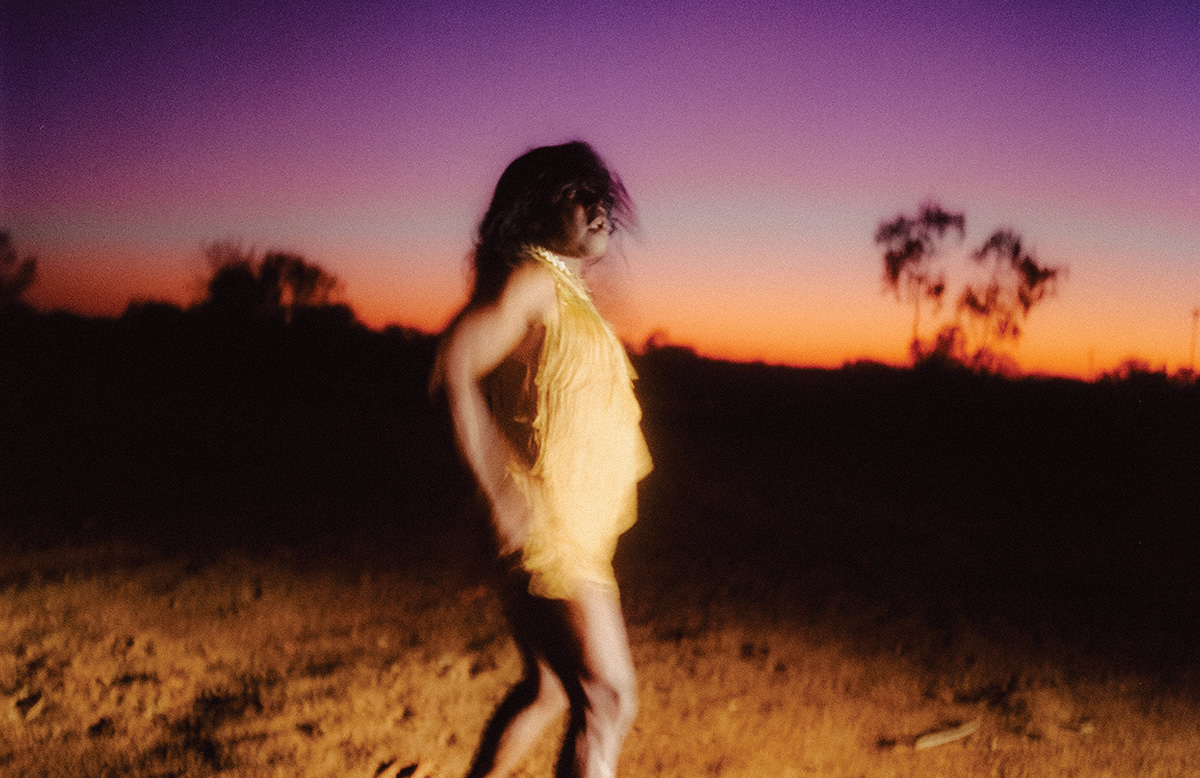
Catalogue : 2023Marungka Tjalatjunu (Dipped in Black) | Experimental doc. | 16mm | color | 24:0 | Australia | 2022
Matthew Thorne, Derik Lynch
Marungka Tjalatjunu (Dipped in Black)
Experimental doc. | 16mm | color | 24:0 | Australia | 2022
Marungka Tjalatjunu (Dipped in Black) follows Yankunytjatjara man Derik Lynch's road trip back to Country for spiritual healing, as memories from his childhood return. A journey from the oppression of white city life in Adelaide, back home to his remote Anangu Community (Aputula) to perform on sacred Inma ground. Inma is a traditional form of storytelling using the visual, verbal, and physical. It is how Anangu Tjukurpa (story connected to country / dreaming / myth / lore) have been passed down for over 60,000+ years from generation to generation.
Matthew Thorne is a South Australian filmmaker and artist whose work explores contemporary 'Australian' identity, spirituality, relationship to land, and masculinity through film, photography, and reenactment. His recent docufiction short film, Marungka Tjalatjunu (2023), made with Yankunytjatjara man Derik Lynch, won the Silver Bear Jury prize at Berlinale. Matthew also contributed photography to Nick Cave and The Badseed's album Ghosteen (2019), Justin Kurzel's True History of the Kelly Gang (2019), and Ridley Scott’s Alien: Covenant. In 2022, Matthew received the Adelaide Film Festival & Samstag Gallery of Art Commission. - Derik Lynch is an initiated Yankunytjatjara man. He is a performer, filmmaker, and artist who grew up between Alice Springs and remote Communities in the Northern Territory and South Australia. He has worked both nationally and internationally in theatre, film and TV. Marungka Tjalatjunu is Derik’s debut as a writer/director for screen telling part of his own story.
Matthew Thorne
Joshua Thorson
Catalogue : 2013Horizon | Experimental fiction | hdv | color | 13:0 | USA | 2011
Joshua Thorson
Horizon
Experimental fiction | hdv | color | 13:0 | USA | 2011
In 1982 Walt Disney World?s EPCOT Center, or, the Experimental Prototype Community of Tomorrow, opened to the public, a little late for an utopic modernist project. The original park featured an ?infotainment? ride called Horizons, which was sponsored by G.E. It showed a future in which technology and innovation coupled with the family unit would evolve into exciting and previously unimaginable territories?with colonies in outer space and under the Earth?s oceans. In 2000, the ride was demolished to make way for an immersive thrill-ride called ?Mission: Space.? The story in this video, about a family doing research on a colony in the Chamaleon Complex whose supplies and funding inexplicably stop arriving, and who are determined to survive however they can, accompany archival Hi-8 video footage of the ride.
Joshua Thorson is a video-maker and writer based in New York. He works with narrative conceptually, exploring and exploiting the narrative exchange through the themes of science, religion, transcendence, authenticity, idealism, and trauma. Using tonal shifts and stringent economy, this work seeks to both cater to and usurp expectations, opening up the ?story? to ontology. Thorson?s work has been presented at museums, galleries, and theaters internationally.
Lena Maria Thuering
Catalogue : 2010Das Haus | Video | dv | color | 11:0 | Switzerland | 2008
Lena Maria Thuering
Das Haus
Video | dv | color | 11:0 | Switzerland | 2008
?The father shoots the first wild boar, it is being decomposed and skinned in the basement and hung in the laundry. 20 cents costs a glimpse on the shot animal. The nanny has to clean the wild boar teeth and to put them in a box.? What defines memory and what exactly does it set about? In Lena Maria Thüring?s video work ?The House? half a century of family history is reflected upon a detached house?s empty walls: Slowly and continuously the camera runs through hallways, rooms, and the staircase, while a background voice narrates the past. Thüring?s interaction with time and space in the film consecutively plays with the expectations of the observer and questions the relationship between documentation and fiction. By objectification of word and vision in the formal realisation, Thüring hence confronts the viewer with his own past. Annette Amberg
Lena Maria Thüring is born 1981 in Arlersheim, BL, Switzerland her native place is Basel, BS, Switzerland. She lives and works in Zürich, Switzerland. 2002 Artistic preparatory course at the School of Art Zurich, Zurich 2002?2007 Photography at the School of Art Zurich, Zurich since 2005 partial artistic cooperation with Annette Amberg.
Georg Tiller, Ranaïvojaona Maéva
Catalogue : 2021Zaho Zay | Experimental fiction | 4k | color | 98:0 | Austria | 2020
Georg Tiller, Ranaïvojaona Maéva
Zaho Zay
Experimental fiction | 4k | color | 98:0 | Austria | 2020
A young woman works as a guard in a hopelessly overcrowded prison in Madagascar. She passes the time daydreaming about her father, a murderer who abandoned her as a child after killing his own brother. In her imagination, her father becomes a mythical killer, wandering the countryside and rolling enchanted dice to decide the fate of his victims. Secretly, she yearns for the day he might turn up amongst the prisoners. When a new inmate arrives claiming to know her father, the young woman’s fantasies begin to turn to nightmares.
Maéva Ranaïvojaona is a French filmmaker with Malagasy origins. She graduated from the National Fine Art Academy of Dijon and Bourges, France. After couple of years working as an artist’s assistant ( among them Ernesto Neto?—?Brazil, and Kristina Solomoukha?—?France ), she worked as a first director’s assistant beside young filmmakers in Paris and Berlin. She wrote, produced and directed two short films, that have been shown and awarded at several international film festivals among them the International Film Festival Rotterdam and Cannes Film Festival. Since 2017 Maéva Ranaïvojaona works as a screenwriter, filmmaker and producer at Subobscura Films company. She currently lives and works in Paris and Vienna. After unfinished studies in philosophy and theater, Georg Tiller studied film and television with Harun Farocki at the Academy of Fine Arts Vienna, film directing and cinematography with Michael Haneke and Christian Berger at the Film Academy Vienna, and film directing at the German Film and Television Academy Berlin (dffb). He has worked as a freelance artist and filmmaker, a producer of his own work and that of friends, and with the artist collective naivsuper. He worked as a Senior Partner at the production company Mengamuk Films in Germany, and he is currently Managing Director of Subobscura Films in Vienna, Austria and Paris, France. His films have been shown and awarded at world-renowned festivals including the Berlinale, the IFF Rotterdam, and the Viennale Film Festival. He has also exhibited work at the Bienal de Såo Paulo, the Centre Georges Pompidou, and the Luleå Vinter Bienal, among many other places.
Catalogue : 2016White Coal | Experimental doc. | 16mm | color and b&w | 70:0 | Austria | 2015
Georg Tiller
White Coal
Experimental doc. | 16mm | color and b&w | 70:0 | Austria | 2015
A mound of coal, black dust dissipating into the air, a stone statue of a worker: These are the opening images of White Coal. Loosely inspired by Hermann Melville`s "The Confidence Man", the story of a blind passenger aboard a Mississippi steamboat, the first thread of White Coal follows the journey of a Polish coal transport ship and a male figure dressed as in silent movies of the proletarian heyday. Always seeming to appear as if someone had called for him, this man wanders around a disintegrating industrial town aimlessly. We see dogs barking, and the sounds of heavy industry linger in the air. He enters a ship furtively, apparently unaware that it is a coal ship set to travel on down a narrow river. It is as if the boat had the entire crew under a spell cast by its slow but steady motion. Only minimal movements are possible on board this ship, and the "blind passenger" becomes the spectator of this self-contained routine. The film`s second thread portrays the physical structures and environment in which coal is exploited at the world`s largest coal-burning power plant, located in Taychung, Taiwan. Here color enters the film, yet it feels like the present is falling behind the past, industrial landscapes, truck transports, giant chimneys burning coal, monitoring stations following their own beat. Computers out of order and people scooting around in chairs. The drone of the Polish coal ship is mirrored by the crushing din of industry, then cancelled out by an aseptic control room vacuum that swallows whatever might otherwise be a human gesture. This is Melville`s steamboat, chugging slowly and unstoppably down a river with no end, where human beings have no voice with which to speak and exist encapsulated in their own imagined present tense. Although the film uses the material as the primary source of its investigation, White Coal is less a film about coal than an exploration of industrial film motifs from the 1920s to the present.
After unfinished philosophy and theater studies, he studied film studies first with Harun Farocki at the Academy of Fine Arts Vienna, then film directing and cinematography with Michael Haneke and Christian Berger at the Film Academy Vienna and later film directing at the German Film and Television Academy Berlin (dffb). Since early on he has been working as a freelance artist and filmmaker later also as a producer of his own and his friends work, initially with the artist collective naivsuper. His films have been shown at numerous film festivals around the world and he has exhibited his work at the Bienal de Såo Paulo, the Centre Georges Pompidou and the Luleå Vinter Bienal among many other places. He is one of the co-founders of the production company Mengamuk Films and managing director of Subobscura Films. Georg currently lives in Vienna and Berlin.
Georg Tiller
Catalogue : 2012Vargtimmen - Nach einer Szene von Igman Bergman | Experimental film | 16mm | black and white | 6:20 | Austria | 2010
Georg Tiller
Vargtimmen - Nach einer Szene von Igman Bergman
Experimental film | 16mm | black and white | 6:20 | Austria | 2010
Vargtimmen?After a Scene by Ingmar Bergman is the exact reconstruction of a scene in Bergman?s 1968 film of the same name. Frame for frame, Georg Tiller and his cameraman Claudio Pfeifer reproduced the same shots?with the crucial difference that no actors are visible. All we see are the ocean and cliffs in black and white, steep rock formations, and with them the quiet surface of the water, ruffled slightly by the breeze. The soundtrack, which had no dialogue in the original either, was taken from the first film and adds narrative structure to the lonely landscape. While in Vargtimmen Bergman concentrated on the faces of people, the focus of Tiller?s film experiment is space, and nature. The camera glides over the barren countryside, and stone slabs with numerous cracks and gaps lie in the sun, providing a stark contrast with the velvety smooth, nearly black water. In Bergman?s film a nightmarish drama plays out before this background: In a frenzy, a man kills a boy, then lets the lifeless body slip into the water. Without human figures, the space itself becomes an actor. The camera examines the section of coastline from a number of different angles, includes the horizon to add a painterly touch, then the cliffs loom threateningly into the sky again. The music gives these images of empty countryside a dramatic arc, the tragedy in the original story can be sensed. At the same time the filmic representation of the landscape enters the foreground, like an empty stage becoming a projection screen. Tiller has created a study, and its conceptual rigor opens up a broad field of associations involving perception, representational forms and the construction of filmic space. (Andrea Pollach) Shot for Shot reconstruction of a scene from the film Vargtimmen (1968) by Ingmar Bergman using the same technical devices - Lenses, Framing, Length of Shots as well as movements of the Camera. The absence of the bodies of the actors opens the room for a complete concentration on the filmic space. This reconstruction is understood as a reenactment by the reconstructeur, a becoming of Ingmar Bergman, thus reenacting a specific style of directing.
Born 1982 in Vienna. Studied Philosophy and Russian at the University of Vienna, since 2000 at the Academy of Fine Arts, Vienna. Studied from 2005-2006 at the University of Music and Performing Arts Vienna, dept. film and television. Studies since 2006 at the Academy of Film and Television, Berlin.
Georg Tiller
Catalogue : 2021Zaho Zay | Experimental fiction | 4k | color | 98:0 | Austria | 2020
Georg Tiller, Ranaïvojaona Maéva
Zaho Zay
Experimental fiction | 4k | color | 98:0 | Austria | 2020
A young woman works as a guard in a hopelessly overcrowded prison in Madagascar. She passes the time daydreaming about her father, a murderer who abandoned her as a child after killing his own brother. In her imagination, her father becomes a mythical killer, wandering the countryside and rolling enchanted dice to decide the fate of his victims. Secretly, she yearns for the day he might turn up amongst the prisoners. When a new inmate arrives claiming to know her father, the young woman’s fantasies begin to turn to nightmares.
Maéva Ranaïvojaona is a French filmmaker with Malagasy origins. She graduated from the National Fine Art Academy of Dijon and Bourges, France. After couple of years working as an artist’s assistant ( among them Ernesto Neto?—?Brazil, and Kristina Solomoukha?—?France ), she worked as a first director’s assistant beside young filmmakers in Paris and Berlin. She wrote, produced and directed two short films, that have been shown and awarded at several international film festivals among them the International Film Festival Rotterdam and Cannes Film Festival. Since 2017 Maéva Ranaïvojaona works as a screenwriter, filmmaker and producer at Subobscura Films company. She currently lives and works in Paris and Vienna. After unfinished studies in philosophy and theater, Georg Tiller studied film and television with Harun Farocki at the Academy of Fine Arts Vienna, film directing and cinematography with Michael Haneke and Christian Berger at the Film Academy Vienna, and film directing at the German Film and Television Academy Berlin (dffb). He has worked as a freelance artist and filmmaker, a producer of his own work and that of friends, and with the artist collective naivsuper. He worked as a Senior Partner at the production company Mengamuk Films in Germany, and he is currently Managing Director of Subobscura Films in Vienna, Austria and Paris, France. His films have been shown and awarded at world-renowned festivals including the Berlinale, the IFF Rotterdam, and the Viennale Film Festival. He has also exhibited work at the Bienal de Såo Paulo, the Centre Georges Pompidou, and the Luleå Vinter Bienal, among many other places.
Catalogue : 2016White Coal | Experimental doc. | 16mm | color and b&w | 70:0 | Austria | 2015
Georg Tiller
White Coal
Experimental doc. | 16mm | color and b&w | 70:0 | Austria | 2015
A mound of coal, black dust dissipating into the air, a stone statue of a worker: These are the opening images of White Coal. Loosely inspired by Hermann Melville`s "The Confidence Man", the story of a blind passenger aboard a Mississippi steamboat, the first thread of White Coal follows the journey of a Polish coal transport ship and a male figure dressed as in silent movies of the proletarian heyday. Always seeming to appear as if someone had called for him, this man wanders around a disintegrating industrial town aimlessly. We see dogs barking, and the sounds of heavy industry linger in the air. He enters a ship furtively, apparently unaware that it is a coal ship set to travel on down a narrow river. It is as if the boat had the entire crew under a spell cast by its slow but steady motion. Only minimal movements are possible on board this ship, and the "blind passenger" becomes the spectator of this self-contained routine. The film`s second thread portrays the physical structures and environment in which coal is exploited at the world`s largest coal-burning power plant, located in Taychung, Taiwan. Here color enters the film, yet it feels like the present is falling behind the past, industrial landscapes, truck transports, giant chimneys burning coal, monitoring stations following their own beat. Computers out of order and people scooting around in chairs. The drone of the Polish coal ship is mirrored by the crushing din of industry, then cancelled out by an aseptic control room vacuum that swallows whatever might otherwise be a human gesture. This is Melville`s steamboat, chugging slowly and unstoppably down a river with no end, where human beings have no voice with which to speak and exist encapsulated in their own imagined present tense. Although the film uses the material as the primary source of its investigation, White Coal is less a film about coal than an exploration of industrial film motifs from the 1920s to the present.
After unfinished philosophy and theater studies, he studied film studies first with Harun Farocki at the Academy of Fine Arts Vienna, then film directing and cinematography with Michael Haneke and Christian Berger at the Film Academy Vienna and later film directing at the German Film and Television Academy Berlin (dffb). Since early on he has been working as a freelance artist and filmmaker later also as a producer of his own and his friends work, initially with the artist collective naivsuper. His films have been shown at numerous film festivals around the world and he has exhibited his work at the Bienal de Såo Paulo, the Centre Georges Pompidou and the Luleå Vinter Bienal among many other places. He is one of the co-founders of the production company Mengamuk Films and managing director of Subobscura Films. Georg currently lives in Vienna and Berlin.
Aidan Timmer
Catalogue : 2026Tarik en Ik | Experimental doc. | 4k | color | 21:48 | Netherlands, Belgium | 2025
Aidan Timmer
Tarik en Ik
Experimental doc. | 4k | color | 21:48 | Netherlands, Belgium | 2025
Looking back on the footage of a hijacking at the Dutch national news broadcast, back in 2015. Aidan Timmer, who now shares the age of the culprit, reflects on the incident. While watching the young man struggle to recite a letter on live television, Aidan gets emotionally closer to the boy who took his father hostage.
Aidan Timmer (b. Amsterdam, The Netherlands) his work is mainly based in the audio-visual field. He has increasingly immersed himself in documentary, essayistic and hybrid filmmaking. Most of his films or works arise from this obsessive fascination for all that attempts to convey truth or verity. He sees his films as essayistic explorations of objectivity and the illusion of impartiality. ‘Tarik en Ik' portrays the emotional and obsessive relationship with a fear from the past.
Zanic Tin
Catalogue : 2021Antiotpad | Fiction | dcp | | 18:6 | Croatia | 2020
Zanic Tin
Antiotpad
Fiction | dcp | | 18:6 | Croatia | 2020
Somebody’s car is on fire. Somebody’s head got kicked in. Somebody got their mobile stolen. Will the troublesome adolescent break the vicious cycle of violence he might or might not have started himself?
Tin Žani? graduated from the National Film and Television School (NFTS) with an MA in Fiction Directing as a Croatian Audiovisual Centre scholar. Prior to NFTS, he finished BA studies in Film and Theatre Production in Zagreb. His first two short films Komba (2011) and Manja?a (2014) received awards and special mentions and were shown at A-list Film Festivals, TV and Film Markets such as International Film Festival Rotterdam, Clermont-Ferrand International Short Film Festival, Tampere Film Festival, Sarajevo Film Festival, Hamburg International Film Festival, Zagreb Film Festival, etc.
Thadeusz Tischbein
Catalogue : 2023How the wooden structures survived in my mind | Video | mov | color | 9:3 | Germany | 2022
Thadeusz Tischbein
How the wooden structures survived in my mind
Video | mov | color | 9:3 | Germany | 2022
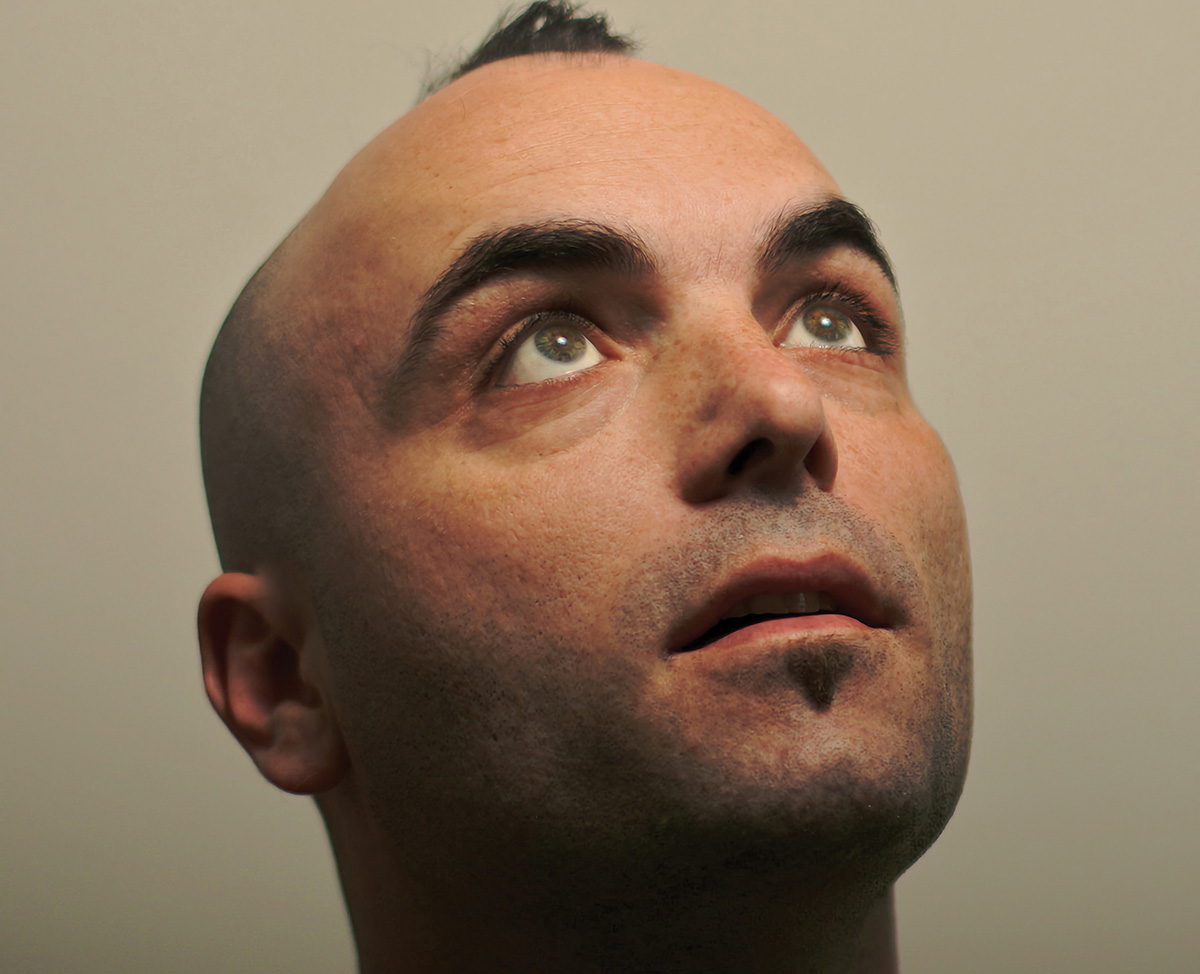
How do memories actually come about? Isn't it a process that involves both – forgetting and reinventing? This construction process of memories is symbolized in the film using architectural fragments. The camera moves through structures reminiscent of film sets as well as abandoned places. We are reminded of places where we’ve been before, we are guessing. The Australian voice actor, heard from somewhere in the dark, remembers details from his way to school in Melbourne, reports on forays through foreign cities and describes these structures from his memories. His voice is fading, but is remembered by tape machines.
Thadeusz Tischbein is a Germany-based video artist. He is interested in cruel intersections of history and everyday live. In his films he uses often documentary footage along with models and archival material to develop a fictionalized version of a documentary, a forensic speculation. HOW THE WOODEN STRUCTURES SURVIVED IN MY MIND (2023) is using architectural leftovers to investigate the (re)construction of memories. In 2021 a series of nine short films using poems by Joseph Brodsky was produced. The 2017 video essay SNOW WHITE (2K Cinemascope, 19:40 min) is a journey to the dead bodies in mausoleums, churches and museums. THE ATLAS OF THE WOUNDED BUILDINGS (HD, 12:56 min, 2016) is an attempt to examine narrations written in bullets holes. Thadeusz Tischbein studied Visual Arts with Candice Breitz in Braunschweig/Germany and Clemens von Wedemeyer in Leipzig/Germany. His films were invited to many German and international film festivals, among others EMAF Osnabrück, IndieLisboa, Manifesta 12 Palermo (collateral event), Rencontres Internationales Paris/Berlin, Stuttgarter Filmwinter, Filmfest Dresden. Most of his films started as multichannel installations and where shown for instance in Teatro Franco Parenti, Milan/Italy or Schaubuehne Lindenfels Leipzig/Germany. He lives and works in Leipzig/Germany.
Catalogue : 2018Schneewittchen (Snow White) | Video | hdv | color and b&w | 19:40 | Germany | 2017
Thadeusz Tischbein
Schneewittchen (Snow White)
Video | hdv | color and b&w | 19:40 | Germany | 2017
What role can culture play, when dead bodies are not burried after death, but being used for other purposes “Snow White” examines this question, using stalinist Mausoleums, preparated animals in Natural History Museums and relics in churches. What form of story telling is being used to hide actions and translate them?
Thadeusz Tischbein is a Germany-based video artist. He studied between 2008 and 2016 in Leipzig, Braunschweig (Germany) and Bucharest (Romania) with Candice Breitz, Clemens von Wedemeyer and Günther Selichar. His 2017 video essay SNOW WHITE (2K Cinemascope, 19:40 min) is a journey to the dead bodies in mausoleums, churches and museums. In THE ATLAS OF THE WOUNDED BUILDINGS (HD, 12:56 min, 2016) he is trying to examine narrations written in bullets holes. INVENTORY (HD, 16:9, 5:49 min) from 2015 is talking about the strange living room of so called office plants.
Benjamin Tiven
Catalogue : 2019The Mirrored Message | Experimental doc. | hdv | color | 12:30 | USA, Sweden | 2018
Benjamin Tiven
The Mirrored Message
Experimental doc. | hdv | color | 12:30 | USA, Sweden | 2018
The Mirrored Message documents two scientists as they prototype a new device that transfers data between wireless computer networks and living plants. Observing their work from within a sealed electronics facility near Stockholm, we follow procedural steps in the device's programming and fabrication. The initially alien laboratory space slowly reveals itself as a kind of photographic darkroom, and we watch the light-sensitive production of the device's specialized circuitry. From the artificial air of this controlled lab we move to a coastal forest near the Baltic Sea, where the transmitter is installed for testing. Weather impedes the work. As the humans slowly fade from the scene, a living specimen comes online, finally addressable by a local network.
Benjamin Tiven is a filmmaker and the co-director of Library Stack. His films have screened at FID Marseille, Viennale, Rotterdam, Oberhausen, Courtisane, MUMOK, the Institute of Contemporary Art, Philadelphia, Delfina Foundation, London, Fotografisk, Copenhagen, the Museum of the Moving Image, NYC, and Arsenale Kino, Berlin.
Benjamin Tiven
Catalogue : 2014A Third Version of the Imaginary | Video installation | | color | 12:0 | USA, Kenya | 2012
Benjamin Tiven
A Third Version of the Imaginary
Video installation | | color | 12:0 | USA, Kenya | 2012
A Third Version of the Imaginary traces an encounter with the video and film library of the Kenya Broadcasting Corporation in Nairobi. We follow the station?s librarian through tightly-packed shelves of video cassettes: he is searching for a specific image, and must sift through the identifying paperwork from a number of tapes. As he methodically moves among the stacks, a Swahili voice-over speaks about the arrival of video technology in Kenya and its impact on the archiving of television images: video may have cheapened production, but its material expense put pressure on storage. Later, the librarian converts a basement storage closet into a makeshift cinema, in order to screen some 16mm film material. The voice-over shifts accordingly, moving from video to film, and to the linguistic problem posed by the very word ?image? in Swahili. A visual and narrative echo chamber, this video addresses video?s address of film: the material facts of these media become the aesthetic facts of the work.
Benjamin Tiven lives and works in Brooklyn, New York, US. Forthcoming exhibitions, 2014: ICA Philadelphia (solo); gallery 1/9 Unosunove, Rome, IT (in collaboration); Courtisane festival, Ghent, Belgium. Recent exhibitions: Henningsen Gallery, Copenhagen, DN; Westfälischer Kunstverein, Münster, DE; Charlottenborg Kunsthal, Copenhagen; Bronx Museum of Art, Bronx, NY; Vivo Media Arts Center, Vancouver; Center for Curatorial Studies at Bard College. Recent film screenings: Rotterdam International Film Festival; Migrating Forms, NY; Museum of the Moving Image, NY; Cinéphémère, FIAC, Paris, FR; Vienna International Film Festival, AT; Arsenal Cinema, Berlin, DE; FID Marseille, FR; RIDM Festival, Montreal, QB; Oberhausen Short Film Festival, DE; 25FPS Festival, Zagreb, HR; Images Festival, Toronto, ON. Journal contributions: Triple Canopy, Nka: Journal of Contemporary African Art, Bidoun, Bulletins of the Serving Library, Roulotte issue #10, ACM, Barcelona, ESP. Public presentations, 2013: the Drawing Center; the Colloquium for Unpopular Culture, Westfälischer Kunstverein.
Alain Tjiong
Catalogue : 2014Voyeur | Experimental fiction | | color | 19:52 | Netherlands, Belgium | 2013
Alain Tjiong
Voyeur
Experimental fiction | | color | 19:52 | Netherlands, Belgium | 2013
SYNOPSIS Out of the black night she emerges. Her waving soft fair hair reminds the glamour of the Hitchcock blondes. Her pale skin fragile like a china doll. She turns her head and looks at us.
BIOGRAPHY Alain Tjiong (The Netherlands, 1991) is currently a master student film at the School of Arts (KASK) in Ghent, Belgium. His films are first and foremost a means of personal expression, a way to communicate his feelings and his thoughts with a audience. While still operating in the field of narrative fiction, he is always searching for the bounderies of narrative cinema and trying to rediscover its (lost) relevance.
Ali Tnani
Catalogue : 2019Even The Sun Has Rumors | Experimental doc. | mov | color | 18:4 | Tunisia | 2017
Ali Tnani
Even The Sun Has Rumors
Experimental doc. | mov | color | 18:4 | Tunisia | 2017
In the mining town of Redeyef (Tunisia), a disused site still full of affect: the staff co-op. Established and managed by the phosphate company of Gafsa during colonial times, this empty site still retains within its walls the stratum of the ambivalence of a history where the sparkling surface relates the arrival, where there is nothing, of a haven of comfort for a society burdened by work in the mine. But beyond the initial impression, it's a darker reality that the staff co-op induces: that of a commercial extension of a mine exploiting the earth as much as its people. A vestige site, the staff co-op is a place of abandoned memory that a videographic and poetic eye penetrates, bringing to light, by the chiaroscuro of the time that goes by, through the voice of a child still living in the memories of a mine worker, the spaces, surfaces and historic depth of a site is portrayed.
Born in 1982 in Tunis, Ali Tnani is a Tunisian contemporary artist based in Tunis and Paris. He received his Masters in 2007 from the Institut Supérieur des Beaux-arts of Tunis and has since exhibited widely and participated in international residency programs. Tnani recently completed a two-year residency at the prestigious Cité Internationale des Arts in Paris. A leading practitioner in the field of conceptual art, Tnani is known for his multimedia installation work examining social issues in post-revolutionary Tunisia. With a practice that draws on installation, drawing, and photography, he explores the question of erasure and the negative in narratives of traces, memory and history in an era of hyper-connectivity. He has participated in various solo and group exhibitions internationally, including the 13th Biennial of Dakar, the Musée du Bardo in Tunis, PA the Plateforme de création contemporaine and Cité Internationale des Arts in Paris, La Terrasse Nanterre Art Space and le Château d'Oiron (France), the 5th Marrakech Biennial, the Musée de Carthage in Tunis, the Musée des Beaux-Arts de Mons (Belgium) and the Biennial of young artists from Europe and the Mediterranean in Skopje, Macedonia.
Rob Todd
Catalogue : 2017Phases of Noon | Experimental film | 16mm | black and white | 11:25 | USA | 2016
Rob Todd
Phases of Noon
Experimental film | 16mm | black and white | 11:25 | USA | 2016
Watching four species of paradise perform in four phases of noonlight reflecting on four film rolls, in four acts
A lyrical filmmaker as well as a sound and visual artist, Robert Todd continually produces short works that resist categorization. His visually stunning body of work, which comes from a deeply personal place, takes a variety of poetic approaches to looking at the personal, political, and social ways in which we choose to live. His films have been exhibited internationally at a wide variety of venues and festivals. He teaches film production at Emerson College.
Catalogue : 2016ICE | Experimental film | 16mm | black and white | 9:0 | USA | 2015
Rob Todd
ICE
Experimental film | 16mm | black and white | 9:0 | USA | 2015
Following the feel of black and white rising and falling through caverns and across plains.
A lyrical filmmaker as well as a sound and visual artist, Robert Todd continually produces short works that resist categorization. His visually stunning body of work, which comes from a deeply personal place, takes a variety of poetic approaches to looking at the personal, political, and social ways in which we choose to live. His large body of short-to-medium format films have been exhibited internationally at a wide variety of venues and festivals. He teaches film production at Emerson College.
Catalogue : 2015LoveSong | Experimental film | 16mm | color and b&w | 6:0 | USA | 2014
Rob Todd
LoveSong
Experimental film | 16mm | color and b&w | 6:0 | USA | 2014
Threads, strings, love`s touch attuned, rising like the dawn in song.
A lyrical filmmaker as well as a sound and visual artist, Robert Todd continually produces short works that resist categorization. His visually stunning body of work, which comes from a deeply personal place, takes a variety of poetic approaches to looking at the personal, political, and social ways in which we choose to live. His large body of short-to-medium format films have been exhibited internationally at a wide variety of venues and festivals. He teaches film production at Emerson College.
Catalogue : 2014Free-Forms | Experimental film | 16mm | black and white | 7:0 | USA | 2013
Rob Todd
Free-Forms
Experimental film | 16mm | black and white | 7:0 | USA | 2013
A small universe unbound.
A lyrical filmmaker as well as a sound and visual artist, Robert Todd continually produces short works that resist categorization. His visually stunning body of work, which comes from a deeply personal place, takes a variety of poetic approaches to looking at the personal, political, and social ways in which we choose to live. His large body of short-to-medium format films have been exhibited internationally at a wide variety of venues and festivals.
Catalogue : 2013Habitat | Experimental film | 16mm | black and white | 10:0 | USA | 2012
Rob Todd
Habitat
Experimental film | 16mm | black and white | 10:0 | USA | 2012
Locations that shift, split and spill over one another like sand in an hour glass. This is my world. A graphically-oriented spatial portrait, an in-camera layered tapestry: inversions and conversions that mark time with the chaos of my waking work-life, diffusing as it moves inward.
A lyrical filmmaker as well as a sound and visual artist, Robert Todd continually produces short works that resist categorization. His visually stunning body of work, which comes from a deeply personal place, takes a variety of poetic approaches to looking at the personal, political, and social ways in which we choose to live. His large body of short-to-medium format films have been exhibited internationally at a wide variety of venues and festivals.
Catalogue : 2011Rayning | Experimental film | 16mm | black and white | 6:0 | USA | 2010
Rob Todd
Rayning
Experimental film | 16mm | black and white | 6:0 | USA | 2010
Light rayns-rains-reigns across a dream of tranquility that thickens, darkens and evaporates.
A lyrical filmmaker as well as a sound and visual artist, Robert Todd continually produces short works that resist categorization. In the past twenty years he has produced a large body of short-to-medium format films that have been exhibited internationally at a wide variety of venues and festivals and have won numerous festival prizes, grants, and artist?s awards. He teaches film production in the Boston area, and works as editor, sound designer/editor, post-supervisor or music producer on various broadcast and theatrically-released productions.
Catalogue : 2009cabinet | Experimental film | 16mm | color and b&w | 10:0 | USA | 2007
Rob Todd
cabinet
Experimental film | 16mm | color and b&w | 10:0 | USA | 2007
?Cabinet? A room set aside for the exhibition of objects or works of art. View into, through and from within a set of ?cabinets? as both passive and active containers. The film looks into what makes intimacy possible in mediation, through close attention to the movement, contours, textures and colors of objects and scenarios close to the filmmaker. The shifting sense of the presence felt between subject, viewer, author and machine is what drives this film?s visual transformations.
Robert Todd has been making short films in the Boston area since 1990. His visually stunning body of work, not easily defined or categorized, comes from a deeply personal place, which is quiet, thoughtful, and curious. The films take a variety of poetic approaches to looking at the personal, political, and social ways in which we choose to live.
Brad Todd
Catalogue : 20223050 K | Video | mp4 | color | 9:27 | Canada | 2021
Brad Todd
3050 K
Video | mp4 | color | 9:27 | Canada | 2021
3050 K is an AI/Neural Net project which utilizes imagery of stage lighting (floods, spots, footlights, gels) sourced from 70 concerts and performances of rock music from the 1970’s. These images are in turn used as primary material for a Neural Net and provide the training model for the resultant imagery. The images which are generated from this process are visualizations of emergent forms and tableau which are the offspring of the original material. These images are then re-processed and provide the individual frames for a video representation of the GAN’s procedural and generative algorithmic creation. The hypnotic and somnambulant visuals are accompanied by a score I created, composed of a number of heavily processed aural artifacts from the era. The title ’3050 K’ is in reference to the average number of Kelvins used in stage and theatrical lighting.
Brad Todd is an artist whose works span several fields of inquiry, principally involving the research/creation of responsive environments which implicate technology as a mirror, filter and catalyst for experience writ large in both an individually embodied sense and its attendant broader socio-political context. Recent and past projects have focused on issues of visualizing and conditioning invisible, abstract and liminal material such as EMF, infrasonics, aggregate data and microclimates, while in other works the content is more explicit and political. Having received an M.F.A. from Concordia University (Montréal), he began playing music in the post-punk band Sofa, which released the inaugural album and single on the Constellation Records label. From the generative and reactive to the composed and performative, audio and sound design continues to play a key role in his works. Brad has received numerous grants and awards and has exhibited his works in galleries and media festivals in North America, South and Central America, Asia and Europe. Presently he is an instructor in the Design and Computation Arts program at Concordia University in Montréal.
Catalogue : 2019dresden.cuba.clouds | Experimental video | mp4 | | 3:15 | Canada | 2018
Brad Todd
dresden.cuba.clouds
Experimental video | mp4 | | 3:15 | Canada | 2018
dresden.cuba.clouds is a generative video which incorporates imagery from the skies above the city of Dresden coupled with footage of clouded ice formations and video from the Museum of the Revolution in Havana. This small database of video is processed in realtime and is sensitive to a number of parameters derived from, and responsive to, an audio recording of the Cuban "sonic attacks" of 2017. The footage of the skies and ice in particular also speak to notions of veracity as they are indistinguishable from one another. As a number of the reported cases of aural and cerebral trauma were inaudible, so too is this work. The choice of imagery from Dresden is a nod to its primacy in the place it occupies in the historical record, most obviously as the site of the devastating aerial bombing campaign during WWII. It is also referencing Dresden`s post-war history as a center of the cold war headquarters of the east German KGB/Stasi security services, notorious for their psyops, whose legacy continues today, largely unseen (and unheard it would seem). As a parable, foil and metaphor for the machinations of power and policy, this work is intended as a mute and disquieting presence, background noise.
Brad Todd is an artist whose works span several fields of inquiry, principally involving the research/creation of responsive environments which implicate technology as a mirror, filter and catalyst for experience writ large in both an individually embodied sense and its attendant broader socio-political context. Having received an M.F.A. from Concordia University (Montréal), he began playing music in the post-punk band Sofa, which released the inaugural album and single on the critically acclaimed Constellation Records label. From the generative and reactive to the composed and performative, audio and sound design continues to play a key role in his works. Brad has received numerous grants and awards and has exhibited his works in galleries and media festivals in North America, South and Central America, Asia and Europe, including the 3rd Beijing International New Media Art Exhibition and Symposium in Beijing, Eyebeam, N.Y., Paços das artes, Sao Paulo, Brazil, The New Museum of Contemporary Art, N.Y., ISEA festivals in Nagoya, Japan, Belfast and Hong Kong and Cynet art in Germany. Presently he is an instructor in the Design and Computation Arts program at Concordia University in Montréal.
Robert Todd
Catalogue : 2018Restless | Experimental film | 16mm | black and white | 0:0 | USA | 2016
Robert Todd
Restless
Experimental film | 16mm | black and white | 0:0 | USA | 2016
Changing winds, shifting moods, stirring, awaiting…
A lyrical filmmaker as well as a sound and visual artist, Robert Todd continually produces short works that resist categorization. In the past twenty years he has produced a large body of short-to-medium format films that have been exhibited internationally at a wide variety of venues and festivals including the Media City Festival, San Francisco International Film Festival, Rotterdam International Film Festival, New York Film Festival, Le Rencontres Internationale, Black Maria Film Festival, Nouveau Cinema in Montreal, Cinematheque Ontario, the Harvard Film Archive, Pacific Film Archive, the Paris Biennial, Slamdance Film Festival, and others. His films have won numerous festival prizes, grants, and artist’s awards. He teaches film production at Emerson College in Boston.
Vladimir Todorovic
Catalogue : 2010the snail on the slope | Animation | dv | black and white | 7:42 | Serbia, Singapore | 2009
Vladimir Todorovic
the snail on the slope
Animation | dv | black and white | 7:42 | Serbia, Singapore | 2009
The Snail on the Slope is a generative movie based on a book of the same title by Strugatsky brothers. The novel is set on an unknown planet, where humans have a base from which they are investigating and trying to conquer the Forest. The Forest, which is a huge single organism is constantly changing and fighting back. It is also dangerous and there are a lot of unexplained phenomena that they are discovering, frequently. The movie is made of five chapters, which critically address the questions of artistic and scientific efforts to understand nature. The topics that arise in those chapters and that are rendered in semiotic relationship with nature are: sublime view, role of knowledge, escape from ubiquitous bureaucracy, and apocalyptic tone that comes with the destruction of nature. By applying an organic narrative structure to the generative dynamic forms, a spectator witnesses a definition of a novel cinematic experience. In the movie, all the scenes are generated with computer programming language Processing. They are created as abstractions and visualizations of the atmospheres in which all of the action takes place. The music is generated with various analog, digital synthesizers and software instruments.
Vladimir Todorovic, born 1977. Zrenjanin (Serbia), studied visual arts, at the Academy of the Arts in Belgrade and University of California Santa Barbara. Currently, he is working as Assistant Professor at the School of Art, Design and Media, NTU, Singapore. He co-founded the new media art collective called ʻsyntfarmʼ based in Singapore and the Institute for Flexible Cultures and Technologies `NAPON` in Novi Sad, Serbia. His research and art practice focus on generative art forms that are defining novel approaches in new media art and design. In his work, generative forms are utilized in the development of media performances and installations. They are used in various media including: generative video, audio-visual installation and performance, rapid-prototypes, computer games, mixed-reality systems, nano-fabrication, and various others. His projects were exhibited at events and venues like: ICA Singapore, ISEA08, Wired NextFest, Dislocate07, Enter3, ISEA06, Siggraph 06, Transmediale 05, File 2004, MuseumsQuartier Vienna, Machinista, Entermutlimediale 2, WRO05 Biennale, Museum of Contemporary Arts Belgrade, etc; and reviewed at/by: Channel NewsAsia, Reuters, ?Smart Surfaces? ? Springer/Birkhäuser, Wired, New Scientist, Gamasutra, Futures-labs, Neural.it, Res Magazine, Selectparks.net, Turbulence, Artmagazine, Remont, Danas, etc. Recently, he served as the chair of Ludic Interfaces theme and the organizer of ISEA08 in Singapore.