Catalogue > List by artist
Browse the entire list of Rencontre Internationales artists since 2004. Use the alphabetical filter to refine your search. update in progress
Willoh S. Weiland
Catalogue : 2015FINALE | Video | hdv | color | 15:22 | Australia | 2013
Willoh S. Weiland
FINALE
Video | hdv | color | 15:22 | Australia | 2013
Finale is a short film that follows one man's journey to the silver screen, inspired by and starring un-sung local hero Evan Knoble alongside senior marching ladies, motorcycle clubs, community orchestras and primary school students. Finale merges the essence of a musical with contributions from a diverse range of local community groups located in the Mornington Peninsular of Victoria, Australia. The nostalgia associated with Drive In Cinemas unfolds alongside the local wild natural landscapes to create a journey of longing and commitment. Finale merges the surreal with wild natural landscapes to create a dark portrait of our longing for that one moment of fame. Finale was created by Aphids with its key artists collaboratively writing, creating and producing the work.
Aphids creates epic contemporary art projects using performance, music, site-specificity and new technologies. Collaborative and driven by a passionate belief in the social role of art, Aphids investigates what is current and urgent in contemporary culture. Aphids is led by Artistic Director Willoh S.Weiland in collaboration with Artistic Associates Martyn Coutts, Elizabeth Dunn, Tristan Meecham, Lara Thoms and Thea Baumann (Shanghai). Based in Melbourne, Australia, Aphids has created and presented collaborations across Europe and in Japan, China, South Africa, USA, Mexico and Australia. Current projects include the large scale Forever Now inspired by the Golden Record sent into space in 1977 on the Voyager Space Probe.
Wolfgang Weileder
Catalogue : 2006House-Birmingham | Experimental doc. | dv | color | 9:42 | Germany, United Kingdom | 2005
Wolfgang Weileder
House-Birmingham
Experimental doc. | dv | color | 9:42 | Germany, United Kingdom | 2005
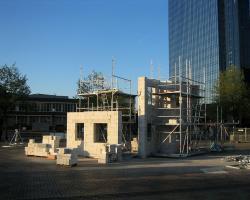
Over a period of twelve-days two groups of builders simultaneously constructed and deconstructed a series of house shells reminiscent of two interlocking terraces. Five metres high, they were juxtaposed via a rotational symmetry and built from lightweight cellular concrete blocks, involving a new fast-bonding dry-assembly construction technique. The process had been synchronized so that the construction and de-construction was choreographed sequentially: The opposite segments of the two terraces slowly moved around each other until house-birmingham was completed. Two separate terrace structures had been built in the same place at the same time. House-birmingham was recorded using time-lapse camera. The camera moved around the installation clockwise on a circular track. After 12 days it reached its staring point again. House-birmingham explores the relationship between the temporary and the permanent in architecture as well as investigating the boundaries between process, artwork and documentation.
Wolfgang Weileder is an artist working with large-scale sculptures and installations in a variety of material and media. Located in the architectural and urban context, his site-specific work incorporates new uses of temporary and socially interactive art practice. Recent projects include house-birmingham, a time-based site-specific sculpture and movie commissioned by IKON Gallery, Birmingham, UK. Since 2000 Wolfgang Weileder lives in Newcastle upon Tyne, UK, where he is a Reader in Contemporary Sculpture Practice at the University of Newcastle.
Lawrence Weiner
Catalogue : 2009Around the Park | Art vidéo | dv | color | 7:26 | USA | 2007
William Wegman
Around the Park
Art vidéo | dv | color | 7:26 | USA | 2007
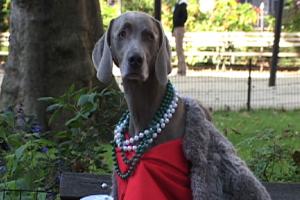
Around the Park was a public art project commissioned by the Madison Square Park Conservency in New York in autumn 2007. The video, which stars Wegman`s canine cast enjoying a fall day in the park, was presented on four outdoor monitors near Madison Square Park`s food kiosk. Commissioned by the Madison Square Park Conservatory. Director: William Wegman. Camera: Andrea Beeman. Crew: Jason Burch, Ben Dowell, Marlo Kovach, Sara Fuller. Starring: Bobbin, Candy, Penny. Hands: Jason Burch, Marlo Kovach, Katie Williams. Cameo Appearances: Molly Burch, Lola Wegman, William Wegman. Editor: Andrea Beeman. Additional Sound Editing: Ben Tudhope. Online Editor: George Englezos. Special Thanks: Stewart Desmond, Debbie Landau, Kim Wicker.
William Wegman has gained international recognition for his work in photography, painting, drawing and video. A postmodern, conceptual humorist, he has been termed a "master of whimsy, whose [works] have a charm and absurdist intelligence sometimes worthy of Beckett," by The New Yorker. Although Wegman is best well known for his witty portraits of his Weimeraner dogs, he is a highly original figure in the history of video art. His comedic, performance-based tapes of the 1970s are among the most enduring of video classics. Wegman`s early video works, many of which star his famous Weimeraner and alter ego, the late Man Ray, use understated humor, minimalist performance and the immediacy and intimacy of low-tech video to create brilliant moments of idiosyncratic narrative comedy. Recorded as single takes in real time, performed in front of a static camera, his tapes document absurdist anecdotes, droll monologues and surreal sight gags. With subversive wit, Wegman ingeniously employs minimal props, his own body and everyday situations as comedic material, delivering monologues in a wry deadpan. The dog Man Ray, a hapless innocent, functions as an unlikely protagonist, a comic foil and "straight man" for Wegman`s fictions. Obedient and trusting, Man Ray is a blank slate upon which Wegman projects and transfers an outrageous psychology of human emotions and motivations. In situational one-liners, Man Ray is provoked into conditioned reactions; Wegman then ascribes anecdotal meaning to the dog`s behavior, imposing human traits onto this Other. In one of his most engaging works with Man Ray, the dog appears to respond with consternation when Wegman corrects his spelling lesson; in another, two dogs follow the movements of an off-screen object in perfect unison. The transference of identity from Wegman to Man Ray is central to the tapes` comic tension. Much of the humor derives from the incongruity of what one sees and what one hears, and the meanings assigned to them ? the ironic gap between anticipated and actual behavior, expectations and actuality. Many of the works involve sight gags that parody minimalist and body art practices; body parts and other inanimate objects assume human voices. Television monologues are rendered as absurdist confessionals; extended actions end in hopelessly anticlimactic climaxes. Historically significant and extremely influential, these tapes are also genuinely funny. Since the late 1970s Wegman has received international acclaim for his work in photography, much of which features anecdotal images of Man Ray and his canine successor, Fay Ray. Fay Ray is also the star of Wegman`s later video works, which include a series of comic vignettes for television`s Sesame Street. Wegman was born in 1943. He received a B.F.A. in painting from the Massachusetts College of Art and an M.F.A. in painting from the University of Illinois, Urbana. He has received numerous awards, including grants and fellowships from the Guggenheim Foundation, the National Endowment for the Arts, and Creative Artists Public Service (CAPS). Wegman`s photographs have been the subject of several publications, including Man`s Best Friend (1982) and William Wegman: Paintings, Drawings, Photographs, Videotapes (1990). His photographs, paintings, drawings and videotapes have been exhibited widely throughout the United States and Europe, in major one-man shows at institutions including the Walker Art Center, Minneapolis; Los Angeles County Museum of Art; Holly Solomon Gallery, New York; Kunstmuseum, Lucerne; Centre Georges Pompidou, Paris; Stedelijk Museum, Amsterdam; Kunstverein, Frankfurt; and the Institute of Contemporary Art, London. Wegman`s work has also been seen in group exhibitions at festivals and institutions including several Documentas, Kassel, Germany; Whitney Museum of American Art Biennial; Kunsthalle Wien, Vienna; San Francisco Museum of Modern Art; Venice Biennale; The Museum of Modern Art, New York; Institute of Contemporary Photography, New York; the Victoria and Albert Museum, London, and Creative Time`s Video Art on the Times Square Astrovision in New York. His work was the subject of a 1990-91 travelling retrospective, William Wegman: Paintings, Drawings, Photographs, Videotapes 1970-1990, which originated at the Kunstmuseum, Lucerne. His videotapes have been broadcast in the United States and abroad, and have been shown nationally on The Tonight Show, The David Letterman Show, and Saturday Night Live. Funney/Strange, a retrospective of Wegman`s work, was organized by the Addison Gallery of American Art, Phillips Academy, Andover, Massachusetts, in 2006, with a catalogue published by Yale University Press. The retrospective toured to numerous sites, including the Brooklyn Museum of Art and the Wexner Center for the Arts, Columbus, Ohio. Wegman lives in New York.
Catalogue : 2009Turning Some Pages | Art vidéo | 0 | color | 5:0 | USA | 2007

Lawrence Weiner
Turning Some Pages
Art vidéo | 0 | color | 5:0 | USA | 2007
Turning Some Pages was produced in conjunction with the printing of a limited edition journal of the same name by the Howard Smith Paper Group, a British paper merchant. The action of reading a book informs the structure of this motion drawing. Abstract arrangements of shapes and images of dice are interspersed with cryptic aphorisms ("With the addition of explicit meaning, the implicit sense of the throw of the dice becomes clear"); arrows suggest the turning of a page. Weiner adds another layer of complexity and enigma by repurposing his droll 1981 audio work Where It Came From as a soundtrack. Accompanied by Roma Baran on the piano, Weiner matter-of-factly explains: "Art is not a metaphor upon the relationship of human beings to objects and objects to objects in relation to human beings, but a representation of an empirical existing fact." A Structure of Lawrence Weiner. Voice: Lawrence Weiner. Piano: Roma Baran. Computer Graphics: Bethany Izard. A Production of Moved Pictures.
A key figure in Conceptual Art, Lawrence Weiner has long pursued inquiries into language and the art-making process. From his pioneering installation works of the 1960s and `70s through his new digital projects, Weiner posits a radical redefinition of the artist/viewer relationship and the very nature of the artwork. Translating his investigations into linguistic structures and visual systems across varied formats and manifestations, Weiner has also produced books, films, videos, performances and audio works. In his recent series of digital works, Weiner stakes out new territory even as he extends these investigations. Evoking analytic philosophy and linguistic games, Weiner deploys animated drawings and epigrammatic text that interact in a symbolic language. Ultimately, these visual and linguistic systems take on provocative narrative meaning. Lawrence Weiner was born in the Bronx, New York, in 1942. He has received numerous grants and awards, including the Skowhegan Medal for Painting/Conceptual Art; Wolfgang Hahn Prize, Ludwig Museum, Cologne, Germany; the John Simon Guggenheim Fellowship, and the National Endowment for the Arts Fellowship, among many others. Weiner`s works have been widely exhibited internationally. Recent solo exhibitions have been seen at the Kunstmuseum Wolfsburg, Germany; Hirshhorn Museum and Sculpture Garden, Washington, D.C.; Institute of Contemporary Art, London; Dia Center for the Arts, New York; Musée d`Art Contemporain, Bordeaux; San Francisco Museum of Modern Art; Walker Art Center, Minneapolis; Philadelphia Museum of Art, and Museum Ludwig, Cologne, Germany. His work has been included in major group exhibitions internationally, including Documenta in Kassel, Germany, and the Venice Biennial. In 2007-2008, Weiner was honored with a 40-year retrospective of his work, entitled Lawrence Weiner: AS FAR AS THE EYE CAN SEE at the Whitney Museum of American Art in New York. Weiner lives and works in New York.
Laurence Weiner
Catalogue : 2008Inherent in the rhumb line | Experimental video | dv | color | 7:0 | USA | 2005

Laurence Weiner
Inherent in the rhumb line
Experimental video | dv | color | 7:0 | USA | 2005
"With the advent of the rhumb line - a line of constant bearing or loxodrome - a cognitive pattern developed in the Western world that allowed the possibility to conceive pillage on voyages of discovery. Inherent in the Rhumb Line is an imperative for use - regardless of consequence - a flattened convolution that marries landscape with loot and preordination. Inherent in the Rhumb Line is a silent 7 minute motion drawing." -- Moved Pictures
A key figure in Conceptual Art, Lawrence Weiner has long pursued inquiries into language and the art-making process. From his pioneering installation works of the 1960s and `70s through his new digital projects, Weiner posits a radical redefinition of the artist/viewer relationship and the very nature of the artwork. Translating his investigations into linguistic structures and visual systems across varied formats and manifestations, Weiner has also produced books, films, videos, performances and audio works. In his recent series of digital works, Weiner stakes out new territory even as he extends these investigations. Evoking analytic philosophy and linguistic games, Weiner deploys animated drawings and epigrammatic text that interact in a symbolic language. Ultimately, these visual and linguistic systems take on provocative narrative meaning. Lawrence Weiner was born in the Bronx, New York, in 1942. He has received numerous grants and awards, including the Skowhegan Medal for Painting/Conceptual Art; Wolfgang Hahn Prize, Ludwig Museum, Cologne, Germany; the John Simon Guggenheim Fellowship, and the National Endowment for the Arts Fellowship, among many others. Weiner`s works have been widely exhibited internationally. Recent solo exhibitions have been seen at the Kunstmuseum Wolfsburg, Germany; Hirshhorn Museum and Sculpture Garden, Washington, D.C.; Institute of Contemporary Art, London; Dia Center for the Arts, New York; Musée d?Art Contemporain, Bordeaux; San Francisco Museum of Modern Art; Walker Art Center, Minneapolis; Philadelphia Museum of Art, and Museum Ludwig, Cologne, Germany. His work has been included in major group exhibitions internationally, including Documenta in Kassel, Germany, and the Venice Biennial. Weiner lives and works in New York.
Immanuel Weinland
Catalogue : 2007Green Sky | Video installation | dv | color | 10:40 | Germany | 2006

Immanuel Weinland
Green Sky
Video installation | dv | color | 10:40 | Germany | 2006
The belief in the apocalypse is part of the Christian faith and western culture. Politics, church and media are all part of it. Is our imagination of the apocalypse only a projection of what we see every day? "Green Sky" was recorded on New Year's Eve 2005/2006 at Ramstein Air Base, which is the headquarters of the American Air Force in Europe. The original material was cut into 60 pieces and rearranged. The sound in the film is a modification of George W. Bush saying the word "Terror", stretched over 10 minutes.
Pablo Wendel
Catalogue : 2008Terracotta Warrior | Art vidéo | dv | color | 8:38 | Germany, China | 2006
Pablo Wendel
Terracotta Warrior
Art vidéo | dv | color | 8:38 | Germany, China | 2006
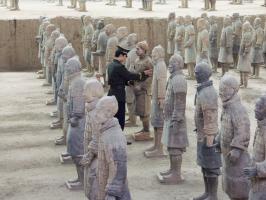
Terracotta Warrior: Video | 8´38´´min. 16. September 2006 Während meines Studienaufenthalts als Stipendiat an der China National Academy of Fine Arts, Hangzhou CHINA (2006), bereitete ich die Intervention Terracotta Warrior in der Nähe der nordchinesischen historischen Stadt Xi?an vor. Mit einem selbst angefertigten Kostüm kopierte ich einen Infanteriesoldaten der ca. 2200 Jahre alten Terrakotta-Armee. In dieser Verkleidung schmuggelte ich mich vorerst unbemerkt unter die Tausenden von individuell ausgearbeiteten Tonsoldaten. Als Skulptur versteinerte ich in einer statuarischen Haltung, ohne sie trotz Aufforderung aufzugeben. Die Performance dauerte 23 min., nach ca.7-10 min wurde ich erst von einem Touristen entdeckt und verraten. Besonders interessierte mich hierbei auch die Situation, dass eine der ältesten Armeen der Welt von einer der größten gegenwärtigen, der chinesischen, bewacht wird. In der Vorbereitung recherchierte ich sehr genau, so habe ich z.B. die Schuhe so täuschend echt nachgearbeitet, dass das original Schuhprofil noch heute im Staub des Museumsbodens von Xi?an als Fußabdruck eines Terrakotta-Kriegers zu sehen ist. Einer möglichen Bestrafung oder Ausweisung entging ich. Die Behörden verstanden, dass ich keinem destruktiven Impuls, sondern meiner Liebe zur Terrakotta-Armee gefolgt bin.
Am 01.09.1980 wurde ich als ältester Sohn in Tieringen, Deutschland, geboren. Von 1999 bis 2002 absolvierte ich eine Steinmetz- und Bildhauerausbildung. Nach abgeschlossener Ausbildung zum Steinbildhauer begann ich im Wintersemester 2002 das Studium der Bildhauerei an der Staatlichen Akademie der Bildenden Künste in Stuttgart bei Werner Pokorny, Udo Koch und Alexandra Ranner. Während dem Hauptstudium wechselte ich in die Fachklasse für Performance und Video von Christian Jankowski. Durch das Baden-Württemberg-Stipendium studierte ich 2006 an der China National Academy of Fine Arts, Hangzhou/China, für ein Semester. Seit 2007 bin ich als Stipendiat in das Förderprogramm der Studienstiftung des deutschen Volkes aufgenommen.
Frank Werner
Catalogue : 2006Survival training- ballet | Art vidéo | dv | color | 1:0 | Germany | 2005
Frank Werner
Survival training- ballet
Art vidéo | dv | color | 1:0 | Germany | 2005
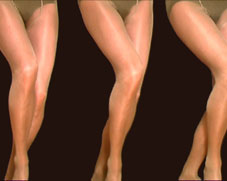
Everything is self-made
Carte Blanche Werner Schroeter
Catalogue : 2010Winter Soldier | Documentary | 16mm | color and b&w | 96:0 | Germany, USA | 1972
Carte Blanche Werner Schroeter
Winter Soldier
Documentary | 16mm | color and b&w | 96:0 | Germany, USA | 1972
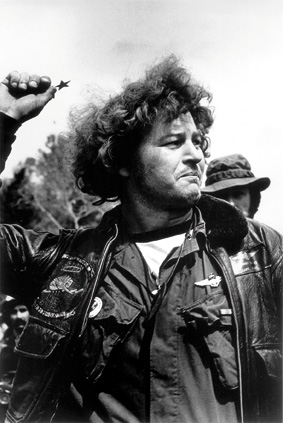
"Winter Soldier" a été réalisé par un collectif anonyme de cinéastes qui a rassemblé cent neuf "anciens" soldats de la guerre du Vietnam dans un hôtel de Détroit du 31 janvier au 2 février 1971, à l`instigation de l`association Vietnam Veterans Against the War. "Winter Soldier" ne comporte ni commentaire ni effet de montage qui dramatise l'image de manière exagérée, mais l`abondance des témoignages est telle que sa vision ne laisse pas le spectateur indemne. Viols, fusillades en masse, corps jetés d`avion dans la mer, prisonniers découpés vivants ou décapités "pour l`exemple"? ce sont tout autant les faits que leur nombre, leur cruauté et le visage angélique de leurs agents qui terrifient. D`où le refus des cinémas (à l`exception d`une salle new-yorkaise) de projeter "Winter Soldier" à sa sortie en 1972. Mais ce qui frappe surtout dans "Winter Soldier", c`est le contraste entre les atrocités que ces soldats d`une vingtaine d`années ont commises un ou deux ans auparavant, avec leur maturité, leur liberté verbale et leur sens de l`urgence politique. Il semble que, toute honte bue, ils aient à l`esprit la nécessité, alors que la guerre bat encore son plein, de rendre leur témoignage utile, et pour cela, de ne pas l`expurger. Winter Soldier, plutôt que de multiplier les témoins, s`attache à une poignée de visages marquants - ceux des plus prolixes et des plus lucides sans doute - qui prennent corps comme personnages, doués d`une profondeur humaine qui dépasse de loin celle des fictions à la Voyage au bout de l`enfer. Le film donne aussi une idée de la disparité ethnique et sociale d`une Amérique dans laquelle, comme le rappelle un Noir dans l`auditoire, "après le lycée, nous [Afro-américains] n`avons pas d`autre choix que d`entrer dans l`armée, sinon on finit à la rue". Ce moment d`intense concentration des locuteurs mais aussi des journalistes de l`assistance offre à la fois un portrait en coupe de la moitié d`une génération qui n`a pu qu`entendre parler de Woodstock depuis "là-bas", et l`occasion du retour d`un pays sur son Histoire : un Indien d`Amérique n`y rappelle-t-il pas, les larmes aux yeux, que les contrats de cession des terres des Indiens rédigés par les colons stipulaient "Tant que poussera l`herbe, tant que couleront les rivières", et qu`au Vietnam, l`herbe ne poussera plus à l`endroit des centaines de villages réduits en cendres ?
Elsa Werth
Catalogue : 2014un triangle dangereux | Experimental fiction | hdv | color | 4:30 | France | 2013
Elsa Werth
un triangle dangereux
Experimental fiction | hdv | color | 4:30 | France | 2013
Mise en place d?une stratégie guerrière factice. Jeux de samouraïs avec comme décor une ville de province française et un club de free-fight. Dans la vidéo « Un triangle dangereux » l?attention est portée à l?image que donnent d?eux mêmes des amateurs de free-fight, imprégnés par la culture des jeux vidéo et des films d?action. Ils posent, s?observent, se photographient, se filment. Ces images en mouvements sont rythmées par des plans fixes qui leur confèrent un caractère pictural. Les personnages sont piégés dans un récit qui ne démarrera pas, qui les restreint à faire de la figuration.
Elsa Werth née en 1985, vit et travaille à Paris. Elle est diplômée de l?Ecole Nationale Supérieure des Arts Décoratifs de Paris en 2009 et diplômée de l?Ecole Nationale Supérieure des Beaux-Arts de Paris en 2013. Elle est lauréate du prix Humankind Léo Burnett en 2013. Elle développe parallèlement un travail de vidéo et de sculpture. Elle assure actuellement le commissariat d?un cycle d?expositions qui aura lieu du 15 mars au 29 mai à Paris. Elle prépare un nouveau film. www.elsawerth.net
Marcel Wesdorp
Catalogue : 2013Out of Nothing | Création numérique | hdv | black and white | 125:0 | Netherlands | 2010
Marcel Wesdorp
Out of Nothing
Création numérique | hdv | black and white | 125:0 | Netherlands | 2010
The digital film-animation Out of Nothing is the third movie from the project I Wish I Couldn`t Lie / Out of Nothing witch I Started In Spring 2005. With the aid of digital technique, topography and 3D software I build a virtual Landscape. This landscape is a result of calculations, nowhere higher than 300 meters and where all shades of green have been translated into a grey scale. Time and emptiness takes an important role in the work. Out of Nothing portraying a landscape that in surface does measures 10 kilometers square but never the less is physically inaccessible. The illusion in Out of Nothing is being emphasized by a faint heartbeat that resonates through the space. There are no humans, animals, trees or bushes within the landscape. It is reminiscent of a tundra or steppe emphasizing the insignificance and temporality of men. I`m fascinated by how we experience time. A short stroll can seem to last for long while in reality only a short time has passed. The reversal also holds true. The way we experience time does not necessarily rhyme with reality or the conventions of calculating time by means of mechanics. Out of Nothing has a duration of 2 hour and 5 minutes. I Wish I Couldn`t Lie, the first movie in this triology has a duration of 4 hour an 43 minutes with no sound in it.
Marcel Wesdorp (Rotterdam, 1965) lives and works in Schiedam, the Netherlands He studied at the Graphic Lyceum and at the Academy of Art in Rotterdam. He also followed the advanced programme in photography at the St Joost Academy of Art and Design in Breda. Wesdorp makes film animations, maps and prints of digitally designed landscapes. As a viewer, you can hardly believe that the landscape you are looking at is only a virtual one. Although, in the case of Out of Nothing, it has a calculated surface area of ten kilometres by ten, the landscape cannot be entered. The illusion is reinforced by a soft heartbeat that is heard in the space. Wesdorp is fascinated by the idea of time that humans have. A walk can feel like it has lasted for hours although only a short time has actually elapsed. What happens in our heads is often not aligned to what is happening in reality, or to the common method of time measurement. The visual stroll through the virtual landscape approaches that experience. The Out of Nothing film animation is a landscape resulting from a calculation. It offers a hilly landscape that is not higher than three hundred metres, where green tints have been converted to grey. There are no people, animals, trees or bushes in the landscape. It is a tundra or steppe that emphasizes the insignificance and loneliness of humankind.
Frank Westermeyer, Sylvie Boisseau
Catalogue : 2012Neue Brüder | Experimental doc. | hdcam | color | 130:0 | Germany, Switzerland | 2010
Frank Westermeyer, Sylvie Boisseau
Neue Brüder
Experimental doc. | hdcam | color | 130:0 | Germany, Switzerland | 2010
Will the indigenous peoples, whose cultures tend to privilege the relation with nature, obtain any benefit from the rising interest in the protection of nature, that seems to be developing worldwide? Or should they rather distrust an idea of nature preservation that barely ever takes into account their territorial claims, and even tends to have a destructive counterpart? Bearing such questions in mind, Boisseau and Westermeyer travelled to the south of Chile, a region still steeped nowadays in the German immigration that arrived there during the second half of the 19th century. In their film Neue Brüder (New Brothers) they confront the current territorial situation with the influential figure of one of the precursors of that immigration: the romantic German painter Carl Alexander Simon (1805-1852). During the German revolutionary period, around 1848, Simon published a utopian text of his own entitled The Emigration of Democrats and Proletarians, and the National German Colonization of the Free South American State of Chile. For Simon, the south of Chile was the most adequate region for a German immigration. That ?land of the potato?, was the place where ?the German plant could flourish?.There, he said, the indigenous Mapuche people were looking forward to welcoming the new German brothers? Once in Chile, Simon would be the first artist to produce landscape painting of the southern regions. The film questions these representations of the landscape and leads us to perceive the ideology they convey. Further on, Boisseau and Westermeyer try to debunk the reasons for which, in most of these paintings, Simon`s signature was erased and replaced by that of Vicente Perez Rosales, a leading Chilean statesman in charge, at the time, of the colonization program in the south of Chile. They also wonder why has that wrong authorship persisted. May power relations express themselves through the representation of landscape? The film does not have any voice over, instead, it emblematizes landscape itself as the protagonist of some minutely chosen single shots. Through the weaving of interviews conducted with a variety of denizens of those regions ? which convey a plurality of visions and a polyphony of discourses ?, we are eventually brought to perceive a critical deconstruction of the landscape. Freed from any naturalism, landscape becomes a medium.
Judith Westerveld
Catalogue : 2022Message from Mukalap | Experimental film | mov | color | 14:41 | Netherlands | 2021
Judith Westerveld
Message from Mukalap
Experimental film | mov | color | 14:41 | Netherlands | 2021
At the core of the film Message from Mukalap lies a unique sound recording that captures a spoken message from a man named Mukalap, recorded around 1936 in South Africa. Mukalap speaks in the now-extinct Khoe language !ora. He calls on a European audience to listen to his beautiful language just for once, and to him. ?His message is not only an urgent appeal for recognition, he also asks the audience to respond and send a message in return. The film is a response to his request.
Judith Westerveld (1985) grew up in South Africa and the Netherlands. She studied Fine Art at the Gerrit Rietveld Academie, followed by the Master Artistic Research at the University of Amsterdam. In her films, audio-visual installations, photo-collages and performance based work, Judith Westerveld researches the relation between the archive, the voice and the narrative, probing who is heard and seen, remembered and historicized in a postcolonial world. Language in spoken, written and embodied form, as well as memory, oral history and archival material are recurring elements that shape her work. Gathering a multiplicity of perspectives and interpretations that are historical and contemporary, public and private, her works intertwine the worlds of facts and stories. With her work she aims to address and reflect upon the multiple ways the colonial past continues to impact the present. Her films and videos are distributed by, and part of the collections of LIMA (Amsterdam) and ARGOS (Brussels). From 2019 until 2023 her practice is supported by the Artist Basic grant, Mondriaan Fund. In 2017-2018 she received the Artist Start grant from the Mondriaan Fund.
Synnøve Sizou Wetten
Catalogue : 2023TRANSITION III | Experimental film | 4k | color | 5:29 | Norway | 2021
Synnøve Sizou Wetten
TRANSITION III
Experimental film | 4k | color | 5:29 | Norway | 2021
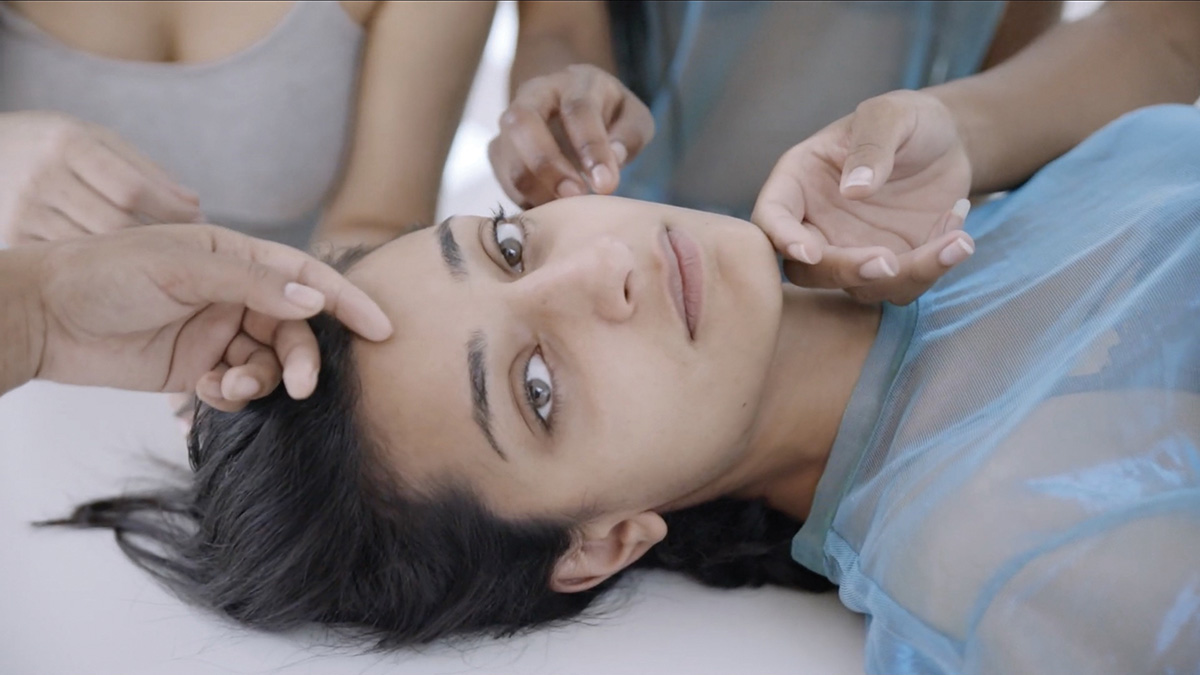
TRANSITION III Scientific and technological breakthroughs are constantly shaping humanity’s understanding of its own existence. With their poetic and atmospheric short film, Synnøve Sizou G. Wetten explores the existential questions which emerge when the borders between biology and technology are blurred. The urgent need for feminist algorithms is put forth as an essential premise to facilitate and develop new and equitable systems in a digital reality. How will gender and sexuality evolve in a biotechnological future? What is consciousness? Could it be that we find ourselves in a computer- simulated reality? The film emphasizes empathy, touch, and presence as radical political tools. Mirroring is a consistent theme of the film. Mirror neurons in the brain are essential neurological players which awaken and stimulate empathy. Essentially, the mirror neurons react to actions which we observe from others. These nerve cells exhibit the same behavior as when we reproduce the same action ourselves. Simulated mirrors are used in augmented reality (AR) technology. The futuristic characters in my film can be perceived as members and players in a growing community; an expanding neural network, displayed in their interplay and mirroring of one another.
Synnøve Sizou G. Wetten is a visual artist, residing and working in Oslo, Norway. They studied at Konsthögskolan in Malmö and Akademie fur Bildende Kunst in Vienna. Their works have been shown at the Sydney Biennial, The National Museum of Art in Norway, Human Resources Los Angeles, KODE art museum, Göteborg International Biennial for Contemporary Art, Kunsthall Oslo, Kunstnernes Hus, Public Art Screens- i/o/lab - Senter for Fremtidskunst, Sørlandets Art Museum and Haugar Art Museum among others.
Oliver Whitehead
Sharon Whooley
Catalogue : 2016Fathom | Experimental doc. | hdv | color and b&w | 21:30 | Ireland | 2013
Sharon Whooley, Whooley, Sharon
Fathom
Experimental doc. | hdv | color and b&w | 21:30 | Ireland | 2013
The Fastnet Lighthouse is built on a pinnacle rock about 7km off the South West coast of Ireland. It is surrounded by water on all sides. `Fathom’ is a non-narrative, meditative film on isolation and thinking framed by this Lighthouse . The lightkeepers who worked here sometimes spent weeks at a time in their tower, out in the middle of the sea. In this film we are using the lighthouse to evoke the idea that, we are, in an important sense, the places that we inhabit.
Sharon Whooley and Pat Collins of Harvest Films have been making films for nearly 20 years. The films have been shown both nationally and internationally. Pat Collins wrote and directed his first feature film Silence in 2012. It was chosen by Geoff Andrew in ‘Sight and Sound’ magazine as one of his top 5 films for 2013. A CD of the sounds from ‘Silence’ , was launched in November 2015 by Farpoint Recordings. The Irish Film Institute hosted a mid-screen retrospective of Pat Collins` work in 2013. His second feature film, ‘Song of Granite’ on Irish traditional singer Joe Heaney starts shooting in March 2016. Sharon Whooley was co-writer on ‘Silence’ and ‘Song of Granite’. She is currently filming ‘Distance’ , a experimental film on memory and place for the Arts Council of Ireland. Most recently, `Fathom` was screened at the Institute of Contemporary Arts in London and at the Galway Arts Festival in Ireland.
Catalogue : 2006John McGahern: A private World | Documentary | betaSP | color | 52:0 | Ireland | 2005
Sharon Whooley
John McGahern: A private World
Documentary | betaSP | color | 52:0 | Ireland | 2005
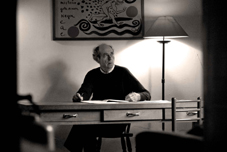
John McGahern : A Private World is an hour long documentary which explores the life and work of Ireland¹s leading fiction writer. The film uses McGahern?s recently published memoirs as a backbone. It explores McGahern¹s childhood experiences in Leitrim and Roscommon and his development as a writer. Through intimate interviews, a strong and compelling sense of the man behind the work emerges as well as offering a rare insight into the creative process.
BIOGRAPHY - Pat Collins Award Winning Director Pat Collins has directed several critically acclaimed documentaries including ?Marooned?, ?Frank O?Connor: The Lonely Voice?, and ?Talking to the Dead?. He received an IFTA in 2003 for his documentary ?Oileán Thoraí?. His latest project ?Sundays In Ireland? will be broadcast later in the year. BIOGRAPHY ? Philip King Co-director of Hummingbird Productions, Philip King has been closely involved with the arts in Ireland as a filmmaker and musician for over 20 years. He has directed and produced several award winning documentaries, films and series?. His sits on the Arts Council of Ireland and is curator of the ?Music Migrations? programme for Cork 2005.
Sharon Whooley, -
Catalogue : 2019Distance | Experimental film | hdv | color and b&w | 13:30 | Ireland | 2018
Sharon Whooley, -
Distance
Experimental film | hdv | color and b&w | 13:30 | Ireland | 2018
DISTANCE looks at multiple dimensions of time in a specific place, Glenbride in Co. Wicklow, from three distinct perspectives: geographical memory, the memory of a house and the tangled forces of human memory. Inspired in part by the ideas of Scottish writer and poet Nan Sheperd "Thirty years in the life of a mountain is nothing, the flicker of an eyelid" we also echo James Joyce's words "Places Remember Events" (written in the margins of "Ulysses").
Sharon Whooley is a Film Artist based in Baltimore in West Cork in Ireland. "I have worked in film for over 20 years, as co-director of Harvest Films (www.harvestfilms.ie. As writer, I was co-writer with Pat Collins and Eoghan Mac Giolla Bhríde on the feature films Silence (2012) and Song of Granite (2017) (Dir: Pat Collins). We are currently writing a new film The Aran Islands based on John Millington Synge's book of the same name. My own films include Fathom (2013) a meditation on thinking and isolation based on the Fastnet Lighthouse, Nettle Coat (2014) on Visual Artist Alice Maher's work of the same name, Imogen Stuart: Dealbhóir (2016) on Irish/German sculptor, Imogen Stuart and Distance (2018); a story about time in a specific place, Glenbride in Co. Wicklow in Ireland. All of these films were funded by the Arts Council of Ireland. My next film, Night Flight is an experimental film about yearning and the human condition seen from the real world, the dream world and the other-world." SW
Sharon Whooley, Whooley, Sharon
Catalogue : 2016Fathom | Experimental doc. | hdv | color and b&w | 21:30 | Ireland | 2013
Sharon Whooley, Whooley, Sharon
Fathom
Experimental doc. | hdv | color and b&w | 21:30 | Ireland | 2013
The Fastnet Lighthouse is built on a pinnacle rock about 7km off the South West coast of Ireland. It is surrounded by water on all sides. `Fathom’ is a non-narrative, meditative film on isolation and thinking framed by this Lighthouse . The lightkeepers who worked here sometimes spent weeks at a time in their tower, out in the middle of the sea. In this film we are using the lighthouse to evoke the idea that, we are, in an important sense, the places that we inhabit.
Sharon Whooley and Pat Collins of Harvest Films have been making films for nearly 20 years. The films have been shown both nationally and internationally. Pat Collins wrote and directed his first feature film Silence in 2012. It was chosen by Geoff Andrew in ‘Sight and Sound’ magazine as one of his top 5 films for 2013. A CD of the sounds from ‘Silence’ , was launched in November 2015 by Farpoint Recordings. The Irish Film Institute hosted a mid-screen retrospective of Pat Collins` work in 2013. His second feature film, ‘Song of Granite’ on Irish traditional singer Joe Heaney starts shooting in March 2016. Sharon Whooley was co-writer on ‘Silence’ and ‘Song of Granite’. She is currently filming ‘Distance’ , a experimental film on memory and place for the Arts Council of Ireland. Most recently, `Fathom` was screened at the Institute of Contemporary Arts in London and at the Galway Arts Festival in Ireland.
Catalogue : 2006John McGahern: A private World | Documentary | betaSP | color | 52:0 | Ireland | 2005
Sharon Whooley
John McGahern: A private World
Documentary | betaSP | color | 52:0 | Ireland | 2005
John McGahern : A Private World is an hour long documentary which explores the life and work of Ireland¹s leading fiction writer. The film uses McGahern?s recently published memoirs as a backbone. It explores McGahern¹s childhood experiences in Leitrim and Roscommon and his development as a writer. Through intimate interviews, a strong and compelling sense of the man behind the work emerges as well as offering a rare insight into the creative process.
BIOGRAPHY - Pat Collins Award Winning Director Pat Collins has directed several critically acclaimed documentaries including ?Marooned?, ?Frank O?Connor: The Lonely Voice?, and ?Talking to the Dead?. He received an IFTA in 2003 for his documentary ?Oileán Thoraí?. His latest project ?Sundays In Ireland? will be broadcast later in the year. BIOGRAPHY ? Philip King Co-director of Hummingbird Productions, Philip King has been closely involved with the arts in Ireland as a filmmaker and musician for over 20 years. He has directed and produced several award winning documentaries, films and series?. His sits on the Arts Council of Ireland and is curator of the ?Music Migrations? programme for Cork 2005.
Boedi Widjaja
Catalogue : 2022A tree rings, a tree sings | Experimental doc. | 4k | color | 10:0 | Singapore, China | 2021
Boedi Widjaja
A tree rings, a tree sings
Experimental doc. | 4k | color | 10:0 | Singapore, China | 2021
New findings in epigenetics suggest that we inherit ancestral memories. Could we inherit images and sounds–audiovisual signals–through genetic transmissions? In 2012, I visited my grandfather’s hometown and snapped with my phonecam ~700 photos in 5 days. In 2021, I re-shot the photos into moving images through an analogue process involving an inverted lens where the visual outcome encodes the artist’s presence. The soundtrack uses inverted gamelan sounds, a metallophone instrument from my hometown Java. The music score is a hybrid DNA code - my Y-chromosome; DNA of the Chinese parasol tree (my grandfather's namesake); and an encoded text - a chimera of person, plant and poetry. The video is generative, an algorithmic composition that plays differently every time, and almost infinitely.
Boedi Widjaja (Indonesia/Singapore) probes into the concerns of diaspora, cultural hybridity and space - physical and psychological - through long-running, interdisciplinary series developed in parallel. His approach is often autobiographical and oblique. Drawing as method is a defining element in his practice; expressed through diverse media from photography and architectural installations to bio art and live art, with an emphasis on process and bodily engagement. Widjaja was trained in architecture and has worked in graphic design. Widjaja received the inaugural QAGOMA and Singapore Art Museum co-commission which was presented at the 9th Asia Pacific Triennial (2018-19) and the 6th Singapore Biennale (2019-20). His works have been included in group shows such as Cladogram: KMA’s 2nd International Juried Biennial (2021), Katonah Museum of Art, New York, in which he was awarded First Prize; MAP1: Waterways (2017), Diaspora Pavilion, 57th Venice Biennale; Yinchuan Biennale (2016); From east to the Barbican (2015), Barbican, London; Infinity in flux (2015), ArtJog, Indonesia; and Bains Numériques #7 (2012), Enghien-les-Bains, France amongst others. Recent solo exhibitions include Kang Ouw?????(2022), Esplanade Tunnel, Singapore; Declaration of (2019), Helwaser Gallery, New York; Rivers and lakes Tanah dan air (2018), ShanghART Singapore; and Black—Hut (2016), Singapore Biennale Affiliate Project, ICA Singapore.
Philip Widmann
Catalogue : 2018Das Gestell | Experimental film | super8 | color and b&w | 30:0 | Germany | 2017
Philip Widmann
Das Gestell
Experimental film | super8 | color and b&w | 30:0 | Germany | 2017
A Japanese philosopher writes a letter to a famous German colleague. He asks the German to advise the Japanese people how to deal with the permeation of modern life by technology. More than 50 years later, the same issues are being discussed among academics and aspiring engineers. It is hard to grasp how humans and technology continue to coexist. Resorting to biographical trivia, mythological histories and the recounting of dreams is not helping them to see these issues any clearer. In the grainy images of the film, landscapes from an uncertain time appear, occasionally flooded by water and a cacophony of brass players. The uncontrollable finds its ways into a world that tries to minimise risks and thus creates new dangers.
Philip Widmann makes films, texts, film programs and occasionally collaborates in the field of performing arts. His film and video works have been shown in art spaces and film festivals internationally, among them the Wexner Center for the Arts, Berlin International Film Festival, International Film Festival Rotterdam, New York Film Festival, Yamagata International Documentary Film Festival, FID Marseille, CPH:DOX and Visions du Réel.
Catalogue : 2016Scheinkraft | Experimental doc. | 16mm | black and white | 15:0 | Germany, India | 2015
Philip Widmann
Scheinkraft
Experimental doc. | 16mm | black and white | 15:0 | Germany, India | 2015
“These things don’t happen by force,” says Observer A. “Or by one’s will,” adds Observer B. Fictitious Force is an exchange on the impossibility to share experiences, in black and white and grey.
Philip Widmann, born in West-Berlin in 1980, graduated in Cultural Anthropology from the University of Hamburg and in Visual Communications from the University of Fine Arts Hamburg. His works have been shown in art spaces and film festivals, such as the Wexner Center for the Arts, WRO Biennale Wroclaw, Berlin Film Festival, Rotterdam International Film Festival, New York Film Festival, FID Marseille, CPH:DOX und Visions du Réel.
Clara Wieck, Ginan Seidl & Clara Wieck
Catalogue : 2014rotation | Experimental doc. | | color | 7:54 | Germany | 2012
Clara Wieck, Ginan Seidl & Clara Wieck
rotation
Experimental doc. | | color | 7:54 | Germany | 2012
A a pole dancer and a rhythmic gymnast each conquer the stage of the other one. In this test case, rotation investigates the reciprocal relationship between body, dance, and space. or Two practices with very dissimilar functions find themselves exposed and reunited according to a principle of alternation. A gymnast and a cabaret dancer pivoting in a modestly voyeuristic, fragmented ?rotation?. (Catalogue text FID Marseille)
Sebastian Wiedemann
Catalogue : 2017Los (De)pendientes | Video | hdv | black and white | 24:0 | Colombia, Argentina | 2016
Sebastian Wiedemann
Los (De)pendientes
Video | hdv | black and white | 24:0 | Colombia, Argentina | 2016
"Sampling Argentinian critical and revolutionary films from 1956 to 2006, Los (De)pendientes offers a great step in the conception of film history. Without any words, considering the past, it tells what visual works were faithful to the real issues of their times; considering the present, it shows in which poor condition are these crucial images of life and struggle; considering the becoming, it indicates what remains to be done to reconstruct a fairest and truest history of cinema; considering eternity, it is an auratic poem of bold shadows." NICOLE BRENEZ
Colombian experimental filmmaker based in Sao Paulo, Brazil, has shown his films in galleries and festival in the Americas, Europa and Asia. His film "Zugang" was edited by Experiments in Cinema - DVD Collection - New Mexico, USA. In 2015 his film "Los (De)pendientes" was included in Artforum Magazine list of the best films of the year. His work received retrospective shows at Cinematheque of Rio de Janeiro, Museum of Modern Art of Medellin, Colombia and at La Neomudéjar Museum, Madrid-Spain. He defines his cinematic practice as the search of a perpetual becoming state of the image in relation with the cosmos, through the following formula: "I make cinema because I’m not a painter. I make cinema as a compositor would do."