Catalogue > Search
Results for : Tout le catalogue
Baden Pailthorpe
Formation V
Création numérique | hdv | color | 20:39 | Australia | 2012
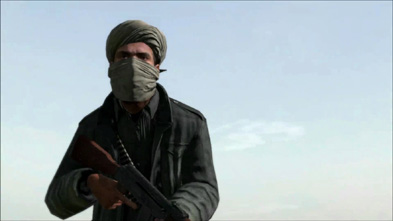
Made using an Afghanistan-based war simulator, Baden Pailthorpe?s Formation V explores the aesthetics and dynamics of military movement. In the work, two opposing forces of US soldiers and Taliban combatants follow invisible way-points side-by-side. Oblivious to each other?s presence thanks to a hacked game setting, the usual violence of this relationship is transformed into a poetic rhythm that repeats and amplifies the avatars? movement.
Baden Pailthorpe (b. 1984) is an Australian media artist, writer and curator. His work engages with the political and conceptual potential of technologies and cultural content. His recent international exhibitions have been focused on the politics and aesthetics of military technologies, including simulators, cinema and video games. Baden Pailthorpe is currently undertaking a Ph.D in New Media Aesthetics at UNSW, Sydney. He holds a MFA from l`Université Paris VIII and a MA from the College of Fine Arts, UNSW. His work is held in private and public collections. Some recent solo and group exhibitions include Gap Year: New Sydney Art, ARTSPACE, Sydney; Formations, Martin Browne Contemporary, Sydney; Yes, We`re Open, The Netherlands Media Art Institute (NIMk), Amsterdam; FILE 2012, Sao Paulo, Brazil; Game Change, Telfair Museum of Art, Savannah, USA; Lingua Franca, Firstdraft Gallery, Sydney & Monobandes II, Les Territoires, Montréal, Canada. Baden Pailthorpe is currently curating an ambitious exhibition in partnership with Screen Space, Melbourne, around the theme of military vision to be held in April 2013.

María Palacios Cruz
Argos
0 | 0 | | 0:0 | Belgium | 2007
Argos is a Brussels based centre for art and media that was founded in 1989. Over the years the organisation has developed from a distributor of artists' video and film into a broader art centre incorporating functions such as exhibitions, screenings and events, production, conservation and preservation, publishing, and the development of a public media library. As an interdisciplinary centre for art and audiovisual media, the goal of Argos is to create a production, presentation, distribution, and preservation platform for contemporary Belgian and international audiovisual and visual arts, and more generally all forms of artistic expression moving on the crossing point with the audiovisual media. In a rapidly evolving social and cultural landscape, Argos wants to track characteristic developments in the audiovisual and visual arts, and the socially speaking visual and media culture as a whole, in a critical way providing a frame of reference and interpretation to the public.
Jean Jacques Palix
CE DISQUE EST LE MEME QUE L'AUTRE
Video | dv | color | 9:0 | France | 2009
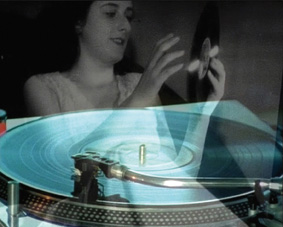
Film multi-écrans de 9 minutes utilisant des rushes de longs métrages représentant des tourne-disques ou des personnes manipulant des disques. La bande sonore est constituée du mixage naturel des sons originaux de ces rushes.
Compositeur et arrangeur de musiques de films et de chorégraphies, scénographe sonore pour des installations, collecteur et archiviste de musiques rares, chasseur de sons, Jean Jacques Palix est toujours attentif aux expérimentations. À la suite de ses années de productions et de réalisations de programmes radiophoniques à Radio France puis à Radio Nova dont il fut un des fondateurs en 81, il crée Tapage Atypique, puis, en 1991, le label de disques Song Active, pour répondre à son désir d`un studio ouvert aux rencontres artistiques, musicales et sonores. Il compose les musiques pour de nombreuses chorégraphies ainsi que des films d`artistes et documentaires parmi lesquels, récemment, "A l?infirmerie" de Fleur Albert, "Ode pavillonaire" de Frédéric Ramade.... En 2002, il réalise le film "Conférence sur rien" autour d`une lecture d`Eve Couturier, d`après "Lecture on nothing" de John Cage. En 2007, il crée 16`33", 33 hommages de 30" à 33 compositeurs et expose cette pièce à la galerie IN SITU / Fabienne Leclerc à Paris. En 2009, il réalise le film "Ce disque est le même que l`autre" pour une exposition personnelle ?Staccato? à la galerie Michel Journiac à Paris. Il est commissaire de l`exposition "Cornelius Cardew et la liberté de l`écoute" au CAC de Brétigny sur Orge.
Ursula Palla
Flowers IV
Experimental video | dv | color | 7:0 | Switzerland, Netherlands | 2004
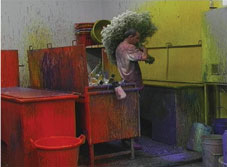
"Flowers IV", a video work belonging to the "flowers" series (I-XVII), was made at the flower reloading point in Aalsmeer, Holland. It shows workers busy dyeing flowers and plants. White flowers, preferably carnations, asters, roses, tulips, and Baby's Breath, are manually plunged into coloured baths, then dried and packed up. Starting at four in the morning, workers, for the most part illegally, busy themselves with filling the colour wishes of a difficult clientele. This way, flowers the colour of which is in fashion are delivered more exactly and more rapidly, and can be more efficiently adapted to the changing seasons whereas cultivating them requires time. The video accompanies the dyers and offers a short glimpse of their daily lives in which the flowers' perfumes mix with the smell of the synthetic colours while in the background we hear a radio praising the merits of authenticity (original song from the dyeing workshop). The walls covered with traces of hard work display the struggles between the desire for frills and the economic and ethic abuses. Flowers, the symbol of natural beauty, turn into a metaphor of merchandise and waste. A video that evokes and mixes the most variant of levels. This handmade work, in this electro-digital world, where everything seems possible, and where with a single click we can modify a colour, gives us a peculiar impression and reminds us of times we thought were gone for long What's more, on another level the video presents an aesthetic history of paint and of the sensual joy born out of colours in continuity with Jackson Pollock's performance in "Action Painting", in the country of flowers. Fragile situations, the multiple various ways of seeing, and the realities are in this way made visible.
Ursula Palla was born in Chur, Switzerland, in 1961, and now lives and works in Zurich. Education and Projects: 1989 ? 1992: F+F Zurich, School of Art and Media Design Since 1992: works independently in media art 1992 ? 1999: teacher of video at F+F Zurich 1994 - 2002: member of the media-performance group cpx Zurich Since 1998: has worked with several artists, including; Doris Schmid, Walter Pfeiffer, Franz Gratwohl, Victorine Müller, and Fabrice Gygi. Selected Video Festivals - Viper, Lucerne, Switzerland, 1996 - San Francisco, USA, 1997 - Centre Culturel Suisse, Paris, 1998 - experiMental Zurich, Switzerland 2000 - Videofestival, Guadalajara, Mexico 2000 - Videofestival Reithalle Bern, Switzerland 2003 - Viper Basel Kunsthalle, Switzerland, 2006 - Balkan TV Zurich, Switzerland, 2006 Grants and Scholarships -Werkstipendium 1997 and 1999 Kanton AR, Switzerland -Werkstipendium 2000 Kanton GR, Switzerland -Werkstipendium Kanton Zürich, Switzerland 2004 -Stipendium Art in Residence die Höge, Germany (June - August 2001) -Atelierstipendium Stiftung Binz 2002 ? 2004 Zurich, Switzerland Awards -CynetART Award 2004 Dresden, Germany for "flowers I" Permanent work in a public space: Wohnüberbauung ABZ Jasminweg Zurich, Switzerland 2003 Public Collections - Kunsthaus Zurich, Switzerland - Stadt Zurich, Switzerland - Zentrum für neue Medien Karlsruhe, Germany - Seedammkulturzentrum Pfäffikon, Switzerland - ArtEastFoundation Tirgu Mures, Romania
Manuel Palma
Noche día
Video | hdv | color | 11:25 | Spain | 2015
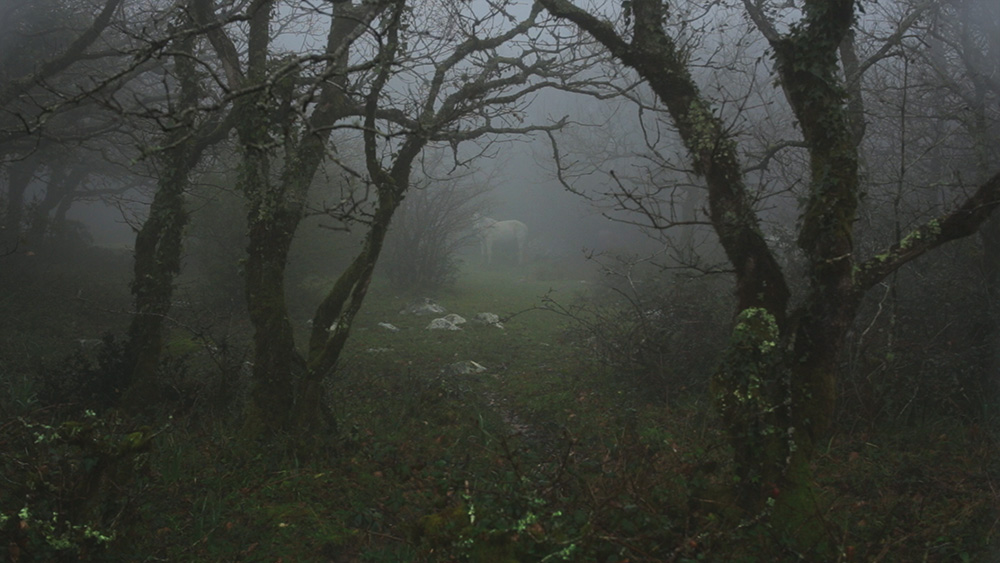
A path and someone walking. We observe several atmospheric phenomena such as: the thick haze of mist gradually reveals the way, various intensities of rain falling waved by wind gusts. We move between a haunting and strange serenity which is interrupted by sounds of creatures who live in this place. A way of looking that is used to link space and thought. We move at same time as the landscape with a movement of camera that slides between the natural rhythms of the forest.
Manuel Palma was born in Cadiz in 1986. His audiovisual work has been seen in centers and festivals such as V Festival de MARGENES "Film Letters" in Madrid, ZINEBI57 "Zinergentziak15" in Bilbao, FIVA International Video Art Festival in Buenos Aires, "Music and Visual Arts Sens meeting" in Rambleta, Valencia, CINEMISITICA "Art Cinematheque Cinemistica 7" in Granada, "XXIV Muestra Abierta de videoartistas 18D" in Neomudejar, Madrid. He studied Fine Arts in Sevilla and Valencia were he was strongly influenced by classical painting and drawing. He combined his knowledge in drawing and painting with video and sound art education. Manuel Palma complete his audiovisual education with the exchange program at Lietuvas Dailes Akademija in Lithuania, ECAM: Film School in Madrid and VideoLab Master in Madrid. He has developed courses and workshops with artists and filmmakers like James Benning, Lois Patio, Victor Erice, Mercedes Alvarez. Currently he resides in Madrid.
Riley Pam-grant, Abi Meekel, Claire Meekel
Tomato Sauce Takeaway
Experimental film | hdv | color | 4:13 | South Africa | 2018
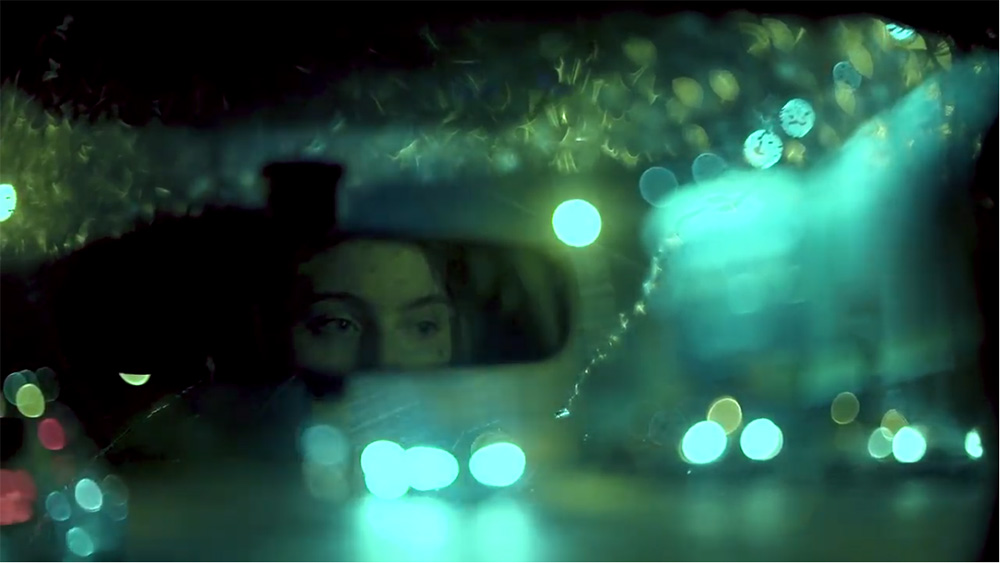
Tomato Sauce Takeaway is a four minute short film, shot in Johannesburg, South Africa. The film documents the final evening routines of a few urban life forms in Johannesburg city. It does so in a way that is observational, introspective and personal given our own relations to space, routines and urban loneliness. The mundanity of these acts highlights an absurdity in the city life routines we take for granted. The people and the city itself become characters in a narrative of the last things we do before retreating to residential respite.
Terrace House is a Johannesburg based artist collaboration between Abi Meekel, Riley Pam-Grant and Claire Meekel that began in early 2017 with an immersive video and sound installation titled "The Blue Exhibition". They predominantly but not exclusively work in video, light and sound installations. Since the collaboration's inception, Terrace House has exhibited "The Blue Exhibition" twice in Johannesburg, with the first iteration at a trendsetting club and exhibition space called Glory, and then again at the Fak'ugesi African Innovation Festival. In January 2018, Terrace House exhibited "The Blue Exhibition" in a solo show at Gallery MOMO Cape Town. Their most recent video and sound installation titled "Monument" was also shown at Gallery MOMO Cape Town in July 2018 as part of the gallery's forth annual video exhibition, Transmissions, and again in Johannesburg where they were invited to show "Monument" in launching the 99 Juta design showrooms space situated in Braamfontein, which is the cultural melting pot of Johannesburg. The short film, Tomato Sauce Takeaway, was filmed in 2018 and has not been screened as of yet.
Stefan Panhans, Andrea Winkler
Anima Overdrive
Experimental video | hdv | color | 4:19 | Switzerland, Germany | 2023
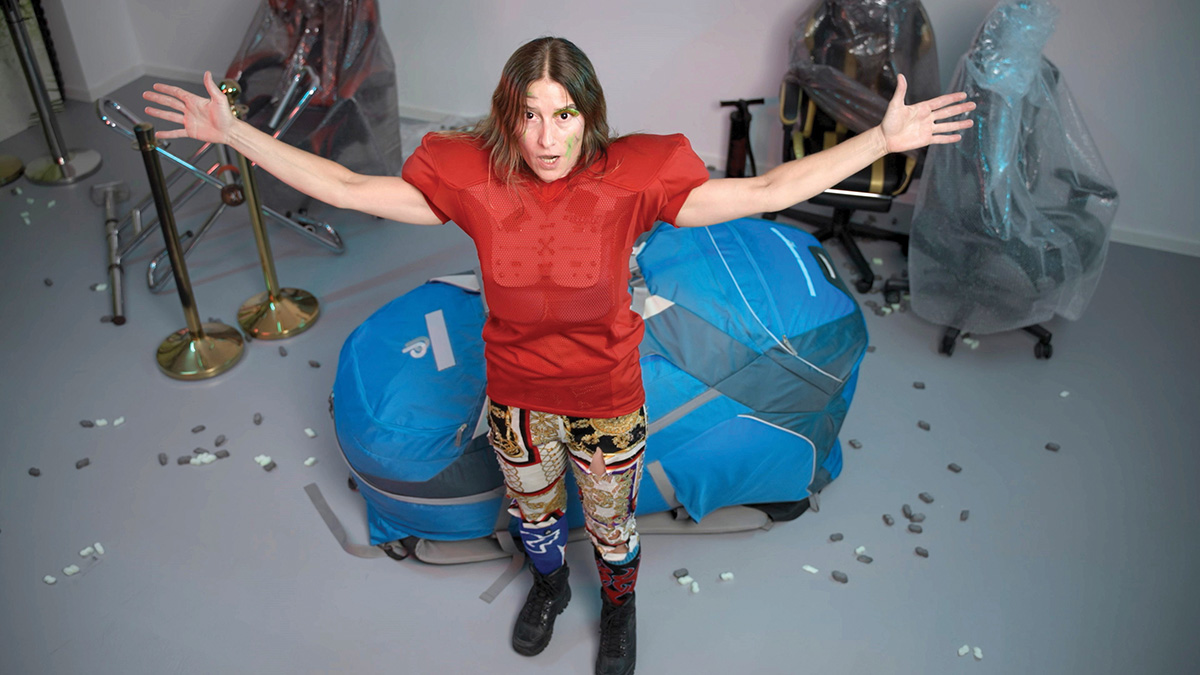
I deliver everything! raps the 'delivery-anti-heroine' and 'delivers' the sound of a rebellious exhaustion in a world increasingly defined by algorithms and AI where everything seems to become a commodity and we all breathless suppliers
Stefan Panhans & Andrea Winkler are artists and filmmakers collaborating on films and video installations that are shown internationally at film and media festivals and in numerous solo and group exhibitions.
Tassos Papatsoris
Vanitas
Animation | dv | black and white | 4:0 | Greece, United Kingdom | 2004
Vanitas is a film animation with a very experimental character.It is an effort to make a contadiction between the style of the 2D, traditional (black and white) animation and a story, characterised by a very shocking and unusual for such kind of work concept. The explicit and detailed depiction of a very shocking action (as suicide is) with the use of cartoon, funny chatacters creates a very weird and hard final result that shocks the audience. Finally the project underlines the fact that the promising, posthumusly eternal life does not necessarily exist and the religious theories where support that concept are as fake as cartoons are.
STUDIES 1996-2002 Athens School of Fine Arts- BA Fine Art(Painting) 2004-2005 University of West England- MA in Animation WORK EXPERIENCE 1996-2000 Life drawing teaching at N.Stefos foundation art school (17 Kallifrona Street, 11256 Athens) 1997-2002 Life drawing teaching at D.Giotakis foundation art school (8 S.Merkouri Street, 11632 Athens)
Guillaume Paris
Bad Anima
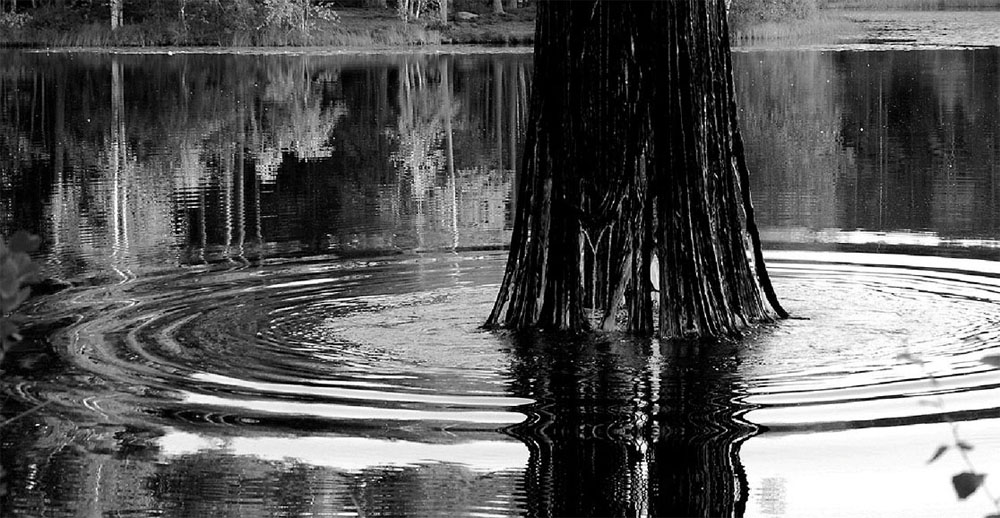
Animation | hdv | color | 2:50 | France | 2012

Bob Paris
Shadow of a Doubt
Experimental film | dv | black and white | 6:10 | USA | 2009
Jean Taek Park
One Rainy Night
| hdcam | color | 10:1 | Korea, South | 2013
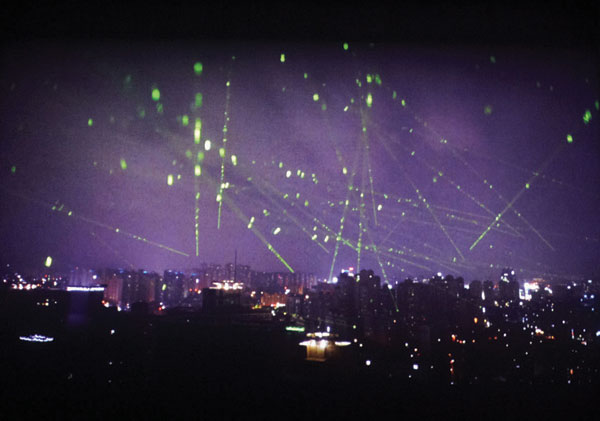
One man is on his way home where he could not feel at home. He dreams of fleeing away but in the same time tries to settle down by building a room within the house with laser beams. Looking into particles floating in the air which are not visible under normal light conditions he finds that the natural movements of air seems to resonate with his emotions.
Jean Taek Park is an architect. Born in Seoul 1975, he grew up in the time of rapid economic growth and mass construction. Places where he lived in had completely transformed. Naturally he became interested in architecture not as an iconic object nor a perfect shelter but rather as a time-space which one could emotionally attach to it. He uses film to discover a new dimension of time-space.

Maximiliano Parlagreco, Micaela Pinalli
Yo La Tengo
Experimental VR | 0 | color | 0:0 | Argentina | 2018
When the Lumière brothers invented the cinematograph in 1985, they quickly understood that the spectator's curiosity was aroused by the mere reflection of reality: people were flabbergasted at watching situations that they usually took for granted, such as a train arriving at a station or workers leaving a factory. In this piece we scanned objects and environments which make up our conception of reality and placed them in a virtual space by using photogrammetry, a 3D reconstruction technique. We allow the users to experience a twist on the conception of time and space they are used to by altering the dimensions of the scans, placing them on new positions, and embracing the errors that occur when capturing reality. The result is an absurdly atypical territory which can be navigated via teleportation as if it were a new planet. The spectator is physically circumscribed to a narrow perimeter but virtually the limits become fuzzy and elusive, every direction is equivalent and their individual and uniqueexploration will force them to reflect on the nature of virtual reality.
Maximiliano Parlagreco is an audiovisual design student (FADU, UBA) who’s interested in the impact of technology on society and the fuzzy line which divides reality from virtuality. He has employed photography, video, creative coding and digital animations in an experimental way to create navigable universes which are slightly different from the one we live in. Lately he’s ventured both in the field of virtual and augmented reality, as well as that of artificial intelligence, exploring the human-machine symbiosis that occurs in these devices. Micaela Pinalli is an audiovisual design student (FADU, UBA) who has worked in analogue and digital found footage creation with a great interest in montage and the way accidental interactions between shots creates a meaning. She currently develops projects ranging from interactive and graphic design to photography and animation. Since June 2019 she's been running the independent publisher Cuarto Ciego, where she creates and sells artistic graphic pieces.
Tania Parovic
ATTENTATE
Experimental film | dv | color and b&w | 10:40 | Germany | 2006
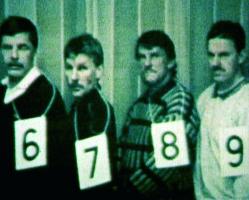
The term assassination describes a planned, attempted or successfull assassination of a public figure. The goal of such an assassination is not the killing of a private person. The assassination is meant to destroy the person as a political, social or public persona. The project assembles diverse material from film, TV and the press and shows in its structure and composition different approaches to the collected material. By structuring the material series arise showing homogenic structures which embody different aspects like the various scenes of the crime, media coverage, speculations, collective mourning, victims, assassins and remembrance of assassinations. With the serial character in mind a kind of game unfolds which produces the possibility to highlight one specific aspect, an assassination, an assassin, a motive, the results of the assassination or the victim - or serve as a model. The serialisation of the assassinations results in continuous correlations of the different deeds, a shift of themes within the series but it also shows their interchangeable character. It is not the meaning of a specific image or text or crime scene that matters by treating this theme artistically. More important are the associations and interpretations of the beholder and the interactions of the pictures themselves.
Tania Parovic. Born 1977 in Aachen, germany. 2002 Diploma in Communications Design at the academy of fine arts Msastricht, netherlands with the film »0709.«. 2003?2005 Postgraduate study at the academy of media arts Cologne and various works and projects for Television, fashion and art. 2006 Diploma with the filmproject »ASSASSINS«.
Agustín Parra
Autorretrato 2
Performance | dv | color and b&w | 1:42 | Colombia | 2008
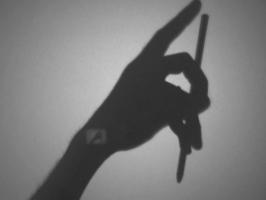
This work develops a reflection about the performative character of drawing. Autorretrato (Self-portrait) belongs to a series of video performances that explore basic elements of drawing in relation to the idea of self representation. The intimate and indissoluble connection between mind and body permits a drawing becomes an event, that is to say, an alive experience that not only takes place during the execution of the outline but also during the route of spectators? glance. The video media emphasizes the ephemeral character of the drawing, focusing the awareness of spectators in the processes involved in the act of drawing instead of in the drawing itself. The video presents the shadow of a hand that tries to draw its contour. As the shadow is mutable, immaterial and impermanent, the drawing tries to establish the limits of that elusive form, which resists by its own nature to be fixed. Thus, the resulting outline is a product of being in time: the track of an event instead of the representation of any objective element of the material reality.
Arnold Pasquier
Borobudur
Fiction | hdv | color and b&w | 80:0 | France, Italy | 2015
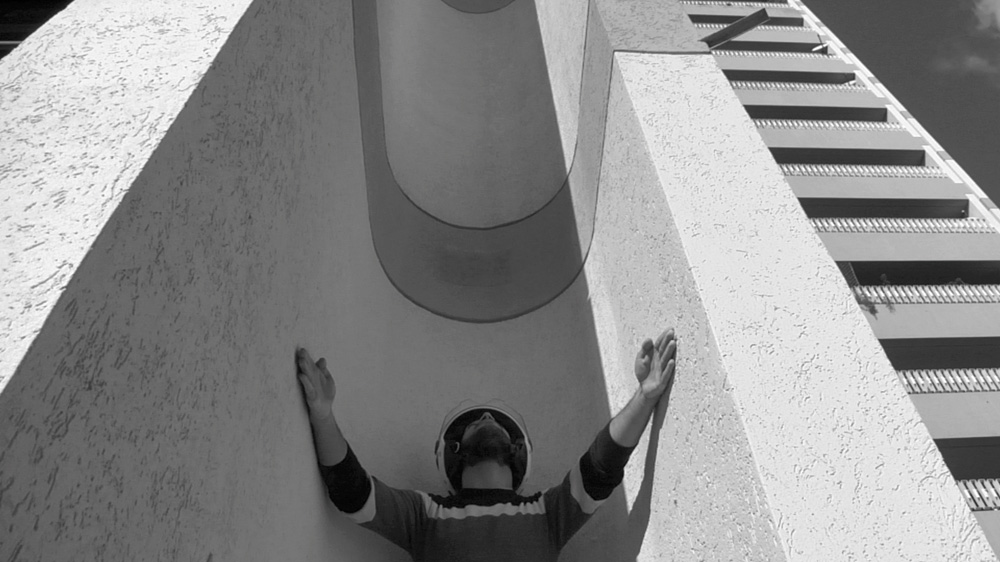
Federico est étudiant en architecture à Palerme. Il parcourt la ville à la recherche de bâtiments moderne qu’il dessine et photographie. Dans un parc, il rencontre un jeune homme, Borobudur, qui va lui ouvrir les portes d’une autre urbanité. Dans le sillage de ce garçon magique, Federico abandonne son quotidien et découvre une ville qui le métamorphose.
Arnold Pasquier est né à Paris en 1968. Dès ses études d’arts plastiques et de cinéma, il réalise des essais en Super 8 et en vidéo dans lesquels il développe un univers de journaux filmés et de fictions. À vingt ans, il se rapproche de la danse contemporaine et collabore avec des chorégraphes comme documentariste et comme danseur. Cette expérience marque la réalisation d’une œuvre où la danse tient une place importante. En 1997, il est reçu comme résident au Fresnoy, Studio national des arts contemporains à Tourcoing où il conçoit l’installation C’est ici que je donne des baisers. En 1999, il présente dans la Grande Nef du Fresnoy le spectacle C’est merveilleux pour 10 danseurs et acteurs. Il est l’auteur de nombreux films (fiction, documen- taire, art vidéo), de mises en scène de spectacles, de scénographies, d’émissions de radio pour les Ateliers de Création Radiophonique de France Culture. Son travail s’articule aux croisements de ces différentes disciplines. En 2004-2005, à la faveur d’une résidence de l’association française d’action artistique, programme, «Villa Médicis hors-les-murs», il réalise le film Celui qui aime a raison fiction de long métrage sortie en salle en 2006.Il collabore avec des cinéastes et des plasticiens comme cadreur ou monteur.
Arnold Pasquier
O amor moderno
Video | hdv | color | 8:52 | France, Brazil | 2017
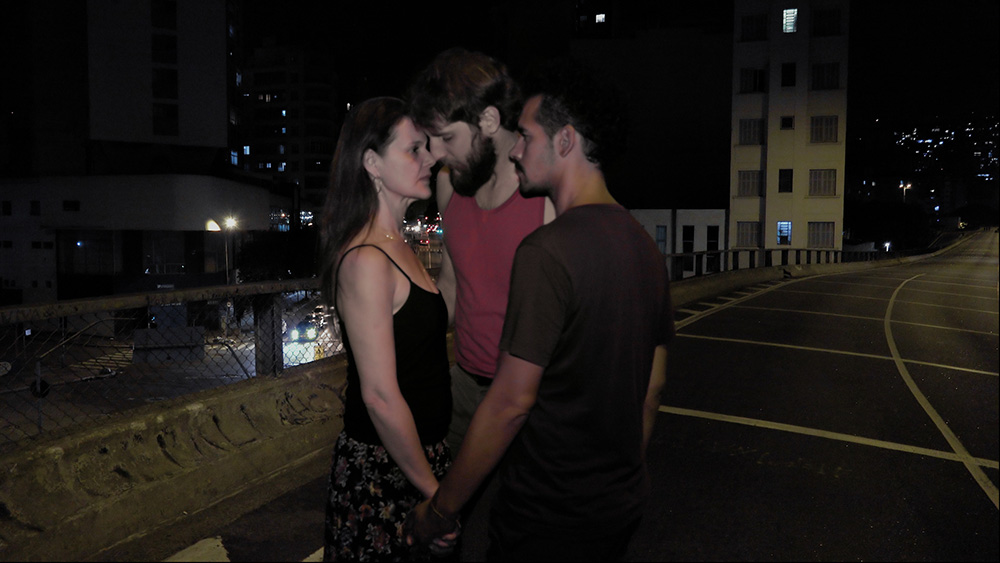
L'installation vidéo d'Arnold Pasquier fait partie d'une série qui vise à reflèter les conditions d'une expérience sentimentale en lien avec un paysage et à inventer la forme spectaculaire d'un amour contemporain. Deux paysages creusent une absence et révélent la possibilité d'une rencontre. D'une part, une sculpture monumentale couvre les ruines du village de Gibellina en Sicile, détruit par un tremblement de terre; d'autre part, une autoroute coupe irrémédiablement en deux un quartier d'immigrants italiens de la ville de Sao Paulo au Brésil. Ce cercueil blanc, ce moulage en béton débordant, offre une nouvelle scène pour exprimer - jour et nuit - un amour qui est en lui-même l'invention d'une forme d'amour.
Arnold Pasquier est né en 1968 à Paris. Dès ses études d’arts plastiques et de cinéma à l’Université Paris 1 Panthéon-Sorbonne, il réalise des essais en super 8 et vidéo dans lesquels il développe un univers de journaux filmés et de fictions. À vingt ans, il se rapproche de la danse contemporaine et collabore avec des chorégraphes en tant que documentariste et danseur. Ces expériences inaugurent la réalisation d’une oeuvre où la danse tient une place importante. En 1997, il intègre le Fresnoy, Studio national des arts contemporains. Arnold Pasquier est l’auteur de nombreux films, vidéos, documentaires, fictions, mises en scène de spectacles et émissions radiophoniques : son travail se dèveloppe au croisement de ces différentes disciplines. Ses films ont été présentés et primés dans de nombreux festivals de cinéma en France et à l’étranger (Festival du film de Locarno, Festival Côté Court à Pantin, Vidéodanse, Biennale de Busan, FIDMarseille, Rencontres Internationales Paris Berlin Madrid). En 2005, il est lauré d’une bourse Villa Médicis Hors les Murs et il réalise le film Celui qui aime a raison au Brésil, sorti en salle en 2006. Son film Notre amour est présenté en sélection officielle au Festival du film de Locarno en 2009. En 2012, il présente un court métrage intitulé L’Italie et, lauréat d’une résidence de réalisation du Festival Côté Court de Pantin, il achéve la réalisation d’un long métrage de fiction expérimentale, Si c’est une île, c’est la Sicile.

Chiara Passa
Still Life
Virtual/Augmented/eXtended Rea | 4k | color | 0:0 | Italy | 2020
“Still life” is an art-installation both physical - because it is composed of several AR sculptures made of ceramic, 3D printing, and other materials - and VR, because it is usable through oculus rift 3D viewer. “Still life” analyses the processes of nature by investigating the relation with it and what is represented in art nowadays as still life. The VR artwork puts in question what is really dead in nature and what is still alive in history of art, by speculating on landscapes, paintings and objects, and so creating through virtual reality an object-oriented space formed by a vibrant still-life environment designed all around the spectators. To design the vr artwork’s environment I used the techniques of photogrammetry and 3D scan objects, then I worked on manipulating the related maps/textures. The onlookers wearing the headset can touch the things ( i.e. food, flowers, fake dead animals, plants, rocks, shells, drinking glasses, books, vases, jewellery, coins, pipes, etc. ) in the still-life recreated by the real objects placed physically on situ. Audience can discover hidden senses by interacting with wired objects and new spaces of perception unfolding into diverse meanings. I make a sort of Duchampian détournement / decontextualization on the use of the vr medium itself, by designing immersive milieu in which, sometimes, the vr camera view angle is locked at 180°, 220°, or 310° instead of 360°. So, the onlooker is forced to peek/peep through the real space, into a reconstructed and resized immersive space sometimes semi-open or semi-closed, but made of wired geometric angles and futuristic views, playing with the concept of infinite including infinitely large, infinitely small, micro and macro dimensions, producing an unexpectable slide and shift of meaning. “Still life” is an experimental project, which challenges physical place to render it vibrant and participatory. It is through audience experience that “Still life” addresses us to the paradox of the modern space-time condition, even more diluted between physical and liquid space. “Still life” is part of a vr research project which I began in 2015 and which slots into my artistic journey since 1997, the fruit of a deep interest in space and how it is transformed and shaped “by” and “in” the language of informatics. In software and electronic devices, I find potential vehicles for the investigation and visualization of my research and theories. My “Still life” by investigating and analysing the ancient and fervid European Still Life art-practice, wants to keep alive its tradition across the magical ontology of the VR vision. In “Still life” I designed each piece to behave and move beyond its own functionality, according also to the Object Oriented Ontology philosophy.
Chiara Passa, visual artist (b. Rome 1973) working in media art since 1997. I graduated (M.F.A.) from the Fine Arts Academy of Rome, Master in audio-visual media at the Faculty of Modern Literature. After living in many different places I’m currently living and working around & in Rome. My artistic research analyses differences in virtual spaces through a variety of techniques technologies and devices - often using virtual reality and augmented reality technologies as an artistic medium to explore architecture as interface. I use VR and AR to comprise their intrinsic language and so on for shaking-up and challenging the static notion of architecture, by exploring the liminal duality between tangible and virtual place, achieving in art a strange oscillation between spaces. Yet, I work with animations, net-artworks, interactive and site-specific video-installations and AR / VR video-sculptures, sometimes made of Carrara marble, fresco technique, plexiglass, or 3D printing parts. Yet, I use VR medium in order to create site-specific video installations using a wide range of google cardboards. Typically, the 3D viewers are installed all over the real space, designing geometric shapes in liminal areas where onlookers can peek/peep thru 3D viewers over the wall, and so immerse themselves into a re-constructed/resized VR space made of wired geometric angles and futuristic views, sometimes semi-open or semi-closed at 180°, 220° or 360°, so highlighting the paradox of the modern space-time condition, which nowadays is even more diluted in between physical and liquid space. My work has been internationally exhibited from festivals, conferences, and institutions, including: 2019 «Object Oriented Space». Solo show at Museum MLAC Rome. «Virtual Natives – Sculpture», Roehrs & Boetsch gallery, Zurich (2019); «Oslo Night show», HEK Museum Basel (2018); «InSonic» immersive art show, ZKM | Center for Art and Media Museum, Karlsrhue (2017); «From live architecture: Dimensioning», solo show at Furtherfield gallery, London (2016); «Off Biennale Cairo» (2015-2016); «ISEA Disruption», Conference and exhibition at Vancouver Art Gallery. (2015); «Morphos», Vortex Dome - immersion media, Los Angeles (2014); Media Art Histories IV - RENEW conference, Riga. (2013). FILE | Electronic Language International Festival, São Paulo. (2011); Electrofringe - festival of new media art, Newcastle, Australia. (2008); BizArtCenter, Shangai (2005); MACRO – Museo di Arte Contemporanea, Roma (2004), 11° Biennale of young artists of Europe and the Mediterranean countries: «Cosmos - a sea of art», Athens. (2003); 48a Biennale di Venezia (with Oreste group), Venezia (1999) e Fondazione Bevilacqua La Masa, Venezia (1999).
Gregor Passens
Wake up
Experimental video | dv | color | 5:18 | Germany, Argentina | 2005
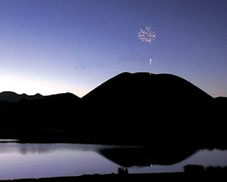
In the crater of a volcano in Catamarca, Argentina, a firework is set off at dawn, at 4000 metres altitude.
Born in 1974, Gregor Passens lives and works in Munich and Buenos Aires, Argentina. He studied at the Munich Academy of Arts, where he was part of Professor Nikolaus Gerhart's class; he graduated in 2002. Selection of Scholarships: 2002/03 Annual scholarship from DAAD, Buenos Aires, Argentina 2005 International Villa of Artists, Concordia, Bamberg 2006 American scholarship of Bavaria. Selected Exhibitions: 2003 "Verboden op het Werk te komen" W 139 in Brakke Grond, Amsterdam; II Biennial of Tirana, Albania 2004 STUK, Louvain, Belgium; "Xtreme Houses" Lothringer 13, Munich + Halle 14 Federkiel foundation, Leipzig; "Muslim Mulligi Prize", the Kosovo Art Gallery, Pristina 2005 "A Parasite Showing" k-forum, Vienna, and ARGE Gallery, Bozen; "Buenos dias Santiago" - an exhibition as expedition, Museum of Contemporary Art, Santiago of Chili 2006 VIDEOTHEKA, Vienna Kunsthalle; "Triumph", El Basilico, Buenos Aires; Open Space, Art Cologne, Cologne
Chinmoyi Patel
Chin Goes to Stansted
Video | dv | color | 2:36 | India, United Kingdom | 2009
Sara Pathirane
Holding Clouds
Video | hdv | color | 9:40 | Finland | 2018
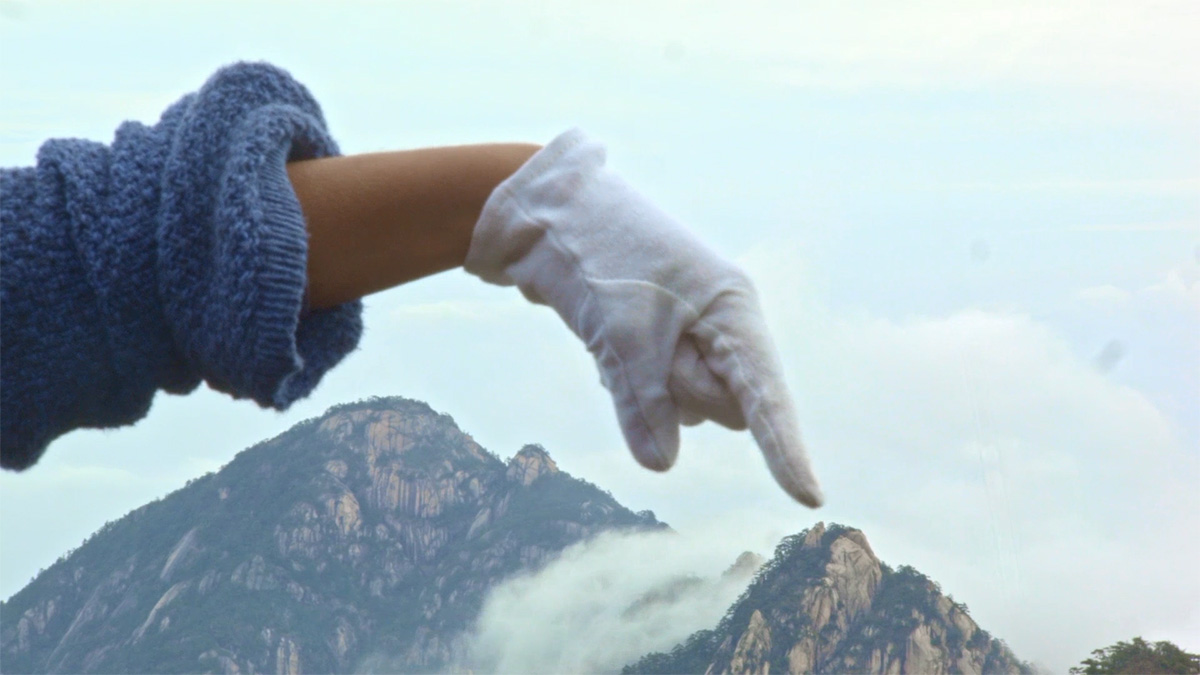
Holdind Clouds depicts a choreography on Huangshan the Yellow Mountain in China. The mount Huang is famous from the old chinese shan shui – mountain-water ink paintings. Still now the landscape gathers people to witness it. The view itself is often covered in clouds, only a peak of a mountain hovering in the sight. Still a thousand photos are taken there daily. People pose for photos infront of the landscape. The rythm of gestures done by the visitors, the reaching out, pointing, holding the air and touching the mountains formulates a choreography for the mountain. Chilean composer Fernando Munizag’s piece Mi última palabra china (My last Chinese word) binds the poses into a broken language, an attemp to get hold of tones and diftongs hidden in the grayscale of the moving clouds. The music is based on discoveries Munizaga made in the field of phonetic analysis of Mandarin language. There is a constant movement, with rather simple materials and gestures. All the harmony of the piece is based on strings’ natural harmonics.
Sara Pathirane’s work deals with the tradition of landscape painting and the problematics of taking a picture. As shooting locations for her videos she uses nature areas known from movies and paintings, shifting between the everyday and the fiction. She works with video, painting and live-installations. Pathirane lives and works in Helsinki. She has studied in the Finnish Academy of Fine Arts and Accademia Albertina in Torino. Her works have been shown for example at Taiga-Space, Saint-Petersburg (2016), Colombo Art Biennale (2016) and Kiasma (2010, 2013).
Lois Patiño
Ecos del bosque
Experimental doc. | | color | 6:30 | Spain | 2011
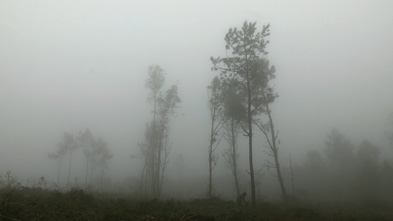
From a conception of the forest as a mythical space we observe this landscape being transformed by the woodcutters. The fog´s atmosphere emphasize the idea of the spiritual linked to the Nature. The tree as a sacred symbol. The man is here observed from the distance, we keep the point of view of the forest being cut down. This suggest a reflection about the relationship between man and landscape. From a poetic look we try to find the revelation in the landscape, a perceptive look to the process of changing in the landscape. The woodcutters cut down one by one the tall trees as a mechanical action. Again the contrast of the mythical thought inspired by the Nature and the idea of the scientist progress by the machines.
LOIS PATIÑO (b. Spain, 1983) Lois Patiño studied Psychology at the Universidad Complutense of Madrid, and cinema at the NYFA of New York and the UdK of Berlin. He studied documentary cinema in Barcelona at the UPF. He has done workshops with directors and artists such as Pedro Costa, Joan Jonas, José Luis Guerín or Víctor Erice. He has worked with the filmmaker Mercedes Álvarez in her second film Future´s´Market. His works around identity and landcape have been exhibited in places such as Reina Sofía, Centre Georges Pompidou, CGAC, Casa Encendida, CGAI... and in festivals (Documenta Madrid, Festival de Las Palmas, Jihlava festival, VideoFormes, Big Screen Project New York...)