Catalogue > Search
Results for : Tout le catalogue
Julien Loustau
Sub
Experimental doc. | dv | color | 45:0 | France, China | 2006
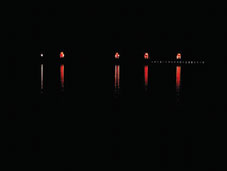
Vostok Lake has been trapped under the Antarctic ice and isolated from the rest of the world for millions of years. This exceptional environment, deprived of light and subject to extreme pressures and temperatures, might shelter unknown forms of life. The only technology that would allow people to reach the lake without any risk to contaminate it is the Cryobot, a sounding line conceived by NASA and meant to explore sub-ice oceans on Mars and Europe. In China, in the area of the Three Gorges, the construction project of the biggest hydroelectric dam in the world is about to be finished. 600 km of valleys have already been flooded by this dam, which means that hundreds of towns have disappeared and 1.8 million Chinese people had to relocate. Throughout a night trip over the Yangtze River, in the distant exploration of its banks in a state of respite, this movie imagines the solitary odyssey of the Cryobot through the ice to Vostok lake.
Julien Loustau was born in 1971 in Salies-de-Béarn. He lives and works in Paris.

Ariane Loze
Nein weil wir
Video | hdv | color | 18:11 | Belgium, Germany | 2019
Collective consciousness has built itself up over the centuries, but society's boat is sailing on the seas of globalization. Voices sometimes very old warn us about the risks that men incur, when they are handed over to excess. The video features fragments of these discourses, which from generation to generation have brought fervor and citizen hope, in front of an empty room, symbol of our desertion in front of realities, sign of our increasing capitulation, expression of our renunciation. Outside, it rains more and more and a terrible wind rises. Climate change is on the horizon ... Increase the speed!
Ariane Loze, Belgium 1988. Lives and works in Brussels, Belgium Since 2008 Ariane Loze researches the coming to life of a story out of seemingly unrelated images with her camera. In these series of videos she takes on all the parts: she is at the same time the actress, the camerawoman and the director. Through the editing of the images she develops a relation between two (or more) characters and the architecture. The videos of Ariane Loze put the spectator in the active role of creating his/her own story out of the basic principles of film editing: shot and counter-shot, the presumed continuity of movement, and the psychological suggestion of a narrative. The filming of these videos has been made public as a ongoing performance. Ariane Loze studied theatre direction at the RITCS Brussels, and took part in a.pass (Advanced Performance And Scenography Studies) in Antwerp. She is laureate of the HISK (Higher Institute for Fine Arts) Ghent 2016-17. Recent exhibition projects include Videoformes Clermont-Ferrand (2015), Traverse Vidéo Toulouse FRAC Midi-Pyrénées (2015), Medienwerkstatt Berlin (2016), S.M.A.K. Etcetera Ghent (2016), Boghossian Fondation Brussels (2016), De Appel "You are such a curator" Amsterdam (2016), "Kunst om de lijf" Emergent Veurne, New York Anthology Film Archive AXW screening (2017), Watch this Space Biennale #9 Lille Brussels (2017), Gemischte Gefühle Tempelhof Berlin (2017), Salon de Montrouge Paris (2018), RIBOCA Riga Biennial of Contemporary Art (2018), Moscow Biennial of Young Art (2108) KANAL Centre Pompidou Brussels (2018). Solo exhibition at Centre d’Art Contemporain Chanot, Paris, exhibition at Gallery Michel Rein Paris (2019), Urbane Künst Ruhr – Ruhr Ding : Territorien curated by Britta Peters Oberhausen (2019), Solo exhibition De Vereniging S.M.A.K., Ghent (2019), Solo exhibition Gallery Michel Rein Brussels (2019). Ariane Loze’s videos got selected for the Movimenta Video Art prize in Nice (2017), and the Prix Médiatine Brussels (2016) and got awarded at the Art Contest Brussels (2015), by the Art For All Society of Macau (2016), Côté Court Festival Pantin (2017), Watch this Space Biennale #9 (2017) and Salon de Montrouge (2018) Ariane Loze will be resident at ISCP New York on the invitation of the Salomon Foundation in from January until June 2020.
Gabriela Löffel
Nous n’avons pas besoin de nous connaître à l’avance
Video installation | hdv | color | 20:15 | Switzerland | 2024
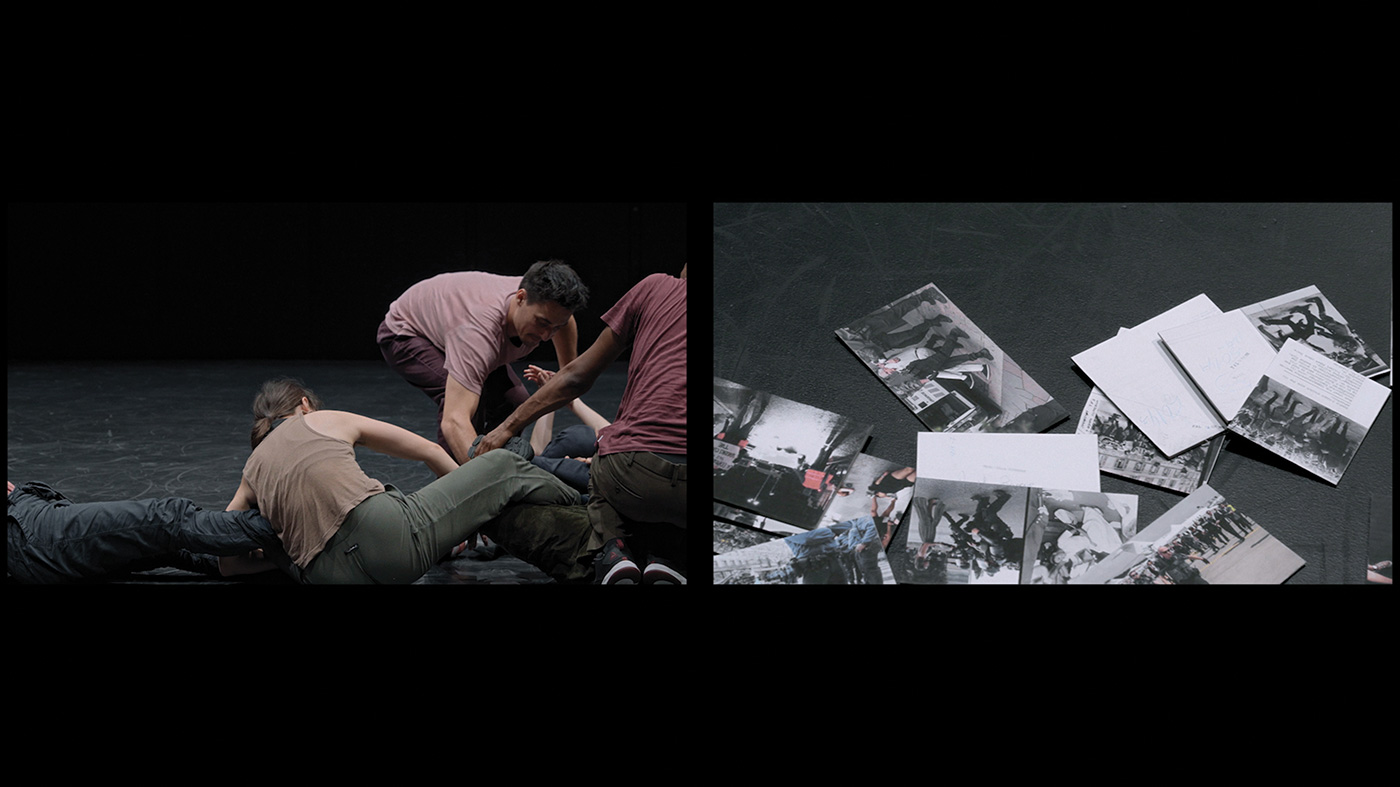
« We do not have to know each other in advance » is a hybrid video work that alternates moments of dance performance with archive footage and textual quotations. Gabriela Löffel draws on the political aspect of public space to construct her thinking, developing a visual essay that stages the ‘performativity of bodies in this zone of political action’. Drawing on the written work of Judith Butler, an American philosopher and gender theorist who has worked on the question of the body and its normalised representativeness in contemporary society, Löffel gives corporeality to the issues raised by the author. Quotations from Butler's work are shown alongside the danced and archival elements of the video. The almost fixed camera allows us to examine in detail the slow, precise movements of the dancers. The camera's movements are almost imperceptible, so subtle are they. The artist and choreographer Cédric Gagneur worked closely together to define the various movements that make up the choreography: they propose an abstraction of gestures of resistance or revolt, drawn from archive images from the collection of the Archives contestataires de Genève. The piece is inhabited by slowness and silence, giving the body enough space to unfold individually or collectively. The work offers a dialectic of the potential for protest in the public space. Co-produced by the Fonds cantonal d'art contemporain and the Fonds d'art contemporain de la Ville de Genève for the Mire program.
Gabriela Löffel mainly works with time-based media and focuses on the zones of political and finance structures, and infrastructures. Shifting and translating from the documented immediate to the fields of interpretation and mise-en-scène are strategies she uses in her work process. A method that often results in long-term projects and enables her to create spaces for questions and to propose disruptions to linear narratives. She is interested in the obliquity of the subject and his context. It’s in this gap, brought about by her way of addressing subjects, that her work opens onto reflections on the sense of how we understand a world when we become conscious of the fragmentation of our knowledge. Her work has been presented at institutions and galleries including MAST Bologna, Aargauer Kunsthaus, EMAF Osnabrück, Galería Metropolitana Santiago, Dazibao Montreal, and the Kochi-Muziris Biennale among others. Gabriela Löffel is a recipient of the Swiss Art Award, the Lewis Baltz Research Fund, the Landis+Gyr Grant, as well as others.
Birgit Ludwig
The Partition
Experimental fiction | hdv | color | 21:21 | Luxembourg, United Kingdom | 2018
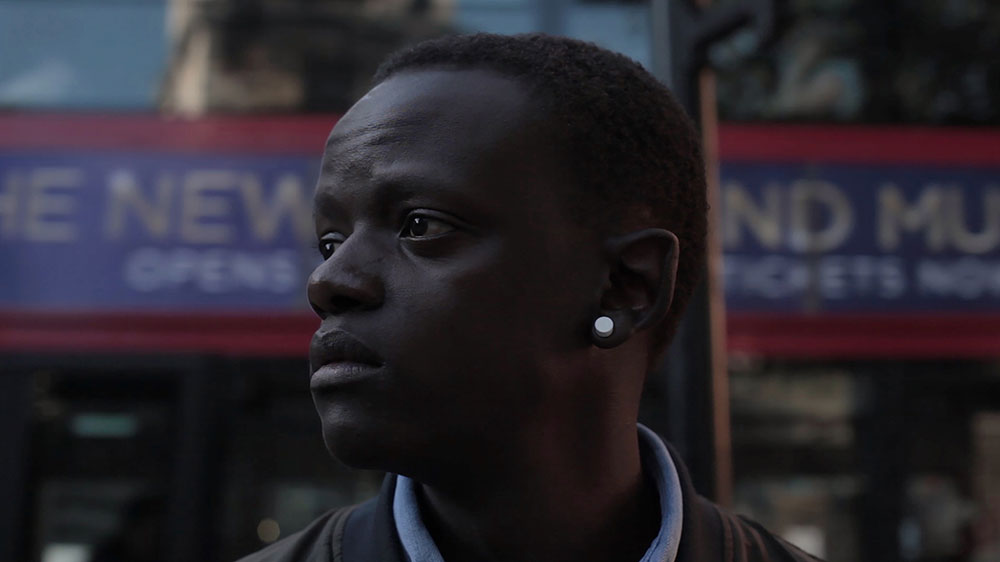
Blake awakes from a comatic episode for which there doesn't seem to be any explanation. Set in London, the film interweaves his and other characters' discontinued journeys marked by peculiar moments and encounters. At once sober and enigmatic, "The Partition" reflects on singularity, alienation and intangible windows in the wider context of a shifting techno-capitalist environment.
Birgit Ludwig (b. Luxembourg) is a filmmaker and artist based in London. Her films take the form of unconventional dramas or documentaries, interweaving realism and a poetic uncanny. She is a graduate of Central Saint Martins School of Art (BA Fine Art/Phoebe Llewellin Smith Scholarship Award) and Kingston University (MA Experimental Film).
Immo Luedemann
Estate
Experimental doc. | dv | color | 9:34 | Germany, USA | 2005
The video consists of scenes, that describe the course of a morning in a suburban area in Southern California. Observing and subjective views of spaces and details establish the place. The images and the editing suggest a closed form of narrative development of the film. Shortly after it seems that a character will become established, a break happens. Images showing subjective views, which might have got assigned to a person, take on a shift and one can hear three US-Marines answering questions about there living conditions in Iraq, while the images stay in suburbia.
Immo Lüdemann wurde 1975 in Düsseldorf geboren und studierte bis zum Jahr 2005 an der Universität der Künste Berlin und dem California Institute of the Arts, Los Angeles, bei Heinz Emigholz, Harun Farocki und James Benning. Seine Arbeiten beschäftigen sich mit strukturellen Problemen des filmischen Erzählens und mit Fragen der narrativen Beziehungen von Bildern. Er lebt und arbeitet in Berlin und Hamburg. Immo Lüdemann was born in Düsseldorf in 1975. Until 2005 he studied at the University of the Arts Berlin and the California Institute of the Arts, Los Angeles, with Heinz Emigholz, Harun Farocki and James Benning. His works deals with structural problems of cinematic storytelling and with questions of narrative relations between images. He lives and works in Berlin and Hamburg.
Stephan Lugbauer
About Me
Video | hdv | color | 10:3 | Austria | 2011
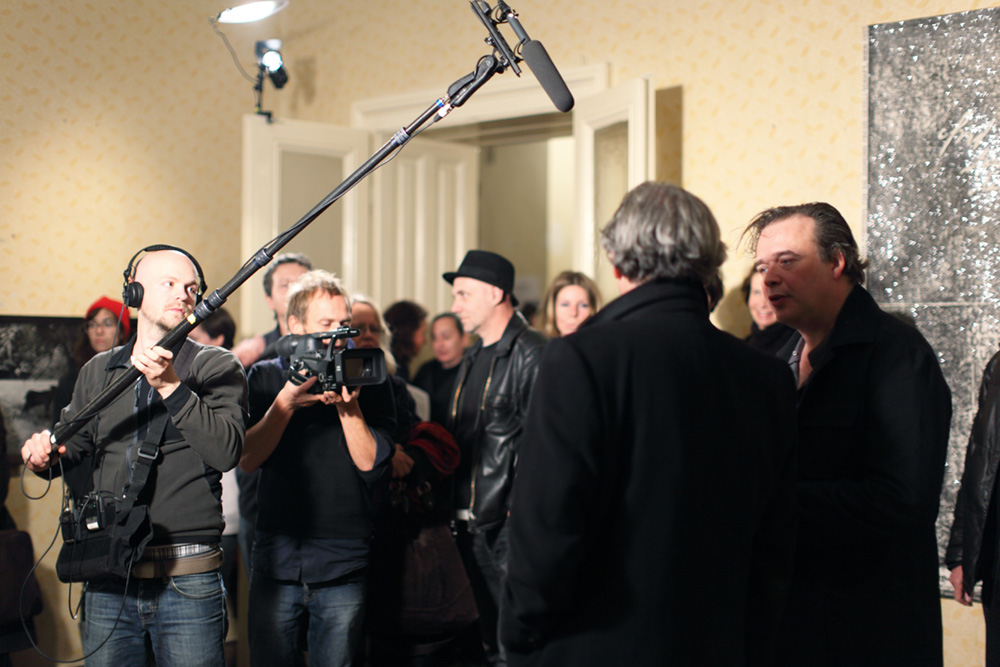
This work interlinks filmic, installative and performative layers. Joseph Kosuth?s compiled collection of contemporary art in the Freud Museum in Vienna is used as a filmset. Accompanied by a cameraman and sound technician a journalist interviews an artist pacing through the exhibition. The takes of this scene discuss conditions of myths of biographical narration and are being repeated over and over for about 50 minutes. The spectators transform into extras.
born 1976 in Feldkirch (Aut), lives and works in Vienna and Lower Austria 1994 Studies Architecture at the Technical University Vienna. 1996-2003 Studies at the Academy of Fine Arts Vienna. since 2008 Saprophyt, Projectspace (Co-founded with Barbara Kapusta), Webgasse 29, Vienna.
Stephan Lugbauer
The Mackeys
Experimental film | hdv | color | 23:0 | Austria | 2010
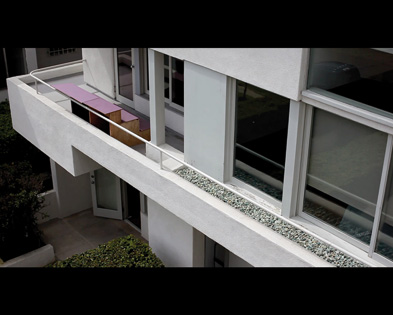
THE MACKEYS evolved out of a six months residency during the MAK Schindler Program in Los Angeles. The Movie A filmic collage on Los Angeles based on former residents?s memories, diary entries, references to art, literature and film. It starts with a young woman talking about a confusion of two movies with nearly identical titles - L.A. Plays Itself and Los Angeles Plays Itself. Subsequently follows a remake of the opening titles to Thom Anderson?s Los Angeles Plays Itself. A couple of minutes later we hear the sound of an helicopter taken from the opening sequence of Robert Altman?s Short Cuts while the camera pans in bird?s-eye view across the hedge?s and front yard of R.M. Schindler?s Mackey Apartment House. A voiceover recites a passage from Memoirs of My Nervous Illness by Daniel Paul Schreber: ?To make myself at least somewhat comprehensible I shall have to speak much in images and similes, which may at times perhaps be only approximately correct. For the only way a human being can make supernatural matters, which in their essence must remain incomprehensible, understandable to a certain degree is by compairing them with known facts of human experience.?
Margit Lukacs, Persijn Broersen
Lion's Court
Video | 0 | color | 20:0 | Netherlands | 2025
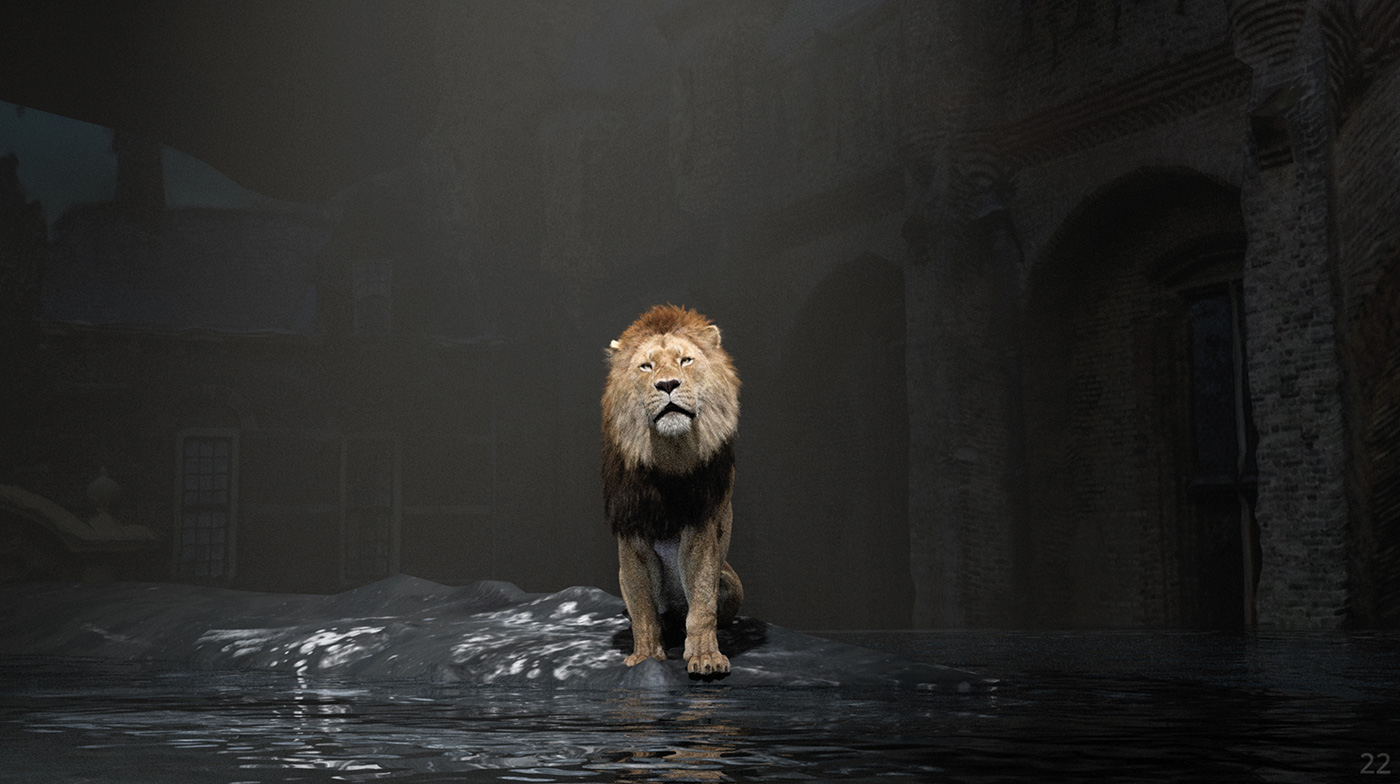
Lion’s Court is a cinematic short opera in which the Binnenhof—the seat of Dutch Parliament in The Hague—is reimagined as a virtual stage where history dissolves into myth. Inspired by the discovery of 14th-century lion bones at the site and by stranded whales as omens, Lukács & Broersen collaborated with composer and political scientist Bram Kortekaas to reinterpret Goethe’s Faust’s vision of redemption. At its center stands the lion Faust, sung by baritone Michael Wilmering—a despot in pursuit of a freedom that consumes itself, a mirror of imperial ambition on the verge of collapse. The artists also drew on the 1650 writings of Johan de Witt, the republican Grand Pensionary, whose words are voiced by the whale (alto-mezzo Carina Vinke), rising from beneath the flooded foundations of the Binnenhof. De Witt believed that a true republic is not ruled by the whims of a single individual, but rooted in the principles of freedom and equality—the very foundations of democracy. In Lion’s Court, a digital hortus conclusus unfolds: a fluid, enclosed world where power, morality, and prophecy converge, and where the myths of the past reverberate through the politics of the present.
Margit Lukács and Persijn Broersen are an Amsterdam-based artist duo exploring the entanglements between nature, culture, and technology. Their work includes films, digital animations, and spatial installations that investigate how media shapes our perception of the natural world. Graduates of Graphic Design at the Gerrit Rietveld Academie, they completed their MFA at the Sandberg Institute and were artists-in-residence at the Rijksakademie in Amsterdam. Broersen & Lukács’ practice is rooted in media theory, art history, and mythology. Drawing from cinematic, scientific, and historical sources, they reimagine landscapes and natural phenomena through digitally layered environments. Their work often reflects on the politics of representation and the appropriation of nature, reconfiguring dominant narratives through fragmented, multi-perspective storytelling. Their installations and films have been widely shown internationally, including at the Stedelijk Museum Amsterdam (NL), Centre Pompidou (FR), FOAM (NL), MUHKA (BE), Centraal Museum (NL), MacKenzie Art Gallery (CA), WRO Biennale (PL), Biennale of Sydney (AU), Rencontres Internationales (HKW Berlin, Louvre/Grand Palais/CWBP, Paris), and Wuzhen Biennale (CN). In 2024, they represented the Netherlands at the Gwangju Biennale. Their film I Wan’na Be Like You was nominated for the Tiger Award/IFFR 2024.

Ausra Lukosiuniene
JUODA
Experimental doc. | 4k | black and white | 20:0 | France, Lithuania | 2024
Valdas is a talented architectural visionary who left his life unexpectedly ten years ago, and who did not fit into the standard architectural frameworks. As the architect of many of the Centre for Contemporary Art's exhibitions, he spent a large part of his life at the museum. It is here that the artist's daughter Elena walks, having to unload the artist's legacy from the museum. The visit becomes a tender farewell and a touch of her father's work, as well as the projects that were never realised. Dark matter is not only the title of the film, but also the title of the architect's last phase of work: a black as a hole in space sadness and Ozarinskas own words: "We haven't done anything more".
Graduated Russian Institute of Theatre, Music and Cinematography, directing. 1987m. 13 years as a director and producer for national TV. For many years worked in Lithuania as an executive producer for cultural events, film festivals, fashion days. Manager and shareholder of Impar reklama, advertising company, Commercial Director of radio station RADIOCENTER. In 2018 she founded Vegele Films. Lives in Europe.
Armando Lulaj
Recapitulation
Experimental film | hdv | color and b&w | 13:0 | Albania, Italy | 2015
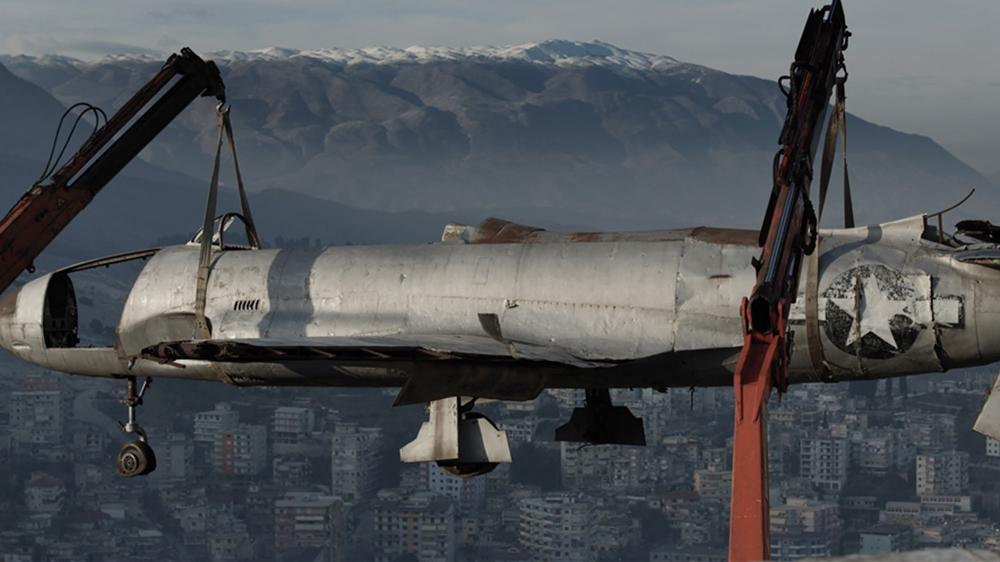
On December 23, 1957, at 11:10 AM, a US Lockheed T-33 Shooting Star aircraft flown by Major Howard J. Curran left Chateauroux, France, heading for Naples, Italy. Above Turin, the aircraft radio failed and after hitting bad weather with strong winds, the plane veered off its flight path to end up, by mistake, in the sovereign airspace of the People`s Republic of Albania. At 1:28 PM, the intruder was intercepted by the Albanian Air Force Command, which instantly ordered two MiG-15 fighter jets to take off and identify it. By 3:50 PM, the fighters reported that they had spotted the intruder in the area around Rinas Airport, flying at 500-650 km/hr at an altitude of 150-200 m. Prompt countermeasures were taken. The airplane was forced to land and, to keep it from taking off again, the airport was locked down.
Born in 1980 in Tirana, Albania, Armando Lulaj is a writer of plays, texts on risk territory, film author, and producer of conflict images, orientated toward accentuating the border between economical power, fictional democracy and social disparity in a global context. Exhibitions include the Prague Biennial (2003; 2007), Tirana Biennial (2005), 4th Gothenburg Biennale (2007), the 6th Berlin Biennial (2010), the 63rd Berlinale International Film Festival (2013) and the 56th Venice Biennale - Albanian Pavilion (2015).
Henrik Lund Jörgensen
The Recruitment (And Escape) Of A Plastic Soldier
Video | 4k | color | 10:15 | Denmark, Sweden | 2015
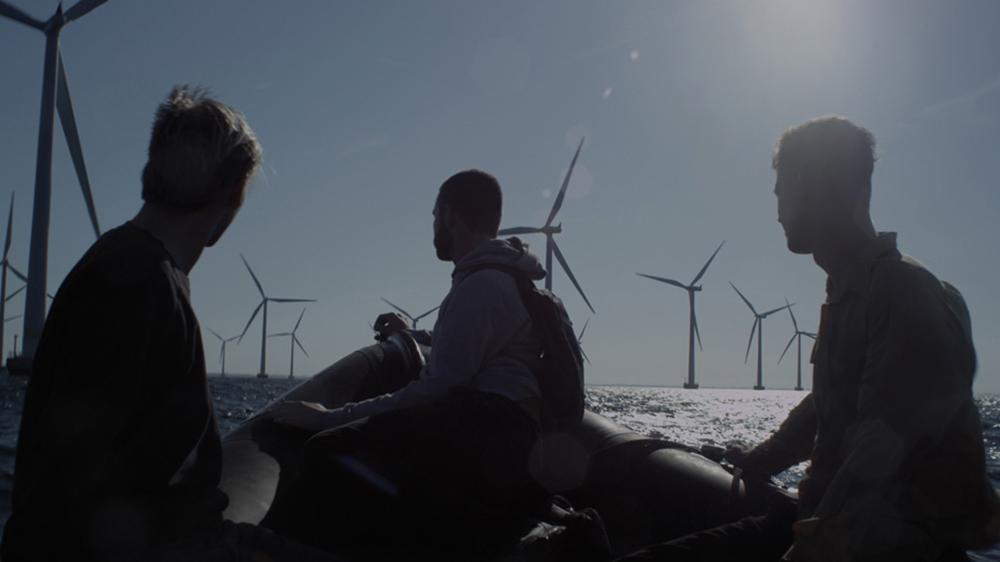
With references to landscape painting from the Romantic era and to silent film Henrik Lund Jørgensen draws inspiration from the works of the Danish film maker Carl Th. Dreyer in the making of his new video The Recruitment (And Escape) Of A Plastic Soldier (2015). In a cinematic language a narrative arises that exchange concepts as recruitment and flight and for whom it concerns.
Henrik Lund Jørgensen received his Master’s degree in Fine Arts in 2005 at the Malmö Art Academy, where he also lives and works today. In addition, he has a Bachelor’s degree in photography and a Master’s degree in film. In recent years, he has taught in the Master’s Programme Cinematic processes at Valand Academy of Film at Gothenburg University. Lund Jørgensen has exhibited both in Sweden and internationally, including at the Kunstmuseum Bonn, Kunsthalle Rostock, Museum Kunst der Westküste (DE), Kiasma (Helsinki), Norrtälje Konsthall, Scandinavia House (New York), The Hirschsprungske Collection (Copenhagen) and at the Atelier Nord ANX (Oslo) and was recently a grant holder at the Iaspis program in Stockholm.
Cecilia Lundqvist
Area of Use
Animation | dv | black and white | 5:12 | Sweden | 2009
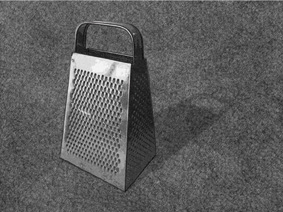
The video Area of Use is an illustration of a housewife?s inner thoughts about alternative ways of using her most common working tools. It is also a manifestation of a sealed existence that exposes a mind which gives a sense of being trapped in a treadmill.
Born 1971 in Eskilstuna, Sweden. Currently living and working in Stockholm, Sweden. Artistic education: 1999-00 Royal University Collage of Art, Postgraduate, Stockholm, Sweden 1994-99 University Collage of Arts, Crafts and Design, Art Department, Stockholm, Sweden Artist specializing in animation and since 1994 working almost exclusively with videos, which have been screened at numerous museums, galleries and festivals worldwide. Around 25 videoworks have been created between 1994 and 2009, works that generally are narrative and deal with issues like domestic violence, power structures and human behaviours. Represented with videoworks at several art institutions, among them Moderna Museet in Stockholm and Centre Georges Pompidou in Paris.

Cecilia Lundqvist
Eternal Start
Art vidéo | | color | 3:16 | Sweden | 2010
The video is a description of two people who are situated in an constant state of present, where the past is continuously fading and the future seems unreachable. It appears as if the woman and the man are unaware of their situation, which amplifies the sense of meaninglessness. "Eternal Start" illustrates a relationship where everything is routine, and every day is the same. Eternity becomes a reflection of a life without meaning, in which they are unable to change their accustomed behaviour. They converse like a record that is stuck, and never gets the chance to develop. The video highlights and gives insight to the importance of having the ability to make new memories, so that life can go on.
Born 1971 in Eskilstuna, Sweden. Currently living and working in Stockholm, Sweden. Artist specializing in animation and since 1994 working almost exclusively with videos, which have been screened at numerous museums, galleries and festivals worldwide. Around 30 videoworks have been created between 1994 and 2010, works that generally are narrative and deal with issues like domestic violence, power structures and human behaviours. Represented with videoworks at several art institutions, among them Moderna Museet in Stockholm and Centre Georges Pompidou in Paris.

Cecilia Lundqvist
En av dem (One of them)
Animation | hdv | color | 1:53 | Sweden | 2017
The animated video “ en av dem/one of them ” reflects the anxiety of knowing that eternal life is not for everyone.
Working almost exclusively with animated art, mostly as single channel videos. Through animating my own drawings, I am mediating tales of human relationships and not shying away from life’s darker and more destructive sides. Since 1994 I’ve created over 30 videos, works that generally are narrative and deal with issues like domestic violence, power structures and human behaviours. My works have all been screened at numerous occations worldwide and I’m represented at several art institutions, among them Moderna Museet in Stockholm and Centre Georges Pompidou in Paris.
Cecilia Lundqvist
Making Pancakes
Animation | dv | black and white | 4:58 | Sweden | 2005
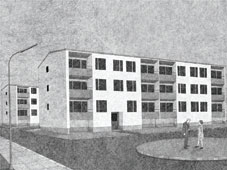
"Making Pancakes" is an animated video, showing a woman and a man in a totally unbalanced relationship. At times we see a seemingly everyday course of events, and other times they are in a more threatening situation. The man is filled with self-satisfaction and yet he shines from an uncertainty and a longing for acknowledgement. The woman acts in a numb and routine way, doing all she can to uphold the façade. By changing the standard and placing the domestic violence outdoors, where it iss visible, and the upholding of the perfect façade hidden behind the closed doors of the home, the absurdity of this behaviour is revealed. The trivial mistakes while making dinner serve as the catalyst of the violent outrages; they serve as the last straw.
Cecilia Lundqvist
Oh, I'm So Happy
Art vidéo | dv | black and white | 3:7 | Sweden | 2008
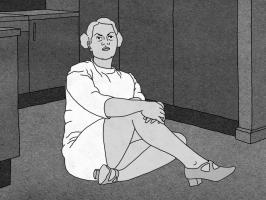
Oh, I`m So Happy is an animated video where we meet a middle-aged woman who is living in total isolation, with an extreme loneliness as a result. The woman performs a monologue, in which she tries her best to convince us about how happy and content she is with her present situation. However, her attempt is totally shallow and transparent.
Born 1971 in Eskilstuna, Sweden. Currently living and working in Stockholm. Artist specializing in animation and since 1994 working almost exclusively with videos, which have been screened at numerous museums, galleries and festivals worldwide. More than 20 videoworks have been created between 1994 and 2006, works that generally are narrative and deal with issues like domestic violence, power structures and human behavior. Represented with videoworks at several art institutions, among them Moderna Museet in Stockholm and Centre Georges Pompidou in Paris. ARTISTIC EDUCATION 1999-2000 Royal Collage of Art, Post Graduate, Stockholm 1994-1999 University Collage of Arts, Crafts & Design, Art Department, Stockholm 1993-1994 Birkagården, Art Department, Stockholm 1991-1993 Gotland Art School
Cecilia Lundqvist
Power Play
Art vidéo | dv | black and white | 10:55 | Sweden | 2004
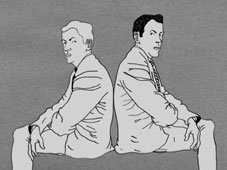
Power Play is an animated video, consisting of ten different scenes in which two men compete in emphasizing their manhood, using different attributes in a series of nonsense acts. The video comments on and clearly ridicules the stereotypes that the two characters embody in their man-to-man conversation, customs that are generally established in the western culture. The film focuses on this play of acts, to make the viewer clear on how meaningless this behavior is. When installed in a gallery a counterpoint and spectator to this part of the work is present. In this other video, containing only one scene, a completely bored woman is watching the men performing their acts.
Born 1971 in Eskilstuna, Sweden. Originally constructing engineer, changing career in 1991 into arts, and since 1994 working with animated videos, which have been screened at numerous occasions worldwide. Represented with videoworks for instance at the Modern Museum of Art in Stockholm and Centre Georges Pompidou in Paris. Artistic education: 1991-93 Gotland Art School 1993-94 Birkag?rden, Art Department, Stockholm 1994-99 University Collage of Arts, Crafts and Design, Art Department, Stockholm 1999-00 Royal Collage of Art, Video Department, Stockholm Currently living and working in Stockholm and London.
Cecilia Lundqvist
The Quiet Game Starts Now
Video | hdv | color | 5:47 | Sweden | 2012
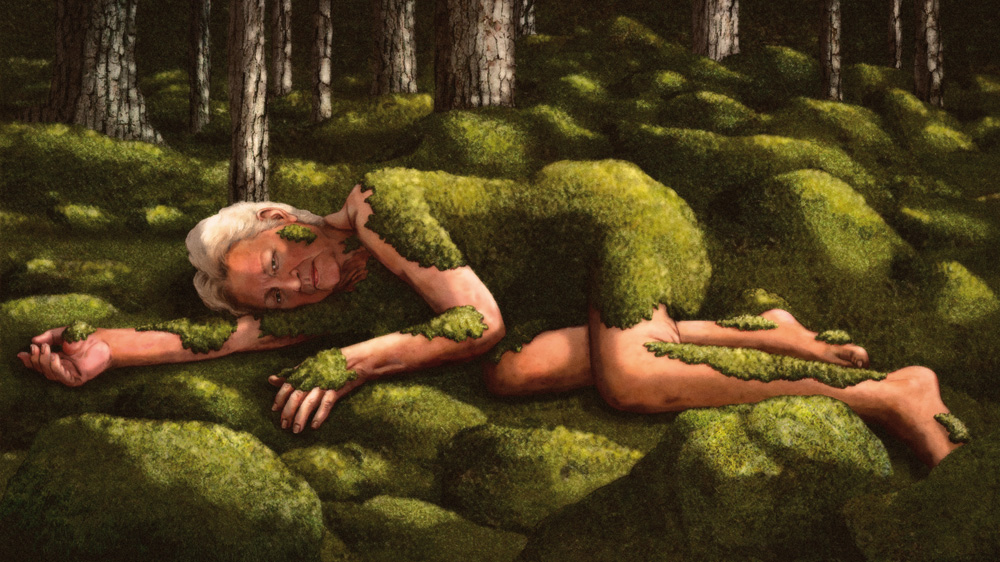
The animated video The Quiet Game Starts Now (Tysta leken börjar nu) is a satire about the current escalation of self-absorption. Two women meet in a conversation, which from the start is a one-way communication, with one dominating party. After a while there is a shift in power and the silence grows stronger and starts to speak.
Born 1971 in Eskilstuna, Sweden. Currently living and working in Stockholm, Sweden. Artist specializing in animation and since 1994 working almost exclusively with videos, which have been screened at numerous museums, galleries and festivals worldwide. Over 30 videoworks have been created between 1994 and 2014, works that generally are narrative and deal with issues like domestic violence, power structures and human behaviours. Represented with videoworks at several art institutions, among them Moderna Museet in Stockholm and Centre Georges Pompidou in Paris.
Cecilia Lundqvist
Tilt
Animation | hdv | color | 5:6 | Sweden | 2014
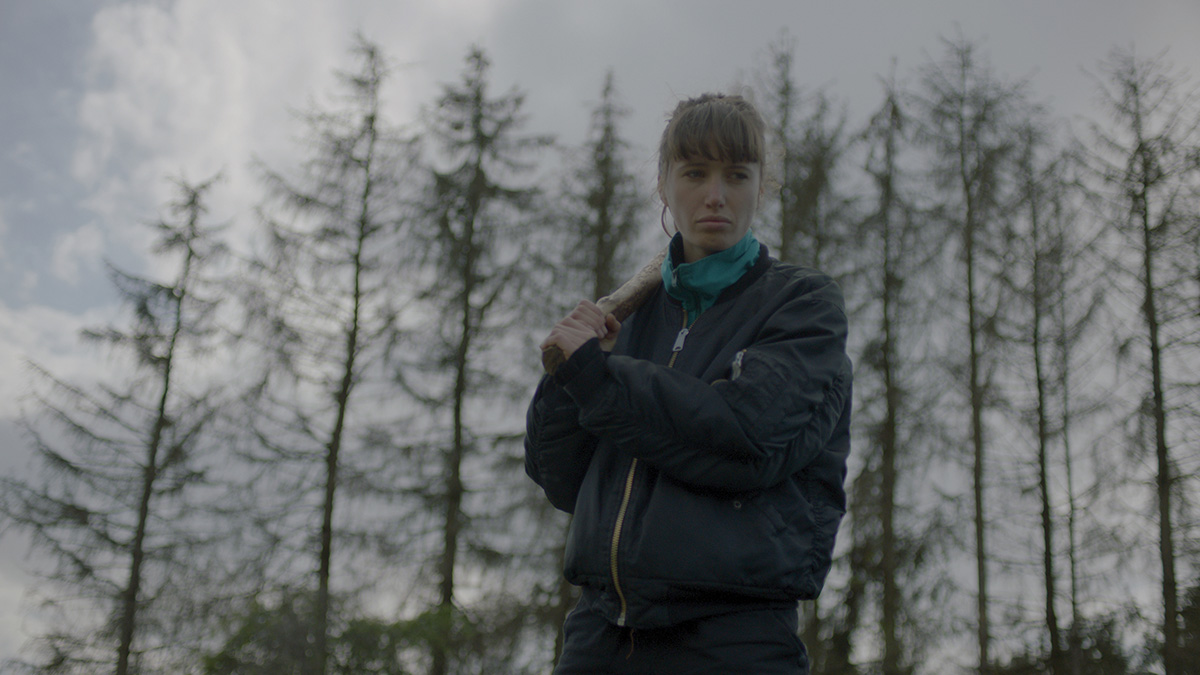
The animated video "Tilt" describes a deep relation that is abruptly broken up and as a result, the existing life is turned into ruin. The video is a contemplation of a human being’s inability to comprehend its own transience.
Working almost exclusively with animated art, mostly as single channel videos. Through animating my own drawings, I am mediating tales of human relationships and not shying away from life’s darker and more destructive sides. Since 1994 I’ve created over 30 videos, works that generally are narrative and deal with issues like domestic violence, power structures and human behaviours. My works have all been screened at numerous occations worldwide and I’m represented at several art institutions, among them Moderna Museet in Stockholm and Centre Georges Pompidou in Paris.
Felix Luque Sanchez, Nicolas Torres
Junkyard I
Experimental fiction | 4k | color | 6:43 | Spain, Belgium | 2019
“… Junkyard explores the accumulated car wrecks as archeological remains for the future - a future that is undergirded by the consumptive cultures of petroleum, rare earth minerals and metals of which the car is emblematic. Paul Virilio’s argument about the relationship of technology and accidents is illuminating in this sense: "every time that a new technology has been invented,” he writes “a new energy harnessed, a new product made, one also invents a new negativity, a new accident.”[1] In this sense, the easy conclusion would say that the people who invented the car also invented the car accident. But what happens, when we think about not individual accidents but the industry as a whole as an extended scale of a systematic accident that leaves traces of wrecks as the memory of past archaeological periods, whether that pertains to chemicals, metals or residual traces of media of past automobile cultures? In other words, what if we think that the whole industry, with production, distribution, excavation and use, and what it has been doing to the earth’s “resources,” the organisation of labour and gender roles, an historical accident that undermines the viability of organised human existence? – the car industry as the accident of the fossil fuel culture” …
Felix Luque Sánchez (Oviedo, Spain, 1976) is an artist whose work explores how humans conceive their relationship with technology and provides spaces for reflection on current issues such as the development of artificial intelligence and automatism. Using electronic and digital systems of representation, as well as mechatronic sculptures, generative sound scores, live data feeds and algorithmic processes, he creates narratives in which fiction blends with reality, suggesting possible scenarios of a near future and confronting the viewer with her fears and expectations about what machines can do. Luque’s installations are configured as autonomous and uncontrollable systems in which each element plays a role in both their functional and visual design. The machines are thus conceived not only in terms of the processes they carry out, but also as objects of aesthetic contemplation. Each artwork is divided into different parts or sections, that can be read as chapters of the same narrative, constitutive elements of a system, or attempts at exploring a single subject. This fragmentation counters the apparent oneness of the piece and the seemingly perfect operation of the machine. Failure and vulnerability are present in the way that these devices are forced to maintain delicate balances, pursue nonsensical dialogues, generate incomplete renderings of reality, and finally express themselves by means of a sound score that results from their own activity and the physical processes involved in it. The artist consciously plays with the contradictory perception of technology as purely functional while at the same time imbued with a mysterious purpose, and the fear that machines may replace humans. Inspired by science fiction, he draws from its aesthetic and conceptual foundations the tools to elaborate speculative narrations and address the spectator using preconceptions about technology in popular culture. The outcome is a series of artworks that fascinate by their technical elegance and intriguing opacity, at the same time attracting and distancing themselves from the viewer.
Johann Lurf
Embargo
Video | hdv | | 10:0 | Austria | 2014
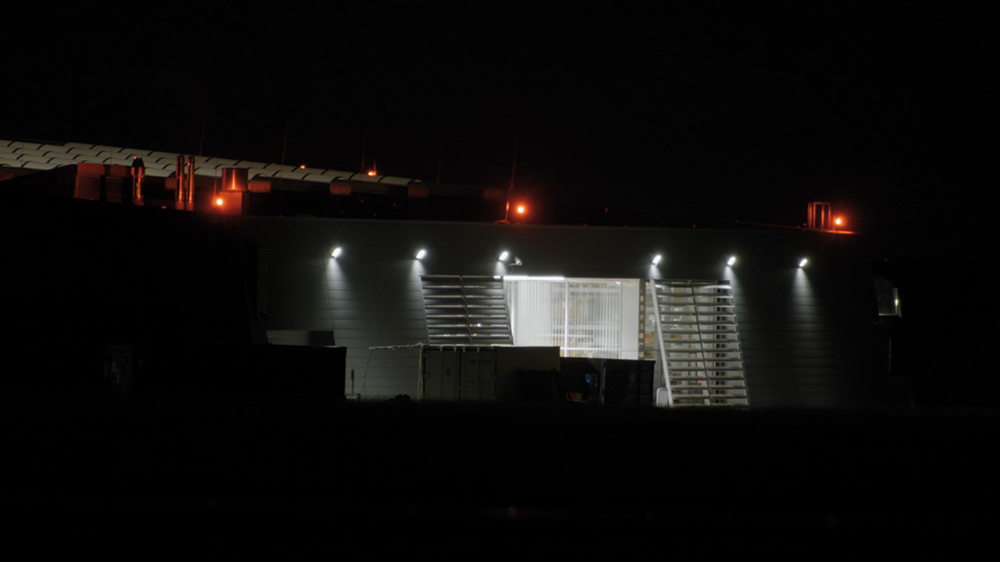
Using elaborate recording technology, Johann Lurf breathes life into Austrian arms manufacturers – more precisely, the surface of their architecture, which is visible from a distance and therefor contradicts the information embargo inside. Set to a driving gaming sound, levels shift and signal lights glow in rich contrasts. In our midst and yet seemingly from another world. Sebastian Höglinger
Born in 1982 in Vienna Johann Lurf has studied at the Academy of Fine Arts in Vienna and the Slade School of Art in London. He graduated from Harun Farocki’s film class in 2009. He received the State Grant of Austria for Video- and Media Art and participated in the Artist-in-Residence Programs at the MAK Center for Arts and Architecture in Los Angeles 2011 and at the SAIC in Chicago 2015. His works have been internationally shown and awarded in numerous exhibitions and festivals.