Catalogue > Liste par artiste
Parcourez la liste complète des artistes présentés dans le cadre des Rencontres Internationales depuis 2004. Utilisez le filtre alphabétique pour affiner vos recherches.
Mathieu K. Abonnenc
Catalogue : 2016Secteur IX B | Fiction | 4k | couleur | 42:35 | France | 2015
Mathieu K. Abonnenc
Secteur IX B
Fiction | 4k | couleur | 42:35 | France | 2015
Secteur IX B met en scène la conservation d’une collection anthropologique ramenée la Mission Dakar-Djibouti, une des plus grande opération de collecte coloniale, à travers une relecture de l’ouvrage L’Afrique fantôme de Michel Leiris. Par son dispositif, tourné entre la France et le Sénégal, le film dévoile le destin et la mémoire d`archives par un récit fantasmé, qui désigne un état des relations entre les peuples.
Mathieu Kleyebe Abonnenc s’attache à interroger les formes d’hégémonie culturelle sur lesquelles s’est appuyée l’évolution de nos sociétés contemporaines. Qu’il s’agisse de vidéos, de photographies, d’installations, de dessins ou de projets d’exposition, Mathieu Kleyebe Abonnenc explore les principes de représentation dominants en s’appropriant des éléments et des événements préexistants, principalement liés aux histoires impériales et coloniales des pays dits développés. Autant d’objets appartenant à une mémoire collective dont l’universalisme de principe est mis à l’épreuve depuis plus d’un siècle. Chacun de ces éléments nécessite d’être constamment renégocié afin d’en dégager des problématiques contemporaines, en termes de construction d’une identité, d’une communauté, d’une nation, et ainsi permettre par moment de réinventer l’action artistique et politique. Mathieu Kleyebe Abonnenc est diplômé des Beaux-arts de Marseille en 2002. Il a fait parti du programme de recherche La Seine de l’Ecole Nationale supérieure des Beaux-arts de Paris de 2006 à 2008 . Son travail à fait l’objet en 2013 de deux expositions personnelles, Songs for a Mad King à la Kunsthalle de Bâle, Suisse et Kannibalen au Bielefelder-Kunstverein, Allemagne. En 2012, deux institutions, la Fondation Serralves à Porto au Portugal et Pavilion à Leeds en Angleterre, ont organisé des expositions personnelles de l’artiste. Toujours en 2012 , Mathieu Kleyebe Abonnenc a participé à la Triennale de Paris, Intense Proximité, au Palais de Tokyo, ainsi qu’à des expositions collectives à la Fondation d’entreprise Ricard à Paris et l’ICA – Institue d’Art Contemporain de Philadelphie aux États-Unis.
Yasmine Kabir
Catalogue : 2018Roshi (Rope) | Doc. expérimental | hdv | couleur | 9:30 | Bangladesh | 2017
Yasmine Kabir
Roshi (Rope)
Doc. expérimental | hdv | couleur | 9:30 | Bangladesh | 2017
Continuing a tradition that goes back centuries, children are employed as rope-makers in old town, Dhaka, making rope from jute fibres. They twist, tie, knot and weave from early morning till nightfall. This silent film has metaphorical allusions
Yasmine Kabir is an independent filmmaker. She lives and works in Dhaka and Chittagong, Bangladesh. Her documentaries are on stories that reflect the human condition.
Catalogue : 2011The Last Rites | Documentaire | dv | couleur | 17:0 | Bangladesh | 2008
Yasmine Kabir
The Last Rites
Documentaire | dv | couleur | 17:0 | Bangladesh | 2008
` The Last Rites?, a silent film by Yasmine Kabir, depicts the ship breaking yards of Chittagong- a final destination for ships that are too old to ply the oceans any longer. Every year, hundreds of ships are sent to yards in Bangladesh. And every year, thousands of people come to these yards in search of jobs. Risking their lives to save themselves from hunger, they breathe in asbestos dust and toxic waste. The elemental struggle between man and metal figures throughout the film, as men carry the weight of steel ropes over their shoulders, pull huge parts of the vessels inland, and bear great metal plates. ` The Last Rites? is an allegorical portrayal of the agony of hard labor.
Yasmine Kabir is an independent filmmaker based in Bangladesh. Her filmography includes: Death Chant 1992 A day at the Embassy 1996 For Solaiman 1997 A Mother`s Lament (Duhshomoy) 1999 My Migrant Soul (Porobashi Mon Amar) 2000 Direct-Direct (Music Video) 2003 A Certain Liberation (Shadhinota) 2003 The Last Rites (Shesh Kritto) 2008
Pablo Kaes
Catalogue : 2015vida | Documentaire | hdcam | couleur | 9:0 | Allemagne | 2013
Pablo Kaes
vida
Documentaire | hdcam | couleur | 9:0 | Allemagne | 2013
Deep in the mountains of Patagonia live two people. We see how a day starts. It is dark and cold outside. An old man drinks mate, the typical Argentinian drink. Then he starts his daily tour with his sheeps. The day goes by in silence. In the evening they have to kill a goat. And eat it. No distractions. Nothing needless. Just life.
Pablo Kaes, born 1988 in Mainz, Germany. 2008/2009 Social working in Guadalajaras / Mexico 2010 Assistand director trainee 2010 Studies Film Directing at HFF "Konrad Wolf" in 2010. 2013/2014 Studies Dirección at Universidad del Cine, Buenos Aires 2015 Estimated degree Diplom Regisseur
Jane Jin Kaisen
Catalogue : 2023Halmang | Vidéo | 4k | couleur | 13:13 | Danemark, Coree du Sud | 2023
Jane Jin Kaisen
Halmang
Vidéo | 4k | couleur | 13:13 | Danemark, Coree du Sud | 2023
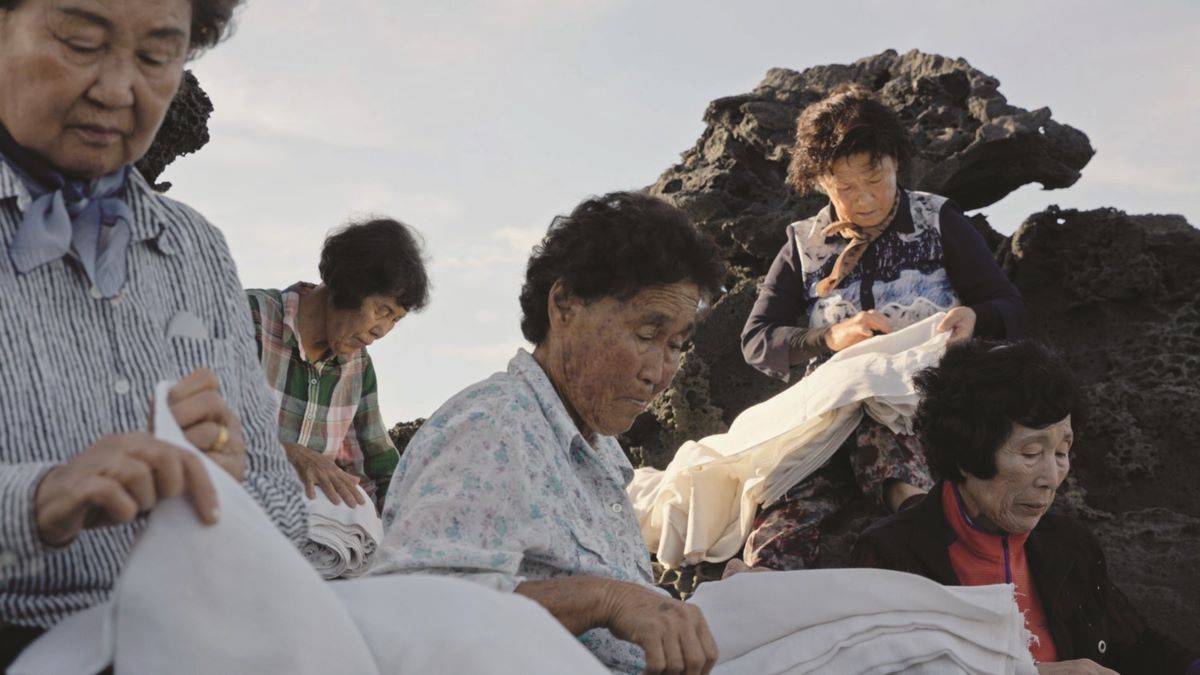
Halmang revolves around a group of eight women in their 70s and 80s. It is filmed by the coast of Jeju Island near a lava rock islet that used to serve as a shamanic shrine for the wind goddess Yongdeung Halmang. The women, who have worked and made a living together for most their lives as haenyeo sea divers, used to depart together for the sea from this very location. The title Halmang refers to this spiritual aspect as shamanic goddesses in Jeju are referred to as ‘halmang’ while also being the Jeju term for ‘grandmother’ and a respectful form of address for a woman. It was also from this area that Kaisen’s grandmother during her lifetime used to depart for the sea as a haenyeo sea diver. The film portrays the aging women’s lived experience, their community and spirituality connected to the sea, the wind and the island. Central to the work is its focus on the collective use and care for sochang; a white, long cotton cloth associated with female labor and a symbol of cycle of life and death and humans’ connection to the spirit world. The camera carefully registers their hands, gestures, and facial expressions as they meticulously tend to the fabric. As the piece unfolds, they start connecting the long rolls of sochang until it comes to form a large spiral enveloping the black lava rocks. The music is produced by Lior Suliman (also known as Dub Mentor) and is comprised of layers of on-site recordings, looped, interleaved and treated to create an immersive sound experience. It also features The Song of the Haenyeos by Gang Gyung Ja and Song of Haenyeo Preservation Association.
Jane Jin Kaisen is an artist, filmmaker, and Professor of the School of Media Arts, The Royal Danish Academy of Fine Arts. Spanning the mediums of video installation, experimental film, photography, performance, and text, her work is informed by extensive interdisciplinary research and long-term engagement with minoritarian communities. She is known for her visually striking, multilayered, performative, poetic, and multi-voiced feminist works through which past and present are brought into relation. Engaging topics such as memory, migration, borders, and translation, she activates the field where lived experience and embodied knowledge intersect with larger political histories. Kaisen is a recipient of is a recipient of the New Carlsberg Foundation Artist Grant (2023) and a 3-year work grant from the Danish Arts Foundation (2022) and awarded Exhibition of the Year 2020 by International Association of Art Critics, Denmark for the exhibition Community of Parting at Kunsthal Charlottenborg. She represented Korea at the 58th Venice Biennale and has exhibited and screened her artworks and films in a wide range of contexts internationally.
Jane Jin Kaisen
Catalogue : 2023Burial of this Order | Film expérimental | 4k | couleur | 25:12 | Danemark, Coree du Sud | 2022

Jane Jin Kaisen
Burial of this Order
Film expérimental | 4k | couleur | 25:12 | Danemark, Coree du Sud | 2022
A procession of non-conforming people – from musicians, artists and poets to anti-miliary activists, environmentalists and diasporic, queer and trans people – carry a coffin together through the ruins of what turns out to be an abandoned resort on the South Korean island of Jeju. It soon becomes clear that this is no traditional Confucian funeral. Age and gender roles are subverted, the coffin is draped in dark camouflage colours and the traditional portrait of the deceased is replaced by a black mirror. In the field between funeral ritual, political protest and carnival performance, the people in the procession who have come together to undo a world order built upon hierarchy and division, march through the ruins of capitalist modernity. Time and place begin to lose their stability as mythical Dokkaebi deities pass through the building and heavy rain and wind blow through its cavities. As if possessed the group, in a moment of revolutionary fervour, overthrows and dismantles the scaffolding of the prevailing order and other stories begin to take form. Jane Jin Kaisen’s interdisciplinary work not only activates Jeju’s violent history as a site of oppression and rebellion, but is a work with universal power.
Jane Jin Kaisen (born 1980 in Jeju Island, lives in Copenhagen) is a visual artist, filmmaker, and Professor of the School of Media Arts, The Royal Danish Academy of Fine Arts. Spanning the mediums of video installation, narrative experimental film, photographic installation, performance, and text, Kaisen’s artistic practice is informed by extensive interdisciplinary research and engagement with diverse communities. She is known for her visually striking, multilayered, performative, poetic, and multi-voiced feminist works through which past and present are brought into relation. Engaging topics such as memory, migration, borders, and translation, she activates the field where lived experience and embodied knowledge intersect with larger political histories. Through multi-year projects and collaborations, she has engaged topics such as transnational adoption, the Korean War and division, the Jeju April Third Massacre, and Cold War legacies. Another recurring focus revolves around nature and island spaces, cosmologies, feminist re-framings of myths, and engagement with ritual and spiritual practices. Working from the thresholds of mediums and forms, disciplines and sensibilities, her works negotiate and mediate the means of representation, resistance, and recognition, thus contouring alternative genealogies and sites of collective emergence. Kaisen is a recipient of the New Carlsberg Foundation Artist Grant (2023) and a 3-year work grant from the Danish Arts Foundation (2022). She represented Korea at the 58th Venice Biennale with the film installation Community of Parting (2019) alongside artists Hwayeon Nam and siren eun young jeong in the exhibition History Has Failed Us, but No Matter curated by Hyunjin Kim. She was awarded “Exhibition of the Year 2020” by AICA - International Association of Art Critics, Denmark for the exhibition Community of Parting at Kunsthal Charlottenborg. Kaisen has participated in the biennials of Liverpool, Gwangju, Anren, Jeju, among others. Recent solo exhibitions include Jane Jin Kaisen: Braiding and Mending at The Image Centre (2023), Of Specters or Returns at Le Bicolore (2023), Currents at Fotografisk Center (2023) Parallax Conjunctures at Museum of Contemporary Art Detroit (2021), Community of Parting at Art Sonje Center (2021) and Kunsthal Charlottenborg (2020). Other recent exhibitions and screenings: Dislocation Blues: Jane Jin Kaisen, Tate Modern (2023), Ceremony (Burial of an Undead World), Haus der Kulturen der Welt (2022), Checkpoint: Border view from Korea, Kunstmuseum Wolfsburg (2022), Unmoored Adrift Ashore, Or Gallery Vancouver (2022). She holds a PhD in artistic research from the University of Copenhagen, Department of Art and Cultural Studies, an MFA in Interdisciplinary Studio Art from the University of California Los Angeles, an MA in Art Theory and Media Art from The Royal Danish Academy of Fine Arts, and she participated in the Whitney Museum of American Art Independent Study Program. Other exhibition and screening venues include: Kunsthal Aarhus, Nikolaj Contemporary Art Center, The National Museum of Photography (DK), Haus der Kulturen der Welt, Berlinale, Kunstmuseum Wolfsburg, Times Art Center, Museum Ludwig, Videonale (DE), Asian Art Museum, Museum of Contemporary Art Los Angeles, Gana Art New York, DePaul Art Museum (USA), ARKO Art Center, Seoul Museum of Art, Incheon Art Platform, Seoul New Media Art Festival, Leeum Samsung Museum of Art, Asia Culture Center, Coreana Museum of Art, DMZ International Documentary Film Festival (KR), Silencio Club, Palais de Tokyo, Foundation Fiminco (FR), Malmö Konstmuseum, Malmö Konsthall, Inter Arts Center, Kalmar Art Museum (SE), Sørlandet Art Museum and Oslo Kunstforening (NO), Finnish Museum of Photography (FN), ParaSite (HK), Kyoto Arts Center, Kyoto Museum of Art, Fukouka Museum of Art, Yamagata International Documentary Film Festival, (JP), Times Museum Guangzhou, Beijing 798 Art Zone (CN), Kaohsiung Museum of Fine Art, Taiwan International Documentary Film Festival (TW), Museum of Contemporary Art and Design (PH), The National Gallery (Indonesia), and Townhouse Gallery (EG).
Jane Jin Kaisen
Catalogue : 2015Reiterations of Dissent | Doc. expérimental | hdv | couleur et n&b | 59:0 | Danemark | 2014
Jane Jin Kaisen
Reiterations of Dissent
Doc. expérimental | hdv | couleur et n&b | 59:0 | Danemark | 2014
Reiterations of Dissent concerns the suppressed history and fragmented memories of the Jeju 4.3 Uprising and Massacre, which took place shortly before the outbreak of the Korean War on the filmmaker´s birthplace, Jeju Island, South Korea. In a ‘red hunt’ the Korean military and police, under supreme command of the U.S. Military, committed genocide onto the civilian population. For more than five decades, it was prohibited to talk about the event. Composed of six different video narratives – Ghosts, Jeju Airport Massacre, Lamentation of the Dead, The Politics of Naming, Retake: Mayday and History of Endless Rebellion – Reiterations of Dissent uncovers the underlying political motivations and portrays how the un-reconciled trauma of Jeju 4.3 resonates in the natural landscape, in literature, in memories of survivors and relatives, in shamanic rituals mediating between the living and the dead, and in protests against the ongoing construction of the Jeju Naval Base. Using various audiovisual registers and editing techniques, Reiterations of Dissent explores a new language for documentary filmmaking and challenges relationships between text, image and narrative. Each video shows a different aspect of the Jeju 4.3 as an unstable episode of modern history by presenting a multi-layered archive of experiences, events and perspectives.
Jane Jin Kaisen is a visual artist and filmmaker based in Copenhagen. She holds an MFA in Interdisciplinary Studio Art from the University of California Los Angeles, an MA in Art Theory from the Royal Danish Academy of Fine Arts where she is currently doing an artistic research PhD. Being invested in questions of memory, history and subjectivity, Kaisen’s work deals with transnational political histories that have been silenced or banned but that resonate in the present moment through a sense of haunting. Recent narrative experimental films include Reiterations of Dissent (2014) concerning the suppressed history and fragmented memories of the Jeju April Third Uprising and Massacre, The Woman, The Orphan, and The Tiger (2010) that explores how mechanisms of militarism, patriarchy, colonialism and nationalism effected three generations of women in Korea. Kaisen has presented her films and video installations at various art museums and film festivals internationally, including Videonale, Seoul International New Media Festival, the Liverpool Biennial, the Incheon Women Artists’ Biennale, Yamagata International Documentary Film Festival, Taiwan International Documentary Film Festival, Korean American Film Festival New York, Fokus Video Art Festival, Kunsthallen Brandts, Gana Art New York, Jeju International Womens Film Festival and Asian Womens Film Festival Berlin.
Leilani Kake
Catalogue : 2012Tino Rangatira Tanga | Documentaire | dv | couleur | 16:6 | Nouvelle-Zélande | 2008
Leilani Kake
Tino Rangatira Tanga
Documentaire | dv | couleur | 16:6 | Nouvelle-Zélande | 2008
Maranga mai Wake up Maranga mai e te iwi Rise up the people O nga hapu Ngapuhi of the families of Ngapuhi Ki a mau, ki a u,ki a pupuri ai be strong,be fixed,hold on ki nga akoranga nui to the larger lessons "My very first memory of my Dad actually has no visual label but is made up of Sound, the warm soundscape of him singing as he strums the guitar, his voice booms over the acoustic harmonies of the strings. His mouth smiles as he sings a verse, his hands strums with vigor. I am safe in his song. On the night of the seventeenth of April 2008 my father Richard Kake passed away in Whangarei Hospital after suffering a massive stroke, he was fifty seven years old." Tino Rangatira Tanga invites the viewer into a sacred space of Love, loss and revelation. "It is a celebration of my relationship with my Father told through deeply intimate experiences strengthened through the musical soundscape that surrounded my Father?s life and death. The process of filming,editing and viewing the footage of my father?s life and untimely death helped me to grieve and in turn heal. Being able to experience and share this work has created moments of personal growth and insight. "
Kia Ora and Warm Pacific Greetings, My name is Leilani Kake, I live in Otara, Manukau City, South Auckland,Aotearoa(New Zealand) and I am a practicing Video Installation Artist of Nga Puhi, Tainui (NZ Maori) and Manihiki (Cook Island) descent. I graduated with the University of Auckland at the Manukau School of Visual Arts with a Bachelor of Visual Arts in 2002 and a Post Graduate Diploma of Fine Arts in 2005. My work transfers documentary footage and the recording of real events into an art context. My projects tend to be highly personal stories dealing with issues of identity and culture, tradition and change. Insight: ?Raising awareness of important issues pertaining to myself, Tangata Whenua(New Zealand Maori) and Pacific people in a way that creates constructive discussion has always been the main focus of my art.?
Kai Kaljo
Catalogue : 2018Isegi nimi on mõnikord sama (Even the Name Is Sometimes the Same) | Vidéo | hdv | couleur | 1:55 | Estonie | 2017
Kai Kaljo
Isegi nimi on mõnikord sama (Even the Name Is Sometimes the Same)
Vidéo | hdv | couleur | 1:55 | Estonie | 2017
Among others, Kai Kaljo(1877-1906) lives on in my video "Even the Name is Sometimes the Same"(1877-2017). I don´t know if we are related or not, but does it really matter? The video was made in cooperation with the photo collection of the Tallinn town museum. In the corner of a very old photograph (made in 1877) of the Tallinn Old Town Harbor, there is a person sitting, very tired. For some unknown reason, I was overwhelmed by that person. She (or he) had no idea that photography existed so she never suspected being accidentally captured by someone´s camera, neither did she suspect that, for some reason, she would become so important for somebody after 140 years.
Kai Kaljo is an artist living and working in Tallinn, Estonia. She studied painting at the Estonian Academy of Arts. Since 1997, when she completed her first video "Loser", she mainly works in video. In 2006 and 2017, she used to work at Tallinn University as a professor for contemporary art. Her video work was often described as poetic, social, humorous/tragic. In recent years, she had been working with archival images and texts.
Catalogue : 2006AEG | Vidéo expérimentale | super8 | couleur | 1:0 | Estonie | 2005
Kai Kaljo
AEG
Vidéo expérimentale | super8 | couleur | 1:0 | Estonie | 2005
Catalogue : 2006Das Wichtigste | Film expérimental | dv | couleur | 18:40 | Estonie | 2005
Kai Kaljo
Das Wichtigste
Film expérimental | dv | couleur | 18:40 | Estonie | 2005
Durant l'automne 2004, j'ai passé deux mois magnifiques en Allemagne au Künstlerhaus Schloss Wieperdorf, avec toutes ces personnes merveilleuses. Et alors que nous avions cette magnifique opportunité d'être libres de tous les soucis quotidiens et de pouvoir se concentrer sur ce qui est le plus important, j'ai commencé à me demander ce qu'était en fait le plus important. Voici quelques réponse à cette question.
Kai Kaljo est né à Tallinn, Estonie, en 1959. Il étudie la peinture à la Tallinn Art Academy en 1990. Depuis 1997, il travaille avec la vidéo.
Jade Kallio, Remi Vesala
Catalogue : 2025Laava | Vidéo | 4k | couleur | 15:0 | Finlande | 2024
Jade Kallio, Remi Vesala
Laava
Vidéo | 4k | couleur | 15:0 | Finlande | 2024
Lava is a love letter to things that cannot be written about: love, exciting piles of twigs, longing, a disappearing landscape, memories you can’t trust. Either writing hurts, or it is impossible to find the words. Lava is a continuation of the working group’s previous work Magma (2020). Both works deal with human relationships and ecology. The wishes for transformation, non-monogamy and boundless love, which were still partially smouldering under the surface, erupt in Lava, a video dealing with the end of a relationship.??
Jade Kallio is working with a variety of media including experimental cinema, performance and installation art. Their personal and collaborative works mix speculative fiction with everyday life. Kallio's works have been presented at festivals and institutions such as Europian Media Art Festival (2019, 2017), Beursschouwburg Art Center Brussels (2019), Kunsthalle Osnabrueck (2019), International Film Festival Rotterdam (2019, 2017), CCA derry (2016), HAM gallery (2017), Turku Art Museum (2017), Gallery Sinne (2017).
Felix Kalmenson
Catalogue : 2025Gamodi | Fiction | digital | couleur | 97:31 | Canada, Georgie | 2023

Felix Kalmenson
Gamodi
Fiction | digital | couleur | 97:31 | Canada, Georgie | 2023
Against the backdrop of a sprawling half-constructed tower block in Tbilisi, Viktor, a local celebrity drag queen, and Tarzan, a drifting teenager, search for fleeting possibilities of intimacy in the vestiges of a collapsing world. Playing out meager tasks of survival in a restricted not so far future, Viktor and Tarzan slowly come to understand their environment as a vestibule of the afterlife. "In Tbilisi, Georgia, an apartment tower sits in a liminal state, its construction halted at a critical juncture by the global pandemic. In its shadowy alcoves, Viktor, a legendary drag queen, and Tarzan, a teenage drifter, have embraced their collective purgatorial languor, subsisting on brief instances of intimacy. While intermittent television reports apprise them of developments from the outside world, it’s increasingly unclear whether they’re still inhabiting this plane of existence. The first solo directorial effort from multihyphenate Felix Kalmenson (of the acclaimed Pejvak artist collective), Gamodi employs stunning chiaroscuro, exacting compositions, and intriguing sound design to conjure a legitimately dreamlike milieu. Practically every pristine shot in Kalmenson’s poetic fable invites admiration and rewards careful examination. Equally informed by the material and spiritual, Gamodi casts an enthralling spell as it unfurls, and lingers in the subconscious long after it draws to its haunting close.” - VIFF
Felix Kalmenson (b. Saint Petersburg, Russia, 1987) is a non-binary artist, filmmaker, and producer. Their debut solo-feature 'Gamodi' was awarded 'Honorable Mention for Best Canadian Film' at Vancouver International Film Festival in 2023. Their films have screened in numerous international film festivals including at São Paulo International Film Festival, Vancouver International Film Festival, Festival du Nouveau Cinéma Montreal, Tampere Film Festival, Arkipel, Doclisboa, Sharjah Film Platform, Kasseler Dokfest, Berwick Film & Media Arts Fest and Media City Film Festival, winning awards including the Prix George at Internationale Kurzfilmtage Winterthur, 2020. For the past 13 years they have been creating films between Georgia, Armenia, Turkey and Uzbekistan, at times collaborating with Iranian artist and filmmaker Rouzbeh Akhbari under the collective name 'Pejvak'. They are also an artist having exhibited internationally including; Villa Arson (Nice), MAC VAL (Paris), M HKA (Antwerp), Van Abbemueum (Eindhoven), Z33 (Hasselt), Kim? CAC (Riga), Blaffer Art Museum (Houston), ACAC (Aomori, Japan), and Museum Abteiberg (Germany). As Pejvak they were long-listed for the prestigious Sobey Art Award in 2023.
Felix Kalmenson, Akhbari Rouzbeh and Kalmenson Felix
Catalogue : 2023Shokouk | Film expérimental | 4k | couleur | 16:30 | Canada, Ouzbékistan | 2022
Felix Kalmenson, Akhbari Rouzbeh and Kalmenson Felix
Shokouk
Film expérimental | 4k | couleur | 16:30 | Canada, Ouzbékistan | 2022
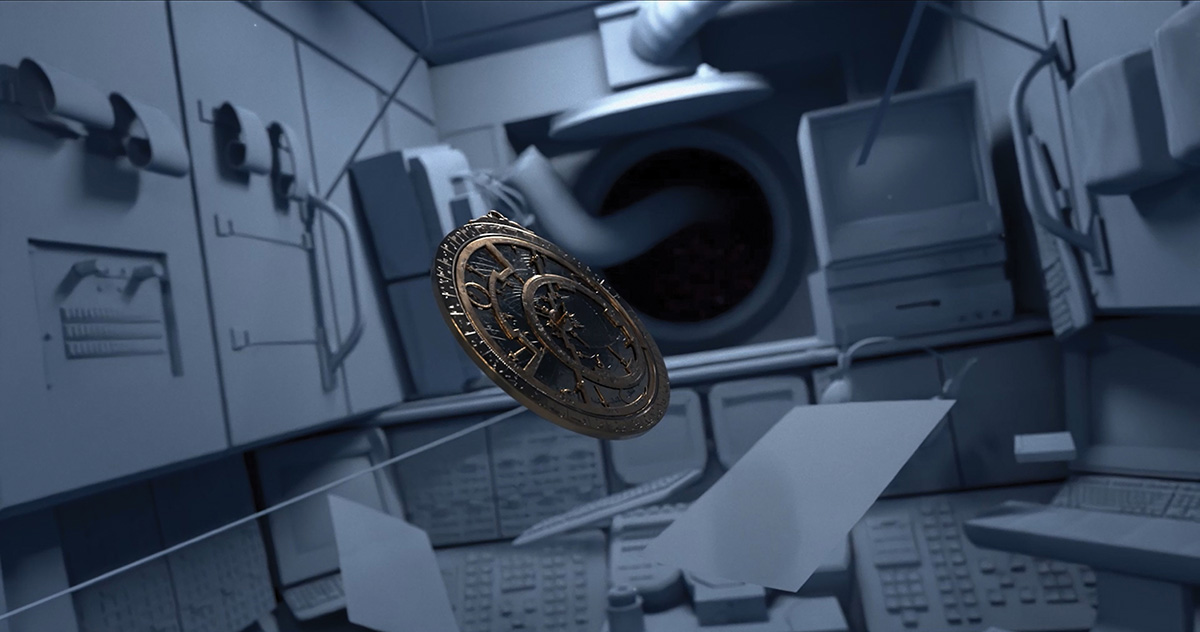
Shokouk: A Cosmicomedy in Four Acts is a transhistorical hybrid documentary that traces a polyphony of characters, sites and encounters related to infrastructures of space travel and cosmic imaginaries. Following a vertiginous narrative connecting various cosmic machinations from the 12th century Persianate world to the Baikonur Cosmodrome in the present moment, the film weaves historical facts and archival fabulations, and questions our common perceptions of time and space.
Pejvak is an ongoing collaboration between Rouzbeh Akhbari (Tehran, Iran 1992) and Felix Kalmenson (Saint Petersburg, Russia 1987). Their films have screened in numerous international film festivals including at São Paulo International Film Festival, Doclisboa, Sharjah Film Platform, and Kasseler Dokfest, winning awards including the Prix George at Internationale Kurzfilmtage Winterthur, 2020. Their work has been exhibited at museums and galleries internationally including; MAC VAL (Paris), Villa Arson (Nice), Van Abbemuseum (Eindhoven), M HKA (Antwerp), Z33 (Hasselt) and Si Shang Art Museum (Beijing).
Catalogue : 2020A Passage | Doc. expérimental | 4k | couleur | 16:57 | Canada, Arménie | 2019
Felix Kalmenson, Rouzbeh Akhbari
A Passage
Doc. expérimental | 4k | couleur | 16:57 | Canada, Arménie | 2019
‘A Passage’ is a film which tackles the political economy and social ecology of border infrastructures in Southern Armenia. By focusing on two significant events that illustrate the dominant political shifts in the region, ‘A Passage’ looks at how processes of rapid militarization and neoliberalization have restructured these borders. These two events include the recent erasure of the historic Yerevan-Baku Railway; and the upcoming construction of an industrial Free Economic Zone (FEZ) planned precisely where the removed train infrastructure was housed. The scrapping of the railway symbolizes the socio-political adherence to maintaining strict mobility regimes for citizens, while the introduction of the FEZ signals how capital supersedes these bodily restrictions and borders. The film stitches together various contested sites of the region including Meghri’s abandoned airport (which is slated to be refurbished as the forward command of Russia’s Middle Eastern operations), a functioning Soviet-era Copper and Molybdenum mine, a 16th century church (which is the last remaining building of a village abandoned by the mines expansion) the abandoned Karchivan and Meghri train stations and an abandoned rail tunnel that bridges the geopolitical boundary of Nakhchivan and Armenia.
Pejvak is an ongoing collaboration between Rouzbeh Akhbari (Tehran, Iran 1992) and Felix Kalmenson (Saint Petersburg, Russia 1987) which began in 2014 in Casablanca, Morocco. Over the past five years they have undertaken large scale exhibition and research projects internationally including at Si Shang Art Museum (Beijing), The Work of Wind produced by Blackwood Gallery (Mississauga), Onsite Gallery (Toronto), State Silk Museum (Tbilisi), ACSL (Yerevan), Les Abattoirs (Casablanca) and Hay Art (Yerevan). They are currently in the post-production phase of their first feature-length film Bring Forth, funded by the Canada Arts Council and the Ontario Arts Council and in the pre-production of our second film The Seed. In addition to being featured in C Magazine, LEAP, Funambulist and Prefix Magazine, they co-authored a book chapter in Unsettling Colonial Modernity in Islamicate Contexts published by Cambridge Scholars and are also contributors to The Work of Wind: Land, K. Verlag Press.
Felix Kalmenson
Catalogue : 2025Gamodi | Fiction | digital | couleur | 97:31 | Canada, Georgie | 2023

Felix Kalmenson
Gamodi
Fiction | digital | couleur | 97:31 | Canada, Georgie | 2023
In Tbilisi, Georgia, an apartment tower sits in a liminal state, its construction halted at a critical juncture by the global pandemic. In its shadowy alcoves, Viktor, a legendary drag queen, and Tarzan, a teenage drifter, have embraced their collective purgatorial languor, subsisting on brief instances of intimacy. While intermittent television reports apprise them of developments from the outside world, it’s increasingly unclear whether they’re still inhabiting this plane of existence.
Felix Kalmenson (b. Saint Petersburg, Russia, 1987) is a non-binary artist, filmmaker, and producer. Their debut solo-feature 'Gamodi' was awarded 'Honorable Mention for Best Canadian Film' at Vancouver International Film Festival in 2023. Their films have screened in numerous international film festivals including at São Paulo International Film Festival, Vancouver International Film Festival, Festival du Nouveau Cinéma Montreal, Tampere Film Festival, Arkipel, Doclisboa, Sharjah Film Platform, Kasseler Dokfest, Berwick Film & Media Arts Fest and Media City Film Festival, winning awards including the Prix George at Internationale Kurzfilmtage Winterthur, 2020.
Felix Kalmenson, Rouzbeh Akhbari
Catalogue : 2023Shokouk | Film expérimental | 4k | couleur | 16:30 | Canada, Ouzbékistan | 2022
Felix Kalmenson, Akhbari Rouzbeh and Kalmenson Felix
Shokouk
Film expérimental | 4k | couleur | 16:30 | Canada, Ouzbékistan | 2022
Shokouk: A Cosmicomedy in Four Acts is a transhistorical hybrid documentary that traces a polyphony of characters, sites and encounters related to infrastructures of space travel and cosmic imaginaries. Following a vertiginous narrative connecting various cosmic machinations from the 12th century Persianate world to the Baikonur Cosmodrome in the present moment, the film weaves historical facts and archival fabulations, and questions our common perceptions of time and space.
Pejvak is an ongoing collaboration between Rouzbeh Akhbari (Tehran, Iran 1992) and Felix Kalmenson (Saint Petersburg, Russia 1987). Their films have screened in numerous international film festivals including at São Paulo International Film Festival, Doclisboa, Sharjah Film Platform, and Kasseler Dokfest, winning awards including the Prix George at Internationale Kurzfilmtage Winterthur, 2020. Their work has been exhibited at museums and galleries internationally including; MAC VAL (Paris), Villa Arson (Nice), Van Abbemuseum (Eindhoven), M HKA (Antwerp), Z33 (Hasselt) and Si Shang Art Museum (Beijing).
Catalogue : 2020A Passage | Doc. expérimental | 4k | couleur | 16:57 | Canada, Arménie | 2019
Felix Kalmenson, Rouzbeh Akhbari
A Passage
Doc. expérimental | 4k | couleur | 16:57 | Canada, Arménie | 2019
‘A Passage’ is a film which tackles the political economy and social ecology of border infrastructures in Southern Armenia. By focusing on two significant events that illustrate the dominant political shifts in the region, ‘A Passage’ looks at how processes of rapid militarization and neoliberalization have restructured these borders. These two events include the recent erasure of the historic Yerevan-Baku Railway; and the upcoming construction of an industrial Free Economic Zone (FEZ) planned precisely where the removed train infrastructure was housed. The scrapping of the railway symbolizes the socio-political adherence to maintaining strict mobility regimes for citizens, while the introduction of the FEZ signals how capital supersedes these bodily restrictions and borders. The film stitches together various contested sites of the region including Meghri’s abandoned airport (which is slated to be refurbished as the forward command of Russia’s Middle Eastern operations), a functioning Soviet-era Copper and Molybdenum mine, a 16th century church (which is the last remaining building of a village abandoned by the mines expansion) the abandoned Karchivan and Meghri train stations and an abandoned rail tunnel that bridges the geopolitical boundary of Nakhchivan and Armenia.
Pejvak is an ongoing collaboration between Rouzbeh Akhbari (Tehran, Iran 1992) and Felix Kalmenson (Saint Petersburg, Russia 1987) which began in 2014 in Casablanca, Morocco. Over the past five years they have undertaken large scale exhibition and research projects internationally including at Si Shang Art Museum (Beijing), The Work of Wind produced by Blackwood Gallery (Mississauga), Onsite Gallery (Toronto), State Silk Museum (Tbilisi), ACSL (Yerevan), Les Abattoirs (Casablanca) and Hay Art (Yerevan). They are currently in the post-production phase of their first feature-length film Bring Forth, funded by the Canada Arts Council and the Ontario Arts Council and in the pre-production of our second film The Seed. In addition to being featured in C Magazine, LEAP, Funambulist and Prefix Magazine, they co-authored a book chapter in Unsettling Colonial Modernity in Islamicate Contexts published by Cambridge Scholars and are also contributors to The Work of Wind: Land, K. Verlag Press.
Dejan Kaludjerovic
Catalogue : 2026DREAMS STATION | Installation vidéo | 4k | couleur | 18:50 | Autriche | 2024

Dejan Kaludjerovic
DREAMS STATION
Installation vidéo | 4k | couleur | 18:50 | Autriche | 2024
Dreams Station (2024) is the latest iteration of Dejan Kaludjerovi?’s long-term project Conversations, based on audio-recorded interviews with children from around the world. This immersive film presents the voices of children from Dnipro, recorded just one month before the outbreak of the 2022 Russian-Ukrainian war. Their answers to the question “What are you dreaming about?” echo through the deserted Dnipro-Lotsmanska Station, once crowned by the monumental mosaic The Metallurgists—a symbol of a glorified industrial future now frozen in decay. As the camera slowly reverses its movement, distancing itself from the heroic figures on the wall, the children’s dreams—fragile and intimate—seem to move in the opposite direction of progress, dissolving into the metallic hum of the abandoned space. Concealing their bodies, Kaludjerovi? transforms their voices into spectral presences, suspended between departure and arrival, hope and despair. Dreams Station becomes both elegy and resistance: a meditation on unrealized futures and the resilience of imagination in the face of destruction. Through the acousmatic soundscape, the work transforms the derelict station into a site of haunting beauty, where children’s dreams, though silenced by war, continue to resonate—ephemeral yet enduring.
Dejan Kaludjerovi? was born in Belgrade, Yugoslavia. He studied at the Academy of Applied Arts in Vienna in the class of Erwin Wurm and earned an MA in Visual Arts from the Academy of Fine Arts in Belgrade in 2004. For his achievements in visual arts, he was granted honorary Austrian citizenship. Kaludjerovi? is the co-founder of Verein K – Kunst, Kultur, Kommunikation in Vienna and, from 2023 to 2026, serves as a member of the advisory board of Kunsthalle Exnergasse. His work has been presented internationally in numerous solo and group exhibitions across Europe, the USA, South America, Asia, and Australia, including the 60th Venice Biennale (Vlatka Horvat’s Croatian Pavilion, 2024), Lentos Kunstmuseum (Linz), Whitechapel Gallery (London), Ballroom Marfa (Texas), Steirischer Herbst 21 (Graz), Weltmuseum Wien, Museum of Contemporary Art Belgrade, Essl Museum, and Museum of Contemporary Art Taipei, among others. He has participated in major biennials such as Bucharest, Athens, and Ljubljana, and was the winner of the 55th October Salon Award (Belgrade, 2014). Recent residencies include KAMOV (Rijeka), Dnipro Center for Contemporary Culture (Ukraine), and Toba?na001 (Ljubljana). In 2017, he was nominated for the MUMOK – Kapsch Contemporary Art Prize. He lives and works in Vienna.
Eleni Kamma
Catalogue : 2021MIGRATIE | Vidéo | mov | couleur | 8:20 | Chypre, Pays-Bas | 2020
Eleni Kamma
MIGRATIE
Vidéo | mov | couleur | 8:20 | Chypre, Pays-Bas | 2020
Dans "Migratie", humains et marionnettes se réunissent pour raconter une parabole sur la migration écrite par Pieter De Buysser, écrivain, réalisateur et artiste de scène flamand. Les interprètes portent des masques, reproductions déformées de leur propre visage. Les interactions entre les marionnettes et les humains servent à faire des choses qui seraient scandaleuses/interdites dans la réalité (par exemple, mettre le feu à un politicien). Ceci crée un effet très étrange et aliénant, amplifiant l’impact de la vidéo sur les spectateurs. Le jeu exagéré entre la réalité et l'imagination ouvre d'autres possibilités sur la manière d'agir. Le détour par l'imaginaire et l'artificiel, pour être en mesure de s’exprimer directement, pourrait être une des meilleures stratégies pour relier le film en tant que construction à la parrhésie.
Eleni Kamma (née à Athènes (Grèce) en 1973) est artiste visuelle, réalisatrice et chercheuse. Sa pratique s'inscrit dans un schéma en forme de ruban de Moebius, qui ne cesse de circuler entre elle-même en tant qu'artiste individuelle et des collaborations dialogiques. Elle vit à Maastricht (Pays-Bas) et à Bruxelles (Belgique), et possède la double nationalité grecque et chypriote. En raison du statut de réfugié de son père en Grèce et de l'occupation de la partie nord de Chypre, d'où sa famille est originaire, elle a éprouvé, dès son plus jeune âge, le sentiment de "ne pas être à sa place". Cela l'a amenée à se considérer comme une pároikos - quelqu'un qui vit à proximité des autres en tant qu'habitant temporaire - ce qui l'a amenée à se demander comment faire entendre sa voix par rapport à son identité en période de migration et de mobilité. À qui s'adresser? Et comment? Sa pratique s'inspire des lacunes, des contradictions et des angles morts inhérents aux structures et aux récits culturels existants. Celles-ci impliquent les questions de la mémoire, de l’authenticité et de l’identité, souvent dans le contexte d'une Europe de plus en plus paradoxale. Depuis 2015, elle étudie la parrhésie, la notion, issue de la Grèce antique, de l'obligation de parler pour le bien commun, même si cela implique un risque personnel. Elle fait partie de l'organisation bruxelloise gérée par les artistes Jubilee - Platform for artistic research and production (Belgique).
Catalogue : 2013The Tuner's Monologue | Vidéo | hdv | noir et blanc | 13:9 | Chypre, Pays-Bas | 2012
Eleni Kamma
The Tuner's Monologue
Vidéo | hdv | noir et blanc | 13:9 | Chypre, Pays-Bas | 2012
The Tuner?s Monologue Synopsis: If the idea of folding and unfolding depends on the structure and expectations a city arouses or suppresses, what images can be produced by the coexistence of sound and space, the space between lived experience and a simultaneous reflection of it? The Tuner?s Monologue A voiceover in the form of a monologue, in which a tuner of musical instruments describes aspects of the profession, is superimposed to B&W film footage of architectural facades of buildings under construction in the ?new heart? of Rotterdam. Both text and footage have been subjected to an increased degree of abstraction.
Eleni Kamma ( b. Athens [CY/GR], 1973) studied at the Chelsea College of Art & Design in London (MA) and the Athens School of Fine Arts (BA).In 2008-2009 she was a Fine Art Researcher at the Jan Van Eyck Academie, Maastricht. Kamma lives and works in Brussels and Maastricht. Recent solo exhibitions include: Winner of The Euregional Preis fur Junge Kunst / Prijs voor Jonge Kunst / Prix de l?Art Jeune,NAK Neuer Aachener Kunstverein,Aachen (2012), Found In Translation Chapter P like Politics like Parrots, Maison Gregoire, Brussels (2012), P Like Politics,P Like Parrots, Alex Mylona Museum, Athens (2012), From Bank To Bank On A Gradual slope, Villa Romana, Florence (2012), Enlever et Entretenir II, Wiels Project Room, Brussels (2011).Her work has been included in group shows such as On Dilettantism, Halle 14,Leipzig (2012),Found in Translation, Casino Luxembourg, Luxembourg (2011), Botanies of Desire, Video Program, SALT Beyoglu, Istanbul (2011) ,Animacall-The Animation project 2011, State Museum of Contemporary Art, Thessaloniki (2011), Expanded Ecologies. Perspectives in a time of emergency, National Museum of Contemporary Art, Athens (2009), 1st International Moscow Young Biennial, Moscow (2008); Chanting Baldessari, Bonnefanten Museum, Maastricht (2008), 10th International Istanbul Biennial, Istanbul (2007); Other Spaces, 1st Thessaloniki Contemporary Art Biennial: Heterotopias, Thessaloniki (2007) and the 5th DESTE Prize,DESTE Foundation,Athens (2007).
Mumtoz Kamolzoda
Catalogue : 2009Nikoh | Doc. expérimental | dv | couleur | 3:37 | Tadjikistan | 2007
Mumtoz Kamolzoda
Nikoh
Doc. expérimental | dv | couleur | 3:37 | Tadjikistan | 2007
Sur le toit du monde (Pamir) est l?une des plus anciennes cérémonies que l?on connaisse. Une femme désire ardemment se marier, mais son mari meurt avant. Le prochain homme qui s?éprendra d?elle devra se montrer prudent avant de prendre une telle femme. Elle devra d'abord se marier à un arbre. La mariée, au moment convenu, va à l'arbre où sa famille prépare la cérémonie du mariage. Alors que les hôtes se divertissent, la mariée reste pendant un moment avec son nouveau conjoint-arbre. Conformément à la tradition, après un tel mariage, la personne est sauvée. La femme ne pourra se remarier que lorsque l'arbre aura séché. Si jamais l?arbre continue à reverdir, la femme devra se marier avec un autre arbre jusqu'à ce que ses proches obtiennent le résultat voulu. Par le biais de ces cérémonies antiques, la femme est libérée des mauvais esprits.
Mumtoz Kamolzoda est né au Tadjikistan. Il a étudié la peinture à l?école des Beaux-Arts auprès de M. Olimov de 1996 à 1999 puis de 2003 à 2008, la linguistique et la communication interculturelle à l?Université Slave Russo-tadjik. En 2006-2007, il étudie le chinois à l?Université des Langues et de la Culture de Pékin (Chine) et, en 2008-2009, la culture indienne à l?Université de Delhi (Inde).
Behnam Kamrani
Catalogue : 2009endurance | | dv | couleur | 3:44 | Iran | 2006
Behnam Kamrani
endurance
| dv | couleur | 3:44 | Iran | 2006
Une chambre dans la maison qajarid d?une femme (Zinat-ul-Molk). Un atelier de miroir brillant dans la nuit comme un ciel étoilé. Malgré son ambiguïté, la relation entre l?homme et la femme dans la pièce indique les tensions qui suivent une rupture. La femme en blanc peut aussi être considérée comme un esprit ou comme la tension qui reste après les virages et les brûlures.
Né en 1968 à Shiraz (Iran), Behnam Kamrani obtient sa licence à l?Université des Beaux-Arts de Téhéran (Iran) en 1995 avant de poursuivre ses études en Master (1999) puis en doctorat à l?Université des Arts.
Bidzina Kanchaveli
Catalogue : 20087 ½ Frauen | Fiction expérimentale | 16mm | couleur | 9:30 | Georgie, Allemagne | 2005
Bidzina Kanchaveli
7 ½ Frauen
Fiction expérimentale | 16mm | couleur | 9:30 | Georgie, Allemagne | 2005
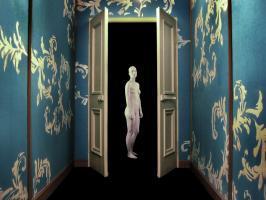
L'une après l'autre, sept femmes, toutes nues et d'une pâleur maladive, veulent pénétrer le monde claustrophobique d'un homme qui a juste assez d'espace pour lui-même et une oie. Ondulant amoureusement et maladroitement ou dansant, elles essaient en vain d'atteindre les toilettes, tandis que l'homme semble se désespérer de cette intrusion féminine.
Bidzina Kanchaveli est né en 1974 à Kutaisi, en Géorgie. Depuis 2000, il vit en Allemagne. A l'âge de vingt ans, il met en scène avec succès sa première pièce, "At first was the word". Il réalise encore quatre autres pièces qui reçoivent la reconnaissance du public. En 1999, il réalise son premier court-métrage, "Novice No21", qui trouve une résonance impressionnante dans divers festivals européens, notamment au festival du film noir de Rome. "Novice No21" a représenté la Géorgie aux Academy Awards en 2000. Sur invitation de la Ludwigsburg film school en Allemagne, SWR Channel et Arte, il réalise son court-métrage suivant "71⁄2 women?. Kanchaveli travaille actuellement sur un nouveau projet, un film de science-fiction sur une humanité, avant le stade de l'homo sapiens, qui vivrait une nouvelle étape de l'évolution.
Diane Kaneza
Catalogue : 2025Ubuntu | Documentaire | hdv | couleur | 34:0 | Burundi | 2023
Diane Kaneza
Ubuntu
Documentaire | hdv | couleur | 34:0 | Burundi | 2023
Au cœur du Burundi, rivalités et extrémisme ethnique entrainent des milliers de pertes de vies humaines depuis l’indépendance. Dans cette folie meurtrière que nous avons traversée, il y a eu des protecteurs de la vie. Au péril de la leur, ils ont caché, protégées des amis et des voisins de l’autre ethnie.
Depuis 15 ans, Diane KANEZA, combine le cinéma, la communication audiovisuelle et le journalisme. Passionnée de l’image, elle l’utilise pour raconter des histoires de Chez elle. Diplômée du Master 2 Cinéma Documentaire de Création, elle en sort avec le Film « Mon Identité ». Une œuvre mémoire qui condense toute son expertise en matière d’acuité du regard documentaire, de capacités de création à partir du réel... Elle cofonde et dirige l’agence de communication MIKADIE Production, qui fait la réalisation et la production des films institutionnels/auteurs et des outils de communication, depuis 2012. Chargée de la programmation du Festival International du Cinéma et de l’Audiovisuel du Burundi de 2013 à 2015, directrice du festival en 2016. Elle allie la production des œuvres audiovisuelles et cinématographique, depuis 2020, à la direction de la chaine de télévision « Burundi News Publication Télévision » (BNP TV). Transmettre, partager ont toujours été son leitmov de par les magazines : « Événement Culturel de la Semaine », « Bonne réponse » et « Notre Terre, Notre Héritage » ; qu’elle développait déjà au sein de la télévision Nationale de 2006 à fin 2011, en tant que Réalisatrice et Animatrice TV. Professeur visiteur au sein de deux universités de Bujumbura (Université Lumière de Bujumbura et Université du Lac Tanganyika), elle enseigne la « Production Documentaire », dans la faculté des sciences de la communication, option communication et conception audiovisuelle.
Ji Youn Kang
Catalogue : 2006My memories are singing to me. | Création sonore | 0 | | 9:2 | Coree du Sud | 2005
Ji Youn Kang
My memories are singing to me.
Création sonore | 0 | | 9:2 | Coree du Sud | 2005
When an event happens, one might remember it, following to the most impressive parts of the event, such as strong smell and beautiful colour. Once it comes into their heads, every factor in their memory cannot be exactly the same as what actually happened. It should be partly changed and distorted according to one?s emotional state. In this work, Ji Youn assumed that if a sound is ?an event?, the partials from the sound and their dynamics can be ?those factors? as mentioned before. For this, Ji Youn extracted four to seven partials from a sampled sound in the way of classifying them by decibels and frequencies. A phrase was made up of a sampled sound and a group of partials. My memories are singing to me consists of three parts; the first part simply describes how people remember an event and how it is varied in one?s head, the second part presents more specific and strong events and factors, which causes one to remember it more easily, and in the last part, Epilogue, the author one by one partial from each sound, combined all together, and made it as ?my memories ? song ?. Ji Youn Kang used Audiosculpt 1.2b to extract partials from a sampled sound (total 13 sampled sounds from ?A-Jeng? one of Korean traditional string instruments). In a phrase, the main soud and the partials were re-generated and controlled with the algorithmic structures using CSound, and Ji Youn assigned the values ? the minimum sample position and the average volume level of the sound files ? to the lengths of each sampled sound, the time-rate for time-stretching and spatial movement.
Ji Youn Kang is an accomplished, seasoned composer with a variety of experiences in both, acoustic and electro-acoustic music. Also, Kang is specially active through community and group activities and has a superior artistic sense, not only in music, but also in web design. Between 2001 and 2003 she had also numerous solo activities related to music, for example the composition and conductor for the Graduation Concert or some arrangement for the Dom Ensemble, for the opening concert of Coste Hall in Myung Dong Catholic Church. As her own compositions we count for example, a Suite for Piano in 1998, ?The shadow of Sound? part 1 for Piano 4 hands and Cello in 1998 or ?Kim ji ha? for Soprano and Piano also in 1998. Through her research as a student in Han Yang University at the Department of Music and Multimedia Laboratory she developed with her team a new electronic instrument ? The Super Jang-go Project. With the Electronic Percussion Designing Project in 2003, in collaboration with the Gong-Myung Percussions Ensemble, she also designed several new electronic percussion instruments, based on traditional Korean instruments, Ji Youn KANG also works as a freelance Website-Designer, so she made lots of websites, such as www.kingeve.com or www.sma21.com. In 2002 she won the president prize in composition of Chu - Gye University for the Arts
Yan-zhi Kang
Catalogue : 2026I tried to carry a statue with me | Vidéo | mp4 | couleur | 16:9 | Taiwan, Pays-Bas | 2024
Yan-zhi Kang
I tried to carry a statue with me
Vidéo | mp4 | couleur | 16:9 | Taiwan, Pays-Bas | 2024
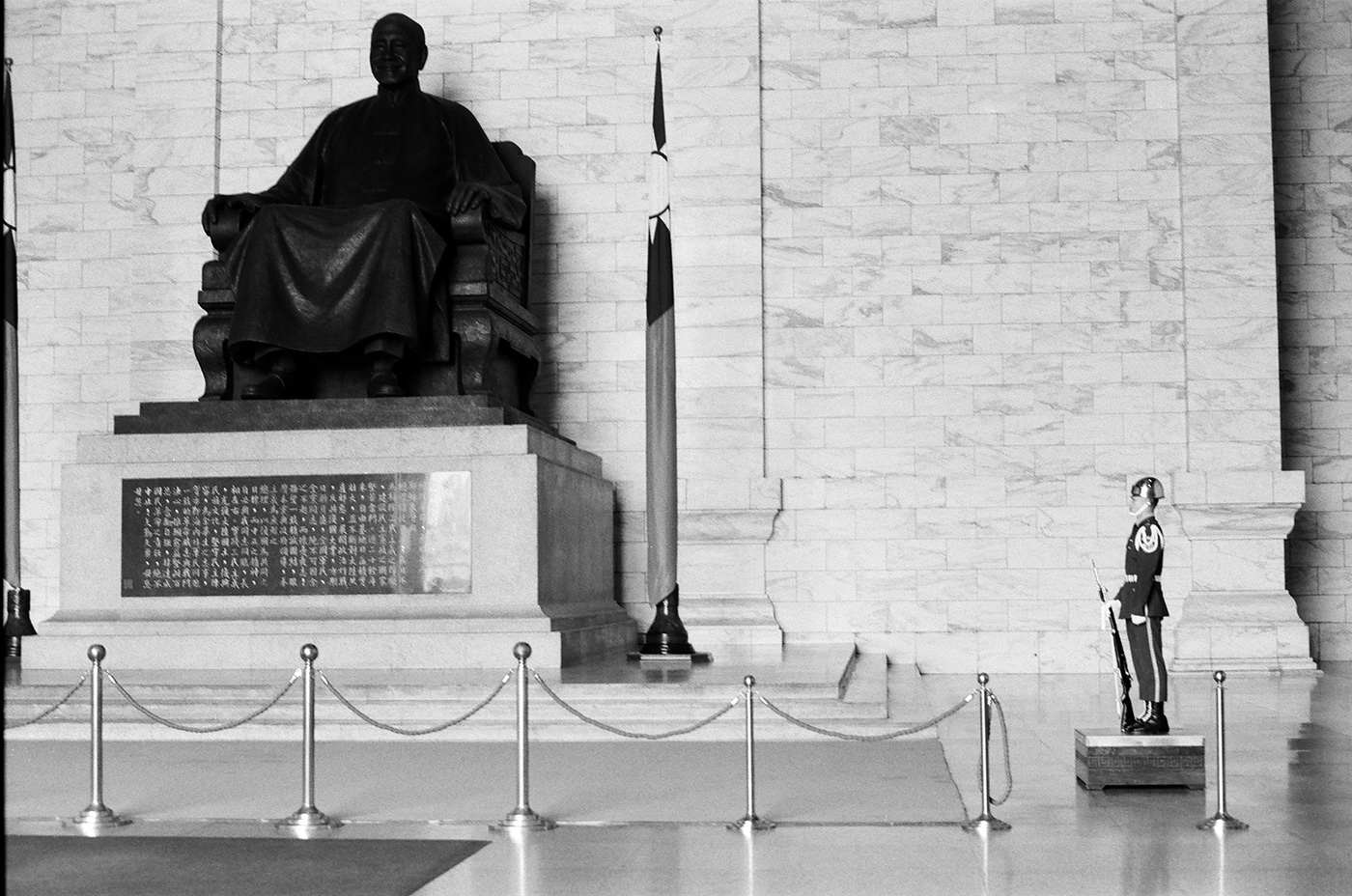
In life, there are certain situations where people have to learn to move on from the past and live life, adapting to new perspectives. During this process, certain things cannot be preserved, while others are constantly remembered, reinforced, and eventually coalesce into beliefs. While delving into the memories of family within this belief, I discover plausible traces derived from the history of East Asia and ideology originating from geopolitics. By seeking out fragmented pictures of past memories and reenacting them, I attempt to reassemble the ideological tension derived from fragmented beliefs in the past and present, visualizing it in the form of a textual narrative.
Yan-Zhi Kang is a visual artist based in Berlin, currently studying Art and Media at the Berlin University of the Arts. His practice examines historical archives, communication media, and national narratives through field research, interviews, and the reconstruction of fragmented histories. By intertwining personal narratives with broader historical contexts, he reveals the ideological structures embedded in images and archival materials. Through a poetic yet analytical approach, his work explores how media shapes personal and collective memory, uncovering the complex interplay between contemporary life and historical consciousness.