Catalogue > List by artist
Browse the entire list of Rencontre Internationales artists since 2004. Use the alphabetical filter to refine your search. update in progress
Peter Downsbrough
Catalogue : 2017THE [ AS | Video | hdv | black and white | 10:12 | USA, Belgium | 2016
Peter Downsbrough
THE [ AS
Video | hdv | black and white | 10:12 | USA, Belgium | 2016
Peter Downsbrough (1940, New Brunswick, N.J.) studied architecture and art. Around the mid-1960’s, after several years of work and exploring materials, including cardboard, wood, steel, lead, neon tubing, an evolution took place which resulted, in 1970, in the work with the ‘Two Pipes’ (outside), ‘Two Dowels’ (inside) and ‘Two Lines’ (on paper). At the same time, he also started taking photographs to document these pieces. By taking photographs from different angles and distances, he gradually started taking photographs of ‘cuts’ that already existed in the urban landscape. Some of these photographs were used in books, some appeared in magazines, but it wasn’t until 1980 that they showed up in exhibitions. From 1977 on, Downsbrough realized several videos as well as audiotapes. A record was made in 1978 and released in 1982. Looking to expand the vocabulary, he developed a series of works using dice. In 1980, on the Spectacolor Board on Times Square, New York, he realized a piece, a 30 seconds spot shown once every hour for four days, and documented it in a short film, ‘7 come 11’. Around 1980, he also started using regular postcards, initially by applying two lines, later to be followed by the use of words. The work with models as a means of exploring space and structure started around 1983. The first commissioned public work was a wall piece realized in Rennes, France, 1990. The film ‘Occupied’was produced in 2000, ten years after it was conceived. Since then, several films, shot with a digital camera, have been published as dvd’s. Today, all these disciplines occupy the field of his activities. Downsbrough’s interest for industrial architecture takes many forms. More often than not, ‘preservation’ means survival in the form of a film or photo series. His films and photos always capture an industrial or (sub)urban reality that will sooner or later vanish or be subject to redevelopment ‘ be it late Seventies Manhattan or the industrial zones around Kent, UK.
Peter Downsbrough
Catalogue : 2019AND TO | Video | hdv | black and white | 3:1 | USA, Belgium | 2018
Peter Downsbrough
AND TO
Video | hdv | black and white | 3:1 | USA, Belgium | 2018
We don`t know where we are. We`re in a car, looking at other cars, roads, structures, tunnels – wasteland. Position? The Global Positioning System informs us, with its horde of satellites, orbiting Earth. Guiding us with its synthesised voice, transporting us, `translating` us. Telling us what to do. `After 250 meters, keep to the right on the Brudermühlstraße, then keep to the left.` (And so on, and so forth.)
Brussels-based Peter Downsbrough (born New Jersey, USA, 1940) has developed a highly distinctive, strongly cohesive body of work that includes sculpture, drawings, photographs, films, videos, books, wall pieces and room pieces, architectural maquettes, and sculptural interventions in public space. Frequently heightening his famously sparse visual vocabulary with an equally sparse linguistic component—often just a single word—Downsbrough calls attention to a vast landscape of structures both physical and social, cultural and political—that shape modern life.
Catalogue : 2014AS ... | | hdv | black and white | 1:46 | USA, Belgium | 2013
Peter Downsbrough
AS ...
| hdv | black and white | 1:46 | USA, Belgium | 2013
Catalogue : 2013IN [ TO | Video | hdv | black and white | 2:47 | USA, Belgium | 2012
Peter Downsbrough
IN [ TO
Video | hdv | black and white | 2:47 | USA, Belgium | 2012
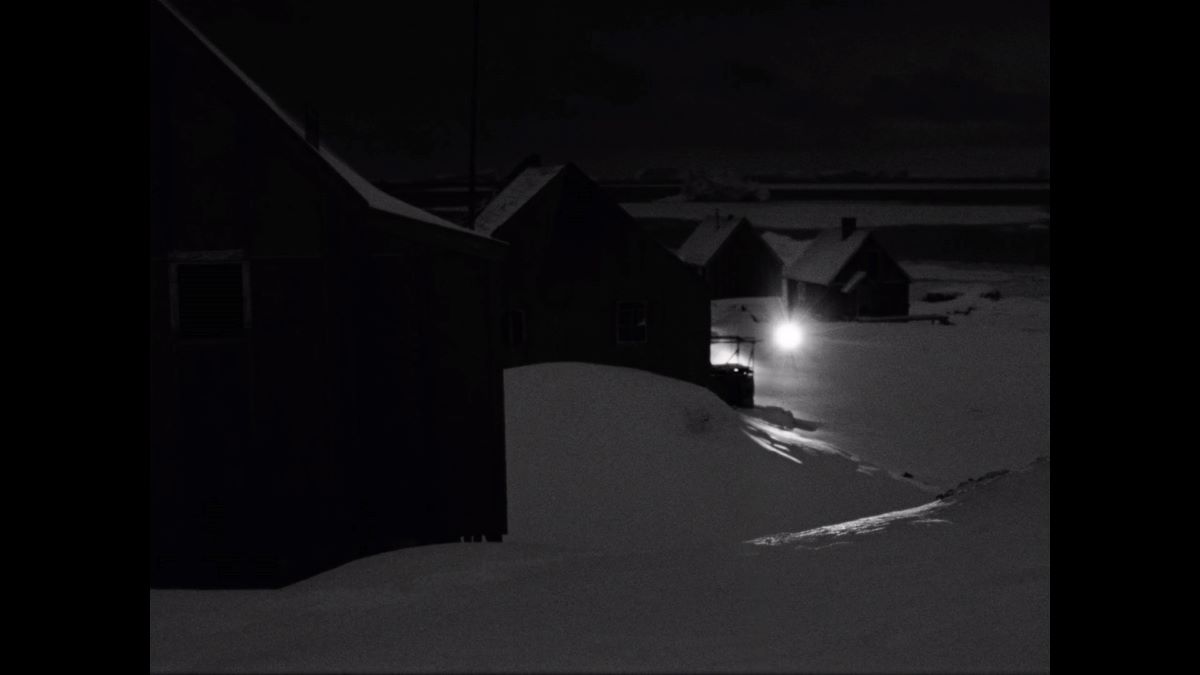
The silent, ultra-short black-and-white video IN [ TO is shorter than a video clip: it clocks in at 2 minutes, 47 seconds. It was made with material shot exclusively for the film, plus footage filmed `on the occasion`, while Downsbrough was working on other projects. One sees images from (South) Chicago, Brussels and Kent respectively, but since everything is filmed at night, only viewers who are familiar with the location will easily identify the spots. Here, the purpose is not to be specific about a site, to identify a place, or to document a certain location. Rather, Downsbrough gives an overall feeling of some quasi-archetypical `city at night`. The city is shot both as cityscape, from a distance, e.g. from outside the window of a Brussels apartment private building, or from nearer-by: a zoom-in from inside of the same building. IN [ TO contains many elements that define former Downsbrough films, both content-wise ? urbanism, cars, freeways and ring roads ? and formally: clean, `structural` framing, abstraction, the use of graphically inserted words. Here, as before, a phrase or a word game, almost hidden, can be discerned ? it might or might not be a key to the film. First, there?s the title of course, IN [ TO. Only at the very end, when the image is fading, the word TIME lights up, shortly. It seems like an indication of what time does: fading out light. Into time, the light fades out. A stream of cars passes by, only their head lights are visible. Everything else is dark, except for the horizon, with the outlines of distant buildings and hundreds of lights flickering: lit windows, neon publicity, street lights. At the film`s very end, a point of view shot from inside a car shows a road at night: Kent ? but it might be any city, or in between cities. To the left, trees; to the right, light posts; in front, the beam of the headlights, some other cars` rear lights. Then the image fades. TIME. The image`s gone. IN ] TO, with reversed bracket. Credits. - Steven Tallon -
Peter Downsbrough (1940, New Brunswick, N.J.; lives in Brussels) initially studied architecture but decided early on to work as a sculptor. Taking photographs of his trademark Two Pipes lead to taking photographs of ?cuts? that already existed in the urban landscape. Initially used in his books, they were shown in exhibitions from 1980 on. After having realized a few videos around 1978, Downsbrough took up filming again when he got a digital camera in 2002. In 1980, on the Spectacolor Board on Times Square, New York, he realized a 30-second spot shown once every hour for four days, and documented it in a short film, ?7 come 11.? His ongoing research of time, space and structure is further articulated through lines and letters in maquettes, wall and room pieces, and public commissions. Exhibitions include POSITION, 2003, curated by M.-T. Champesme, Palais des Beaux-Arts, Brussels (B), Espace de l?Art Concret, Mouans-Sartoux (F) and Muzeum Sztuki, Lodz (PL); Mamco, Genève (CH); FRAC Bourgogne, Dijon (F); SMAK, Ghent (B) and PETER DOWNSBROUGH: THE BOOK(S), curated by M. Küng, deSingel, Antwerp (B) which will have a second venue at Fabra i Coats, Barcelona (E) in the beginning of 2013.
Catalogue : 2012ET- [ | | hdv | color and b&w | 9:11 | USA, Belgium | 2009
Peter Downsbrough
ET- [
| hdv | color and b&w | 9:11 | USA, Belgium | 2009
ET[- opens with a silent black-and-white close-up of a vertical rod shuttling back and forth across a mechanical loom. The short sequence could be mistaken for footage from an early 20th-century propaganda film. Cut sharply to the next scene, also in black and white and taken from a fixed position but unmistakably contemporary. Reflected in a polished, slightly distorting surface, cars are seen entering a gated parking lot. That image is overlaid on the lower left by the film's title, printed in black, and is accompanied by a burst of ambient sound: the dull rumble of traffic. Cut abruptly to a silent close-up in color -- a kind of industrial interior still-life-- then cut again to black and white: a steel door opens vertically onto a cavernous corridor where mini-forklifts scurry about. The rest of the film, which zig-zags between exterior and interior views, is in black and white. Two more jarring spurts of ambient sound are heard and a second word, LA, appears, in white and preceded by a closed bracket, just before the final fade-out and credits. The reflected scene over which ]LA is superimposed is much like the one seen in the film's title image. ET[- has all the characteristics of a signature piece by Peter Downsbrough. The mostly silent, almost entirely black-and-white film is a visual exploration of constructed form, in this case, a modern factory building, a sprawling reflective box situated next to a busy road in a semi-rural setting. The blind facade of pleated, polished stainless-steel mirrors the constant flux of its surroundings and seems to dissolve into them. Inside is a different story: a universe of crisp, hard-edged geometries, gleaming surfaces and clinical precision. Giant spools, looms and bolts of material are stacked, aligned and otherwise arranged in perfect order. Fully automated machines revolve, throb, swivel and tick, each in its own rhythm and speed in the film's eerie silence. Eerie too is the absence of humans. Except for the two forklift operators, whose tiny vehicles occasionally career by like wind-up toys in a madcap adventure, there isn't a soul in sight. The camera surveys the factory's outside features and inner workings with slow pans, and it fixes on details with a steady gaze, shifting its focus constantly from interior to exterior, and its pacing from smooth, stately pans to rapidly cut fixed shots -- a visual interweaving that mimics the manufacturing processes taking place in the factory itself. If the final product is shown wrapped up and ready to go, we don't necessarily recognize it as such. However, we do witness its departure in trailer trucks as they pull out from the factory's loading docks, bound for the highway. That part of the drama, too, is seen reflected in the building's skin. - Sarah McFadden -
Catalogue : 2011I, Y, AND | | dv | color and b&w | 6:30 | USA, Spain | 2010
Peter Downsbrough
I, Y, AND
| dv | color and b&w | 6:30 | USA, Spain | 2010
Catalogue : 2010A]PART | Video | dv | black and white | 11:50 | USA, Belgium | 2009
Peter Downsbrough
A]PART
Video | dv | black and white | 11:50 | USA, Belgium | 2009
A]PART is the first publication in the brand new CKA _ EDITIONS series, run by Christian Kieckens. It constitutes the third collaboration between Brussels-based American artist Peter Downsbrough and Brussels architect Christian Kieckens. Sharing the same sensibilty for both industrial architectural heritage and public space in general, former joint-ventures involved the industrial `Amylum` site in the centre of Aalst (culminating in the 1996 exhibition and photo/text publication Densities) and Brussels? city centre, where Kieckens took on the technical and logistical side of the public commissioned work AND /MAAR, OP AND /POUR, ET (2000-03). Downsbrough?s passion for industrial architecture takes many forms. More often than not, ?preservation? means survival in the form of a film or photo series. His films and photos always capture an industrial or (sub)urban reality that will sooner or later vanish or be subject to redevelopment ? be it late Seventies Manhattan or the industrial zones around Kent, UK. For now, and for the foreseeable future, this seems not to be the fate of Citroën`s impressive, prototypical modernist interbellum garage at Place d?Yser in Brussels ? the subject of Downsbrough`s latest film. The building, once threatened with demolition, will hopefully be there for some time to come, and Downsbrough pays homage to the building and its architects, Belgians Alexis Dumont and Marcel Van Goethem, who cooperated with French architect Maurice Ravazé. By publishing this work, architect Kieckens pays tribute to them as well. The black-and-white film underscores the building`s basic logic and rhythm. The garage consists of two parts, garage and showroom, and Peter Downsbrough films both in a playful yet formally precise way. This includes trade-mark Downsbrough idiosyncrasies, like suddenly letting in short diegetic environmental sounds, or superimposing words, e.g. IN TIME, at the beginning of the film. Typical `car movements` are alternated with proper cinematic movements like pannings; sometimes, an image freezes, and film becomes film still, photo. Shot from the passenger seat of a car driving down the distended corkscrew ramp, the film shows the garage?s interior and views through its windows onto the urban setting below. Downsbrough In a way, the building is filmically taken apart by Downsbrough: from top to bottom (including close-ups of the stained garage floor) it is visually analysed and scrutinised. Yet the physicality of the building also imposes its framing rules on the film; `rules` the artist evidently plays with ? as before. Towards the end of the film, we witness a gay, somewhat absurd dance of cars at the roundabout in front of the building, a picture reminiscent of the famous last scene of Jacques Tati`s fillm Trafic. Still, A]PART ? elegant, heedful and spare ? has a darker side too: it is both ode and elegy. A part. In time. Apart in time. In paying attention to all the minute details of the space and its immediate surroundings, the work symbolically preserves the Citroën building-as-film. However, it also shows how space itself (every space, not just a filmed one) is formed as well by an `attention`. Created by circumstances of history, society and perception, it will in the end always be subjected to the workings of time. (Steven Tallon)
Peter Downsbrough (1940, New Brunswick, N.J.) studied architecture and art. Around the mid-1960?s, after several years of work and exploring materials, including cardboard, wood, steel, lead, neon tubing, an evolution took place which resulted, in 1970, in the work with the Two Pipes (outside), Two Dowels (inside) and Two Lines (on paper). At the same time, he also started taking photographs to document these pieces. By taking photographs from different angles and distances, he gradually started taking photographs of ?cuts? that already existed in the urban landscape. Some of these photographs were used in books, some appeared in magazines, but it wasn?t until 1980 that they showed up in exhibitions. From 1977 on, Downsbrough realized several videos as well as audiotapes. A record was made in 1978 and released in 1982. Looking to expand the vocabulary, he developed a series of works using dice. In 1980, on the Spectacolor Board on Times Square, New York, he realized a piece, a 30 second spot shown once every hour for four days, and documented it in a short film, ?7 come 11?. Around 1980, he also started using regular postcards, initially by applying two lines, later to be followed by the use of words. The work with maquettes as a means of exploring space and structure started around 1983. The first commissioned public work was a wall piece realized in Rennes, France, 1990. The film ?Occupied? was produced in 2000, ten years after it was conceived. Since then, several films, shot with a digital camera, have been published as dvd?s. Today, all these disciplines occupy the field of his activities. An overview exhibition, curated by Marie-Thérèse Champesme, opened on June 24, 2003, at the Paleis van Schone Kunsten, Brussels. It was accompanied by an extensive catalogue and traveled to two other venues.
Catalogue : 2009And [ Back | Video | dv | black and white | 4:37 | USA, Belgium | 2006
Peter Downsbrough
And [ Back
Video | dv | black and white | 4:37 | USA, Belgium | 2006
AND [BACK ?plays? a complex ?game? with the words AND and BACK, where the word BACK sometimes functions as indicator, sometimes as trigger, sometimes as a comment on what is happening on-screen. It?s especially the left/right and right/left (?back? also meaning ?backwards?) movement of represented things ? mostly vehicles ? but of that of cinematic interventions as well, that is of importance. This BACK movement is sometimes repeated in the typography; finally it penetrates and in a sense organises the film in its entirety: as a ?story? that unfolds, as a ?structure? with its symmetries and morphologic qualities. The very first image is black. Then, like a shutter (or some puppet theatre) the image opens itself, a black strip moving from right to left, gradually showing an archetypical American bungalow park: one white bungalow after the other, some slightly weaving trees, a dark sky, a somewhat cracked road; a very symmetrical image. After ten seconds, at the lower part of the image (more or less in the middle) a part of the title is shown, while the ?curtain? still opens and half of the image is exposed: [BACK. It?s unsure ? as always with Downsbrough, where things are often noticed afterwards, on second view? when exactly the viewer actually sees the [BACK; perhaps only after eighteen seconds, when the title is suddenly visible in its totality: AND [BACK. Then there?s a shot of another setting, somewhere in the USA as well, no bungalows this time but a road lined with commercial-looking buildings and palm trees, and cars and trucks passing. Followed by a view from inside a car, driving on the motorway, and low-screen in the right corner, the word AS, mirrored right to left. The little words, seemingly coming from other Downsbrough films (from AS] IN? or from AS] THEN?) gradually invade the screen. A truck driving by on the left suddenly ?wears? the AND from the title, more or less at the spot where we expect a number plate. It stays there, becoming smaller as the vehicle moves away from the viewer. When it fully disappears, the mirrored AS becomes a BACK, and as if on command (?Back!?) we?re back at the preceding image, with the palm trees, the passing vehicles, the commercial facilities. Next, another image is shown, symmetrical as well, presenting a similar road (the same?), not filmed from the side this time, but with the camera placed more or less in the middle of it. At the same spot as where the first word block ([BACK) appeared, the word THERE is shown. After it has faded out, there are new shots from inside a car, showing a similar motorway. For some seconds, the word CONTAIN appears, in the right corner of the screen, tilted to the right at a 90° angle. And in the blink of an eye it communicates with ?Welsh Cargo? ? a container company ? not inserted there by Downsbrough, but part of the industrial landscape the car is driving through. During a split second, typography in the represented space and ?presented?, inserted (stitched-on) typography intersect: both worlds are interchangeable. AS appears again on regular, graphic white walls, the camera panning, still filming from inside a car. The image fades to black, AND appearing again, like CONTAIN before, in the upper right corner and tilted 90°. We?re back to where the film began: the symmetrical bungalow view with the weaving trees. The shutter closes now, from left to right. There?s AND in the middle, where [BACK was before, then just the [ , finally the image is black again. B(L)ACK. (Steve Tallon)
° 1940, New Brunswick, N.J. Lives and works in Brussels, Belgium In Downsbrough?s oeuvre, the relationship between work (sculpture, photo, videos, books, or some combination) ?exhibition? space (including its specific architecture, which can be the city as a whole) and viewer (in front of the work and inside exhibition space or town) is central. ?Inside? the work, this triangle is often doubled or mirrored, by underscoring the link and the tension that exists between image and language. In doing so, many spaces ? many places ? are being created, where the viewer can lodge him/herself mentally. There?s the architectural space itself, the space created between the work and the exhibition space, the space (or spatial relations) within the work, and finally a purely mental space, produced by the game between word and image (?mind sculptures?). The viewer positions himself before the works and inside the space ? POSITION was the title for a recent exhibition at BOZAR, Brussels ? but is at the same time positioned by both work and space (and its continuum: the interstice between work and space). Sometimes these spaces may become genuine places: cuts in time/space where the visitor can dwell. Inversely, s/he may get lost in the labyrinth, even ? or especially ? with those works that include somehow ironic ?indications?: spatial or linguistic ?pointers?. Because of his interest in language, and in incorporating written language in his work (both as signifier and as plastic form), Downsbrough is often seen as a ?conceptual? artist. But his work is very personal and rather idiosyncratic, while at the same time being open to the world as it exists outside the ?art games?. The world as social construct in particular is a recurring theme: the urban, and the organisation of urban space, are a permanent source of inspiration. Among other things, he shows us how thinking about space and giving form to (social) space is culturally relative, and how space co-defines the social. Inversely, some of his maquettes were actually executed, witnessing a thinking-in-practise.
Catalogue : 2008AS] IN | Art vidéo | dv | color | 3:35 | USA, Belgium | 2007
Peter Downsbrough
AS] IN
Art vidéo | dv | color | 3:35 | USA, Belgium | 2007
The interior of an empty office building in Zaventem?s Corporate Village, next to Brussels Airport. Human presence is only to be found outside, through the windows, in the passing cars or close-by office buildings. Using fluid camera movements, travellings as well as panoramics, Downsbrough scrutinizes the environment, exploring the possible relations that may rise from it: inside and outside, empty and inhabited, horizontal and vertical, light and dark surfaces. The geometry of the space, emphasized by Downsbrough?s use of black and white images, determines that of the screen as well. In Downsbrough?s work, the way of looking at space, and at a space in particular, is deeply political. His videos and films point out the limits, the order and the regulations that the social system imposes upon us and our ways of appropriating the space, reminding us that all ?placement? is at the same time an ?ordering?.
The work of Peter Downsbrough (US, 1940) ? sculpture, graphics, photography, video, film, books ? began with an interest in architecture and articulates a complex relationship between architecture, language and typography. Only the bare essentials remain: form is reduced to lines, colours are mostly barred. In his videos, movement and language are explored in relation to time and space: they both represent and deconstruct modern urban and industrial architecture. At the same time, a linguistic twist takes place: by inserting and interposing word blocks like AND, AS or IN, Downsbrough tilts the videos to a kind of ?phrase?, which simultaneously functions as a ?place? for the viewer to lodge in. Downsbrough has exhibited at the Reina Sofi a (Madrid), the SMAK (Ghent), the Paleis voor Schone Kunsten/Palais des Beaux-Arts (Brussels) and the Muzeum Sztuki (Lodz).
Catalogue : 2008And Here | Experimental video | dv | color | 24:0 | USA, Belgium | 2007
Peter Downsbrough
And Here
Experimental video | dv | color | 24:0 | USA, Belgium | 2007
] AND HERE is a video project filmed in North Kent?s urban and industrial environment. It captures images from Kentish town centres to the container transport hub on the Isle of Grain, to the Isle of Sheppey?s caravans, etc. It was commissioned by the Faversham Society in response to the rapid changes brought about by The Thames Gateway North Kent Development, a major regeneration programme extending from Dartford to Teynham in the south of the region. The Faversham Society is a voluntary organisation established in 1962 to protect and promote the heritage of the market town of Faversham and its surrounding area in Kent. Somewhat different from other Downsbrough films, here the represented space is fully identified. This makes it theoretically possible (if one would have this want) to trace down on a/the map the places Downsbrough visited with his camera. But above all it underlines an aspect of Downsbrough?s work (current in other films as well) that consists of documenting lived material history: places still there ? still ?on the go? ? but going, disappearing as well. Another difference lies in the mentioning of ?B/W? ànd ?colour? in the technical specifications above. Indeed, contrary to most Downsbrough?s films, this one also features colour (A]S and THRU does too), albeit in a somewhat ironic and rather teasing way: the concentrated viewer may at some moment discern two full seconds of colour image! Finally, with its 24 minutes running time this is also the longest film since the 1979 The Other Side (25?). In general the viewer is confronted with comparable Downsbrough ?worlds? as the ones preceding this film. As before, the film is made up of space ? a represented space as well as a mentally-induced place ? and typography and word blocks: the title?s ]AND HERE itself of course or words like AS, seemingly migrating from other Downsbrough films. The film alternates between fixed camera shots, travelling and images filmed from the inside of a car, and one could easily ?prolong? some car-shot scenes from for example AND [BACK into this film, or vice versa. Still, not only industrial sites are visited: there are also images from Kent?s cities and villages. With their typical use of bricks, the presence of pubs etc., these places and habitations ? contrary to the formally and geo-economically unifying, ?de-placing? force of industrial space ? are thus identifiable, clearly indicating to the southeast of England and more in particular, to the county of Kent. But the most important difference with former projects, perhaps indicating a new road taken by Downsbrough, can be discerned, not so much in the use of text and images (or ?textual images?) but in that of sound. For ] AND HERE Downsbrough uses especially commissioned improvised music, executed by Xavier Garcia Bardon and Benjamin Franklin, both members of the Brussels-based jam/shoegaze/trance band Buffle. Music was already used in the very first videos ? with (pop) bands like The Spinners or Talking Heads ? and some recent films feature music as well, but here the purpose is not only to create a certain atmosphere, but to use the music as a structural and structuring element as well. As is the case with the filmed images, the music is often interrupted quite suddenly ? the longest continuous piece of music being only about one minute ? than continued. There is a (minimal) musical theme, as is the case in most narrative cinema, but there is also a confrontation and dialogue between sound/music and image/typography. Similar to the ?structuralist? images of Downsbrough?s cinema, the music ? positioning itself somewhere between 90s shoegaze, post-rock and improvisation ? has a strong emphasis on texture, especially through the use of guitar pedal effects and digital signal processing. At the same time, there?s an industrial side to it, reflecting and reinforcing the industrial landscapes filmed by Downsbrough. Interestingly, the glitch-like noise returning throughout the performance is actually not a real glitch ? an electronic slip or short-lived fault in a system, used purposely and creatively in contemporary electronic music ? but a pedal-induced loop. In some undercurrent way the creation of sound by using analogue material at times sounding digital (the glitch) reflects the way in which the film?s seeming aloofness ? above all stemming from the use of industrial footage and from the strict formal approach ? is tempered or dialectically refined, both by the word and language games Downsbrough plays, and by the interest he pays, not only to the spookiness of the industrial landscapes ? void of people ? but to the much more individualised and localised (if not less empty) cityscapes as well. If both film and film music possesses a certain ?frozen? quality, then at the same time they are as if betrayed (tempered, complexified) by the very material side of the process of structuring (?ideally?) a space or a soundscape. It?s exactly this material side of Downsbrough?s ?method? ? ?real? matter turned ?film material?, matter that is always historical, ever residual ? which creates a tension in his films, as well as the pleasure of watching them.
The work of Peter Downsbrough (US, 1940) ? sculpture, graphics, photography, video, film, books ? began with an interest in architecture and articulates a complex relationship between architecture, language and typography. Only the bare essentials remain: form is reduced to lines, colours are mostly barred. In his videos, movement and language are explored in relation to time and space: they both represent and deconstruct modern urban and industrial architecture. At the same time, a linguistic twist takes place: by inserting and interposing word blocks like AND, AS or IN, Downsbrough tilts the videos to a kind of ?phrase?, which simultaneously functions as a ?place? for the viewer to lodge in. Downsbrough has exhibited at the Reina Sofi a (Madrid), the SMAK (Ghent), the Paleis voor Schone Kunsten/Palais des Beaux-Arts (Brussels) and the Muzeum Sztuki (Lodz).
Philipp Döring
Catalogue : 2008Deutschland im Sommer | Fiction | 16mm | color | 13:20 | Germany | 2006
Philipp DÖring
Deutschland im Sommer
Fiction | 16mm | color | 13:20 | Germany | 2006
Germany, in the summer 2006: a woman is roaming around, torn between images of her past in the Red Army Faction and the flood of pictures of the world football championship. Her loneliness grows between the huge "public viewing" places and the giant screens, when talking to officials, and finally standig in front of the grave of Baader, Ensslin and Raspe. By associative montage the film tries to portray from ?behind the mirror? what Germany looked like in the Summer 2006.
Philipp Doering was born November 28th, 1977, in Freiburg, Germany. After high school one year of civil services in Hamburg. He studied German, Slavistics and Cognitive Science at the University of Freiburg, Germany. Since 2004 he studies film directing at the Film Academy Baden-Wuerttemberg in Ludwigsburg, Germany.
Catalogue : 2007Kalypso | Fiction | dv | color | 15:20 | Germany | 2006
Philipp DÖring
Kalypso
Fiction | dv | color | 15:20 | Germany | 2006
A short film about parting.
Philipp Doering was born November 28th, 1977, in Freiburg, Germany. After high school he completed one year of civil service in Hamburg. He studied German, Slavistics, and Cognitive Science at the University of Freiburg. Since 2004 he has been studying film directing at the Film Academy Baden-Wuerttemberg in Ludwigsburg, Germany.
Christoph Draeger
Catalogue : 2006Black september | Experimental video | dv | color | 1:0 | Greece, USA | 2004
Christoph Draeger
Black september
Experimental video | dv | color | 1:0 | Greece, USA | 2004
Robert Aliaj Dragot
Catalogue : 2008Spring & Stalin | Experimental doc. | dv | color | 8:30 | Albania | 2006
Robert Aliaj Dragot
Spring & Stalin
Experimental doc. | dv | color | 8:30 | Albania | 2006
"Spring & Stalin" is based on 27,000 stills photographed from the archives of the National Television in Tirana. The movie is accompanied by a poem from the writer, Ismail Kadare, which was published in "The teacher and the Art", 1953, p. 49- 53. It is a reflection on the mentality and nature of the transition period in the artist's home country. Kadare's poem is intentionally recited by an anonymous fictional voice that has no clue about poetry, not even about language, and it reads in a mechanical and computer-like manner, with a low rhythm and almost sleepy voice, which later on generates a chaotic tension to an growing stressed babbling. All this pandemonium unfolds the idea of false propaganda and governmental elite hypocrisy that in fact displays doubt in these images, which are not believed and understood even from those who see them. Here, the goal is not to stigmatize Kadare's work, but the veiling of that happy and idyllic in disguise reality, after which was hidden the drama of the persecuted people, unable to have the freedom of speech and the freedom of individuality; a people who tried to survive in a oppressed and isolated society.
Robert Aliaj Dragot, not only began as a painter, but his painting was also the point of departure for all the other activities he has manifested. At the end of 90's, after a long career as a pop star singer, he nearly stopped music altogether to go back to his first career as an art painter. Now many years later in Brussels, he is focused especially on a multimedia research, experimenting with photography, moving images, animations, sounds, and painting without losing the picturesque quality. His attention is divided between a critical curiosity of the artistic scene in Europe and a renewed interest for the shockingly fast therapeutic change that the Albanian state underwent.
Sam Drake
Catalogue : 2026Suspicions About the Hidden Realities of Air | Experimental doc. | 16mm | color and b&w | 9:9 | USA | 2025
Sam Drake
Suspicions About the Hidden Realities of Air
Experimental doc. | 16mm | color and b&w | 9:9 | USA | 2025
Fragmented records of events almost too sinister to believe: Cold War era covert radiation testing performed by the United States government on its citizens. The film grapples with the challenges of documenting the invisible, and capturing what is merely waves and frequencies. Shot on expired film, it is through the contaminated image and a complex soundscape that the unseen becomes manifest. – Cristina Kolozsváry-Kiss, IFFR During the Cold War, the U.S. government developed a program of covert human radiation experiments, using its own citizens as test subjects. Suspicions About the Hidden Realities of Air is an elliptical exploration of this dark historical episode, operating across vast landscapes and individual human bodies. Fragments of archival and 16mm imagery – shot on expired film stock – evoke the locations of numerous test sites across the United States. Urban landscapes at night, bleached scenes of the American desert, and close-up details of rural America are interwoven with voice-over and on-screen text that reference testimony of the continuing impact of this period of covert testing. – Open City Documentary Festival
Sam Drake (b. Dayton, OH) is a filmmaker based in Milwaukee, WI. Her work has been exhibited at film festivals and venues including The Museum of Modern Art, International Film Festival Rotterdam, Media City Film Festival, CROSSROADS, The Museum of the Moving Image, Alternative Film/Video, Collectif Jeune Cinéma, Non-Syntax Experimental Image, Winnipeg Underground Film Festival, Transient Visions Festival of the Moving Image, and Antimatter. She has programmed for the Union Cinema and Mini Microcinema and is currently a lecturer at the University of Wisconsin-Milwaukee.
Catalogue : 2025Terminal Island | Experimental doc. | 16mm | color | 12:51 | USA | 2024
Sam Drake
Terminal Island
Experimental doc. | 16mm | color | 12:51 | USA | 2024
Tracing a space between real and phantasmatic ecological dread, Terminal Island presents a multi-sensory portrait of a landscape in peril, an ambivalent lament for LA’s vanishing palms and a sermon on Doomsday infrastructure delivered to no one.
Sam Drake (USA) is a filmmaker based in Milwaukee, WI. Working with 16mm film and found media, her work embraces collage as a framework for interrogating contemporary life and landscapes. She received a BFA in Film from Wright State University, and an MFA from the University of Wisconsin-Milwaukee in Cinema Arts. Her work has been exhibited at film festivals and venues including International Film Festival Rotterdam, Doc Fortnight (MoMA), Media City Film Festival, ExiS, Edinburgh International Film Festival, Curtas Vila do Conde, CROSSROADS, Non-Syntax Experimental Image, Alchemy Film & Moving Image Festival, Collectif Jeune Cinéma, Winnipeg Underground Film Festival, Transient Visions Festival of the Moving Image, and Antimatter. She is currently a lecturer in Film, Video, Animation and New Genres at the University of Wisconsin-Milwaukee.
Fabian Driehorst, Frédéric schuld
Catalogue : 2014Hohenpeissenberg | Video installation | 35mm | color | 0:0 | Germany | 2011
Fabian Driehorst, Frédéric schuld
Hohenpeissenberg
Video installation | 35mm | color | 0:0 | Germany | 2011
A car is burning in front of the Alps and swallows it`s smoke. Two screens, one scene: one backwards, one forward. The impact on the ground of the car falling from the sky and flying back to it is the point of synchronization of both film- channels. The car is disappearing and exploding loop after loop. The sound channels of both projections forward and backwards access into each other creates a collage of sound.
SHORT BIO Fabian & Fred: Fabian Driehorst & Frédéric Schuld studied together at Academy of Media Arts, Cologne (KHM) till October 2011. Hohenpeissenberg is one of a couple of works they created together in and alongside their studies at Academy of Media Arts. Frédéric worked as a designer for multimedia and Fabian worked as cameraman, editor and director of film productions. They work together as creative duo called Fabian&Fred. Fabian Driehorst (born 17.02.1982, Gifhorn) 2004-2011 freelance cameraman, director, editor 2006-2011 studied Film and Art at the Academy of Media Arts (KHM), Cologne 2011 founded creative atelier Fabian&Fred 2012-2013 scholarship of AV-Gruenderzentrum for Fabian&Fred 2011 till now Director, Author, Producer of art- and film projects. Frédéric Schuld (born 20.06.1985, Dusseldorf) 2004-2011 freelance designer for multimedia and film 2006-2011 studied Film and Art at the Academy of Media Arts (KHM), Cologne 2011 founded creative atelier Fabian&Fred 2012-2013 scholarship of AV-Gruenderzentrum for Fabian&Fred 2011 till now creative director of art- and film projects.
Driessens & Verstappen
Catalogue : 2026E-volved Formulae | 0 | 0 | black and white | 10:1 | Netherlands | 2024
Driessens & Verstappen
E-volved Formulae
0 | 0 | black and white | 10:1 | Netherlands | 2024
The image generating Formulae E-volver software is developed by the artists. The building blocks of the software are all kinds of basic mathematical operators. The computer can compose an infinite amount of valid formulas out of these elements. Each time, a small set of formulas is composed and visualised on the screen. The viewer compares these animated images with each other and reviews them. In turn, the software responds on those reviews when it composes new formulas. Formulas that were displayed on the screen for a long time have more chance to crossbreed, whereby visual properties are mixed and passed on to future generations. The process begins with a "primordial soup" which yields relatively simple images. On the basis of personal preferences of the user, this gradually evolves into complex intriguing animations. The final results, the E-volved Formulae, are stored and are displayed on a large screen or projected. They show a wide variety of outcomes of the successive evolutionary processes.
The Amsterdam based artist couple Erwin Driessens (1963 Wessem) and Maria Verstappen (1964 Someren) have worked together since 1990. After their study at the Maastricht Academy of Fine Arts and the Rijksakademie Amsterdam, they jointly developed a multifaceted oeuvre of software, machines and objects. Their research focuses on the possibilities that physical, biological and computer algorithms can offer for image generating processes. An important source of inspiration are the self-organizing processes in nature. In the Morphoteques series (form collections), they show the form variations, which can be expressed within a specific generative process. In other works, the shape transformations are evoked in real time by means of a machine. In their software and AI projects, they develop an artificial nature, which is expressed in all kinds of variations. Driessens & Verstappen participated in numerous exhibitions in the Netherlands and abroad, a.o. Stedelijk Museum Amsterdam, Museum Boijmans van Beuningen Rotterdam, Centre Pompidou Paris, IVAM Institute Valencia, Museum Kröller-Müller Arnhem, Garage Museum Moscow, CaixaForum Barcelona, Eyebeam New York. The couple gives lectures and presentations at universities, art academies, festivals and conferences, a.o. Siggraph Los Angeles, Sonic Acts Amsterdam, Second Iteration Melbourne. In 1999 and 2001 their Tickle robot projects have been awarded first prize at VIDA Telefónica Madrid. In 2013 the couple received the Witteveen+Bos Art+technology Award for their entire oeuvre. The artists are represented by gallery DAM in Berlin.
Catalogue : 2018Deep Dive | Création numérique | 0 | color | 7:35 | Netherlands | 2016
Driessens & Verstappen
Deep Dive
Création numérique | 0 | color | 7:35 | Netherlands | 2016
Deep Dive offers an endless zoom into a picture, revealing an infinitely detailed imaginary world that emerges from the original image. While zooming, the image is constantly being refined in real-time, and the viewer can steer this process by tracking points of interest with the cursor. Each new `dive` starts with a randomly downloaded picture from the online WikiMedia archive.
The artists couple Driessens & Verstappen have worked together since 1990. They attempt an art in which spontaneous phenomena are created systematically. Art that is not entirely determined by the subjective choices of a human being, but instead is generated by autonomously operating processes. In addition to working with natural processes, the couple develops computer programs for artificial growth and evolution. An important source of inspiration are the self-organising processes in nature which continuously create original forms. Works of Driessens & Verstappen are in collections a.o. Centre Pompidou Paris, Stedelijk Museum Amsterdam, Museum Boijmans van Beuningen Rotterdam. They exhibited at museums and galleries a.o. Kröller-Müller Museum Otterlo, IVAM Institute Valencia, Neue Pinakothek München, Eyebeam New York, Young Projects Los Angeles. The artists couple gave presentations at conferences such as Siggraph Los Angeles, Second Iteration Melbourne. In 1999 and 2001 they have won the VIDA award with their Tickle robot projects in an international competition for Art & Artificial Life. In 2013 the couple received the Witteveen+Bos Art+Technology Award for their entire oeuvre. Driessens & Verstappen are represented by DAM gallery Berlin.
George Drivas
Catalogue : 2018Laboratory of Dilemmas | Video | 4k | color | 10:38 | Greece | 2017
George Drivas
Laboratory of Dilemmas
Video | 4k | color | 10:38 | Greece | 2017
Laboratory of Dilemmas is a narrative video installation based on Aeschylus’ theatre play Iketides (Suppliant Women), which poses a dilemma between saving the Foreigner and maintaining the safety of the Native. Addressing current global sociopolitical issues, the work deals with the anguish, puzzlement, and confusion of individuals and social groups when called upon to address similar dilemmas. Aeschylus’ Iketides (Suppliant Women) is the first literary text in history that raises the issue of a persecuted group of people seeking for asylum. The Suppliants have left Egypt to avoid having to marry their first cousins and arrive at Argos seeking asylum from the King of the city. The King is then faced with a dilemma. If he helps the foreign women, he risks causing turmoil among his people and going to war with the Egyptians, who are after the Suppliants. But if he doesn’t help them, he will break the sacred laws of Hospitality and violate the principles of Law and Humanism, leaving the Suppliants to the mercy of their pursuers. Laboratory of Dilemmas focuses on the play’s dilemma through the excerpts of an unfinished documentary in the form of found footage about a scientific experiment. This experiment was never completed for unknown reasons, however the found excerpts of the unfinished documentary reveal today, after so many years, details of the experiment, as well as the hopes of the professor who envisioned it and the disagreements with his co-researchers.
George Drivas completed an MA in Film and Media studies at the Freie Universitaet in Berlin, after doing his bachelor in Political Science and Public Administration at the National and Kapodistrian University of Athens. The artist makes films combining texts, videos and photographs. Through his camera, the artist seems to hide from his subjects. He focuses his narrative on the relation of the individual to society, addressing themes such as social integration, alienation, promisses, desillusion. He is the recipient of numerous awards namely the Best Experimental Film Award at London Greek Film Festival, London, UK (2010); Special Mention at “Strange Screen”, Experimental Film and Video Festival, Macedonian Museum of Contemporary Art, Thessaloniki, Greece (2009); 2nd prize at VII Media Art Forum, XXVII Moscow International Film Festival, Moscow, Russia (2006); 2nd prize at the Zebra International Poetry Film Festival, Berlin, Germany (2002) and Jury Award for Experimental Short Film at the New York Expo, NY, NY (2002). The artist’s work has also been featured as a Solo Show at the Galleria Nazionale, Rome, Italy, (2017) and the National Museum of Contemporary Art, Athens, Greece (2009); as a Tribute to him at the Athens’s International Film Festival (2014), and as part of a group exhibition or festival among others in “ANTIDORON- the EMST Collection”, documenta 14, Kassel, Germany (2017), “As Rights Go By”, Group Show, Q21 International, MuseumsQuartier Vienna, Austria (2016), Festival du nouveau cinéma, Montreal, Canada, (2015), “future past – past future”, Group Show, Transmediale Festival, Berlin, Germany (2014), “Art Projections”, Thessaloniki Biennale of Contemporary Art (2013), “Hybrid Stories”, Group Show, National Museum of Contemporary Art, Athens, Greece (2013), “Melancholy in Progress”, Video Art Exhibition, Hong-Gah Museum, Taipei City, Taiwan (2012), “FILE”, Electronic Language International Festival, FIESP Cultural Center, Sao Paulo, Brazil (2012), “Annual Exhibition”, Group Show, Center on Contemporary Art, Seattle, USA (2012), “Les Rencontres Internationales: New Cinema and Contemporary Art”, Centre Pompidou, Paris, France, “Polyglossia”, Onassis Cultural Centre, Athens, Greece (2011), “ECU”, European Independent Film Festival, Paris, France (2010); “Digital Wave”, Thessaloniki International Film Festival, Thessaloniki, Greece (2009); “Transexperiences Greece” at Space 798, Beijing, China (2008); “Young Greek Artists – In Present Tense” at the National Museum of Contemporary Art, Athens, Greece (2008); “Les Jeunes Cinéastes D’aujourd’hui” at the Centre Pompidou, Paris, France (2007); Media Art Forum, XXVII Moscow International Film Festival, Moscow, Russia (2006); Poetry International Festival, Rotterdam, Netherlands (2003); and Dactyl Foundation for the Arts and Humanities, NY, NY (2002). George Drivas’s work is part of the Athens’s National Museum of Contemporary Art (EMST) collection.
George Drivas
Catalogue : 2022Aeonium | Video | 4k | color | 21:53 | Greece | 2020
George Drivas
Aeonium
Video | 4k | color | 21:53 | Greece | 2020
In a plant nursery, five plant-nursery employees speak about a mysterious disaster, a “terrible event”, while cultivating a plant of the genus Aeonium. They are trying to understand what was that which happened to them. They try to explain the unexplainable.
George Drivas was born in Athens. He represented Greece in Venice Biennale, 2017. ?n 2020, he was nominated for the Eye Art & Film Prize (Eye Filmmuseum, Amsterdam). He had solo shows at Annex M, the Athens Concert Hall (2020), at the National Museum of Contemporary Art, Athens (2018 and 2009) and the National Museum of Modern Art, Rome (GNAM, 2017), tributes at the International Forum of Performance Art (Drama, Greece 2021), Lumen Quarterly Festival, Beijing, China (2017/18) and Athens International Film Festival (Greek Cinematheque 2014) and participations in over 150 group shows and festivals in Greece and abroad like ”Rencontres Internationales, New Cinema and Contemporary Art”, Louvre Museum, Paris, France (2021), “After Us”, Maxxi Museum, Rome, Italy (2021), “back forward rewind”, Media Art Lab, Moscow, Russia (2020), “Imagined Communities”, 21st Biennial of Contemporary Art_Videobrasil, São Paulo, Brazil (2019-20), “Resilient Futures”, Contemporary Art Center of Thessaloniki (2018), “ANTIDORON”, documenta 14, Kassel, Germany (2017), “As Rights Go By”, Q21 International, MuseumsQuartier Vienna, Austria (2016), Festival du nouveau cinéma, Montreal, Canada, (2015), “future past – past future”, Transmediale Festival, Berlin, Germany (2014).
Catalogue : 2021Empirical Data 2.0 | Experimental fiction | hdv | black and white | 30:0 | Greece | 2019
George Drivas
Empirical Data 2.0
Experimental fiction | hdv | black and white | 30:0 | Greece | 2019
Empirical Data 2.0” is based on the personal experience of the georgian actor David Malteze as an immigrant in Greece, and his trajectory from entering the country to taking up acting. The protagonist of the film David Malteze, impersonates himself, at his first professional steps 10 years ago in one half of the screen. The reenactment of the actor’s real life is contrasted with a monologue held by himself, presented at the other half of the screen.
George Drivas was born in Athens, Greece. He has represented Greece at the 57th Biennale di Venezia, 2017. George Drivas’s work has been featured as a Solo Show at AnnexM / Megaron, Athens (2020), the National Museum of Contemporary Art, Athens (2018 and 2009) and La Galleria Nazionale, Rome, Italy, (2017) , as a tribute to him at the Lumen Quarterly Festival, Beijing, China (2017/18) and Athens’s International Film Festival (2014), and as part of a group exhibition or festival among others in “back forward rewind”, Media Art Lab, Moscow, Russia, “Imagined Communities”, 21st Biennial of Contemporary Art_Videobrasil, São Paulo, Brazil (2019-20), “Resilient Futures”, Contemporary Art Center of Thessaloniki (CACT, 2018), “ANTIDORON- the EMST Collection”, documenta 14, Kassel, Germany (2017), “As Rights Go By”, Q21 International, MuseumsQuartier Vienna, Austria (2016), Festival du nouveau cinéma, Montreal, Canada, (2015), “future past – past future”, Transmediale Festival, Berlin, Germany (2014), “Art Projections”, Thessaloniki Biennale of Contemporary Art (2013), “Hybrid Stories”, National Museum of Contemporary Art, Athens, Greece (2013), “Melancholy in Progress”, Hong-Gah Museum, Taipei City, Taiwan (2012), “FILE”, Electronic Language International Festival, FIESP Cultural Center, Sao Paulo, ?razil (2012), Center on Contemporary Art, Seattle, USA (2012), “Polyglossia”, Onassis Cultural Centre, Athens, Greece (2011), “Digital Wave”, Thessaloniki International Film Festival, Thessaloniki, Greece (2009); “Young Greek Artists – In Present Tense”, National Museum of Contemporary Art, Athens, Greece (2008)and Media Art Forum, XXVII Moscow International Film Festival, Moscow, Russia (2006)
Catalogue : 2012SEQUENCE ERROR | Experimental fiction | hdv | color | 11:0 | Greece | 2011
George Drivas
SEQUENCE ERROR
Experimental fiction | hdv | color | 11:0 | Greece | 2011
?Sequence Error? is inspired by the well known Karl Marx quote, ?History repeats itself first as tragedy and than as farce?, and re-uses parts of two famous speeches of the 20th century delivered by Che Guevara (1963) and George Marshal (1947). In a contemporary corporate environment and on the occasion of a sudden system crisis, two leaders of two different groups (workers vs. executives) deliver some parts of the two aforementioned speeches.
George Drivas is the recipient of numerous awards and distinctions namely, Best Experimental Film Award at London Greek Film Festival, London, UK (2010), Special Mention at the ?Strange Screen?, Experimental Film and Video Festival, Macedonian Museum of Contemporary Art, Thessaloniki, Greece (2009), 2nd Prize at VII Media Art Forum, XXVII Moscow International Film Festival, Moscow, Russia (2006), 2nd Prize at the Zebra International Poetry Film Festival, Berlin, Germany (2002) and Jury Award for Experimental Short Film at the New York Expo, NY, NY (2002). George Drivas?s work has been featured as a Solo Show at the National Museum of Contemporary Art, Athens, Greece, (?un-documented?, 2009) and is part of the Athens?s MoCA permanent collection.
Zackary Drucker
Catalogue : 2016Southern for Pussy | Fiction | hdv | color | 4:40 | USA | 2015
Zackary Drucker
Southern for Pussy
Fiction | hdv | color | 4:40 | USA | 2015
Over a long weekend, a mother and daughter discuss thinning vaginal walls and humiliate a handsome stranger.
Zackary Drucker is an independent artist, cultural producer, and trans woman who breaks down the way we think about gender, sexuality, and seeing. She has performed and exhibited her work internationally in museums, galleries, and film festivals including the Whitney Biennial 2014, MoMA PS1, Hammer Museum, Art Gallery of Ontario, MCA San Diego, and SF MoMA, among others. Drucker is an Emmy-nominated Producer for the docu-series This Is Me, as well as a Co-Producer on Golden Globe and Emmy-winning Transparent. She is a cast member on the E! docu-series I Am Cait.
Zackary Drucker
Catalogue : 2014At least you know you exist | Experimental film | 16mm | color | 16:0 | USA | 2011
Zackary Drucker
At least you know you exist
Experimental film | 16mm | color | 16:0 | USA | 2011
Catalogue : 2011Lost Lake | Video | dv | color | 8:0 | USA | 2010
Zackary Drucker
Lost Lake
Video | dv | color | 8:0 | USA | 2010
Filmed at the peak of autumn foliage in a rural Midwestern US locale, this non-narrative short film posits beauty and fear as inextricable from the psyche of the American landscape. Contemplative moments and stunning vistas are jarringly punctuated with the vocabularies of witch-hunts, hate crimes and psychological violence.
Zackary Drucker born: Syracuse NY, 1983 lives and works in Los Angeles, CA
Sophie Dubosc
Catalogue : 2006Esprit | Art vidéo | dv | color | 1:50 | France, Japan | 2004
Sophie Dubosc
Esprit
Art vidéo | dv | color | 1:50 | France, Japan | 2004
Static shot on three people chatting in a common language, English, outside a Japanese tourism sight. The pointless and zany conversation is rapped out by the subtitles which overlap the moving picture of the landscape
Sophie Dubosc received a degree from the Ecole du Louvre in 1997 and obtained a research master's degree from the University of Paris-IV Sorbonne in 1998. She attended the Ecole Nationale Supérieure des Beaux-Arts from which she graduated in 2002. She also studied at Glasgow School of Art and at Musashino Art University in Tokyo. She followed the program of the "Pavillon", a research lab attached to the Palais de Tokyo. For four years she has exhibited her photographic work a the Conde Duque in PhotoEspana (Madrid), Art Brussels (Bruxelles), Rencontres Internationales de la Photographie (Arles)as well as her installations and videos at the Palais de Tokyo, Hiroshima Art Document, Centre d'Art Contemporain in Brétigny and a number of galleries in France.
Julien Dubuisson, Arnaud LAROCHE
Catalogue : 2016Pavillon nocturne | Video | hdv | black and white | 5:45 | France | 2015
Julien Dubuisson
Pavillon nocturne
Video | hdv | black and white | 5:45 | France | 2015
Inspiré par la pièce d’Alberto Giacometti Le Palais à 4h du matin (1932), Pavillon nocturne est conçu comme un « petit théâtre ». Un théâtre dans lequel les personnages ont été remplacés par des formes, l’histoire par les relations qu’elles entretiennent entre elles, les récits qu’elles portent ainsi que leur inscription dans l’histoire de l’art. La sculpture (la combinaison de six formes emboîtées) est une structure construite et close sur elle-même, il n’y a pas d’espace entre les pièces aucun autre élément ne peut y entrer ni en sortir. A la fois «white cube» et «black box theater», cette forme à tiroirs se présente sous la forme d’une collection, un musée, une sépulture, une abstraction, une mort. Un enfant assis sur le sol assemble les pièces en plâtre d’un étrange jeu de construction. Dans ses mains des formes (un visage, une pierre, une forme géométrique, etc.) apparaissent et disparaissent progressivement par un système d’emboîtement rappelant le principe des poupées russes.
Julien Dubuisson est né en 1978 en France. Il est diplômé de l`École nationale supérieure des Beaux-arts de Paris en 2005 et participe depuis 2103 au programme de recherche 5/7de la Villa Arson. Son travail a fait l’objet de plusieurs expositions dont notamment : Basse déf au Palais de Tokyo, Paris (2009) ; Dynasty au Palais de Tokyo / musée d’Art moderne de la ville de Paris (2010) ; Parois au Parc culturel de Rentilly (2011) ; Agir dans ce paysage au Centre international d’Art et du Paysage de l`île de Vassivière (2013) ; Natura Lapsa au Confort Moderne (2014) ; aux bois dormants au musée départemental d’Art contemporain de Rochechouart (2014) ; L`Ordre des lucioles à la Fondation d`entreprise Ricard (2015) ; l’après midi à la Villa Arson (2015).
Catalogue : 2007Passes | Experimental video | dv | color | 17:0 | France | 2005
Julien Dubuisson, Arnaud LAROCHE
Passes
Experimental video | dv | color | 17:0 | France | 2005
The movie is a succession of travelling shots which allow us to discover the architecture of the roof of the inhabited unity of Firmigny, in a slow and close to the ground dolly out shots motion. The rhythm is set by four characters who play the ball, the architecture becoming a protagonist. The sound of the ball as well as part of the music (broadcast on the spot) is a quadrophonic record. Quadrophony renders well the depth and the origin of the sound of the ball on the architecture as well as the movements of the players. The sounds of the game open the movie. The first "image" of the location, in the movie, is a sound image, the location is initially drawn through its acoustic qualities. (The 45 first seconds in the movie only let us hear the sound of the ball, which also happens later on, and sometimes only the music can be heared).
Julien Dubluisson was born in 1978, Arnaud Laroche in 1979. We first met at the Fine Arts School of Nancy (Already 6 years ago) and met again at the Fine Arts School of Paris, after studying briefly in the Fine Arts Schools of Reims and Saint-Etienne. We decided to work together one year after (Four years ago) and passed the Dnsep together in 2005. Together we have published "Repérage" (Onestparpress Editions) in 2004, produced the movie "Passes" in collaboration with le Corbusier foundation in 2005, create a work art for the Cerise space in Paris ("it's still in the elevator!") in 2003, had a drawings exhibition at the SCA in Australia, 2005, and exhibited a sculpture at the highschool (Louis Geisler) in the region of Les Vosges, France, in 2006. We currently prepare a collective exhibition at the "Point Ephémère", Paris.
Julien Dubuisson
Catalogue : 2016Pavillon nocturne | Video | hdv | black and white | 5:45 | France | 2015
Julien Dubuisson
Pavillon nocturne
Video | hdv | black and white | 5:45 | France | 2015
Inspiré par la pièce d’Alberto Giacometti Le Palais à 4h du matin (1932), Pavillon nocturne est conçu comme un « petit théâtre ». Un théâtre dans lequel les personnages ont été remplacés par des formes, l’histoire par les relations qu’elles entretiennent entre elles, les récits qu’elles portent ainsi que leur inscription dans l’histoire de l’art. La sculpture (la combinaison de six formes emboîtées) est une structure construite et close sur elle-même, il n’y a pas d’espace entre les pièces aucun autre élément ne peut y entrer ni en sortir. A la fois «white cube» et «black box theater», cette forme à tiroirs se présente sous la forme d’une collection, un musée, une sépulture, une abstraction, une mort. Un enfant assis sur le sol assemble les pièces en plâtre d’un étrange jeu de construction. Dans ses mains des formes (un visage, une pierre, une forme géométrique, etc.) apparaissent et disparaissent progressivement par un système d’emboîtement rappelant le principe des poupées russes.
Julien Dubuisson est né en 1978 en France. Il est diplômé de l`École nationale supérieure des Beaux-arts de Paris en 2005 et participe depuis 2103 au programme de recherche 5/7de la Villa Arson. Son travail a fait l’objet de plusieurs expositions dont notamment : Basse déf au Palais de Tokyo, Paris (2009) ; Dynasty au Palais de Tokyo / musée d’Art moderne de la ville de Paris (2010) ; Parois au Parc culturel de Rentilly (2011) ; Agir dans ce paysage au Centre international d’Art et du Paysage de l`île de Vassivière (2013) ; Natura Lapsa au Confort Moderne (2014) ; aux bois dormants au musée départemental d’Art contemporain de Rochechouart (2014) ; L`Ordre des lucioles à la Fondation d`entreprise Ricard (2015) ; l’après midi à la Villa Arson (2015).
Catalogue : 2007Passes | Experimental video | dv | color | 17:0 | France | 2005
Julien Dubuisson, Arnaud LAROCHE
Passes
Experimental video | dv | color | 17:0 | France | 2005
The movie is a succession of travelling shots which allow us to discover the architecture of the roof of the inhabited unity of Firmigny, in a slow and close to the ground dolly out shots motion. The rhythm is set by four characters who play the ball, the architecture becoming a protagonist. The sound of the ball as well as part of the music (broadcast on the spot) is a quadrophonic record. Quadrophony renders well the depth and the origin of the sound of the ball on the architecture as well as the movements of the players. The sounds of the game open the movie. The first "image" of the location, in the movie, is a sound image, the location is initially drawn through its acoustic qualities. (The 45 first seconds in the movie only let us hear the sound of the ball, which also happens later on, and sometimes only the music can be heared).
Julien Dubluisson was born in 1978, Arnaud Laroche in 1979. We first met at the Fine Arts School of Nancy (Already 6 years ago) and met again at the Fine Arts School of Paris, after studying briefly in the Fine Arts Schools of Reims and Saint-Etienne. We decided to work together one year after (Four years ago) and passed the Dnsep together in 2005. Together we have published "Repérage" (Onestparpress Editions) in 2004, produced the movie "Passes" in collaboration with le Corbusier foundation in 2005, create a work art for the Cerise space in Paris ("it's still in the elevator!") in 2003, had a drawings exhibition at the SCA in Australia, 2005, and exhibited a sculpture at the highschool (Louis Geisler) in the region of Les Vosges, France, in 2006. We currently prepare a collective exhibition at the "Point Ephémère", Paris.
Benjamin Ducroz
Catalogue : 2009PIN | Animation | dv | color | 1:0 | France | 2007
Benjamin Ducroz
PIN
Animation | dv | color | 1:0 | France | 2007
Pin pines deep in a thickly flanked forest, catapult the camera into flurried reams of pointillist perspectives flying limb from limb on a quick cut ride of kaleidoscopic possibilities.
Benjamin Ducroz Presenting a fast-paced morphology of the modern artefact-in-transformation underscored by vibrantly lyrical witticisms and impossible perspectives, Ducroz?s purist emphasis on real objects suffused with a surreal post-architectural explosiveness, unleashes the hyperreal latency of everyday objects and obsolete technologies in a sixty second mediaflash.
Aurore Dudevant, Philippe ZULAICA
Catalogue : 2007Forces Mobiles | Experimental video | dv | color | 3:10 | France | 2006
Aurore Dudevant, Philippe ZULAICA
Forces Mobiles
Experimental video | dv | color | 3:10 | France | 2006
The agitation of the funfair: height of social agglomeration, movement, and accidental proximities. This entertainment area, meant as a way to escape from social order, is also a paradox of voluntary submission to other people´s gaze, and to the technical and physical forces of merry-go-rounds (which could be linked to those of automobiles). The visitors of the funfair free themselves from their simplest feelings while at the same time voluntarily enslaving themselves there; fear, surprise, joy, euphoria, excitement, dread. This ambiguous process is already described in the film "l'Aurore", directed by Murnau in 1927. Country folk discover and learn the city and modern life through the prism of the fair. The agitation of the fair frees them from their rural condition. Through the shock of encounters, social friction, and mechanical power of the attractions, it mentally and physically prepares them for life in modern society. In the video "Forces mobiles", images of fun fairs and aerial photos of motorway interchanges, entrance and exit ramps, bypasses, and roundabouts are juxtaposed. The purpose of these many systems is not linked to a will to draw, structure the urban scenery, or express a coherent vision of the city, but really is to perfectly adapt the trajectories of the pendulous routes of the automobiles to the continual flux of cars driving towards workplaces, commerce, housing, and activity.
Aurore Dudevant was born in 1979. She obtained a BA in Architecture at Nancy's (France) College. She also studied at Oporto's University (Portugal) She´s been working as an architect since 2004. Philippe Zulaica was born in 1997 and graduated from the Architecture College of Nancy. He studied architecture for one year in Brighton (UK). He´s been an architect since 2002. His work has been shown at Berlin Visage (Goethe Insitut, Nancy), The Villette (Paris) in 2003 during the exhibition called "Urbanisme", Young Creation 2003 at the Great Hall (Grande Halle, La Villette, Paris), ORILLA#05, MAC (Santa Fe, Argentina) in 2005, and Sao Paulo, Brazil.
Dana Berman Duff
Catalogue : 2017Catalogue Vol.6 | Experimental film | hdv | black and white | 11:38 | USA | 2016
Dana Berman Duff
Catalogue Vol.6
Experimental film | hdv | black and white | 11:38 | USA | 2016
"Catalogue" is a series of 16mm films and videos that consider the time it takes to look at the objects for sale in a mainstream furniture catalogue of designer knock-offs. The catalogue presents de-saturated photographs of staged rooms shot and printed to resemble sets for film-noir era movies. This mediation hypothetically increases the objects` desirability by picturing them in a nostalgic historical moment that is, in fact, fictional. In these pictures, copies of designer furniture are indistinguishable from original pieces. The film is a documentary of the filmmaker’s looking; each cut was determined by the rise and decay of her interest in the object. Each film takes one volume of the 11-volume mail order catalogue as its subject. They can be screened as a set or individually. "Catalogue Vol.6" was shot with audio clips from a horror movie that mention the words "house," or particular rooms or parts of a house, playing in the studio while the film was being shot so that each shot acquired a random "soundtrack." Then the film clips were organized as a "tour" through the rooms of a house: foyer, living room, dining room, kitchen, study, bath, ending at the bedroom.
Dana Berman Duff’s artworks are included in the collections of the Museum of Modern Art and the New Museum of Contemporary Art in New York, the Phillips Collection (Washington DC), Brooklyn Museum (NYC), The Carnegie Museum (Pittsburgh), and a number of private collections. Her works in small format film and video have been screened in a number of festivals including the Toronto International Film Festival, International Film Festival Rotterdam, the Biennale de l’Image en Mouvement (Geneva), Edinburgh International Film Festival, ExIS (Seoul), Antimatter (Vancouver), San Francisco Cinematheque’s Crossroads, Experiments in Cinema (Albuquerque), Cairo International Film Festival, Timisoara Festival (Romania), Filmmakers Festival (Milan), Onion City Experimental Film Festival (Chicago), LaborBerlin microcinema (Berlin), Dortmund/Cologne International Women’s Film Festival, Seattle Filmforum, Echo Park Film Center (Los Angeles). The Gringas, (2013) was named Best Documentary Feature at the 2014 Mexico International Film Festival. Dana Berman Duff teaches at Otis College of Art and Design in Los Angeles and lives part-time in Mexico.
Benjamin Dufour, Régis Feugère
Catalogue : 2015Few times, few places | Experimental doc. | hdv | color | 10:44 | France, Luxembourg | 2013
Benjamin Dufour, Régis Feugère
Few times, few places
Experimental doc. | hdv | color | 10:44 | France, Luxembourg | 2013
Europe’s landscape familiar to us today is largely the product of centuries of planning and decisions, meant to go hand in hand with the development of humankind in its habitat. We are most often faced with a man-made landscape in a constant state of flux. This vast undertaking is the result of choices made by public or private institutions, whether democratic or not. Various human, legal, political and economic activities constantly set pace to and modify the environment. Few times, few places paints a portrait of places where these activities are concentrated. The notion of landscape sometimes invokes a surface on which we rest our gaze. In this piece, it is a question of heading upstream towards the very source of this surface.
Félix Dufour-laperrière
Catalogue : 2010M | Animation | 35mm | black and white | 7:45 | Canada | 2009
Félix Dufour-laperriÈre
M
Animation | 35mm | black and white | 7:45 | Canada | 2009
Petites architectures et brèves nébuleuses. Film abstrait.
Félix Dufour-Laperriere est né en 1981, à Chicoutimi. Il a étudié à Montréal et y vit et travaille présentement. M est son sixième film. Il est également co-fondateur de la galerie en ligne www.lappentis.com.
Anne-marie Duguet
Catalogue : 2013... | | | | 60:0 | France | 0
Anne-marie Duguet
...
| | | 60:0 | France | 0
.
.