Catalogue > List by artist
Browse the entire list of Rencontre Internationales artists since 2004. Use the alphabetical filter to refine your search. update in progress
Anton Ginzburg
Catalogue : 2023ML_CRSH | Experimental video | 4k | color | 3:26 | USA | 2021
Anton Ginzburg
ML_CRSH
Experimental video | 4k | color | 3:26 | USA | 2021
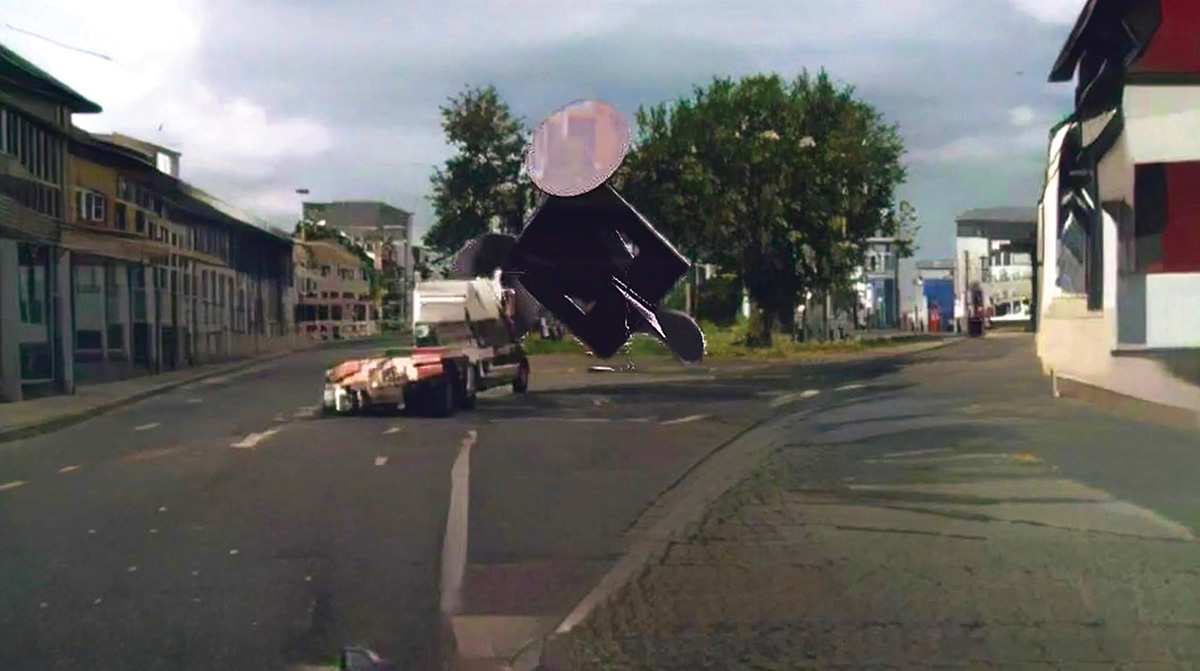
“ML CRSH” is a video work that was developed using a 3D gaming engine environment for self-driving vehicles. The AI algorithm was used to apply the database collection of photo materials and textures of Dresden to the 3D models, causing unpredictable digital artifacts. The initial video was inspired by the “Media Burn” 1975 performance organized by Ant Farm collective, where a customized Cadillac drove into a wall of flaming television sets. Translating it into today’s digital environment of “database logic” of new media objects and employment of AI, it features a montage of crashes of autonomous vehicles into digital replicas of art objects. The artwork turns its focus on the proliferation of database and AI technologies and disrupts its patterns with an iconoclastic gesture of a crash.
Anton Ginzburg is a New York–based artist and filmmaker who uses an array of historical and cultural references as starting points for his investigations into art’s capacity to penetrate layers of the past and reflect on the contemporary experience. Born in 1974 in Saint Petersburg, Russia, Ginzburg received a classical arts education before immigrating to the United States in 1990. He earned a BFA from Parsons The New School for Design and MFA degree from Bard College (Milton Avery Graduate School). His art has been shown at the 54th Venice Biennale, Blaffer Art Museum, Lille3000, Palais de Tokyo in Paris, the San Francisco Museum of Modern Art, White Columns, and the Smithsonian Cooper-Hewitt, National Design Museum. Screenings included IFFR, NYFF/Projections, Ann Arbor, Go Shorts and Images/Toronto.
Eva Giolo
Catalogue : 2020A Tongue Called Mother | Experimental doc. | 16mm | color | 18:0 | Belgium | 2019
Eva Giolo
A Tongue Called Mother
Experimental doc. | 16mm | color | 18:0 | Belgium | 2019
A Tongue Called Mother depicts the relationship between language, gestures and affiliation. It slowly captures the actions and words of three generations of women in the same family and children learning to read, meditating on words learnt and forgotten through the body.
Eva Giolo (b.1991 Brussels) is an audio visual artist and filmmaker who lives and works in Brussels. Giolo obtained a BA and MA in Fine Arts at the Media Arts department of the Royal Academy of Arts (KASK), Ghent. She completed her music education at the Institute of Contemporary Music in London. Giolo won the VAF Wildcard for experimental film (2016). Eva Giolo is a founding member of elephy and a post-grad art resident at HISK in Ghent (2018-2020).
Eva Giolo
Catalogue : 2018Remote | Experimental film | hdv | color | 23:41 | Belgium | 2016
Eva Giolo
Remote
Experimental film | hdv | color | 23:41 | Belgium | 2016
Remote is a suggestive story. Portrait of a tender companionship in a secluded Irish countryside. Residing in the simplicity of the moment, the waiting and the repetition of days. This is a place where there is no space for imagining a future other than the perpetual repetition of the present. This is a place for survival, to be strong, alone with the wind, eyes burnt by the light. A place of unspoken tenderness, a landscape of silence and solitude in which there will always be someone.
Eva Giolo (b.1991 Brussels) is an audio visual artist. Her practice is predominantly made of filmic portraits that weave between fiction and documentary. They focus on individuals, almost always facing a certain kind of loneliness. She mainly focus on those individuals in their daily life, scripting and observing their actions and daily gestures through the camera. They often touch upon universal human themes and explore the relationship between loss, time and memory. But also the in-between language of the camera and the subject. Presenting memories, images and portraitures as something that can be manipulated and seen with multi-perspectives. Questioning the power of images is a recurrent theme and memories often stand as a central narrative. Giolo obtained a BA and MA in Fine Arts at the Media Arts department of the Royal Academy of Arts (KASK), Ghent. She completed her music education at the Institute of Contemporary Music in London. Recent screenings and exhibitions include: Imagine Science Film Festival, New York; TAZ#17, Ostend; Côté court, Paris; International Film Festival Rotterdam; Blaa Galleri, Copenhagen; BOZAR, Brussels; Courtisane Film Festival, Ghent; Ishibiki Gallery, Kanazawa; In Out Film Festival, Gdansk among others. Giolo won the VAF Wildcard for experimental film (2016) and is a founding member of the small distribution and production platform elephy. Eva Giolo is a post-grad art resident at HISK in Ghent (2018-2020). She currently works and lives in Brussels.
Eva Giolo
Catalogue : 2026Memory Is an Animal, It Barks with Many Mouths | Experimental film | 16mm | color | 24:0 | Belgium | 2025
Eva Giolo
Memory Is an Animal, It Barks with Many Mouths
Experimental film | 16mm | color | 24:0 | Belgium | 2025
Eva Giolo’s latest work takes us to Val Gardena, where people still speak Ladin, a Rhaeto-Romance language. Giolo subverts the usual representation of mountain communities to deliver a portrait of a precious cultural heritage in constant evolution. Here, the inhabitants preserve and nurture their culture for future generations with awareness of the world and creativity. Shot on 16mm film sensitive to the grandeur and fragility of nature, Memory Is an Animal, It Barks with Many Mouths is an exquisite essay on the vital importance of linguistic diversity.
Eva GIOLO (1991, Belgium) is an artist working in film, video and installation. Her work places particular focus on the female experience, employing experimental and documentary strategies to explore themes of intimacy, permanence and memory, along with the analysis of language and semiotics. Her films, installations and other projects have been widely exhibited internationally at festivals, museums and galleries, including Sadie Coles HQ, Viennale, FIDMarseille, IFFR, New York Film Festival and many others. Her film Flowers blooming in our throats (2020) was nominated for The European Film Award and awarded the Top Prize at THIS IS SHORT 2021. She also received the National Award Special Mention at Lago Film Fest 2021, the Jury Special Mention at First Crossings Festival and the Critics’s Jury Award at 25FPS Festival. She is a laureate from HISK (2018-2020) and a former art resident at SeMA NANJI (2020), the year-long film–writing residency Conversation #4 (CVB, GSARA and Beursschouwburg), CASTRO studio program (2021), WIELS (2021), RU Unlimited New York and Fogo Island Arts (2022). Her films are distributed by elephy and Light Cone.
Catalogue : 2025Stone, Hat, Ribbon and Rose | Experimental film | 16mm | color | 16:0 | Belgium | 2024
Eva Giolo
Stone, Hat, Ribbon and Rose
Experimental film | 16mm | color | 16:0 | Belgium | 2024
Part of the YOURS project, an assemblage of five short films dedicated to Chantal Akerman, STONE, HAT, RIBBON AND ROSE offers a strictly personal and decidedly fragmented guide to Brussels; this idiosyncratic city symphony takes us across different urban terrains and unveils each location’s visual and sonic wonders. Amplifying the film’s elusive, drifting quality are a series of one-person performances involving disparate objects in the city. Playful and sombre, quotidian and fantastic, Eva Giolo’s film is a tender love letter to Akerman’s work. (Hyun Jin Cho)
Eva Giolo is an artist working across film, video, and installation. Her work has been exhibited at Sadie Coles HQ, Harlan Levey Project, WIELS centre for Contemporary Art , MAXXI–National Museum of 21st Century Art, Kunstmuseum Den Haag, BOZAR Centre for Fine Arts, Palazzo Strozzi, Museum of Contemporary Art Antwerp, Kunsthalle Wien, and major film festivals like International Film Festival Rotterdam, Viennale, FIDMarseille and Vision du Réel among others. She is a founding member of the production and distribution platform elephy.
Catalogue : 2022Flowers blooming in our throats | Experimental film | 16mm | color | 8:37 | Belgium, Italy | 2020
Eva Giolo
Flowers blooming in our throats
Experimental film | 16mm | color | 8:37 | Belgium, Italy | 2020
Everyday occupations, some domestic tools, fruits, light, rope and many hands. Hands that dig in the earth, that cut, that cook, that touch, rip, wash, squeeze, erase, press, push. The sound of domestic spaces and its silence. Red flowers one summer. Flowers blooming in our throat is a cinematic poem in response to the worldwide pandemic of 2020. Commissioned and produced by in between art films for the project Mascarilla 19 – Codes of Domestic Violence. Filmed in 16mm just after the lockdown caused by COVID-19, Flowers blooming in our throats is an intimate, poetic portrait of the fragile balances that govern everyday life in a domestic setting. The artist films a group of her friends in their own homes, performing various small actions in accordance with her instructions. Giolo chooses to walk a shifting line where gestures remain symbolically ambiguous, expressing a kind of violence that is not immediately recognizable. Hands try to support or escape, but also to grip or strike, in a subtle interweaving of sounds and references that adds to the viewer’s sense of tension and unease. A dialogue of gestures, made up of repeated visual sequences where time is marked by the spinning of a small toy top, as unstable and precarious as the balance of a relationship.The artist repeatedly uses a red filter on her lens, creating a conceptual device that relies on an element of abstraction to conceal and transfigure the image. The mechanical insertion of the filter over the lens thus becomes the simulation of a violent act, immediately changing the way we perceive and remember an action we have seen before.This coexistence of opposites can also be found in the title, which metaphorically suggests how the beauty of a natural phenomenon—and implicitly, love – can turn into a suffocating force. Leonardo Bigazzi
Eva Giolo (Belgium) is an audio-visual artist working in film, video, and installation, born in Brussels in 1991. Her work places particular focus on the female experience, employing experimental and documentary strategies to explore themes of intimacy, permanence and memory, along with the analysis of language and semiotics. Giolo uses her camera to capture the “mundane” moments of the everyday to reveal their hidden depth. After pursuing music at East London University (2011), she received her BA in Media Arts (2015), and MA in Fine Arts, Royal Academy Fine Arts Ghent (2016). Her films, installations and other projects have been widely exhibited at festivals, museums and galleries internationally, including Sadie Coles HQ, WIELS, MAXXI–National Museum of 21st Century Art, BOZAR Centre for Fine Arts, Palazzo Strozzi, Festival Internacional de Cine Independiente de La Plata Buenos Aires, Viennale, Museum of Contemporary Art Antwerp, Kunsthalle Wien, International Film Festival Rotterdam, Kunstmuseum Den Haag, Lago Film Festival, Viennale, FIDMarseille, Courtisane Film Festival, Rencontres International Paris Berlin, Cinéma du Réel and Punto de Vista among others. Giolo’s work is in the permanent collections of Fondazione In Between Art Film (Rome) and Het Huis Van Alijn (Ghent), Museum M (Leuven). Her film Flowers Blooming in Our Throats (2020) was nominated for the European Film Awards (2020), and received Grand Prize from This Is Short, a collaborative online event co-presented by the International Short Film Festival Oberhausen, Vienna Short Film Festival, and other European organizations. She is the recipient of a VAF Wildcard Prize (2016), the Cedric Willemen Award (2019) and special recognition from the Vordemberge – Gildewart Foundation (2020). She was an artist in residence at the Higher Institute for Fine Arts (2018–2020), SeMA NANJI in Korea and WIELS Centre for Contemporary Art (2020) and the CASTRO studio program (2021). In 2022, Eva will be an art resident at Fogo Island Arts in Canada. Eva is co-founder of the Moving Image Atelier (Belgium) and co-founder and Artistic Director of Elephy, a production and distribution organization for film and media art, with Rebecca Jane Arthur, Chloë Delanghe, and Christina Stuhlberger. She lives and works in Brussels, Belgium.
Eva Giolo, Rebecca Jane Arthur, Katja Mater, Sirah Foighel Brutmann & Eitan Efrat, Maaike Neuville
Catalogue : 2025Yours, | Experimental film | 16mm | color and b&w | 82:0 | Belgium | 2023

Eva Giolo, Rebecca Jane Arthur, Katja Mater, Sirah Foighel Brutmann & Eitan Efrat, Maaike Neuville
Yours,
Experimental film | 16mm | color and b&w | 82:0 | Belgium | 2023
A group of artists are invited to be inspired by the work of the well-known, Belgian filmmaker Chantal Akerman, specifically her film News from Home (1976). The busy city of New York serves as the film’s main character. Meanwhile, we hear Akerman’s voice reading letters from her mother in Brussels. She recounts daily anecdotes from the home front and increasingly urgent requests for news from New York. A group of artists are asked to make one film together: each with their own voice, style, and starting point. During the working process, questions arose such as: how do you as an artist relate to another film practice, how do you create a collective work while maintaining your individuality? You’ll see no less than five different films within one kaleidoscopic film: Stone, Hat, Ribbon and Rose by Eva Giolo, Barefoot Birthdays on Unbreakable Glass by Rebecca Jane Arthur, When Things Fall Apart by Katja Mater, Un Âne by the artistic duo Sirah Foighel Brutmann and Eitan Efrat, and The possibility of being sea by Maaike Neuville. Details such as letters and metros, and themes such as dislocation, detached city life, alienation versus feeling at home, distance versus proximity, and the mother-daughter relationship echo Akerman’s films. Unfortunately, the artists are no longer able to engage directly with the filmmaker, who passed away in 2015. However, this joint work attests to a way of engaging in dialogue with her work.
Eva GIOLO (1991, Belgium) is an audio-visual artist and filmmaker from Brussels. She obtained an MA in Fine Arts at KASK, Ghent and her musical education at the Institute of Contemporary Music in London. In her work Giolo tries to capture familial stories using documentary strategies to make portraits of usually private and unseen interior worlds. Her work has been exhibited all over the worl, and in 2016 she won the VAF Wildcard for experimental film. She is a founding member of elephy, a Brussels-based production and distribution platform for film and media art. Rebecca Jane Arthur is a visual artist working predominantly with the moving image and writing. Her works often revolve around portraits of people and places, and her interest lies in personal stories that depict a socio-political context and history. Arthur obtained her MA in Fine Arts at KASK, Ghent, in 2017. She completed her BA in Fine Arts at Sint-Lukas Brussels in 2015, after spending one year at the Academy of Fine Arts Vienna. Arthur recently exhibited her work at Tallinn Photomonth 2017: Contemporary Art Biennial; ARGOS Centre for Art and Media, Brussels; Convent, Ghent; and Courtisane Festival, Notes on Cinema 2017, Ghent, among others. Recent texts on Arthur’s work have been published in Metropolis M and KORTFILM.be. Arthur works in Brussels as a freelance writer, proofreader, copy-editor, translator (NL-EN) and moving image producer. She is co-founder of the film and media art platform elephy, together with Chloë Delanghe, Eva Giolo and Christina Stuhlberger. In 2017-18, she is working as a researcher on the art-based research project Six Formats on the chapter ‘Screening’, which is run by Felicitas Thun-Hohenstein and Ingrid Cogne, funded by FWF-Peek and hosted by the Academy of Fine Arts Vienna. Katja Mater’s (*1979 in Hoorn/The Netherlands, lives and works in Brussels and Amsterdam) practice focuses on the parameters of photography and film from a meta-perspective, using them as non-transparent media. By creating hybrids between different optical media, installation and performance she documents something that often is positioned beyond our human ability to see. Interested in revealing a different or alternative (experience of) reality through capturing the areas where optical media hardly behave like the human eye, Mater mediates between time, space, perception and our understanding of them, she records events that simultaneously can and cannot be – holding midway between information and interpretation. Sirah and Eitan are working in collaboration, creating works in the audiovisual field, installation and performance. They live and work in Brussels. Sirah and Eitan’s practice focuses on the performative aspects of the moving image. In their work they aim to mark the spatial and durational potentialities of reading of images – moving or still; the relations between spectatorship and history; the temporality of narratives and memory and the material surfaces of image production. Their works have been shown in duo exhibitions in Kunsthalle Basel (CH); Argos, Brussels (BE) and CAC Delme (FR); at group exhibitions in Argos (BE); Museum für Kunst und Gewerbe, Hamburg (DE); Portikus, Frankfurt (DE); Jeu de Paume, Paris (FR) and STUK, Leuven (BE). In film festivals such as EMAF, Osnabrück (DE); Atonal, Berlin (DE); Doc Lisboa (PT); Oberhausen Film Festival (DE); Rotterdam Film Festival (NL); Les Rencontres International, Paris and Berlin (FR/DE); New Horizons, Wroc?aw (PL); Images, Toronto (CA); 25FPS, Zagreb (HR). Sirah and Eitan are currently teaching at ERG, Brussels. Maaike Neuville (°1983) is a Belgian actress and director. Maaike graduated in 2005 from Studio Herman Teirlinck in Antwerp.
Marina Gioti
Catalogue : 2023Teleti Kathelkisis | Experimental film | dcp | black and white | 16:42 | Greece | 2021
Marina Gioti
Teleti Kathelkisis
Experimental film | dcp | black and white | 16:42 | Greece | 2021
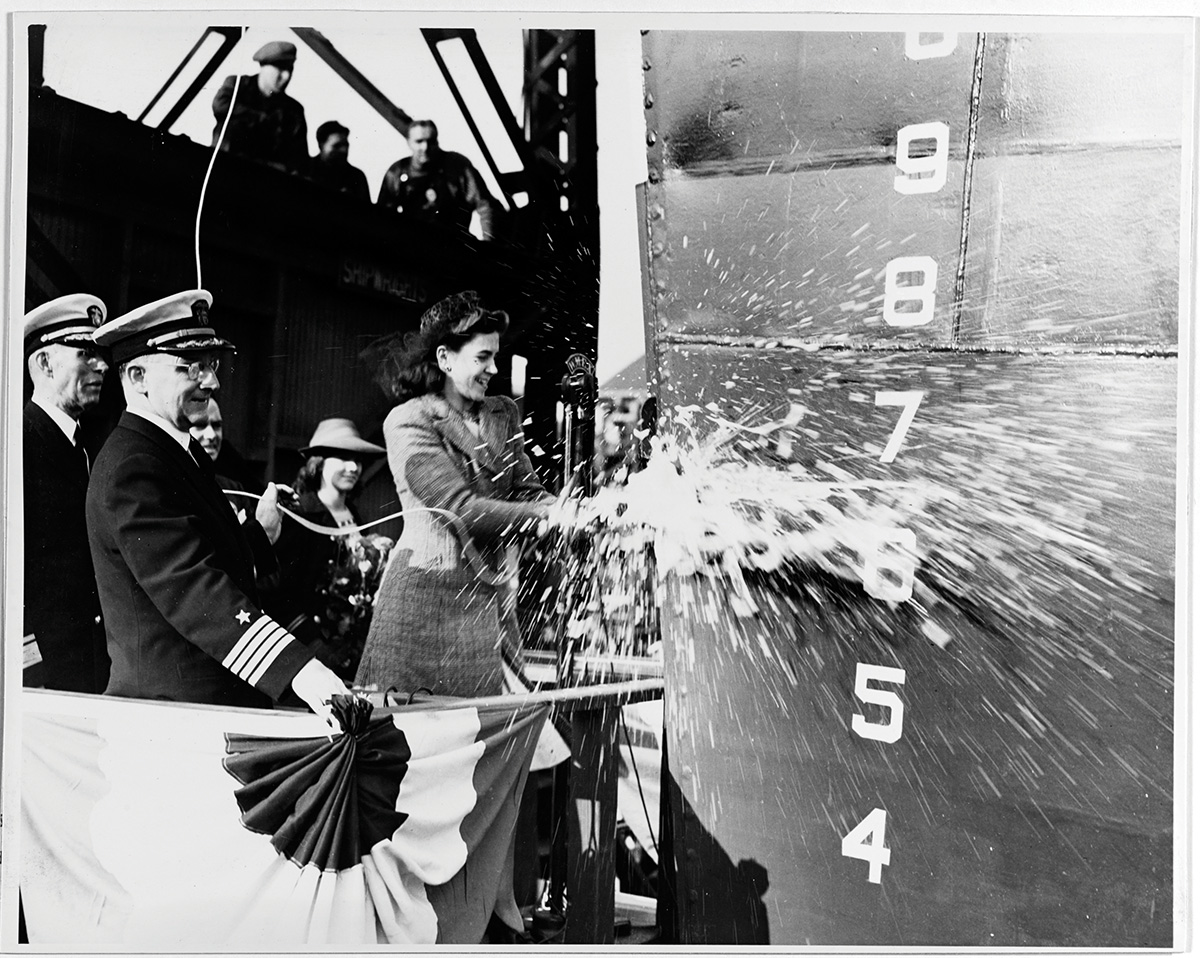
LAUNCHING CEREMONY (2021) Single-channel video, B&W, sound, 17min Originally conceived to be performed in a shipyard, ‘Launching Ceremony’ is an audiovisual poem focusing on the ceremonial launching of a new ship embarking on her maiden voyage. Through a reanimation of mid- century archival footage “choreographed” to a commissioned theremin score, the work invites its viewers to partake in the ceremony, as well as to reflect on free movement and lost futures in an increasingly entrenched world. A commission by the Syros International Film Festival (SIFF) realized with the support of NEON Organization for Culture and Development, in partnership with the Greek Film Archives. Credits A film by Marina Gioti | Music: May Roosevelt | Producer: Jacob Moe
Marina Gioti (Athens, 1972) Filmmaker and visual artist based in ?thens, Greece. She is also a trained Chemical Engineer with post graduates studies in Environmental Management, Media & Communication and New Media. In her works, which comprise of films, installations and media art pieces, she often revisits historical eras and stories offering parallel readings to dominant narratives. Artistic, archival and scientific research alongside observation play a crucial role in her practice, while objets trouvés and cultural debris serve as raw material or situate themselves at the center of her works. She is the laureate of the 2022 ?ceans-themed COAL prize for art and ecology. Recent shows and festivals include: Elefsina Mon Amour, Eleusis 2023 European Cultural Capital Flagship art show, Old Oil Mill Factory, Eleusis, Greece (2023), ARCOmadrid Special - La Casa Encendida, Madrid (2023) | Public Domain- New Acquisitions MOMus – Thessaloniki Museum of Contemporary Art, Thessaloniki (2022) | Launching Ceremony, Tarsanas Shipyard/ Syros International Film Festival-SIFF (solo, 2021)| Theorimata II, EMST - Athens Museum of Contemporary Art (2020)| Atlas: A Sound Cartography of Europe, Centre Pompidou, Paris / ZKM-Center for Art and Media, Karlsruhe / Onassis Stegi, Athens (2019) | CPH:DOX, Copenhagen (2019)| Harmonie Inconnue I & II, Galerie Dominique Fiat, Paris (2019)| | Polysomnogarden- Forum Frohner, Krems an der Donau (Solo, 2018)| Berlinale Forum Expanded (2018)| Yebisu Intl Festival for Art & Alternative Visions, Tokyo Museum of Photographic Art (2018)|The Invisible Hands, Signal - Contemporary Art Space, Malmö (solo, 2018)| Past Future Perfect, Akademie Schloss Solitude, Stuttgart (solo, 2018)| 1st Anren Biennale, Chengdu (2018)| documenta 14, Athens & Kassel (2017) www.marinagioti.net
Catalogue : 2016AS TO POSTERITY | Experimental doc. | hdv | color | 12:0 | Greece | 2014
Marina Gioti
AS TO POSTERITY
Experimental doc. | hdv | color | 12:0 | Greece | 2014
A collection of visual evidence from an Athens of the near future devoid of humans. Its inhabitants have mysteriously disappeared, leaving behind a tableau mourant of concrete, metal and plastic coexisting with with glorious marble and the local flora and fauna. Part science fiction, part archaeological mystery, the work offers a picturesque expedition of the new Greek ruins, through an apposition of findings that serve as hints for the fate of the film’s elusive protagonists, the -conspicuous by absence- Athenians.
Marina Gioti is a filmmaker/ visual artist based in Athens, Greece. She studied Chemical Engineering, Environmental Management (MSc), Filmmaking, and Media and Communication (MA) in Greece, UK and Belgium. Her films and installations have been screened and exhibited worldwide at both international film festivals (Toronto IFF, Transmediale, Jeonju, Viennale,Les Rencontres Internationales, etc.) and museums/ visual art platforms [Thessaloniki Biennial, Wrocklaw Media Art Biennial (Poland), the Whitechapel Gallery (London), Bozar (Βrussels)]. She is currently in post-production of her first feature, “The Invisible Hands”, a documentary set in Cairo, Egypt.
Catalogue : 2010To Krifo Scholio | Experimental film | 16mm | black and white | 10:0 | Greece | 2009
Marina Gioti
To Krifo Scholio
Experimental film | 16mm | black and white | 10:0 | Greece | 2009
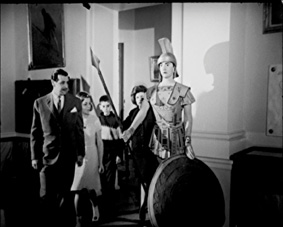
Greece, the early 70?s. A family visits the museum of the 1821 Greek Revolution and War against the Turks. As they wander inside the museum, one of the paintings comes to life ... ?Sabotaged? version of a rare -found- propaganda film,produced during the Greek military junta in the 70s, supporting a largely debated fact -for many a national myth- related to the birth of the modern Greek nation and the construction of its ethnic identity.
Born in Athens, Greece, Marina Gioti has studied Chemical Engineering, Environmental Management (MSc), Filmmaking and Media and Communication (MA) in Greece and the UK. Since 1999 she lives and works in Athens as a filmmaker/ video artist working mainly with found footage and animation. She has presented work at festivals and galleries in Athens, Europe and the United States, notably at the Toronto International Film Festival, The Rencontres Internationales, Cinematexas, New York Underground Film Festival and Transmediale festival in Berlin. She is also working as an independent curator and film programmer organizing art exhibitions and experimental film and documentary screenings around Athens.
Catalogue : 2007b-alles | Experimental video | dv | color | 2:0 | Greece | 2005
Marina Gioti
b-alles
Experimental video | dv | color | 2:0 | Greece | 2005
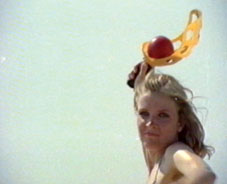
A Greek TV-commercial from the 80s of a product-action racquet game- that failed to become a success in the local market, is being manipulated anew in terms of image and sound. Apart from a funny rhythmical reworking of a rather trite found footage, this work aims at presenting a comical and simplistic view of how American products and trends have been implanted on our collective subconscious through advertising.
Marina Gioti is a filmmaker based in Athens, Greece. Her film and video work has been presented at various festivals and special screenings around Europe and the United States. Her most recent video "B-alles" was an official selection at: New York and Chicago Underground Film Festivals, Cinematexas 11, Hi/Lo Film Festival, Hull International Short Film Festival, among others. She also works as an independent film and video curator, programming and organizing experimental film and video screenings at various venues around Athens, mainly under the name "novaXpress". She has also programmed for Synch Festival (artistic director Synch Cinema 2005) and Cinematexas. She is the co-curator of the art exhibition "Anathena", which recently opened at the Deste Foundation (Athens, Greece).
Mathilde Girard
Catalogue : 2025Que quelque chose vienne | Experimental doc. | mov | color | 70:33 | France | 2023
Mathilde Girard
Que quelque chose vienne
Experimental doc. | mov | color | 70:33 | France | 2023
“In Paris, at curfew time, people linger and hurry down the street before going home. In the morning, a person wakes up alone and listens to the messages left for her. At night, a woman recounts the symptoms of a strange illness to a cab driver. The stories unfold and touch, waiting for something to come.”
Mathilde Girard is a philosopher, psychoanalyst and writer and a member of the Lignes Committee. She has contributed to Chroniques Purple, Diacritik and AOC. She is the author of the books: Proprement dit, entretien sur le mythe, avec Jean-Luc Nancy (Lignes, 2015); L’Art de la faute – selon Georges Bataille (Lignes, 2017); Défense d’écrire – entretiens, avec Michel Surya (Encre Marine, 2018); La Besogne des images, avec Léa Bismuth (Filigranes, 2019), Un personnage en quête de sublimation (Gallimard, 2019). She writes for the cinema since 2017 and make her first films: MON PERSONNAGE (2020), LES ÉPISODES - PRINTEMPS 2018. (2020).
Guy Girard
Catalogue : 2006Sainkho Namtchylak | Experimental doc. | betaSP | color | 45:0 | France | 2004
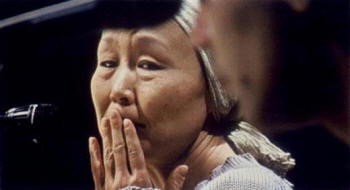
Guy Girard
Sainkho Namtchylak
Experimental doc. | betaSP | color | 45:0 | France | 2004
Sainkio is a singer that links throw singing in the Tuva traditional way and in jazz manner, which is, according to the beleif, this singing practice is dangerous for women health. Souce: Bilan du Film Ethnographique.
Mathilde Girard
Catalogue : 2026Recherche Médée | Experimental doc. | 0 | color | 57:43 | France, Switzerland | 2025
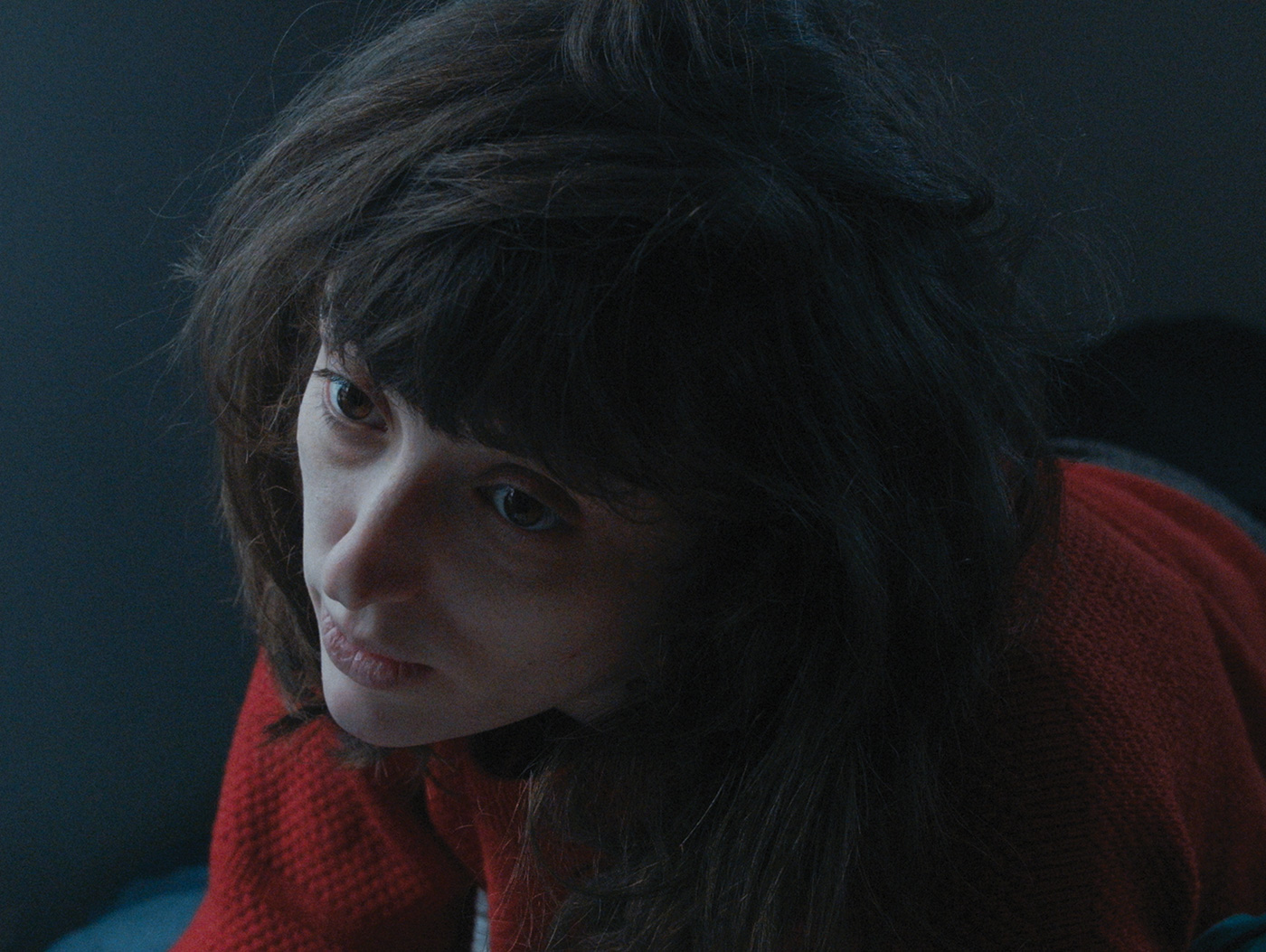
Mathilde Girard
Recherche Médée
Experimental doc. | 0 | color | 57:43 | France, Switzerland | 2025
How can we recognize Medea? What can she reveal about ourselves? I search for her with Alice, Élise, Nino and other friends, at the crossroads of our urgent questions about life, love and children. Between the intimacy and a text, Heiner Müller's "Medea material", each of us learns to tell our own story. Perhaps this time we'll be able to hear.
Born in Paris in 1979, Mathilde Girard is a psychoanalyst, writer and filmmaker. A doctor of philosophy, she has published several works on the notion of community in contemporary thought (by Georges Bataille and Jean-Luc Nancy). For several years now, she has been working as a screenwriter with Pierre Creton, writing three feature films with him: Va, Toto ! (2017), Le bel été (2019), and Un prince (2023, winner of the SACD award at the Director’s Forthnight in Cannes). Her first film, EPISODES - SPRING 2018, won the First Film award at FID Marseille in 2020 and has been shown at numerous festivals including the New York Film Festival, Sheffield Doc/Fest, Viennale, Doc Lisboa. His second film, the feature-length essay THE NIGHT DRAGS ON, won the Georges de Beauregard award at the FID Marseille 2023. With the medium-length film MEDEA RESEARCH, her new work, she continues the investigation on love started with her first episodes. Mathilde Girard's work straddles the border between solitude and the world, love and politics. For her, cinema is born of this relationship, which presupposes collective involvement and aims to link the thought, intimate words of each individual and the contemporary.
Christoph Girardet
Catalogue : 2026One Hundred Years Later | Experimental film | mov | black and white | 7:55 | Germany | 2025
Christoph Girardet
One Hundred Years Later
Experimental film | mov | black and white | 7:55 | Germany | 2025
In 1939, a second unit with a double and extras filmed scenes for the Hollywood classic “Mr. Smith Goes to Washington” in the Lincoln Memorial. The succession of the long, sorted-out plan sequences undermines the classic cinematic narration; the plot does not seem to progress. The neoclassical architecture remains the setting for a recurring and questionable ritual, in which the protagonist is lost.
Christoph Girardet, born in 1966, is a German video artist and filmmaker. Girardet makes both the accidentally found and the extensively researched found footage from the archives of film history the subject of his art. Montage, omissions, and repetitions reveal the actual structures and inner mechanism of the depicted cinematic reality. Beyond the analysis of the material and its clichés, his work deals in essence with a melancholic state of absence, thus creating an individual pictorial world. From 1988 to 1994, Girardet studied Visual Arts at the Braunschweig University of Art (HBK) in the film class of Birgit Hein. Since 1989 he has produced films, videos and video installations, some of them in collaboration with video artist Volker Schreiner (1994 – 2004), and, more frequently, in collaboration with filmmaker Matthias Müller (1999 – ongoing). Girardet has participated in group shows at the Stedelijk Van Abbemuseum, Eindhoven, MoMA PS1, New York, Palais de Tokyo, Paris, Hirshhorn Museum, Washington, and Eye Filmmuseum, Amsterdam, among others. He had solo exhibitions at institutions such as FACT, Liverpool, Kunstverein Hannover and West, The Hague. He has taken part in major film festivals worldwide, including the festivals at Cannes, Venice, Berlin, Toronto, Locarno, Oberhausen and Rotterdam. His work is included in public and private collections. He has received numerous awards, among them a stipend for the International Studio and Curatorial Program in New York (2000) and a scholarship at Villa Massimo in Rome (2004). He lives and works in Hanover, Germany.
Catalogue : 2025Jishin | Experimental film | hdv | black and white | 8:0 | Germany | 2022
Christoph Girardet
Jishin
Experimental film | hdv | black and white | 8:0 | Germany | 2022
Jishin (Japanese: earthquake) shows an archaic-looking special effect for a Hollywood film of the 1940s: a house begins to sway, stone lanterns fall over, an actor loses his grip. Finally, mountains of debris fill the screen. The drama is repeated in five successive, slightly varied camera perspectives. The uncut raw material allows an analytical view of the clichéd and scenery-like setting: the disaster is not due to a natural event but to a precalculated performance.
born in Langenhagen, Germany, in 1966, studied Visual Arts at the Braunschweig University of Art (HBK). Since 1989 he has produced films, videos and video installations, some of them in collaboration with video artist Volker Schreiner (1994 – 2004), and, more frequently, in collaboration with filmmaker Matthias Müller (1999 – 2022). He lives and works in Hanover, Germany.
Catalogue : 2022Misty Picture | Experimental film | 4k | color | 16:32 | Germany | 2021
Christoph Girardet, Matthias Müller
Misty Picture
Experimental film | 4k | color | 16:32 | Germany | 2021
Twenty years ago, the towers of the New York World Trade Center collapsed. The endlessly repeating television images of this event were preceded by manyfold stagings of the building, either as a highly symbolic icon, a speculative destruction fantasy or merely as a spectacular backdrop. In Misty Picture, such fictional motifs string together: city symphony, disaster movie and medial trauma therapy become one.
Christoph Girardet, born in Langenhagen, Germany, in 1966. Lives in Hannover. Studied at the Braunschweig HBK. Matthias Müller, born in Bielefeld, Germany, in 1961. Lives in Bielefeld and Cologne. Studied at the Bielefeld University and at the Braunschweig HBK. Collaborative works since 1999
Catalogue : 2018It Was Still Her Face | Experimental film | hdv | black and white | 8:0 | Germany | 2017
Christoph Girardet
It Was Still Her Face
Experimental film | hdv | black and white | 8:0 | Germany | 2017
Portraits of women. And men, who are spellbound by them. The painted portraits, a recurring motif of film noir as well as European postwar cinema, aesthetically stand in a tradition of an outmoded academic style that is bent on striking likeness with the model. They are revenants, omens of absence, metaphors for loss and death, objects of desire and fixation, which mesmerize both the viewer in the movie and in front of the screen.
Christoph Girardet, born in Langenhagen, Germany, in 1966. Lives in Hannover. Studied at the Braunschweig HBK. filmography (single channel, selection) 1991 Schwertkampf 1993 Fieberrot 1996 Release 2001 Scratch 2002 Absence 2004 Fiction Artists (with Volker Schreiner) 2007 Pianoforte | Storyboard 2012 The Eternal Lesson | Dirigible 2014 Fabric 2015 Synthesis 2017 It Was Still Her Face collaborations with Matthias Müller 1999 Phoenix Tapes 2002 Manual | Beacon 2003 Play | Mirror 2006 Kristall 2009 Contre-jour | Maybe Siam 2011 Meteor 2013 Cut 2016 personne
Catalogue : 2015Fabric | Experimental film | hdv | black and white | 9:52 | Germany | 2014
Christoph Girardet
Fabric
Experimental film | hdv | black and white | 9:52 | Germany | 2014
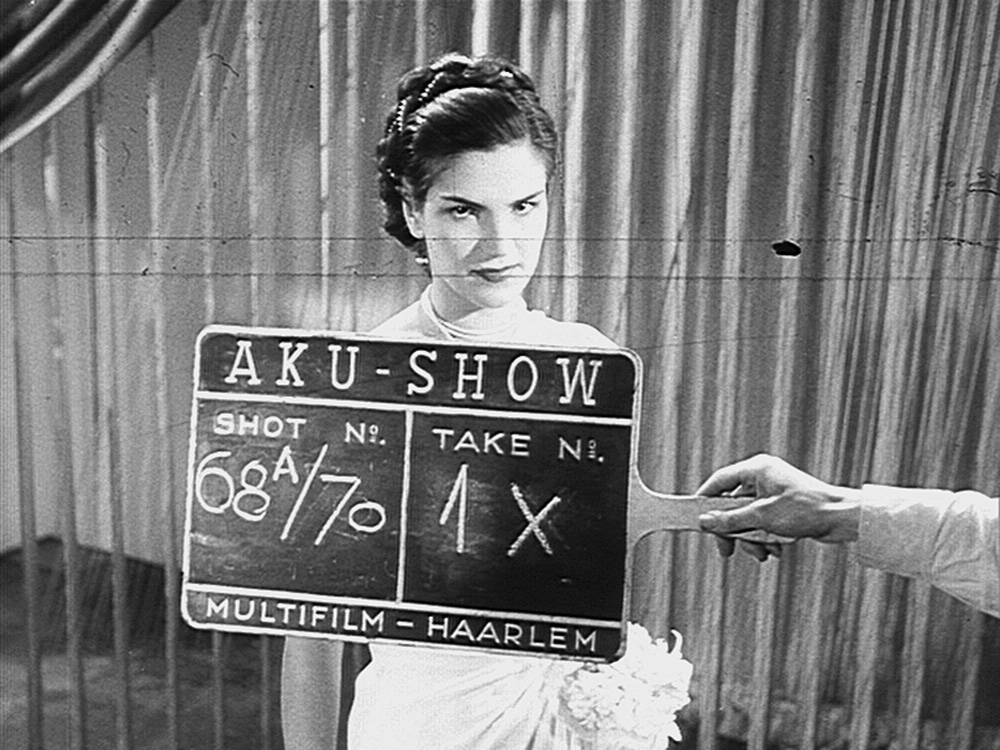
Fabric is a montage based on remaining workprints from a commercial film about viscose that no longer exists. The original attempt of the film to visualize perfect images of a young tailor and models dressed in sensual fabric while acting within a decorative modernist setting is mirrored in its shortcoming. The leftovers only show the preliminaries, faulty repetitions and aborted takes, thus all footage which was thrownout. Clapper boards indicating each take by numbers allowed to reconstruct a part of the film’s original storyboard. The new montage shows all of the remaining snippets from the related scenes including the clapper boards, the repeated takes and the glitches in the film material. However, all parts which probably have been used to edit the original film are missing, the gaps are marked with beeps on the otherwise silent soundtrack. While following a fragile new narrative, Fabric also generates a counterpart of an artefact that was lost.
Christoph Girardet, born in Langenhagen, Germany, in 1966. He studied Fine Arts at the Braunschweig School of Art (Master’s degree in 1994). Since 1989 he has produced video tapes, video installations and films, some of them in collaboration with video artist Volker Schreiner beginning in 1994 and as of 1999 with filmmaker Matthias Müller. He was awarded a stipend for the International Studio and Curatorial Program in New York (2000) and the Villa Massimo stipend in Rome (2004). He lives and works in Hanover.
Catalogue : 2011Maybe Siam | Experimental film | betaSP | color and b&w | 12:20 | Germany | 2009

Christoph Girardet, Matthias Müller
Maybe Siam
Experimental film | betaSP | color and b&w | 12:20 | Germany | 2009
They call me a dreamer, well maybe I am. / But I know that I`m burnin` to see / Those far away places with the strange-soundin` names / Callin`, callin` me. (no translation, English only, please)
Christoph Girardet, born in Langenhagen, Germany, in 1966. Lives in Hannover. Works in video, film and installation since 1987. Studied at the Braunschweig HBK. Selected works: 1991 Schwertkampf, 1997 Release, 2001 Scratch, 2001 7:48, 2002 Absence, 2007 Pianoforte, 2010 Silberwald Matthias Müller, born in Bielefeld, Germany, in 1961. Lives in Bielefeld and Cologne. Works in film, video and photography since 1980. Studied at the Bielefeld University and at the Braunschweig HBK. Selected works: 1990 Home Stories, 1994 Alpsee, 1998 Vacancy, 2000 nebel, 2004 Album. Joint projects of Christoph Girardet and Matthias Müller: Phoenix Tapes 1999, Manual 2002, Beacon 2002, Play 2003, Mirror 2003, Ray 2004, Catch 2005, Ground 2005, Hide 2006, Kristall 2006, Locomotive 2008, Contre-jour 2009, Maybe Siam 2009
Catalogue : 2009Storyboard | Art vidéo | betaSP | color | 5:0 | Germany | 2007
Christoph Girardet
Storyboard
Art vidéo | betaSP | color | 5:0 | Germany | 2007
Storyboard is a collage made from a variety of randomly found images: empty spaces, enigmatic gestures, artificial environments. Is this life according to a cinematic memory?
Christoph Girardet was born in 1966 in Langenhagen and lives in Hanover, Germany. He studied Fine Arts at the School of Art in Braunschweig. He works since 1987 on video, film and installation. He began to collaborate in 1994 with video director Volker Schreiner, and in 1999 with Matthias Müller (Phoenix Tapes), with whom he made numerous projects using digital techniques as a resource. He explores, amongst other subjects, the banalities of industrial filmmaking. Girardet has participated in collective exhibitions in prestigious institutions as Stedelijk Van Abbemuseum (Eindhoven) and the P.S.1 Contemporary Art Center in New York. Individual exhibits of his work have taken place at Kunstverein in Hanover and at the Sean Gallery in New York. He has received numerous awards.
Christoph Girardet, Matthias MÜLLER
Catalogue : 2019Screen | Video | hdv | color and b&w | 17:30 | Germany | 2018
Christoph Girardet, Matthias Müller
Screen
Video | hdv | color and b&w | 17:30 | Germany | 2018
"While he mused on the effect of the flowing sands, he was seized from time to time by hallucinations in which he himself began to move with the flow." -Kobo Abe Liminal zones. Floating particles. Fire, water, earth, air. Voices of fictional characters: sometimes suggestive, sometimes strict, leading the viewer away from the here and now. Who`s talking? The relationship between the hypnotized subject and the hypnotist is mirrored in the spectator`s relationship to the screen.
CHRISTOPH GIRARDET was born in Langenhagen, Germany, in 1966. He studied Fine Arts at the Braunschweig School of Art (Master´s degree in 1994). Since 1989 he has produced video tapes, video installations and films, some of them in collaboration with Volker Schreiner beginning in 1994 and as of 1999 with Matthias Müller. He was awarded a stipend for the International Studio and Curatorial Program in New York (2000) and the Villa Massimo stipend in Rome (2004). He lives and works in Hanover. MATTHIAS MÜLLER was born in Bielefeld, Germany in 1961. Müller is an artist working in film, video and photography. He is based in Bielefeld and Cologne, Germany. Studied Arts and German Literature at Bielefeld University and Fine Arts at HBK Braunschweig. Master’s degree. Since 2003, Professor in Experimental Film at Academy of Media Arts, KHM, Cologne. Müller organized numerous avant-garde film events such as the "Found Footage Film Festival" (1996 & 1999) and the first German festival of autobiographical films "Ich etc." (1998) and various touring programs. With his films and videos he has taken part in major film festivals worldwide, including the festivals at Cannes, Venice, Berlin and Rotterdam. His work has also been featured in several group and solo exhibitions. His films and videos are part of the collections of institutions such as Centre Georges Pompidou, Paris, Museu d’Art Contemporani, Barcelona, Nederlands Film Museum, Amsterdam, Australian Centre For The Moving Image, Melbourne, Kunsthalle Bielefeld, the Goetz Collection, Munich, the collection of Isabelle and Jean-Conrad Lemaître, London, and Tate Modern, London.
Catalogue : 2017Personne | Experimental film | hdv | color and b&w | 15:4 | Germany | 2016
Christoph Girardet, Matthias MÜLLER
Personne
Experimental film | hdv | color and b&w | 15:4 | Germany | 2016
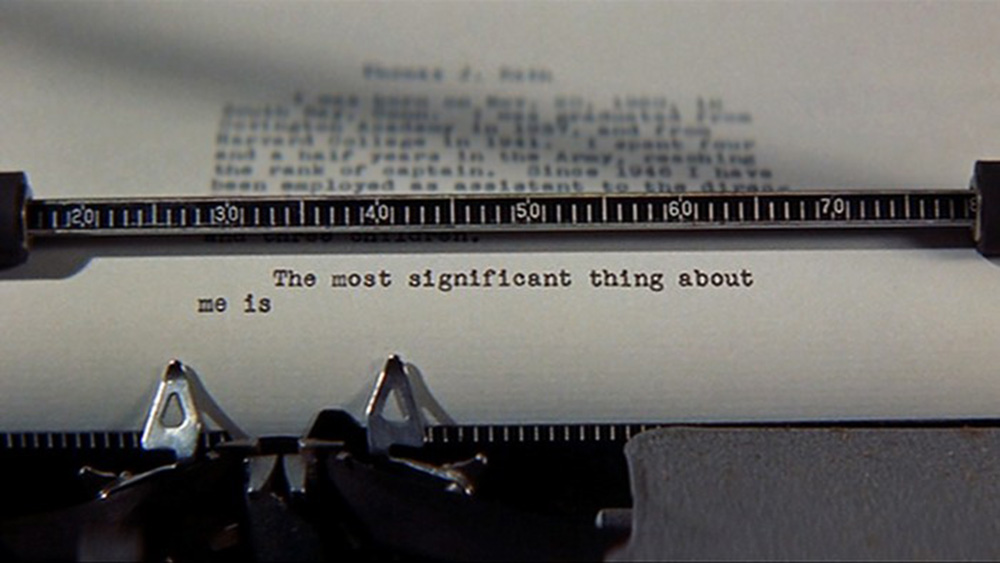
A broken bottleneck lies on the ground. An analogue telephone with a blank dial plate. The hero of the film, Jean-Louis Trintignant, in younger years – in older years. A man huddled on an elevator floor. Skewered butterflies. He is all alone in the world. The external is sealed off. The internal barricaded. He shifts between times. His focus is always trained on the other. Is he wanted, condemned, persecuted? The man whom we observe from the rear, is only able to see his back in the mirror. His face cannot be recognised. All the actions and movements, all the seeking and striving, all the alterations and associations revolve around the view and excerpt from “La reproduction interdite”, painted by Belgian surrealist René Magritte in 1937. The mirror axis of the film, and yet, and simply for that reason, one becomes the other. The other becomes many. “personne – that is somebody and nobody and anyone. That is us in the course of time. Persistently, in vain. The self is the need for permanent self-assertion”.
Christoph Girardet & Matthias Müller are directors, known for Cut (2013), Contre-jour (2009) and Personne (2016).
Christoph Girardet, Matthias Müller
Catalogue : 2026One Hundred Years Later | Experimental film | mov | black and white | 7:55 | Germany | 2025
Christoph Girardet
One Hundred Years Later
Experimental film | mov | black and white | 7:55 | Germany | 2025
In 1939, a second unit with a double and extras filmed scenes for the Hollywood classic “Mr. Smith Goes to Washington” in the Lincoln Memorial. The succession of the long, sorted-out plan sequences undermines the classic cinematic narration; the plot does not seem to progress. The neoclassical architecture remains the setting for a recurring and questionable ritual, in which the protagonist is lost.
Christoph Girardet, born in 1966, is a German video artist and filmmaker. Girardet makes both the accidentally found and the extensively researched found footage from the archives of film history the subject of his art. Montage, omissions, and repetitions reveal the actual structures and inner mechanism of the depicted cinematic reality. Beyond the analysis of the material and its clichés, his work deals in essence with a melancholic state of absence, thus creating an individual pictorial world. From 1988 to 1994, Girardet studied Visual Arts at the Braunschweig University of Art (HBK) in the film class of Birgit Hein. Since 1989 he has produced films, videos and video installations, some of them in collaboration with video artist Volker Schreiner (1994 – 2004), and, more frequently, in collaboration with filmmaker Matthias Müller (1999 – ongoing). Girardet has participated in group shows at the Stedelijk Van Abbemuseum, Eindhoven, MoMA PS1, New York, Palais de Tokyo, Paris, Hirshhorn Museum, Washington, and Eye Filmmuseum, Amsterdam, among others. He had solo exhibitions at institutions such as FACT, Liverpool, Kunstverein Hannover and West, The Hague. He has taken part in major film festivals worldwide, including the festivals at Cannes, Venice, Berlin, Toronto, Locarno, Oberhausen and Rotterdam. His work is included in public and private collections. He has received numerous awards, among them a stipend for the International Studio and Curatorial Program in New York (2000) and a scholarship at Villa Massimo in Rome (2004). He lives and works in Hanover, Germany.
Catalogue : 2025Jishin | Experimental film | hdv | black and white | 8:0 | Germany | 2022
Christoph Girardet
Jishin
Experimental film | hdv | black and white | 8:0 | Germany | 2022
Jishin (Japanese: earthquake) shows an archaic-looking special effect for a Hollywood film of the 1940s: a house begins to sway, stone lanterns fall over, an actor loses his grip. Finally, mountains of debris fill the screen. The drama is repeated in five successive, slightly varied camera perspectives. The uncut raw material allows an analytical view of the clichéd and scenery-like setting: the disaster is not due to a natural event but to a precalculated performance.
born in Langenhagen, Germany, in 1966, studied Visual Arts at the Braunschweig University of Art (HBK). Since 1989 he has produced films, videos and video installations, some of them in collaboration with video artist Volker Schreiner (1994 – 2004), and, more frequently, in collaboration with filmmaker Matthias Müller (1999 – 2022). He lives and works in Hanover, Germany.
Catalogue : 2022Misty Picture | Experimental film | 4k | color | 16:32 | Germany | 2021
Christoph Girardet, Matthias Müller
Misty Picture
Experimental film | 4k | color | 16:32 | Germany | 2021
Twenty years ago, the towers of the New York World Trade Center collapsed. The endlessly repeating television images of this event were preceded by manyfold stagings of the building, either as a highly symbolic icon, a speculative destruction fantasy or merely as a spectacular backdrop. In Misty Picture, such fictional motifs string together: city symphony, disaster movie and medial trauma therapy become one.
Christoph Girardet, born in Langenhagen, Germany, in 1966. Lives in Hannover. Studied at the Braunschweig HBK. Matthias Müller, born in Bielefeld, Germany, in 1961. Lives in Bielefeld and Cologne. Studied at the Bielefeld University and at the Braunschweig HBK. Collaborative works since 1999
Catalogue : 2018It Was Still Her Face | Experimental film | hdv | black and white | 8:0 | Germany | 2017
Christoph Girardet
It Was Still Her Face
Experimental film | hdv | black and white | 8:0 | Germany | 2017
Portraits of women. And men, who are spellbound by them. The painted portraits, a recurring motif of film noir as well as European postwar cinema, aesthetically stand in a tradition of an outmoded academic style that is bent on striking likeness with the model. They are revenants, omens of absence, metaphors for loss and death, objects of desire and fixation, which mesmerize both the viewer in the movie and in front of the screen.
Christoph Girardet, born in Langenhagen, Germany, in 1966. Lives in Hannover. Studied at the Braunschweig HBK. filmography (single channel, selection) 1991 Schwertkampf 1993 Fieberrot 1996 Release 2001 Scratch 2002 Absence 2004 Fiction Artists (with Volker Schreiner) 2007 Pianoforte | Storyboard 2012 The Eternal Lesson | Dirigible 2014 Fabric 2015 Synthesis 2017 It Was Still Her Face collaborations with Matthias Müller 1999 Phoenix Tapes 2002 Manual | Beacon 2003 Play | Mirror 2006 Kristall 2009 Contre-jour | Maybe Siam 2011 Meteor 2013 Cut 2016 personne
Catalogue : 2015Fabric | Experimental film | hdv | black and white | 9:52 | Germany | 2014
Christoph Girardet
Fabric
Experimental film | hdv | black and white | 9:52 | Germany | 2014
Fabric is a montage based on remaining workprints from a commercial film about viscose that no longer exists. The original attempt of the film to visualize perfect images of a young tailor and models dressed in sensual fabric while acting within a decorative modernist setting is mirrored in its shortcoming. The leftovers only show the preliminaries, faulty repetitions and aborted takes, thus all footage which was thrownout. Clapper boards indicating each take by numbers allowed to reconstruct a part of the film’s original storyboard. The new montage shows all of the remaining snippets from the related scenes including the clapper boards, the repeated takes and the glitches in the film material. However, all parts which probably have been used to edit the original film are missing, the gaps are marked with beeps on the otherwise silent soundtrack. While following a fragile new narrative, Fabric also generates a counterpart of an artefact that was lost.
Christoph Girardet, born in Langenhagen, Germany, in 1966. He studied Fine Arts at the Braunschweig School of Art (Master’s degree in 1994). Since 1989 he has produced video tapes, video installations and films, some of them in collaboration with video artist Volker Schreiner beginning in 1994 and as of 1999 with filmmaker Matthias Müller. He was awarded a stipend for the International Studio and Curatorial Program in New York (2000) and the Villa Massimo stipend in Rome (2004). He lives and works in Hanover.
Catalogue : 2011Maybe Siam | Experimental film | betaSP | color and b&w | 12:20 | Germany | 2009
Christoph Girardet, Matthias Müller
Maybe Siam
Experimental film | betaSP | color and b&w | 12:20 | Germany | 2009
They call me a dreamer, well maybe I am. / But I know that I`m burnin` to see / Those far away places with the strange-soundin` names / Callin`, callin` me. (no translation, English only, please)
Christoph Girardet, born in Langenhagen, Germany, in 1966. Lives in Hannover. Works in video, film and installation since 1987. Studied at the Braunschweig HBK. Selected works: 1991 Schwertkampf, 1997 Release, 2001 Scratch, 2001 7:48, 2002 Absence, 2007 Pianoforte, 2010 Silberwald Matthias Müller, born in Bielefeld, Germany, in 1961. Lives in Bielefeld and Cologne. Works in film, video and photography since 1980. Studied at the Bielefeld University and at the Braunschweig HBK. Selected works: 1990 Home Stories, 1994 Alpsee, 1998 Vacancy, 2000 nebel, 2004 Album. Joint projects of Christoph Girardet and Matthias Müller: Phoenix Tapes 1999, Manual 2002, Beacon 2002, Play 2003, Mirror 2003, Ray 2004, Catch 2005, Ground 2005, Hide 2006, Kristall 2006, Locomotive 2008, Contre-jour 2009, Maybe Siam 2009
Catalogue : 2009Storyboard | Art vidéo | betaSP | color | 5:0 | Germany | 2007
Christoph Girardet
Storyboard
Art vidéo | betaSP | color | 5:0 | Germany | 2007
Storyboard is a collage made from a variety of randomly found images: empty spaces, enigmatic gestures, artificial environments. Is this life according to a cinematic memory?
Christoph Girardet was born in 1966 in Langenhagen and lives in Hanover, Germany. He studied Fine Arts at the School of Art in Braunschweig. He works since 1987 on video, film and installation. He began to collaborate in 1994 with video director Volker Schreiner, and in 1999 with Matthias Müller (Phoenix Tapes), with whom he made numerous projects using digital techniques as a resource. He explores, amongst other subjects, the banalities of industrial filmmaking. Girardet has participated in collective exhibitions in prestigious institutions as Stedelijk Van Abbemuseum (Eindhoven) and the P.S.1 Contemporary Art Center in New York. Individual exhibits of his work have taken place at Kunstverein in Hanover and at the Sean Gallery in New York. He has received numerous awards.
Fabien Giraud
Catalogue : 2006Thes Straight Edge | Experimental video | betaSP | color | 13:8 | France | 2005
Fabien Giraud
Thes Straight Edge
Experimental video | betaSP | color | 13:8 | France | 2005
A crowd dances to the sound of a music that is not heard played by a band that is not seen. What is left is the sound of the bodies in movement, the image of a moving order. The Straight Edge is an experiment conducted in a concert of hardcore punk music. The crowd and its intensity provide the material. The shared expressions of joy, violence, and boredom are the elements of the cultural fiction at stake here. Within it, forms are tried, shifted, repeated. I approach community as a complex interplay in which individuals invent themselves. Sharing rules, postures, rhythms, each one constructs itself and creates a world. This movement of construction is at the heart of my work. I believe that it is always flexible, modifiable, that it can be altered and recreated. I believe in the fiction and the possibility of its reinvention.
Fabien Giraud, born in France in 1980, has studied at the Ecole Nationale Superieure des Arts Décoratifs in Paris and at the National Institute of Design in India. Presently living and working at Le Fresnoy, Studio National des Arts Contemporains in Tourcoing, France.
Alexander Girav
Catalogue : 2026Burn Ceremony | Experimental doc. | 0 | color | 17:0 | USA | 2024
Alexander Girav
Burn Ceremony
Experimental doc. | 0 | color | 17:0 | USA | 2024
An unsanctioned observation of [redacted]’s largest oil refinery, processing 440,000 barrels of crude oil a day. By night, the complex becomes a heaving edifice of flame and fog. We observe its operation from afar as the inferno slowly engulfs the frame, accompanied by an original hypnotic soundscape by UK club experimentalist Loraine James. A vision of industrial desolation in which dread turns to awe.
Alexander Girav (b. 1995) is an American filmmaker and cinematographer whose observational work explores post-capitalist landscapes through an experimental, ethnographic lens. His films have been screened at Sundance, the International Film Festival Rotterdam, the Chicago International Film Festival, the Edinburgh International Film Festival, the Atlanta Film Festival, and the Jeonju International Film Festival. His cinematography on The Harvest earned him a nomination for the National Geographic Award for Best Cinematography at Millennium Docs. He earned a BFA in Film/Video from CalArts in 2017.
Alexander Girav
Catalogue : 2018The Night in All Things | Experimental doc. | hdv | color | 9:46 | USA | 2017
Alexander Girav
The Night in All Things
Experimental doc. | hdv | color | 9:46 | USA | 2017
Somewhere, a young man is asleep, his room illuminated green by the flicker of his computer screensaver. Even the night sky resembles its digital replication. Anthropological observations on sleep in the age of technology, and the ways in which it substitutes natural environments.
Alexander Girav was born in Chicago in 1995 and now works as a cinematographer in Los Angeles. While a student at CalArts, he had his work screen at The Chicago International Film Festival and Valvidia International Film Festival. Upon receiving his BFA in Film/Video, Alex`s work has been selected to screen by Ann Arbor Film Festival and International Film Festival Rotterdam - among others.
Helena Girón Vázquez, Samuel M. Delgado
Catalogue : 2026Un dragón de cien cabezas | Experimental doc. | 16mm | color | 14:50 | Spain | 2025
Helena GirÓn VÁzquez, Samuel M. Delgado
Un dragón de cien cabezas
Experimental doc. | 16mm | color | 14:50 | Spain | 2025
In the Garden of Hesperides, a fruit, capable of granting immortality to whoever ate it, once grew. This garden, located somewhere off the coast of West Africa, was guarded by a dragon with one hundred heads. Through the use of bio-sonification of banana trees, a monoculture crop in the Canary Islands, we discover a tale of eternal life where this mythical garden used to exist.
Their work investigates the relationship between mythology, history and materialism. Their first feature film, Eles transportan a morte (2021), premiered at the Venice and San Sebastian festivals winning awards at both. It has subsequently been shown at international festivals such as Rotterdam, Cairo, Mar del Plata, Viennale, Hamburg and Sao Paulo. Their short films have been shown at festivals like Toronto, Locarno, New York, Ann Arbor and many others. They have made installations and performances in art centers like CCCB (Barcelona), BAM (New York), TEA (Tenerife) or Solar (Vila do Conde).
Catalogue : 2023Bloom | Experimental film | 16mm | | 18:0 | Spain | 2023
Helena GirÓn VÁzquez
Bloom
Experimental film | 16mm | | 18:0 | Spain | 2023
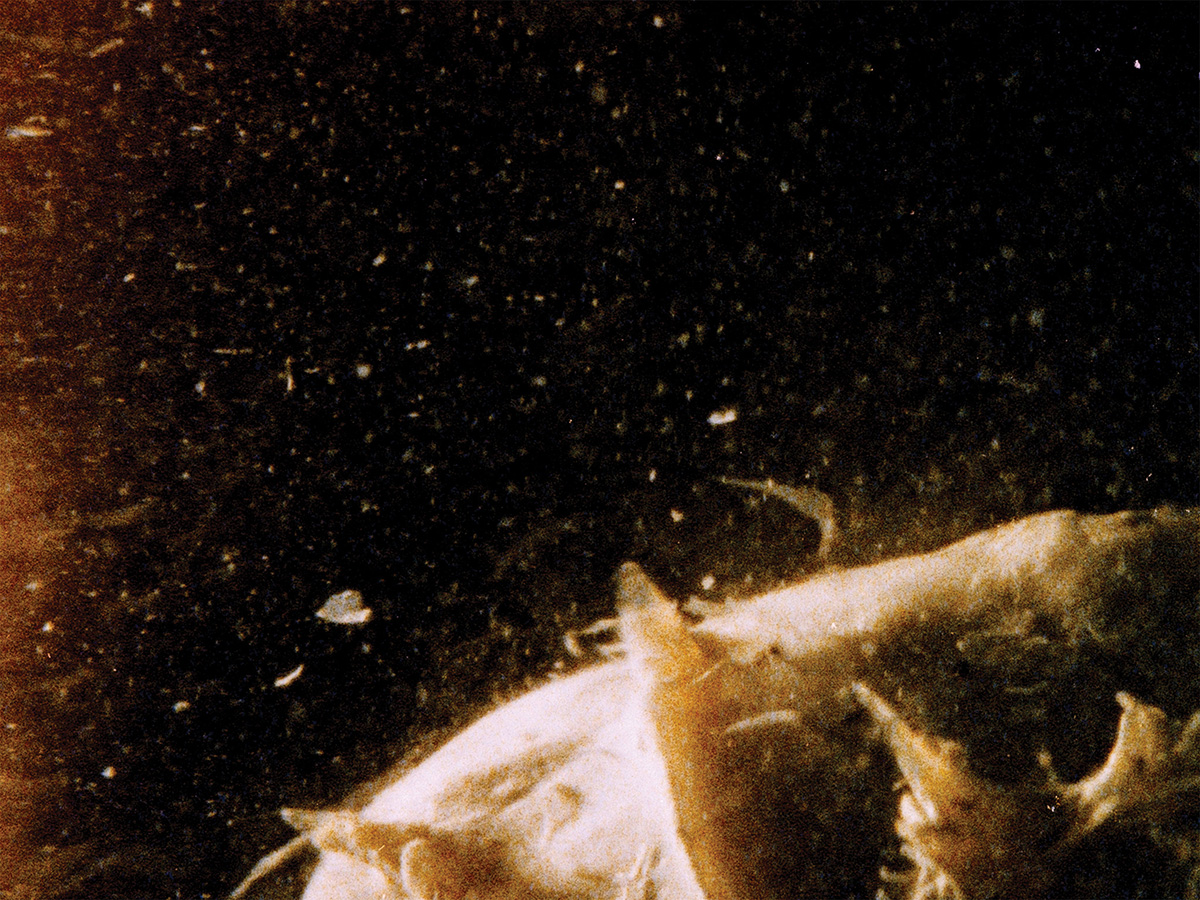
San Borondón is a mythical island that appears and disappears. It has appeared on maps throughout history in the vicinity of the Canary Islands. The legend of the island of San Borondón became so pervasive that, during the XVI, XVI and XVIII centuries, expeditions were organized to find and conquer it. After centuries of oblivion, it has finally been found.
Helena Girón and Samuel M. Delgado Their work investigates the relationship between mythology, history and materialism. Their first feature film, Eles transportan a morte (2021), premiered at the Venice and San Sebastian festivals winning awards at both. It has subsequently been shown at international festivals such as Rotterdam, Cairo, Mar del Plata, Viennale, Hamburg and Sao Paulo. Their previous short films have been shown at festivals like Toronto, Locarno, New York, Ann Arbor and many others. They have made installations and performances in art centers like CCCB (Barcelona), BAM (New York), TEA (Tenerife) or Solar (Vila do Conde).
Helena Girón Vázquez
Catalogue : 2026Un dragón de cien cabezas | Experimental doc. | 16mm | color | 14:50 | Spain | 2025
Helena GirÓn VÁzquez, Samuel M. Delgado
Un dragón de cien cabezas
Experimental doc. | 16mm | color | 14:50 | Spain | 2025
In the Garden of Hesperides, a fruit, capable of granting immortality to whoever ate it, once grew. This garden, located somewhere off the coast of West Africa, was guarded by a dragon with one hundred heads. Through the use of bio-sonification of banana trees, a monoculture crop in the Canary Islands, we discover a tale of eternal life where this mythical garden used to exist.
Their work investigates the relationship between mythology, history and materialism. Their first feature film, Eles transportan a morte (2021), premiered at the Venice and San Sebastian festivals winning awards at both. It has subsequently been shown at international festivals such as Rotterdam, Cairo, Mar del Plata, Viennale, Hamburg and Sao Paulo. Their short films have been shown at festivals like Toronto, Locarno, New York, Ann Arbor and many others. They have made installations and performances in art centers like CCCB (Barcelona), BAM (New York), TEA (Tenerife) or Solar (Vila do Conde).
Catalogue : 2023Bloom | Experimental film | 16mm | | 18:0 | Spain | 2023
Helena GirÓn VÁzquez
Bloom
Experimental film | 16mm | | 18:0 | Spain | 2023
San Borondón is a mythical island that appears and disappears. It has appeared on maps throughout history in the vicinity of the Canary Islands. The legend of the island of San Borondón became so pervasive that, during the XVI, XVI and XVIII centuries, expeditions were organized to find and conquer it. After centuries of oblivion, it has finally been found.
Helena Girón and Samuel M. Delgado Their work investigates the relationship between mythology, history and materialism. Their first feature film, Eles transportan a morte (2021), premiered at the Venice and San Sebastian festivals winning awards at both. It has subsequently been shown at international festivals such as Rotterdam, Cairo, Mar del Plata, Viennale, Hamburg and Sao Paulo. Their previous short films have been shown at festivals like Toronto, Locarno, New York, Ann Arbor and many others. They have made installations and performances in art centers like CCCB (Barcelona), BAM (New York), TEA (Tenerife) or Solar (Vila do Conde).
Peter Gizzi, Natalia ALMADA
Catalogue : 2010Threshold Songs | Experimental film | super8 | color | 10:0 | Morocco | 2009
Peter Gizzi, Natalia ALMADA
Threshold Songs
Experimental film | super8 | color | 10:0 | Morocco | 2009
"Threshold Songs," by Natalia Almada and Peter Gizzi is part of "The Tangier 8," a film-poetry project that took place in Tangier, Morocco in June 2009. Working under tight time constraints-they had just four days to film, four days for sound, and four days for editing, the artists took inspiration from the city of Tangier-its history, architecture, people, politics, as well as from each other, to produce these short film-poems.
Natalia Almada- Born in 1974 in Mexico. She graduated with a Masters in Fine Arts in photography from the Rhode Island School of Design and shares her time between Mexico City and Brooklyn, New York. Her directing credits include All Water Has a Perfect Memory, an experimental short film; Al Otro Lado, her award winning debut feature documentary about immigration, drug trafficking and corrido music; and her most recent film, EL GENERAL, a family memoir and portrait of Mexico past and present which premiered at the 2009 Sundance Film Festival and won the best documentary director award. Her films have been shown at The Museum of Modern Art, The Guggenheim Museum, The Whitney Biennial, as well as at several film festivals around the world. She has received support for her work from numerous foundations including The Creative Capital Foundation, The Tribeca Film Institute, The Sundance Institute Documentary Film Program, PBS and others. Almada is a MacDowell Colony Fellow and a 2008 Guggenheim Fellow. 2) Peter Gizzi- Born in 1959 in Massachusetts. Gizzi attended Brown University, NYC and SUNY Buffalo. His books include The Outernationale (Wesleyan, 2007), Some Values of Landscape and Weather (Wesleyan, 2003), Artificial Heart (Burning Deck, 1998), and Periplum (Avec Books, 1992). In 2004 Salt Publishing of England reprinted an expanded edition of his first book as Periplum and other poems 1987-92. He has also published several limited-edition chapbooks, folios, and artist books. His work has been translated into numerous languages and anthologized here and abroad. His honors include the Lavan Younger Poet Award from the Academy of American Poets (1994) and fellowships in poetry from The Fund for Poetry (1993), The Rex Foundation (1993), Howard Foundation (1998), The Foundation for Contemporary Arts (1999), and The John Simon Guggenheim Memorial Foundation (2005).
Helidon Gjergji, Fatos Qerimi
Catalogue : 2022Info Jazz | Multimedia performance | mp4 | color | 26:49 | Albania | 2019
Helidon Gjergji, Fatos Qerimi
Info Jazz
Multimedia performance | mp4 | color | 26:49 | Albania | 2019
This project is a sound and visual performance that has its origins in the ubiquitous digital tones of the cell phones comprising the soundtrack of our contemporary life. These sound waves provide the raw material for this piece, which recreates an urban space saturated with an ever-changing cacophony of electronic alerts. In order to add an appropriately surreal dimension to this soundscape, the space is filled with theatrical smoke that creates an atmosphere, which, like the public, is trapped between the physical and digital realities. In this performance Fatos Qerimaj, a contemporary musician, plays the clarinet in a jazz-like dialogue with the ring tones, turning the mobile phones into avatar-instrumentalists of an unpredictable cyborg ensemble. If jazz once responded spontaneously to the rhythms and beat of life, in this piece it still does, with the rhythm of our lives now being the sounds of our digital devices.
Helidon is a contemporary artist, who was born in Albania and currently lives in NYC. He studied art at the Academies of Fine Arts of Tirana and Naples as well as Northwestern University. Over the course of his career he has worked in a variety of mediums, and has shown his work internationally, in venues such as Venice Biennale, Manifesta, Tirana Biennale, Festival of Ideas of the New Museum, and Ludwig Museum. He has taught in several universities and lectured about his work at Harvard, Columbia and Parsons. His work has been reviewed in Artforum and Flash Art. Qerimaj is a distinguished contemporary Albanian musician who plays the clarinet, composes, conducts, and serves as an artistic director and university professor. Born in Albania, he graduated in clarinet and composition from the Academy of Fine Arts in Tirana, where he now works as a professor. He has performed in many concerts throughout Europe and beyond. He is the artistic director of a few festivals in Tirana, such as the Jazz Festival, Clarimpro Festival, and the Magic Flute Festival. Among other prizes, in 2005 he was awarded the Kult Prize for the best Albanian musician of the year.
Shaun Gladwell
Catalogue : 2006Storm Sequence | Art vidéo | dv | color | 5:37 | Australia | 2000
Shaun Gladwell
Storm Sequence
Art vidéo | dv | color | 5:37 | Australia | 2000
Gladwell is the calm in the storm. In slow motion we are able to grasp his skating ability - he was after all a champion skateboarder for Australia - as well as his ability to demonstrate the beauty in genuine and profound vulnerability. Gladwell was and continues to be fascinated with the slowing down of time and focusing on the beauty that exists in fleeting moments. In skateboarding culture, skaters will spend hours in front of a TV(or computer screen) playing footage in slow motion to learn and later execute various skateboarding techniques. Unsuspecting viewers are introduced to a standard practice of a particular subculture and offered the opportunity to cast a fresh eye over an ?other?. In the Silent, Ambient and Harder Remixes exhibition catalogue essay, Simon Rees rightly states the artist is wearing Turner-esque shaded clothes that are various shades of grey, which includes the heavy silver chain that sways back and forth with his every move. Not only does this work document contemporary skateboard fashion but it complements the stormy and sombre landscape in the background. Storm Sequence was dedicated to the artist?s skateboard trainer and close friend who died in the late 90?s, hence the interpretation of genuine and profound vulnerability. There is a great sadness that underlies this fabulous piece, yet it is peaceful and meditative. Gladwell is an intelligent, well read artist, interested in theories questioning the notion of public and private spaces and notions of the ?other? and this particular case, the ?sub?. Storm Sequence, made in 2000, is one of a four part series comprised of; Storm Sequence, Kick flipping Flaneur, Tangara and Double Line Work. The work was commissioned by Peter Fay and has been the focus of many exhibitions in Sydney, Canberra, Perth, Beirut, New York and London.
SHAUN GLADWELL Born 1972, Western Sydney Shaun Gladwell completed a bachelor of Visual Art (Hons) at the University of Sydney in 1996, followed by a Masters of Visual Art at the College of Fine Arts, University of New South Wales. In 2001, he was awarded a three-month Australia Council residency at the Cité International Des Arts, Paris. An Anne and Gordon Samstag International Scholarship enabled him to undertake associate research at Goldsmiths College, London (2001?02). During this time, he was included in the show, The Mind is a Horse, at Bloomberg Space, London. In 2002, Gladwell was commissioned to present a broadcast work for Netherlands TV network 4DTV and was included in Iain Borden?s first theoretical survey on skateboarding culture. Recent solo exhibitions include New Balance at Perth Institute of Contemporary Art (2004) and two Sherman Galleries? exhibitions, Silent, Ambient and Harder Remixes (2003) and MMXBREAKLESS SESSIONS (2005). Shaun Gladwell has been represented in important national and international group exhibitions, including Primavera 2003: Exhibition of Young Australian Artists, Museum of Contemporary Art, Sydney; 2004: Australian Culture Now, Australian Centre for the Moving Image (ACMI) and The Ian Potter Centre: NGV Australia, Melbourne; and, in 2005, the Anne Landa Art Award, Art Gallery of New South Wales, Sydney; Not Worried: New Art From Australia, Raid Projects, Los Angeles; New Acquisitions, Govett-Brewster Art Gallery, New Plymouth, NZ; and Space Invaders, Museum Kunsthaus Baselland, Basel, Switzerland. Shaun Gladwell is represented by Sherman Galleries, Sydney.
Shaun Gladwell, -