Catalogue > List by artist
Browse the entire list of Rencontre Internationales artists since 2004. Use the alphabetical filter to refine your search. update in progress
Nicolas Wackerbarth
Catalogue : 2008Halbe Stunden | Fiction | 35mm | color | 20:0 | Germany | 2007
Nicolas Wackerbarth
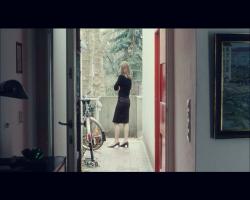
Halbe Stunden
Fiction | 35mm | color | 20:0 | Germany | 2007
Melanie lives aimlessly into the day, or more accurately: into a Friday. She's alone at home. "Half Hours" describes the time you have for yourself. Before someone arrives, after someone has left. If you gazing into space too long, you could lose yourself. Time lenghthens itself, till it becomes a threat. A Thriller about an uneventful day.
Nicolas Wackerbarth Director, Writer and Actor. Co-editor of the film magazine "Revolver". 1992-93 studies of law. 1993-96 studies at the Bavarian Theatre Academy: Graduate Actor. 1996-97 State Theatre Of Frankfurt, 1997-99 State Theatre Of Cologne. Since 2000 studies at the dffb, German Film and Television Academy of Berlin. Films / Director (selection): brat (short film 2000), Lovesick - Max Ophüls Wettbewerb/ Hauptpreis Pathos Award München (short film 2003), ?Beginners!? - Price of the Jury Med Film Rom/ Best Video GLTurin Film Fest. (TV, 2004) Westerntown (documentary 2005), Half Hours - Cannes Cinéfondation/ Kurzfilmtage Oberhausen (short film 2007)
Emmanuelle Waeckerle, Jimmy ROBERT
Catalogue : 2006Newsflash | Art vidéo | dv | color | 8:4 | France, United Kingdom | 2004
Emmanuelle Waeckerle, Jimmy ROBERT
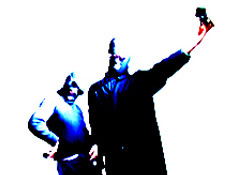
Newsflash
Art vidéo | dv | color | 8:4 | France, United Kingdom | 2004
In a series of slapstick tableaux we respond with humour and pathos to media manipulation in relation to War and Terrorism - while attempting to make a personal sign of protest. Behind our seemingly desperate satire and selfmocking attitude lurks a critique of violence and demagogy. Originally devised as a performance for Berlin International Meetings 2003 @ La gaite Lyrique in Paris -Feb 2003, as a personal response to the war ?against Irak? that had just started. The work feels as timely now as it did then.
Emmanuelle Waeckerle's interdisciplinary practice evolves between sound language and the body, exploring their performative intersections. The idea of fluidity and flux in identity and space has been central to modernity and has always found its way into her multidisciplinary art practice - Perhaps due to her own experience of a mixed cultural background (from Morocco to France to England). But also as in Henri Michaux words ? one of the best remedy against one?s own vulnerability, dissatisfaction and fundamental sense of inadequacy in the world ?. She is currently exploring new technologies of interactivity in relation to using, hearing and seeing the voice and the possibilities of a vocal yet non-verbal communication. Research funded by London Arts and Surrey Institute of Art and Design where she is a senior lecturer in Visual Communication. Jimmy Robert is currently at the rijks akademie in Amsterdam, completing the 2 years postgraduate residency programme.. His work gravitates in the space between materiality and representation, evolving from photography towards film and performance as well as writing. He attempts to activate the porosity of different identificatory supports such as literature and cinema, to reach beyond the page or the screen by merging with the image or embodying the text.
Janaina Wagner
Catalogue : 2025Quebrante | Experimental doc. | 16mm | color | 23:0 | Brazil | 2024

Janaina Wagner
Quebrante
Experimental doc. | 16mm | color | 23:0 | Brazil | 2024
A spell breaking, QUEBRANTE traverses the caves, ruins and phantasmagorias of Transamazon BR230 Highway, portraying its stones and its ghosts. QUEBRANTE follows Ms. Erismar, known in the region as "The Cave Woman". A huge nationalistic propaganda part of the progress and development project of Brazil, Transamazônica Highway was implemented during the civic-military dictatorship that took place at the moment – and it is till nowadays a warm scar of the wreckage dream of the history of the country. A conversation between the moon and the stones, QUEBRANTE is freely inspired in Robert's Smithson project THE TRULY UNDERGROUND CINEMA (1971) and in the film THE VERY EYE OF THE NIGHT (1958) by Maya Deren.
Janaina Wagner (1989) develops her research in film, drawing and installations. Her work aims to present a critical understanding of the ways in which humans impose systems of order and control upon their surroundings. Currently a Phd student at Le Fresnoy-Studio National des Arts Contemporains (FR), Janaina has participated in several residencies, such as Gasworks (UK); VISIO - European Program on Artists’ Moving Images (IT); FID Campus (FR), Bolsa Pampulha (BR). Her work is part of important collections, such as Instituto Inhotim (BR), Galeria Municipal do Porto (PT) and Coleção Moraes Barbosa (BR). Among the main exhibitions, stand out the individuals CINEMA CAVERNA (BR) and With burning love - Villa Belleville (FR); and the group 22a Bienal Videobrasil (BR), Ensaio de Tração - Pinacoteca do Estado de São Paulo (BR); Garganta - CIAJG - José de Guimarães International Arts Center (PT); Aliens are temporary - Kunstraum Kreuzberg/Bethanien (DE). Janaina has been participating in several film festivals, such as Berlinale (DE) and Tiradentes Film Festival (BR). Janaina Wagner is currently developing her first feature film, the experimental documentary A Mala da Noite. ?Janaina lives and works between Paris and São Paulo.
Beny Wagner
Catalogue : 2021Coal Mine in the Canary | Experimental doc. | mp4 | color | 18:34 | Germany, United Kingdom | 2020
Beny Wagner
Coal Mine in the Canary
Experimental doc. | mp4 | color | 18:34 | Germany, United Kingdom | 2020
An essay film told through the body, 'Coal Mine in the Canary' explores the work of John Scott Haldane, the late 19th century physiologist whose experiments with respiration in atmospheric extremes led him to put canaries in coal mines as early indicators of air toxicity. The film explores this historical technique as a form of environmental control, one that would ultimately shape the possibilities of exchange between organisms and their surroundings, determined as a series of regulated variables. In the canary, Haldane developed a new paradigm: to modify an organism is a form of environmental control because there is no border at which the organism begins and the environment ends.
Beny Wagner is an artist, filmmaker, researcher and writer. Working in moving image, text, installation and lectures, he constructs non-linear narratives situated within the ever shifting threshold of the human body. ? He has presented his work in festivals, exhibitions and conferences internationally including: Berlinale, International Film Festival Rotterdam, Eye Film Museum, Haus der Kulturen der Welt, Media Art Biennale WRO, 5th and 6th Moscow Biennale for Young Art, Moscow International Experimental Film Festival, Plato Ostrava, Künstlerhaus Bremen, Kunsthalle Amsterdam, Sonic Acts, Impakt Festival, Berlin Atonal, Venice Biennale, White Columns among many others. His work has been featured in Artforum, Spike Magazine Quarterly, Frieze Magazine, Kaleidoscope Press, Flash Art and Die Zeit. His writing has been published in Valiz and Sonic Acts Press among others.
Catalogue : 2019Outside | Experimental film | mp4 | color | 14:0 | Germany | 2017
Beny Wagner
Outside
Experimental film | mp4 | color | 14:0 | Germany | 2017
`Outside` traverses two cyclical metabolic paths in the attempt to forge a reciprocal relationship between the two. Moving from the metabolism of the human body to the metabolism of waste infrastructures, the film creates an inverted exchange wherein the concealment of waste inside the human body turns to the concealment of the human body inside waste. The boundary that divides waste from production would seem to contain an underlying set of moral implications. The film considers these as situated somewhere between law enforcement and class structure as defined through labor positions.
Wagner has exhibited his work and screened films world wide: International Film Festival Rotterdam, Media Art Biennale WRO, Movimenta Biennale (Nice), Rongwrong (Amsterdam), Haus der Kulturen der Welt (Berlin), Art Athina (Athens), Impakt Festival (Utrecht), 5th Moscow Biennale for Young Art, Eye Film Museum (Amsterdam), Venice Biennale, Plato (Ostrava), Import Projects (Berlin), Future Gallery (Berlin), Center (Berlin) among others. His work has been featured in Artforum, Spike Magazine Quarterly, Frieze Magazine, Kaleidoscope Press, and Die Zeit. He has published texts with Valiz, BLOCK Magazin and 60 pages. Wagner graduated with honors from Bard College, New York in 2008. He was a researcher at Jan van Eyck Academy, The Netherlands in 2015-6. He is currently a lecturer at Gerrit Rietveld Academy, Amsterdam, and has been a guest teacher at several other academies.
Janaina Wagner
Catalogue : 2025Quebrante | Experimental doc. | 4k | color and b&w | 23:0 | Brazil | 2024
Janaina Wagner
Quebrante
Experimental doc. | 4k | color and b&w | 23:0 | Brazil | 2024
A spell breaking, QUEBRANTE traverses the caves, ruins and phantasmagorias of Transamazon BR230 Highway, portraying its stones and its ghosts. A conversation between the moon and the stones, QUEBRANTE is freely inspired in Robert's Smithson project THE TRULY UNDERGROUND CINEMA (1971) and in the film THE VERY EYE OF THE NIGHT (1958) by Maya Deren. Set in the tiny town of Rurópolis (Pará) - the very first one to be build in the Highway to serve as a base for the workers that were building it - QUEBRANTE follows Ms. Erismar, known in the region as "The Cave Woman". A retired elementary school teacher, Ms. Erismar was the one responsible for the discovery of the region's caves: she would enter the dark unknown holes till their ends, with only a candle in her hands and a lighter tied to her pants - in case the flame would fade out. A huge nationalistic propaganda part of the progress and development project of Brazil, Transamazônica Highway was implemented during the civic-military dictatorship that took place at the moment – and it is till nowadays a warm scar of the wreckage dream of the history of the country.
Janaina Wagner (1989) develops her research in film, drawing and installations. Her work aims to present a critical understanding of the ways in which humans impose systems of order and control upon their surroundings. Currently a Phd student at Le Fresnoy-Studio National des Arts Contemporains (FR), Janaina has participated in several residencies, such as Gasworks (UK); VISIO - European Program on Artists’ Moving Images (IT); FID Campus (FR), Bolsa Pampulha (BR). Her work is part of important collections, such as Instituto Inhotim (BR), Galeria Municipal do Porto (PT) and Coleção Moraes Barbosa (BR). Among the main exhibitions, stand out the individuals CINEMA CAVERNA (BR) and With burning love - Villa Belleville (FR); and the group 22a Bienal Videobrasil (BR), Ensaio de Tração - Pinacoteca do Estado de São Paulo (BR); Garganta - CIAJG - José de Guimarães International Arts Center (PT); Aliens are temporary - Kunstraum Kreuzberg/Bethanien (DE). Janaina has been participating in several film festivals, such as Berlinale (DE) and Tiradentes Film Festival (BR). Janaina Wagner is currently developing her first feature film, the experimental documentary A Mala da Noite. Janaina lives and works between Paris and São Paulo.
Catalogue : 2022Cães Marinheiros | Video | mov | color | 7:0 | Brazil | 2020
Janaina Wagner
Cães Marinheiros
Video | mov | color | 7:0 | Brazil | 2020
Cães Marinheiros (Sailors Dogs) was filmed in the ruins of the small town of Velho Aira?o, in the Brazilian Amazon, at the confluence of Rio Negro and Rio Jaú. Founded by Portuguese missionaries in 1694, Airão concentrated the entire rubber production in the region. After a rapid and unsustainable economic growth, followed by the decline of the Rubber Cycle, the city went bankrupt. A politician at the time said that the population was being eaten by ants. Ruined, Airão was abandoned. Sailors Dogs juxtaposes the homonymous tale by Portuguese poet Herberto Helder with the dismantled landscapes of the village. In a perspectivist inversion, textual and visual images assemble and disassemble within a forest eaten away by men. By reflecting on the precarity and fragilities of human nature, and the limits of our relationship with the environment, the film questions our place of dominance in the universe that we inhabit.
Franco-Brazilian artist JANAINA WAGNER (1989) works with cinema, photography, scenography, drawing, video and installations, researching the relations of limit, control and contention that human-kind establishes with the world. Currently on a PhD at Le Fresnoy-Studio National des Arts Contemporains (FR), Wagner participated in several artistic residencies, such as Gasworks, VISIO, FID Campus - Festival International de Cinéma de Marseille, Bolsa Pampulha, Festival Mondes Possibles - Théâtre Nanterre-Amandiers, Casa Tomada, Anarcademia W139 Amsterdam and NES Skagaströnd. Among the main exhibitions and film festivals, stands out Eco-spectrality: Residual Fabulations - Glasgow Film Festival, Thinking Beyond: Images for a post pandemic world (IT), Aliens are Temporary - Kunstraum Bethanien (DE), A natural history of Ruins – Pivô (BR), Mostra de Cinema de Tiradentes (BR), Casa Carioca – MAR Museu de Arte do Rio de Janeiro (BR), Ensaio de Tração - Pinacoteca do Estado de São Paulo (BR), Simultan Festival XV – Unseen (RO), 10 ª Semana de Cinema do Rio de Janeiro (BR), Bestiário - Centro Cultural São Paulo - CCSP (BR). Graduated both in Fine Arts and in Journalism (BR), her references derives from the procedures through which human-kind registers and articulates its progress and legacy – a constellation of tales, facts and images. Janaina lives and works between Paris and São Paulo.
Nicolas Wagnieres, benoit peverelli
Catalogue : 2008hotel jugoslavija 1.0 | Documentary | 16mm | color | 12:50 | Switzerland, Serbia | 2006
Nicolas Wagnieres, benoit peverelli
hotel jugoslavija 1.0
Documentary | 16mm | color | 12:50 | Switzerland, Serbia | 2006
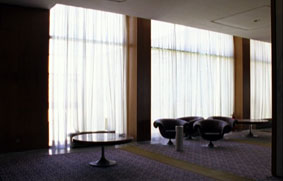
This film traces the history of the JUGOSLAVIJA hotel in Belgrade, witness of past times and of the many historical changes the country has known. Through a voice over testimony of a previous director and former employees, the history of the building is unravelled and is partly recreated as the camera sweeps the rigorous architecture with long travelling and panoramic shots of the place and brings us to a building site-like present.
Gwenola Wagon
Catalogue : 2025Chroniques du soleil noir | Experimental fiction | hdv | color and b&w | 17:0 | France | 2023
Gwenola Wagon
Chroniques du soleil noir
Experimental fiction | hdv | color and b&w | 17:0 | France | 2023
In a dystopian future, humans have had to block out the sun in order to survive on Earth. Drought is extreme and the planet is gradually turning into a scorching desert where the survivors, installed in the basements of the great observatories, live in perpetual darkness. To compensate for the image of a sun they can no longer see, they instruct an artificial intelligence program to reconstruct it. The AI is supervised by a young woman whose mental images are particularly vivid. Drawing on the photo-novel structure of Chris Marker's film La Jetée (1962), Chronicles of the Dark Sun work on a science fiction narrative in which, as in Marker's film, an algorithm is tasked with reconstructing the past using an image from the protagonist's childhood. By recycling photographs from personal albums, advertising images and scientific snapshots, all of which are reprocessed by an AI, the film examines our relationship with technology in a disturbing and ironic way. This work is an uncanny fable that makes us think about the deformation of reality in AI as well as the unsustainability of our way of inhabiting the planet. Production with the support of Hangar Y, in partnership with l’Observatoire de Paris-PSL
Gwenola Wagon is an artist and researcher. She teaches at the Sorbonne School of Arts and the University of Paris 1. Through installations, films and books, she imagines alternative and paradoxical narratives for thinking about the contemporary digital world. With her first films, Globodrome, she surveyed the virtual globe, investigating the space of hyperinformation and Internet infrastructures in collaboration with artist Stéphane Degoutin, with whom she co-produced World Brain and the book Psychoanalysis of the International Airport. After Bienvenue à Erewhon, Virusland and Chroniques du soleil noir, post-cybernetic fables with Pierre Cassou-Noguès, she published Planète B, an essay that blends investigation and fiction in order to apprehend a rapidly expanding monster.
Hamid Waheed
Catalogue : 2022Areoles | Video | 4k | color | 13:46 | Norway | 2021
Hamid Waheed
Areoles
Video | 4k | color | 13:46 | Norway | 2021
Queer characters talk about their lives and making sense of their worlds.
Hamid Waheed is a filmmaker and visual artist utilizing moving images, as well as writing and performing. His work often emphasizes characterization, dramaturgy and queer desires as methods of investigating psycho-social structures, ruminating on time, intimacies and violence. He is also interested in histories and the materialities of archived data. Works have been presented a number of places, including the Museum of Cultural History, Fotogalleriet and Kunstnernes Hus Kino (Oslo), METEOR International Theatre Festival (Bergen), Open Out Festival (Tromsø), Nikolaj Kunsthal (Copenhagen) and Rencontres Internationales Paris. He’s also part of the curatorial collective ’HÆRK’ and has a BFA in Moving Images from Nordland College of Art and Film. Currently, he’s pursuing an MFA at the Oslo National Academy of the Arts.
Catalogue : 2020Etterkrigstid | Fiction | 4k | color | 30:0 | Norway | 2018
Hamid Waheed
Etterkrigstid
Fiction | 4k | color | 30:0 | Norway | 2018
A city dweller moves through various routines and encounters throughout a single day. The gradually revealed circumstances point toward a crisis starting to unfold.
Hamid Waheed is a filmmaker and artist currently based in Oslo, Norway. He works with the film and video, as well as utilizing writing and performance. The work often emphasizes characterization and queerness as methods of investigating social/physical structures, with a particular interest in history and archived data. Film projects are initiated through ’Verbal Film’, often in collaboration with other parties. Aside from this, a practice in curating video works is ongoing through the collective ?HÆRK’. He has a BFA in Moving Images from Nordland College of Art and Film.
Kay Walkowiak
Catalogue : 2015Minimal Vandalism | Video | hdv | color | 3:49 | Austria | 2013
Kay Walkowiak
Minimal Vandalism
Video | hdv | color | 3:49 | Austria | 2013
Touching art objects in an exhibition space is usually not allowed. Not so in Kay Walkowiak´s Minimal Vandalism, where this prohibition is practically stomped on. The setting, the Generali Foundation in Vienna is the epitome of a modernist exhibition building, which—as neutral White Cube-like shell—is meant to intervene as little as possible in the act of viewing art.. Well, other than the tube-like enfilade with the massive concrete wall running down the middle along which a parcours of minimalist sculptures is set up in Minimal Vandalism. And it truly is a parcours, as after a brief exposition, in which the jerky camera movements already lead us to suspect that something’s up, an entirely unexpected performance unfolds. In one of the few calm takes, a surveillance camera soon becomes visible and the show begins: a skateboarder (Kilian Martin) coming from the depths of the room makes his approach on three boards piled on top of one another, to subject the sculptures to a test of endurance, or skill. The “performer” relentlessly includes the objects in his acrobatics, regardless of the fact that they are art, gliding up onto them, sliding across their surfaces, and daringly jumping over them.
*1980 in Salzburg, lives and works in Vienna. Several Grants and awards; e.g. Artist in Residence Grant Banff(2014), Beijing(2013), Varansi (2013), Theodor Körner Preis (2010), Otto Prutscher award (2008), Fred Adlmüller scholarship (2006). He studied philosophy and psychology at the University of Vienna, photography and video art at the Academy of fine Arts, Vienna and art & communication and sculture & multimedia art at the University of Applied Arts, Vienna.
Susanna Wallin
Catalogue : 2026Lizzy | Experimental doc. | 4k | color | 15:0 | Sweden, USA | 2024
Susanna Wallin
Lizzy
Experimental doc. | 4k | color | 15:0 | Sweden, USA | 2024
Lizzy is the result of the days spent in the aftermath of the death of a neighbour, who passed in the house where she had lived out her whole life on the Hillsborough River in Tampa, Florida and who left behind an electric organ addressed to the filmmaker, without a note. To receive it was like a wild riddle.How might one story continue in the hands of another? What powers organize the telling? Through weaving indoors with outdoors, dust with swamp, celebration with critique, the film traverses binary notions such as self-world, truth-fiction, witnessing-imagining and nature-experience among others.
Susanna Wallin is an artist and filmmaker engaged in questions regarding what to do with our time, our bodies and the tools we are given to live a life. She probes subject matter across diverse contexts, modalities and timescales, often immersing herself in a particular place over extended periods. She is attentive to what emerges in hesitation, together, through experimentation and open ended, lending an ear to the unspoken with fiction as practice. Born and raised in Sweden, she studied filmmaking and art practice/theory at Goldsmiths College and University of the Arts London in the UK. She has been the recipient of numerous awards including The Flamin London Artist Film and Video Award, New Approaches, Film London UK, Pure Fiction, Sweden and commissions from the UK Film Council, Channel 4, BBC, Arts Council England, Arte France/Germany, SVT, Sweden and the BFI in the UK. Her award-winning films are shown in cinema and gallery contexts and have appeared in venues such as MOCA LA, The American Cinematheque, The Barbican, Whitechapel Gallery, The London Underground, ICA and the British Film Institute. In recent years, Wallin has been developing several feature length film projects, one of which is set in Florida and now in post production. She is part of the Research School at University of the Arts London in the UK completing a PhD through practice and is Assistant Professor of Film and Video at University of South Florida in the US. She lives and works between Tampa and London.
Patrick Wallochny
Catalogue : 2021attractions | Experimental doc. | mov | color | 4:27 | Germany | 2020
Patrick Wallochny
attractions
Experimental doc. | mov | color | 4:27 | Germany | 2020
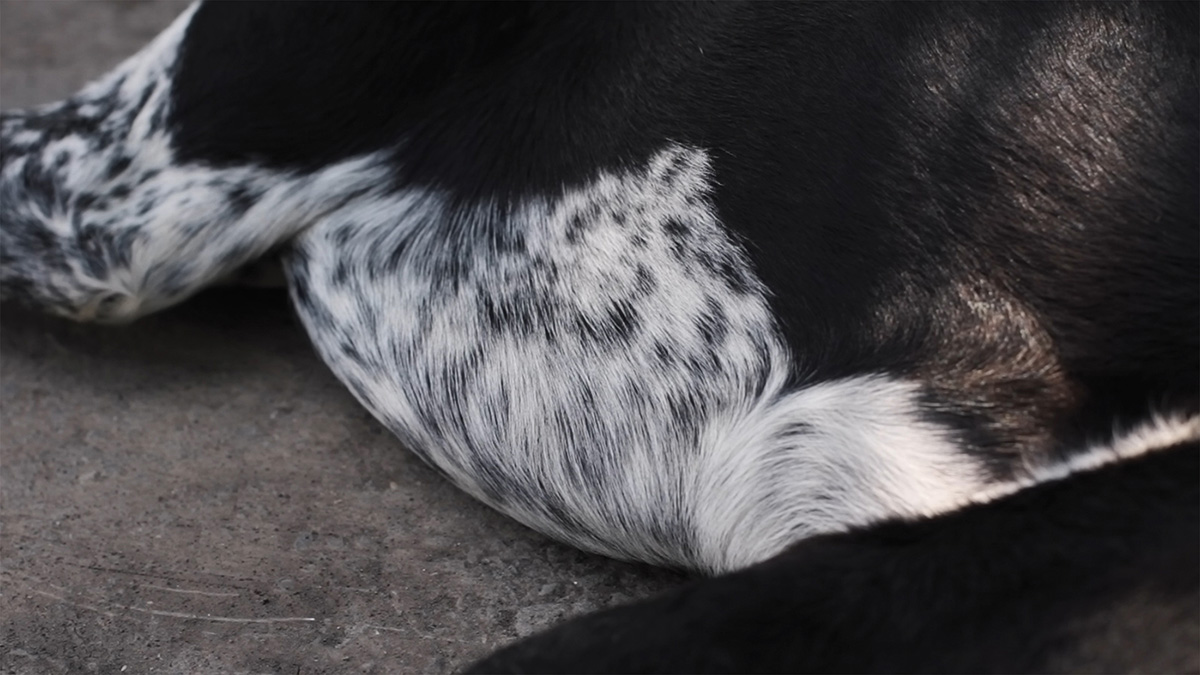
The gaze in “attractions” is focused on the animals. Any human activity seems strange. It forces its way into the otherwise equable way of life at Gori Park, ultimately calling into question the way humans constantly take it for granted that they are above nature.
Patrick Wallochny, born in Düsseldorf in 1990, is a filmmaker and video artist. He works as a director, editor and producer and lives in Berlin. His short films and site-specific audio and video installations move between documentary and fiction and try to playfully explore the limits of the medium. They are in dialogue with the cinema as well as with other art forms and pop culture. His eyes are on places as well as on people. On humour as on melancholy.
Alexander Walmsley
Catalogue : 2025Memory Architecture | Experimental fiction | hdv | color | 14:29 | United Kingdom, Sweden | 2023
Alexander Walmsley
Memory Architecture
Experimental fiction | hdv | color | 14:29 | United Kingdom, Sweden | 2023
In Memory Architecture, a surveyor travels to the north of Sweden to survey a site for the building of a new data centre. This systematic task of transforming the terrain into a digital model quickly becomes a desperate search for some kind of underlying structure of the surveyor’s surroundings.
Alexander Walmsley (UK, b. 1992) is a filmmaker and photographer. In his research-based practice, he investigates how our understanding of the earth is shifting, mediated by the new technological, environmental and social realities of the 21st century. His recent work has been shown at the Daejeon Biennale of Arts and Sciences, Tirana Art Lab, Sharjah Art Foundation, The Photographers' Gallery, and Athens Digital Art Festival. He was a commissioned artist for the Albanian pavilion of the 59th Venice Biennale and was shortlisted for the Deloitte Photo Grant in 2023 and Istanbul 212 Photography Prize in 2021. He previously studied Anthropology and Archaeology at the University of Cambridge (UK) and the University of Geneva (CH), and is currently a lecturer at the Film University Konrad Wolf in Potsdam, Germany, where is also undertaking an artistic PhD on the subject of real-time representations of the planet.
Catalogue : 2023Tirana Time Capsules | Experimental VR | 4k | color | 0:0 | United Kingdom, Albania | 2021
Alexander Walmsley
Tirana Time Capsules
Experimental VR | 4k | color | 0:0 | United Kingdom, Albania | 2021
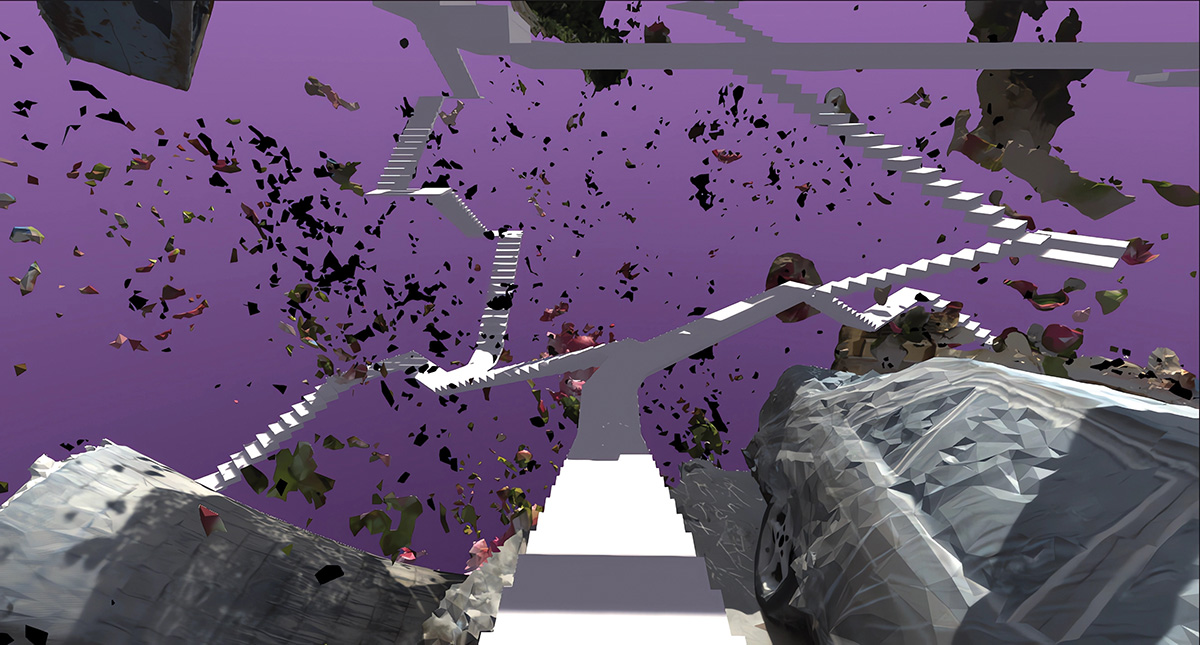
The Tirana Time Capsules are a series of three virtual environments, accessible via web browser, that act as time capsules for three different neighbourhoods of Tirana in 2021. The chosen areas - 21 Dhjetori, Kombinat, and the Teatri i Gjelbërimit, an area of the Tirana Great Park - each embody different aspects of Tirana’s urban development over the past 100 years. Particularly since the early 2000s, this has been characterised by the gradual disappearance of public space as the building sector has increasingly become controlled by private interests. Drawing on the metaphor of the time capsule and employing so-called high-fidelity recording techniques such as photogrammetry and field recording, the work re-appropriates and re-constitutes these different areas of the city as virtual environments as a way of exploring the intersection of personal memory and community heritage. In addition, the work seeks to question the promises made by such recording technologies that claim to render and preserve reality as a high-fidelity digital copy: in short, what exactly is being preserved when we use these techniques of digital preservation?
Alexander Walmsley (b. 1992) is a media artist with a particular interest in the landscapes of the real and the virtual. In his practice, he investigates how our understanding of these landscapes is shifting, mediated by the new technological, environmental and social realities of the 21st century. His work is situated primarily between 3D, photography, animation, and XR. His recent work has been shown at the Daejeon Biennale of Arts and Sciences, Tirana Art Lab, Sharjah Art Foundation, The Photographers' Gallery, and VRHam! Festival. He was a commissioned artist for the Albanian pavilion of the 59th Venice Biennale and has taken part in residencies at the Tirana Art Lab, Albania, and Moskosel Creative Lab, Sweden, among others. Previously, he studied Anthropology and Archaeology at the Universities of Cambridge (UK) and Geneva (CH).
Alexander Walmsley
Catalogue : 2026Tropical Depression | Experimental doc. | 0 | color | 31:9 | United Kingdom | 2025
Alexander Walmsley
Tropical Depression
Experimental doc. | 0 | color | 31:9 | United Kingdom | 2025
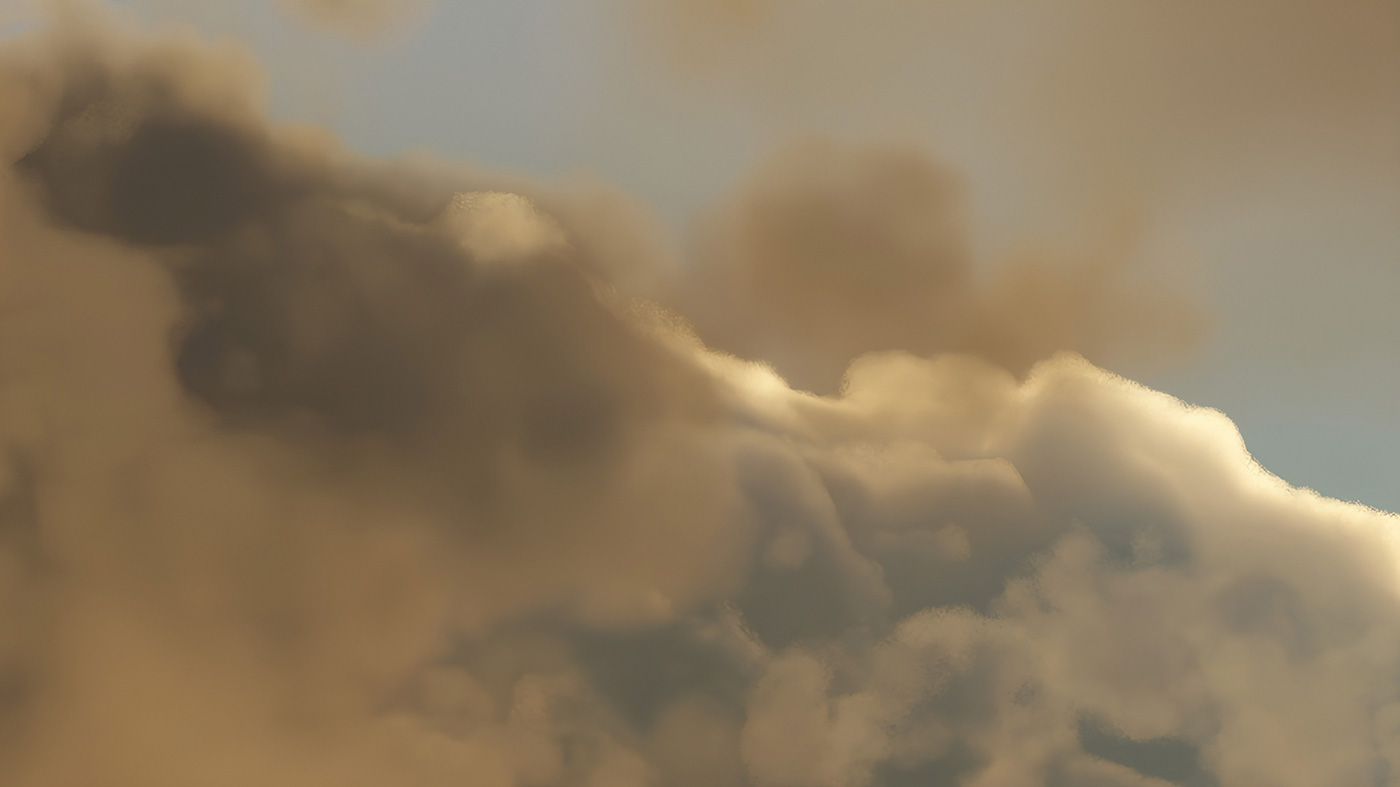
Tropical Depression follows the life and death of 21 cyclones that took place in the southern Hemisphere during the 2023 to 2024 cyclone season. Combining found footage and text fragments with recorded footage of the storms within Microsoft Flight Simulator - a videogame where weather is visualised in realtime using meteorological data - the film explores the aesthetic implications of documentary filmmaking that relies on data-generated rather than lens-based imagery, and the depiction of violent weather events as data-driven climate models.
Alexander Walmsley (UK, b. 1992) is an artist working between film, photography and digital media. In his research-based practice, he investigates how our understanding of the earth is shifting, mediated by the new technological, environmental and social realities of the 21st century. His recent work has been shown at the Daejeon Biennale of Arts and Sciences, Tirana Art Lab, Sharjah Art Foundation, The Photographers' Gallery, and Athens Digital Art Festival. He was a commissioned artist for the Albanian pavilion of the 59th Venice Biennale and was shortlisted for the Deloitte Photo Grant in 2023 and Istanbul 212 Photography Prize in 2021.
Emmett Walsh
Catalogue : 2012The Pathfinder: Prospect | Video | hdv | color | 13:11 | Ireland, USA | 2011
Emmett Walsh
The Pathfinder: Prospect
Video | hdv | color | 13:11 | Ireland, USA | 2011
`The Pathfinder: Prospect`, begins with the painted portrait of a 19th century politician and pioneer, John C. Frémont, housed in the Brooklyn museum, New York. From this figure the camera begins to build curious panning views of staged historical dwellings and stuffy expansionist-era oil paintings, before moving on to stationary shots of the nearby Prospect Park, with its carefully allotted tracts of woodland and pasture. The pace of the footage is dictated by a recording of a local drum circle; a loose collective of neighbourhood residents who come together each week, with no clear leader, and improvise African and Caribbean drum rhythms. A crescendo is reached through fragmented visions of paths and roads, dissected by painted lines and cracked patterns. A series of subtitles appear throughout the video, in which a loose conversation is recounted. A narrator struggles to clarify it`s own position in remembering a past journey to distant islands, when utopian ideals were discussed and only half formulated. Throughout `The Pathfinder: Prospect`, the uneasy collision between 19th and 20th century urban planning, the displacement of migrant communities, and idealised visions of pastoral equilibrium are melded together through the intuitive, pulsing efforts of the drum circle.
Emmett Walsh is an artist and writer from the UK, currently based in Los Angeles. His work spans sculpture, writing, video, photography, and print. He graduated from the MFA program at the Glasgow School of Art in 2008.
Calum Walter
Catalogue : 2023Entrance Wounds | Experimental film | hdv | color | 17:48 | USA | 2023
Calum Walter
Entrance Wounds
Experimental film | hdv | color | 17:48 | USA | 2023
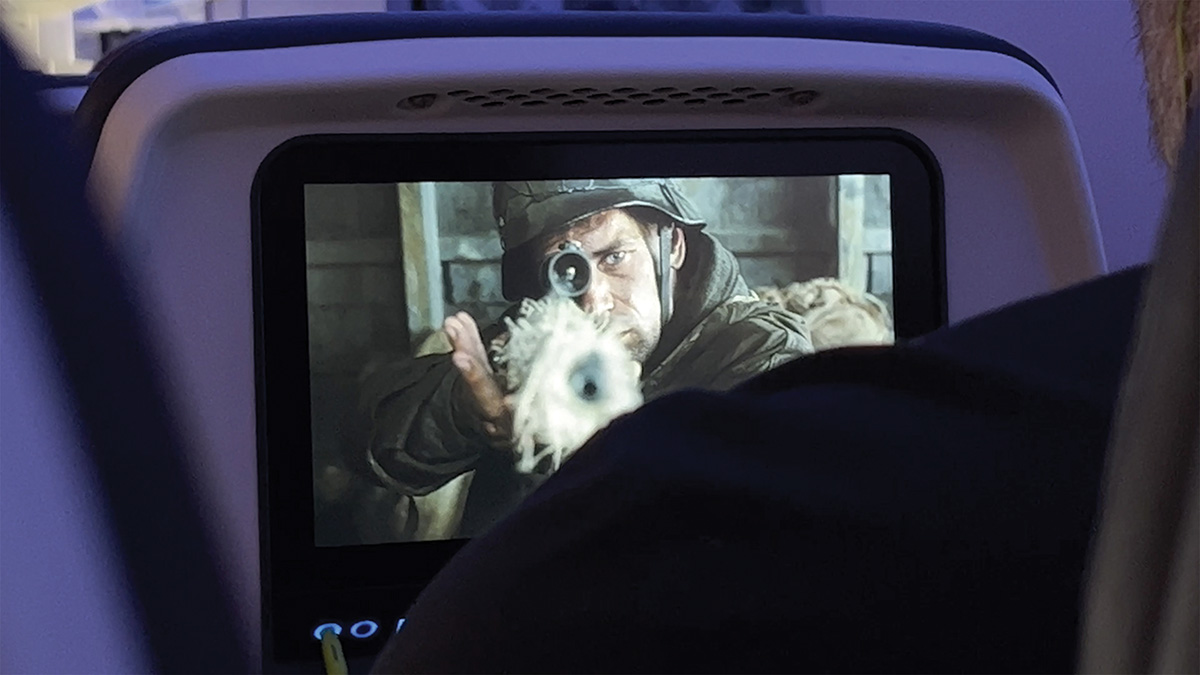
A meditation on the image and the bullet. Entrance Wounds considers the modern challenge of trying to unsee an image. The film sifts through moments of the everyday, imagining a world where afterimages of disaster drift near transparency over the present.
Calum Walter is an artist working in sound and moving image. His recent work has focused on human and machine error, collective anxieties, and the cultural moment as it is shaped by emerging and consumer technologies. His films have screened at the Berlinale, Sundance, Toronto International Film Festival, New York Film Festival, Rotterdam International Film Festival, Ann Arbor Film Festival, Rencontres Internationales Paris/Berlin, FIC Valdivia, Images Festival, Slamdance and the Hong Kong Arts Centre. He is a 2018 MacDowell Fellow and has received awards from the Harpo Foundation and the Illinois Arts Council. He lives in the Los Angeles area and teaches in the Film/Video program at CalArts.
Catalogue : 2017Unknown Hours | Video | hdv | color | 12:30 | USA | 2016
Calum Walter
Unknown Hours
Video | hdv | color | 12:30 | USA | 2016
Unknown Hours studies a precarious nightscape. An observer journeys down a main street in Chicago towards a neighborhood known for its nightlife. The moving image is slowed to reveal the intermittence of street lights and sports bar televisions. A camera peers into the moments between events.
Calum Walter is a filmmaker, artist and sound designer. He has a BFA from the University of Colorado where he studied filmmaking with an emphasis on sound, and later received a MFA from the School of the Art Institute of Chicago. He continues to do sound design and recording for his own films, and has collaborated with artists as cinematographer, sound recordist and designer. His work has screened widely at places including New York Film Festival, Toronto International Film Festival, Rotterdam International Film Festival, Slamdance, Ann Arbor Film Festival and the Big Ears Music Festival. He Teaches in the department of Radio/Television/Film at Northwestern University.
Michael Walter, Susanne BERGGREN
Catalogue : 2006Der Hörnermann | Experimental video | dv | color | 17:30 | Germany, Sweden | 2004
Michael Walter, Susanne BERGGREN
Der Hörnermann
Experimental video | dv | color | 17:30 | Germany, Sweden | 2004
?Der Hörnermann? - A phenomenal conceptual animal on a mediative passing through a landscape with horizons. The Hörnermann is a creature who is oscillating between nature and culture. In the shootings you see a human with horns held to his head slowly walking through the forest. At times he seems to be a foreigner to the landscape, masquerading to fit in or hide, at others he seems to be the sovereign, and at yet others he seems to be part of it, no longer human. Filmed in the urwald of Tiveden, Sweden, the imagery is beautiful, and refrains from becoming ironic but stays sensitive, both in compassion and accuracy in regards of the changing facets of the being of Hörnermann. ?It is quite strange in its simplicity, and in its refusal to show anything else than what it shows at first, aside from small variations (which consequently you tend to pay attention to). I like the sound(s) and the peacefulness and pacing that comes from the soundtrack. I like the fact that it?s not boring, and that on the opposite, in its own way it is quite funny. The Hörnermann?s gesture is so « suspended » (...) between a lot of different things that you can?t really pinpoint, that it keeps you guessing, even though it is very simple. I also like that it allows you to look at the landscape and enjoy it while ridding this action of its possible sentimentality and kitsch. ? Comment by J-P A
MICHAEL WALTER (*1966) works as visual artist. Various exhibitions in Europe. SUSANNE BERGGREN (Stockholm/Berlin) has worked as a choreographer since mid-nineties in the contexts of dance, visual arts and club. She normally works in close collaboration with artists from various fields, and produces works in different medias. Her work has been presented in Sweden and internationally. The last years she also worked extensively as a dancer with choreographers as Xavier LeRoy, Eszter Salamon, and Antonia Baehr, touring Europe. amongst others at Modern Dance-theatre, The Modern museum of Art, Fylkingen and various clubs and restaurants in Stockholm, Sweden, in Hau, Berlin, Thomas Nordanstad Gallery New York, Art Genda 2000, Helsinki, Wienna International Apartment, Wien and Åbo.
Alexia Walther, Maxime Matray
Catalogue : 2009L'élan | Fiction | 16mm | color | 15:24 | Switzerland, France | 2008
Alexia Walther, Maxime Matray
L'élan
Fiction | 16mm | color | 15:24 | Switzerland, France | 2008
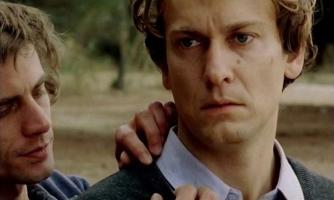
Even nowadays, these things do happen sometimes: you get up at dawn, you`re accompanied, you walk throughout the woods, you get encouraged, you fear, you jabber, you play, you hum. You`re expected. You don`t have much to lose, but your honor.
Alexia Walther was born in Geneva in 1974, she lives and works in Nice and Paris. She graduated in 1999 from ESAV (École Supérieure d?Art Visuel), Geneva, Switzerland. She directed mixed media installations. Maxime Matray was born in 1973 in Paris. He lives and works in Nice and Paris. He graduated in 1995 from EPIAR (École Pilote Internationale d?Art et de Recherche), Villa Arson, Nice. He?s a mixed media artist and author. They started working together on the short-film TWIST (2006), that won several awards in many festivals. They wrote and directed together the short-film L?ÉLAN (THE RUN-UP).
Jan Wandrag
Catalogue : 2007David+Jonathan | Experimental fiction | dv | color | 15:0 | South Africa, USA | 2006
Jan Wandrag
David+Jonathan
Experimental fiction | dv | color | 15:0 | South Africa, USA | 2006
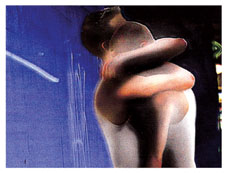
"David+Jonathan" is a non-straight street photography project. It is a retelling of the Bible story, set in modern day New York. After David defeats Goliath, the King takes an interest in him. David then develops a relationship with Jonathan, the King's son. When the King finds out about it, he forbids Jonathan to ever see David again. The building blocks of this film are a series of re-photographed stills. The images began as video shot in public, of young men unaware of the camera. Fictional scenes were composed from these images by digitally manipulating them and placing the actors found into the story.
Jan Wandrag was born in South Africa in 1976. His video work has been included in festivals in New York, Chicago, Dallas, and Washington, DC. Jan recently had his first solo gallery show, "Images of David+Jonathan", at Peter Hay Halpert Fine Art, New York. He has also participated in numerous group shows in the United States, South Africa, and Europe. Jan was awarded the Aaron Siskind Scholarship in 2004. In 2005 he completed a MFA in photography, video, and related media at the School of Visual Arts in New York City. He currently resides in New York with his partner David.
Joel Wanek
Catalogue : 2014Sun Song | Experimental doc. | hdv | color | 14:35 | USA | 2013
Joel Wanek
Sun Song
Experimental doc. | hdv | color | 14:35 | USA | 2013
A poetic journey from the darkness of early dawn into the brightness of the midday sun in the American South. Filmed on one bus route over the course of six months in Durham, North Carolina, Sun Song is a celebration of light and a meditation on leaving.
Joel Wanek (1974, Nebraska, USA) is a filmmaker and photographer living in Oakland. Over the years he has developed a creative documentary practice that often blurs the line between subject and maker, mixes techniques of narrative and vérité modes, and uses public spaces for collaborative engagement. He holds a MFA in Experimental and Documentary Arts from Duke University.
Yuyan Wang
Catalogue : 2025Look On the Bright Side | Experimental doc. | mov | color | 17:2 | China, France | 2023
Yuyan Wang
Look On the Bright Side
Experimental doc. | mov | color | 17:2 | China, France | 2023
In an age of wire and string, futuristic visions anchor in lithic time. In the dark, people are driven to shine in the most spectacular ways. Light, emitted from our digital extensions, has roots traversing millions, even billions of years.
Yuyan Wang, born in 1989 in China and currently based in Paris, is a filmmaker and video artist. Her works involve recycled materials from the industrial sphere of image production, tracing their mutation and proliferation within the digital frameworks and representations. Through the editing process, Wang deconstructs and recontextualizes the intricate hierarchies and inherent meanings in materials —whether found, processed, and produced—striping symbols of their conventional paths of perception and turning them into immersive sensory experiences. Wang completed her studies at the École des Beaux-Arts de Paris in 2016 and later at Le Fresnoy - Studio national des arts contemporains in 2022. Her work has been showcased at Tate Modern, Palais de Tokyo, UCCA Beijing, the 12th Berlin Biennale and various festivals, such as the Berlinale International Film Festival, the International Film Festival Rotterdam, MoMa Doc Fortnight, CPH:DOX, the European Media Art Festival, receiving numerous awards.
Catalogue : 2025The Moon Also Rises | Experimental doc. | hdv | color | 23:40 | China, France | 2024
Yuyan Wang
The Moon Also Rises
Experimental doc. | hdv | color | 23:40 | China, France | 2024
Just before the launch of artificial moons, a retired couple finds their harbor in the fading darkness. Trying to catch up with the pace of modernity, their daily life traces this forthcoming brightness back to its earthly origins.
Yuyan Wang (b. 1989, China) is a filmmaker and multidisciplinary artist. Her work focuses on the impact of image creation in media, representation, and the attention economy. By deconstructing and recontextualizing inherent meanings of found materials, her practice probes the continual mutations within the industrial production chain of images, a perpetual development leading to an abstraction of reality. Her work has been showcased at Tate Modern, Palais de Tokyo, the 12th Berlin Biennale and various festivals, such as Berlinale, IFFR, European Media Art Festival, Indie Lisboa, receiving numerous awards.
Lingjie Wang, Catherine Egloffe, Andrea Palade Flondor, HAO Jingfang, Serge Desire Ouedraogo, Bouna Cherif Fofana
Catalogue : 2013ouvrières ? | Experimental doc. | hdv | color | 10:46 | China | 2012
Lingjie Wang, Catherine Egloffe, Andrea Palade Flondor, HAO Jingfang, Serge Desire Ouedraogo, Bouna Cherif Fofana
ouvrières ?
Experimental doc. | hdv | color | 10:46 | China | 2012
Comment les ouvrières se voient à leur travail ? Pourquoi font elles ce métier ? Qui sont elles ? Pas seulement ici, mais aussi ailleurs. Le regard se concentre sur les femmes de l`industrie textile mais porte au delà d`un pays. Il va là où des artistes partagent cette même envie de regarder les femmes se regardant au travail. Ce qui importe d`abord c`est la manière dont chacune se voit, se pense. Les femmes parlent de leur désir, désir d`indépendance, pour le reste elles décrivent leur vie au travail, les difficultés, la dureté, le besoin de travailler, les peurs, les envies, les regrets... Souvent, elles se ressemblent, par leurs gestes attachés aux machines, mais aussi par leur histoire, le besoin d`argent, d`indépendance, certaines ont peur, d`autres se rebiffent, refusent. Ce qui importe aussi c`est la manière dont chaque artiste voit ces femmes au travail. Les croisements de regards, se font au gré des images et des paroles, sans autre guide que le jeu du loin et du proche, dans l`espace recomposé des usines, du rapport des corps aux machines, au travail.
«Images en transit », C`est un processus artistique collectif, qui a commencé en 2010 avec un travail expérimental sur le regard des femmes au travail, dans le textile. Nous sommes 6 artistes, de 3 continents, Europe, Afrique, Asie, qui avons imaginé peu à peu un dispositif pour travailler en collectif. Chacun a filmé dans son pays des ouvrières au travail, puis nous avons mis en commun les images. L?idée a été de réaliser une vidéo, avec une écriture commune, mais chacun a pu et pourra continuer à sa manière le travail engagé. Les images appartiennent au collectif et à chacun. Le temps de l`écriture collective a été celui du projet, puis celui du montage, chacun ?uvrant à partir des ses propres images et de celles des autres. Une centaines d?heures au total. Toutes les interviews ont été intégralement traduites. Le processus est expérimental et très ouvert donc. Nous ?uvrons sur l`écart des regards, l`écart dans le travail, des artistes et des femmes, les idées comme les images circulent. Co auteurs : Catherine Egloffe (France), WANG Lingjie (Chine), Andrea Palade Flondor (Roumanie), HAO Jingfang (Chine), Serge Desire Ouedraogo (Burkina Faso), Bouna Cherif Fofana (Mali)
Catalogue : 2012Flotter dans le noir | Experimental video | | color | 6:23 | China, Mali | 2011
Lingjie Wang, Jingfang HAO
Flotter dans le noir
Experimental video | | color | 6:23 | China, Mali | 2011
Wandering in the night, floating in the dark. Video filmed in February 2011 in Bamako, Mali, in the district Djicoroni Para, with the broadcast of muezzin`s calls. By the lacking of public street lighting, the landscape of the street is nothing familiar to us. The whole environment has changed. Houses, stores, waste, plants, even clothes of the passengers, everything is fading in the dark. We see the lights and shadows, the images taken. The movement of light and shadow built the memory of the territory that floats in time.
After his graduation as an engineer in industrial design in 2007, WANG Lingjie decided to continue his journey of creation by a more challenging and fundamental way, which leads him to start a 5 years study in contemporary art. WANG Lingjie has a various interests and so in the early years, he explored some different domains include: information technology, ecology and architecture, which he integrate to his creation of art works. Some after, influenced by his political background and thoughts of idealism, the artist focus his practices to installation, photography and video/motion picture which involve both fiction and documentary. By these mediums, he develops projects which reflect his thoughts on our existence, our relations with the nature and the univers. WANG Lingjie lives and works in Lorraine, France and Shanghai, China.