Catalogue > List by artist
Browse the entire list of Rencontre Internationales artists since 2004. Use the alphabetical filter to refine your search. update in progress
Dominique Gonzalez-foerster, Tristan BERA
Catalogue : 2014Belle comme le jour | Experimental fiction | | color | 12:0 | France | 2012
Dominique Gonzalez-foerster, Tristan BERA
Belle comme le jour
Experimental fiction | | color | 12:0 | France | 2012
SYNOPSIS Prélude aux Belle de Jour (1967) de Luis Buñuel et Belle Toujours (2006) de Manoel de Oliveira, Belle comme le Jour est l?histoire de Séverine avant son mariage avec Pierre et avant de devenir Belle de jour. Séjournant à l?Hôtel Regina de Paris, près de la rue de Rivoli, elle rencontre au musée du Louvre un étranger qui lui raconte une histoire dérangeante. À partir de son récit du saint et de la chienne elle commence à rêver d?une toute autre cérémonie. Belle comme le Jour c?est aussi l?histoire d?une jeune étudiante parisienne, une cinéphile d?aujourd?hui qui cultive sa ressemblance avec Catherine Deneuve et qui, en rejouant ses scènes de cinéma préférées, rencontre le sosie de Marcello Mastroianni. Belle comme le Jour c?est enfin l?histoire de S., un cas d?étude masochiste : une jeune femme vit avec un trauma secret et développe une double vie dans l?imaginaire et la fiction qui questionne le plaisir et la soumission. Sa rencontre avec G. dans le monde des antiques du musée du Louvre est l?occasion pour elle de développer de nouveaux fantasmes.
DOMINIQUE GONZALEZ-FOERSTER Dominique Gonzalez-Foerster (France, 1965) vit à Paris et Rio de Janeiro. Elle est artiste visuelle et réalisatrice. Parmi ses récentes expositions monographiques: les projets pour la Dia Art Foundation, New York (2009); le Turbine Hall, Tate Modern, Londres (2008); MUSAC Museo de Arte Contemporáneo de Castilla y Léon (2008); Musée d?Art Moderne de la Ville de Paris / ARC, Paris (2007). Elle a aussi participé au Skulptur Projekte Münster (2007) et à la Documenta XI de Kassel (2002). Elle a obtenu le prix Marcel Duchamp en 2002. Ces cinq dernières années elle a mis en scène T.451 à la Tensta Konsthall (Stockholm, 2012); «the 121st Night» à Istanbul avec Tristan Bera produit par Protocinema; T.1912 avec le Wordless Music Orchestra au Guggenheim Museum, New York (2011); K.62/K.85 pendant Performa 09 NY (2009) avec Ari Benjamin Meyers. Parmi ses nombreuses videos: Park Central (2006), Atomic Park (2004), Riyo (1999), Ile de Beauté (1996) coréalisé avec Ange Leccia. TRISTAN BERA Tristan Bera (France, 1984) vit à Paris. Artiste visuel, formé en philosophie et histoire de l?art, son travail est basé principalement sur des références littéraires et cinématographiques et inclut différents formats et médias et toujours à tendance psychosexuelle. Depuis 2009, il collabore avec Dominique Gonzalez-Foerster dans différents projets comme expositions, films, fanzines, performances. En 2011, ils ont présenté Human Valley - the other side of contemporary history : un scénotope inspiré de Truffaut et Godard à la Kunsthalle de Zurich, entouré d?artistes, curators et collectionneurs. Dans ce cadre, ils ont initié une conversation et une lecture avec Catherine Millet : «Balzac et moi» au Zurich Schauspielshaus et à Bordeaux (Oct 2012). Ils éditent un fanzine de personnages (Torpille Valley, Farouche féline, Vertige Gradiva et Lago Monaco-Visconti). Après The Magic Skin (2011), Belle comme le jour (2012) est leur deuxième film, présentée en installation vidéo à Basel Art Unlimited (commissaire : Gianni Jetzer, juin 2012). En 2012, après «The 121st Night», un happening produit par Protocinema à Istanbul, il crée «peer-to-gynt» en collaboration avec DGF & Ari Benjamin Meyers. En 2013, il conçoit pour Charles Arsène-Henry et la Fondation Luma à Arles l?enfer d?une bibliothèque, Le Rayon Noir, ainsi qu?un film masochiste WHIP!.
Gabriel González
Catalogue : 2007Los amantes polarizados | Animation | dv | color | 4:54 | Spain | 2006

Gabriel GonzÁlez
Los amantes polarizados
Animation | dv | color | 4:54 | Spain | 2006
Two creatures wake up at the top of huge rocky towers. To love each other they will have to jump into the emptiness.
Gabriel González [-dhijo-], is self-taught artist and a cofounder of the independent group "...dijo el monje" (1994-1997). He works as a creative director arranging his works as an animated short films director. "Primario" (stereoscopic interactive 1994-1995), "Amamanta" (random narrative techno-ritual 1995-1997), and "Elgiroeneleje" (meditative state of dynamic polarity 1998-2007) have been shown in the most important electronic art festivals in Spain: ArtFutura, Sonar, Observatori, Ciber@rt, Ciberconf, Arco, and Decibelio, and at other film/video events. He has also had several exhibitions outside of Spain: UNAM México Retrospective; File fest Sao Paulo; Net Affects at Kunstvlaai4 Amsterdam; Arteweb - canal (a) de Argentina; and Raisat Art, Venice Biennal.
Shalom Gorewitz
Catalogue : 2007Soft Targets | Experimental video | dv | color | 5:0 | USA | 2004
Shalom Gorewitz
Soft Targets
Experimental video | dv | color | 5:0 | USA | 2004
The visuals were recorded around ground zero in lower Manhattan during several visits in the weeks and months after September 11. Gorewitz also recorded along Route 17 in New Jersey, a busy highway with many large stores and malls. While processing footage in his studio with various electronic and computer imaging devices, he thought about what it meant to be a soft target while getting used to living with the fear that has been pervading the region since. Editing during the early days of the war against Iraq, Gorewitz imagined what it might look like if the US were being bombed with "shock and awe", its children dying. Sometimes the most ordinary moments become ominous and foreboding. But, of course, Europeans know this, like Israelis, Iraqis, and too many others - sudden, swift destruction, agonizing wounds, and slow death. The sense of reality changes after breathing in a neighbourhood reduced to ash and burned flesh.
Salom Gorewitz's father was a business manager for many artists, performers, and musicians, so Salom grew up on the edge of the NYC art world of the early 1960`s. His mother is a survivor of the Shoah who raised her children as observant Jews. Gorewitz believes that his work flows between the freedom and revolutionary spirit of the artists he met through his father and the life of a Jew passed on by his mother and her ancestors. At its best, there is no gap between art making and spirituality. Since graduating from the California Institute of the Arts in 1971, he has continuously been able to engage in both.
Shalom Gorewitz
Catalogue : 2026Notary Uprising! and the Flag Stomp Romp | Fiction | mp4 | color | 86:26 | USA | 2025
Shalom Gorewitz
Notary Uprising! and the Flag Stomp Romp
Fiction | mp4 | color | 86:26 | USA | 2025
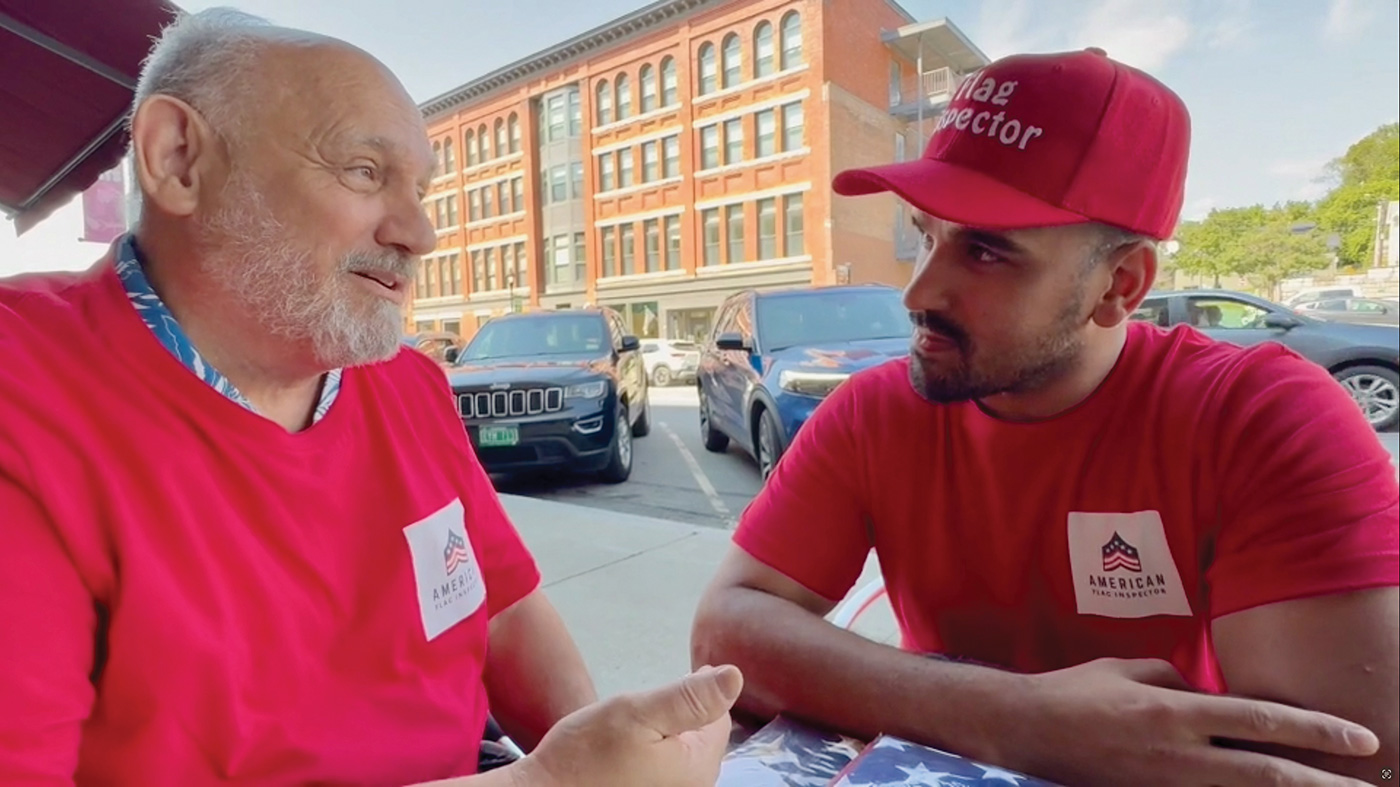
Sarge and Joseph are flag inspectors working in Vermont. We see them criticizing the placement of a flag, having a confrontation with an angry Libertarian, and listening to a conversation where Joseph expresses doubt. They find a US flag with a tractor and accuse local farmer of being a traitor. The inspectors retreat with promise of future payments. Sarge notices two women folding a US flag with a lobster. The women explain that this is the Notary Uprising flag. Joseph falls in love with Nova, the a leader of the local notaries. They coincidentally meet in an art gallery and decide to go to NYC together. While notary rebels are plastering their slogans over Manhattan, Nova and Joseph visit Times Square where he is moved by the pixellated flag. Nova meets other notaries. Joseph finds army vets in Central Park who try to convince him he is Jewish. He fights off Mossad agents. The Vets encourage him to visit Reb Pineas, immortal sage from Chelm. Joseph is convinced to stay while Nova returns to Vermont. After learning the secret of the Three Stooges, Joseph returns to Vermont and shops for kosher products in a local grocery store.
Shalom Gorewitz (born 1949), a pioneering video artist, curator, and writer, bridges image processing and social commentary. A Guggenheim Fellow and former curator at The Kitchen, he collaborated with dancers like Daniel Nagrin, Lucinda Childs, and Regina Miranda. His work was exhibited internationally while Gorewitz explored experimental media. In 2022, he retired from Ramapo College of New Jersey and has since directed nine feature narrative films with improvisational non-professional performers. The Northeast Kingdom, a region in Vermont and the US, is Gorewitz’s primary filming location. He does camera work and post-production. Notary Uprising!, the first NEKflix film shot in Vermont, New York City, and New Jersey, Previous films address the plight of returning citizens, the fentanyl crisis, eco-terrorism, and other local issues. Notary Uprising! Is Gorewitz’s seventh film and first comedy. Gorewitz was inspired to be a film maker after seeing Godard’s Breathless and Anger’s Scorpio Rising at the Bleeker Street Cinema when he was 17 years old. He began Major influences include Emir Kusturica, Tony Gatlif, and Frank Capra. He began making feature films when he was 71. He resides in New York City and Danville, Vermont, with his wife, the poet Rachel Hadas.
Dzhovani Gospodinov
Catalogue : 2025Meadows wait, mist diffuses | Experimental film | hdv | color | 17:10 | Luxembourg | 2023
Dzhovani Gospodinov
Meadows wait, mist diffuses
Experimental film | hdv | color | 17:10 | Luxembourg | 2023
In Meadows Wait, Mist Diffuses, Dzhovani Gospodinov captures the enigmatic energies of Hosbësch. Ruminating on the encroaching influence of civilisation in its woodlands and the ways in which humans disrupt and alter the intimacies between animals, the film queries the ethics of our intrusion into the natural world. Shot over four years with motion activated cameras and interlaced with Gospodinov’s own fragmented recollections of the woods, the film poeticises the protracted rupturing of a landscape. Moving between the visual and affective modalities of the voyeuristic and introspective, the film is at once a portrait of—and elegy to—Hosbësch.
Dzhovani Gospodinov is a Luxembourgish filmmaker whose work experiments with the boundaries between documentary and fiction. Interested in the power of observational filmmaking and its ability to conjure both exteriorised and reflexive modes of storytelling, Gospodinov’s projects have illustrated the poetics of ancient pagan rituals, the erosion of intimacies between humankind and the natural world, and hermetic, monastic orders, amongst other things.
Lana Gospodnetic, Lovrec STEFANOVIC
Catalogue : 2007DaDa | Création sonore | 0 | | 11:6 | Croatia | 2005

Lana Gospodnetic, Lovrec STEFANOVIC
DaDa
Création sonore | 0 | | 11:6 | Croatia | 2005
DADA ? Some claim that the word was chosen randomly at the Cabaret Cafe in 1916, when a paper knife was found inserted into a dictionary pointing to the term "dada". It is French for "hobbyhorse". In Croatian it means "yes yes". Rather than returning to the original works of Dada, we have chosen to put together a new (hi)story of Dada-Zagreb. Led by the techniques of Dadaism such as montage, collage, and the use of ready-mades, this piece merges 45 years of recordings of Biennial Zagreb Music, with sounds of contemporary Zagreb. We start roughly at a time when Dadaism was conceived, with "the father of electronic music" Edgard Varese, bringing back a recording of his Ionisation performed at the 15th Music Biennial. It was he, 100 years ago, who fell in love with the sounds of a city. The roar of the modern times became his inspiration in discovering the new worlds of sound ? dissonant chords, sirens, polyphonies of percussion and wind... So we followed him. Setting forth on a path of music remembered in the Phono-archives of Croatian Radio, and visiting the most beautiful sights in the center of Zagreb along with its concert venues, our sound collage makes possible the encounter of Edgard Varese, Benjamin Britten, Igor Stravinsky (speaking about vodka), Michael Nyman, Sofia Gubaidulina, Daryl Runswick, Dieter Schnebel, Alvin Lucier, Howard Skempton, David Hykes, Stefano Scodanibbio, Peter Maxwell Davies, Josef Anton Riedl, and our guide - the voice of John Cage (Mushrooms and Variations). As in a dream, where realistic scenes are joined by bizarre connections, these individuals from our past all meet in contemporary Zagreb. Just as Dada works forced the observer to question accepted realities and acknowledge the role of chance and imagination, the listener of this piece becomes an editor, or a Dada artist, who connects many excerpts of discontinued time, and creates an authentic reality. These two aspects confronting each other ? reality of detail and irreality of the piece as a whole, create a version that is one in a thousand possibilities composed in this way.
Iva Lovrec ?tefanović was born in 1964. She earned a degree in Musicology and Comparative Literature from Zagreb University. Since 1988 she has been working at Croatian Radio as a reporter, producer and host. She has conceived numerous programs for Music Departement with topics ranging from early music to contemporary music festivals, electronic music, and ars acustica. For more than five years, she has been hosting a talk show about Croatian music, where she discusses current issues with prominent and young composers, interpreters, musicologists, and others involved in the musical arena. Her passion is experimenting with various forms of radio programming, including documentaries and ars acustica. Occasionally she writes about music for specialized magazines and works for TV. She is a member of Croatian Musicological Society and Croatian Music Union. Lana Gospodnetić was born in 1979. She earned diplomas in Art History from Tufts University, and Sound Art from the School of the Museum of Fine Arts, Boston. Since 2003 she has been living in Zagreb, Croatia, and working as a sound designer for radio and film. Her video and sound installations have been presented at the Museum of Fine Arts, Boston, USA; Brandeis University, Waltham, USA; The Berwick Institute, Boston, USA; Prix Marulić International Festival of Radio Plays and Documentary Radio Drama, Hvar, Croatia; and BAG Gallery, Boston, USA. Sound work has been published on Acustiphobia, by Sublingual Records. Finally, she won second prize Prix Marulić in Croatia in 2005.
Yaela Gottlieb
Catalogue : 2025¿Dónde está Marie Anne? | Experimental film | 35mm | color | 5:56 | Peru, Argentina | 2023
Yaela Gottlieb
¿Dónde está Marie Anne?
Experimental film | 35mm | color | 5:56 | Peru, Argentina | 2023
Marie Anne escapes from a world that seems to promise her a perfect life. At that moment her trace is lost forever. Foundfootage made from advertisements recovered by the Museo del Cine de Buenos Aires from the years 1976-1983.
Yaela is a Peruvian filmmaker based in Hamburg. Her works explore photography, film and video from montages containing affects, in tension with fiction. Her films have been showcased at the film festivals including Punto de Vista, Berlin Critics' Week, FICValdivia, Lima FilmFestival, BAFICI, Torino Film Festival, among others as well as in museums such as MAR Museum of Contemporary Art, Proa21, and MACBA. She has also curated film programs for museums in Peru and Argentina. She's received awards such as the Juan Downey for Latin American creation (2022), Bienal Arte Joven (2019), CineAr (2023), Fondo Nacional de las Artes (2019, 2022). In 2021, she released her first feature film "No hay regreso a casa".
Mounir Gouri
Catalogue : 2020Naufrage | Video | hdv | black and white | 8:51 | Algeria | 2016
Mounir Gouri
Naufrage
Video | hdv | black and white | 8:51 | Algeria | 2016
Deux jeunes sont filmé sur une barque en mer devant la ville d’ Annaba, juste avant le départ vers l’Europe clandestinement. L’un est danseur et l’autre musicien, ils expriment leurs désirs dans une mise-en-scène poétique.
Mounir Gouri est née en 1985 dans la ville d’Annaba en Algérie. Il a grandit et débuté sa carrière artistique à Annaba. Il vit et travaille entre Annaba et Paris depuis 2018.
Aude Gourichon
Catalogue : 2006Vert ? | Art vidéo | super8 | color | 3:5 | France | 2004
Aude Gourichon
Vert ?
Art vidéo | super8 | color | 3:5 | France | 2004
A pedestrian is waiting for a sign in order to be able to cross a very busy street: but what kind of sign? True to their reputation as bad drivers, the italians can sometimes make it difficult for the pedestrians to cross a street. The video called Vert? is a static shot of 3mn05 filmed on Super8, which shows a man waiting either for the greenlight or for a spiritual help such as a miracle performed by the voice of Pope John Paul II in order to eventually be able to go to the opposite side of the street.
Aude Gourichon studied five years at the Art School of Quimper, France. Since she obtained her diploma, she has taken part in several audiovisual festivals such as the Short Film Festival of Brest and Lyon.
Alexandre Gouzou, Jean-Claude Taki
Catalogue : 2025Une chronique américaine | Documentary | hdv | black and white | 65:38 | France | 2023

Alexandre Gouzou, Jean-Claude Taki
Une chronique américaine
Documentary | hdv | black and white | 65:38 | France | 2023
A film about a film that never existed. In the 1970s, Michelangelo Antonioni wrote a screenplay, entitled Two Telegrams, with the American Rudy Wurlitzer. In the 1980s, Portuguese producer Paulo Branco agreed with the director to make the film in the United States. For various reasons, the film didn’t happen. In this film, the imagination of the two directors picks up on what this unfinished project could have been.
Alexandre Gouzou, born in 1963, founded the magazine Les Épisodes in 1997, which has published unpublished works by American authors (Kerouac, Harrison, Burroughs.) and French writers (Henri Calet, Emmanuel Bove.). He has also published short stories in magazines. J'aurais voulu que tout soit autrement is his first book. In it, he asserts himself with a muted voice, both melancholy and funny. Jean-Claude Taki is a film director. He has made both short and feature-length films using cell phones. In 2005, he made his first short films, which were the first steps towards his pocket cinema. On his website (http://www.jctaki.com/), you can find extracts from his writings, including “Lettres kazakhes”: a short illustrated epistolary novel. Written by young women, the letters are all addressed to Guillaume, a young Frenchman who has returned to France after a long stay in Kazakhstan. Through the humor, hopes and feelings delicately sprinkled throughout these letters and drawings, a rich, nuanced and subtle picture of a little-known country emerges.
Elisa Gómez Alvarez
Catalogue : 2016Me Myself and I | Experimental fiction | mov | color | 5:13 | Germany | 2015
Elisa GÓmez Alvarez
Me Myself and I
Experimental fiction | mov | color | 5:13 | Germany | 2015
The experimental short film ME, MYSELF AND I directed by Elisa Gómez Alvarez (script and rea- lisation) and Nicolas Stephan Fischer (fashion-collection F65.0) is about a metro-sexual matrix at the old Berlin corner pub "Soldiner Eck“. With stylistic devices of Western, Science-Fiction and the CAMP-movement the film questions society-forced role models and male stereotypes. Based on a shared research the fashion-collection and the short film were simultaneously realised in a synergetic project at University of Arts Berlin 2015. Surrounded by fairy lights and plastic flowers three male figures meet at an old Berlin pub. Despite their identical appearance they distinguish by personality and clothing. There is a strained relationship between them. Mutely the men communicate with minimal gestures as they seem confused between desire and fear. Camouflage-like their outfits vanish in the lavis- hly decorated ambience. A strange meeting, an interaction between alive and dead things in a surreal space.
ELISA GÓMEZ ALVAREZ was born 1989 in Berlin. She studies Visual Communication at the University of Arts Berlin since 2012. Since September 2015 she is a fellows- hip holder in one of Germany‘s most important foundation „Studienstiftung des deutschen Volkes“. During her studies she visited the studio class „MEDIA ART“ by Prof. Maria Vedder and „Expanded Media“ by Prof. Anna Anders. Now she is taking part in the studio class „Experimental Film / Media Art“ by Prof. Nina Fischer. Initiating a variety of short films and video installations she is a versatilely en- gaged student at University of Arts Berlin. One of her most complex projects was the film opera by Bohuslav Martinů. She realised a mixed media video work for stage scenery. The jazz-opera was performed first in Berlin. (Première: 4th/5th of July 2014)
Iria Gómez Concheiro
Catalogue : 2007Dime lo que sientes | Fiction | 16mm | color | 24:0 | Mexico | 2006
Iria GÓmez Concheiro
Dime lo que sientes
Fiction | 16mm | color | 24:0 | Mexico | 2006
Micaela, a young woman from downtown, leaves her house to meet her boyfriend. They have planned to leave together for the USA. But that morning he doesn?t show up. Instead of him, she meets a mutual friend who hands her a letter: "don?t wait for me any longer, I have met someone". Defeated, she goes looking for help from an old friend. She also finds an idea for a new job: to write letters for money. Working at the exit of a subway station she meets Julian, who helps her to find clients. The business gets better and better, and they get closer and closer, even though she tries to keep herself distant. One morning Julian asks her to write a letter as if he were a client: "Stella, don?t wait for me any longer, I have met someone..." Micaela, recognizing her own story, runs away into the station. Julian reaches her at the next stop, sits beside, and they look at each other and smile as the train moves off.
Iria Gómez was born in Mexico City in 1979. She entered a cinema school and studied dramatic art and photography for six years at the "Centro de Capacitación Cinematográfica" (C.C.C), Mexico City, where she took part in different projects. In 2001 she shot her first short film, "Memoria del Olvido" (Memories of Oblivion), in 16mm. She was director of photography for another short film, "El Tercer Ojo" (The Third Eye). After taking part in a few other films, she directed "Dime lo que sientes" (Tell Me What You Feel), in 35mm, which was completed this year; she granted importance to this project by being involved in each detail of the production process. In 2004 she went to Rome where she directed the short film "Tagglioneto". She is now working on the post-production of her documentary "La Changa" (The Joke) and on the pre-production of the film "Asalto al Cine" (Aggression In Theater).
Ana María Gómez López
Kemal Görgülü
Catalogue : 2006Dertli Köyüm | Documentary | dv | color | 52:0 | Germany, Turks & Caicos | 2005
Kemal GÖrgÜlÜ
Dertli Köyüm
Documentary | dv | color | 52:0 | Germany, Turks & Caicos | 2005
Burunören is a village where 50 souls live, in Middle Anatolia. After having spent 30 years in Germany as an immigrant worker, CERKEZ, retired, returns home in order to take care of the cultivation of his fields. He comes up against HÜSEYN, the village´s mayor. HÜSEYN has appropriated the money of the village, had a firm set up in order to work the sand of the river nearby, and contests CERKEZ´s property right in court. Due to the abusive exploiting of the river, the most fertile lands are covered with sand, thus ending the argument between the two old men. Burunören is a village which is danger of disappearing. While the village has split into two groups gathered around the two opponents, CICI, a 75-year-old woman, lives her own tragedy. Facing the probable death of her seriously ill husband (who´s in hospital 800 kms away), she tries to prepare for loneliness ...
UNIVERSITY July 2004 - Graduation: ?Diplom Medienwirt (FH)? 1999?July 2004 - Media Economics at the University of Applied Sciences, Wiesbaden, Germany 2001?2003 - Ecole Supérieure d?Audiovisuel, University of Toulouse II (Filmschool), France *2002 : Licence *2003 : Maitrise (Spécialisation Réalisation) *2004 : Titre Ingénieur Maitre
Matze Görig
Catalogue : 2025Les microbes | Video | 0 | color | 17:47 | Germany | 2024

Matze Görig
Les microbes
Video | 0 | color | 17:47 | Germany | 2024
Les microbes is based on the stories of some of the crew members that were told during the filmmaking process and reflects on their situation in an experimental way. They had to flee their homes due to poverty, war and prosecution. Now, after their long journey, they have to persevere and wait. Wait while the world is turning madly.
Matze Görig works at the interface between film, visual arts and sculpture in various contexts and often in the socio-cultural field. His cinematic and digital sculptural works have been shown at various exhibitions and film festivals and as interactions in opera and theater productions (e.g. International Short Film Festival Oberhausen, Hof Film Festival, Karlovy Vary Film Festival, Kunstraum München, Kino der Kunst, Konzerthaus Berlin, Transmediale Berlin, Theater Hannover). Matze Görig writes scripts, edits films and creates sound designs for his own and other artists' works. He has worked as a lecturer in various institutions (UDK Berlin, Kunsthochschule Weissensee, HFF Munich, Schlesische27) Since 2020, he has been the artistic director of theexperimental workspace Falscher Fisch in Berlin-Neukölln, which has set itself the task of inspiring new dialogues through art projects together with young refugees and in cooperation with changing partners
Graft
Catalogue : 2006Graft 1 | Création sonore | dv | | 20:0 | Germany | 2002
Graft
Graft 1
Création sonore | dv | | 20:0 | Germany | 2002
GRAFT proposes an electro acoustic performance involving five musicians. Their basic proposal comprises one piece with the title GRAFTI (?Graftone?). This piece can be qualified as improvised music. The performance may last any time between 20 and 60 minutes, the preferred version being an open duration between 35 and 45 minutes. As an alternative to this single piece performance they can also offer a full-length concert which is similar to the material on CD, which are excerpts and a complete recording of one version performed in May 2005. The presentation format is an electro acoustic ensemble with two players playing acoustic instruments and three players with electronic equipment. This music is amplified and spatialised through eight loudspeakers surrounding the audience totally. GRAFT would be impossible to repeat with different musicians as no precise instructions or documentations exists; only a way of working that is specific to the musicians involved and that has evolved over time. All five musicians have developed their own unique palette of sounds and gestural types. In many way Graft is a reaction to their more usual preoccupations with notations as performers and composers, and a desire for a musical situation that is ?other? to their usual practice. To conclude GRAFT is a rich English metaphor with many interesting meanings, which all of them are applicable to their musical intentions. GRAFT refers to the process where one plant is inserted in another to form a new growth, it is also a surgical term where living tissue is taken from one part of the body and applied to another to replace damaged tissue. It also means to induce union between living materials that are normally separate, and this can be said to apply to electronic and acoustic sounds as well to the more usually distinct roles of composer and performer in western music.
GRAFT consists of the following musicians : Sam Hayden - computers Urs Liskea ? computers, synthetisers Daniel Hjorth - computers Glenn Larsson - percussions Carl Rosman - clarinets The GRAFT improvised music project began during an artistic residency at the Academy Schloss Solitude in Stuttgart during 2002. GRAFT first performed at the 2002 KlangRaum experimental music festival in 2005, in association with Musik der Jahrhunderte. GRAFT essentially involves the combination of improvising acoustic and electronic instruments with live computers processing and sound spatialisation techniques using Max/MSP and others? GRAFT began in 2002 as a quartet with composers Sam Hayden and Daniel Hjorth, composers/pianist Urs Liska and clarinettist Carl Rosman. In 2003 GRAFT used the same three composers with percussionist Glenn Larsson as an alternative/additional instrumentalist. The project now consists of all five musicians.
Dan Graham
Catalogue : 2008Yin/Yang | Experimental video | dv | color | 4:39 | USA | 2006
Dan Graham
Yin/Yang
Experimental video | dv | color | 4:39 | USA | 2006
Graham produced this short video for the 2006 Sao Paulo Biennale, to accompany an architectural model of his Yin/Yang Pavilion at MIT in Cambridge, Massachusetts. According to MIT, Graham`s 2002 Yin/Yang Pavilion "is made of concave and convex two-way mirrored glass -- a material that creates constant fluctuations between transparency and reflection. The pavilion is activated by viewers who move through its curving spaces to experience anamorphic reflections of the sky, surrounding objects and landscape, and the superimposed images of other spectators. `The observer becomes conscious of himself as a body, as a perceiving subject and of himself in relation to his group. This is the reversal of the usual "loss of self" when a spectator looks at a conventional artwork,` Graham said."
Since the mid-1960s, Dan Graham has produced an important body of art and theory that engages in a highly analytical discourse on the historical, social and ideological functions of contemporary cultural systems. Architecture, popular music, video and television are among the focuses of his provocative investigations, which are articulated in essays, performances, installations, videotapes and architectural/sculptural designs. Graham began using film and video in the 1970s, creating installation and performance works that actively engage the viewer in a perceptual and psychological inquiry into public and private, audience and performer, objectivity and subjectivity. Restructuring space, time and spectatorship in a deconstruction of the phenomenology of viewing, his early installations often incorporate closed-circuit video systems within architectural spaces. The viewer`s perception is manipulated and displaced through such devices as time delay, projections, surveillance and mirrors. In installations focusing on the social implications of television, as articulated in private and public viewing spaces, Graham refers to video`s semiotic function in architecture in relation to both window and mirror. Graham has also published numerous critical and theoretical essays that investigate the cultural ideology of such contemporary social phenomena as punk music, suburbia and public architecture. Graham was born in 1942. He has published numerous critical essays, and is the author of Video-Architecture- Television (1980). His work is represented in the collections of numerous major institutions in the United States and Europe, including Moderna Museet, Stockholm; Centre Georges Pompidou, Paris; and The Tate Gallery, London. He has had retrospective exhibitions at Van Abbemuseum, Eindhoven, Holland; Museum of Modern Art, Oxford, England; The Renaissance Society, University of Chicago; Kunsthalle, Berne, Switzerland; and the Art Gallery of Western Australia, Perth; and has been represented internationally in group exhibitions at Documenta 7, Kassel, Germany; Art Institute of Chicago; Stedelijk Museum, Amsterdam; P.S. 1, New York; American Film Institute National Video Festival, Los Angeles; and The Museum of Modern Art, New York, among other festivals and institutions. Dan Graham lives in New York.
Michael Graham
Catalogue : 2007Rotations and frame divisions | Art vidéo | dv | color | 3:5 | Canada, United Kingdom | 2006
Michael Graham
Rotations and frame divisions
Art vidéo | dv | color | 3:5 | Canada, United Kingdom | 2006
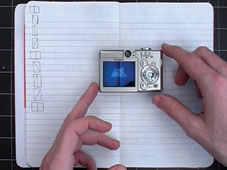
"Rotations and frame divisions" is a video created by systematically rotating a camera following a set of graphical instructions drawn in a notebook. The resulting footage, displayed on the camera's LCD screen, depicts failed attempts at precise and mechanical movement.
Michael Graham is a Canadian artist whose artwork and research is concerned with the relationship between technology, theories of representation, and human nature. His artwork has been exhibited at galleries and festivals in Canada, Europe, and Asia. Michael is currently based in Sheffield (UK) and lectures in multimedia and communication design at Sheffield Hallam University, where he is also in the process of completing an MA, incorporating both research and fine art practice.
Andrea Grambow, Andrea Grambow, Joscha Kirchknopf
Catalogue : 2025Because We Bleed | Experimental film | 4k | color and b&w | 13:50 | Germany | 2023
Andrea Grambow, Andrea Grambow, Joscha Kirchknopf
Because We Bleed
Experimental film | 4k | color and b&w | 13:50 | Germany | 2023
An unknown entity, discovers the human world in a nocturnal car ride through Los Angeles, observing people at the side of the street and listening to their stories. The film mixes the journey of a fictional character, an unknown entity played by drag performance artist Beaujangless, with documentary roadside encounters in a nocturnal car ride through the ‚City of Angels’. Observations of people passing by, accompanied by an AI-generated voice-over reciting first-person narratives from interviews, intertwine with sequences of the main character dancing to Holly Herndon‘s song ‚Frontier‘. The film explores narratives as both center and limit of human world experience and self-awareness, the concept of an immortal human soul in neo-religious, dataist times, as well as the USA as a collective narrative of capitalist superiority in decay. ‚Because We Bleed‘ is a meditation on storytelling and a poetic journey into a new, dark age.
Andrea (born 1986, Rostock, Germany) is a non-binary artist and director. Joscha (born 1984, Stuttgart, Germany) is an artist and director. Since 2009, the two have been working as a duo. They hold a diploma in photography and media from the University Of Applied Sciences Bielefeld (2006-2012). Their collaborative work revolves around people and the narratives in which they are captured. This results in non-linear stories evolving from anthropological field research and artistic subversion. Their photographs and films are exhibited and showcased internationally. Both live and work in Berlin.
Valéry Grancher
Valéry Grancher