Catalogue > List by artist
Browse the entire list of Rencontre Internationales artists since 2004. Use the alphabetical filter to refine your search. update in progress
Daniel Haas
Catalogue : 2023VRA | Multimedia performance | 0 | black and white | 40:0 | Austria | 2022
Daniel Haas
VRA
Multimedia performance | 0 | black and white | 40:0 | Austria | 2022
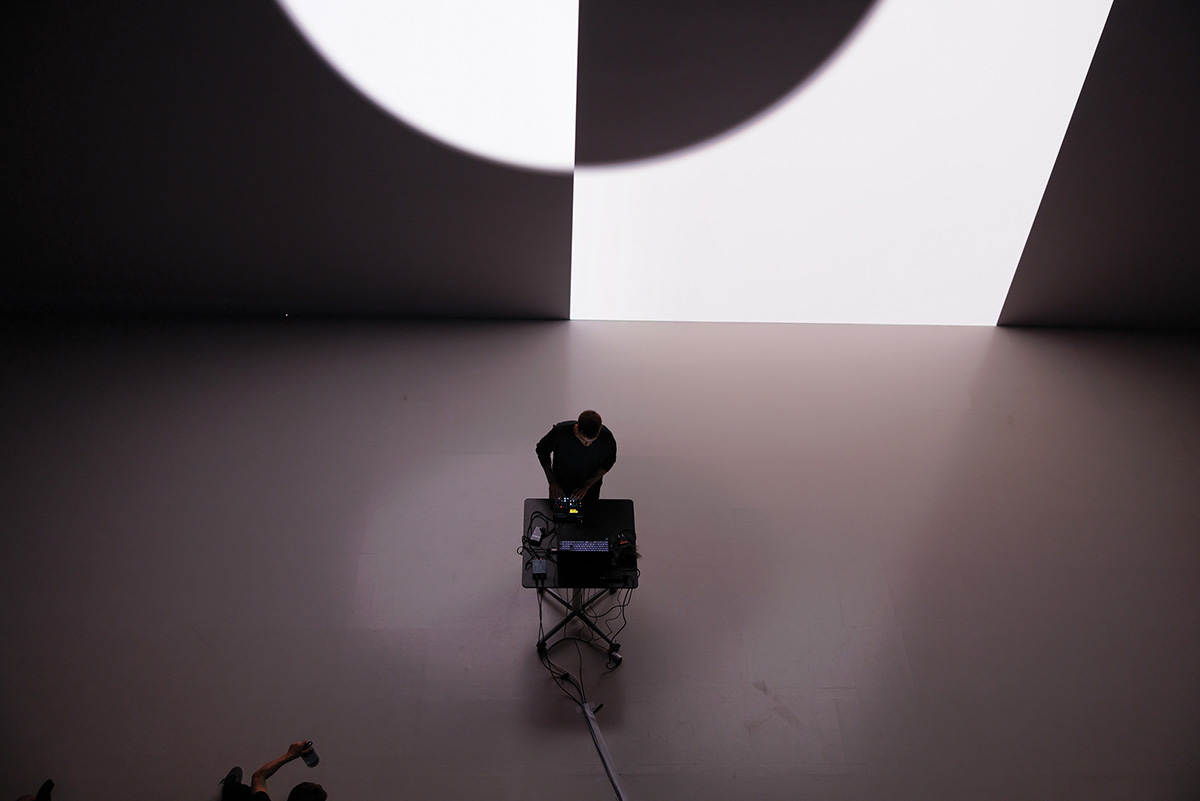
Synopsis In "VRA" 2D-shaders are used to generate a stobocopic noise-performance, by image to sound translation.
Daniel Haas connects sound and light in new and unique ways to generate sensory-intensive experiences.
Elie Habib (a.k.a) Siska
Catalogue : 2025JE$US SAV€S | Experimental doc. | 16mm | color and b&w | 12:20 | Lebanon, USA | 2024
Elie Habib (a.k.a) Siska
JE$US SAV€S
Experimental doc. | 16mm | color and b&w | 12:20 | Lebanon, USA | 2024
J€SUS $AVES explores the archeology of Hollywood as well as Arab fetishism in cinema and the early film industry. It is a reflection on how Hollywood's influence can shape our perceptions of race, gender, and power. In Los Angeles, I initiated research and shot 16mm films. In the dunes near Guadalupe, California, midway between San Francisco and L.A., Cecil B. DeMille constructed the largest movie set in history for his silent film, The Ten Commandments. The set was called "The City of the Pharaoh". Following filming, DeMille ordered that the entire set be dismantled and secretly buried in the dunes. J€SUS $AVES uses this as a launching point to explore themes of cultural appropriation and belonging.
Siska was born in Beirut and resides primarily in Berlin. He holds a Master's degree in Film and Audiovisual Arts from the Lebanese Academy of Fine Arts. A key figure in the early Beiruti graffiti scene, Siska has also produced and performed music as part of the Lebanese Hip Hop group Kitaa Beirut ???? ?????. A large part of his practice involves archiveology, examining sociopolitical narratives in relation to personal and collective memories. It is common for his work to take the form of extended cinema where he applies cinematic codes as well as film language in order to explore various visual narrative techniques. At the Haus der Statistics in Berlin in August-2021, he curated a series of conversations, films, readings, and live performances as the artistic director of redeem ????, a platform for ongoing conversations between voices from Beirut in Berlin. In 2024 he became the artistic director and curator of ADfD - Alternative Monument for Germany, an Augmented Reality Memorial commemorating migration in Berlin that included workshops and public talks at Spore Initiative. Additionally, Siska has collaborated on numerous performance and music productions, taking a midpoint between his career as a visual artist and performance artist. In 2022, he completed his residency and fellowship at Villa Aurora in Los Angeles. Siska's work has been internationally shown, including Martin Gropius Bau (Berlin), Halle 14 (Leipzig), Paris 104 (Paris), Beirut Exhibition Center (Beirut), Mosaic Rooms (London), Berlinale (Berlin International Film Festival) and Silent Green Kulturquartier among others...
Catalogue : 2018Bayna Hayakels Studio Baalbeck (In the Ruins of Baalback Studios) | Experimental doc. | 16mm | color | 47:29 | Lebanon | 2017
Elie Habib (a.k.a) Siska
Bayna Hayakels Studio Baalbeck (In the Ruins of Baalback Studios)
Experimental doc. | 16mm | color | 47:29 | Lebanon | 2017
The work is about the ruination of film heritage in Lebanon navigated through the country`s cinematic heydays of the late 60s and early 70s - a period that witnessed a rise of Egyptian producers and directors moving to Lebanon to make films partly due to Nasser`s nationalization of the Egyptian cinema. The story of this film project evolves around one of the biggest production studios in the Arab world, and its lost archive. Located on Charles Helou Boulevard in the East of Beirut, the remains of Studio Baalbeck, a white modernist villa with open doors, broken windows and a garden full of wild plants and pine trees, appear like a lifeless place. But even if this biggest production studio in the Arab region initiated in 1962 had fallen victim to the Lebanese civil war (1975 to 1990), it has nevertheless left behind a treasure of an archive of voice recordings and films that still are famous throughout the entire Arab world, spanning productions from Erbil to Amman, and from Damascus to Cairo. Negligence by the Lebanese authorities has led to mold growing on parts of this archive inside the damp underground warehouses.
Siska`s body of work has two strong features, working with archive and memory through experimental use of analogue filmmaking. His installations have a strong site-specific feature that he usually develops exclusively for the respective location. His pursuit conjures pertinent questions regarding the ruination of Arab cultural heritage and the conflicted relationship between individual rights and the duties of the state, and the ever-illusive gaps between the personal and the collective. His practice usually starts with an intuitive approach, stretching documentary forms towards fictional territories while remaining faithful to the essential questions at sake managing somehow to extract a poetic, almost fairy-tale quality to the narratives he explores. Siska was born as Elie Alexandre Habib in Beirut Lebanon in 1984, graduated from the Lebanese Academy of Fine Arts ALBA in Beirut with a master degree in cinema studies and film directing. Now he lives and works between Beirut and Berlin. Siska` work was shown in prominent contemporary art venues and film festivals in New York, Berlin, Beirut, Cologne and Paris.
Shadi Habib Allah
Catalogue : 2017Dag'aa | Experimental doc. | hdcam | color | 19:0 | Palestine | 2016
Shadi Habib Allah
Dag'aa
Experimental doc. | hdcam | color | 19:0 | Palestine | 2016
Palestinian contemporary artist and filmmaker Shadi Habib Allah takes us with him on an unlikely journey of discovery – at gunpoint across the Sinai Peninsula, led by Bedouins who will force us across an unmapped terrain whose only signposts are the small stories they tell about the stakes of living, dying, and moving through this mysterious space. Stories, itineraries, directions, and allegiances become as blurred as the status of the Bedouins themselves, who remain unrecognized non citizens of this no man’s land, through which Habib Allah is led – behind the lines of military checkpoints, off the political, economic, and historical grid, a place where these desert outliers quietly continue their lineage with the help of snakes…
Born in Jerusalem, Palestine in 1977, Shadi Habib Allah received a BFA from Bezalel Academy of Arts and Design in 2003 and an MFA from Columbia University in 2010. His practice ranges from film, sculpture and drawing to installation. While each projects defines its own terms based on research and physical engagement, a common thread is opening up suggestive modes of navigation across circulation networks of people, technologies, objects, images and economy to examine ideas of use and value and the structures that hold them in place. He was twice awarded 2nd Prize for the Young Artist Award from the A.M. Qattan Foundation, and has attended residencies at Cittadelarte, Fondazione Pistoletto in Biella, Italy and Gasworks in London, England. He was nominated for the Luma Award 2011 and was the 2012 recipient of the Louis Comfort Tiffany Award. Habib Allah was a part of the fall residency program at Delfina Foundation in London, in October 2016. Habib Allah’s work has been exhibited at the New Museum Triennial (2015); Art Statements, Art Basel 43 (2012); Palestine c/o Venice, Venice Biennale (2009); the Riwaq Biennale, Ramallah (2009); and In Focus, Tate Modern, London (2007), amongst others. His Films have screened at the International Film Festival Rotterdam, Courtisane Festival Belgium, the 40th Norwegian Film Festival and 32nd Hamburg International Short Film Festival. Recent exhibitions include:I can call this progress to halt, Los Angeles Contemporary Exhibitions (LACE), Los Angeles, CA (2017); Black Box Screenings O Solitude, Beursschouwburg, Brussels, Belgium (forthcoming 2017);Daga`a, Green Art Gallery, Dubai, UAE (2017); House of Commons, Portikus, Frankfurt/Main, Germany (2016),Biscuits and Green Sox Maaike, Reena Spaulings Fine Art, New York, USA (2016)Shadi Habib Allah: 30KG Shine, Rodeo, London, UK (2015) The Verdant, Hacienda, Zurich, Switzerland (2015); Artists Space on Randall Island, Frieze Art Fair, New York, USA (2014); Empire State curated by Norman Rosenthal & Alex Gartenfeld, Palazzo delle Esposizioni, Rome, Italy (2013) & Galerie Thaddaeus Ropac, Paris, France (2013); Frozen Lakes, Artists Space, New York, USA (2013);Nouvelles Vagues, curated by Jason Waite and Antonia Alampi, Palais de Tokyo, Paris, France (2013). Shadi Habib Allah lives and works in New York.
Laura Haby
Catalogue : 2013OURS | Video | hdv | black and white | 5:30 | France | 2012
Laura Haby
OURS
Video | hdv | black and white | 5:30 | France | 2012
Ours dévoile l?intimité d?un agent forestier, ses gestes, ses parcours quotidiens et la sérénité théâtrale inhérente.
Après avoir fait ses études aux Beaux-Arts de Montpellier et obtenu un diplôme National d?Art Plastiques, Laura Haby, née en France en 1988, s?installe à Lyon. La production artistique de Laura Haby se situe du coté de la vidéo et de la peinture, aborde des écritures liées aux lieux comme motifs de référence. Ses ?uvres mettent en joue les paysages, les hommes qui y circulent et toute la dimension émotionnelle qui y trouve racine. Son travail a déjà été présenté dans plusieurs festivals ainsi que dans des dispositifs relevant des arts plastiques.
Narges Haghighat
Catalogue : 2017Women of the Plains | Animation | hdv | color | 1:40 | Iran, Canada | 2015
Narges Haghighat
Women of the Plains
Animation | hdv | color | 1:40 | Iran, Canada | 2015
Nomadic is the oldest way of life which is still alive in some parts of the world, and it has been called the most scenic attraction in the age of technology. This film represents some of the hard work of nomad women in Iran which they repeat almost every day. Living in mountains and plains has increased these women`s tolerance and made them strong against life`s obstacles.
Narges Haghighat was born in Iran, 1984. She has been painting in different styles such as realism, expressionism, and abstract since 2004. She holds a bachelor of computer software from the Pasargad University of Shiraz, Iran. Currently, she is studying Film Animation at Mel Hoppenheim School of Cinema- Concordia University in Montreal, Canada.
Karissa Hahn, Karissa HAHN, Andrew KIM
Catalogue : 2017(I)Frame | Experimental fiction | 16mm | color | 10:30 | USA | 2016
Karissa Hahn, Karissa HAHN, Andrew KIM
(I)Frame
Experimental fiction | 16mm | color | 10:30 | USA | 2016
A video is a stream of information, and this moving image relies upon the relationship of static frames which are algorithmically determined.... In the language of video compression, the (I) frames are the reference points between which movement is interpolated. Manual deletion or misplacement of (I) frames results in a video glitch known as a datamosh ‘ the stream of nformation d srupted, d sorgan zed ‘ nterupeted ‘ lost ‘ the ( ) frame removed, rejected ‘ BUT, reclaimed, the (I) frame, the burning bolts of the machine, are at once reasserted in this dance macabre.... (I) FRAME is a mechanical ballet set to the original tempo that characterizes motion on screen at 24 (I) frames a second’.
Karissa Hahn is a visual artist who uses the mechanical devices of cinema to deconstruct former artifacts by physically transforming celluloid - an osmosis of digital manipulation & optical printing; creating a degraded aggregation into resurrection. Her work often employs a series of format transfers to birth digitally-native effects on film and homogenized products which have been referred to as ‘spectra ephemera.’ Karissa currently makes performative short super 8 films, hi8 videos filmed in the break room, and phone calls to corporations. Hahn has shown work around the globe in various micro-cinemas and institutions. Andrew Kim makes many different kinds of films. He is inspired by motion picture technology and how it is/was/and can be used to create meaning. Armed with a wry sense of humor, in conjunction with a concern for formal playfulness, Andrew attempts to transcend the exact mechanics that make movies possible. He is searching for a new kind of knowledge. Andrew`s films have screened at a variety of venues and festivals in the United States and abroad. He lives by the Los Angeles River in Los Angeles, California.
Ian Haig
Catalogue : 2023Useless Eaters | Experimental video | 4k | color | 16:2 | Australia | 2022
Ian Haig
Useless Eaters
Experimental video | 4k | color | 16:2 | Australia | 2022
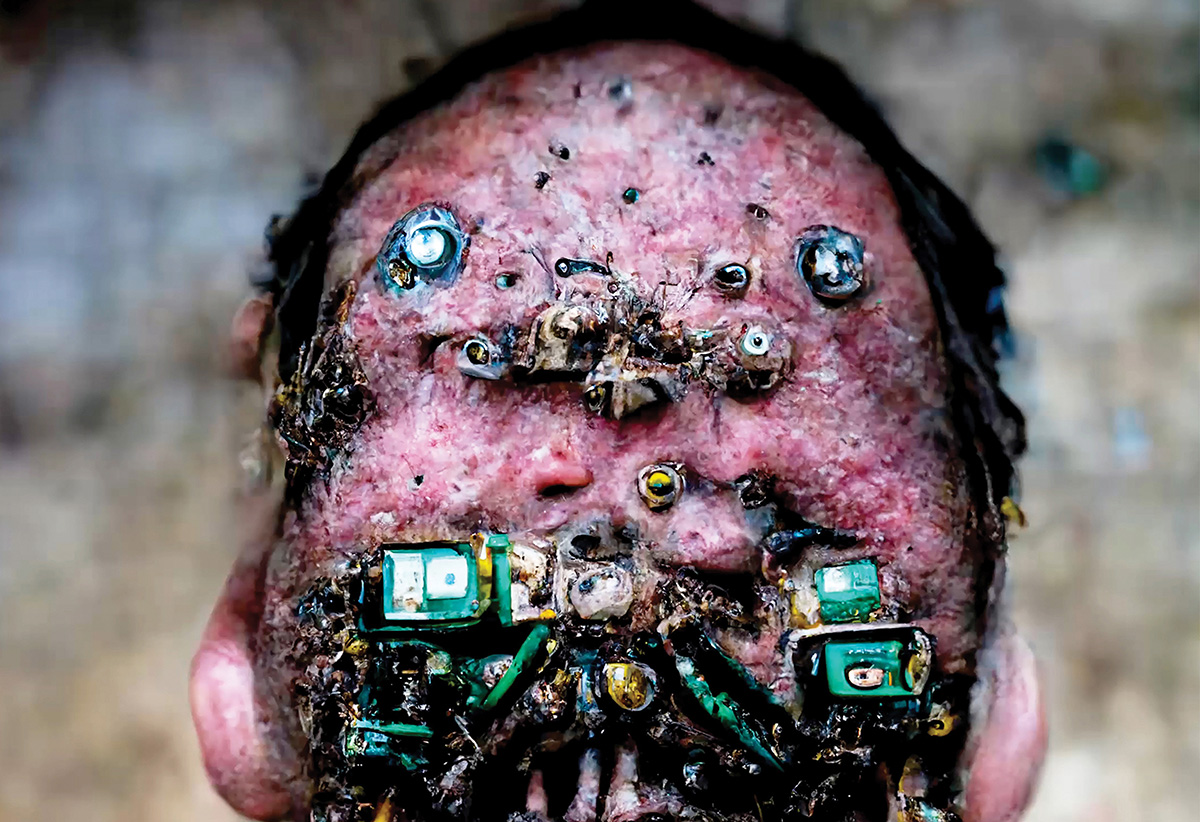
Mutated hackable bodies, bodies that didn’t quite work out and bodies that can no longer be classified as bodies. Hybridised flesh and code using AI. Drawing on the transhumanist musings of Yuval Noah Harari, humans are now hackable animals.
Ian Haig's work has been exhibited in galleries and video/media festivals around the world. Including exhibitions at: The Australian Centre for Contemporary Art, Melbourne; The Ian Potter Museum of Art, Melbourne; The Experimental Art Foundation, Adelaide; The Australian Centre for the Moving Image, Melbourne; Gallery of Modern Art, Brisbane; The Museum of Modern Art, New York; Artec Biennale – Nagoya, Japan; Centre Georges Pompidou, Paris; China Millennium Monument Art Museum, Beijing; Museum Villa Rot, Burgrieden-Rot, Germany; Kunstlerhaus Bethanien, Berlin, Germany; The Havana Biennial, Cuba. In addition his video work has screened in over 150 festivals internationally including The Ann Arbor film festival, US and VideoBrasil, Sao Paulo, Brazil. In 2003 he received a fellowship from the New Media Arts Board of the Australia Council and in 2013 and 2017 he curated the video art shows Unco and Very Unco at The Torrance Art Museum in Los Angeles.
Margaret Haines
Catalogue : 2026La Jumelle | Experimental fiction | hdv | color | 23:23 | Canada, France | 2025

Margaret Haines
La Jumelle
Experimental fiction | hdv | color | 23:23 | Canada, France | 2025
Drawing on the life of Joan of Orléans (Jeanne d’Arc) and the ideas of occultist Cameron, Haines’ speculative sci-fi film centers on the notion of a female Messiah.
Margaret Haines (*1984) is an artist, writer and filmmaker born in Montréal, QC. She is a former scholarship holder of the Rijksakademie van beeldende kunsten, Amsterdam. Her works have been shown at the SCHIRN in Frankfuer, Organ Vida Festival at the Museum of Contemporary Art Zagreb (2022), the MAC Musée d'art contemporain in Montreal (2021) and Auto Italia (2018) in London, amongst others. She is currently writing a book on the life and work of artist, poet, actress and occultist Marjorie Cameron; served on the board of the Cameron Parsons Foundation; and periodically works as a lecturer in the history of the occult and contemporary film at Sciences Po in Paris.
Wang Haiyang, Haiyang WANG
Catalogue : 2017Double Fikret | Video | hdv | color | 3:27 | China | 2012
Wang Haiyang, Haiyang WANG
Double Fikret
Video | hdv | color | 3:27 | China | 2012
This entire animation is a revolving mechanism, with no beginning or outcome. There`s only an obsession-like force pushing the plot along, which causes regeneration, substitution, disruption/disintegration, construction, circulation and chain reactions to occur between different objects. I take advantage of the language of animation to excavate and erect hidden relations between various objects, while the plotline moves in the direction of nothingness. Changes occur randomly throughout the production process of this work, which is devoid of presuppositions or predefined script. Hence, the work requires me to personally participate in each part of the production, taking the thought variables that continuously spring up throughout this process and record them into the development of the work. Therefore, the process is also a part of the "performance art" involved in making the work.
1984 Born in Shandong, China 2008 Bachelor of Fine Arts, Central Academy of Fine Arts, Beijing, China. Currently lives and works in Beijing
Hamza Halloubi
Catalogue : 2014Nature Morte | Experimental doc. | hdv | color | 11:24 | Belgium | 2013
Hamza Halloubi
Nature Morte
Experimental doc. | hdv | color | 11:24 | Belgium | 2013
Nature Morte is a film about the Italian painter Georgio Morandi (1890-1964). It shows his images, paintings and photographs in a book. The film juxtaposes the still life paintings made by the artist with striking images drawn from art history and events of the 20th century. It is a reading of Morandi?s work in relation to the unstable history of the last century, termed by the Marxist historian Eric Hobsbawm ?the age of extremes?. The film questions the relationship between the artist and the political and artistic news of the time.
Born in 1982 in Tangier, Morocco, Hamza Halloubi Across a wide range of media, including video, photography, sculpture, and installation. Hamza Halloubi?s work shows an interest both in the grammar and semiotics of film and language. These rather theoretical fields are then linked to more subjective issues such as memory and translation. Taking personal experience as a point of departure and filtering it through more abstract concepts, Hamza Halloubi creates inviting visual metaphors. His films develop an aesthetic that tries to merge the internal poetics of human encounters with a rather conceptual approach. His light boxes and installations investigate language?s ability to evoke narratives from fragmented writings. The artist lives and works in Brussels and Tangier.
Catalogue : 2012Leave | Video | dv | black and white | 3:45 | Belgium, Morocco | 2010
Hamza Halloubi
Leave
Video | dv | black and white | 3:45 | Belgium, Morocco | 2010
The spectator of the video is in the place of the one who is looking at a portrait of a close relative go away in the road. The spectator is put in the position of someone who leaves and sees things disappear / appear around him. The video ?Leave? is a search for the simplicity of a plan. The simplicity of a sensation.
Born in 1982 in Tangier, Morocco, Hamza Halloubi works across a wide range of media, including video, photography, sculpture, and installation. Exploring the relationship between the individual and the faculty of knowledge, he aims at a representation of alternative ideas of identity and culture by disrupting the dogmas of what is defined and established in culture. He comprises quotes in order to discuss issues such as institution, exile, solitude, and melancholy. Instead of direct perspectives he is interested in gestures and attitudes that upset the established order. Halloubi attended LA CAMBRE Ecole Nationale Supérieure des Arts Visuels de Bruxelles. He was the subject of a solo exhibition at The Monty "Modest Expectations", Antwerp(2011). Recent important group exhibitions include IMAGINE BEING HERE NOW The 6th Momentum Biennial, Moss, Norway(2011), FotoTageTrier 2010 ?LEBEN elementar?, Trier, Germany(2010), 4th Cairo Video Festival, Goethe Institute, Egypt(2010), BAD MOON RISING 3, Boots Contemporary Art Space, St. Louis, MO, USA (2010), the 1st International Roaming Biennial of Tehran 1st station: Istanbul, Turkey(2008) The artist lives and works in Brussels, Gent and Tangier.
Yang Ah Ham
Catalogue : 2013Invisible Clothes | Experimental fiction | hdv | color | 13:31 | Korea, South | 2008
Yang Ah Ham
Invisible Clothes
Experimental fiction | hdv | color | 13:31 | Korea, South | 2008
`Invisible Clothes` is a quasi-sci-fi film about the conversation between a scientist and a fashion stylist on invisible clothes, reflects upon one`s ego constituted by the gaze of others and the subject perceiving that ego. An abundance of metaphors and satire exposes the absurdity of contemporary society, which constantly produces human desire. "The Other holds a secret-the secret of what I am. He makes me be, and thereby he possesses me, and this possession is nothing other than the consciousness of possessing me. (...) the Other steals my being from me." - Jean-Paul Sartre
Yang Ah Ham lives and works in Amsterdam, Netherlands and Seoul, Korea. She has lived in different cities and deals with society and individuals` lives through this experience. Yang Ah Ham showed her continuous project, `Adjective Life in the Nonsense Factory` in ArtSonje Center, Seoul 2010 followed by `Transit Life` in Gumho Museum of Art, Seoul 2005 and `Dream...in Life` in Insa ArtSpace, Seoul 2004. Her works also has been exhibited in Art of Communication :Anri Sala, Yang Ah Ham, Philippe Parreno, Jorge Pardo,The National Museum of Contemporary Art, Seoul,2011; Gwangju Biennale, Gwangju 2010; Shanghai Biennale, Shanghai 2008; Busan Biennale, Busan 2006. She was awarded Arts Award of the Year, Arts council Korea 2005 and nominated for Hermes Art Prize, Hermes Foundation 2008. Her monograph was published in 2011 supported by Mondriaan Foundation. Currently she was involved in the artist initiative project,`be mobile in immobility`(DEPO, Istanbul 2011, Total Museum, Seoul 2011) as a co-organizer . She studied at; New York University, New York; Seoul National University, Seoul; and did the following Artist in Residence, Platform Garanti contemporary Art Center, Istanbul 2010; Rijksakademie van Beeldende Kunsten, Amsterdam 2006-7; ISCP, The International Studio and Curatorial Program, New York 2003; ArtPace, San Antonio, U.S. 2000.
Robert Hamilton
Catalogue : 2006Shopping street | Experimental video | dv | color | 4:0 | Canada | 2004
Robert Hamilton
Shopping street
Experimental video | dv | color | 4:0 | Canada | 2004
The title of the video Velserbroek is taken from the name of a neighbourhood outside of Haarlem, The Netherlands. The neighbourhood is an example of what is referred to in the Netherlands as "Social Architecture." It is a massive housing complex similar in many ways to a typical American suburb. However, the scale in which the Dutch housing divisions are built is significantly different. Currently there are complexes being built that contain over 8,000 residences. The complexes are also referred to as "VINEX" complexes. While visiting Velserbroek, the artist was struck by the near absence of people. It was nearly empty. It seemed that documenting the emptiness of what was projected as "Social Architecture" could be ironic. He took the idea one step further by digitally erasing all traces of cars, bikes and people from the video. Hamilton enhanced the emptiness and other-worldliness. He created the video with a consumer digital still camera resulting in a sort of time-lapse motion photography. The video is actually hundreds of still images edited together. The video is an exploration of the familiarity of "home" in a slightly surreal manner. Hamilton chose the subject of new houses in Holland as a metaphor for the sense of alienation and displacement of the traditional idea of home; familiar yet foreign. (Robert Hamilton)
Hamilton is a multimedia artist whose mediums include video, sound and sculpture. His video work began in 1983 and his videos have played in numerous national and international festivals, receiving many awards. Hamiliton's work leans towards experimental narratives exploring various kinds of human relationships. He invents interesting visuals and sound from the most modest of means.
Maya Han
Catalogue : 2025C18H10N2O4: On Melanin and Mycology | Experimental doc. | mov | color | 8:3 | USA | 2023
Maya Han
C18H10N2O4: On Melanin and Mycology
Experimental doc. | mov | color | 8:3 | USA | 2023
Maya Han C18H10N2O4 2023, US, video essay/hybrid documentary, 35:00 (8:00 excerpt) C18H10N2O4 is the chemical compound of melanin, one of the most ancient and ubiquitous biological pigments found across nature, including in humans and fungi. Using as a point-of-departure melanin’s historical role as a spurious marker of racial categories, this essay film explores the surprising ways in which melanin and mycology are intertwined, uncovering connections to African and colonial histories, as well as the chemical’s fascinating larger role in nature and culture.
Maya Han is an artist, writer, and experimental filmmaker. Her work is a form of soft activism, critically engaging with issues of race, gender, class, labor, diasporic identities, and marginalized histories. Her education includes studies in Lettres et Langues from the Université de Paris III La Sorbonne Nouvelle and an MFA from the University of California, Irvine. She has screened and exhibited in the US and internationally including at the Harlem Film Festival, New York NY; The Film Gallery, Paris France; The National Museum of Women in the Arts, Washington DC; and the Busan International Film Festival, Busan South Korea. She can usually be found in Paris or in Brooklyn, where she is cultivating our garden.
Zhuang Han
Catalogue : 2019BEM-TE-VI | Experimental film | mov | color | 15:35 | China, Brazil | 2017
Zhuang Han
BEM-TE-VI
Experimental film | mov | color | 15:35 | China, Brazil | 2017
J`ai marché dans la jungle du Brésil, c`était tellement calme que je pouvais seulement entendre le chant de l`oiseau local BEM-TE-VI (BIEN-TE-VOIR) et mon souffle. Puis j`ai vu cinq personnes. J`essayais de continuer à marcher, mais n`importe où que j`aille, ils émergeaient toujours devant moi, encore et encore. Jusqu`au moment où la nuit tombait. BEM-TE-VI a été tourné le 22 août 2017 de 16h55 à 17h12 dans la jungle à l’ouest de Recife, au Brésil. J`ai montré ce qui est arrivé sur mon chemin, la relation avec les cinq personnes et la relation avec moi-même par un plan séquence. Mon corps est l`endroit où le péché peut s`échapper et je veux l`affronter et l`effacer. Cependant, ce n`est pas qu`un cours discontinu, j’ai donné à moi-même et à ces cinq personnes une sorte de destin et j`ai expérimenté ce qui se rapproche de la de limite de ce destin, y compris mon orientation sexuelle. Au cours de ma discontinuité, j`ai découvert que cette limite peut se transformer en expérience et même en expérience libre et c`est une expérience privée. Ces expériences sont basées sur ma croyance religieuse et le pouvoir théologique.
Ses oeuvres sont souvent créées dans différents temps et espaces, lieux et corps. Entre l`implantation et la transformation des symboles, une performance en art vidéo apparemment absurde mais néanmoins émouvante est présentée.
Markus Hanakam, Roswitha Schuller
Catalogue : 2026Cosmic Commissioner | Animation | 4k | color | 13:21 | Austria | 2025
Markus Hanakam, Roswitha Schuller
Cosmic Commissioner
Animation | 4k | color | 13:21 | Austria | 2025
Hanakam and Schuller’s new animated work Cosmic Commissioner takes a satirical dive into the world of typical AI-generated styles such as new-age, comicesque and hyperrealism, which are based on creative commons and influenced by big tech, as well as their handling of diversity and material bases. The narrative character is the fictional Cosmic Commissioner – inspired by Victor Gruen, the exiled Austrian architect and urban planner – who reacts to burning environmental and security issues on Earth as a more-than-human being from the cosmos. In 1975 Gruen, godfather of the American suburban shopping mall, wrote his satirical book: Is Progress a Crime? Environmental planning instead of the End of the World. Gruen turned increasingly to environmental planning in the 1970s – under the influence of contemporary phenomena such as environmental destruction, the space race and nuclear armament. Scenes with architects, military personnel, urban planners and environmental activists are realised through short dialogues from Gruen’s texts on the level of lyrics and synthetic disco space sounds. The project links historical and current social challenges such as global security and environmental destruction. Cosmic Commissioner invites you to take a reflective, humorous look at the interfaces between AI, pop culture and social challenges – a visual and acoustic journey through time, space and digital realities.
Many of the artifacts of Hanakam & Schuller, an artist duo that lives in Vienna, are shapeshifters, changing their outer form and then reappearing in a variety of contexts. As artists and explorers, Markus Hanakam and Roswitha Schuller redesign the rules of the fine arts for their own purposes and create unconventional arrangements and new world designs in videos and objects. They also work with applied artforms. Their works have been shown in Berlin’s Haus der Kulturen der Welt, the Eyebeam art and technology center in New York, Paris’ Palais de Tokyo, Moscow’s Garage Museum of Contemporary Culture, Vienna’s MAK, the MAK Center for Art and Architecture in Los Angeles, and Tokyo’s National Art Center. Their video— animation The Borgia Device (Second Day) is part of the show ANTHROPOCENE ON HOLD — 20 artists address the impact of a global pandemic on arts ecosystems and earth's resilience and sustainability — by PCAI Polyeco Contemporary Art Initiative in Piraeus, Greece, curated by Kika Kyriakakou, accompanied by a catalogue with Hans Ulrich Obrist, Nadim Samman, Selina Nwulu (2020–21).
Markus Hanakam, Roswitha Schuller
Catalogue : 2022The Moist Cabinet | Video | 4k | color | 5:8 | Austria, Germany | 2021
Markus Hanakam, Roswitha Schuller
The Moist Cabinet
Video | 4k | color | 5:8 | Austria, Germany | 2021
THE MOIST CABINET is inspired by the literary genre of climate fiction. Through the voice-over of the film, we encounter poems by Bettina von Arnim and William Shakespeare, each in the original language. Hanakam & Schuller view these poems from the 16th and 19th centuries a prequel to cli-fi. Both poets seem to be in dialogue with each other, yet testify to different attitudes: in Shakespeare, the description of nature serves as a catalyst of sexual desire; in Arnim, the physical encounter with nature triggers a need to preserve the source of erotic experience: “Your silence, nature, do not break.?/?Not on rustling leaf?/?With stylus wake thee.” THE MOIST CABINET thus also describes the influence of literary narratives on the relationships between nature and humans, and the consequential actions.
HANAKAM & SCHULLER is an artist duo living in Vienna. As artists and explorers, Markus Hanakam and Roswitha Schuller redesign the rules of fine arts and create unconventional arrangements and new world designs in videos and objects as well as applied artforms. Their works have been shown in Haus der Kulturen der Welt, Berlin; Eyebeam Art + Technology Center, New York; Palais de Tokyo, Paris; MAK, Vienna; MAK Center for Art and Architecture, Los Angeles; and the National Art Center in Tokyo. In 2022 they will work with Current Interests on a spatial installation for MAK Garage Top in Los Angeles.
Ihar Hancharuk
Catalogue : 2023Belarus.OST. | Experimental doc. | mp4 | color | 36:14 | Belarus | 2021
Ihar Hancharuk
Belarus.OST.
Experimental doc. | mp4 | color | 36:14 | Belarus | 2021
The work contains sounds extracted from the amateur videos filmed during the protests in Belarus in 2020. The videos are mostly very brutal and full of violence and evoke pure and irrational rage and hatred. By cutting off the images and leaving only the sounds I want the viewer/listener to concentrate on what is behind: sounds of the beatings, a dinner in a kitchen with shooting in the background, heavy breathing of those running away, sobbing of a person filming from a balcony, etc. I provide CCTV camera footage from Minsk for my work. Nothing is happening on the screen, it's just a square and people walking by, living normal lives, but the sounds you hear prove that they don't live normal lives anymore. At the same time, this duality reminds us that active protests were totally suppressed. This very view from a CCTV camera looks almost exactly like a view from a prison cell camera - same angle, same grey colours, same texture, and same figures down there. The final part of my work is a footage from a police wagon showing police beating the detained after they were brought to the detention centre.
Born in Belarus in 1986. Studied languages in Belarus, Poland and Germany, which later influenced my artistic practice and let me not be limited to only one cultural context. Different approaches to education in Belarus and Europe gave me a strong push for further personal development. Served mandatory military service in 2009-2010. There I observed the state system of patriarchy and violence, which I would later often refer to in my projects. Studied at the School of contemporary photography Docdocdoc in St. Petersburg, participated in Simon Menner's master class in Minsk, took the online course More than a project, went to residencies organized by ISSP and Sputnik Photos and basically never stopped self-education. In the winter of 2022-2023, I attended the Social Camp course organized by the Goethe Institute to support civil society in Belarus. After the events in Belarus in 2020, I focused on the modern archive and propaganda narratives, and how an authoritarian system creates an alternative reality in the age of the Internet. In 2015 I got polish citizenship, now I have two.
Alexandra Handal
Catalogue : 2010From the Bed & Breakfast Notebooks | Art vidéo | | black and white | 13:46 | Palestine, United Kingdom | 2008
Alexandra Handal
From the Bed & Breakfast Notebooks
Art vidéo | | black and white | 13:46 | Palestine, United Kingdom | 2008
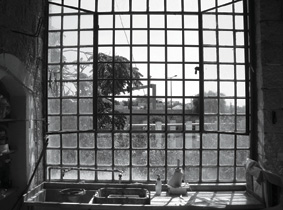
When Jerusalem was divided into Israeli West and Jordanian East by the 1948 war, Musrara was among the neighbourhoods split in half by the Armistice Line. Palestinian Arabs who lived on the Israeli controlled side fled or were driven out of their homes from what thereafter became known as West Musrara. After the Six-Day War of 1967, Israel annexed East Jerusalem. The No Man?s Land was dismantled, but the city remained divided, as Palestinians were prevented from returning to their homes. Some of the expropriated Palestinian houses were converted into bed and breakfasts by the Israeli Jews who now occupied them, promising a ?homey atmosphere? for tourists in search of an ?authentic experience of Jerusalem?. It is in one of those guesthouses in West Musrara that the Palestinian artist stayed for thirteen nights in August 2007. The result is a film that has the feel of a crime scene investigation. Stills from the interior of the house, environmental sounds, oral history of Palestinian refugees, video-footage from the artist?s drifts through east and west Musrara, interlace with a diaristic text - opening an intimate space that is at once unsettling and evocative. The wounded city becomes tangible.
Alexandra Handal is a London based artist with a transnational upbringing. Born into a Bethlehemite, Palestinian family, Handal has lived in numerous cities around the world, among them: New York City, Port-au-Prince, Jerusalem, and Santo Domingo. She obtained an MA in Studio Art at New York University (2001), a BFA in Painting and minor in Art History at Boston University, Boston, MA (1997); and pursued parallel studies during the summer in Paris and Madrid. Handal is currently completing a combined practice/theory PhD at Chelsea College of Art and Design, London. She is the recipient of the University of the Arts London Research Studentship Award (2004) and was a Finalist for the Young Artist of the Year, Hassan Hourani Award from the A.M. Qattan Foundation, Ramallah, Palestine (2004). Her video From the Bed & Breakfast Notebooks was selected for the prestigious New Contemporaries 2009 internationally juried exhibit, which showcases emerging artists in the United Kingdom. Her artworks have been included in group exhibitions internationally, namely at A Foundation, London (2009) Cornerhouse, Manchester (2009); Al-Hoash Gallery, Jerusalem (2009); DePaul University Museum, Chicago, IL (2005); A Space Gallery, Toronto, Canada (2003); The Performance Space, Sydney, Australia (2003); Dumbo Art Center, Brooklyn, NY (2001).
Michelle Handelman
Catalogue : 2021These Unruly and Ungovernable Selves | Experimental video | 4k | color | 6:0 | USA | 2020
Michelle Handelman
These Unruly and Ungovernable Selves
Experimental video | 4k | color | 6:0 | USA | 2020
Michelle Handelman’s new video piece, THESE UNRULY AND UNGOVERNABLE SELVES (The Lockdown), recontextualizes characters from her previous works into a hypnotic visual essay about the transfiguring of interiority during periods of isolation and fear. It takes as its starting point the coronavirus pandemic and filters it through theorist Jill Casid’s writings on the necrocene, and Walter Benjamin's writings from The Arcade’s Project, sliding between threshold and boundaries, considering how bioterrorism may not only be an intentional release of viruses, but it may also be what lives inside, our own fear that late stage capitalism uses to destroy us. Handelman's characters, who each have already struggled with existential questions of belonging and fear in her projects DORIAN, A CINEMATIC PERFUME (2009/11); IRMA VEP, THE LAST BREATH (2013/15); and HUSTLERS & EMPIRES (2018), are juxtaposed with found images and texts sourced during the pandemic to take on a new form that both denies and struggles with containment. Casid writes, “May none of us rest as we live our dying. May we not forget but actually do the work of reckoning with the still uncounted, of the crimes of the endless war we are still in.”
Michelle Handelman is a visual artist, filmmaker, and writer whose work pushes against the boundaries of gender, race and sexuality. Coming up through the years of the AIDS crisis and Culture Wars, Handelman has built a body of work that investigates the dark and uncomfortable spaces of queer identity. She is a Creative Capital awardee (2019); Guggenheim Fellow (2011); Art Matters Awardee (2011) and NYFA Fellow (2011). She has exhibited widely including the San Francisco Museum of Modern Art, Eli & Edythe Broad Art Museum, PERFORMA Biennial, MIT List Visual Arts Center, PARTICIPANT, INC, The Henry Art Gallery; Museum of Contemporary Art Chicago, Contemporary Arts Museum Houston, Guangzhou 53 Art Museum; Film at Lincoln Center, The British Film Institute, and Centre Georges Pompidou. During the 1990s, Handelman was based in San Francisco where she collaborated with Monte Cazazza, a pioneer of the Industrial music scene; directed the feature film BloodSisters: Leather, Dykes and Sadomasochism (1995), and performed in several films by Lynn Hershman-Leeson. Her work has been written about in Bomb Magazine, Artforum, Art in America, Filmmaker Magazine, and The New York Times, and is in many private collections including the Eli & Edythe Broad Art Museum; Kadist Art Foundation, Paris; di Rosa Foundation and Preserve; Zabludowicz Art Trust. She is based in Brooklyn and is a Professor in the Film, Media and Performing Arts department at Fashion Institute of Technology, NYC.
Amina Handke
Catalogue : 2023Mein Satz | Experimental fiction | dcp | color | 85:0 | Austria | 2022
Amina Handke
Mein Satz
Experimental fiction | dcp | color | 85:0 | Austria | 2022
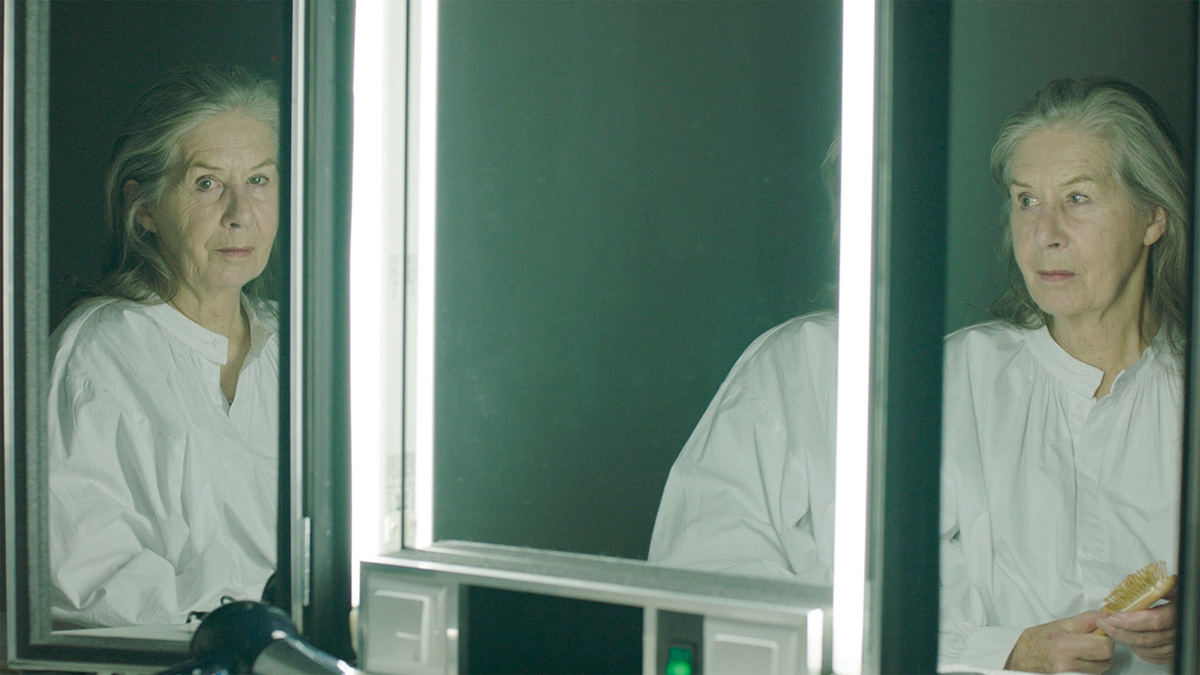
The eighty-year-old actress Libgart Schwarz suddenly loses her language while rehearsing for a film version of the play KASPAR. The play is based on the historic enfant sauvage Kaspar Hauser who assumedly grew up locked in a dark room with no social contacts. Just as it’s protagonist, MY SENTENCE does not fit in. Although in German, it is about universal politics of language and (age) discrimination. Amina Handke’s first feature-length film translates her father’s famous play into cinematic language. The protagonist, originally a young man, is replaced/played by the director’s mother. The play itself questions the rules and violence of language and naturalistic narration. The movie transforms this disobedience into a world full of quotations and references. „What begins as a pure and playful family meta-fiction turns into a surreal, partly nonsensical Babylonian confusion, it’s just that it’s not different languages that are clashing but layers and fragments of the German language, the language of the father. Losing a language becomes an act of resistance against the expected channels of communication, the seriousness of conversation and also the model text. There couldn’t be a truer adaption of the original play than the one taking it apart.“ Patrick Holzapfel, VIENNALE
Amina Handke's work evolves around topics of originality, subjectivity, authorship / audienceship and reception: where does the actual work happen, who produces it, how many versions or realities of it exist and where – in the minds, as documents, as remains? And what is it worth? Her perception of artistic work emphasises the privilege of formulating questions rather than contributing to the universe of commodities. Her practice roots in a wide range of expertise and experience in the fields and intersections of arts, social practice, participative media and a multitude of disciplines: mainly time based (audiovisual, performing and conceptual) arts. It is fueled by the concern to exchange experiences and thoughts with others and to create dialogues about the perception of contradictory, complex constructions of reality. As a curator, she combines her artistic concerns with reflections on working processes and documentary / expanded artistic practices.
Hangover Ltd
Catalogue : 2006Remake | Fiction | dv | color | 19:20 | Germany | 2004
Hangover Ltd
Remake
Fiction | dv | color | 19:20 | Germany | 2004
This film was inspired by John Cassavetes'"Faces", but something quite original takes place. The question "what do you expect from life?" is represented and performed with undisguised pleasure and with courageous risk-taking. In a quite tiny room, four women with different personalities and sexual expectations meet and walk around a handsome sailor. The result is an atmospheric and condensed miniature that oscillates between hysteria and self-mockery. Remake was awarded with the Prize for the Best Contribution to the German Competition in Oberhausen.
Hangover Ltd. is a group of young women who all are filmmakers and whose members are: Christine Groß, Sophie Huber, Ute Schall, Tatjana Turanskyj, and Claudia Splitt. They have been working together for a few years. They made PETRA which is a co-production with the Volksbühne am Rosa-Luxemburg-Platz, and "Sehnsucht nach Schüssen," with the Prater-Volksbühne among others.