Catalogue > List by artist
Browse the entire list of Rencontre Internationales artists since 2004. Use the alphabetical filter to refine your search. update in progress
Zach Hart, Alexandra Wilson
Catalogue : 2026Sick Landscapes | Experimental doc. | hdv | color and b&w | 24:20 | USA, Germany | 2025

Zach Hart, Alexandra Wilson
Sick Landscapes
Experimental doc. | hdv | color and b&w | 24:20 | USA, Germany | 2025
Traced through the degradation of a bog body, Sick Landscapes draws historical links between Reinhold Lingner, the GDR’s chief landscape architect, Israel’s aggressive demolition and control of occupied Palestinian land and Eva Kemlein, a holocaust survivor trained as a forensic photographer. Kemlein was hired to photograph the sick body of The Berlin City Palace before its set demolition in 1950. Using her scientific documentation, the Palace was rebuilt and re-opened as the Humboldt Forum in 2021. Its spirit was strong enough to survive. Lingner was one of many public figures who advocated to preserve the palace before its initial destruction. Historical idea’s which developed around architectural and landscape preservation inspired landscape planners, ecologists and Nazi’s to try and prevent the spiritual and literal erosion of German architecture and soil. Starting in the 1930s, there was a linguistic trend which anthropomorphized the German cultural landscape. It was often described as a mono-cultural organism, suggesting the possibility of a homogenous cultural spirit embedded into the land itself. The organism of the cultural landscape needed to be saved from degradation. Despite efforts to prevent spiritual erosion through landscape preservation, unhealthy spirits still infest Germany. They inhabit the soil, architecture and the language.
ZACH HART Zach Hart (NYC 1994) is an artist based in Berlin. His practice spans different disciplines while his background in experimental film, sculpture and literature inform his artistic work. He has a longstanding interest in artificial landscape design and urbanism. His moving image, sound and installation works often fictionalize history or draw upon documentary images in order to provoke new connections between historical discourses/image making practices and contemporary politics. From 2018, he has collaborated with Alexandra Wilson on a series of moving image installation works. He received a BA from Hampshire College and a Masters in Sound Studies and Sonic Arts at UDK, Berlin. ALEXANDRA WILSON Alexandra Wilson (NYC 1993), is a Barcelona-based multi-media artist working primarily in sculpture, costume/fiber, and film. Driven by her experience as a textile maker, her work concentrates on the process of fabrication. Tools (both domestic & industrial), schematic diagrams, and urban plannings are sources of inspiration. She integrates digital manipulations with traditional image making in order to shift perspective and dimensional understandings of quotidian objects. Since 2018, she has collaborated with Zach Hart on a series of moving image installation works. She received a BA from Hampshire College in 2016.
Hartanto
Cécile Hartmann
Catalogue : 2007Kessoku | Experimental video | dv | color | 7:0 | France, Japan | 2006
Cécile Hartmann
Kessoku
Experimental video | dv | color | 7:0 | France, Japan | 2006
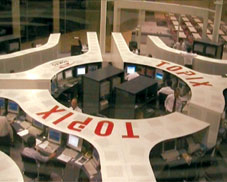
Two places draw closer in a movement of interchange and reversal: the financial centre of the Tokyo stock exchange and the volcanic craters in the Açores archipelago. The economic fluctuations are connected to the earth tremors in search of a point of balance and bonding. A feeling of gentle worry emerges from this state of encounter.
Born in Colmar in 1971, Cécile Hartmann currently lives in Paris. She approaches images through the mediums of painting, photography, and most recently, video. Immediately, her work is situated on the side of a meditative image, in a negotiation between mystery, dream, utopia, and a contemporary reality linked to the large urban ensembles, to their influence on earth space, and on the way of life of the humans that live there. Paradoxally, the critic and political range of the works expresses itself in magnified forms, non authoritarian to the limits of the fantastic. The minimalism of the compositions, the use of saturated colours, or even the frequent presence of a powdery texture on the subjects, provides its fixed images as well as its video works with hypnotic and sensual character. A graduate from the Ecole Nationale Supérieure des Beaux Arts in Paris in 1988, and in Plastic Arts and Art History in 1994, Cécile also participated in the exhibition "La Force de l'Art" in Paris in 2006, and in "Emerging Artists" in Vienna in 2005. She completed a residency at the Cité Internationale des Arts in Paris in 2006, and in Japan in 2004 under the framework of the Villa Médicis Hors les Murs. Her works are a part of the Fonds Nationale d?Art Contemporain collection.
Cécile Hartmann
Catalogue : 2012ACHRONE | Video | hdv | color and b&w | 12:0 | France, United Arab Emirates | 2011
Cécile Hartmann
ACHRONE
Video | hdv | color and b&w | 12:0 | France, United Arab Emirates | 2011
At night, workers dig the sand in a pit. At dawn, around them, immense towers of a futuristic city raise themselves. Gradually human activities slow down, details appear, stones get loose, the sand pours, grounds disintegrate. Fragile on its bases, the city seems to be in a paradoxical time of destruction and construction, a future ruin aimed to come to an end. Achrone, invariant adjective stemming from physics and from medicine, indicates a region which it is impossible to observe a precise temporality. Shot and photographed in 2008 in the construction sites of the city of Dubai to echo the diurnal and night-working cycles of the workers, Achrone develops an abstract reorganization from the balance of power between architecture and nature.
Cécile Hartmann was born in Colmar in 1971, and works ad lives in Paris. After studies at the Beaux-Arts of Paris and at the University of Human Sciences of Strasbourg, Cécile Hartmann develops a work between contemporary art and cinema. In a pictorial and political prospect, mingling post-minimalist aesthetic with documentary dimension, her films explore phenomenons of exchange and of knocking between different worlds and mutating systems. The question of a poetic transformation of History by a recomposition of force links between the built and the organic is her main interest. She has lived several month in Japan and in Berlin during residencies. Her shootings took place in Dubaï, Tokyo, Hiroshima and on the Azores archipelago. Her work is shown in cinema festivals as well as in exhibitions where her films work in very precise loops. Several solo exhibitions were devoted to her recently : "Supra-Continent" at the Center of Art "Les Eglises", "Mirages à demeure" at the Photographic Center of Ile-de-France, Microclimat at the CCC. In 2009, she exhibits at the Photographic Museum of Salonika and the Museum of Modern Art of Bogotà and takes part in "La Force de l'Art" in 2006 in Paris and in "Emerging Artists" at the Samlug Essl of Vienna in 2005. Critical articles of Pascal Beausse, Paul Ardenne and Eileen Sommerman have been written about her work.
Philipp Hartmann, Danilo Carvalho
Catalogue : 2022virar mar / meer werden | Fiction | hdcam | color | 85:0 | Germany, Brazil | 2020
Philipp Hartmann, Danilo Carvalho
virar mar / meer werden
Fiction | hdcam | color | 85:0 | Germany, Brazil | 2020
Water as a physical and metaphysical metaphor and background of human existence. A docu-fictional essay between the Brazilian Sertão-deserts and the Northern-German flood areas of Dithmarschen. Dramas and day-by-day-observations in times of climate change.
Philipp Hartmann, born in 1972 in Karlsruhe, Germany, working as a filmmaker since 2000. Before studying film at Hamburg University of Fine Arts (graduated in 2007) he obtained a master’s degree in Latin American Sciences and a Ph.D. in Environmental Economics in Cologne and Brazil. His last feature length films were: virar mar / meer werden / becoming sea (2020), From the 84 Days (2021), El Argentino (2021), 66KINOS (2017) and Time goes by like a Roaring Lion (2013). He also makes short films like Skala (2019), About the Necessity to Travel the Seas (2010) or requiem for Mrs. H. (2007), as well as commissioned films, especially for museums and artists. Danilo Carvalho, born in 1972 in Fortaleza, Northeast Brazil. Filmmaker specialized in sound recording, sound design and soundtrack. Studied music at the State University of Ceará. Worked as a sound engineer and sound designer for directors such as Karim Aïnouz (Brazil), Hilton Lacerda (Brazil) or Margarita Hernandez (Cuba). Directed the films Supermemórias (2010), virar mar / meer werden (2020) and Torquato Imagem da Incompletude (2020). He founded the experimental jazz band Realejo Quartet and, at the end of the 1990s, he played in the bands Cidadão Instigado and Belchior. He teaches classes in sound recording or sound design at universities, schools and NGOs.
Philipp Hartmann
Catalogue : 2025En vez de árboles / Instead of trees | Experimental film | 16mm | color | 79:0 | Germany | 2024

Philipp Hartmann
En vez de árboles / Instead of trees
Experimental film | 16mm | color | 79:0 | Germany | 2024
A film critic with philosophical interests, played by the film critic Roger Koza, wonders about the nature of nature. And he obsessively tries to capture it with his cell phone camera. Other experts – filmmakers from different countries, art historians, a scenographer in charge of a natural science museum, and members of the human species from a distant future – think about ways of representation of nature. Kaleidoscopic and playful collage, sometimes fiction, sometimes documentary, „En vez de árboles“ cannot help but wonder about the nature of cinema itself.
Philipp Hartmann, born in Karlsruhe in 1972, has been working as a freelance filmmaker and video artist since 2000. Before studying film (graduating in 2007) at the Hamburg University of Fine Arts (HfbK), he studied Latin American Studies and completed a Ph.D. in environmental economics in Cologne and Brazil. His most recent feature films are „virar mar / meer werden“ (2020, together with Danilo Carvalho), „From the 84 Days“ (2021), „El Argentino“ (2022), „66KINOS“ (2017) and „Time goes by like a roaring lion“ (2013). He also regularly makes short films (e.g. „Of Seeing in Salt“ (2024), „Rüdiger“ (2021), „About the necessity to travel the seas“ (2010) or „requiem for Mrs. H.“ (2007) and commissioned productions, especially for museums and visual artists. He teaches at the Hafencity University Hamburg and in the summer semester 2023 as a substitute professor for film at the HfbK School of Fine Arts Hamburg. Also working as a moderator in different filmfestivals.
Cécile Hartmann
Catalogue : 2022Le Serpent Noir | Experimental doc. | hdv | color | 44:23 | France | 2021
Cécile Hartmann
Le Serpent Noir
Experimental doc. | hdv | color | 44:23 | France | 2021
The gigantic Keystone pipeline delivers 700,000 barrels of impure oil every day, from boreal forest open-air exploitations through the Great Plains of the Sioux Nation, spoiling lands and water resources. In a voyage in the heart of darkness, contemporary history returns to the prophetic time of beginnings : "when there was no moon or star”. A place of shadow, emergence and disappearance.
Cécile Hartmann is a french artist and filmmaker based in Paris. Born in Colmar, she studies Art at the National Fine Arts Academy of Paris (2000) and Art History in Human Sciences at the University of Strasbourg. Inspired by documentary aesthetics and Minimalism, her work questionnes the divisions between a constructed world and a natural world. Using different mediums and image regimes she fuses video, photography and performative gestures to create effects of instability and sublimity in her representations. Close to the terrestrial surface, in search for hidden layers and collective mythologies, her cinematic language plays on the indecisive nature of perception, between the visible and invisible, the organic and non-organic, past and futur. Main exhibitions included : Le Serpent Noir, MABA, Nogent-sur-Marne, Achrone, MOCA, Hiroshima, Et voici la lumière, Museo de Arte del Banco de la República, Bogotá, The family of the invisibles, SEMA Séoul Museum of Art, AGITATIONISM, Eva Internationale Bienniale, Limerick, De la Casa a la Fabrica, Palau la Virreina, Barcelone, French Edges, Museum of Fine Arts, Boston, Paysages de la conscience, MAMBO, Bogotà, Microclimat, CCC, Tours.
Maj Hasager
Catalogue : 2017We Will Meet in the Blind Spot | Experimental doc. | hdv | color and b&w | 36:0 | Denmark, Italy | 2015
Maj Hasager
We Will Meet in the Blind Spot
Experimental doc. | hdv | color and b&w | 36:0 | Denmark, Italy | 2015
We will meet in the blind spot, 2015 Maj Hasager The film ”We will meet in the blind spot” takes its point of departure from the architecture in and around the Esposizione Universale di Roma (EUR) area in Rome. The EUR was built during the fascist rule and was meant to be the site of the World Exposition in 1942, in addition to being a celebration of the 20-year jubilee for fascism in Italy. The World Exposition in 1942 never took place due to WWII, and the area intended as Mussolini’s “Third Rome” wasn`t completed until the 1960`s - though not in the shape the utopian project was given from the onset. Since then Italian filmmakers have made extensive use of EUR as an exterior location. We will meet in the blind spot is intended as a document of stories and voices that are often lacking in the discussion on migration, both in an Italian context as well as within a broader European perspective. Through encounters with a local Filipino community that is centred around a church in EUR, stories and voices were revealed and the film departs from their personal accounts. In the film, which is situated between documentary and fiction, the focus is on leisure time, interests described by individuals in the group and referencing scenes from Italian film of the 60’s.
Maj Hasager is a Danish artist and filmmaker based in Copenhagen, Denmark. She studied photography and fine art in Denmark, Sweden and the UK, earning an MFA from Malmö Art Academy, Sweden. Her work deals with power structures, identity, memory, the construction of history, and architecture, looking at how these interlinked phenomena are interpreted and represented culturally and spatially. Her artistic approach is research-based and interdisciplinary, and she works predominantly with text, sound, video and photography. She has exhibited her work internationally in events and institutions such as; Society Acts, Moderna Museet Malmö (2014), A voice of ones own, Malmö Konstmuseum (2014), Past Upon Past, Red Barn Photo Gallery, Belfast, Ireland (2013), Decembers, LAZNIA Centre for Contemporary Art, Gdańsk, Poland (2012), Liverpool Biennial, UK (2010). She has been awarded grants in support of her work from the Danish ArtsCouncil, The Danish Arts Foundation, Arab Fund for Arts and Culture (Beirut, Lebanon), ArtSchool Palestine, Danish Centre for Culture and Development and the Danish Arts Agency. She is the programme director of Critical and Pedagogical studies at Malmö Art Academy, and is a guest lecturer at the International Academy of Art – Palestine, Dar al-Kalima College, Bethlehem and University of Ulster, Belfast.
Catalogue : 2015Two within close range | Experimental film | super8 | color | 15:0 | Denmark, Palestine | 2011
Maj Hasager
Two within close range
Experimental film | super8 | color | 15:0 | Denmark, Palestine | 2011
The project Two within close range is an investigation of urban spaces that remain private or inaccessible despite their public significance. The urban structures and familiar places - a park and a construction site with a disputed past - are used to reflect the socio-political issues in the area outside the walled city of Jerusalem. Instead of remaining invisible and unnoticeable in the everyday environment, aspects of contemporary experience of place are revealed through observations of the usage patterns of the selected sites, the Rockefeller Garden and the Nusseibeh building. In this way, they become the centre of attention. In the work, the two sites are represented through still images, video and 8 mm film corresponding with written narratives weaved together in an attempt to re-write and expand what already exists as the oral history of these places. The written narratives deal with the recent past of the area, as well as historical and political narratives, through a more descriptive and spatial approach. By using official information, personal stories collected from the area and fictional elements, a mix of voices and positions appear in order to reproduce and examine recent, at times unnoticed, history.
Maj Hasager is a Danish artist and filmmaker based in Copenhagen, Denmark. She studied photography and fine art in Denmark, Sweden and the UK, earning an MFA from Malmö Art Academy, Sweden. Her work deals with power structures, identity, memory, the construction of history, and architecture, looking at how these interlinked phenomena are interpreted and represented culturally and spatially. Her artistic approach is research-based and interdisciplinary, and she works predominantly with text, sound, video and photography. She has exhibited her work internationally in events and institutions such as; Society Acts, Moderna Museet Malmö (2014), A voice of ones own, Malmö Konstmuseum (2014), Past Upon Past, Red Barn Photo Gallery, Belfast, Ireland (2013), Decembers, LAZNIA Centre for Contemporary Art, Gdańsk, Poland (2012), Liverpool Biennial, UK (2010). She has been awarded grants in support of her work from the Danish ArtsCouncil, The Danish Arts Foundation, Arab Fund for Arts and Culture (Beirut, Lebanon), ArtSchool Palestine, Danish Centre for Culture and Development and the Danish Arts Agency. She is the programme director of Critical and Pedagogical studies at Malmö Art Academy, and is a guest lecturer at the International Academy of Art – Palestine, Dar al-Kalima College, Bethlehem and University of Ulster, Belfast.
Tamer Hassan
Catalogue : 2025Homing | Experimental doc. | hdv | color | 34:25 | USA | 2023
Tamer Hassan
Homing
Experimental doc. | hdv | color | 34:25 | USA | 2023
Centuries prior to the colonization of the Americas, Purple Martins began to nest in gourds that people hung to store food and water and became companion species for many tribes. The birds that European settlers brought with them drove Purple Martins out of their wild habitats so that now they can only nest in birdhouses that people build to prevent their extinction. Homing follows the migration of Purple Martins from the Amazon to the Great Lakes, between the conservationists who study them and to the houses they are dependent on for survival.
Tamer Hassan has screened his films internationally including at Viennale, Cinéma du Réel, Lincoln Center’s Art of the Real, Mar Del Plata International Film Festival and Punto de Vista. He has been a fellow at the Flaherty Film Seminar and participated in the Berlinale Talents program. He teaches at Parsons School of Design.
Heidi Hassan
Catalogue : 2025Souvenir | Experimental doc. | 4k | color and b&w | 11:0 | Cuba, Spain | 2024
Heidi Hassan
Souvenir
Experimental doc. | 4k | color and b&w | 11:0 | Cuba, Spain | 2024
Fascinated tourists stroll through the GDR museum as if it were an amusement park, detached from the painful narratives of the communist regime. Their casual attraction to vintage relics, coupled with a comfortable amnesia, and a desire for utopian ideals, renders them complicit in the current Cuban reality.
Heidi Hassan is a Swiss-Cuban filmmaker and visual artist with a career that spans documentary, experimental cinema, and hybrid forms. After earning a degree in Cinematography from the Escuela Internacional de Cine y Televisión (EICTV) in Cuba and a distinction from the Haute École d'Art et Design (HEAD) in Geneva, her work has been celebrated globally. Her films often explore themes of exile, identity, and memory, and have been exhibited at prestigious festivals around the world. Among her works, "A Media Voz" (2019) stands out, having won multiple awards such as Best Documentary at IDFA-Holland, at the Havana Film Festival-Cuba, Málaga Film Festival-Spain, Iberoamerican Festival of Ceará- Brazil, FICCALI-Colombia. Her other acclaimed films include "Tierra Roja" and "Otra Isla" Additionally, she has received numerous grants and participated in exhibitions like "Inner Landscape" in Taiwan and collective shows in New York, Buenos Aires, and Geneva. Through her deep engagement with both cinema and visual arts, Hassan continues to craft narratives that challenge conventional storytelling.
Bjørn Erik Haugen
Catalogue : 2019The Pen is Mightier Than the Word | Video | hdv | color | 5:6 | Norway | 2017
Bjørn Erik Haugen
The Pen is Mightier Than the Word
Video | hdv | color | 5:6 | Norway | 2017
In my video I problematize how how scientific research is published now and the changes and demands it is stands forward on regard to the Open Access-declaration and Sci-hub. I have concentrated my work on the idea of authorship, and in the near future when cognitive or artificial intelligence will curate, compile and find correlations over many research disciplines. This will be possible when research will gain open access. I think that we will see knowledge organized in new ways and in cross-disciplines. AI I have made a paraphrase on the old saying which is "The Pen is mightier than the Sword", that is central to my works proposed for this exhibition. The pen is here a metaphor for the Computer with AI / cognitive computing that can read and compile research material. It is not the person/author that is central, it is the knowledge that other can read/build upon that is important. The video is a mixture between documentary and a power-point presentation. In my works I often make archives, and work with several medias to make installations. Knowledge production, science-sociology and bio-politics are central in my artistic work. And I want with my works to make the viewer reflect on what they see/experience. I look upon art as knowledge-production. The ideological foundation for Open access to research I will focus on is the UN declaration of human rights article 27: "Every has the right freely to participate in the cultural life of the community, to enjoy the arts and to share in scientific advancement and its benefits." We know see that access to research is expensive and more difficult to access, and the privileged Universities has access while African/Asian and South-American Universities and their researchers and student must resort to criminal activities, copying articles from more privileged colleagues or from Sci-hub. This structure correlate to the same structure of wealth in the world. The video was screened at the Research Pavilion during the Venice Biennial in May 2017.
My name is Bjørn Erik Haugen, and I have an MA from the National Academy in Oslo 2007. Currently I am working on a phd at the Academy of Music in Oslo. I work mainly with sculpture, sound- and video installation. I work from a conceptual platform where the idea to the work comes before the material, media or way of expression. My works has been shown on the annual national autumn exhibition in Norway, and have been screened in Wienna, Barcelona, Sweden, Germany, England and in USA. I exhibited at Transmediale, 2012 I received«Honorary Mention» at Prix Ars Electronica 2012 in the section Digital Musics & Sound Art. One of my videos was screened at Rencontres Internacionales 2012 and at WRO International Media Art Biennale 2013. In 2014 I exhibited at Bucharest Biennial, ISCM 2014 and at Bristol Biennial. Last year I exhibited at Land-Shape, Arhus, Spring- exhibition, Fotogalleriet, Oslo, ISEA 2015, Vancouver and at 28. Festival Les Instants Vidéo, Marseille. In 2017 I had a solo- exhibition at Haugar Art Museum and presented a video-work at the Second Research Pavilion for the 2017 Venice Biennale. Last year I performed at Only Connect Festival, Klang Festival, Copenhagen and Blurred Edges, Hamburg, and participated on a group exhibition at Haugar Art Museum. This year I have a concert at Ultima 2019, and a solo exhibition at Khåk.
Catalogue : 2017Forensic | Video | hdv | color | 190:0 | Norway | 2015
Bjørn Erik Haugen
Forensic
Video | hdv | color | 190:0 | Norway | 2015
Forensic Forensics is a collection and a research in how forensic images is aesthetisized in the American TV-series CSI. I have used all 15 seasons and collected all the forensic / technical images and presented them in a single-video work. e videos are categorized in four video- streams: Optical, photographic, video and interface. Forensic is inspired by the work of Vilem Flusser.
My name is Bjørn Erik Haugen, and I have an MA from the National Academy in Oslo 2007. I work mainly with sculpture, sound- and video installation. I work from a conceptual platform where the idea to the work comes before the material, media or way of expression. My works has been shown on the annual national autumn exhibition in Norway, and have been screened in Wienna, Barcelona, Sweden, Germany, England and in USA. I exhibited at Transmediale 2012, Berlin. I received«Honorary Mention» at Prix Ars Electronica 2012 in the section Digital Musics & Sound Art. One of my videos was screened at Palais de Tokyo, during Rencontres Internacionales, December 2012 and at WRO International Media Art Biennale in May. In 2014 I exhibited at Bucharest Biennial, ISCM 2014 and at Bristol Biennial. Last year I exhibited at Land-Shape, Århus, Spring- exhibition, Fotogalleriet, Oslo, ISEA 2015, Vancouver and at 28. Festival Les Instants Vidéo, Marseille. I started my artistic research position this autumn.This year I will have a solo-exhibition at Haugar Art Museum and I will exhibit at the Research Pavilion in Venice and at Wroclaw Media art Biennial 2017.
Catalogue : 2013What does it matter how many lovers you have if none of them gives you the universe | Video | dv | black and white | 11:33 | Norway | 2012
Bjørn Erik Haugen
What does it matter how many lovers you have if none of them gives you the universe
Video | dv | black and white | 11:33 | Norway | 2012
What does it matter how many lovers you have if none of them gives you the universe This project is a transcription for mechanical piano of a lecture by the French psychoanalyst Jaques Lacan. The audience`s response in the lecture is played by a guitar amplifier. The video of the lecture will be screened with a video projector. Lecture The Lecture where he talks about the language as a foundation for our understanding of our surroundings. He is abruptly disrupted by a student that ruins his lecture notes with flour and water, that is the part II of the piece, as a protest against society. He is a situationist, inspired by Debord they start discussing before he ruins Lacan`s cravat/tie and is thrown out of the lecture hall. Lacan then starts lecturing about the protesters views about people and society, about revolution and love. Thoughts about the project In art discourse both Lacan and Debord are central, this is a meeting of their views upon society. This lecture hel place in 1971. The happening is highly coloured by the context, the student protests in France in the late sixties, and revolution as an frequent used word in discussion. The choice of the piano is intended to both be a critique and a hommage to Lacan and postmodern thinkers like him as they first started with theories that revolutionized and transformed how we experience our world, and ended up as virtuous theoretical performers. The audience knew exactly what they were getting when they entered their lectures. The title is a famous quote by Lacan. Here it refers to the two «ideologies» in the piece, the situationist and the psychoanalytic. What does it matter how many lovers you have if none of them gives you the universe received Honorary Mention at Prix Ars Electronica 2012 in the section Digital Musics & Sound Art.
My name is Bjørn Erik Haugen, and I have an MA from the National Academy in Oslo 2007. I work mainly with compositions, sound- and video installation. I work from a conceptual platform where the idea to the work comes before the material, media or way of expression. Art Practice My works has been shown on the annual national autumn exhibition in Norway, and have been screened in Wienna, Barcelona, Sweden, Germany, England and in USA. I exibited at Transmediale, Berlin, February this year.
Anthony Haughey
Catalogue : 2016UNresolved | Experimental doc. | hdv | color | 17:22 | Ireland, Bosnia & Herzegovina | 2015
Anthony Haughey
UNresolved
Experimental doc. | hdv | color | 17:22 | Ireland, Bosnia & Herzegovina | 2015
UNresolved reflects on the twentieth anniversary of genocide in Srebrenica, where in 1995 more than 8000 men and boys were systematically murdered by the Bosnian Serb army of Republika Srpska (VRS). The title relates to the UN Security Resolution 819, passed on the 16th April 1993 declaring Srebrenica as a ‘safe’ area for refugees – the prelude to what was the largest act of genocide in Europe since the holocaust. Following Haughey’s earlier work in Bosnia, between 1998-2002, he gained exclusive access to buildings and atrocity sites in Serb controlled territory, areas that have hitherto been off limits. Since completing the film in early 2015 the building where the Dutch UN was based has been renovated. As a result Unresolved is also an important historical document which captures the building in its original state. The film includes eyewitness accounts of massacre victims collated from archives such as Human Rights Watch and also directly from people encountered on research visits to Bosnia, with accounts of resistance and survival, testimonies from young Dutch soldiers who were serving in Srebrenica and conflicting accounts from UN personnel and Serb military commanders. The film explores ideological and political narratives informing this emerging and contested history.
Anthony Haughey is an artist and a lecturer in the Dublin Institute of Technology. He was Senior Research Fellow (2005-8) in Belfast School of Art, where he completed a PhD in 2009. His work has been widely exhibited and collected nationally and internationally, most recently Uncovering History, Kuunsthaus Graz, Excavation, Limerick City Gallery where he premiered his new film, Unresolved, Making History, Colombo Art Biennale Art of the Troubles, Ulster Museum, Belfast, Settlement, Belfast Exposed, Northern Ireland: 30 years of photography, the MAC and Belfast Exposed, New Irish Landscapes, Three Shadows Gallery, Beijing and Homelands, a major British Council exhibition touring South Asia. His work has been published in more than seventy publications, monographs include The Edge of Europe (1996), Disputed Territory (2006) and an artist’s book State (2011). His work is represented in many international public and private collections and he is an editorial advisor for the Routledge journal, Photographies. He was recipient of the Create Arts and Cultural Diversity Award 2014 and is currently working on a new film supported by a Projects Award from The Arts Council/An Chomhairle Ealaíon which will premiere in NYC in April 2016.
Alys Hawkins
Catalogue : 2007You Never Listen | Animation | betaSP | black and white | 3:0 | United Kingdom | 2005
Alys Hawkins
You Never Listen
Animation | betaSP | black and white | 3:0 | United Kingdom | 2005
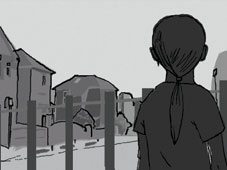
"You Never Listen" is a three-minute film about an eight-year-old girl called Shirley who escapes from her life one afternoon. Frustrated by misunderstandings at home and hostility out in the street, Shirley sees her chance to flee and, impetuously, takes it, running away from the world that she knows; never looking back.
Alys Hawkins was born in the heat wave of 1976 and grew up in Southampton, U.K. She studied film at Northumbria University in Newcastle upon Tyne and completed an MA in Animation at the Royal College of Art, London in 2002. Her films have won awards and achieved festival success worldwide; her last project was commissioned for Channel 4 television. She is currently working on a railway arch in Southampton, development on an erotic experimental short, and a dance film to be shot in Berlin.
Anna Hawkins
Catalogue : 2020Fall Fell Felt | Experimental video | hdv | color | 10:31 | Canada | 2018
Anna Hawkins
Fall Fell Felt
Experimental video | hdv | color | 10:31 | Canada | 2018
Fall Fell Felt begins from an examination of “fail” videos, a popular genre where physical blunders and bloopers are caught on camera and disseminated online. Focusing on an extremely prevalent sub-genre, so-called “girl fails,” this project tests the ability of these images to elicit empathy, while considering the ways that women’s bodies have been used throughout the history of moving images to provoke physical and visceral responses from viewers.
Anna Hawkins is an American artist based in Canada. She works primarily with video and is concerned with the ways that images, gestures and information are transmitted, transformed and experienced online. She has recently exhibited solo projects at Centre Clark (Montreal, CA, 2016), Eastern Edge Gallery (St. John’s, CA, 2016), Untitled Art Society (Calgary, CA, 2018), and The Contemporary Art Museum of the Laurentians (St-Jérôme, CA 2020). Her works have been shown and screened internationally at the UCLA New Wight Biennial (Los Angeles, USA), the WRO Media Art Biennale (Wrocaw, PL), Galerie Sturm (Nürnberg, DE) and LUX (London, UK).
Eleanor Hawkridge
Catalogue : 2008I have a number of small cats | Art vidéo | dv | color | 1:22 | United Kingdom | 2007
Eleanor Hawkridge
I have a number of small cats
Art vidéo | dv | color | 1:22 | United Kingdom | 2007
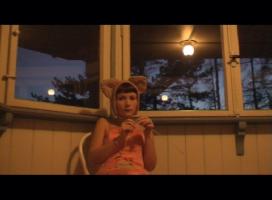
It is night. As the sky darkens a girl sits alone in a tower. She wears cat ears and repetitively knits. With allusion to Alfred Lord Tennyson?s The Lady of Shalott, she feverishly muses on the secret dreams and conflicting desires of women in contemporary society, often expressed through the phenomenon of ?blogs?, and the meticulously mediated and choreographed portraits of woven life they represent. The artist uses a hybrid style of stop animation fused with moving image which heightens the piece?s intimate texture and fragility, while referencing the unreliability and inherently flawed quality within any personal storytelling.
Eleanor Hawkridge lives and works in Liverpool UK. Born in 1981, she studied Timebased practice at The University of Wales Institute, Cardiff and has since gone on to have her work exhibited across Europe and internationally. Through performance, video and documentary installation, she pieces together mundane tragedies with fragments of modern-day hope. Through a mixture of narrative and metaphor infused with faulty logic and fundamentally flawed, she expresses the tenderness and fragility of human experience, emotively and with nostalgia. Eleanor is also co-founder of The Royal Standard, an artists? studio, gallery and social workspace in Liverpool, UK, supporting emerging artists and contemporary movements in fresh art production and practice.
Steve Hawley, Steve Dutton
Catalogue : 2026Midville | Experimental doc. | mp4 | color | 13:20 | United Kingdom, Slovenia | 2025
Steve Hawley, Steve Dutton
Midville
Experimental doc. | mp4 | color | 13:20 | United Kingdom, Slovenia | 2025
‘Midville’ was the pseudonymous name given to a Midlands Art School in the United Kingdom when it was studied over a period of three years from 1967 by two sociologists. The resulting book, ‘Art Students Observed’, published in 1973 has become a classic document within art teaching literature, the place where “romantic” and “conceptual” art first collided. 58 years later I traced the students in the book and interviewed them about their recollections and (sometimes traumatic) experiences. We have recreated ‘Midville’ as a 13-minute AI supported mini collage ‘opera’, where the students as they were then and now, pronounce their testimonies via AI voices, choirs, avatars, and real-world original footage.
Steve Hawley is a Ljubljana based artist who has been since 1981 part of the second wave of British video artists. His work deals with language, humour, and the nature of memory through archive film and video, and has been shown at video festivals and broadcast worldwide. Work on myth and the city includes Ghost made in Hong Kong, screened at the 2000 Cannes Director's Fortnight. War Memorial 2017 was nominated for best short documentary at the Sheffield DocFest and his book, Men, War and Film, about the Calling Blighty message films of WWII was published in 2022. Steve Dutton is an artist and occasional curator based in the South West of England. His practice spans drawing, sound, moving image and text, with a focus on exploring the intersections and overlaps of language, space, and time. He is currently developing a new solo body of work titled "The Phantom Industry." His work engages with the acts of reading, drawing, painting, speaking and writing and might be best described as a language-based practice.
Thomas Hawranke, Lasse Scherffig
Catalogue : 2023COLOSSAL CAVE ADVENTURE – THE MOVIE | Animation | mp4 | color | 55:33 | Germany | 2022
Thomas Hawranke, Lasse Scherffig
COLOSSAL CAVE ADVENTURE – THE MOVIE
Animation | mp4 | color | 55:33 | Germany | 2022
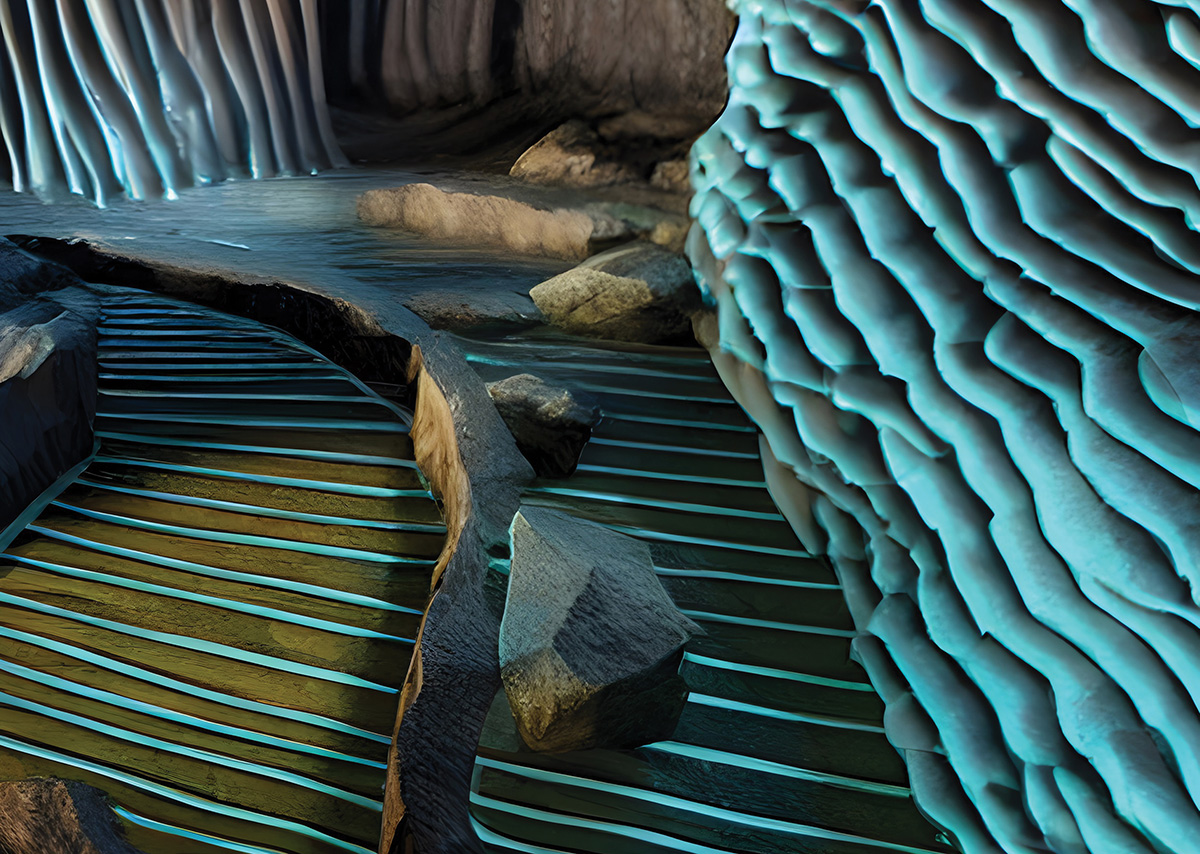
The project deals with one of the first text-based adventure games in computer game history. Colossal Cave Adventure was developed by Will Crowther in 1976 and is based on the spatial presence of Mammoth Cave in Kentucky. Crowther’s game completely avoids a visual representation of the cave – instead, text input and text response shape the cave in the player’s individual perception. The AI-based animated film is approximately 55 minutes long. The camera constantly moves downwards, digging through geological layers and exposing new cave spaces again and again. Every eight seconds, the AI system receives a new textual description. These descriptions are taken from Crowther’s source code from Colossal Cave Adventure in 1976, which contains a total of 379 inputs ranging from narrative descriptions of nature, to jargon from the vocabulary of speleologists, to single words meaning an object, a compass direction, or an exclamation.
Thomas Hawranke and Lasse Scherffig are two interdisciplinary artists collaborating at the fringes of art, technology, and science. Rooted in media archeology, animation, and computational art, their most recent work employs generative AI systems to question their aesthetic and epistemic foundations. They have previously collaborated within the artist group Paidia Institute and have exhibited and published internationally.
Thomas Hawranke
Catalogue : 2019Grand Ape Town | Experimental fiction | hdv | color | 13:30 | Germany | 2016
Thomas Hawranke
Grand Ape Town
Experimental fiction | hdv | color | 13:30 | Germany | 2016
Grand Ape town is a realtime animation movie based on a conducted research about human-animal relations in videogames. Within the movie half of the population of the videogame Grand Theft Auto V is swapped with the 3d-model of a chimpanzee. Through this modification the city of Los Santos is transformed into a hybrid playground of human and animal agency. It invites the viewer to perform Donna Haraways response-ability as a test-action in digital worlds.
Thomas Hawranke is artist and researcher. He received a diploma in audiovisual media from the Academy of Media Arts Cologne and a Ph.D. in media art from the Bauhaus-University in Weimar. In 2005 he joined the artist group susigames, was an artist in residence at the Center for Art and Media (ZKM) Karlsruhe and held a scholarship for artistic research in video games. In 2009 he co-founded Paidia Institute, an interdisciplinary research group operating between art, technology, and science.
Célia Hay
Catalogue : 2025Does Spring Hide Its Joy | Experimental film | super8 | color | 10:0 | France, United Kingdom | 2023

Célia Hay
Does Spring Hide Its Joy
Experimental film | super8 | color | 10:0 | France, United Kingdom | 2023
“Does Spring Hide Its Joy” is an immersive audio experience by American composer Kali Malone featuring musicians Stephen O'Malley and Lucy Railton. The music is a study in long-form, non-linear durational composition, with a heightened focus on septimal just intonation and beating interference patterns. At the same time, it is a film documenting the sound piece, where Célia Hay creates a portrait of the derelict Birkenhead Docks, an industrial place where nature has quietly reclaimed its rights.
Célia Hay is a French artist whose work mixing film, photography, poetry and installation oftentimes depicts isolated social misfits wandering, on their journey to mysterious existential quests. Characters who have left the world to carry out uncanny and rebellious gestures of intimacy which are theirs only, and invent new ways to love and to exist. Themes of mourning, sisterhood, drifting, and how the loss of words can establish bonds in surprising ways are at the core of her practice. Kali Malone is an American composer and musician who creates sonic monoliths that tug at the very material of listening. Malone’s compositions implement specific tuning systems in minimalist structure for pipe organ, choir, chamber music ensembles, and electroacoustic formats. Her music is rich with harmonic texture through synthetic and acoustic instrumentation in repetitive motions and extended durations. The music emits distinct emotive, dynamic, and affective hues which bring forth a stunning depth of focus.
Isabelle Hayeur
Catalogue : 2025Holiday Out | Video | 4k | color | 10:45 | Canada | 2024
Isabelle Hayeur
Holiday Out
Video | 4k | color | 10:45 | Canada | 2024
In California, around 172,000 people are homeless, 30% of the country's total, even though the state represents only 12% of the US population. Lack of affordable housing, mental health problems and drug use are the main causes of this social crisis. This human distress is everywhere these days, but it's far from trivial. Homeless people are affected by heatwaves and floods, which can be deadly due to lack of access to shelter, clean water, and healthcare. I met homeless individuals when I was in the town of El Centro; I captured a few moments of their daily lives on the edge of Interstate 8 and the Sonoran Desert.
Isabelle Hayeur is known for her photographs and her experimental videos. Her work is situated within a critical approach to the environment, urban development and to social conditions. Since the late 1990s, she has been probing the territories she goes through to understand how our contemporary civilizations take over and fashion their environments. She is concerned about the evolution of places and communities in the neoliberal sociopolitical context we currently live in. Her works have been shown at the Massachusetts Museum of Contemporary Arts, Neuer Berliner Kunstverein and at Les Rencontres internationales de la photographie à Arles, amongst others. She has also actively participated in international artists’ residencies and festivals.
Catalogue : 2015La saison sombre | Video | hdv | color | 8:45 | Canada | 2014
Isabelle Hayeur
La saison sombre
Video | hdv | color | 8:45 | Canada | 2014
La saison sombre (The Dark Season) is intended as a kind of omen. The video shows us devastated places and landscapes with extreme climates. It alludes to some of the upheavals current societies are undergoing, at a time when our dependence on fossil fuels is only growing.
Born in 1969, Isabelle Hayeur lives and works in Rawdon (Quebec). As an image-making artist, she is known for her large digital montages, her videos and her site-specific installations. Her work is situated within a critical approach to the environment, urban development and to social conditions. She is particularly interested in the feelings of alienation, uprooting and dislocation. Her artworks have been shown in the context of numerous exhibitions and festivals.
Catalogue : 2012Private Views | Experimental video | 0 | color | 8:15 | Canada | 2010
Isabelle Hayeur
Private Views
Experimental video | 0 | color | 8:15 | Canada | 2010
"Private Views" creates a parallel between two starkly different worlds: the wretchedness of the destitute and the conspicuous consumer lifestyle of the nouveaux riches. The video explores the themes of social inequalities, real estate speculation, and dispossession. It documents the decline of some North American cities and casts a critical eye on the emergence of wealthy new suburbs. These private residential enclaves are often gated and under surveillance. Their luxury homes, with their dubious architectural style, are the reflection of a world dominated by appearances, consumption, and social conformity.
Isabel Hayeur is a visual artist, born in Montreal in 1969. She gets a fine arts master degree from the University of Quebec in Montreal in 2002. Her work consists in large photographic montages, videos and in situ installations. She?s the cofounder of the collective ?Perte de Signal?, which exhibited young media artists in international festivals. Her researches focus on the changes in the city planning, showing natural-looking landscapes which are actually totally artificial. Her work is internationally shown in festivals, museums and exhibitions, as the Museum of Fine Arts of Québec (2006), ?Les Rencontres Internationales de la Photographie? in Arles (2006), the Museum of Fine Arts of Canada, the ?Fonds National d?Art Contemporain? of Paris, the Contemporary Art Museum of Montréal, and the Museum of Contemporary Photography of Chicago (MoCP).
Catalogue : 2011HINDSIGHT | Art vidéo | | color | 8:30 | Canada | 2009

Isabelle Hayeur
HINDSIGHT
Art vidéo | | color | 8:30 | Canada | 2009
"Hindsight" traces its arch among the eerily still buildings of Governors Island, within sight of New York City. The presence of the military on this island goes back to Dutch colonial times. It culminated in their settlement in Brick Village; a residential project like so many a Levittown mass-produced along the lines of military housing after World War II to fulfil the promise of liberty and happiness through private property, for the sake of which America fought. This model suburb is now a desert island; its empty houses call to mind those of so many Americans whose dreams of access to property have recently been exploited and shattered by irresponsible financial speculators. They are haunted by the voice of a present-day soldier for whom enlisting seemed like a last chance to escape the planned obsolescence of all but the wealthiest social classes of the United States, by enlisting to fight for them as the promised land of opportunity. This vision of a home of the brave, whose manifest destiny to secure a continent and then make the world safe for free enterprise would ultimately benefit all, ends up dissolving like any mirage, under the peeling paint of leprous walls, along with the statue of Liberty as reflected in the blind windows of a shuttered house.
Born in 1969, Isabelle Hayeur lives and works in Montreal. As an image-making artist, she is known for her large digital montages, her videos and her site-specific installations. Her work is situated within a critical approach to the environment, urban development and to social conditions. She is particularly interested in the feelings of alienation, uprooting and dislocation. Her artworks have been shown in the context of numerous exhibitions and festivals.
Catalogue : 2010Losing Ground | Video | dv | color | 12:40 | Canada | 2009
Isabelle Hayeur
Losing Ground
Video | dv | color | 12:40 | Canada | 2009
"Losing Ground" is a critique of urban sprawl and the resulting erosion and homogenization of the countryside across the world. With its negation of city history, of geographic particularities, and thus of cultural memory, this standardized urbanization imposes its amnesia, individualistic lifestyle, and jarring presence in nature. Filmed in Quartier DIX30 in Brossard, the biggest lifestyle center in Canada, the video sounds out recently man-made territories so as to decipher humanity?s relationships with the environment. It confronts us with the dizzying spectacle of our diminishing local references, as they give way to cultural stereotypes, now become universal through globalization.
Isabelle Hayeur was born in Montreal in 1969. She completed a BFA in 1996 and an MFA in 2002 at Université du Québec à Montréal. As an image-making artist, she is known primarily for my large digital montages and her videos. She has also produced several site-specific installations, public art commissions and a few web art works. Her work is situated within a critical approach to the environment and urban development. She has been widely exhibited across Canada, Europe and the United States, at Musée d`art contemporain de Montréal, the Massachusetts Museum of Contemporary Art (MassMoca), the Museum of Contemporary Photography (Chicago), Casino Luxembourg forum d`art contemporain (Luxembourg), the Neuer Berliner Kuntsverein (Berlin) and at Les Rencontres de la photographie à Arles (France). Her video presentations include LOOP Videoart, Barcelona (2009), Festival des nouveaux médias et de la vidéo de Montréal (2007, 2003, 1999), Vidéoformes, (2001, 2000, 1999, 1998), Videoart Locarno (2001), Les rencontres internationales Paris/Berlin (2000, 1999) and L.A. Freewaves (1998) amongst others.
Stefan Hayn, Anja-Christin REMMERT
Catalogue : 2006Malerei Heute | Documentary | 35mm | color and b&w | 61:0 | Germany | 2005
Stefan Hayn, Anja-Christin REMMERT
Malerei Heute
Documentary | 35mm | color and b&w | 61:0 | Germany | 2005
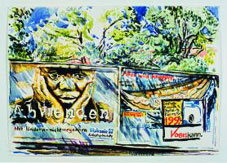
?Malerei heute? présente une série de 156 aquarelles d'affiches publicitaires et d'affiches électorales du paysage urbain berlinois. La démonstration filmique et picturale traitant d' une période étendue (1998-2005) débute au moment où les changements de conditions de travail et de vie en Allemagne réunifiée prennent une importance évidente et - à travers le changement de gouvernement en 98- une signification politique. Non seulement les affiches électorales, mais aussi la publicité pour les cigarettes, la lessive et le cinéma se rapportent plus ou moins à des thèmes tels que la fiscalité, l'assurance vieillesse, la précarité croissante de l'emploi, les crises dans le domaine de la politique intérieure et extérieure. La peinture joue dans le film le rôle d'outil d'analyse, comme travail et comme un effort pour permettre un regard neuf sur les transformations sociales -et leurs répercussions sur la vie privée- au-delà de ce que l'on en connaît déjà . Par le biais de la reproduction filmo-temporelle des aquarelles et de leur confrontation avec des textes narratifs/explicatifs, des séquences filmiques et une musique composée et enregistrée pour le film, l'"oeil du peintre" est rendu accessible aux spectateurs. Au-delà du double "détour" de la reproduction, d'abord picturale, ensuite filmique, d' affiches publicitaires et électorales, le film vise également l'analyse par l'image de ce qu'on appelle les nouveaux médias et de leurs promesses de bonheur dans le domaine social et privé.
Bio- et filmographie Stefan Hayn né en 1965 à Rothenburg ob der Tauber 1986-93 études de peinture et de cinéma à l'école supérieure des arts de Berlin 1993 élève du cours Rebecca Horn 1995-98 étude de projet réalisation de films documentaires à l'académie de cinéma du Bade-Württemberg depuis 1989 Films, dont la majeure partie sont au sein de sa propre société de production, publication de textes Films SCHWULENFILM (1989, Super8 Blow up sur 16mm, couleur, muet, 2 min) TUNTENFILM (1990, Super8 Blow up sur 16mm, couleur, muet, 3 min) PISSEN (1990, Super8 Blow up sur 16mm, couleur et N&B, son optique, 12 min) FONTVELLA?S BOX (1991/92, 16mm, couleur, son optique ,18 min, avec le soutien de la Berliner Filmförderung) KLASSENKAMPF IN AMERIKA (1993, 16mm, couleur, son optique, 18 min) WHAT TO PUT ON TOP OF JACK SMITH?S MEMORIAL CHRISTMAS TREE? (1994, 16mm, couleur et N&B, son optique,7 min) AM ISRAEL CHAI / DAS VOLK ISRAEL LEBT ? BERICHT VON DR. URSULA BOHN (1995, Hi 8/Betacam SP, 46 min) DAS FESTSPIEL (1996, 16mm, couleur, son optique, 21 min) EIN FILM ÜBER DEN ARBEITER (1997/98, 16mm, N & B et couleur, son optique, 18 min) DREIZEHN REGELN ODER DIE SCHWIERIGKEIT SICH AUSZUDRÜCKEN THIRTEEN RULES OR THE DIFFICULTY OF SEXPRESSING ONESELF (d'après Ad Reinhardt et Copi, 1998, 16mm, N&B et couleur, son optique,50 min, Aide au scénario de la Berliner Filmförderung) Les journées internationales du court-métrage d'Oberhausen ont présenté, en Mai 2005, en programmation spéciale, une rétrospective des courts- et moyen-métrages de Stefan Hayn. Films en collaboration avec Anja-Christin Remmert SCHULDNERBERICHTE - PRIVATVERSCHULDUNG IN BERLIN (2001 / 02, 16mm, couelur et N&B, 88 min, produit par EIKON Südwest dans la série ?Junger Dokumentarfilm?, avec le soutien de MFG-Filmförderung du Bade-Württemberg,) GESPRÄCHE MIT SCHÜLERN UND LEHRERN (2000 / 02, DV, couleur, 45 min) DAS HEIßE EISEN (nach Hans Sachs, 2005, 16mm Blow up auf 35mm, Couleur,15min, avec le soutien du bureau fédéral de la culture et des médias MALEREI HEUTE (1998-2005, 35mm, couleur et N&B, 61 min, avec le soutien du Medienboard Berlin-Brandebourg, 3sat und SWR) Anja-Christin Remmert née en 1970 à Königs Wusterhausen 1992-97 études de réalisation de documentaires à l'académie de cinéma du Bade-Württemberg cours Thomas Schadt, Helga Reidemeister Films ZWISCHENZEIT (1995, 16mm, N & B et couleur, 25 min) GESTA (1997/99, 16mm, N&B, 20 min) IM LEBEN BLEIBEN (1998, avec Helga Reidemeister, vidéo, couleur, 50 min)