Catalogue > List by artist
Browse the entire list of Rencontre Internationales artists since 2004. Use the alphabetical filter to refine your search. update in progress
Van V. Mcelwee
Vahid Vahed
Catalogue : 2007Emha | Fiction | dv | color | 5:0 | Australia, Iran | 2006
Vahid Vahed
Emha
Fiction | dv | color | 5:0 | Australia, Iran | 2006
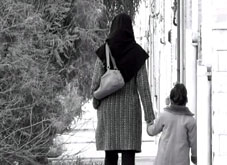
A mother and her daughter are walking towards a local park. The mother is preoccupied with thoughts of her marital issues and neglects to attend to her daughter who is amusing herself on a swing. Meanwhile, a man on a motorbike is fearlessly riding through the busy streets of the city. Inter-cut with these two scenes: a young boy is waiting outside of his school to be picked up. Two young mothers enter the park with a younger child holding a red ball. This does not change the mood of the preoccupied mother but the red ball attracts her daughter. The children notice each other and want to meet but they need their mothers' consent. The young girl with the red ball decides to move forward towards the girl on the swing. She approaches and hands the red ball over to her as a friendly gesture and moves back to the mothers. The girl on the swing is looking at her mother for approval to play with the ball. Among the chaos of her mother?s internal conflicts and the heavy noise of traffic, the young girl on the swing disappears as she exits the park holding the red ball.
Vahid Vahed was born in Tehran, Iran, in 1959. He attended high school and university in England from 1975-81. He studied civil engineering and communications, majoring in photography and film studies. Vahid lived and worked as an editor and a photographer in Germany for three years before immigrating to Australia in 1984. Vahid has worked as a journalist, university lecturer, film and television producer/director, curator and video artist since his arrival in Australia, as well as completing an Associate Diploma at Charles Sturt University (Television and Sound Production), a Bachelor of Fine Arts at College Of Fine Arts UNSW (Sound, Performance and Installation), a Master of Arts, College Of Fine Arts UNSW (Time Based Art). During 1998-2003, he was employed by the NSW Ministry for the Arts as a Multicultural Arts Officer and has been the Artistic Director and Founder of the Auburn International Film and Video Festival for Children and Young Adults (est. 1998) and CINEWEST (est. 1999). In 2002, Vahid was elected as the Vice President of CIFEJ (International Centre of Films for Children and Young People), an international organization conceived and established by UNESCO and UNICEF in 1955. Vahid was awarded a two year fellowship from the Australia Council for the Arts for researching, initiating and developing community cultural development practices and screen culture activities, locally, regionally, nationally and internationally from 2003-2005.
Alexander Vaindorf
Catalogue : 2014Border lessons | Experimental doc. | dv | color and b&w | 9:0 | Sweden | 2013
Alexander Vaindorf, birdfollower
Border lessons
Experimental doc. | dv | color and b&w | 9:0 | Sweden | 2013
Instead of following and depicting actions of others ?Border lessons? utilizes a subjective experience through ?birdfollower? who makes a camera recording while crossing the border in to European Union. This travelogue discloses the instructions, private and secret details behind an effort to migrate over to a better life. Previously undocumented from a first person point of view the daring journey becomes evidence, a bold statement and manual on how to cross the border without getting trapped. Consequently camera lenses are used not only to register the scenes, but moreover as a binoculars to make necessary observation for reconnaissance, as well as a device to find and put on record marked signs and walking paths.
Alexander Vaindorf (*1965 in Odessa, Ukraine) is a Russian-Swedish artist and filmmaker, currently living in Stockholm. Raised in Moscow, USSR he studied at Konstfack University and Royal Institute of Art in Stockholm and received his MFA degree from Columbia University/Visual Arts in New York in 2000.
Catalogue : 2007One particular Sunday | Experimental doc. | dv | color | 14:0 | Sweden, Italy | 2006
Alexander Vaindorf
One particular Sunday
Experimental doc. | dv | color | 14:0 | Sweden, Italy | 2006
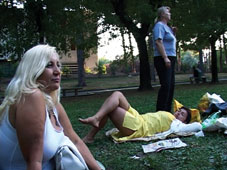
A time fragment in the present history of the unified Europe where considerable numbers of people are not only excluded, but also subject to a "contemporary form of slavery". With reference to the Dziga Vertov portrayal of one day in Moscow after the social revolution 1917, this film depicts work migrants from the former Soviet Union spending their only free day, Sunday, in the Parco di Resistenza in Rome.
Born 1965 in Odessa (formerly CCCP), Alexander Vaindorf has been living and working in Stockholm since 1987. Education 2001-2002 Royal Art Academy, Stockholm. Postgraduate. 1998-2000 Columbia University, NY. Visual Arts, MFA. 1999-2000 Columbia University, NY. Sociology Department. 1995-1998 Konstfack University, Stockholm, BFA. Recent exhibitions and screenings: 2006 Solo exhibition - Salon of the Museum of Contemporary Art, Belgrade; Solo exhibition - Kunstlerhaus Buchsenhausen Innsbruck. 2005; 10th Rencontres Internationales Paris/Berlin; 51st Short Film Festival Oberhausen 2004; Venice Architecture Biennale, Russian pavilion; 2003 "Narration in Swedish Contemporary Art", Sweden; B-fact: Tirana and Istanbul Biennale; "It is hard to touch the real", Kunstverein Munich, 26:e Gothenburg Film Festival.
Catalogue : 2006Kids (group D) | Art vidéo | dv | color | 58:0 | Sweden | 2003
Alexander Vaindorf
Kids (group D)
Art vidéo | dv | color | 58:0 | Sweden | 2003
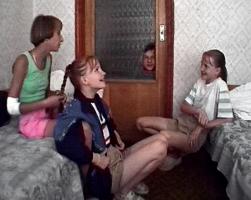
?Kids (group D)? is a film with and about Chernobyl kids, reflecting on reality from a teenage perspective, the reality forced upon them by the events they never experienced. It is filmed in Ukraine during summer of 1999 in a sanatorium where I lived for one month with the kids who have a Chernobyl status ID, group D (D stands for ?child?). Their families lived in the areas around the Chernobyl Power Plant and after the explosion were evacuated to various different cities. All of the 13 kids in the film were born right before or after the accident and their memory is a construction of the information from their families, media and school. The story shows ?their? idea about the events after the disaster and how it has affected their generation. In contrast to the media-image, the kids look like any other teenagers and talk about their thoughts for the future, as well as the response of society towards them.
ALEXANDER VAINDORF Born 1965 in Odessa, f. CCCP, since 1987 lives and works in Stockholm. Education 2001-2002 Royal Art Academy, Stockholm. Postgraduate. 1998-2000 Columbia University, New York. SoA/Visual Arts, Master of Fine Arts. 1999-2000 Columbia University, New York. Sociology Department. 1995-1998 Konstfack University College, Stockholm, BA of Fine Arts.
Catalogue : 2006New romantics | Experimental video | dv | color | 6:45 | Sweden | 2003
Alexander Vaindorf
New romantics
Experimental video | dv | color | 6:45 | Sweden | 2003
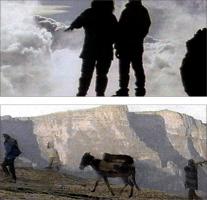
Footage of different remote locations is manipulated to create an experience of one, generic place where two white Westerners, two local guides and a donkey are on an endless search through this ?unknown? landscape.
ALEXANDER VAINDORF Born 1965 in Odessa, f. CCCP, since 1987 lives and works in Stockholm. Education 2001-2002 Royal Art Academy, Stockholm. Postgraduate. 1998-2000 Columbia University, New York. SoA/Visual Arts, Master of Fine Arts. 1999-2000 Columbia University, New York. Sociology Department. 1995-1998 Konstfack University College, Stockholm, BA of Fine Arts.
Alexander Vaindorf, birdfollower
Catalogue : 2014Border lessons | Experimental doc. | dv | color and b&w | 9:0 | Sweden | 2013
Alexander Vaindorf, birdfollower
Border lessons
Experimental doc. | dv | color and b&w | 9:0 | Sweden | 2013
Instead of following and depicting actions of others ?Border lessons? utilizes a subjective experience through ?birdfollower? who makes a camera recording while crossing the border in to European Union. This travelogue discloses the instructions, private and secret details behind an effort to migrate over to a better life. Previously undocumented from a first person point of view the daring journey becomes evidence, a bold statement and manual on how to cross the border without getting trapped. Consequently camera lenses are used not only to register the scenes, but moreover as a binoculars to make necessary observation for reconnaissance, as well as a device to find and put on record marked signs and walking paths.
Alexander Vaindorf (*1965 in Odessa, Ukraine) is a Russian-Swedish artist and filmmaker, currently living in Stockholm. Raised in Moscow, USSR he studied at Konstfack University and Royal Institute of Art in Stockholm and received his MFA degree from Columbia University/Visual Arts in New York in 2000.
Catalogue : 2007One particular Sunday | Experimental doc. | dv | color | 14:0 | Sweden, Italy | 2006
Alexander Vaindorf
One particular Sunday
Experimental doc. | dv | color | 14:0 | Sweden, Italy | 2006
A time fragment in the present history of the unified Europe where considerable numbers of people are not only excluded, but also subject to a "contemporary form of slavery". With reference to the Dziga Vertov portrayal of one day in Moscow after the social revolution 1917, this film depicts work migrants from the former Soviet Union spending their only free day, Sunday, in the Parco di Resistenza in Rome.
Born 1965 in Odessa (formerly CCCP), Alexander Vaindorf has been living and working in Stockholm since 1987. Education 2001-2002 Royal Art Academy, Stockholm. Postgraduate. 1998-2000 Columbia University, NY. Visual Arts, MFA. 1999-2000 Columbia University, NY. Sociology Department. 1995-1998 Konstfack University, Stockholm, BFA. Recent exhibitions and screenings: 2006 Solo exhibition - Salon of the Museum of Contemporary Art, Belgrade; Solo exhibition - Kunstlerhaus Buchsenhausen Innsbruck. 2005; 10th Rencontres Internationales Paris/Berlin; 51st Short Film Festival Oberhausen 2004; Venice Architecture Biennale, Russian pavilion; 2003 "Narration in Swedish Contemporary Art", Sweden; B-fact: Tirana and Istanbul Biennale; "It is hard to touch the real", Kunstverein Munich, 26:e Gothenburg Film Festival.
Catalogue : 2006Kids (group D) | Art vidéo | dv | color | 58:0 | Sweden | 2003
Alexander Vaindorf
Kids (group D)
Art vidéo | dv | color | 58:0 | Sweden | 2003
?Kids (group D)? is a film with and about Chernobyl kids, reflecting on reality from a teenage perspective, the reality forced upon them by the events they never experienced. It is filmed in Ukraine during summer of 1999 in a sanatorium where I lived for one month with the kids who have a Chernobyl status ID, group D (D stands for ?child?). Their families lived in the areas around the Chernobyl Power Plant and after the explosion were evacuated to various different cities. All of the 13 kids in the film were born right before or after the accident and their memory is a construction of the information from their families, media and school. The story shows ?their? idea about the events after the disaster and how it has affected their generation. In contrast to the media-image, the kids look like any other teenagers and talk about their thoughts for the future, as well as the response of society towards them.
ALEXANDER VAINDORF Born 1965 in Odessa, f. CCCP, since 1987 lives and works in Stockholm. Education 2001-2002 Royal Art Academy, Stockholm. Postgraduate. 1998-2000 Columbia University, New York. SoA/Visual Arts, Master of Fine Arts. 1999-2000 Columbia University, New York. Sociology Department. 1995-1998 Konstfack University College, Stockholm, BA of Fine Arts.
Catalogue : 2006New romantics | Experimental video | dv | color | 6:45 | Sweden | 2003
Alexander Vaindorf
New romantics
Experimental video | dv | color | 6:45 | Sweden | 2003
Footage of different remote locations is manipulated to create an experience of one, generic place where two white Westerners, two local guides and a donkey are on an endless search through this ?unknown? landscape.
ALEXANDER VAINDORF Born 1965 in Odessa, f. CCCP, since 1987 lives and works in Stockholm. Education 2001-2002 Royal Art Academy, Stockholm. Postgraduate. 1998-2000 Columbia University, New York. SoA/Visual Arts, Master of Fine Arts. 1999-2000 Columbia University, New York. Sociology Department. 1995-1998 Konstfack University College, Stockholm, BA of Fine Arts.
Arnaud Valadie
Catalogue : 2006Sciame/Swarm/Essaim - passage du sens à la scène | Documentary | dv | color and b&w | 22:28 | France | 2005
Arnaud Valadie
Sciame/Swarm/Essaim - passage du sens à la scène
Documentary | dv | color and b&w | 22:28 | France | 2005
The film recounts two years of the creation of philosopher and Italian politician Toni Negri?s first theatrical text. ?Swarm? staged by Barbara Nicolier, retraces the journey of a militant searching for a means of resistance that is not war. After enduring exile and prison, Toni Negri, at 71 years of age, has begun a new experience. The film shows the text being staged.
After studying at the Audiovisual School of Toulouse (ESAV) from 1994 to 1998, he completed a research-oriented postgraduate course at the Université Paris III on the subject of Burlesque Cinema. Subsequently, he worked on the film, ?No Sex Last Night? by Sophie Calle. Since 2000, he has been working in the Colline National Theater, where he is in charge of Internet communication and video. He collaborates with Jacque Bonnaffé, Pascal Rambert, Daniel Danis, Jacque Roubaud, Michel Vinaver, and Edward Bond on the theater?s e-magazine. At the same time, he directed ?Triomphe de la suffisance? (short fiction, 16mm). He occasionally works at the Espace Confluences, namely for: the projection of ?Route 181? by Eyal Sivan, Marcel Ophüls retrospective, and short film nights). In 2003, he met Toni Negri in Rome. From their meetings, ?Swarm? was born, staged by Barbara Nicolier, and the film ?Sciame / Swarm / Essaim ? passing from sense to the stage?.
Cherie Valentina Stocken
Valie Export
Catalogue : 2018Remote… Remote…. | Experimental film | 16mm | | 10:12 | Austria | 1973
Valie Export
Remote… Remote….
Experimental film | 16mm | | 10:12 | Austria | 1973
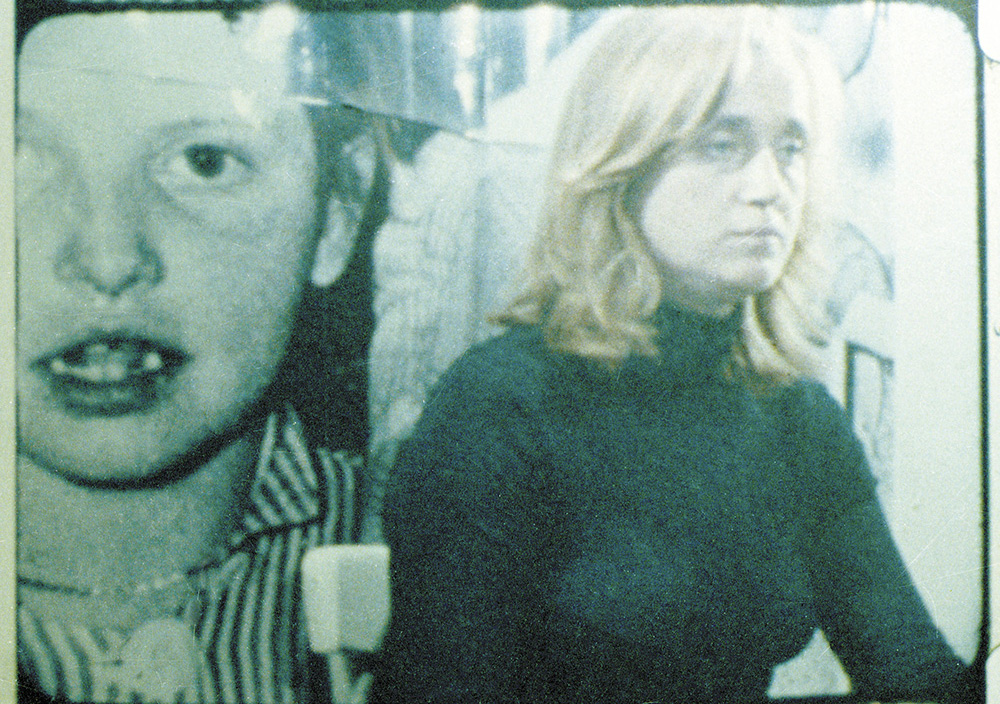
Human behaviour in contrast to machines (animals) is influenced by events in the past, as far back as these experiences may lie. Therefore there exists a psychic paratime parallel to the objective time, where the prayers of anguish and guilt, the inability to win, deformations which rip open the skin, becoming aware of oneself, have their constant effects. I demonstrate something which represents past and present.
VALIE EXPORT, Prof. Dr. h.c.media and performance artist, filmmaker born in Linz, lives and works in Vienna VALIE EXPORT’s artistic work comprises: video environments, digital photography, installation, body performances, feature films, experimental films, documentaries, Expanded Cinema, conceptual photography, body-material interactions, Persona Performances, laser installations, objects, sculptures, texts on contemporary art history and feminism. VALIE EXPORT is one of the most important pioneers on conceptual media art, performance and film. 1967 invention of her artist name VALIE EXPORT: an artistic concept and logo to be written in capital letters only VALIE EXPORT takes part at the documenta 12 2007, and documenta 6, 1977, in Kassel 1985 nomination of EXPORT's feature film “Die Praxis der Liebe”, screenplay and direction, for the Golden Bear at the Berlin International Film Festival Since 1975 curatorial projects, international symposiums, exhibitions and film programmes Her works are in international collections like Centro Pompidou, Paris, Tate Modern, London, Reine Sophia, Madrid, MOMA, New York, MOCA, Los Angeles ect. Since 1968 participation in international exhibitions, for example: Centre Georges Pompidou, Paris; The Museum of Modern Art, New York; Institute of Contemporary Art, London; Venice Biennale, Venezia; documenta, Kassel; MoCA, Los Angeles; Stedelijk Museum, Amsterdam; MUMOK, Vienna; Generali Foundation, Vienna; P.S.1 Contemporary Art Center, New York; Shanghai Art Museum, Shanghai; Palais des Beaux-Arts, Bruxelles; Tate Modern, London; Metropolitan Museum of Art, Seoul, Korea; Metropolitan Museum, New York; ars electronica, Linz/Austria. Screenings at international film and video festivals, for example London Underground Film Festival; London International Film Festival; Filmex, Los Angeles; Berlin International Film Festival as well as film festivals in Cannes, Montréal, Vancouver, San Francisco, Locarno, Hongkong, Sydney, New York, etc.
Catalogue : 2018ASEMIE - die Unfähigkeit, sich durch Mienenspiel ausdrücken zu können (Körper - Material - Interaktion, Body Performance) | Video | 0 | | 6:44 | Austria | 1973
Valie Export
ASEMIE - die Unfähigkeit, sich durch Mienenspiel ausdrücken zu können (Körper - Material - Interaktion, Body Performance)
Video | 0 | | 6:44 | Austria | 1973
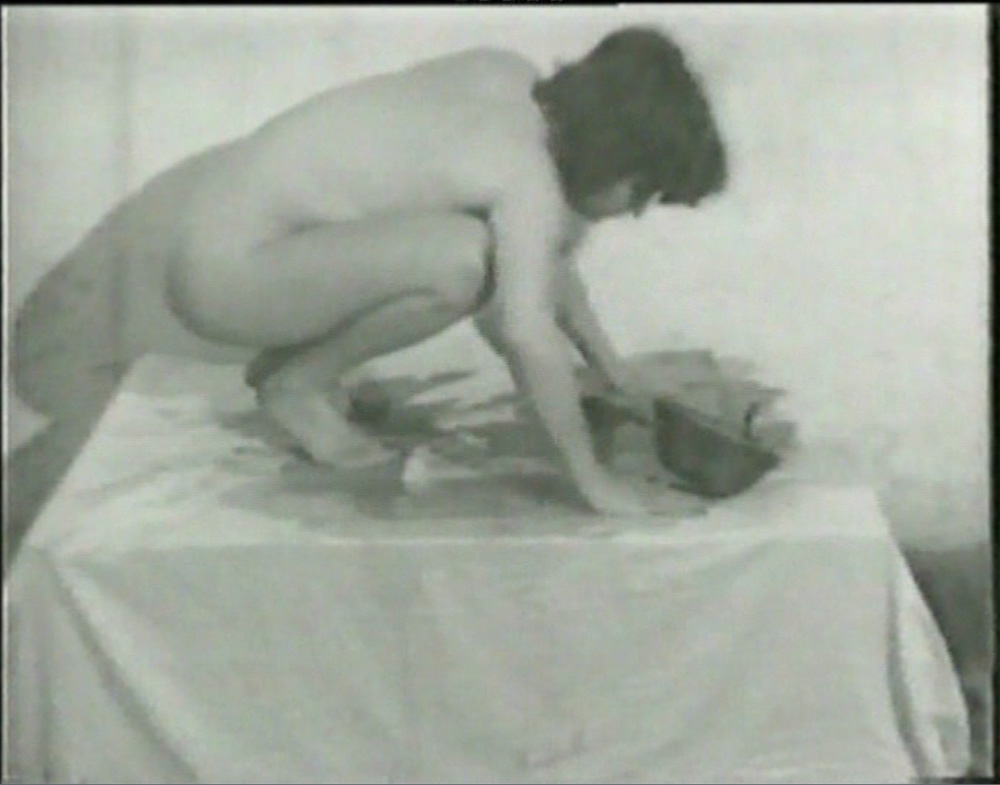
This work documents a ritualistic performance concerned with Ansemia, or the inability to either express or understand gesture. Using symbolic materials - hot wax, a knife, a dead bird - as well as text, VALIE EXPORT investigates human expression, and how communication can fail. "I had used my mouth to take the knife from the podium, holding it in my mouth, (the knife is language, the naming of things, its separates the subject from the object) using it to cut."
VALIE EXPORT, Prof. Dr. h.c.media and performance artist, filmmaker born in Linz, lives and works in Vienna VALIE EXPORT’s artistic work comprises: video environments, digital photography, installation, body performances, feature films, experimental films, documentaries, Expanded Cinema, conceptual photography, body-material interactions, Persona Performances, laser installations, objects, sculptures, texts on contemporary art history and feminism. VALIE EXPORT is one of the most important pioneers on conceptual media art, performance and film. 1967 invention of her artist name VALIE EXPORT: an artistic concept and logo to be written in capital letters only VALIE EXPORT takes part at the documenta 12 2007, and documenta 6, 1977, in Kassel 1985 nomination of EXPORT's feature film “Die Praxis der Liebe”, screenplay and direction, for the Golden Bear at the Berlin International Film Festival Since 1975 curatorial projects, international symposiums, exhibitions and film programmes Her works are in international collections like Centro Pompidou, Paris, Tate Modern, London, Reine Sophia, Madrid, MOMA, New York, MOCA, Los Angeles ect. Since 1968 participation in international exhibitions, for example: Centre Georges Pompidou, Paris; The Museum of Modern Art, New York; Institute of Contemporary Art, London; Venice Biennale, Venezia; documenta, Kassel; MoCA, Los Angeles; Stedelijk Museum, Amsterdam; MUMOK, Vienna; Generali Foundation, Vienna; P.S.1 Contemporary Art Center, New York; Shanghai Art Museum, Shanghai; Palais des Beaux-Arts, Bruxelles; Tate Modern, London; Metropolitan Museum of Art, Seoul, Korea; Metropolitan Museum, New York; ars electronica, Linz/Austria. Screenings at international film and video festivals, for example London Underground Film Festival; London International Film Festival; Filmex, Los Angeles; Berlin International Film Festival as well as film festivals in Cannes, Montréal, Vancouver, San Francisco, Locarno, Hongkong, Sydney, New York, etc.
Catalogue : 2018Raumsehen und Raumhören | Video | mov | | 6:21 | Austria | 1974
Valie Export
Raumsehen und Raumhören
Video | mov | | 6:21 | Austria | 1974
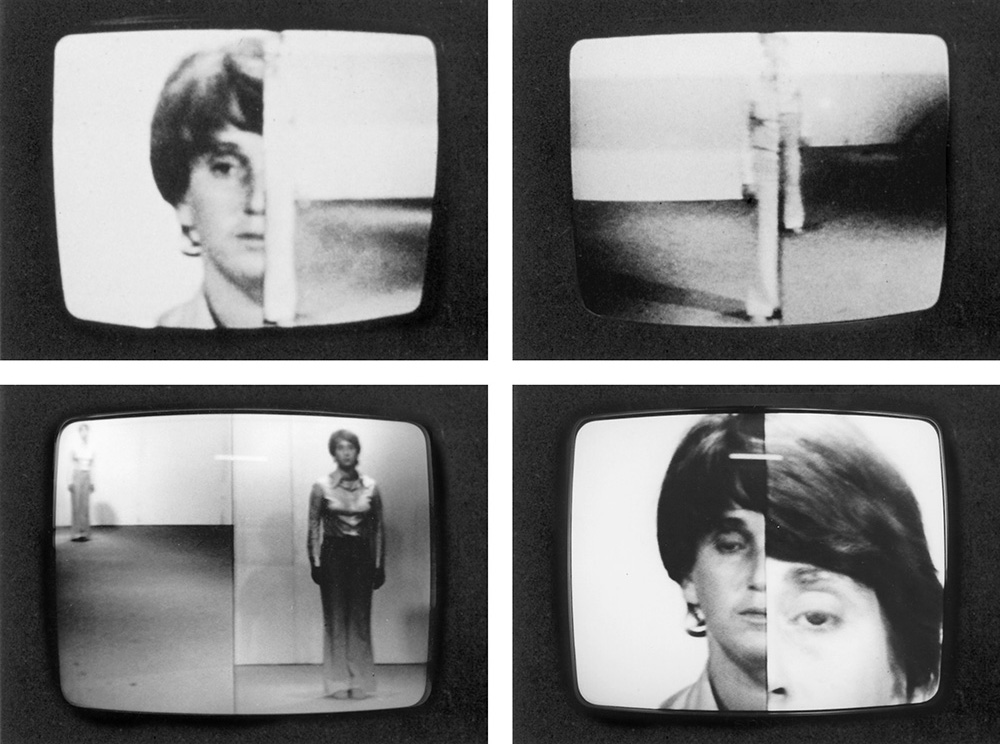
Like in “Split Reality”, the personality conveyed by a medium in this performance tape appears to be schizophrenic. Two video cameras and a mixer make possible a closed-circuit action that demonstrates not only the differences in the way the viewers perceive a person who is physically present in the room and simultaneously electronically reproduced, but also how the image is manipulated by its electronic conveyance. The camera zooms in and out, subjecting the performer's monitor likeness to permanent alteration. Specific synthetic sounds are linked to the picture: optically close = loud sound and rapid tone repetition, optically remote = quiet sound and slow tone repetition. The work is arranged in 6 parts: 1. space position, 2. split images, 3. space position composition, 4. split image composition, 5. body, 6. body composition.
VALIE EXPORT, Prof. Dr. h.c.media and performance artist, filmmaker born in Linz, lives and works in Vienna VALIE EXPORT’s artistic work comprises: video environments, digital photography, installation, body performances, feature films, experimental films, documentaries, Expanded Cinema, conceptual photography, body-material interactions, Persona Performances, laser installations, objects, sculptures, texts on contemporary art history and feminism. VALIE EXPORT is one of the most important pioneers on conceptual media art, performance and film. 1967 invention of her artist name VALIE EXPORT: an artistic concept and logo to be written in capital letters only VALIE EXPORT takes part at the documenta 12 2007, and documenta 6, 1977, in Kassel 1985 nomination of EXPORT's feature film “Die Praxis der Liebe”, screenplay and direction, for the Golden Bear at the Berlin International Film Festival Since 1975 curatorial projects, international symposiums, exhibitions and film programmes Her works are in international collections like Centro Pompidou, Paris, Tate Modern, London, Reine Sophia, Madrid, MOMA, New York, MOCA, Los Angeles ect. Since 1968 participation in international exhibitions, for example: Centre Georges Pompidou, Paris; The Museum of Modern Art, New York; Institute of Contemporary Art, London; Venice Biennale, Venezia; documenta, Kassel; MoCA, Los Angeles; Stedelijk Museum, Amsterdam; MUMOK, Vienna; Generali Foundation, Vienna; P.S.1 Contemporary Art Center, New York; Shanghai Art Museum, Shanghai; Palais des Beaux-Arts, Bruxelles; Tate Modern, London; Metropolitan Museum of Art, Seoul, Korea; Metropolitan Museum, New York; ars electronica, Linz/Austria. Screenings at international film and video festivals, for example London Underground Film Festival; London International Film Festival; Filmex, Los Angeles; Berlin International Film Festival as well as film festivals in Cannes, Montréal, Vancouver, San Francisco, Locarno, Hongkong, Sydney, New York, etc.
Catalogue : 2018Bewegte Bilder über sich bewegende Personen | Experimental film | 16mm | black and white | 4:44 | Austria | 1973
Valie Export
Bewegte Bilder über sich bewegende Personen
Experimental film | 16mm | black and white | 4:44 | Austria | 1973
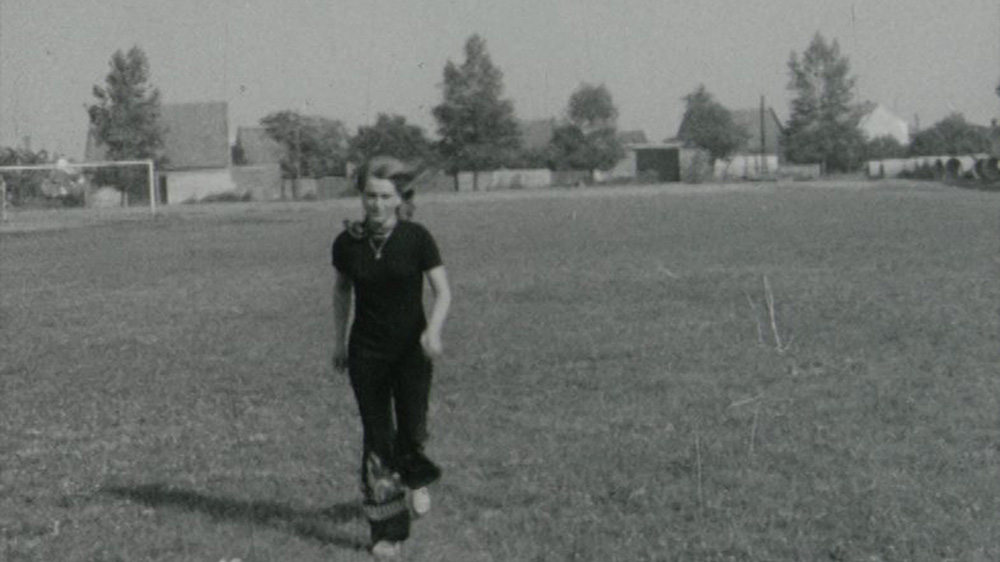
This 16mm film reflects EXPORT`s dialogue with the medium film: "Back then I was occupied with trying to find out how you can use this small machine to do things with various formal, artistic or performance-like sequences on celluloid: cross-fading, rewinding and starting over again, not having any clear pictures. In this project I was interested in moving towards the camera and moving away again."
VALIE EXPORT, Prof. Dr. h.c.media and performance artist, filmmaker born in Linz, lives and works in Vienna VALIE EXPORT’s artistic work comprises: video environments, digital photography, installation, body performances, feature films, experimental films, documentaries, Expanded Cinema, conceptual photography, body-material interactions, Persona Performances, laser installations, objects, sculptures, texts on contemporary art history and feminism. VALIE EXPORT is one of the most important pioneers on conceptual media art, performance and film. 1967 invention of her artist name VALIE EXPORT: an artistic concept and logo to be written in capital letters only VALIE EXPORT takes part at the documenta 12 2007, and documenta 6, 1977, in Kassel 1985 nomination of EXPORT's feature film “Die Praxis der Liebe”, screenplay and direction, for the Golden Bear at the Berlin International Film Festival Since 1975 curatorial projects, international symposiums, exhibitions and film programmes Her works are in international collections like Centro Pompidou, Paris, Tate Modern, London, Reine Sophia, Madrid, MOMA, New York, MOCA, Los Angeles ect. Since 1968 participation in international exhibitions, for example: Centre Georges Pompidou, Paris; The Museum of Modern Art, New York; Institute of Contemporary Art, London; Venice Biennale, Venezia; documenta, Kassel; MoCA, Los Angeles; Stedelijk Museum, Amsterdam; MUMOK, Vienna; Generali Foundation, Vienna; P.S.1 Contemporary Art Center, New York; Shanghai Art Museum, Shanghai; Palais des Beaux-Arts, Bruxelles; Tate Modern, London; Metropolitan Museum of Art, Seoul, Korea; Metropolitan Museum, New York; ars electronica, Linz/Austria. Screenings at international film and video festivals, for example London Underground Film Festival; London International Film Festival; Filmex, Los Angeles; Berlin International Film Festival as well as film festivals in Cannes, Montréal, Vancouver, San Francisco, Locarno, Hongkong, Sydney, New York, etc.
Catalogue : 2018Sehtext: Fingergedicht | 0 | 0 | | 1:46 | Austria | 1968
Valie Export
Sehtext: Fingergedicht
0 | 0 | | 1:46 | Austria | 1968
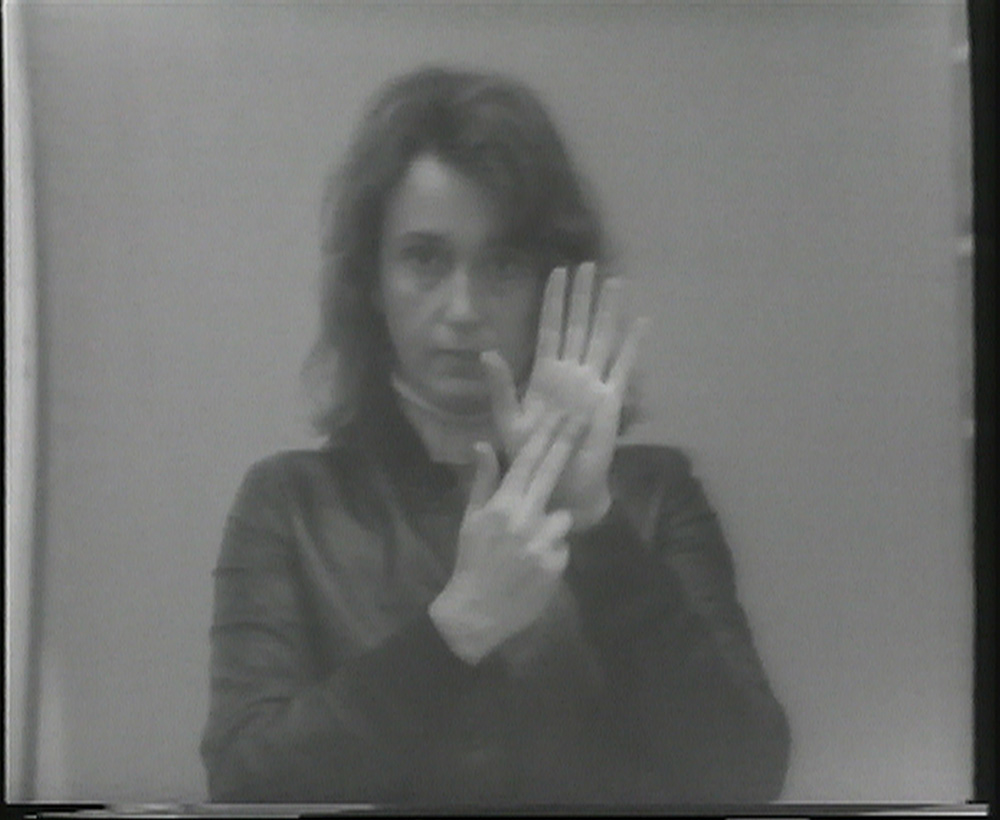
In “Sehtext: Fingergedicht” (Visual Text: Finger Poem) VALIE EXPORT communicates with her fingers. Sign language, as an elision of word and gesture, is investigated in this performance-to-camera work. The artist writes: "The body as carrier of information, in order to convey both spiritual and physical contents, is the reflected image of the internal/psychological and of the external/institutional reality."
VALIE EXPORT, Prof. Dr. h.c.media and performance artist, filmmaker born in Linz, lives and works in Vienna VALIE EXPORT’s artistic work comprises: video environments, digital photography, installation, body performances, feature films, experimental films, documentaries, Expanded Cinema, conceptual photography, body-material interactions, Persona Performances, laser installations, objects, sculptures, texts on contemporary art history and feminism. VALIE EXPORT is one of the most important pioneers on conceptual media art, performance and film. 1967 invention of her artist name VALIE EXPORT: an artistic concept and logo to be written in capital letters only VALIE EXPORT takes part at the documenta 12 2007, and documenta 6, 1977, in Kassel 1985 nomination of EXPORT's feature film “Die Praxis der Liebe”, screenplay and direction, for the Golden Bear at the Berlin International Film Festival Since 1975 curatorial projects, international symposiums, exhibitions and film programmes Her works are in international collections like Centro Pompidou, Paris, Tate Modern, London, Reine Sophia, Madrid, MOMA, New York, MOCA, Los Angeles ect. Since 1968 participation in international exhibitions, for example: Centre Georges Pompidou, Paris; The Museum of Modern Art, New York; Institute of Contemporary Art, London; Venice Biennale, Venezia; documenta, Kassel; MoCA, Los Angeles; Stedelijk Museum, Amsterdam; MUMOK, Vienna; Generali Foundation, Vienna; P.S.1 Contemporary Art Center, New York; Shanghai Art Museum, Shanghai; Palais des Beaux-Arts, Bruxelles; Tate Modern, London; Metropolitan Museum of Art, Seoul, Korea; Metropolitan Museum, New York; ars electronica, Linz/Austria. Screenings at international film and video festivals, for example London Underground Film Festival; London International Film Festival; Filmex, Los Angeles; Berlin International Film Festival as well as film festivals in Cannes, Montréal, Vancouver, San Francisco, Locarno, Hongkong, Sydney, New York, etc.
Catalogue : 2018Anagrammatische Komposition mit Würfelspiel (nach W.A. Mozart, Klavier) für Sopransaxophon von | Video | 0 | color | 5:48 | Austria | 2010
Valie Export
Anagrammatische Komposition mit Würfelspiel (nach W.A. Mozart, Klavier) für Sopransaxophon von
Video | 0 | color | 5:48 | Austria | 2010
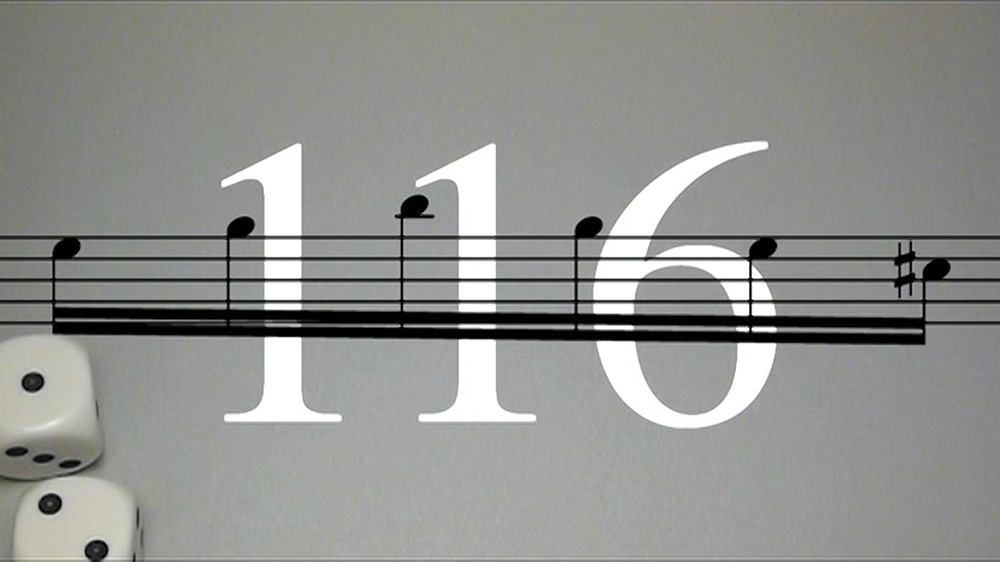
This video was made for a commission EXPORT received from the Theater an der Wien opera house for an installation on the occasion of the Mozart Year 2010. It shows in short intervals various bars of music, behind each one changing number combinations - 13, 167, 123, 16, 4 etc. - and two dice that roll into the picture displaying various numbers of dots. EXPORT's hand can be seen now and then, reaching for the dice. The images are accompanied by melodies played on a soprano saxophone. The springboard for this video work is a manuscript attributed to Wolfgang Amadeus Mozart titled "Anleitung zum Componieren von Walzern vermittels zweier Würfel" ("Instructions for Composing Waltzes Using Two Dice"), published posthumously in 1793. Mozart's interactive composition piece is based on a system for a musical dice game invented in the mid-18th century which is the oldest known method for combining numbers with the help of a random generator, in this case, dice. In this video, EXPORT summons connections to earlier photographic works and installations in which dice and randomness play a central role.
VALIE EXPORT, Prof. Dr. h.c.media and performance artist, filmmaker born in Linz, lives and works in Vienna VALIE EXPORT’s artistic work comprises: video environments, digital photography, installation, body performances, feature films, experimental films, documentaries, Expanded Cinema, conceptual photography, body-material interactions, Persona Performances, laser installations, objects, sculptures, texts on contemporary art history and feminism. VALIE EXPORT is one of the most important pioneers on conceptual media art, performance and film. 1967 invention of her artist name VALIE EXPORT: an artistic concept and logo to be written in capital letters only VALIE EXPORT takes part at the documenta 12 2007, and documenta 6, 1977, in Kassel 1985 nomination of EXPORT's feature film “Die Praxis der Liebe”, screenplay and direction, for the Golden Bear at the Berlin International Film Festival Since 1975 curatorial projects, international symposiums, exhibitions and film programmes Her works are in international collections like Centro Pompidou, Paris, Tate Modern, London, Reine Sophia, Madrid, MOMA, New York, MOCA, Los Angeles ect. Since 1968 participation in international exhibitions, for example: Centre Georges Pompidou, Paris; The Museum of Modern Art, New York; Institute of Contemporary Art, London; Venice Biennale, Venezia; documenta, Kassel; MoCA, Los Angeles; Stedelijk Museum, Amsterdam; MUMOK, Vienna; Generali Foundation, Vienna; P.S.1 Contemporary Art Center, New York; Shanghai Art Museum, Shanghai; Palais des Beaux-Arts, Bruxelles; Tate Modern, London; Metropolitan Museum of Art, Seoul, Korea; Metropolitan Museum, New York; ars electronica, Linz/Austria. Screenings at international film and video festivals, for example London Underground Film Festival; London International Film Festival; Filmex, Los Angeles; Berlin International Film Festival as well as film festivals in Cannes, Montréal, Vancouver, San Francisco, Locarno, Hongkong, Sydney, New York, etc.
Catalogue : 2018Hauchtext : Liebesgedicht | 0 | 0 | | 2:23 | Austria | 1970
Valie Export
Hauchtext : Liebesgedicht
0 | 0 | | 2:23 | Austria | 1970
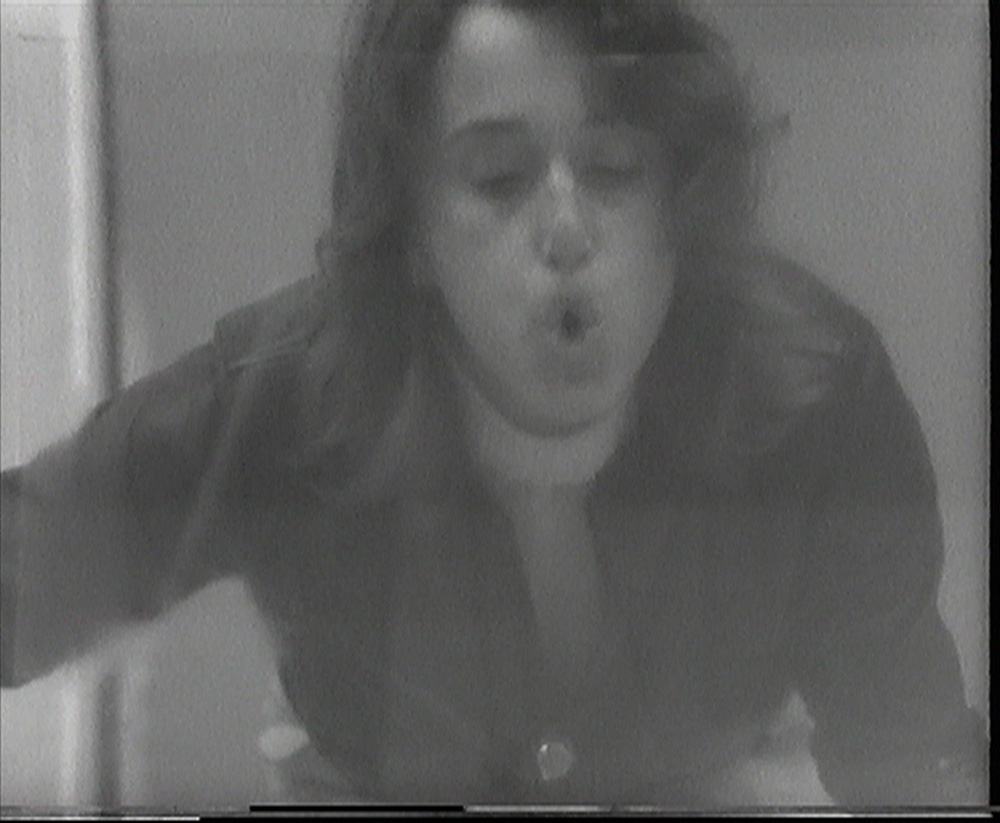
In this video poem VALIE EXPORT speaks to the screen; the body-language action involving her loud, sensual, breathy voice is the main event, while the semantic content as "love-poem" is deliberately more of an afterthought. The focus is instead on the moment of not saying something out loud, of pre-linguistic expression. Only when the viewer follows step-by-step the letters breathed onto the glass pane as well as the performer`s head movements does a sentence become decipherable, which says: "I love you".
VALIE EXPORT, Prof. Dr. h.c.media and performance artist, filmmaker born in Linz, lives and works in Vienna VALIE EXPORT’s artistic work comprises: video environments, digital photography, installation, body performances, feature films, experimental films, documentaries, Expanded Cinema, conceptual photography, body-material interactions, Persona Performances, laser installations, objects, sculptures, texts on contemporary art history and feminism. VALIE EXPORT is one of the most important pioneers on conceptual media art, performance and film. 1967 invention of her artist name VALIE EXPORT: an artistic concept and logo to be written in capital letters only VALIE EXPORT takes part at the documenta 12 2007, and documenta 6, 1977, in Kassel 1985 nomination of EXPORT's feature film “Die Praxis der Liebe”, screenplay and direction, for the Golden Bear at the Berlin International Film Festival Since 1975 curatorial projects, international symposiums, exhibitions and film programmes Her works are in international collections like Centro Pompidou, Paris, Tate Modern, London, Reine Sophia, Madrid, MOMA, New York, MOCA, Los Angeles ect. Since 1968 participation in international exhibitions, for example: Centre Georges Pompidou, Paris; The Museum of Modern Art, New York; Institute of Contemporary Art, London; Venice Biennale, Venezia; documenta, Kassel; MoCA, Los Angeles; Stedelijk Museum, Amsterdam; MUMOK, Vienna; Generali Foundation, Vienna; P.S.1 Contemporary Art Center, New York; Shanghai Art Museum, Shanghai; Palais des Beaux-Arts, Bruxelles; Tate Modern, London; Metropolitan Museum of Art, Seoul, Korea; Metropolitan Museum, New York; ars electronica, Linz/Austria. Screenings at international film and video festivals, for example London Underground Film Festival; London International Film Festival; Filmex, Los Angeles; Berlin International Film Festival as well as film festivals in Cannes, Montréal, Vancouver, San Francisco, Locarno, Hongkong, Sydney, New York, etc.
Catalogue : 2018The voice as performance, act and body. THE PAIN OF UTOPIA. DER SCHMERZ DER UTOPIE | Video | 0 | | 11:34 | Austria | 2007
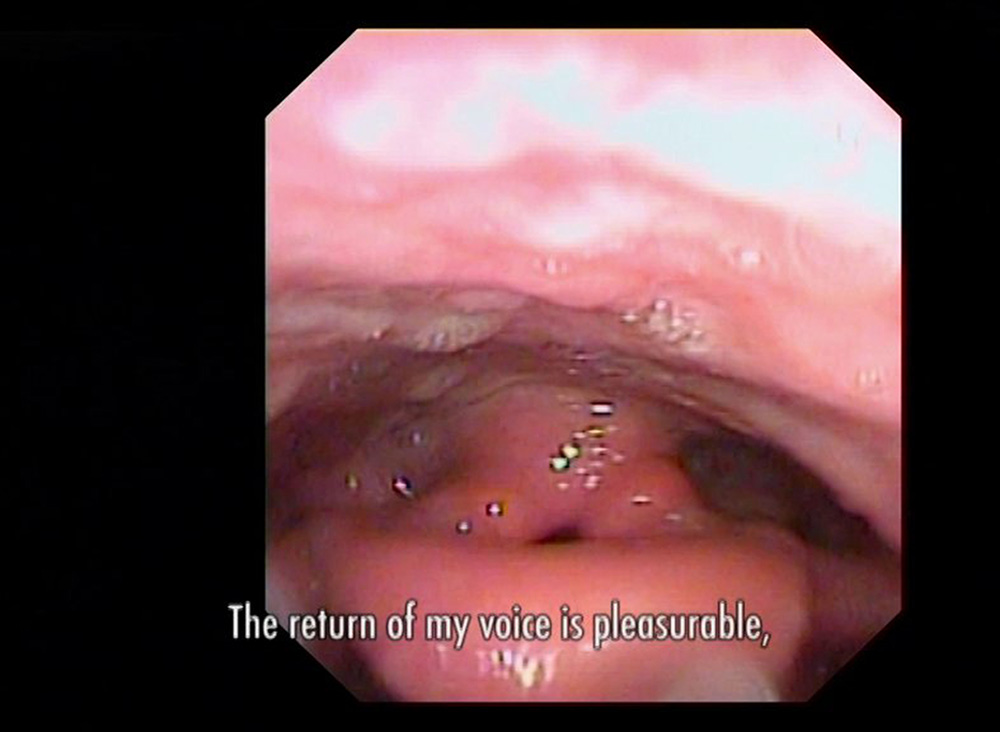
Valie Export
The voice as performance, act and body. THE PAIN OF UTOPIA. DER SCHMERZ DER UTOPIE
Video | 0 | | 11:34 | Austria | 2007
At the 2007 Venice Biennale, I did a 12-minute performance in the Arsenale that showed the vocal folds of my throat while I was speaking. It was called “the voice as performance, act and body”. After a camera was inserted through my nose, the image was shown on large monitors so that you could see my vocal folds in the process of speaking. It was my own text that I read in German, a poetic text about the origin of language. “What is the anatomy of language?” I asked. My answer was just as much a body performance as any of my earlier works. Whenever we think of the body as a vessel for artistic ideas, we somehow always focus on the surface of the body. But the truth is that there is no surface of the body independent of its interior. It’s obvious that the outside of the body is always connected to the inside, to thought processes and to an internal anatomy. (VALIE EXPORT)
VALIE EXPORT, Prof. Dr. h.c.media and performance artist, filmmaker born in Linz, lives and works in Vienna VALIE EXPORT’s artistic work comprises: video environments, digital photography, installation, body performances, feature films, experimental films, documentaries, Expanded Cinema, conceptual photography, body-material interactions, Persona Performances, laser installations, objects, sculptures, texts on contemporary art history and feminism. VALIE EXPORT is one of the most important pioneers on conceptual media art, performance and film. 1967 invention of her artist name VALIE EXPORT: an artistic concept and logo to be written in capital letters only VALIE EXPORT takes part at the documenta 12 2007, and documenta 6, 1977, in Kassel 1985 nomination of EXPORT's feature film “Die Praxis der Liebe”, screenplay and direction, for the Golden Bear at the Berlin International Film Festival Since 1975 curatorial projects, international symposiums, exhibitions and film programmes Her works are in international collections like Centro Pompidou, Paris, Tate Modern, London, Reine Sophia, Madrid, MOMA, New York, MOCA, Los Angeles ect. Since 1968 participation in international exhibitions, for example: Centre Georges Pompidou, Paris; The Museum of Modern Art, New York; Institute of Contemporary Art, London; Venice Biennale, Venezia; documenta, Kassel; MoCA, Los Angeles; Stedelijk Museum, Amsterdam; MUMOK, Vienna; Generali Foundation, Vienna; P.S.1 Contemporary Art Center, New York; Shanghai Art Museum, Shanghai; Palais des Beaux-Arts, Bruxelles; Tate Modern, London; Metropolitan Museum of Art, Seoul, Korea; Metropolitan Museum, New York; ars electronica, Linz/Austria. Screenings at international film and video festivals, for example London Underground Film Festival; London International Film Festival; Filmex, Los Angeles; Berlin International Film Festival as well as film festivals in Cannes, Montréal, Vancouver, San Francisco, Locarno, Hongkong, Sydney, New York, etc.
Catalogue : 2018I turn over the pictures of my voice in my head | Video | 0 | | 11:39 | Austria | 2008
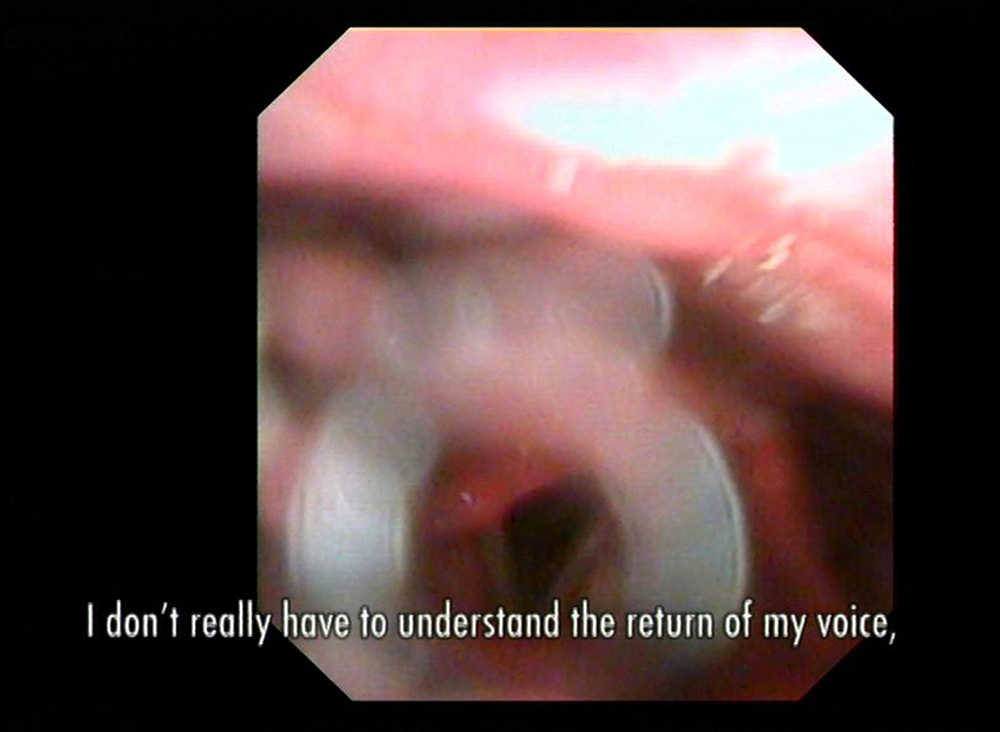
Valie Export
I turn over the pictures of my voice in my head
Video | 0 | | 11:39 | Austria | 2008
The rebellious voice, the split voice. The voice is suture, the voice is seam, the voice is cut, the voice is tear, the voice is my identity, it is not body or spirit, it is not language or image, it is sign, it is a sign of the images, it is a sign of sensuality. It is a sign of symbols, it is boundary. It speaks the “Split Body”, it is hidden in the clothing of the body, it is always somewhere else. The breath of life is its source. (VALIE EXPORT: Segment from the spoken text)
VALIE EXPORT, Prof. Dr. h.c.media and performance artist, filmmaker born in Linz, lives and works in Vienna VALIE EXPORT’s artistic work comprises: video environments, digital photography, installation, body performances, feature films, experimental films, documentaries, Expanded Cinema, conceptual photography, body-material interactions, Persona Performances, laser installations, objects, sculptures, texts on contemporary art history and feminism. VALIE EXPORT is one of the most important pioneers on conceptual media art, performance and film. 1967 invention of her artist name VALIE EXPORT: an artistic concept and logo to be written in capital letters only VALIE EXPORT takes part at the documenta 12 2007, and documenta 6, 1977, in Kassel 1985 nomination of EXPORT's feature film “Die Praxis der Liebe”, screenplay and direction, for the Golden Bear at the Berlin International Film Festival Since 1975 curatorial projects, international symposiums, exhibitions and film programmes Her works are in international collections like Centro Pompidou, Paris, Tate Modern, London, Reine Sophia, Madrid, MOMA, New York, MOCA, Los Angeles ect. Since 1968 participation in international exhibitions, for example: Centre Georges Pompidou, Paris; The Museum of Modern Art, New York; Institute of Contemporary Art, London; Venice Biennale, Venezia; documenta, Kassel; MoCA, Los Angeles; Stedelijk Museum, Amsterdam; MUMOK, Vienna; Generali Foundation, Vienna; P.S.1 Contemporary Art Center, New York; Shanghai Art Museum, Shanghai; Palais des Beaux-Arts, Bruxelles; Tate Modern, London; Metropolitan Museum of Art, Seoul, Korea; Metropolitan Museum, New York; ars electronica, Linz/Austria. Screenings at international film and video festivals, for example London Underground Film Festival; London International Film Festival; Filmex, Los Angeles; Berlin International Film Festival as well as film festivals in Cannes, Montréal, Vancouver, San Francisco, Locarno, Hongkong, Sydney, New York, etc.
Catalogue : 2018TAPP und TASTKINO, expanded cinema (Tapp und Tastkino, Straßenfilm, Mobiler Film, Körperaktion, social action, TV Produktion) | Video | 0 | | 1:11 | Austria | 1969
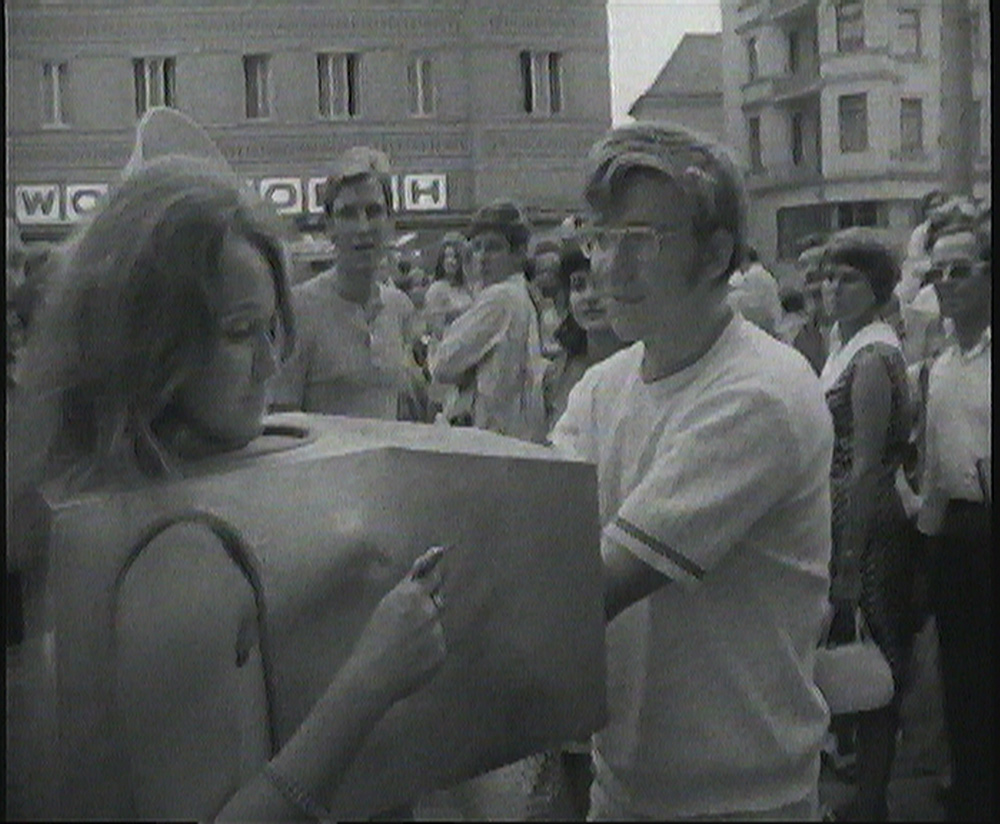
Valie Export
TAPP und TASTKINO, expanded cinema (Tapp und Tastkino, Straßenfilm, Mobiler Film, Körperaktion, social action, TV Produktion)
Video | 0 | | 1:11 | Austria | 1969
As usual, the film is “shown” in the dark. But the cinema has shrunk somewhat – only two hands fit inside it. To see (i.e. feel, touch) the film, the viewer (user) has to stretch his hands through the entrance to the cinema. At last, the curtain which formerly rose only for the eyes now rises for both hands. The tactile reception is the opposite of the deceit of voyeurism. For as long as the citizen is satisfied with the reproduced copy of sexual freedom, the state is spared the sexual revolution. “Tap and Touch Cinema” is an example of how re-interpretation can activate the public. (VALIE EXPORT) This outdoor action on Munich's Stachus square translates the concept of expanded cinema and the cinema's fairground roots into the “first immediate women’s film”, as the artist describes her “Tap and Touch Cinema”. “Public” accessibility – restricted to 30 seconds per person – is noisily proclaimed by Peter Weibel. A direct demonstration of cinema as a projection space for male fantasies, this still ironic transgression of the border between art and life is an early indication of VALIE EXPORT’s often risky, but always resolute, deployment of her own body in later works.
VALIE EXPORT, Prof. Dr. h.c.media and performance artist, filmmaker born in Linz, lives and works in Vienna VALIE EXPORT’s artistic work comprises: video environments, digital photography, installation, body performances, feature films, experimental films, documentaries, Expanded Cinema, conceptual photography, body-material interactions, Persona Performances, laser installations, objects, sculptures, texts on contemporary art history and feminism. VALIE EXPORT is one of the most important pioneers on conceptual media art, performance and film. 1967 invention of her artist name VALIE EXPORT: an artistic concept and logo to be written in capital letters only VALIE EXPORT takes part at the documenta 12 2007, and documenta 6, 1977, in Kassel 1985 nomination of EXPORT's feature film “Die Praxis der Liebe”, screenplay and direction, for the Golden Bear at the Berlin International Film Festival Since 1975 curatorial projects, international symposiums, exhibitions and film programmes Her works are in international collections like Centro Pompidou, Paris, Tate Modern, London, Reine Sophia, Madrid, MOMA, New York, MOCA, Los Angeles ect. Since 1968 participation in international exhibitions, for example: Centre Georges Pompidou, Paris; The Museum of Modern Art, New York; Institute of Contemporary Art, London; Venice Biennale, Venezia; documenta, Kassel; MoCA, Los Angeles; Stedelijk Museum, Amsterdam; MUMOK, Vienna; Generali Foundation, Vienna; P.S.1 Contemporary Art Center, New York; Shanghai Art Museum, Shanghai; Palais des Beaux-Arts, Bruxelles; Tate Modern, London; Metropolitan Museum of Art, Seoul, Korea; Metropolitan Museum, New York; ars electronica, Linz/Austria. Screenings at international film and video festivals, for example London Underground Film Festival; London International Film Festival; Filmex, Los Angeles; Berlin International Film Festival as well as film festivals in Cannes, Montréal, Vancouver, San Francisco, Locarno, Hongkong, Sydney, New York, etc.
Catalogue : 2018Syntagma | Experimental film | 16mm | | 17:46 | Austria | 1983
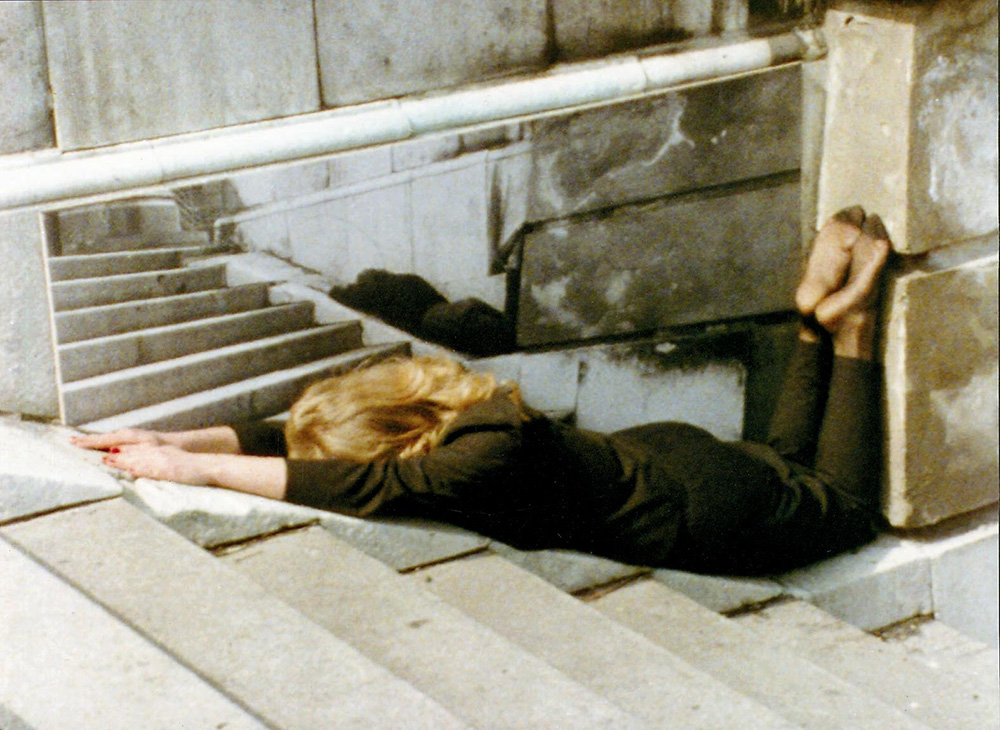
Valie Export
Syntagma
Experimental film | 16mm | | 17:46 | Austria | 1983
"Syntagma” is like a fixed gaze that someone exchanges with himself/herself as if he/she were two people’s eyes staring at oneself and the unyielding gaze of the camera. All that can be seen through these two sets of eyes is the staring act itself. Identity reflections, the mirror as something impenetrable, like an investigating veil. The more the mirror reflects, the more it moves toward forgetfulness as an impenetrable object, even if it imprints itself with images. (VALIE EXPORT)
VALIE EXPORT, Prof. Dr. h.c.media and performance artist, filmmaker born in Linz, lives and works in Vienna VALIE EXPORT’s artistic work comprises: video environments, digital photography, installation, body performances, feature films, experimental films, documentaries, Expanded Cinema, conceptual photography, body-material interactions, Persona Performances, laser installations, objects, sculptures, texts on contemporary art history and feminism. VALIE EXPORT is one of the most important pioneers on conceptual media art, performance and film. 1967 invention of her artist name VALIE EXPORT: an artistic concept and logo to be written in capital letters only VALIE EXPORT takes part at the documenta 12 2007, and documenta 6, 1977, in Kassel 1985 nomination of EXPORT's feature film “Die Praxis der Liebe”, screenplay and direction, for the Golden Bear at the Berlin International Film Festival Since 1975 curatorial projects, international symposiums, exhibitions and film programmes Her works are in international collections like Centro Pompidou, Paris, Tate Modern, London, Reine Sophia, Madrid, MOMA, New York, MOCA, Los Angeles ect. Since 1968 participation in international exhibitions, for example: Centre Georges Pompidou, Paris; The Museum of Modern Art, New York; Institute of Contemporary Art, London; Venice Biennale, Venezia; documenta, Kassel; MoCA, Los Angeles; Stedelijk Museum, Amsterdam; MUMOK, Vienna; Generali Foundation, Vienna; P.S.1 Contemporary Art Center, New York; Shanghai Art Museum, Shanghai; Palais des Beaux-Arts, Bruxelles; Tate Modern, London; Metropolitan Museum of Art, Seoul, Korea; Metropolitan Museum, New York; ars electronica, Linz/Austria. Screenings at international film and video festivals, for example London Underground Film Festival; London International Film Festival; Filmex, Los Angeles; Berlin International Film Festival as well as film festivals in Cannes, Montréal, Vancouver, San Francisco, Locarno, Hongkong, Sydney, New York, etc.
Catalogue : 2018Selbstportrait mit Kopf | Video | 0 | | 4:8 | Austria | 1967
Valie Export
Selbstportrait mit Kopf
Video | 0 | | 4:8 | Austria | 1967
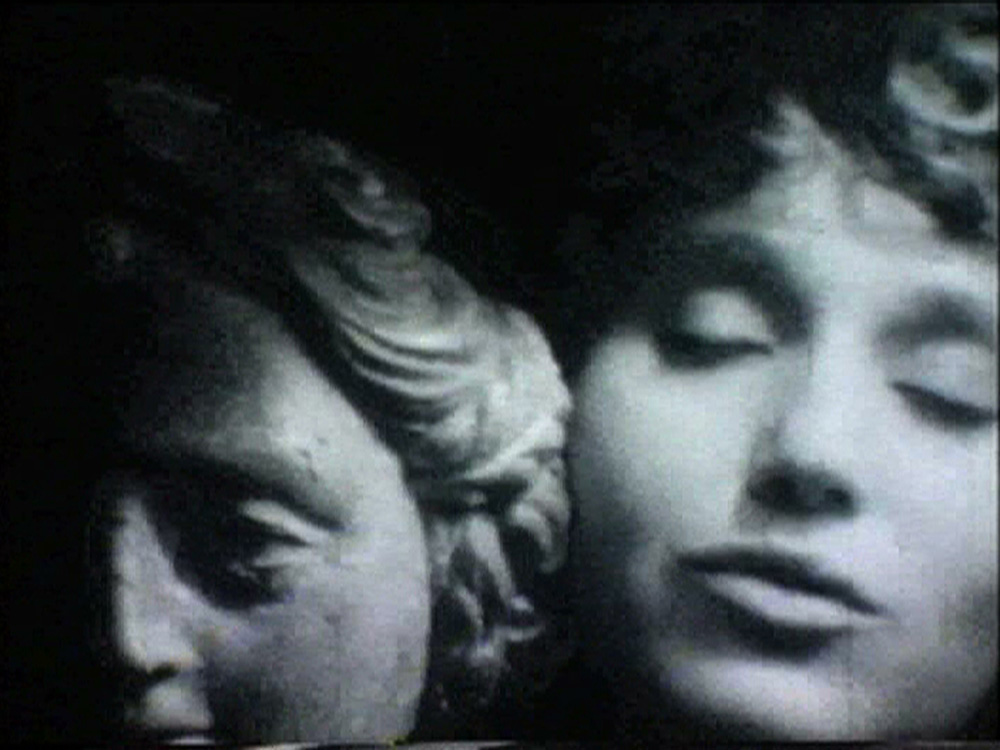
In her first “film self-portrait”, VALIE EXPORT wears an attention-getting curly wig and caresses a woman´s breasts in slow motion, then lasciviously closes and opens her eyes. The carefully applied makeup and wig tell of disguise and acting, and are simultaneously beautiful and terribly stony like the anonymous woman´s head. The brevity and slow speed are reminiscent of Andy Warhol´s Screen Tests, in which every single one of the face´s movements become visible.
VALIE EXPORT, Prof. Dr. h.c.media and performance artist, filmmaker born in Linz, lives and works in Vienna VALIE EXPORT’s artistic work comprises: video environments, digital photography, installation, body performances, feature films, experimental films, documentaries, Expanded Cinema, conceptual photography, body-material interactions, Persona Performances, laser installations, objects, sculptures, texts on contemporary art history and feminism. VALIE EXPORT is one of the most important pioneers on conceptual media art, performance and film. 1967 invention of her artist name VALIE EXPORT: an artistic concept and logo to be written in capital letters only VALIE EXPORT takes part at the documenta 12 2007, and documenta 6, 1977, in Kassel 1985 nomination of EXPORT's feature film “Die Praxis der Liebe”, screenplay and direction, for the Golden Bear at the Berlin International Film Festival Since 1975 curatorial projects, international symposiums, exhibitions and film programmes Her works are in international collections like Centro Pompidou, Paris, Tate Modern, London, Reine Sophia, Madrid, MOMA, New York, MOCA, Los Angeles ect. Since 1968 participation in international exhibitions, for example: Centre Georges Pompidou, Paris; The Museum of Modern Art, New York; Institute of Contemporary Art, London; Venice Biennale, Venezia; documenta, Kassel; MoCA, Los Angeles; Stedelijk Museum, Amsterdam; MUMOK, Vienna; Generali Foundation, Vienna; P.S.1 Contemporary Art Center, New York; Shanghai Art Museum, Shanghai; Palais des Beaux-Arts, Bruxelles; Tate Modern, London; Metropolitan Museum of Art, Seoul, Korea; Metropolitan Museum, New York; ars electronica, Linz/Austria. Screenings at international film and video festivals, for example London Underground Film Festival; London International Film Festival; Filmex, Los Angeles; Berlin International Film Festival as well as film festivals in Cannes, Montréal, Vancouver, San Francisco, Locarno, Hongkong, Sydney, New York, etc.
Catalogue : 2018BODY TAPE | Video | 0 | | 4:2 | Austria | 1970
Valie Export
BODY TAPE
Video | 0 | | 4:2 | Austria | 1970
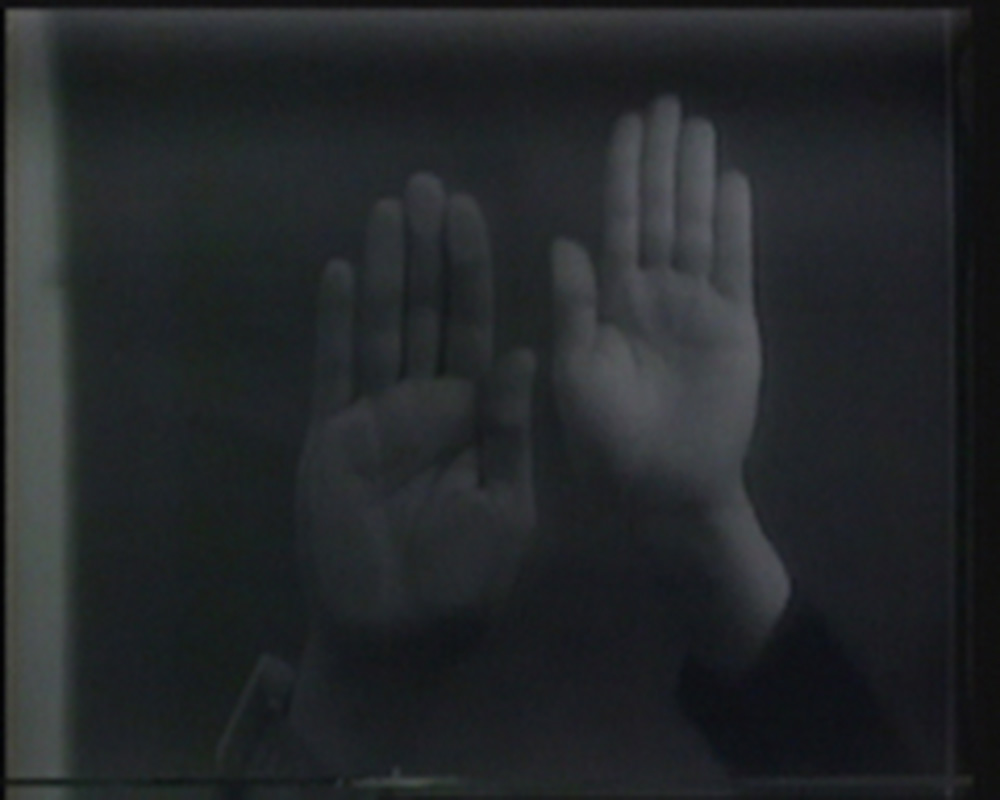
A short videotape showing a frontal view of VALIE EXPORT's semi-figure as she forms various signs by hand and lines them up in a row throughout the tape. It is a sign language using only the fingers and hands, a poem without words or movement of the lips. At the end, the following German text appears which – freely adapting the philosopher Martin Heidegger – suggests a possible theoretical frame of reference: “Ich sage die zeige mit den Zeichen der Sage frei nach Heidegger” (“I say the showing with the signs of the legend”).
VALIE EXPORT, Prof. Dr. h.c.media and performance artist, filmmaker born in Linz, lives and works in Vienna VALIE EXPORT’s artistic work comprises: video environments, digital photography, installation, body performances, feature films, experimental films, documentaries, Expanded Cinema, conceptual photography, body-material interactions, Persona Performances, laser installations, objects, sculptures, texts on contemporary art history and feminism. VALIE EXPORT is one of the most important pioneers on conceptual media art, performance and film. 1967 invention of her artist name VALIE EXPORT: an artistic concept and logo to be written in capital letters only VALIE EXPORT takes part at the documenta 12 2007, and documenta 6, 1977, in Kassel 1985 nomination of EXPORT's feature film “Die Praxis der Liebe”, screenplay and direction, for the Golden Bear at the Berlin International Film Festival Since 1975 curatorial projects, international symposiums, exhibitions and film programmes Her works are in international collections like Centro Pompidou, Paris, Tate Modern, London, Reine Sophia, Madrid, MOMA, New York, MOCA, Los Angeles ect. Since 1968 participation in international exhibitions, for example: Centre Georges Pompidou, Paris; The Museum of Modern Art, New York; Institute of Contemporary Art, London; Venice Biennale, Venezia; documenta, Kassel; MoCA, Los Angeles; Stedelijk Museum, Amsterdam; MUMOK, Vienna; Generali Foundation, Vienna; P.S.1 Contemporary Art Center, New York; Shanghai Art Museum, Shanghai; Palais des Beaux-Arts, Bruxelles; Tate Modern, London; Metropolitan Museum of Art, Seoul, Korea; Metropolitan Museum, New York; ars electronica, Linz/Austria. Screenings at international film and video festivals, for example London Underground Film Festival; London International Film Festival; Filmex, Los Angeles; Berlin International Film Festival as well as film festivals in Cannes, Montréal, Vancouver, San Francisco, Locarno, Hongkong, Sydney, New York, etc.
Jaime Vallaure, Rafael LAMATA, Daniel MUSICCO
Catalogue : 2007El ABC de la Performance | Experimental video | dv | color | 35:22 | Spain | 1995
Jaime Vallaure, Rafael LAMATA, Daniel MUSICCO
El ABC de la Performance
Experimental video | dv | color | 35:22 | Spain | 1995
This first series of works presents basic relations and minor conflicts between human beings. This seeming lack of thematic ambition allows the artist better to focus on essential questions related to the space/time dimensions, the essence of the moving image. The artist works using non professional videos. One of the pieces selected for this catalogue is from this first period: "Tía Berti". This short piece works with autobiographic material, contrasting two ages, two gazes, two smiles; in short, two ways of being in the world. The narrative axis of the video is based on that photographic pose that video captures very differently, from the still image: that waiting in silence for the time of the shot, a time which reveals a more intimate side of the portrayed character, who is unaware of it. The most important early work of the artist are ?Yo creí que había que decir algo?, ?Un regalín para la hija del Portero?, ?Las fotos salen mejor sin ojos? and ?Por favor, no me saques?. This work is based on non professional videos. The next period is represented by the piece "Sería hacia el año 1918", made with Daniela Músico. This is a work of unequal distribution and acceptance. It perfectly combines its author's concerns both in the artistic and technical fields. It is a chrome recording of an old man wandering aimlessly. At the same time his memories are brought back to the present by a voice-over and thrown to the back of the image as if it was a giant film screen. A glass recycling container is used to metaphorically represent what a fragmented memory is made of: individual memories end up shattering into countless fragments shaping a stack of compact but disunited memory. The third period is represented by "¿Quién es?", and characterized by the use of tourist and travel video material, amateur recordings the sole purpose of which is to preserve a fleeting and irretrievable present moment for the future. In this case, on screen we see Roman ruins, in a fixed shot that allows the veiled appearance of absences in space to acquire emotional intensity. Time allows its traces to emerge from achitectonic ruins, like fragments of ephemeral beings who are never going to return, or almost bodiless vanishing presences, intangible souls with no real entity and which can only create evanescent and flickering shadows. As time passes by, the video works assume a character associated with parallel art and social art. The artist's constant work in performances from 1990 on progressively leads his videographical reflection towards more complex territories, in a perspective which it both formal and structural. Video is no longer seen as the result of a process of analysis and re-elaboration of a perceived reality, but rather the synthesis of a performing and communicative activity in which discourse grounds the construction of a concept. Video is not the starting point but the ending point, the conclusion of a travel, the end of a process, the identification act of an experiment; in short, the conclusion of an investigation. 2 pieces of artwork that have been made together by Rafael Lamata have been chosen for the "ABC of performance" dictionary, which gathers vices and habits of this artistic practice. The video was originally meant to be a conference-performance, and was later changed to be a video, its structure adapting itself to the moving image format, and using the TV broadcast model as a reference. The collaboration with Daniela Músico (who plays the role of the greeting hostess) was crucial to present numbers of interconnected and complex concepts. The next piece of artwork, ?Siete Cuentos para la Carcel de Carabanchel?, was co-directed by Rafael Lamarta. This video is the conclusion of a collective intervention process in the Carabanchel prison, with prisoners. It was shown within the prison and elsewhere, with the purpose of transcending stereotyped languages and find yet unknown formulas in the field of social and personal denouncement.
Born in Asturias in 1965, Jaime Vallaure has a BA in Fine Arts from the Universidad Complutense de Madrid. He began his public artistic activity with video art, and more specifically, with mono-channel works that explore the aesthetics of the everyday and the familiar. Jaime Vallaure is presently collaborating with Rafael Lamata on an intervention in the Spanish pavilion in the 52 Venice Biennial, with their conceptual/performative duo Los Torreznos.
Maximilien Van Aertryck
Catalogue : 2014Icebreakers | Documentary | | color | 14:53 | France, Sweden | 2012
Maximilien Van Aertryck
Icebreakers
Documentary | | color | 14:53 | France, Sweden | 2012
A ferry makes its way through the ice floating in the wintery Baltic Sea. Yet the ice has long since broken inside the ship thanks to the evening`s entertainment: with their presentation, the artists breathe a moment of magic into a world which already seems rather unreal. The film evokes a journey into the unknown, full of nostalgia and hope.
Maximilien Van Aertryck is a French-German filmmaker. He currently lives in Sweden.
Maximilien Van Aertryck
Catalogue : 2017Extramaterial | Documentary | hdv | color | 58:0 | France, Sweden | 2016
Maximilien Van Aertryck
Extramaterial
Documentary | hdv | color | 58:0 | France, Sweden | 2016
Tough, initiative taking men, frail and defenceless women, Beretta guns and hoarse mafia boss voices. EXTRA MATERIAL is a behind-the-scenes film which closely studies the making of an artistically acclaimed mafia movie. The goal is to trigger a reflection on the content and attitudes that are reproduced in and throughout cinema.
Maximilien Van Aertryck (director) was born in 1989 in Paris and Axel Danielson (producer) in 1976 in Vittskövle. They collaborate at Plattform Produktion in Gothenburg since 2013, where they also work together with Ruben Östlund. "Our interest lies in the potential of the moving image and our ambition is that the images we produce have a critical and humorous approach to the stream of images that surround us."
Oscar Van Alphen
Catalogue : 2008The Wars | Experimental film | | color and b&w | 32:0 | Netherlands | 2006
Oscar Van Alphen
The Wars
Experimental film | | color and b&w | 32:0 | Netherlands | 2006
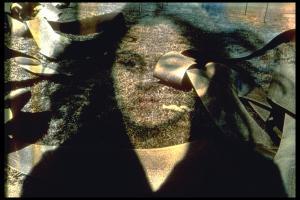
Oscar van Alphen ? the Wars In The Wars, photographer Oscar van Alphen combines an adapted version of Georges Bataille?s text Madame Edwarda with images drawn from his archive. Madame Edwarda (published in 1941 under the pseudonym Pierre Angélique) is a story without beginning or end, in which a male first-person narrator and a prostitute encounter each other in Paris by night. Madame Edwarda is about lust, power, anxiety, desire and humiliation. Van Alphen uses Bataille?s text as a metaphor for the perversity of social structures, for the uncontrollability of political and economic power, and the effects these have on human dignity. He juxtaposes pictures from the decaying and almost deserted industrial regions in northern France and of the 1968 student rebellion in Paris, with the pornographic text that came into being during the first years of WW II. The Wars is a restored version of the projection that was part of the 1984-1985 installation De Oorlogen. Combining still and moving images, set to a voice-over, it was originally projected (using 6 slide projectors and a 16mm film projector) in a space also displaying photographic prints. The 2006 restoration has digitally scanned and re-mastered the visuals, and created an English language version of the original Dutch soundtrack to create a single screen version of the piece. (The Wars will be the core of the retrospective exhibition on the life and work of Oscar van Alphen, entitled I distrust the image, which will be seen from January 19 through March 9 21, 2007, in the Nederlands fotomuseum in Rotterdam. The ?remake? of The Wars will be published on DVD by Paradox, in Dutch and English versions, to accompany the exhibition. At the same time, in its series Monografieën Nederlandse Fotografen, Focus Publishing will bring out a monograph written by Frits Gierstberg, art historian and director of exhibitions at the Nederlands fotomuseum in Rotterdam.)
Oscar van Alphen (b. 1923) is a photographer and writer. He published his first photobook in 1958 (Kinderen in de grote stad/Children in The Big City). He worked for newspapers during the sixties, mainly focusing on street events. From 1972-1979, a highly experimental period in the visual arts and the theatre scene, he provided a weekly theatre column for the magazine Vrij Nederland. His 1978 publication Het Rijke Onvermogen (Prosperous Impotence) and his 1982 book on Palestine take a strong political position. After 1980 he starts to experiment with photographs and text, both on a formal as well as an intellectual level, leading to publications as Het Moment Voorbij (Beyond The Moment, 1982) and De slak op het grasveld (The Snail in The Meadow, 1991). The 1984-1985 audiovisual production De Oorlogen (The Wars, in 2006 complemented by an English soundtrack) can be considered his chef d?oeuvre.
Michiel Van Bakel
Catalogue : 2023What Wide Web? | Experimental video | 4k | color and b&w | 5:0 | Netherlands | 2022
Michiel Van Bakel
What Wide Web?
Experimental video | 4k | color and b&w | 5:0 | Netherlands | 2022
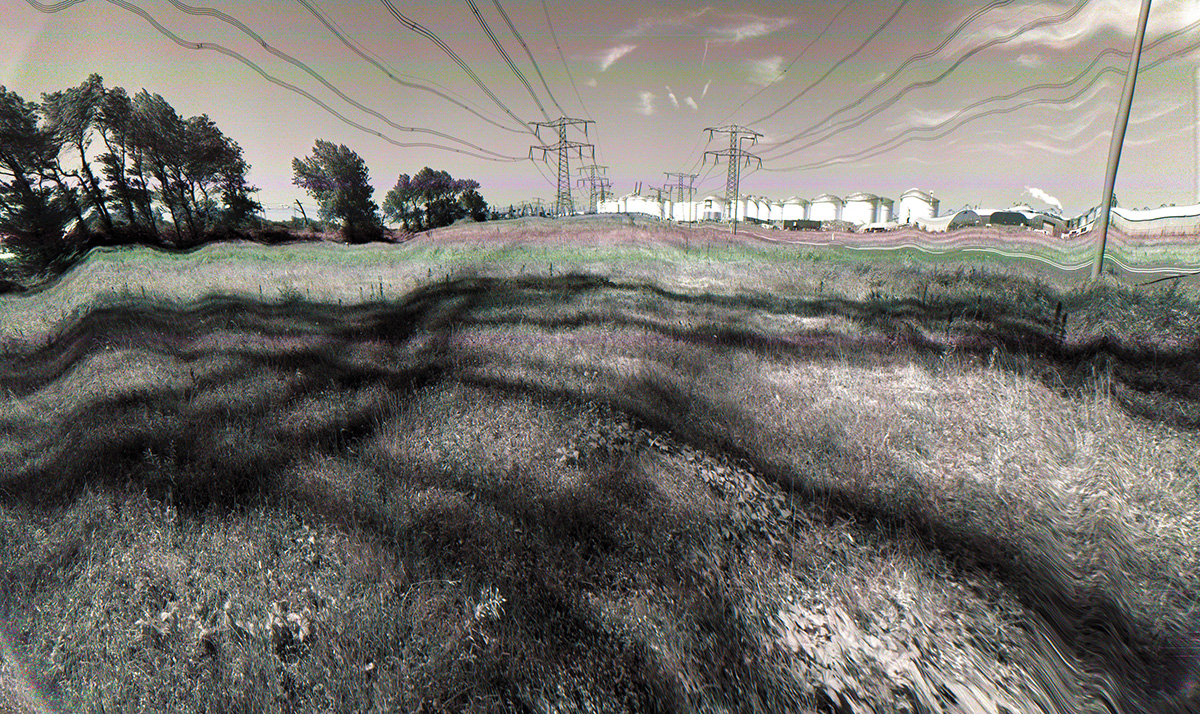
For some years Wood Wide Web is the magic phrase to describe the web of roots, fungi and bacteria helping to connect trees and plants to one another. In ‘What Wide Web?’ Van Bakel depicts the surreal wasteland of Rotterdam Maasvlakte and its forest of pylons. After a bumpy ride we zoom in on the improbable beauty germinating underneath high voltage lines, a living part of our world hardly ever noticed. The plants that grow below the energy-web are shown as in a digital herbarium. We can ask ourselves: are industry and nature evolving more into co-existence? Background info: Location: Rotterdam harbour, Beerweg Maasvlakte, a place that used to be a nature reserve called ‘de Beer’. Sound: Contact mics on humming power-pylons. Geophones in the earth on the spot that record the sound of falling raindrops. Camera: Animation of still photographs made with home-built scannercamera. Instead of bringing plants to a picture-scanner in his studio, the artist dragged the scanner on site over soil and green. “A forest ecology is a delicate one. If the forest perishes, its fauna may go with it. The Atshean word for world is also the word for forest.” Ursula K. Le Guin from The Word for World is Forest.
Michiel van Bakel studied astronomy, film/photography (Psychopolis; Frans Zwartjes) and psychology for several years before he chose for fine art, at art school. Van Bakel expresses himself artistically in film and videos, sculpture and installations. His work focuses on people and their surroundings, often resulting in a poetic reality. It conveys a fascination for the tension between humans and technology, and the perception of time in our disrupted ecosystems. Van Bakel lives and works in Rotterdam.
Catalogue : 2022Bogwaters | Video | 4k | color and b&w | 4:30 | Netherlands | 2021
Michiel Van Bakel
Bogwaters
Video | 4k | color and b&w | 4:30 | Netherlands | 2021
In a Dutch wetland nature reserve we move across the water surface.* The images accelerate and change to infrared; we see the nature sanctuary as through the eyes of the dragonfly that can 'see' many times faster than a human being possibly can perceive. The flight ends where several canals meet; by the water at the foot of a silent witness, a timeless, overgrown bunker. *Striking fact: the former peat exploitation waterways of the Peel bog area have grown themselves into protected nature reserves in the midst of extremely industrial livestock production.
Michiel van Bakel (1966, Deurne NL) studied astronomy (Leiden university) and psychology (Nijmegen university) for several years before he chose for autonomous visual art, at art school (Den Haag and Arnhem). Van Bakel expresses himself through film and videos, sculpture and installations. His work focuses on people and their surroundings, often resulting in a poetic reality. It conveys a fascination for the tension between man and technology, perception of time in our delicate man-made ecosystem.
Catalogue : 2021P-9830 | Experimental film | 4k | color and b&w | 5:10 | Netherlands | 2020
Michiel Van Bakel
P-9830
Experimental film | 4k | color and b&w | 5:10 | Netherlands | 2020
The natural and technological landscape in the Rotterdam port meet in a scouring way. This phenomenon is captured with a glass camera eye. A slightly more literal eye than usual in this analogy: the glass lens is hollow, hand-blown and only functions as a lens when filled with water. The water in the lens is extracted from the channel and sea on the spot. Small contaminants from the water are thus indirectly recorded as pollution particles that float through the water lens, just like the strings that everyone sometimes sees floating in front of his or her eye. The Dutch water landscape is photographed through the water from the landscape in front of us. The shooting technique used is just as hybrid as the subject itself. The camera is a DIY digital model with an old flatbed scanner as a light-sensitive plate. This produces miraculous time-space deformations, for example on the rotor blades of the windmills. These are not retrofitted filters, but deformations that take place inside the camera. Time proves to be all the more elastic. In addition, a game is played with the photographic image of the material world and its classical elements: water, earth, air and fire. Despite the corona crisis prevailing at the time of the shooting, the harbor appears to be an enormous living entity, a robot or a Leviathan with its own pulse of life.
Michiel van Bakel (1966, Deurne NL) studied astronomy (Leiden university) and psychology (Nijmegen university) for several years before he chose for autonomous visual art, at art school (Den Haag and Arnhem). Van Bakel expresses himself through film and videos, sculpture and installations. His work focuses on people and their surroundings, often resulting in a poetic reality. It conveys a fascination for the tension between man and technology, perception of time in our delicate man-made ecosystem. ‘When I look around, I see a lot of technology that aims to constrain reality in predictability, by categorizing and automating. I want to use technology to evoke wonder and transcend reality and predictability. I like to visualize things that were previously unseen and, in that sense, enrich my experience of reality. That is for me the incentive to make use of experimental video and animation techniques. Devices such as cameras, scanners and image processing algorithms I see as an extension of my senses. With these tools I manipulate images that are like anchors in time for me, but also images from my urban backyard: my 'condition urbaine.' Recurring themes are examining human perception, experiencing time, disorientation and instability.‘
Catalogue : 2008Inner Machine | Experimental video | dv | color and b&w | 0:0 | Netherlands | 2007
Michiel Van Bakel
Inner Machine
Experimental video | dv | color and b&w | 0:0 | Netherlands | 2007
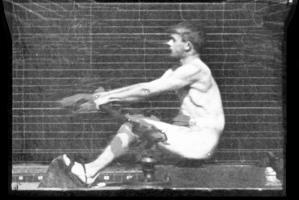
A reflection on relative movements in manipulated time. A visual poem. In comes nightfall Big Dipper is rising Aeon old carbon man burning with oxygen Well drilled soil pale sanded sun Crude black oil of millennia gone Dwellings are moving reflecting the day Blue lights of dawn blown astray
Michiel van Bakel studied astronomy and psychology for several years before he chose for free expression at art academy. Van Bakel has made films and videos as well as sculptures (bronze, steel, plastics) and interactive multi-media-installations. In these he combines the elementary foundations of photography and video with digital animation techniques. While his approach is technical, his work focuses on people, often resulting in a poetic reality.
Martijn Van Boven
Catalogue : 2008Interfield | Experimental video | dv | color | 6:40 | Netherlands | 2007
Martijn Van Boven
Interfield
Experimental video | dv | color | 6:40 | Netherlands | 2007
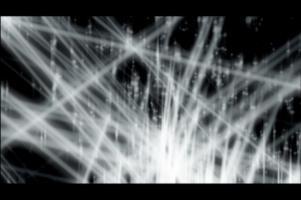
nterfield is a description of a imaginary universe, made visible via abstract imagery and a electronic drone. The work ?Interfield? refers to a position of the audience from where they perceive an environment from which they are not part of. From this position they experience how both media are slightly unfolding in to an autonomous composition scheme. Until a point is reached where both the audio and the image are colliding into a synchronomous point in time. Starting from this point on they continue in a mild symbiosis, to develop endlessly in time.
The work of Martijn van Boven (1977, the Netherlands) lies in the field of experimental film and computer art. Combing the techniques and possibilities of modern image processing and creation within the context of the experimental film and early computer generated films. As well the abstract films of Stan Brakhage and computer art have an influence on his work and thoughts about the creation of abstract images in relation to film. Martijn van Boven studied at the Royal Art Academy in The Hague ( Holland), at the Image and Sound department. His work comes in a wide variety of video-installations, films, collaborationswith composers and Live Cinema performances.His work has been shown at numerous festivals world-wide such as: IFF Rotterdam, State X New Forms, Sonic Acts, Holland Festival, Five Days Off, FICCO (Mexico City, Mexico), RIKZ (Riga, Latvia),SKIF-9 (st. Petersburg, Russia) and Transmediale (Berlin, Germany). Since 2000 Martijn van Boven works as a free-lance film and video curator. Focusing on the avant-garde film and abstract cinema. Martijn van Boven teaches audio-visual Design at the Art Academyof Arnhem (the Netherlands). In 2003 he co-founded the new media art center <>TAG (the Hague, Holland). He lives and works in The Hague Holland.
Meltse Van Coillie
Catalogue : 2019Elephantfish | Experimental doc. | 0 | color | 27:18 | Belgium | 2018
Meltse Van Coillie
Elephantfish
Experimental doc. | 0 | color | 27:18 | Belgium | 2018
We find ourselves aboard of a cargo ship, drifting in an endless sea. This vast emptiness in time and space is something the sailors cope with in their own ways. Imagination rises from beneath the surface and gradually takes the helm…
Meltse Van Coillie (°1992) is currently based in Antwerp. She studied Communicational Sciences at the University of Leuven, with a Master in Film Studies at the University of Ghent. Following these years full of theoretical research, she took part in the Erasmus Mundus Master DOC NOMADS - a course in documentary filmmaking to acquire more practical skills in the field. Lisbon and Budapest were the setting for the numerous films made during this course. In 2015 she moved back to Belgium and started to take classes at KASK, School of Arts in Ghent. In 2018 she graduated as Master in Audiovisual Arts with her graduation film `elephantfish`.
Michael Van Den Abeele
Catalogue : 2009the Sausage Party #2 (the mud club) | Video installation | dv | color and b&w | 4:24 | Belgium | 2008
Michael Van Den Abeele
the Sausage Party #2 (the mud club)
Video installation | dv | color and b&w | 4:24 | Belgium | 2008
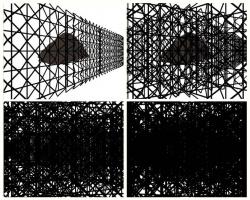
The Sausage Party is a video series. Each part shows a certain social atmosphere in which neurotic and compulsive actions are combined with optical patterns or effect. Shared regression and social cohesion dissolve in each other. The Sausage Party #2 is the most cryptic of the series. Starting with a heap of mud which is encompassed by a fence. Gradually obscured by a growing amount of moving fences, the heap of mud becomes a sort of dirty shapeless treasure/centre. Finally, it transforms into an old-fashioned street-fight (copied from an early how to make cartoons-handbook). Slowly zooming, the swirling fight dissolves into a hypnotising stroboscopic effect, much like Brion Gysin?s dream-machine. The Sausage Party #2 is the most abstract of the series, working with the most optical effects. The fence returns as a visual theme in the Sausage Party #4 (Europa Vostra), where it functions as a classicist fence in an Arcadian landscape.
Michael Van den Abeele °29-05-74 links: www.pilotlondon.org www.youtube.com/watch?v=4wXzrjVHj_M www.etablissementdenfaceprojects.com Exhibitions (selection) 2008 -Curiosität, galerie Micheline Szwajcer, Antwerp, Belgium -With Love from Brussels, VanAbbe Museum, Eindhoven, NL -CAC, Museo de Arte Moderno Toluca, Mexico -Europa Vostra, Trafu, Budapest, Hungaria -Losing Control, de Garage, Mechelen, B 2007 -Rencontres Internationaux, Centre Pompidou, Paris, FR -18, l?Observatoire, Maison Gregoire, Brussels, B -"Vanaf nu!..", LLS 387 (organised by Ulrike Lindmayer, Willem Oorebeek and Ricardo Brey), Antwerp, B -Breughel`s View (part of Commitment), BKSM Mechelen, B -GHB, Van Abbe museum, Eindhoven, NL 2006 -Choose Choice (with Jos deGruyter & Harald Thys), de Brakke Grond, Amsterdam, NL -Le Bonheur, Brussels, B 2005 -Emergency Biennal, Matrix Art Projects, Brussels -Madrid - Grozny -Ambassador, Public> Paris, F 2004 - Shoner Wohnen, New center for contemporay art Waregem, curated by Moritz Kung, B - Visa for 13, PS1, contemporary art center, curated by Jimena Blasqez, NY, USA - Working ethics, Krinzinger Projecte, curated by Philip Pirotte, Vienna, Austria 2003 - Participant of the PS1 contemporary art center, studio program, NY-USA -Viva Romantica, NICC Free Space - KMSK (museum of fine arts), Antwerp, B -?split pick up?, a group-project with A. Hendrickx, G. Lester, B. Rebetez & K. Dedecker, STUK, Leuven, B 2002 -Le vent à double tranchant, Archetype, Kanal 11, Brussels, B -Permanent installation at the ?house of Flemisch representation in Paris?, F -?Haunted house of Arts? Gallery Outline, Amsterdam, NL - Paramount Basics (extended), Muhka, curated by Richard Venlet and Moritz Kung, Antwerp, B 2001 -Flat Space, architecture & virtual space, de Witte Zaal, Ghent, B -Parcours d?incidents, de Ateliers, Amsterdam, NL -Prix du Jeune peinture Belge, Palais des Beaux Arts (BOZAR), Brussels, B 2000 -Etablissement d?en face, Brussels, B -Orbis Terrarum, Plantyn-Moretus museum, curated by Moritz Kung, Antwerp, B -3-ness, in Museum Dhont-Daenens (MDD), curated by Edith Dove, Deurle, B -SubRosa, Ateliers Iternationaux d?Alsace et de Lorraine, curated by Eva Gonzales Sancho, Phalsbourg, F 1999 -JARS 1, curated by Guilaume Bijl, Kunstcentrum-Sittard, Netherlands, NL -Young @ all.ages, Deweer Art gallery, Otegem, B -Small Stuff (organised by Hans Theys), Klagsbrun gallery, NY, USA -Small Stuff (organised by Hans Theys), Herman Teirlinckhuis, Beersel, B Residencies -Artist residence in France ?Ateliers Iternationaux d?Alsace et de Lorraine?, France, 2000 -PS1, contemporary art center, studio program, NY-USA, 2003 -Platform Garanti, Istanbul, Turkey, 2008
Catalogue : 2008Cargo Cult | Experimental video | dv | color and b&w | 7:51 | Belgium | 2006
Michael Van Den Abeele
Cargo Cult
Experimental video | dv | color and b&w | 7:51 | Belgium | 2006
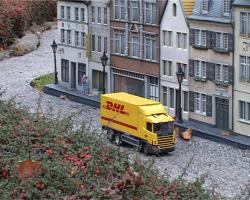
Cargo Cult, 2006 - 7:52 min. animation and video, no sound Cargo Cult starts as a video poem on the courier company DHL, showing rudimentary silhouettes of mountains and valleys. The landscape is travelled through by a container bearing the DHL logo. It is a romantic abstraction of the travelling of goods, over the mountains, through the valleys, across the universe. The DHL-container is depicted in isometric perspective, the mountains and the valleys are the same image turned up-side down. Distance is reduced through -or maximised to- flatness. The second (video-) part of Cargo Cult shows miniature DHL-airplanes, trucks and trains driving through mini-Europe; a theme-park in Brussels which gathers scale-models of all the architectural monuments from the different EU-member states (Berlin wall, Eiffel tower, Big Ben, etc.). More than merely a sponsor of mini-Europe, the DHL transport-network spreads over the park like a supra-national monument. Cargo Cult is a science fiction poem in which the courier company manipulates depth and distance at will, and the goods travel for their own sake and have their own drive. Cargo Cult should be projected or shown on a single-channel monitor in endless loop.
Michael Van den Abeele °1974 - Brussels, Belgium Michael Van den Abeele is a visual artist who lives and works in Brussels. He is also co-curator of the Brussels based art-centre Etablissement d`en face. links: www.youtube.com/watch?v=4wXzrjVHj_M www.pilotlondon.org www.etablissementdenfaceprojects.com
Zeno Van Den Broek
Zeno Van Den Broek
Catalogue : 2020Paranon | Multimedia performance | 0 | | 20:0 | Netherlands | 2020
Zeno Van Den Broek
Paranon
Multimedia performance | 0 | | 20:0 | Netherlands | 2020
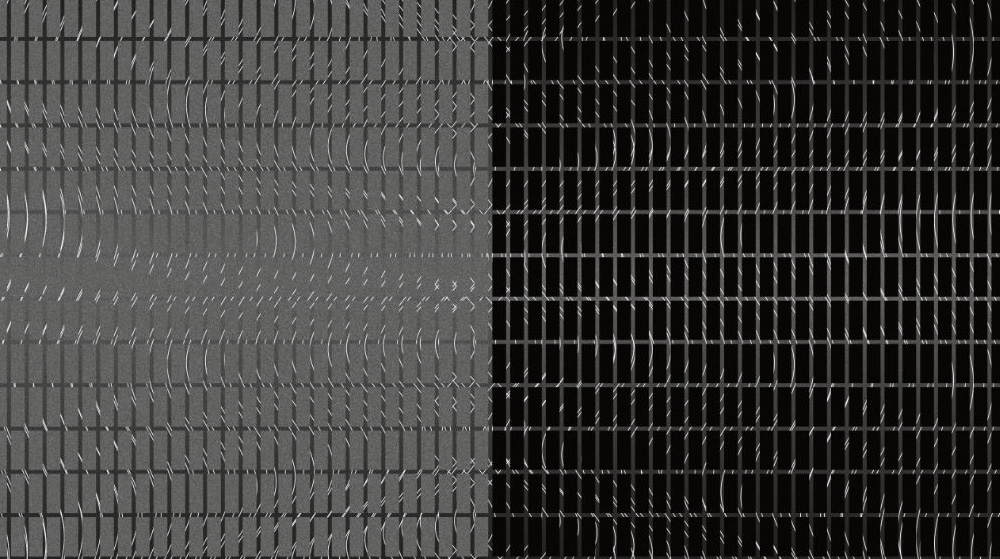
Paranon consists of two compositions based on parameter canons of sine wave generators. The canon is a counterpoint-based compositional technique that creates one or more imitations of a musical movement after a given duration. These imitations replicate the initial movement with transformations of parameters. The custom programmed sine wave generators Zeno van den Broek uses on Paranon make it possible to generate interference, shift phases and alternate frequencies with great precision. The method of the canon creates tension and unexpected, yet cherished, results between the initial sine wave and the imitations that follow. These two concise compositions delve into the beauty of pure sound and explore the richness of colliding sound waves that create spatial events wherever Paranon is being listened to.
Zeno van den Broek is a Dutch-born, Copenhagen-based composer and artist. Van den Broek works in a multi-sensory way to research and express physical, social and acoustic notions. He utilises audiovisual means to create site and concept specific works. This trans-disciplinary method has a strong conceptual foundation, originating from a background in architecture, which enables Zeno to comprehend and reveal the richness and complexity of spatial, visceral and physical perception. He works with a characteristic artistic language based on minimalist and fundamental elements such as sine waves, lines, noise and grids. Zeno van den Broek works with esteemed institutes such as the Gaudeamus Foundation, LIMA and the Old Church of Amsterdam. He presents his work at venues and festivals such as International Film Festival Rotterdam, Sonic Acts and Rencontres Internationales. His music has been released by labels such as Moving Furniture Records, Unsounds and The Tapeworm.
Emmanuel Van Der Auwera
Catalogue : 2025White Cloud | Experimental doc. | digital | color | 19:0 | Belgium | 2024
Emmanuel Van Der Auwera
White Cloud
Experimental doc. | digital | color | 19:0 | Belgium | 2024
In a remote industrial site in Inner Mongolia, miners extract a strategic resource essential to our way of life under dramatic human and environmental conditions. This is where 80% of rare earth minerals, essential to the manufacture of digital technologies, come from. A miner working on the site shares his thoughts on his life and working conditions. White Cloud is a film developed with generative AI that offers a unique perspective on the Bayan Obo mining district. While questions of geopolitics, ecology, capitalism, conspiracy and future scenarios run through the film, the essence is the testimony of a lone miner in search of a better future.
Emmanuel Van der Auwera (b. 1982, BE) works multidisciplinary with video, theater, sculpture, printmaking and often in tension between art and technology, reality vs. simulation and the trivialization of violence. Finding his material in the rampant image production of a global screen culture, he is interested in the meaning of images and how they depict reality while at the same time constructing it. Van der Auwera is the winner of the Goldwasserschenking awarded by WIELS and the Belgian Royal Museums of Fine Arts. His work has been featured in exhibitions at the Pinakothek der Moderne, Munich; WIELS, Brussels; Centre Georges Pompidou, Paris; Palais de Tokyo, Paris; Centro per l’Arte Contemporanea Luigi Pecci, Prato and the HeK - House of Electronic Arts, Basel; amongst others. In 2023, Van der Auwera's work was presented in exhibitions at the Biennale internationale des arts numériques de la Région île-de-France (Paris, FR), Z33, House for Contemporary Art, Design & Architecture (Hasselt, BE). In 2024, his work was shown in the Biennale de l’Image en Mouvement 2024 - BIM 24 (Geneva, CH), KW Institute for Contemporary Art (Berlin, DE), 8th Yokohama Triennale (Yokohama, JP), Kunsthal Charlottenborg (Copenhagen, DK), Kunstverein Hamburg (Hamburg, DE), Deichtorhallen Hamburg (Hamburg, DE), and Royal Academy of Fine Arts (Antwerp, BE).
Benjamin Van Der Burg, Sasha Kulak.
Catalogue : 2023A body without it's flesh | Performance | mp4 | | 0:0 | Netherlands | 2022
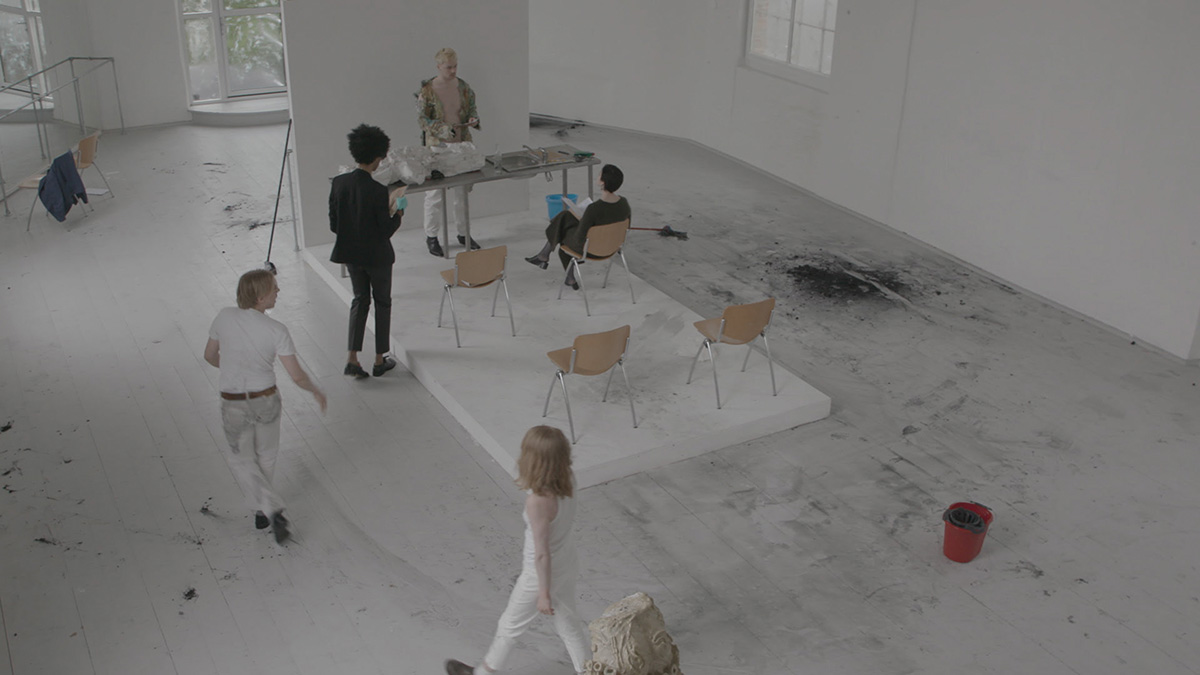
Benjamin Van Der Burg, Sasha Kulak.
A body without it's flesh
Performance | mp4 | | 0:0 | Netherlands | 2022
Within the performance and video work “Copy and Paste” Francis invites people from the public to enter the installation and take on the role of the teacher in front of a class of four ‘students’. In front of the class the assistant of the teacher helps people from the audience to recite from a scripted text. The text refers to dogma’s around art and has been run through Google Translate multiple times, causing errors that needs to be negotiated while reading it out loud. During the performance, both scripted and unscripted mistakes are made. Every time someone makes a ‘mistake’, the teacher’s assistant cleans up the person who made the mistake. In this way, a process is created in which all the participants in the room: audience, performers and artists have an influence on what is labeled as ‘fault’. By taking inspiration from the quintessential spaces for education, control and discipline, i try to flesh out a space that is familiar yet reminds us of those situations of subjection. The heightened awareness in this space, further amplified by a large ballet class like mirrored wall in the middle of the space, all windows covered with vaseline, a steel mortuary table and a series of morphic sculptures that occupy the space as silent spectators, confronts the visitors with what is left of us after endless loops of cleaning.
Benjamin Francis graduated from the Fine Arts programme at ArtEZ BEAR in Arnhem in 2020. Within his work he reflects on his lived experience of continuously being corrected for spelling mistakes, due to his dyslexia. These dissonances or errors are carefully corrected in our current-day society, as anything outside the norm is deemed unproductive and therefore excluded. By exposing the hidden dynamics of the power relations that structure and regulate the way we were taught to distinguish right from wrong, he questions how those systems came into existence and who holds the position to dictate those binary oppositions. Benjamin has recently shown at Hotel Maria Kapel, If I Can’t Dance, Kunsthuis Syb, Het HEM, P/////AKT, Joey ramone, Singular Art, W139 and Mutter, among others.
Bregtje Van Der Haak
Catalogue : 2006Lagos: Wide & Close | Experimental video | dv | color | 60:0 | Netherlands | 2004
Bregtje Van Der Haak
Lagos: Wide & Close
Experimental video | dv | color | 60:0 | Netherlands | 2004
In 2002, Bregtje van der Haak, in cooperation with architect Rem Koolhaas and The Harvard Project on the City made Lagos/Koolhaas, a documentary on self-organization and urbanization in Nigeria. As a sequel, together with designer Silke Wawro, she developed a new project: Lagos Wide & Close, an Interactive Journey into an Exploding City. This innovative DVD contains an interactive video documentary (60`), edited from 55 hours of unused material that brings the viewer closer to the explosively growing megalopolis Lagos. With bus driver Olawole Busayo, the viewer moves through the city and has a choice of a distant (`wide`) or an involved (`close`) perspective, at any random moment in the documentary.
Bregtje van der Haak is a political scientist, journalist and documentary maker. Since 1994, she has been making programs for the public broadcasting network. For VPRO, she makes documentaries for Tegenlicht (Backlight), DNW-Rooksignalen uit De Nieuwe Wereld (Smoke Signals from the New World) and Laat op de avond na een korte wandeling (Late in the evening after a short walk), among others. She graduated from the University of Amsterdam in political science and law and from the Columbia University Graduate School of Journalism. Her television career began on "The Charlie Rose Show" in New York. Since 1990, she has written about art, media and culture. Biography Silke Wawro, designer Silke Wawro graduated from Gerrit Rietveld Academy and the Sandberg Institute in Amsterdam as a graphic designer. Her work, Volksware investigates the creating of value for a product, and the impact of that on the consumer. Her most recent work, the most expensive coat in the world, is made from more than 7,500 labels from clothing brands. Since 2002, she teaches at the Art Academy HGB in Leipzig, Germany, among others.
Jeroen Van Der Stock
Catalogue : 2021Hagibis | Experimental doc. | mov | color and b&w | 10:0 | Belgium, Japan | 2020
Jeroen Van Der Stock
Hagibis
Experimental doc. | mov | color and b&w | 10:0 | Belgium, Japan | 2020
'Hagibis' provides an abstract impression of living with severe weather conditions in a rapidly changing climate. It was recorded while Japan's strongest typhoon in over 60 years passed over the mainland.
Jeroen Van der Stock (°1979) is a Belgian-born filmmaker who earned his Masters in Audiovisual Arts from the Luca School of Arts in Brussels. In his work he often explores ideas around rejection, dysfunctionality and abandonment. Van der Stock his video works have been screened at film festivals including Rotterdam, Oberhausen, RIDM, Rencontres Internationales, CPH:DOX and Jeonju. His short film Night Horse won the Grand Prize at the Image Forum Festival and was nominated for the Found Footage Award at IFFR 2019. Van der Stock is currently living and working in Kanagawa, Japan.
Catalogue : 2020Night Horse | Experimental doc. | hdv | color and b&w | 18:35 | Belgium, Japan | 2019
Jeroen Van Der Stock
Night Horse
Experimental doc. | hdv | color and b&w | 18:35 | Belgium, Japan | 2019
A horse in different shapes, obscurity, digital artefacts and an electroacoustic soundscape are the main travelers on an abstract journey through the night. --A short film entirely based on footage from unsecured live surveillance cameras-- Synopsis: A cave with an animal trapped inside? An eyeball vaguely reflecting a horse asleep? A peephole into the black night? A dark side of the globe? With the exception of a few cars passing, some sleepy village is lacking traces of human activity. In the dimly lit interiors of a house no movements are to be detected. A few trucks hit a road that eventually leads to a hallucinogenic crossroad and a stable with a psychedelic horse. The horse is restless and behaves oddly. Under sea level a couple of predator sharks are slowly exploring the waters. The nearby beach remains empty. Some insects do appear, but they can’t stop the night from turning into something more obscure and less comprehensible. The eyeball shelters a horse in many shapes. The dark side of the globe approaches. The peephole sucks itself deeper into the night.
Jeroen Van der Stock (°1979) is a Belgian-born filmmaker who earned his Masters in Audiovisual Arts from the Luca School of Arts in Brussels. In his work he often explores ideas around rejection, dysfunctionality and abandonment. Van der Stock his video works have been screened at film festivals including Rotterdam, Oberhausen, CPH:DOX, Jeonju and RIDM. His short film ?Night Horse? won the Grand Prize at the Image Forum Festival and was nominated for the Found Footage Award at IFFR 2019. Van der Stock is currently living and working in Kanagawa, Japan.