Catalogue > List by artist
Browse the entire list of Rencontre Internationales artists since 2004. Use the alphabetical filter to refine your search. update in progress
Ine Lamers
Catalogue : 2026The Radiant Screen | Experimental film | 0 | color | 47:17 | Netherlands | 2025
Ine Lamers
The Radiant Screen
Experimental film | 0 | color | 47:17 | Netherlands | 2025
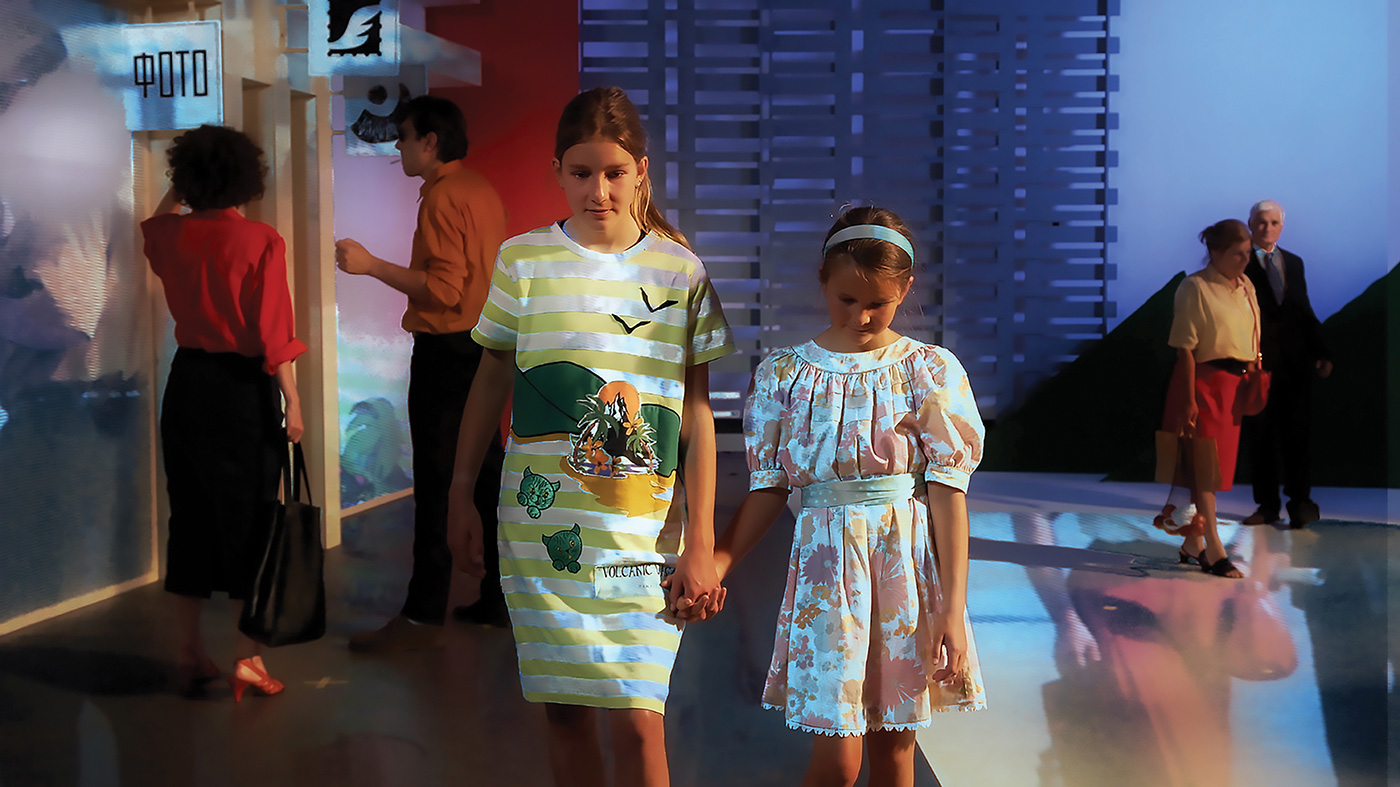
The Radiant Screen is a poetic essay about the pursuit of a utopian fantasy. L., a filmmaker, journeys through the vast red Siberian landscape, obsessed with the enigmatic closed city of ? (Zjeh) ????????????? / Zheleznogorsk. Tucked away in the landscape, ? is described online as "the last socialist paradise on earth." Unphotographable and shrouded in secrecy. While footage of the city's periphery weaves in with studio scenes where actors take stage and testify, the film assembles shifting perspectives on ? (Zjeh). The actors, who seem to be (former) inhabitants, deliver "true" accounts on the inaccessible city as L.'s voice- over clings to the search and the suspended belief in the socialist utopia. Gradually, however, the images begin to fracture, and what emerges is a film suspended between reality and imagination. How far can one pursue a utopia before becoming a hostage to the search? L. is Ine Lamers' fictional alter ego. The making of the film is part of L.'s quest for utopia, reflecting what German philosopher Ernst Bloch called "the utopian impulse".
Biography Ine Lamers “ The strategy of Lamers is intended to break through the prevailing perception of the public (city) space as social space by literally transforming this space into a theatre, where scripted scenes/stories are then acted out. You could read her deployment (or perhaps rather the playing off) of different media in one work or installation as a strategy of alienation-an alienation that establishes distance and blocks easy interpretations…” – Frits Gierstberg, Head of Exhibitions @Nederlands Fotomuseum, Rotterdam- Ine Lamers is an artist working in Rotterdam. Her practice is based in photography and has expanded over the years into film, drawing and mixed media installations. Lamers’ work has been exhibited widely including at Nederlands Fotomuseum (Rotterdam), Centraal Museum (Utrecht), SMs’, (den Bosch NL), Fries Museum (Leeuwarden, NL), MMOMA (Moscow, RU), Neuer Berliner Kunstverein (Berlin) and Akureyri Art Museum (Akureyri, IS). She had solo exhibitions at Museum Boijmans van Beuningen (Rotterdam), Ron Mandos Galerie (Amsterdam), Reuten Galerie,( Amsterdam ). Hales Gallery, (London, GB) Motorenhalle (Dresden, DE), PERMM Museum of Modern Art (Perm, RU). Festivals include IFFR (International Film Festival Rotterdam), Vermont International Film Festival, (Burlington, USA), Kunstfilmbiennale (Cologne, DE) Viper (Basel, CH) and Rencontres Internationales (Paris, Berlin), FIC-autor, (Guadalajara, MEX) PRIZE Best medium Length film.2025
Ardina(ine) Lamers
Catalogue : 2015ochered ( the rehearsal) | Video | hdv | black and white | 10:12 | Netherlands, Russia | 2014
Ardina(ine) Lamers
ochered ( the rehearsal)
Video | hdv | black and white | 10:12 | Netherlands, Russia | 2014
On the stage of an empty museum auditorium, a small amateur theatre company rehearses fragments of the novel Ochered’ for the first time. The backdrop is Soviet Russia’s Banner of Victory. As they articulate the phrases, the actors taste the rhythm and flow of Sorokin`s dialogues. Nine young people thus try to familiarize themselves with the writers` notations of1980s (street) language, and with the novel`s overall dark humour. Vladimir Sorokin’s avant-garde novel Ochered’ was completed in1983 and first published in France. Written in dialogues only, it illustrates a scene in which Russians standing in a long queue in the streets of Moscow, wait to obtain their cut of scarce supplies. The waiting people joke, chat about the news, solve crossword puzzles and argue. The dialogue format, more importantly, the leitmotif of waiting and suspended desire, inspired Lamers to re-edit parts of the novel into a ‘play’ for nine actors. Ochered (the rehearsal) examines how contemporary young Russians interact with precedent social and political circumstances and ideologies. It also explores how past rhetoric and convictions can still be traced in the bodies and gestures of today’s people
Ine Lamers lives and works in Rotterdam, Netherlands Artist Ine Lamers has been active since 1990 as an independent fine artist. Her medium of primary interest has been photography, but since 2000 video has also played an important role in her work. Large format colour photos, slideshow or video installations in which narrative and abstract elements are juxtaposed with one another illustrate urban still-lives with traces of human activity, or paralyzed scenes on which actors take stage. The works form a study after subjective experience and a research into the narrative potentialities of photographic and video media. Lamers seeks out stories and buried memories. She travels to countries where ideology is encapsulated in the architecture and the city space. Socialist city architecture and the traces of communist ideology have central significance in recent photographic and video works. The dystopian scenes in urban peripheries are often captured at dusk or at night, or with actors on theatrical stages. The obscurity and artificiality evoke a view on how the past is still part of the present. Lamers` photos and videos purposefully offer us fragments. In exhibitions the viewer becomes part of the reconstruction of a non-linear visual narrative.
Andrew Lampert
Catalogue : 2016El Adios Largos | Experimental film | 16mm | color | 11:13 | USA | 2013
Andrew Lampert
El Adios Largos
Experimental film | 16mm | color | 11:13 | USA | 2013
In 1973, Robert Altman`s THE LONG GOODBYE was both a critical and commercial flop. Set in a time transposed, neo-noir Los Angeles, Elliott Gould`s bumbling performance as gumshoe Philip Marlowe left Raymond Chandler aficionados dismayed, as did Vilmos Zsigmond;s kinetic camera work and John Williams` cheeky score. The film quickly disappeared from theaters and was never shown on television. While the film was released on RCA`s short-lived Video Disc format in 1981, the movie has not been seen since. All known prints were destroyed, and the original production elements perished due to a leaky sprinkler system in a Culver City in 1983. THE LONG GOODBYE was written off as permanently lost, an all too important missing link from Altman`s greatest period. It has for years remained a film that is impossible to reassess. Filmmaker and archivist Andrew Lampert’s serendipitously purchased a mysteriously film titled EL ADIOS LARGOS from a collector through the mail in 2002. Closer examination revealed that this 16mm, black and white, cropped, Spanish-language dubbed print was actually a reduction copy of Altman’s 35mm, color, widescreen, English-language masterpiece. Knowing the importance of his discovery, Lampert and a team of volunteer preservationists, including colorization expert Jody Blyer, set out on a decade-plus mission to preserve this unearthed gem using the latest digital technology. Lampert has gone to extensive lengths to painstakingly produce the most authentic, thoroughly accurate version that can be made given the considerable difference in materials.
Andrew Lampert is at the forefront of a new generation of artists engaging with film, video and performance, revisiting and extending the dialogue around an expanded cinema. Lampert pursues the alchemy between artist, art, and audience in a public space, especially that of cinema. Bringing unscripted and chance elements into cinema`s veneer of control, and often working with found material, he foregrounds the contingency of film as a medium. Reveling in cinema as a performative environment, Lampert reclaims this space from a mass media culture to emphasize its potential for immediacy and accident—and to make each of his screenings and performances a one-of-a-kind event. Lampert explores the cinematic experience as content, experimenting with the physical spaces between projector, projectionist, audience and screen, and with the experiences made possible through their convergence. The cinema becomes a site of abstract and magical production in his performances, videos and films, as Lampert investigates the gap between an artwork`s private intent and its public reception. Lampert`s media works defy strict categorization as films or videos. His projects are unified in their emphasis on the frame around the edges of narrative—the genres and clichés in which he cloaks on-screen action, the happy accidents during production, and the unexpected events during a screening that shape the audience`s response and foreground human activity in the cinematic context. Lampert was born in St. Louis, Missouri in 1976. His work has been shown at the 2006 Whitney Biennial; The Getty Museum, Los Angeles; Mitchell Algus Gallery, New York; British Film Institute, London; The Kitchen, New York, and Light Industry, Brooklyn, amongst many other venues. Lampert`s work has also been featured in a number of international festivals, including the New York Film Festival and the Rotterdam International Film Festival. In addition to his work as an interdisciplinary artist, he is the Film Archivist at Anthology Film Archives in New York.
Ane Lan
Catalogue : 2009Woman of The World | Art vidéo | dv | color | 7:57 | Norway | 2008
Ane Lan
Woman of The World
Art vidéo | dv | color | 7:57 | Norway | 2008
Staging himself as various women of the world, the artist Ane Lan raises questions of the images and ideas of ethnicity and multiculturalism within the concept of a global economy.
Ane Lan was born in Oslo, Norway in 1972. He graduated from the National College of Art and design in Oslo in 2002 and is working in the field of performance, music and experimental film/video. He has participated in various international exhibitions; The Whitney Museum of American Art, NYC, Paco das Artes, Sao Paolo, the 51 th Venice Biennial and the 10th Istanbul Biennial. Lan has also participated in numerous film & video festivals worldwide.
Catalogue : 2008Afrika | Art vidéo | | color | 4:34 | Norway | 2007
Ane Lan
Afrika
Art vidéo | | color | 4:34 | Norway | 2007
A seemingly native African woman, sitting outside her hut, is preparing a meal for her guest. The guest, a white female lying on her sickbed, is ambiguously accepting the favours given her by her hospitable servant. The ?medicine? provided for her illness however, does not seem to have an effect. Through simple tableaux?s and clichés, this short work is examining the psychological aspects of the post-colonialism relationship Europe- Africa in the face of illegal immigration.
Ane Lan was born in Oslo, Norway in 1972. He graduated from the National College of Art and design in Oslo in 2002 and is working in the field of performance, music and experimental film/video. He has participated in various international exhibitions; The Whitney Museum of American Art, NYC, Paco das Artes, Sao Paolo, the 51th Venice Biennial and the 10th Istanbul Biennial. Lan has also participated in numerous film & video festivals worldwide.
Ane Lan
Catalogue : 2007Vesta | Experimental video | dv | color | 6:13 | Norway | 2006
Ane Lan
Vesta
Experimental video | dv | color | 6:13 | Norway | 2006
In between the burning flames of Vesta, various "Vestal Virgins" ask questions about the virtue of purity and the past and current state of the female appearance. Staging himself both as the painter and the female sitter, Ane Lan raises questions about the gaze of women in classical painting related to the gaze of the masculine eye.
Ane Lan was born in Oslo, Norway in 1972. He graduated from the National College of Art and design in Oslo in 2002 and is working in the field of performance, music, and experimental film/video. He has participated in shows at The Whitney Museum of American Art, Reiner Roterfelt Gallery and the 2005 Venice Biennial. Lan has also participated in numerous international film & video festivals and screenings worldwide.
Claire Lance
Catalogue : 2026A Homeward Bound | Experimental fiction | hdv | black and white | 9:9 | France | 2024
Claire Lance
A Homeward Bound
Experimental fiction | hdv | black and white | 9:9 | France | 2024
Through a hypnotic single-shot sequence, we are transported to the heart of a house, where negative black and white unveil an indefinite space between memory and bewilderment. Fluctuating beneath the social veneer, the gaze undergoes a metamorphosis as the house reveals its secrets; the walls themselves seem to whisper forgotten tales and unspeakable truths.
Claire Lance (born in 1987, France) is an artist who uses mediums closely related to human optics. Her projects explore cognition and the persistence of cultural images in perception through video, installation, and photography. Evolving over time, Lance's works often operate in a manner reminiscent of Rorschach tests, revealing what is generally invisible or described as intangible or non-objective. The global city, where scales and dimensions intersect in successive layers, creates virtual, intangible spaces accessible only to the eye. These indeterminate yet familiar places invoke the metaphor and persistence of images that we individually and culturally carry within us as viewers. Her works have been exhibited at the Ofr gallery in Paris, at the 39th FIFA in Montreal, Kurzfilmvoche Regesnburg, Germany, and have been featured multiple times in the British magazine Carpark. In 2023, she was invited by the CIRM (Centre International de Recherche Mathématiques) for a workshop titled 'Maths and Art: Common Creation'. She holds a master's degree in Practice and Theory of Contemporary Art from the Université Paris 8 Sorbonne. She has collaborated with various film directors as cinematographer on set, and commissioned works with press titles such as L’Obs, Trax, Technikart.
Margot Lançon, Margot Lançon et Chloé Simonin
Catalogue : 2020Béton Amer | Experimental doc. | mov | color | 15:36 | France, Greece | 2019
Margot LanÇon, Margot Lançon et Chloé Simonin
Béton Amer
Experimental doc. | mov | color | 15:36 | France, Greece | 2019
A l’aube, une bande d’amis se retrouve sur les toits d’une école à Athènes. C’est leur rituel. Ils surplombent la ville, cette ville qui sera à eux jusqu’au matin suivant. Le film raconte l’errance d’un groupe d’adolescents à la périphérie d’Athènes. Ils traverseront un lieu gardé sous haute surveillance : Hellinikon. Pendant six décennies, Hellinikon a été le seul aéroport d’Athènes. En 2004, il accueille les infrastructures des Jeux Olympiques. Depuis, les mauvaises herbes ont envahi les ruines des équipements sportifs. Toutes les marques de son passé sont encore, comme sédimentées, inscrites à Hellinikon. Les jeunes décident de s’y introduire avant que le site ne soit rasé, transformé, avant que sa mémoire ne disparaisse.
Margot Lançon vit et travaille entre Genève et Paris. En juin 2019, elle obtient son bachelor en Arts Visuels à la Haute Ecole d’Art et de Design de Genève avec les félicitations du jury. Margot Lançon s’intéresse aux nouvelles formes d’écriture documentaire et développe une pratique mêlant films, vidéos et photographies. Aujourd?hui, elle poursuit son cursus en cycle master à l'École Nationale Supérieure d'Arts Paris - Cergy. Chloé Simonin vit et travaille à Genève. En juin 2017, elle est diplômée d’un bachelor Arts Visuels, filière Information/Fiction, de la Haute Ecole d’Art et de Design de Genève avec les félicitations du jury. Elle étudie actuellement l’anthropologie visuelle à l’université de Neuchâtel.
Robbie Land
Catalogue : 2007Betty's creek | Experimental film | 16mm | color | 6:0 | USA | 2005
Robbie Land
Betty's creek
Experimental film | 16mm | color | 6:0 | USA | 2005
?Betty Creek? is a film constructed of material collected from a location in the Southern Appalachian Mountains. Various items such as dirt, plant life, audio, and timed lapse images have been gathered and applied to the celluloid using numerous methods in order to provide a projected sense of the Betty Creek environment.
Born in Jacksonville, Florida, Robbie began working in film specifically super-8mm in the mid-1980s producing animations and live action experiments. In the early ?90s Robbie attended University of South Florida in Tampa, Florida to study fine art. After graduation he worked numerous jobs and continued to produce motion picture films and photographic stills. He has worked on a variety of projects from cinematographer at the Florida Lightning Research Facility to teaching college level film production. Currently he resides in Atlanta, Georgia and continues to experiment with various film methods for instillations, film screenings and diverse venues. Robbie?s work has screened at Kunst Film Biennale in Colongne, Germany, Museu Do Chiado in Lisbon, Portugal, The International Experimental Cinema Exposition in Denver, Colorado and various other solo and group screenings and venues.
Catalogue : 2006Betty's Creek | Experimental film | 16mm | color | 6:0 | USA | 2005

Robbie Land
Betty's Creek
Experimental film | 16mm | color | 6:0 | USA | 2005
?Betty Creek? is a film constructed of material collected from a location in the Southern Appalachian Mountains. Various items such as dirt, plant life, audio, and timed lapse images of it?s nightlife have been gathered and applied to the celluloid using numerous methods in order to provide a projected sense of the Betty Creek environment.
Born in Jacksonville, Florida, Robbie began working in film specifically super-8mm in the mid-1980s producing animations and live action experiments. In the early ?90s Robbie attended University of South Florida in Tampa, Florida to study fine art. After graduation he worked numerous odd jobs and continued to produce motion picture films and photographic stills. He has worked on a variety of projects from cinematographer at the Florida Lightning Research Facility to teaching college level film production. Currently he resides in Atlanta, Georgia and continues to experiment with various film methods for instillations, festivals and diverse venues.
Marina Landia
Catalogue : 2013Enjoy Business. Volume 5 | Experimental doc. | hdv | color | 15:51 | Germany | 2011
Marina Landia
Enjoy Business. Volume 5
Experimental doc. | hdv | color | 15:51 | Germany | 2011
Video documentary based on interviews with top business leaders and policy maker in different countries. The idea was to provide an insight into the highest level of global business by tracing and making visible different patterns of business thinking, which impacts and shapes it. Today when all the concepts have been challenged and are being rethought I was looking for considerations, ideas, thoughts, deliberations rather than final statements. By placing the business related issues and people representing them into an artistic format, the work would give the audience a different view than produced by the public media coverage, which tends to be either too specialized on business topics for outsiders like myself, or superficial. For conducting and evaluating interviews I use the method I developed based on the theory of sociologist Prof. Ulrich Oevermann of Johann Wolfgang Goethe University of Frankfurt (the founder of ?Methode der objektiven Hermeneutik?) during my previous video project ?Enjoy Business?.
Marina Landia is a video and performance artist based in London. Born in Tbilisi, Republic of Georgia she studied at the State Academy of Arts in Tbilisi and worked eight years as a film set and costume designer for the Georgia Film Studio. After immigrating to Germany she studied at the Institute for Art in Context (post gradual Master studies), UDK in Berlin, where she is a lecturer since 2010. Main focus of her artistic work is exploration and critical evaluation of general social, economical and political trends, working at the point of intersection between art and other disciplines by involving people with different professional and cultural backgrounds. Alongside with her work as independent artist she developed more then 20 interdisciplinary video projects and workshops in co-operation with various institutions in Germany, Great Britain and Russia: Alfred-Toepfer Foundation, Hamburg; Accenture, Moscow; Wimbledon School of Art, London; Kulturamt Neuköln, Berlin; ESMT, European School of Management and Technology Berlin; Xynteo, Oslo.
Paul Landon
Catalogue : 2007Staropramenná | Experimental video | dv | color | 3:30 | Canada | 2005
Paul Landon
Staropramenná
Experimental video | dv | color | 3:30 | Canada | 2005
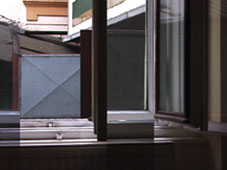
This video is comprised of a series of static shots of a hotel room window that looks out onto an abstract collage of urban surfaces of doors, walls, and roofs. These images are repeated several times to give the effect of the window opening and closing on its own. The window looks out onto Staropramenná, a non-descript street in Prague. The repetition is accelerated and altered, thereby animating the banal view and rendering it mesmerizing and hypnotic.
Paul Landon has been producing single channel video tapes as well as audio/video installations since 1984. His video work has been shown in Canadian museums and in video festivals around the world. His installations have been shown in public galleries in Europe and North America. Mr. Landon completed a Master's degree at the Academie Jan van Eyck in The Netherlands in 1989. He lives in Montreal where he works and teaches video and sound installation at the École des arts visuels et médiatiques of the Université du Québec in Montréal.
Veit Landwehr, Florian Zwissler
Catalogue : 2008Saariselkä | Experimental video | dv | color | 4:41 | Germany | 2006
Veit Landwehr, Florian Zwissler
Saariselkä
Experimental video | dv | color | 4:41 | Germany | 2006
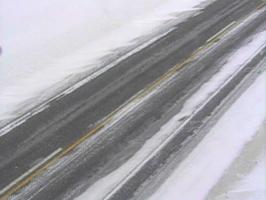
Saariselkä is a video installation about snow, made of over 40,000 single images sent from a webcam in Northern Finland during a six-months recording period. The Finnish Road Administration in Helsinki provides over 300 of these "road weather cameras" to keep the population informed about the actual road condition. In the very likely case that nothing else happens on Lapland´s streets, it´s all about visualizing the binary information "snow or no snow"; everything not following this pragmatic aim has been removed from the final video (over 500 cars and trucks, the summer, etc.). At the end of this pedantic cleaning process, the video has become an "optical concentrate". The sound is composed by sound artist Florian Zwissler to fill the space inside the camera housing/ inside the viewer´s head.
Veit Landwehr (*1969 in Mülheim, Ruhr) studied Architecture at BUGH Wuppertal. After his diploma in 2000, he worked for b&k+ architects, Cologne. Until 2002, he was involved in several exhibitions and publications for b&k+: In Vitro Landscape (Weissenhof- Gallery Stuttgart), H3K (Museum for Applied Art, Cologne), archilab 2002 (Orleans, France), etc.. Detecting the architecture to be an unoperative medium to apply an ultimate, unsophisticated pragmatism, he works as an artist exclusively since 2002. Besides the creation of concept-based, public installations ("improvements") and some "paratechnical" objects, he has a strong focus on video installations. As found in WEB LAND (2004, continued), the distinctive mark in his video work is the sometimes "autistic" view downwards onto the ground; hundreds of webcams deliver the material for large-format prints and videos showing the world in small, but very precise cutouts. His parents still want Veit Landwehr to be an architect.
Andréas Lang
Catalogue : 2026The Horses of Ani | Video installation | 4k | | 14:0 | Germany, Turkey | 2023
Andréas Lang
The Horses of Ani
Video installation | 4k | | 14:0 | Germany, Turkey | 2023
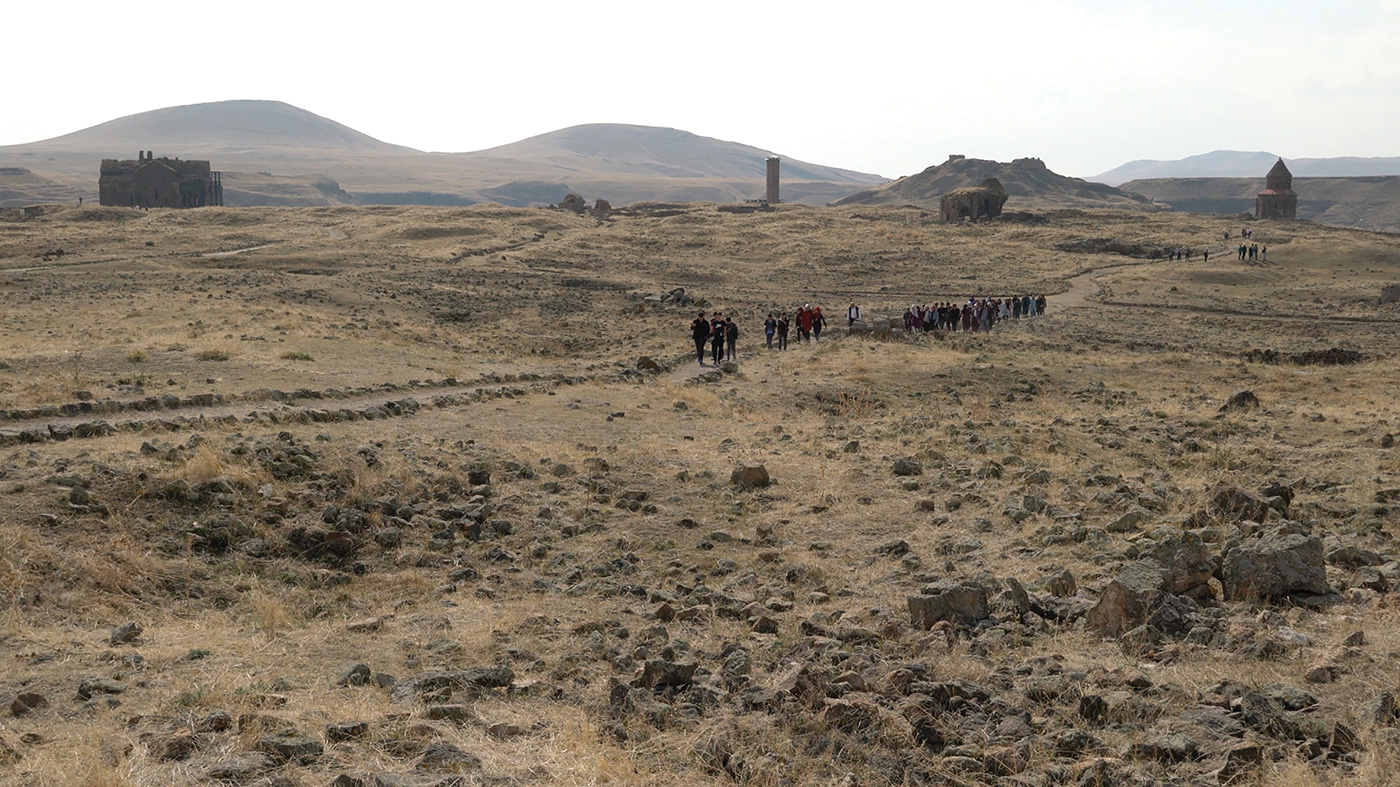
THE HORSES OF ANI 14.00 min. 2-channel video installation, 4K, stereo sound, loop camera and editing: Andréas Lang; sound-design: Jochen Jezussek; musical fragments of 2 Armenian duduks, from the Armenian medieval piece “Akna Krunk” (= song of exile), interpreted by Jordi Savall and Hesperion XXI Channel 1 On the plain next to the medieval ruin city Ani a group of wild horses walk towards the city walls where they used to graze. Just before the walls of Ani is now a construction site for a future parking lot and museum. The site is towered by a huge Turkish flag blowing in the wind, well visible from the nearby Armenian border. The horses enter the construction site, get confused and run around in panic. They finally find their way out and walk back into the endless plain. Channel 2 Sequence of the Akhurian (Turkish: Arpaçay) river in Kars. This river comes flowing from Armenia and passes Ani where it marks the frontier between Turkey and Armenia. The second sequence shows a group of students and tourists walking through the ruin field of Ani. Ani The ancient city of Ani was an important hub for trade caravans and the city controlled the trade routes between Byzantium, Persia, Syria and Central Asia. Merchants and craftsmen flocked to Ani from the older cities of Armenia, accompanied by a population flow from the rural areas. In 992, the Armenian Catholicosate moved its seat to Ani. The population of Ani was well over 100,000 and the wealth and prestige of the city were such that it was known as "the city of a thousand and one churches". Due to the many conquests, earthquakes and tribal raids over the centuries Ani degraded and was abandoned in early 19th century and left deserted. Before the 1915 genocide many Armenians still lived in the region, the ruin field of Ani stands symbolically for their disappearance.
Andréas Lang was born in Zweibrücken, Germany and began his artistic work in Paris, then Munich. Today he lives in Berlin and works with photography and video-installation. His image cycles deal with landscapes and their hidden history, including the intellectual and cultural DNA of Europe. 1999-2005 Photographs of European landscapes in relation to Romanticism, mythology and 20th century history. 2006-2008 Eclipse photography series on historical landscapes in the Middle East in relation to early Christianity and the Crusades. 2011-2024 Project on German colonialism in Central Africa, based on research into historical material. 2017 Photographs and videos about the Brazilian Quarter in Lagos, Nigeria, in relation to slavery and colonialism history. Since 2019, the project Re-Visiting Orientalism, superimposing 19th-century paintings in video installations with contemporary video sequences. From 2018-2023, the project Broken Memories about history and memory culture in Turkey. Since 2024 multimedia project on the historical population exchange between Turks and Greeks. His work has been shown internationally in museums, biennials, galleries and festivals. He has received numerous awards, including the German Photobook Award 2025 and 2023, the Special Mention Award at MDFF-Milano Architecture&Design Film Festival 2021, the Lotto Brandenburg Photography Art Award 2021, the Tarabya Cultural Academy Stipend 2018, the Berlin Senate's Work Grant for Visual Arts 2017.
Jérôme Laniau, Trantor
Catalogue : 2013Trantor | Experimental fiction | hdv | color | 30:0 | France | 2012
Jérôme Laniau, Trantor
Trantor
Experimental fiction | hdv | color | 30:0 | France | 2012
Trantor, planet the most populated with this region of the universe, is the seat of political intrigues. An archaeologist looks for the original planet of the humanity, a man spies him. He does not still know that Trantor once have been called "Earth".
Jérôme Laniau is a french director. His work is at the cross of documentary, cinema and artvideo. His firts movie, "Keita ka so", received the price of the jury at the festival "Tolosa tourne".
Lia Lapithi Shukuroglou
Catalogue : 2010Reasons for War | Doc. expιrimental | dv | color | 3:0 | Cyprus | 2008
Lia Lapithi Shukuroglou
Reasons for War
Doc. expιrimental | dv | color | 3:0 | Cyprus | 2008
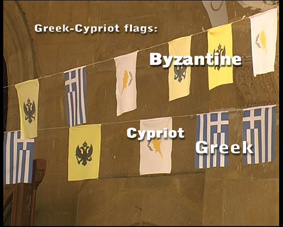
Religion and Nationalism are often used as excuses for War. The film explores the Greek-Cypriot dual identity to their Ethnic and Religious origin. Symbolic to this, is the Greek celebrations of March 25 that is both a National (revolution against the Turks) and religious holiday (Annunciation). Situated across the church, checkpoint (Charlie) in Nicosia shows the inherent tension of Cyprus bi-ethnic state. The nostalgic ?Torn between two lovers? song is superimposed throughout the film, a 70?s tune of a time long ago, perhaps a longing to be able to live together. Many wonder whether Cyprus political problems are fueled so as to ensure that the ?great powers? can better control the island, and its strategic position in the Middle East.
Works in multi-media installations | video | photography and publications in Nicosia, Cyprus. Studied: BA Art and Environmental Design UCSC, California, USA | Mphil Art Lancaster University, UK |Diploma of Architecture Canterbury Institute of Art and Design. Recent Group Exhibitions: Dans la nuit, des images, Création numérique en Europe, Grand Palais, Paris, France | Museo Nacional Centro de Arte Reina Sofia, Madrid, Spain |Haus der Kulturen der Welt, Berlin, Germany| Universite des BeauxArts, Paris, France. Museums collection: Cypriot state collection of contemporary art, Nicosia, Cyprus | Museum of Applied Arts (MAK), Vienna, Austria | Muséum Centre Pompidou, (Nouveaux Médias MNAM-CCI) Paris, France.
Catalogue : 2008Electricity | Experimental doc. | dv | color | 2:30 | Cyprus | 2006
Lia Lapithi Shukuroglou
Electricity
Experimental doc. | dv | color | 2:30 | Cyprus | 2006
Electricity
A 2.5min film by Lia Lapithi Shukuroglou
(Electricity is part of a series of four interconnected short films on Cyprus today, including ?Should I stay or should I go now?? ?Marinated Crushed Olives? and ?Rabbits have no memory?. Throughout the tetralogy the text oscillates between narrative politics, archive documentary and the experimental)
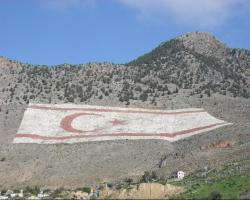
The last time I felt sad was when the largest flag in the world, 1000m, was placed in my back garden. Now this flag has lights all around it, and all through every night at 8pm it lights up. This ?extravaganza? is viewed entering the highway into Nicosia and in the city itself. The flag is on the Pentadactylos Mountain, the Turkish National flag, has written underneath ?so happy to be a Turk? and in reverse colours, is the ?Turkish-Cypriot flag?.
Furthermore, what is most surreal in this situation is who provides the energy to light this double-flag?.
Lia Lapithi is a Cypriot multimedia artist with BA/MA degrees in Fine Arts and Diploma of Architecture (UK RIBA part 2). Her gama of work includes film, large sculpture and photo installations, and has won many art competitions both in her native country and abroad. Works of hers can be found in the Cypriot state collection of contemporary art, Nicosia, Cyprus, at the Museum of Applied Arts (MAK), Vienna, Austria and at the Muséum Centre Pompidou, (Nouveaux Médias MNAM-CCI.), Paris, France. For a more extensive biography and to view her work visit www.lialapithi.com
Catalogue : 2008Receipe for marinated crushed olives | Experimental doc. | dv | color | 3:30 | Cyprus | 2006
Lia Lapithi Shukuroglou
Receipe for marinated crushed olives
Experimental doc. | dv | color | 3:30 | Cyprus | 2006
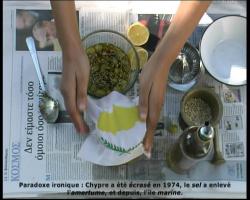
Recipe for Marinated crushed olives, 3 minutes. (?Marinated Crushed Olives? is part of a series of four interconnected short films on contemporary Cyprus, including ?Should I stay or should I go now?? ?Rabbits have no memory? and ?Electricity?. Throughout the tetralogy the text oscillates between narrative politics, archive documentary and the experimental) In Cyprus known as ?tsakistes elies?, prepared in this way as early as the Byzantine era. Also referred to as cracked (green) olives, slit olives or split olives. The film makes an ironic paradox between the Cyprus problem and the making of Crushed Olives; that it is split, salt has removed bitterness, and has been marinating since (1974). This recipe of crushed olives is filmed on a daily Cypriot newspaper with the following headings: Η Ευρωβουλή εξαφάνισε το κυπριακό, Το κυπριακό δεν είναι προτεραιότητα (The European parliament has obliterated the Cyprus problem, the Cyprus problem is not a priority). Δεν είμαστε τόσο όμοιοι όσο νομίζουμε?(We are not as similar as we think?) To make: Ingredients: - Green olives (harvested in October or November while they are still green, unripe and with not much olive oil in their flesh. - Sea salt - Water to cure olives - Dry coriander seeds crushed - Lemons cut into small wedges and lemon juice - Garlic heads broken into cloves or lightly crushed and peeled - Olive oil enough to cover Method: 1. Split open the olives, traditionally, crushing them between 2 stones. Don`t crush too hard, just enough to crack open the olive, but not enough to deform the shape of the olive, and especially being very careful not to crack the stone of the olive. 2. Preparation of brine for curing of the olives: To every 8 cups of water add 1 cup of sea salt. Stir well so that the salt dissolves. Place olives in containers and cover them with the salt water, changing it (the salt water) daily for at least eight days, or until the olives are no longer bitter to the taste. Take great care with the meticulous change of the water otherwise the olives will be spoilt. 3. To serve: Wash the olives gently to remove salt and drain. Marinate with the lemon cuts and lemon juice, garlic and coriander. Finally add olive oil to cover them. Serve olives at room temperature.
Lia Lapithi is a Cypriot multimedia artist with BA/MA degrees in Fine Arts and Diploma of Architecture (UK RIBA part 2). Her gama of work includes film, large sculpture and photo installations, and has won many art competitions both in her native country and abroad. Works of hers can be found in the Cypriot state collection of contemporary art, Nicosia, Cyprus, at the Museum of Applied Arts (MAK), Vienna, Austria and at the Muséum Centre Pompidou, (Nouveaux Médias MNAM-CCI.), Paris, France. For a more extensive biography and to view her work visit www.lialapithi.com
Catalogue : 2006Should I go or should I stay | Experimental video | dv | color | 1:0 | Cyprus | 2005
Lia Lapithi Shukuroglou
Should I go or should I stay
Experimental video | dv | color | 1:0 | Cyprus | 2005
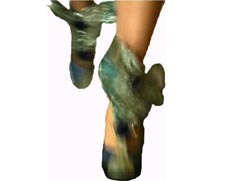
SYNOPSIS Text on film (listing the military branches): Greek Cypriot National Guard (GCNG; includes air and naval elements), Hellenic Forces Regiment on Cyprus (ELDYK), Greek Cypriot Police; Turkish Cypriot Security Force (TCSF), Turkish mainland army units, United Nations soldiers (UN), British Army (2 sovereign bases…) The film could be separated into four layers; In the foreground, from the first frame, at high speed a pair of legs wearing extravagant high-heeled shoes (locally made) is seen running on a treadmill. A second overlay layer, in the background is a film taken with a hidden camera from the passenger seat of the two checkpoints in Nicosia after the boarders ‘opened’ in 2003 and of another boarder which is said to ‘open’ shortly. All checkpoints are major tourist attractions as the last remaining divided city in the world (one checkpoint is even called Berlin wall 2). This is played in reverse mode. As a separate third layer, above the checkpoints and the running shoes, a text dryly informs the viewer, of the military forces currently situated on the island. The fourth layer is acoustic: a girl’s voice is heard trying to learn to sing/hum and play on the guitar the first two verses of the song by the Clash ‘Should I stay or should I go’. The film closes with a last fact, that Cyprus has been described as one of the most militarised countries in the world. 19 soldiers per square kilometre. Third highest world weapon holding 891,000 per 1 million people. The film, playful, darkly humorous, is also loaded with contradictions and symbols; the treadmill a symbol of the isolated islander, the turquoise shoes (are they worn by a Turkish or Greek-Cypriot?), the static running in one place, the outlined legs (are they animated, amputated in half?), the political text, women’s’ exclusion of the Military, the out of tune singing…or is she teasing? Note: After 1974, 67% of Turkish Cypriot citizens have emigrated from the Turkish occupied areas. This has not been the case of the Greek Cypriots of which 1/3 were made refugees. After Cyprus joined the EU, in 2005, there has been an influx of Turkish Cypriots crossing the green line to apply for Cypriot passports to immigrate easier.
BIOGRAPHY 1979-1983 -Studied Fine Arts in California of America, at UCSC Obtained Bachelor of Fine Arts At the same time she studies architecture Obtained Bachelor of Environmental Design. 1984 -Diploma Master of Fine Arts from the University of Lancaster. 1989-1991 -Diploma of Architecture from Canterbury University of Art and Design 1994 -Obtained from the University of Wales the title of Master in Education. AWARDS 2001 - 4th price of the multimedia award at the 3rd Biennial of Florence, Italy 1999 - Le Grand Prix (First overall prize) of the 20th International Biennial of Alexandria, Egypt 1988 - Literary Award, for the writing of unpublished children’s book (illustrated), Ministry of Education & Culture 1983 - Outstanding International Student Award, University of California Santa Cruz, America GROUP EXHIBITIONS 2006 - Prospective Sites, public Art (curator Walter Seidl), Vienna, Austria 2005 - Untouchable things, Backlight 2005 7th International Photography Triennial, Tampere, Finland - Somatopia: Mapping Sites, Sitting Bodies , Hellenic Centre, London, UK - Capturing Utopia, Fournos Centre for Digital Culture, Athens, Greece. - Venice Open, Lido-Venice, Italy - Xperimental 4.0, International Experimental Film Festival, Pantheon Cultural Association, Nicosia, Cyprus - Accidental Meetings, Nicosia Municipal Centre, Nicosia, Cyprus 2002 - "The Room" Manifesta 4, Frankfurter Kunstverein, Germany 2001 - 3rd Biennial of Florence, Italy. 2000 - `Medi@terra 2000` International Art and Technology festival and symposium, Athens, Greece. - 100 years of Cyprus sculpture, National Art Gallery, Nicosia Cyprus - 12 Cypriot painters by Ioannina municipality, Greece 1999 - 20th International Biennial of Alexandria, Egypt. - 4 Women’s Work on the occasion of International Women’s Day by the American Centre, Nicosia, Cyprus. 1997 - Brushstrokes Across Cultures III, Famagusta Gate, Nicosia, Cyprus 1996 - Women creators of two seas, Mediterranean and Black Sea (UNESCO), Thessaloniki, Greece - Modern Goddess contemporary art by women artists from Cyprus and England, Famagusta Gate, Nicosia Cyprus - “Cyprus, Its People and Culture” banner, Nicosia Municipal Art Centre (associated with the Pierides Museum of Contemporary Art), Nicosia, Cyprus - Exhibition of the Van Gogh foundation, Nicosia Municipal Art Centre (associated with the Pierides Museum of Contemporary Art), Nicosia, Cyprus - Cyprus through Leontios Mahairas’ history, Nicosia Municipal Art Centre (associated with the Pierides Museum of Contemporary Art), Nicosia, Cyprus 1995 - Nicosia Cultural month of Europe, Art Exhibition, Ayios Andreas Market, Nicosia, Cyprus 1992 - Imeroessa Lapithos,Stage design, Nicosia Municipal Theatre and Pattichio Municipal Centre, Limassol, Cyprus 1987 - Pan-Hellenic Art Exhibition, Athens, Greece - 1st Biennial of Europe’s Fine Art Schools, Toulouse, France 1986 - 2nd Biennial New Mediterranean Artists, Thessaloniki, Greece - Seven New Cypriot Artists, The Cyprus Popular Bank, Nicosia, Cyprus SOLO EXHIBITIONS 2003 - “Inhale – Exhale”, Pantheon Gallery, Nicosia, Cyprus 2001 - "Operating Theatres", Diatopos Gallery, Nicosia Cyprus 1998 - Gloria Gallery, Nicosia, Cyprus 1997 - Monohoro Gallery, Athens, Greece 1996 - Gloria Gallery, Nicosia, Cyprus 1995 - Gloria Gallery, Nicosia, Cyprus 1993 - Artist’s Studio, Nicosia, Cyprus 1989 - Opus Gallery, Nicosia, Cyprus 1987 - Gloria Gallery, Nicosia, Cyprus 1985 - University Art Gallery, Lancaster, U.K 1983 - Oakes Gallery, Santa Cruz, California, U.S.A. SHORT FILMS 2005 - Grafting/ All my children - Should I stay or should I go now? 2003 - 26 weeks 2001 - Interactive CD-Rom ‘Operating Theatre’ (includes 8 short films; Eye Operation/ Endoscopy / Gastric Binding/ Nose Operation/ Gender Blending/ Leg Operation/ Split-brain and Cryonics)) 2000 - Enchanted Pear Tree 1991 - E tripa (The hole) AWARDS FOR ‘ART IN PUBLIC BUILDINGS’ COMPETITIONS 2005 - First price for Lyceum Ayiou Spiridona, Limassol, Cyprus 2005 Second price Gymnasium Ayiou Theodorou, Paphos 1997 - Police Station, Pera Orinis, Cyprus Professional associations: Member of Royal Institute of British Architects (RIBA), Member of Cyprus Architects Association (ETEK), Member of the Fine Artists Association (EKATE). PUBLICATIONS 2003 - “Inhale Exhale”, Nicosia ISBN 9963-8604-1-9 2001 - “Operating Theatres” Nicosia ISBN 9963-8604-0-0 PUBLICATIONS OFFICIALLY LISTED, AMONGST OTHERS, IN: - Leonardo journal (MIT) / The International Society for the Arts, Sciences and Technology, CA, USA. For books reviews, visit MIT Leonardo Journal - Northlands Kunstmuseum, Denmark. - Finnish National Gallery Library, Finland. - Centre pour l’image contemporaine, Geneva, Switzerland.
Ludivine Large-bessette
Catalogue : 2018Drop Out Bodies | Experimental film | 4k | color | 17:13 | France | 2017
Ludivine Large-bessette
Drop Out Bodies
Experimental film | 4k | color | 17:13 | France | 2017
A monotonous silence envelops a group of men and women who are each standing still in front of their houses in a residential area. As the camera moves among them, they fall, one by one, in a random pattern. Their collapses are clearly irrevocable. The movement of the performers from immobility to choreographed descents is a contemporary reinterpretation of the macabre dance of the Middle Ages. The film questions the fatality of the human body and our individual and collective responsibilities in our complex time.
In her multidisciplinary work, which uses both photography and video, the represented body becomes a mirror that is able to unsettle, to question and to move the audience. Through the use of melodramatic codes of cinema, through the painful sensation of a resisting body and through the play that emerges from absurd situations, she interrogates and confronts the viewer with the role of the body in our social interactions and in our contemporary environment.
Alyona Larionova
Catalogue : 2017Across Lips | Video | hdv | color | 11:43 | Russia, United Kingdom | 2016
Alyona Larionova
Across Lips
Video | hdv | color | 11:43 | Russia, United Kingdom | 2016
Pairing up jazz improvisation with the vastness of big data, Across Lips attempts to decode what it means to tell a story for a digital age. Framed by the gradual and comprehensive expansion of the Internet Archive, this film questions what it means to truly believe in something.
Alyona Larionova (b. 1988 Moscow) earned her MFA from the Slade School of Fine Art in 2013 and her BA in Photography from LCC in 2010. Her work has been exhibited internationally, including at HOW Art Museum in Wenzhou, II Moscow Biennial of Young Art, National Center for Contemporary Arts Moscow, Temnikova & Kasela, and Bermondsey Project Space, among others. The artist has recently premiered her latest film at Picturehouse cinema, supported by Outpost Norwich and Ed Atkins; the film was also nominated for Tenderflix 2016 Award, organised by Tenderpixel London.
Sally Grizzell Larson
Catalogue : 2007Certain Women | Experimental video | dv | color | 7:0 | USA | 2006
Sally Grizzell Larson
Certain Women
Experimental video | dv | color | 7:0 | USA | 2006
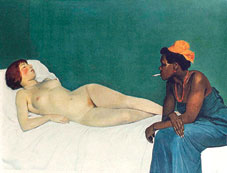
A painting and a living picture answer each other, in a surprising parallelism. A type of painting of a scene on a street, a bedroom, and a museum. A young woman is walking in the street, towards a meeting. A black woman is sitting on a bed persistently watching a young naked white woman sleeping, reproducing a painting of the type. This video has the appearance of a psychological elucidation of passivity, of relations of force contained in a picture. A questioning look, traversing the relationship between two women.
Sally Grizzell Larson is a visual artist based in Philadelphia. Her videos have been screened at Anthology Film Archives in New York; the Museum of Image and Sound in São Paulo, Brazil; Smack Mellon Gallery in Brooklyn in an exhibition curated by Electronic Arts Intermix, New York; the Rio de Janeiro Festival of Electronic Media - Prog: ME; and the Women of Color Film Festival in New York. "Certain Women" was awarded Best of Festival ? Experimental at the Berkeley Video and Film Festival (2006). Larson?s photographic work has been exhibited at the Brooklyn Museum of Art; the Yale University Art Gallery; Centro de Cultura in Malaga, Spain; and Kunstraum B/2 in Leipzig. It has been published in Rethinking Marxism ? A Journal of Economics, Culture and Society, University of Massachusetts, Amherst; LEONARDO magazine; and the books "Photography Reborn" (Abrams Press, 2005), and "Writing the World: On Globalization" (M.I.T. Press, 2005). Her extensive international travel (to Brazil, Argentina, Uruguay, Egypt, China, Hong Kong, Europe, England, Tanzania, Zambia, and Zimbabwe) includes long-term stays in Kenya (1986-87) and Ireland (1987-88).
Béatrice Lartigue
Catalogue : 2026The Unfinished City | Experimental video | mov | black and white | 6:30 | France | 2025
Béatrice Lartigue
The Unfinished City
Experimental video | mov | black and white | 6:30 | France | 2025
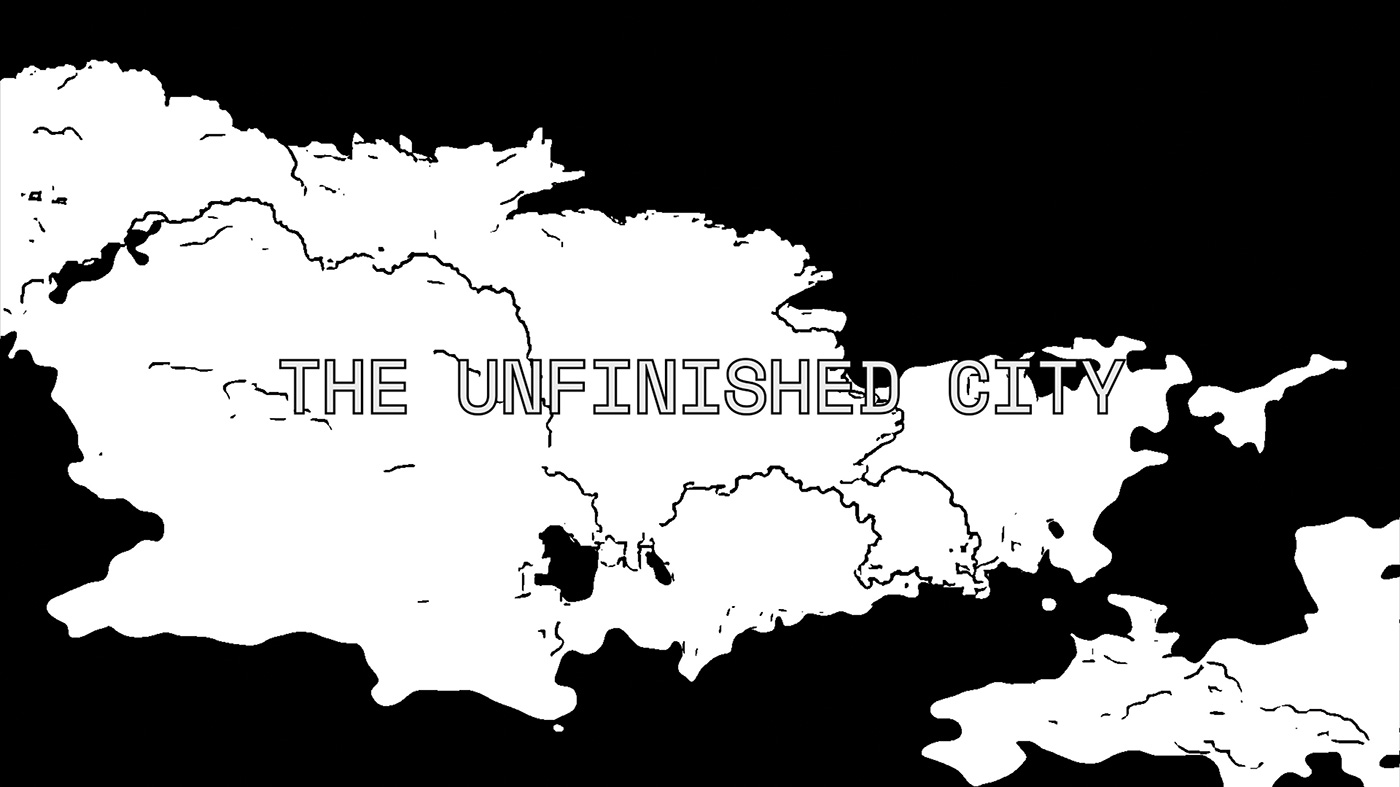
A city as a dynamic evolving system where buildings, like living organisms, can grow and adapt over time. The Unfinished City explores the work of theorist, architect and urban planner William J. Mitchell (1944-2010), a professor at the MIT Medialab. Mitchell is the author of a trilogy that explores the impacts, challenges and potentials raised by the development of digital technology on the way we think about and design the city. “Since new technological systems are complex social constructions, we must understand our emerging options, choose our ends carefully, and build well. Our job is to design the future we want, not to predict its predetermined path. [...] Ultimately it comes down to a basic social and political choice. What will we use the multifaceted and sometimes contradictory affordances of digital technology for?”, e-topia: "Urban Life, Jim—But Not As We Know It", 1999, The MIT Press The Unfinished City takes a subjective, dreamlike perspective on the themes Mitchell sketched out over 25 years ago. The fragmented, shifting city that takes shape before our eyes becomes the film's main protagonist. Thought of as a living organism, this architecture also echoes the thinking of the Metabolist movement that emerged in Japan in the late 50s. Metabolism views cities as dynamic, evolving systems where buildings, like living organisms, can grow and adapt over time. The film combines "traditional" animation techniques with Machine Learning tools.
Béatrice Lartigue is a french visual artist based in Toulouse. She is co-founder of the interdisciplinary collective Lab212. Since 2008, Béatrice Lartigue has been working on projects at the intersection of art, science and technology. Her work explores the materialisation of invisible physical events, by immersing visitors in a space whose rules are partly written and partly in the making. A critical perspective on the utilisation of technology in a fragile environmental context guides her practice. Her works were exhibited at the Barbican Centre (London), the Miraikan Museum (Tokyo), le Centre Pompidou (Paris), la Gaîté Lyrique (Paris), the DMuseum (Seoul), the Times Art Museum (Beijing), Photo Elysée (Lausanne). Béatrice Lartigue has won several international awards, including from the Sundance Film Festival (New Frontier Selection: Notes on Blindness), the Lumen Prize (Performance Award: Portée/), the GIFF Festival (Philémon). She teaches Media and Interaction Design at Gobelins (Paris) and regularly leads workshops in institutions such as ECAL (Lausanne), Beaux-Arts (Toulouse).
Renan Larzul
Catalogue : 2006La Fuite | Art vidéo | dv | color | 3:45 | France | 2005

Renan Larzul
La Fuite
Art vidéo | dv | color | 3:45 | France | 2005
Quand immobile, la douleur s?enfonça trop profond en lui et tournant comme une mèche l?écrasant vers le sol, il ne fut plus possible d?éviter la fuite. Oublier la dureté du chemin en s?égarant sur la route. Avancer vers la paix, retrouver en soi une voie à emprunter, à prendre ou à voler. Ne jamais se retourner ; redevenir maître, en un sens, de sa liberté. Faire taire les doutes, aplanir les chocs, gravir les échelons de son intériorité, Prendre un rond point qui n?est pas final et quand passés les multiples dédales, Sans savoir comment - les plus beaux chemins ne sont-il pas dedans ?- Revenir dans la rue où jadis on pleurait comme un gosse et sentir Sous ses pieds un chemin ouvert et une force gagnée...
Après 10 années de photographie (1995 ? 2005) qui mêlent la rencontre humaine à celle du paysage, Renan Larzul aborde l?image en mouvement par la pratique du Super 8 mm en tourné-monté utilisant le photogramme comme un rappel direct des cadrages « fixes » de la photographie pour des portraits en image par image... mais aussi pour des mouvements de caméra : pano, zoom... supports d?une narration par un traitement expérimental de la pellicule. ... puis logiquement par le montage en série d?images fixes - photographies argentiques noir et blanc ou couleur numérisées - pour des « histoires courtes », récit-sommaires et ramassés de rencontres furtives ou éternelles...
Nina Lassila
Catalogue : 2017Did Van Gogh Get Laid Because of his Paintings? | Video | hdv | black and white | 5:45 | Finland, Belgium | 2016
Nina Lassila
Did Van Gogh Get Laid Because of his Paintings?
Video | hdv | black and white | 5:45 | Finland, Belgium | 2016
A semi critical and humorous review on the showing and hanging of Art. Do we make artworks to impress or for what reason? What is the purpose of art again? To impress sexual mates or to gain fame and richness? Could art be as sexy as muscles and money? Or could the artist actually be a respected figure in society?
Nina Lassila is a visual artist born 1974 in Helsinki, Finland currently living and working in Berlin and Belgium. Nina Lassila works mainly with video and performance. In many of her works she deals with questions of identity – specifically identity affected by social barriers, conventions based on gender and upbringing and cultural differences. Her other bodies of work explore issues of i.e supernatural phenomena, art and economic structures. She has taken part in several group shows and video festivals internationally.
Catalogue : 2016Lucid Dreaming | Experimental fiction | hdv | black and white | 6:45 | Finland, Belgium | 2014
Nina Lassila
Lucid Dreaming
Experimental fiction | hdv | black and white | 6:45 | Finland, Belgium | 2014
Something has happened and society as we know it does not function anymore. In this video I portray situations of an apocalyptic nature. The video is based on my thoughts of a possible future and on a lucid dream I had this year. What and how will survival function in case we have to live through it? And can I trust the ones I used to trust?
Nina Lassila is a visual artist working mainly with video, performance and writing. She was born 1974 in Helsinki Finland but lives and works currently in Belgium and Berlin. Nina Lassila has a MFA from The Valand Academy of Arts in Gothenburg SE. In many of her works she deals with questions of identity – specifically identity affected by social barriers, conventions based on gender and upbringing and cultural differences. Her other bodies of work explore issues of supernatural phenomena, art and economic structures. She has taken part in several group shows and video festivals internationally. i.e The Istanbul Biennial, Rencontres Internationals Paris / Berlin / Madrid, SHE DEVIL V Macro Museum Rome, XV Art Fair Mänttä , Reykjavik Arts Festival, Kassel Documentary & Video art festival, Reality Check TSSK Trondheim , LOOP Barcelona, Une Chambre á soi at Gallery Christophe Gaillard in Paris, The Bristol Biennial. Education: Swedish Polytechnics FIN 1994-1997, School of Photography & film Gothenburg SE 2000-2002, Valand School of Fine Arts (MFA) 2004-2006, Guest at ENSAD Paris 2009.
Catalogue : 2014Design or Destroy | Experimental video | dv | color | 5:0 | Finland, Belgium | 2013
Nina Lassila
Design or Destroy
Experimental video | dv | color | 5:0 | Finland, Belgium | 2013
Design or Destroy Are we born to design or to destroy? video 5.00min 2013 We see "the critic" seated in the grass in a garden on a summer day. He is pondering about questions of nature, animals and landscape. He creates a theory that tries to explain how the human being was born to design his environment and even his life. Furthermore he speculates wether it`s right to breed i.e monster like hormone beef. He wonders if and how crazy we really are.
Biography NINA LASSILA born in Helsinki Finland 1974, lives and works currently in Gothenburg SE and Belgium. Nina Lassila is a visual artist working mainly with video and performance. In many of her works she deals with questions of identity ? specifically identity affected by social barriers, conventions based on gender and upbringing and cultural differences. Her other bodies of work explore issues of i.e supernatural phenomena, art and economic structures. For more information see www.ninalassila.com Education: Swedish Polytechnics FIN 1994-1997, School of Photography & film Gothenburg SE 2000-2002, Valand School of Fine Arts (MFA) 2004-2006, Guest at ENSAD Paris 2009.
Catalogue : 2012Günter und Mutti | Performance | dv | color | 3:7 | Finland, Germany | 2011
Nina Lassila
Günter und Mutti
Performance | dv | color | 3:7 | Finland, Germany | 2011
A Groucho Marx like character analyzes 2 found objects - wooden trivets with the inscription Mutti and Günter on them. He makes up a story about Günter and Mutti . He also debates whether these trivets would work as art works exhibited in a gallery.
Nina Lassila is a visual artist born 1974 in Helsinki Finland, currently based in Berlin. She has taken part in several group shows and video festivals internationally i.e The Istanbul Biennial, Rencontres Internationals 2005 Kassel Documentary & Video art festival 2009, LOOP Barcelona, SHE DEVIL V Macro Museum Rome, Nordic Art Express - Nordic Video Art on tour. Education: Swedish Polytechnics FIN 1994-1997, School of Photography & film Gothenburg SE 2000-2002, Valand School of Fine Arts (MFA) 2004-2006, Guest at ENSAD Paris.
Catalogue : 2008Piiskaa! | Experimental video | dv | color | 1:13 | Finland, Sweden | 2005
Nina Lassila
Piiskaa!
Experimental video | dv | color | 1:13 | Finland, Sweden | 2005
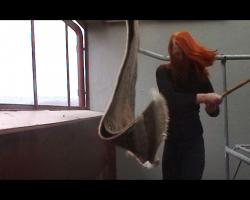
In Piiskaa! / Beat it! we see a woman cleaning a carpet. Though clearly she is beating the carpet up...is she angry and why? There is something provocative about a physical woman; even a loud laughter can provoke some people. There is a prevailing notion that a loud physical woman is somehow deranged, out of control. ? Gender is a lived ideology ? a system of ideas about men and women with which we live our lives. As lived ideology those ideas get transformed into specific bodily practices. Socially produced sex differences are embodied and lived out as real. They are materialized as habit and taken for granted as second nature.? (Bordieu)
Nina Lassila is a visual artist working mainly with video, performance and photography. She was born 1974 in Helsinki Finland but lives and works in Göteborg, Sweden since 2003. In many of her works she deals with questions of identity ? specifically identity affected by social barriers, conventions based on gender and upbringing and cultural differencies. The field of her interest spans from cultural & political issues to mumbojumbo sciene. She has taken part in several group shows and video festivals mainly in the Nordic and the Baltic countries, but also Germany and Canada. In 2004 she was awarded a Nordic Air residency in Tallinn Estonia by Nifca. In October 2008 she is attending the CAMAC residency in Marnay-sur-Seine in France. She is currently working on soloshows for gallery Formverk in Nyköping (SE) and Gallery SINNE in Helsinki (FIN) and she will participate in the Reykjavik Festival of Culture. www.ninalassila.com
Christine Lucy Latimer
Catalogue : 2017Still Feeling Blue About Colour Separation | Experimental film | super8 | color | 2:8 | Canada | 2015
Christine Lucy Latimer
Still Feeling Blue About Colour Separation
Experimental film | super8 | color | 2:8 | Canada | 2015
This film rephotographs over 200 internet-sourced images of ‘Macbeth ColorChecker’ cards on to super-8mm cyanotype emulsion. Macbeth Cards (precision tools in colour film processing), were a popular accessory for small-gauge Kodachrome filmmakers in the 1970`s. They have since been re-adopted by contemporary digital photographers, who use them to compare lighting scenarios on internet blogs and forums. Tracing the history of the colour calibration card through many lenses, I effectively remove all colours, save one. (Commissioned by The 8 Fest)
Christine Lucy Latimer is an interdisciplinary artist working with lens-based and time-based forms. Her work in the past decade has been featured across 5 continents in over 250 film festivals and gallery exhibitions. She currently lives and works in Toronto, Canada.