Catalogue > List by artist
Browse the entire list of Rencontre Internationales artists since 2004. Use the alphabetical filter to refine your search. update in progress
Ange Leccia
Catalogue : 2011Nuit bleue | Experimental fiction | | color | 86:0 | France | 2010
Ange Leccia
Nuit bleue
Experimental fiction | | color | 86:0 | France | 2010
"Celui qui n`accepte pas de se laisser égarer n`empruntera jamais que des chemins déjà tracés: il risquera de manquer celui qui le concernerait en propre. A moins qu`il ne sabote tous les chemins, les coupe et les embrouille." L?égarement de mes personnages dans « Nuit Bleue » s?imprègne de la pensée du philosophe Jean Toussaint Desanti ; mes émotions visuelles tentent de l?illustrer. A. LECCIA
Ange Leccia est né le 19 avril 1952 à Minerviù en Corse. Artiste plasticien, il a été pensionnaire de la villa Médicis à Rome en 1981-1983, puis résident à la villa Kujoyama à Kyoto en 1992-1993. Professeur à l?École Régionale des Beaux-Arts de Grenoble de 1985 à 1997, puis à l`l?École nationale supérieure des Beaux-Arts de Cergy de 1997 à 2000, il est actuellement directeur du Pavillon, le laboratoire de création du Palais de Tokyo. Ses oeuvres ont été exposés dans de nombreux musées (Guggenheim, Centre Georges Pompidou) et manifestations (Kassel, Sydney) en France et à l`étranger et il a réalisé de nombreux films dont Ile de Beauté (1996) et Gold (2000) avec Dominique Gonzales-Foerster, ainsi que Azé (2004) ou encore La déraison du Louvre (2005).
Patrik Lechner
Catalogue : 2026Heumarkt | Multimedia performance | 0 | color | 7:0 | Austria | 2025

Patrik Lechner
Heumarkt
Multimedia performance | 0 | color | 7:0 | Austria | 2025
The short film 'Vitrine' is a gesture of dedication to an object. The “Café am Heumarkt” houses a now-defunct display case, whose sounds, in past decades, often provided the only break in the otherwise concentrated silence of afternoons in the coffeehouse. This gesture originated from the research project Spirits in Complexity – Making Kin with Experimental Music Systems, initially taking the form of an installation that sonically reanimated the display case. The short film represents a further step in this direction: through procedural modelling, the display case was recreated both sonically and visually. No photos, 3D scans, or audio recordings were used—instead, the foundation of the modelling and exploration was a deep engagement with this culturally charged object. The result opens up various fields of action—legible as an archival object as well as a peculiar, audiovisual, real-time capable “instrument,” whose aesthetic possibilities are explored here. “Europe as a museum,” a form of escapism stuck in time, becomes particularly tangible in Viennese coffeehouses. This very anachronism, along with the general discrepancy between tradition and technological progress, is addressed here on an aesthetic level. Video made with TouchDesigner, Audio made with Max/MSP.
Patrik Lechner (AT) is an artist creating experimental audio/video content since the mid 2000s. Developing custom software for these purposes, original content in abstract sound works and real-time 3D graphics arose through the exploration of technology without losing focus on artistic expression. Patrik Lechner held audio/visual performances in Austria, Belgium, Italy, Bulgaria, Germany, Canada, Dubai and MUTEK Mexico and regularly played at the Austrian Pavilion at the world exhibition in Shanghai 2010. He received an honorary mention at PRIX ars electronica 2019 for a musical piece written for an acousmonium.
Johanna Lecklin
Catalogue : 2007Paljon on iloakin | Experimental video | dv | color | 10:0 | Finland | 2005
Johanna Lecklin
Paljon on iloakin
Experimental video | dv | color | 10:0 | Finland | 2005
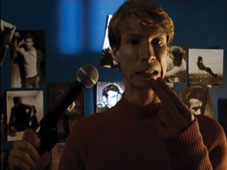
The script in "There is a Lot of Joy, too" is based on discussions with a young boy who has Asperger's syndrome. The script became a fictive dialogue between a boy and his mother. They never meet on the screen, but are shown in their own rooms next to each other. The boy talks about his dreams and the mother recounts how it is to live with a child who is different.
Johanna Lecklin is currently completing a PhD at the Academy of Fine Arts in Helsinki, Finland. Her subject is Narrativity, Documentary, and Performativity in Video Art; it is closely related to her own artistic practices. Her background includes an Erasmus exchange at Slade School of Fine Art, UCL in London 1998-99 and a MA degree from the Academy of Fine Arts in Helsinki in 2003. She has taken part in film and video festivals such as Raindance Film Festival in London, UK in 2006; "bzzz" - Pépinières européennes pour jeunes artistes - 18th Festival International des Programmes Audiovisuels Biarritz in France 2005; and in Kasseler Dokumentarfilm - & Videofest Festival, in Kassel, Germany, 2004. She has had several solo shows in Finland and taken part in group shows in many Finnish museums and abroad. In 2001 she won First Prize of the Artists' Association of Finland.
Elise Leclercq
Catalogue : 2006D'ici Là | Experimental doc. | dv | color | 19:35 | France, Germany | 2005
Elise Leclercq
D'ici Là
Experimental doc. | dv | color | 19:35 | France, Germany | 2005
D'ici là/ (Untill then) Parting, uprooting are adressed through the search of new landmarks situated in the public space of Berlin. Each stakeholder participates to the physical and imaginery construction of its representation. The staged car involves a process of projection and intimate reflection on History and each and every's journey, situated in the "big story's" fringe. The German/Polish border presents a territorial division that evokes another temporality echoing back to the faddish aspect of interventions in an urban environment and to their reliance in an historical politic landscape.
Born in 1980, Elise Leclercq, leaving for 3 years to study scenography at the ENSAV- La Cambre (Brussels), reorientates her researchs towards the video within the workshops of Espaces Urbains (Urban Spaces). She realizes several documentary projects in different parts of Brussels and in Berlin, all orientated around contemporary urban problems. The question of means of individual representation that the inhabitant of a neighbourhood do and that we call the public space, is central. She currently starts on a Master in Anthropology at the EHESS in Paris, during which she counts upon to deepen the evoked reflections of her several artistic projects and to confront them with a scientific reflection.
Samuel Lecocq
Catalogue : 2018Fragility and obsolescence | Experimental doc. | hdv | color | 10:0 | France | 2017
Samuel Lecocq
Fragility and obsolescence
Experimental doc. | hdv | color | 10:0 | France | 2017
The Centre for Prevention, Integration and Citizenship (CIPC) has been opened in September 2016. It is designated as the first French «deradicalization» centre. There is constant debate about its resources, organization and very existence. Access is restricted, its surroundings are heavily protected and it is inaccessible to journalists, not to mention artists. This video is the story of an effort to understand. How a narrative strategy is set in place. With the aim of providing some kind of representation of this physical, aesthetic and philosophical domain. In her essay «Confiscation», Marie-José Mondzain (french philosopher) suggests a re-appropriation of the divisive word «Deradlicaliser»(deradicalize). Once extracted from its reductive definition (reversing an extremist belief), it becomes the means to reveal fragility and obsolescence in the real. The video has been organised, set up and directed according to this conceptual premise.
Samuel Lecocq was born in Paris in 1992. He lives and works in Brussels.
Jean François Lecourt, Thomas Auriol
Catalogue : 2018Tir dans le miroir | Performance | hdv | color | 0:0 | France | 2010
Jean François Lecourt, Thomas Auriol
Tir dans le miroir
Performance | hdv | color | 0:0 | France | 2010
Jean-François Lecourt est né dans le Perche le 3 Novembre 1958, au sein d’une famille d’agriculteurs. Il entre à 17 ans à l’école des Beaux-Arts du Mans où enseigne Gina Pane, une des artistes fondatrices du mouvement de l’art corporel. Parallèlement, il suit l’éducation d’un Maître d’Arts Martiaux en Karaté Do (la voie des mains nues) de l’école Shotokan, et s’adonne assidûment aux pratiques du Tir à l’arme à feu et du Tir à l’arc. Sa démarche est basée sur l’analogie et l’identification. Une méthode qui le conduit à la découverte de l’aspect cyclique et symétrique des processus de tir et de photographie ; d’où le concept majeur de son œuvre : Le Tir dans l’appareil photographique.Cet acte artistique est un cérémonial immuable qu’il pratique depuis 1977. Il ne s’agit pas pour lui d’illustrer une névrose autodestructrice mais de tenter, en un retour immédiat, d’abolir l’arrêt fatal du cliché. La photographie est donc ici un Art martial. Comme dans le Kuy-Do, la cible à atteindre est soi-même, le but étant la réalisation au présent de celui qui pratique. Une nouvelle création vidéo de 2010 implique une série de films qui mettent en jeu l’autoportrait, la détonation, effondrement et la renaissance du paysage, ce travail s’intitule « Les tirs dans le miroir ».
Alejandro Lecuna
Catalogue : 2006718 Nebel und Rauch | Art vidéo | dv | | 7:18 | Venezuela, Germany | 2005
Alejandro Lecuna
718 Nebel und Rauch
Art vidéo | dv | | 7:18 | Venezuela, Germany | 2005
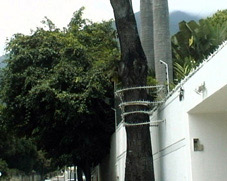
The polarized political situation of Venezuela is presented as an asymmetric documentary that shows the private and the public space in the capital Caracas. The constant fear induced by political in-stability and the incapability of the government in public safety has given raise in the last few years to a prosperous industry of home-security that has re-shaped the public and private space. Bob-wire and electric fences are the new decoration fashion that every house must have in order to be saved from the ?other?. Caracas is a place where nature, humans and panic seem to be able to co-exist in a tense harmony.
Alejandro Lecuna started his career in the arts has aprenticeship of the Venezuelan Op artist Carlos Cruz-Diez. Studied Graphic Design in the Instituto de Diseño de Caracas and in the School of Visual arts of New York with Prof. Milton Glazer, Prof. Tony Palladino and Prof. Ed Benguiat. Recently finished his studies in Visuelle Kommunikation and Video art- at the University of the Arts of Berlin with the German video-artis Prof. Maria Vedder and Prof. Holger Matthies (UdK). Currently studies his Maisterschüler (member of a master class) also with Prof. Vedder. In the commercial world his experience lies in the area of corporate design for print & digital. He has worked for various firms including SME branding and FDTdesign in NY and frogdesign in Germany. Among his clients and projects are Coca-Cola, DaimlerChrysler, Smart, Consors, NHL, NFL, NBA and David Byrne`s music label Luaka Bop. In the art world his video works has found space in the Berlin night scene. His most recent shows include the "Dis-appearances" show in 2004 in the Opel Haus in Berlin Friedrichstrasse (catalog) and the 48 Stünden Neu-Koln Kunst un Kultur Festival. He has concentrated his art in using the public space as the object and objective of his work. He is a regular lecturer in the design and art schools in Venezuela.
äggie Pak Yee Lee
Catalogue : 2023Beauty & the Beasts | Experimental film | mp4 | color | 3:32 | Hongkong | 2021
Äggie Pak Yee Lee
Beauty & the Beasts
Experimental film | mp4 | color | 3:32 | Hongkong | 2021
That night, a lady met a group of lovely beasts - gigantic slimy cheesy ones.
Äggie Pak Yee Lee is an audio-visual artist/ animation director from Hong Kong, graduated in Estonia. Her works draw inspiration from the playful relationship between the flow of sound and of images, with a tint of stupidity. Both of her experimental and narrative shorts were showcased in several festivals such as Sundance, Annecy, Goldenhorse and Interfilm.
Heewon Lee
Catalogue : 2018La pluie (The Rain) | Video installation | 4k | color | 6:0 | Korea, South, France | 2017
Heewon Lee
La pluie (The Rain)
Video installation | 4k | color | 6:0 | Korea, South, France | 2017
LA PLUIE est une rencontre dans un paysage typique, dont l’apparente magie ne saurait faire oublier le drame de la situation. Des voix se font entendre. Qui sont-elles ? Peu à peu leur histoire nous est contée et leur présence semble flotter à nos côtés. Ce film est un hommage aux victimes de l’exploitation sexuelle en temps guère établie par le gouvernement japonais durant la seconde guerre mondiale. Les victimes n’ont pas encore été reconnues par le Japon. Elles sont Coréennes, Chinoises, Philippines, Thaïlandaises, Vietnamiennes, Malaisiennes, Indonésiennes… Ce projet n’intente pas un procès au Japon, mais se focalise sur la douleur humaine traduite métaphoriquement à travers la figure du fantôme et rend hommage à ces femmes. La réalité virtuelle est le moyen le plus approprié pour explorer la vision d’un spectre. Cette mise en forme, la multiplicité de modes de production qu’elle induit, permet d’envisager une immersion totale dans l’œuvre et créer une identification immédiate ; un flou entre les limites physiques et mentales du spectateur et des personnages. Le supplément d’informations que produit la VR enrichit l’environnement du spectateur et l’implique activement dans l’œuvre.
HeeWon Lee est née en 1978 en Corée du Sud. Après avoir étudié la mode à Séoul elle s’installe en France fin 2002 ; elle suit l’enseignement du français à l’université de Nancy II et poursuit son activité artistique. Elle entre à l’Ecole Nationale Supérieure d’Art de Nancy, option Communication Art Visuel, avant de conclure son parcours par un post diplôme au Fresnoy - Studio National des Arts Contemporains, à Tourcoing. Heewon Lee est une artiste multimédia qui développe une pratique artistique où se rencontre vidéo, graphisme, son et installation. Son travail inspiré par notre quotidien opère de légers déplacements qui nous plongent dans un univers fragile et onirique. Ses projets ont été primés et présentés à de nombreuses reprises : Jeunes Talents-Air France, la Diagonale des Arts- Biennale d’art contemporain, Busan International Video Festival, Vidéographie(s), Vidéoformes...et diffusés en France au Grand palais, Palais de Tokyo, Air France, Féstival Némo au 104 et La Gaîté Lyrique, BIAN II au Cinémathèque québécoise, Montréal, Digital life, à Rome, the Special Olympics World Winter Games PyeongChang, Nabi center, Corée du sud, Museum of Art Hong Wan, Beijing... Ses oeuvres sont régulièrement diffusées au Brésil, Canada, Corée du Sud, Maroc, Espagne, Italie, France…
Heewon Lee
Catalogue : 2010phone tapping | Experimental video | betaSP | color | 9:30 | Korea, South | 2009
Heewon Lee
phone tapping
Experimental video | betaSP | color | 9:30 | Korea, South | 2009
The film is built up from that single, imperceptible instant that signals the shift from day to night, a fleeting moment in which what was, is no more, where things might acquire fresh significance. A voiceover guides us through the city, while the camera seems to be searching for a specific plot of land, for the coincidence between narrative and image. The topography of the site continues to advance, while in parallel there emerges a second topography ? mental this time, ? until, perhaps, they meet, somewhere here, in a new psychical space. Using the city of Seoul, it is a personal story that is being told. Our role is to follow it and select a locus of interpretation: truth, (urban) folktale ?
HeeWon Navi LEE Born in December 1978, at Kyeung Ki - Do, South Korea. She worked as a stylist in Seoul, and since 2002 it is installed in France. After studying visual communication at the Ecole Nationale Superieure d?Art de Nancy, Won Hee LEE Navi integrates the Fresnoy - Studio National des Arts Contemporain. His research and practice various artistic blend clothing influences ranging from cinema to graphics, sound installation. His works are moving and using more and more new media across a digital world in works such as;
Marc Lee, Marc Lee
Catalogue : 2009Oamos | Net art | | | 0:0 | Switzerland | 2008
Marc Lee, Marc Lee
Oamos
Net art | | | 0:0 | Switzerland | 2008
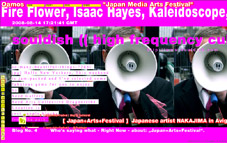
An instrument of Meta-Inspiration. With Oamos, Marc Lee had only one goal: to make the spectator discover with the contents those things likely to please and inspire him. What is Oamos? According to topics launched by the public, Oamos requests machines to investigate, using current events, images, synonyms, music, arguments, noises, blogs and videos. The data are prepared audio-visually and are presented by choice in a pragmatic or entertaining way, with or without sound, with or without interconnecting with the others sites.
Marc Lee was born in 1969 in Switzerland. He created interactive projects oriented towards the network since 1999 in a production directed towards the artistic field. He experiments with information and communication technologies which contain cultural, creative or economic and political aspects. He recently took part an important art media exhibition, such as the ZKM of Karlsruhe, New Museum of New York, the Biennial one of art media of Seoul, Transmediale 02 and 04 of Berlin, Viper 01, 03, 04 and 05 from Basel, Ars Electronica, CeC de Dehli, Read_Me Festival of Moscow and the ICC of Tokyo.
Yong Chao Lee
Catalogue : 2015Jade Man | Fiction | hdv | color | 18:5 | Taiwan | 2014
Yong Chao Lee
Jade Man
Fiction | hdv | color | 18:5 | Taiwan | 2014
About the jade-mining lives led by the Burmese youths, most of whom work illegally for black jobs, risking and betting on their lives, for a meager living or the commitments to their beloved ones.
Yong Chao, born in Myanmar, passed the overseas College Entrance Exam of Taiwan after high school and went to university in Taiwan. During his university years, Yong Chao came into contact with the charm of image and movie, thus embarked on the journey of independent filmmaking.
Meesoo Lee
Catalogue : 2006Spaceship 2000 | Experimental video | dv | color | 3:0 | Canada | 2004
Meesoo Lee
Spaceship 2000
Experimental video | dv | color | 3:0 | Canada | 2004
Meesoo Lee a commencé à faire de la vidéo en utilisant un caméscope et deux magnétoscopes. Inspiré par les DIY ethos of Zines, la musique « lo-fi » et le cinéma d?avant-garde, il réalise des vidéos originales inspirées de la méthode du « vidéo-clip ». Il prétend que ce médium peu coûteux ouvre la voie à un monde infini de créativité et permet l?apprentissage autodidacte sous forme «d?essai-erreur». Meesoo Lee a réalisé des dizaines de courts métrages qui ont été présentés dans divers festivals ainsi qu?au Festival du Front Occidental et au Festival des Images à Toronto
Jangwook Lee
Catalogue : 2026Chang Gyeong | Experimental film | 16mm | color and b&w | 17:20 | Korea, South | 2024
Jangwook Lee
Chang Gyeong
Experimental film | 16mm | color and b&w | 17:20 | Korea, South | 2024
"She would narrate events she had witnessed with her own eyes, as well as events that she had never witnessed." from 'The wind-up bird chronicle' by Murakami Haruki As a child, zoo was a space that gave me a very fantastic experience. In particular, Changgyeonggung (then called Changgyeongwon) was a strange place where zoo, amusement parks and old palaces coexist. Perhaps childhood memories remain as an emotional vestige of events there, of people with whom, of food, of weather, etc. It was not a specific event, but a personal emotion which lies somewhere around the boundaries between the reality and the virtual. It was learned through education that the coexistence of these elements came from the tragic modern history of Changgyeonggung (in the time of Japanese rule, a zoo was created for the purpose of mocking and degrading Changgyeonggung Palace). Even then, Changgyeonggung has a history of animals being victimized during liberation and the Korean War. After learning of this history, the space of Changgyeong Palace no longer had aroused any previous emotional reactions. Emotional memories that had formed the ambiguous boundaries between reality and fantasy began to divide exactly in two, and at the same time there was no emotion left on either side of reality and fantasy.
Lee Jangwook studied filmmaking at the School of the Art Institute of Chicago (SAIC). He has been working on film materials and expanded cinema such as live film performance. In 2004, Space Cell was founded to hold experimental films and hand-made film workshops and is currently underway. Many of the works are archived in the Korea Film Archive and ACC. His works have been shown at festivals and exhibitions like Tate Modern, National Museum of Modern and Contemporary Art (MMCA Seoul), Asia Culture Center (ACC Gwangju), FID Marseille, Internationale Kurzfilmtage Oberhausen, Jeonju International Film Festival, and EXiS.
Yoonjoo Lee
Catalogue : 2020The Garden of All Spheres | Experimental VR | 0 | color | 0:0 | Korea, South, Germany | 2019
Yoonjoo Lee
The Garden of All Spheres
Experimental VR | 0 | color | 0:0 | Korea, South, Germany | 2019
Garden of all spheres is a VR experience which exhibits the live simulation of a pseudo-ecosystem. The garden is built in the video game environment, which can exhibit the most advanced technology in the production and presentation of real-time CGI and simulation. The library of the virtual scenery is parallel with the modern natural history museum - the eye-catching collection of nature - the inventories which are ever-expanding and impossible to complete. Skysphere is a primary, simple prop for creating an illusion of horizon. In the nature of Virtual Reality, the player?s eye is located in the centre of the sphere. It becomes her private sky which is impossible to feel the scale of it - as much like as the sky in the physical world. The camera moves beyond the stage, from inner shell to outer shell and reveals the boundary of human-centred viewpoint. This spherical garden mediated through VR glasses, which embodies the desire for a seamlessly expanded vision. All the animals, humanoids, trees, stones, lights, skies are reflected on the surface of gazing ball and exhibited in the spherical vitrine, and the exhibition becomes meta-ecosphere.
Yoonjoo Lee is a multi-disciplinary artist based in Berlin. Her artistic practice generally focuses on the relationship between voyeuristic/Intellectual curiosity and technology of representation. She uses various digital technologies such as 3d animation and video game engines for a platform of the moving image experiments and explores the apparatus-mediated vision. She is currently studying experimental film and generative art in the Berlin University of Arts.
Samuel Kiehoon Lee
Catalogue : 20075 x 90: the wake | Experimental video | dv | color | 10:45 | Canada | 2005
Samuel Kiehoon Lee
5 x 90: the wake
Experimental video | dv | color | 10:45 | Canada | 2005
Five different stories comprise a single ninety second vignette; each tale illuminating an element of the deceased's life during his wake. A meditation on the Buddhist notion of reincarnation, "5x90: the wake" is a sly and clever look at an interracial family coping with a death in the family.
Samuel Kiehoon Lee's award-winning pieces include the short documentary "How to make Kimchi according to my Kun-Umma"; the experimental narrative "5 x 90: the wake"; and "Hannah".
Eelyn Lee
Catalogue : 2015An Ealing Trilogy | Video installation | hdv | color | 7:46 | United Kingdom | 2014
Eelyn Lee
An Ealing Trilogy
Video installation | hdv | color | 7:46 | United Kingdom | 2014
An Ealing Trilogy is a response to selected portraits from the collection of the National Portrait Gallery, London. Commissioned by the gallery, the film re-invents the lives of inspirational people who have links to Ealing, West London including Dusty Springfield, Charlie Chaplin and Freddie Mercury. Tableaux imagery is combined with an abstract soundscape to create a captivating slow motion film portrait of people and places from a west London borough.
Eelyn Lee is an award-winning artist-filmmaker who had works screened across London including Tate Modern and Whitechapel Gallery as well as internationally in Paris, Berlin and Toronto. Using processes of devising and collaboration her films use rich imagery and soundscapes to tell multi-layered stories about people and place. She is interested in groups of people, both in the making of the work and the subject of the work itself. The vision, energy and experience she brings to the creative process builds an environment conducive to making bold and original work. www.eelynlee.com
Catalogue : 2013Truce Triptych | Video | hdv | color | 3:52 | United Kingdom | 2012
Eelyn Lee
Truce Triptych
Video | hdv | color | 3:52 | United Kingdom | 2012
Inspired by Old Master paintings, three slow-moving tableaux images appear depicting scenes of conflict and resolution on the streets, at home and in the workplace. Shot on locations in East London the images feature young people playing various roles including a young pregnant mum representing Justice and a smart young man battling with a politician at the doors of a local Job Centre. These evocative and multi-layered images employ both photographic and filmmaking techniques, challenging the audience to see different things in them on each viewing. Under the direction of Eelyn Lee, young filmmakers and photographers from A New Direction?s Headstart worked alongside filmmakers at Eelyn Lee Productions and photographers Tim & Barry to create this compelling piece of moving image work. Commissioned by A New Direction
Eelyn Lee is a filmmaker and managing director of Eelyn Lee Productions. After studying fine art she founded the performance group Sacred Cow, producing site-responsive visual theatre in the North of England during the 1990?s. Following a Post-Graduate in sculpture, her work became more installation based, which in turn triggered a career in filmmaking. Her visual art and performance background continues to inform her narrative-led filmmaking, a career in which now spans 15 years. Eelyn has written, produced and directed documentaries, short films and animations. She has a strong reputation for making high quality films about young people that are often devised through participatory processes. Her films have been broadcast on TV and online, shown in festivals and distributed on DVD. In 2012 she received the ?RITTER SPORT Film Prize? for Life and Deaf, a short film selected for the competition programme of the 6th ZEBRA Poetry Film Festival in Berlin. Eelyn lives and works in London and Sheffield and is currently developing ideas for narrative feature films.
Cathy Lee Crane, John Di Stefano
Catalogue : 2026Tra | Video | hdv | color | 5:35 | USA, Canada | 2024
Cathy Lee Crane, John Di Stefano
Tra
Video | hdv | color | 5:35 | USA, Canada | 2024
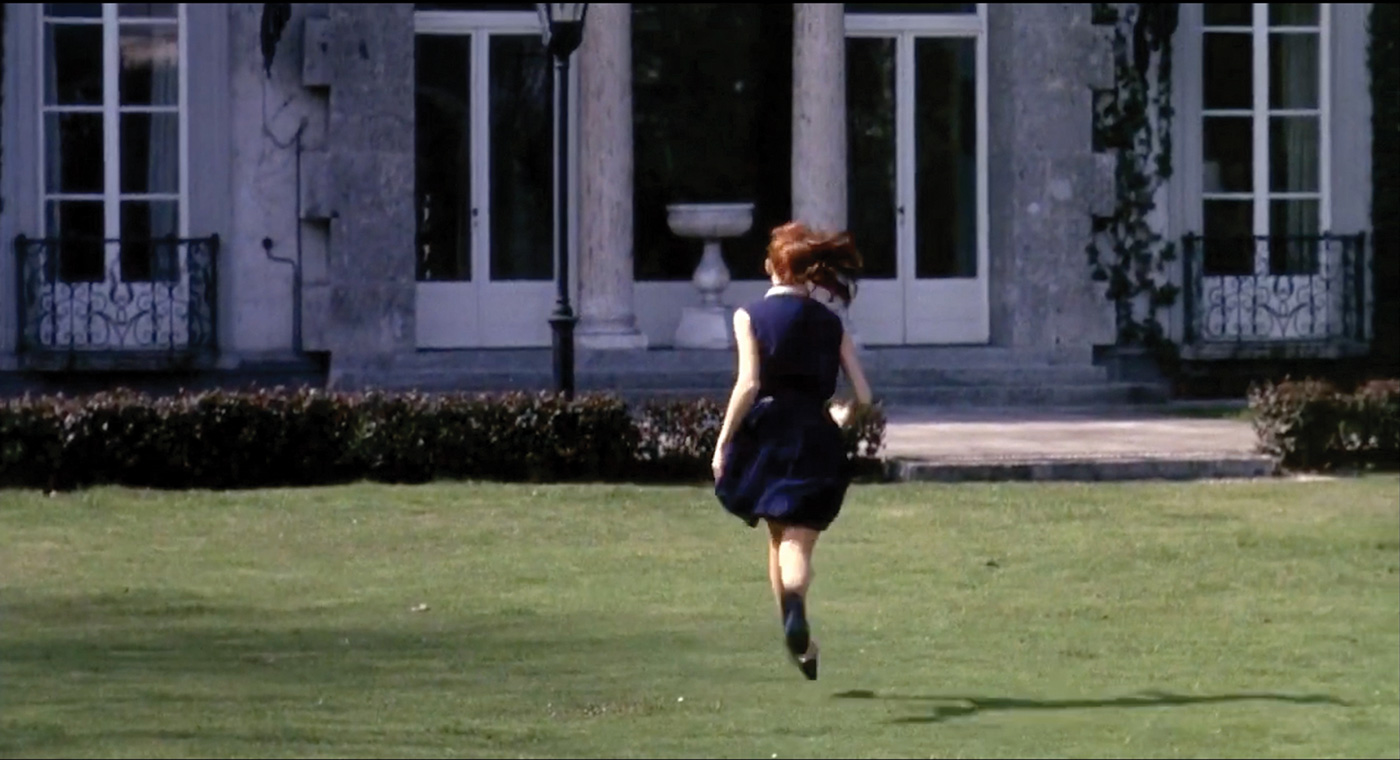
‘Tra' is an ode to Italian filmmaker Pier Paolo Pasolini. ‘Tra' synthesizes the narrative of his film ‘Teorema' (1968) by highlighting its interstitial moments. The act of running that appears throughout the film is isolated and deployed to expose the film’s subtextual currents.
John Di Stefano is an artist/filmmaker, writer, and curator whose work reconciles the personal with the social, the everyday with history through hybrid forms of documentary practices and the essayistic form. His work often deals with his immigrant past seen through a queer lens, including the feature-length 'You Are Here' (2009) which premiered at the Festival International du Documentaire (Marseille). His award-winning work has also been featured at the Videonale (Bonn), Whitechapel Gallery, Tensta Konsthall, Barcelona Museum of Modern Art, Para/Site (Hong Kong), and Anthology Film Archives. His critical writings appear in various international publications. He teaches at Concordia University (Montreal). Cathy Lee Crane is an experimental filmmaker whose work mines the historical archive to produce lyrical films of speculative history. She was a Guggenheim Fellow, and in 2015 her work enjoyed its first survey at the National Gallery of Art (Washington DC). Crane’s award-winning films –including 'Pasolini’s Last Words' (2012)– have screened at Viennale, Cinematheque Francais, BFI, and Arsenal/Berlin. Her interest in borders saw the release of 'Crossing Columbus' (2020) about the border town of Columbus, New Mexico which was supported by the Rockefeller Foundation and the Harun Farocki Institut in Berlin. She teaches at Ithaca College (New York).
Jan Robert Leegte, Raton BOCA
Catalogue : 2006Along the line | Experimental video | dv | black and white | 2:0 | Netherlands | 2005
Jan Robert Leegte, Raton BOCA
Along the line
Experimental video | dv | black and white | 2:0 | Netherlands | 2005
Jan Robert Leegte a étudié à l'académie des arts de Rotterdam, après trois ans d'études d' architecture à l'université de Delft. PArallèlement à ses performances et installations, il a commencé à travailler pour internet en 1997. http://rhizome.org/thread.rhiz?thread=20448&page=1#39300
Pierre Lefrançois Verove
Catalogue : 2023La chambre de Paul | Fiction | 16mm | color | 15:20 | France | 2022
Pierre LefranÇois Verove
La chambre de Paul
Fiction | 16mm | color | 15:20 | France | 2022
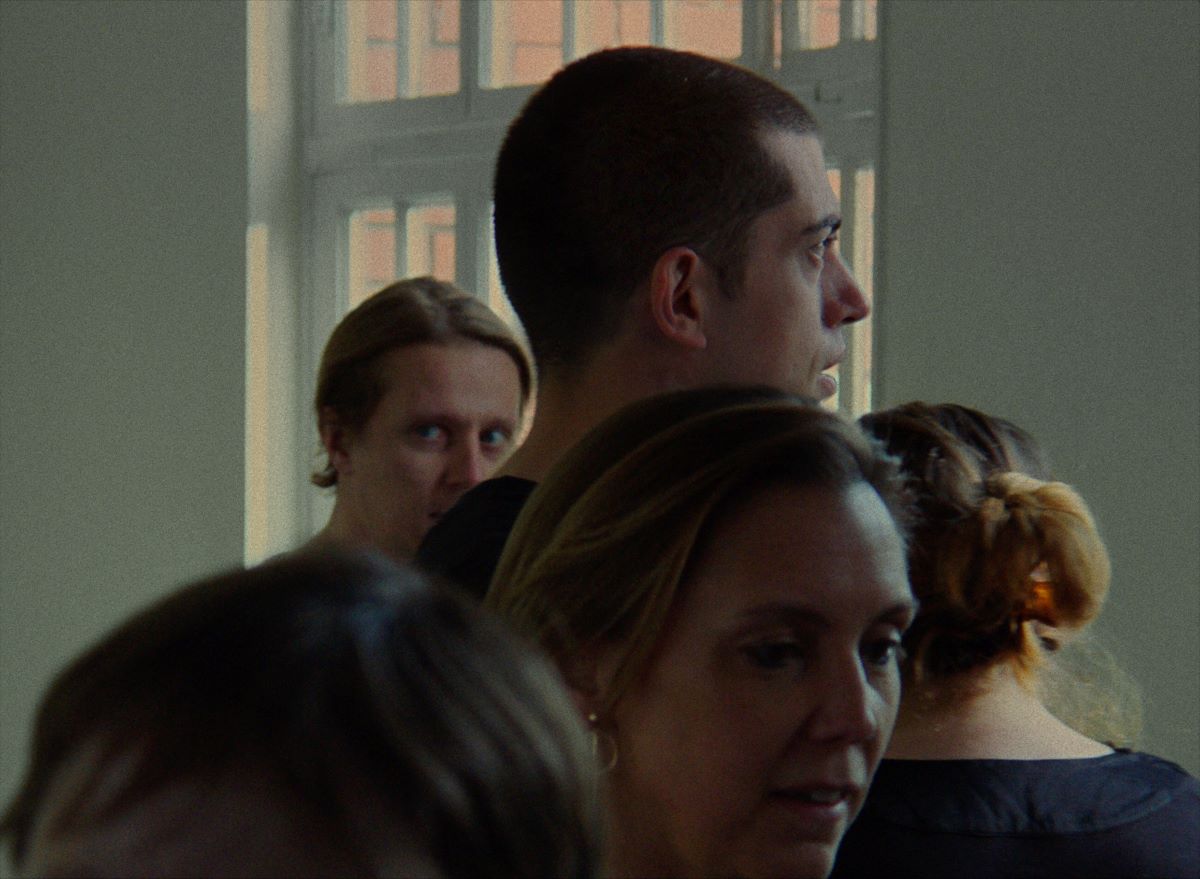
Men and women shout, crowd, shake then embrace. Paul says goodbye to them. He leaves the institution with the hope, perhaps, of a new beginning, but outside, the past persists from one room to another.
Pierre Lefrançois Vérove was born in 1989 and lives in Montreuil, France. He studied at the national school of art of Paris-Cergy before joining Le Fresnoy, national studio of contemporary arts in 2021. His works, films and texts focus on the visible or invisible margins and those who inhabit them. A consideration that led him to explore the field of institutional psychotherapy (La chambre de Paul, 2022) or to follow European borders from Paris to the island of Lesbos in Greece (Algèbre, 2019).
Pierre Lefrançois Vérove
Catalogue : 2025Vigile | Experimental fiction | 4k | color | 12:28 | France | 2023
Pierre Lefrançois Vérove
Vigile
Experimental fiction | 4k | color | 12:28 | France | 2023
When night falls, the city exists only in halos. Vigil or guardian, you must keep watch among the shadows, confusing tiredness with sleep, night after night, scrutinising the darkness even if it means opening a breach in it and stirring the invisible.
Pierre Lefrançois Vérove was born in 1989 and lives in Montreuil (France). He studied at the national school of art of Paris-Cergy before joining Le Fresnoy, National Studio of Contemporary Arts in 2021. His works, films and texts focus on the visible or invisible margins and those who inhabit them. A consideration that led him to explore the field of institutional psychotherapy (La chambre de Paul, 2022) or to follow European borders from Paris to the island of Lesbos in Greece (Algèbre, 2019).