Catalogue > List by artist
Browse the entire list of Rencontre Internationales artists since 2004. Use the alphabetical filter to refine your search. update in progress
Riza Manalo
Catalogue : 2006Lulan | Experimental video | s-vhs | color | 30:0 | Philippines | 1998
Riza Manalo
Lulan
Experimental video | s-vhs | color | 30:0 | Philippines | 1998
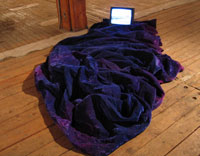
Riza Manalo wurde 1969 in Manila auf den Philippinen geboren. Sie hat Malerei in der Universität von Philippinen (Bachelor of Fine Arts)und Film im Mowelfund Institut studiert. In ihren ersten Werke erforscht sie quer durch die Medien Malerei, Installation und Video Fragen nach Identität und Umwelt. Eins ihrer Werke über diese Themen war "Paper Planet". Für diese Installation modelierte sie Puppen als Darstellung von Models mit Zeitschriften- und Latexschichten, die sie mit gefundenen symbolischen Objekten füllte. Das Werk stellt dem Publikum folgende Frage: Sollen wir uns aufgeben, indem wir als angepasste Wesen in einem von der Gesellschaft geformten Muster bleiben? Manalo benutzt ihre Lebenserfahrung als Referent in ihrer Arbeit. Ihre Sorgen für die Umwelt sind in mehreren Werken integriert, wie z.B. in der Installation "Lulan (To bring back)", wo sie ein 35m langes Band aus wattiertem Samt installiert in 15 verschiedenen städtischen und ländlichen Orten einbindet. Das Werk soll das Thema Wasser als ein Element anregen, das für sie Synonym für Energie, Leben und Regenaration in jeder Form ist. Genauso wie ihr persönliches Tagebuch, das Video und die Fotos von "Lulan" erzählen von ihren zahlreichen Reisen und von den Menschen, die sie auf diesen Reisen kennengelernt hat. Ihre in ihrer Jugend häufigen Umzüge, haben zu einer Arbeit von einer Reihe von grossformatigen Matratzen geführt, die gerollt und mit einer Industriekabel mit Metallplatten geätzt mit Text festgebunden waren. Ihre Bett-Reihen "Grassland" sind sowohl eine Autobiographie wie ein Kommentar über das Nomadenleben von zahlreichen Philippinesen als Resultat der sozialen Bedingungen in diesem Land. Nach ihrem letzten Umzug nach New York Manalo experimentiert mit den verschiedensten Medien und Formaten, mit dem Ziel, die Grenzen der existentiellen, geografischen, sozialen sowie die Probleme der Einwanderungspolitik und der Isolierung zu erforschen. Ihr letztes Video "Homebound" handelt sich von einem Einwanderer, der, während er seine verstorbene Mutter in einem Sarg nach Hause schickt, den Geschmack eines besseren Lebens eifrig zu bringen versucht. Das Auspacken der Geschenke, die zusammen mit der Verstorbenen abgeschickt wurden, stellt die absurde aber praktische Realität dieser Mischung von Konsumverhalten und Tradition in einem Entwicklungsland. "Homebound" gewann 3 Preise als bester Experimentalfilm. Riza Manalo stellt seit 1994 aus. Ihr Werk wurde in mehreren Ausstellugen und Filmfestivals in Philippinen und im Ausland gezeigt, einschliesslich des Cultural Center of the Philippine; Vargas Museum; Quezon City, Philippines; des Museums für zeitgenössische Kunst in Honolulu, HI; des New York Videofestivals, des Lincoln Center, New York, NY;
Giulia Mancassola
Melanie Manchot
Catalogue : 2026Line Of Sight (The Tower) | Video | 4k | color | 12:7 | Germany, Switzerland | 2025

Melanie Manchot
Line Of Sight (The Tower)
Video | 4k | color | 12:7 | Germany, Switzerland | 2025
Filmed in a decommissioned telecommunications tower, which used to house secret military equipment, this work returns to my ongoing investigation of mountains and their architectures as spaces of human-nature entanglements. It also returns more specifically to the alpine village of Engelberg, where I have been making work since 2010. In Line of Sight the camera investigates a deserted structure, a space left behind. As if everyone had vacated in mid-action, the environments bear traces of past life, long gone. Both inside and out, the camera observes this perplexing architecture in long panning and tracking shots, culminating in a moment of flight that reveals the structure – as if floating in space. When it was in operation, the tower fulfilled a host of functions, amongst them serving as a space of refuge and shelter during storms. A room full of old mattresses bears witness to such moments of danger. The title ‘Line of Sight’ refers to these towers standing atop mountain peaks with sight of each other, facilitating older forms of communication. With the advances of technology, these towers are now dinosaurs, standing solitary and defunct and as such become symbols of endurance, resistance and older forms of exchange. In 2025, this tower is being reshaped into a space for “mountain entertainment” – acerbating the dichotomy of mountain industries continually expanding footfall onto summits and glacier, hence contributing to the speed of climate change.
London-based visual artist and filmmaker Melanie Manchot employs photography, film, video and sound to form sustained enquiries into our individual and collective identities. The work interrogates and employs acts of care, resistance and communality to engage in discourses on social and political urgencies of our societies. Her films investigate innovative forms of storytelling with an acute understanding of the power of filmmaking to speak to urgent issues and have profound impact. Location-based research informs all her films and mountainous landscapes are a recurrent theme to address fragile environments in our care. Manchot’s artwork has featured in museum and gallery exhibitions internationally and she is currently working towards a large solo show in the UK in early 2026. Her first feature film, STEPHEN, commissioned by Liverpool Biennial, addresses gambling, substance misuse, recovery and mental health through both narrative fiction and documentary. It had its cinematic release through Modern Film in 2024 and continues to be shown in exhibitions as a multi-channel installation. Manchot is currently working towards her second film, Self Storage, with another feature, a fiction/doc hybrid, called One Day As A Tiger, in development.
Melanie Manchot
Catalogue : 2025Liquid Skin | Experimental doc. | hdv | color | 23:19 | Germany | 2023
Melanie Manchot
Liquid Skin
Experimental doc. | hdv | color | 23:19 | Germany | 2023
Filmed between dusk and dawn, Liquid Skin was filmed with nine women, who all perform night-time labour, across a wide variety of professions, including a baker, pole dancer, care worker, nightclub owner, cleaner etc. These women take us on a tour of night-time working environments, linked by history, economics and events shaping the post-industrial landscape of the Ruhr region in Germany. Through this choice of locations, the work links the nocturnal with questions on the subterranean, which is so present across this region with its thousands of kilometres of quiet tunnels underneath. The video consists of long, mostly single shot sequences each guided by one protagonist. Filming in black & white Infrared gives both the locations and the people a slightly abstracted and ghostly appearance, calling into question the specificity of each situation. Sound is integral to this work as it references industrial, technological, subterranean sounds of coal mining histories. The soundtrack is constructed from field recordings captured in each location but used in a non-diegetic way that consciously avoids synch sound. Visually the work aims to cross the dreamlike counter-logic of Lynch with urban spaces that may evoke Tarkovsky, Lang’s Metropolis or drawings by Escher.
London-based artist/filmmaker Melanie Manchot employs photography, film, video and sound to form sustained enquiries into our individual and collective identities. The work interrogates and employs acts of care, resistance and communality to engage in discourses on social and political urgencies of our societies. Her films investigate innovative forms of storytelling with an acute understanding of the power of filmmaking to speak to urgent issues and have profound impact. Manchot’s first feature film, STEPHEN, commissioned by Liverpool Biennial, addresses gambling, substance misuse, recovery and mental health through narrative fiction and documentary. It had its cinematic release through Modern Film in 2024 and continues to be shown in exhibitions as a multi-channel installation. Manchot is working towards her second feature film: Mount Makalu. She is shortlisted for the Jarman Award, UK. Her work is held in many public collections and was presented in a major survey show at museum MAC/VAL, Paris 2018. Selected solo exhibitions: STEPHEN, The Exchange, Penzance, 2024; Alpine Diskomiks, Parafin, London, 2022; Black Snow White Out, Museum Lumen, Italy, 2021; Mountainworks (Montafon), InnSitu, Innsbruck, Austria (2019); Open Stage/Back Stage, Kunsthaus Pasquart, Switzerland (2019); She completed her MA in Photography at The Royal College of Art in London in 1992.
Michael Mandiberg
Catalogue : 2007All haiku, all the time | Experimental video | dv | color | 3:30 | USA | 2005
Michael Mandiberg
All haiku, all the time
Experimental video | dv | color | 3:30 | USA | 2005
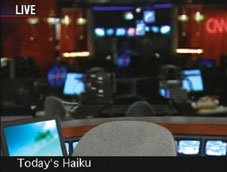
An empty 24 hour news network studio glows on the screen in silence. The background is still, but the news ticker continues, typing out haiku in the night.
Michael Mandiberg is a conceptual artist, computer programmer, and rogue economist who uses the Internet, Video, and performance to explore subjectivity, labour, and commerce. His current work employs Firefox plug-ins and open API platforms to highlight the real environmental costs of a global economy. His most recent projects are "Oil Standard", a browser plug-in that converts all prices on any web page into their equivalent value in barrels of oil, and "All Haiku, All The Time", a video of an empty 24 hour news studio with haiku running in the news ticker. In 2001 he distributed perfect copies of copies, and put all of his possessions up for sale on Shop Mandiberg. His work is exhibited and reviewed internationally. He lives and rides his purple bicycle around Brooklyn.
Stephanos Mangriotis, Alex Frigout, Gaël Marsaud
Catalogue : 2021O Terra, Addio | Experimental doc. | mov | color | 7:48 | Greece, France | 2020
Stephanos Mangriotis, Alex Frigout, Gaël Marsaud
O Terra, Addio
Experimental doc. | mov | color | 7:48 | Greece, France | 2020
A sudden immersion into the mysterious and savage waters of the autonomous carnaval in Marseille. With the city center in a gentrification limbo, the carnaval troops occupy the streets, searching, intertwining. Limbs tear out a part of the present and the troops go on to attack the winter.
Barbara Marcel
Catalogue : 2018Arara | Video | 4k | color | 9:36 | Brazil, Germany | 2017
Barbara Marcel
Arara
Video | 4k | color | 9:36 | Brazil, Germany | 2017
A forest. A cave. A woman and her bird skin. A body animated by past and future lives. Film Credits Actress: Liana Lessa Screenwriter and Director: Barbara Marcel Cinematographer: Rodrigo Levy Sound Mixing: João Polido
Barbara Marcel (Rio de Janeiro, 1985) is an artist and filmmaker, interested in the cultural roots of nature and the problematic heritage of colonial imagery. In her current artistic research PhD at the Bauhaus-University in Weimar, Marcel investigates the essayfilm as a historiographical tool for decolonial thinking with and through images, with the Botanical Garden Berlin-Dahlem and its tropical plants being her current material of study. Barbara Marcel is a scholarship holder of the Heinrich Böll Foundation and lives in Berlin.
Charlène Marchand
Catalogue : 2012L'attaque des clones | Video | dv | color | 1:2 | France | 2009
Charlène Marchand
L'attaque des clones
Video | dv | color | 1:2 | France | 2009
Series of urban phenomenons.
Charlène Marchand was born in 1985 in Nancy, works and lives in Nancy (France). After a year of Applied Arts Upgrading Program, she decides to develop her artistic activity enrolling the Ecole des Beaux-Arts of Metz for five years, and earns her DNSEP. As her work includes notably scenes of everyday life, she directs herself afterwards to a Master of Cinema & Audiovisual titled "Filming the reality" at the IECA of Nancy. In parallel with it, since 2007, she works as a photo/video reporter for the association Monptidoi. "As Pierre Tilman wrote about Robert Filliou, I try to "give a load of sense to the acts of ordinary life." Thus, my work focuses on everyday life, its banality, its accidents and its blunders ; as a painting of the things surrouding us, treated with humour, irony and/or sensibility. Through mediums like photography, video and publication in particular, I develop a work where the idea of association is almost ubiquitous : association of images, of situations, of state of things... Starting from an observation, from a singular look on the everyday life, my images, coming from a collection, create sense by confronting themselves and suggest an unexpected dimension..."
Alain Marcoen
Catalogue : 2006sonia | Documentary | betaSP | color | 48:0 | Belgium | 2004

Alain Marcoen
sonia
Documentary | betaSP | color | 48:0 | Belgium | 2004
Bruxelloise, « bourgeoise » et intellectuelle, Sonia a 52 ans et elle exerce la prostitution depuis 30 ans. Assise en vitrine, elle nous dit aimer son métier et ses clients. Mais comment définir cette manière d?aimer ? Quel est son rapport à la séduction, au corps et aux hommes ?
Nathalie Delaunoy est née à Etterbeek, en Belgique, en juin 1974. Après des études en communication elle participe, à divers postes, sur des productions belges, comme le documentaire Ouvrières du monde de Marie-France Collard en 1999 ou 25 degrés Celsius en hiver de Stéphane Vuillet en 2003. En 2004 elle réalise son premier documentaire Sonia.
Guilherme Marcondes
Catalogue : 2007Tyger | Animation | dv | color and b&w | 4:30 | Brazil | 2006

Guilherme Marcondes
Tyger
Animation | dv | color and b&w | 4:30 | Brazil | 2006
A giant tiger mysteriously appears in a big city. It will reveal the hidden reality in an otherwise ordinary night.
Guilherme Marcondes was born in São Paulo, Brazil. He started working as an illustrator when he was still in Architecture school. In 2000 Guilherme went to the Brazilian animation studio Lobo where he worked for five years for clients such as Diesel, Cartoon Network, and Nickelodeon. After that he spent some time in London directing the build-up campaign for the Europe Music Awards 2005 for MTV Networks and then went back to São Paulo as a freelancer. Guilherme Marcondes is currently working at Motion Theory in California and directing short-films.
Shahar Marcus, Daniel Landau
Catalogue : 2014Seeds | Experimental video | hdv | color | 5:3 | Israel | 2012
Shahar Marcus, Daniel Landau
Seeds
Experimental video | hdv | color | 5:3 | Israel | 2012
The work ?Seeds? explores the phenomenon of the buried mines that exist in Israel and the world over, exposing how these areas still carry the consequence of the war within their soil while supporting the new populations who must inhabit the conflict area. It examines the power of the present moment in these places where efforts are beginning to shift these death zones into places that consciously affirm life, embracing continuity in the very place where it once was blocked.
Shahar Marcus (b. 1971) is an Israeli based artist who primary works in the medium of performance and video art. His initial works dealt with the exploration of his own body and its limitations‐ incorporating various perishable materials, such as dough, juice and ice. His body served as an instrument, a platform on which various ?experiments? took place: lying on the operating table, set on fire, dressed in a ?bread suit? and more. Food is also a major theme in Marcus?s works. For instance, his recurrent use of bread as a symbol of essentiality and survival is juxtaposed with military symbols. By working with food, a perishable, momentary substance and by turning it into a piece of clothing or a set, Marcus also flirts with art history; transforming arbitrary objects and materials into something immortal and everlasting. His early video‐performances feature himself along with other artists, with whom he had collaborated in the past. However, in his recent works, Marcus appears by himself, while embodying different roles and characters. ?The man with the suit? is a personage that was born from an intuitive desire to create a ?clean‐cut? version of an artist, juxtaposed to the common visual stereotype of the artist as a laborer. Drawing influence from Magritte?s familiar figure‐ the headless suit, a symbol of Petite bourgeoisie, Marcus embodies this man with a suit as an artist who is in charge, a director. His most recent works deal with local political issues, by approaching iconic Israeli landmarks with a critical and humorous point of view. Thus, Marcus reflects on his own heritage, environment and the creation of local historical narratives. His works are influenced by the visual language of cinematography along with familiar themes and tributes to art ? history and artists, such as Ives Klein, Paul McCarthy, Peter Greenway and Jackson Pollack. *Shahar Marcus is an active artist for over a decade and has exhibited at various art‐ institutions, both in Israel and around the world, including: The Tate Modern ,The Israel Museum, Tel Aviv Museum of Art, Petach Tikva Museum of Art , Charlottenburg, Copenhagen‐ Kunsthalle , Moscow Biennale, Poznan Biennale, Moscow Museum of Modern Art and at other art‐ venues in Poland, Italy, Germany, Georgia, Japan, the USA and Turkey. Many of his works are a part of various important collections, such as The Israel Museum, Tel Aviv Museum of Art, Petach Tikva Museum of Art as well as art‐ intuitions in Poland and Italy.
Luiza Margan
Catalogue : 2019Monument Reflecting the City | Experimental video | mov | color | 15:11 | Croatia | 2016
Luiza Margan
Monument Reflecting the City
Experimental video | mov | color | 15:11 | Croatia | 2016
The video “Monument Reflecting the City” uses the red granite surface of the recently erected, politically controversial monument to the first Croatian president, as the main aesthetic and narrative element of the video. Placed on the main Riviera of the city of Split, the monument consists of a traditionally crafted bronze figure of a man resting his hand on the red granite cube, which is inspired by the national coat of arms. The visual structure of the video work is created through mathematically determined set of rules: the camera is always placed on the same four positions around the red cube of the monument, recording the reflective surface of each of its four sides for 30 seconds, at each full hour of one summer day - from dawn till sunset. The juxtaposition of the image and the sound composition which has been created specifically for the video, establishes the sensory codes that establish a sort of `haptic` of the work. This abstract coding create the visual poetics of the work, a sensation of a space beneath the red surface, space of the unknown or even of a “threat from within”. -- The red granite surface therefore becomes a "filter" through which we can peek into the public space, by observing the light changes and the reflections on it: the ghostly circulation of tourists, buses and ships in the area that are reflected on the surface. Through its conceptual poetics, the work joins the critical discourse on postwar politics of eastern Europe and the branding of conservative national identity through erasure of history and memory in public space, often through tactics of mass tourism and commodification of public space.
Luiza Margan is a visual artist who lives and works in Rijeka and Vienna. In her art practice, Margan researches the socio-economic complexities of public space and the shaping of cultural identities within it, by dissecting the visual and spatial codes that define it. She uses archives, field research and various found materials as the basis for her sculptural, printed and video works that are often presented in the form of multimedia exhibitions, screenings or performative actions in public space. Margan was awarded the OHO - Best Young Artist Award in Ljubljana/Slovenia in 2007, the THT & Museum of Contemporary Art Award in Zagreb in Croatia in 2012, the Hypo Noe Young Art Award in St. Polten, Austria in 2015. She has been artist in residence in various programs in Mexico City, South Korea, Istanbul, Paris, and Italy. Curently she is a fellow in residence at the Akademie Schloss Solitude in Stuttgart, German. Margan has exhibited in numerous solo and group exhibitions and has had works acquired by public collections like Museum of Contemporary Art - Belvedere 21 in Vienna, Generali Foundation - Museum der Moderne in Salzburg, Austria, Museum of Contemporary Art in Zagreb in Croatia, and Tobacco Museum in Ljubljana. Luiza Margan is a member of The Golden Pixel Cooperative, a nomadic platform of women artists working on the intersection between art and moving image, focusing on the research of documentary configurations.
Charalambos Margaritis
Catalogue : 202574 | Animation | hdv | black and white | 15:0 | Cyprus | 2024

Charalambos Margaritis
74
Animation | hdv | black and white | 15:0 | Cyprus | 2024
An inept figure takes on the impossible task of dealing with the memory of the 1974 Turkish army invasion in Cyprus and its aftermath.
Charalambos Margaritis is a graduate of the National Superior Fine Arts School of Paris. He currently lives and works in Paphos, Cyprus, where, in 2015, he founded Kimonos Animation Studio. He teaches animation and art history at the Department of Multimedia and Graphic Arts of the Faculty of Fine and Applied Arts of the Cyprus University of Technology, while conducting his PhD research in experimental narrative techniques in animated film.
Elke Marhöfer
Catalogue : 2015prendas - ngangas - enquisos - machines {each part welcomes the other without saying} | Experimental doc. | 16mm | color | 25:50 | Germany, Cuba | 2014
Elke MarhÖfer
prendas - ngangas - enquisos - machines {each part welcomes the other without saying}
Experimental doc. | 16mm | color | 25:50 | Germany, Cuba | 2014
A film shot in Cuba. Not an anthropological film, nor a narrative documentary or a film essay, but certainly a film concerned with foreignness and difference. Mostly shot in the hilly communes of Yateras, searching for long disappeared clandestine settlements, so-called palenque, where African slaves, Taínos and Chinese forced laborers, freed themselves from colonial violence, the film narrates a sense of place, which is real and imaginary at the same time. It questions, if it possible to communicate something of the soul of a place, steeped in histories of revolution and dissidence, without relying on didacticism or storytelling, without taking recourse on hierarchical distinctions between the ordinary and the extraordinary, the animate and the inanimate, the macro and the micro? Wondering what heritage (colonial) anthropology leaves behind, or rather, if it is possible to escape from the systems of signification that constitute foreignness, without getting detached from the palpable realities of the world? What if there was a way to approach the foreign by relying on the affects of the world that pass through us, giving way to perceptive cartographies, mapping out nameless intensities and collective sensitivities, leaving space for the non-human, including vegetables and animals that colonized the New Land? In this film, Cuba does not appear as an “outside” to a “Western” inside, but as a sensible texture without anchor or vanishing point, where humans are a part of the composition rather than the principal element.
Elke Marhöfer, born in the year of the goat in Baracoa/Cuba, studied Fine Art at the University of the Arts in Berlin, at the School of the Art Institute of Chicago and at the Whitney Independent Study Program in New York City. Via the potentialities of moving image and suppositious writing Marhöfer works with notions of self-admitted foreignness, radical othering, heterogeneous perceptions of time, the ahistorical and disorientations of narratives. She revises notions of animal, vegetal and object relations. Since 2010 she pursues a PhD at the University of Gothenburg. Projects have received fellowships, grants, and generous support from Courtisane Festival Ghent, Images Film Festival Toronto, IASPIS Residency, Whitney Independent Study Program, Cité des Art International Paris. Art exhibitions include the Manufactura`s Studio Wuhan, FCAC Shanghai, the Houston Museum of Fine Arts, Museum für Gegenwartskunst Siegen and The Showroom, London.
Radwan Mariam, Mariam RADWAN
Catalogue : 2017Untitled | Animation | hdv | color and b&w | 2:21 | France, Egypt | 2015
Radwan Mariam, Mariam RADWAN
Untitled
Animation | hdv | color and b&w | 2:21 | France, Egypt | 2015
Change is constant. If we wish, we can dance to the sound of the subway noise, life is full of inconvenience and transformations
Mariam born and lives in Cairo, 17 July 1989. Graduated from College of Art Education, Pre-masters degree, Sculpture Department. Active member of the Syndicate of Plastic Arts .and the Syndicate of teachers. Participated in the Competition Rencontres de l’Image - Edition 12 - Institut Français d’Egypte. The competition of Youth Salon The 25th and 22nd Sessions. Participated in Collective Exhibition like Log in Art Exhibition - Darb 1718 Contemporary Art and Culture Center.(2016) Exhibition of the 9th Experimental Art Workshop for Media Art, College of Art Education. Exhibition for stone sculpture titled "Abstract" 2015, "Power" 2014. Also Participated in International Symposiums like, Aswan International Sculpture Symposium - Round 20. Soundpainting workshop with the Musician François Jeanneau, Institut Français d’Egypte.(2016)
Cedric Maridet
Catalogue : 2007_habitus | Création sonore | 0 | | 30:0 | France, Hongkong | 2006
Cedric Maridet
_habitus
Création sonore | 0 | | 30:0 | France, Hongkong | 2006
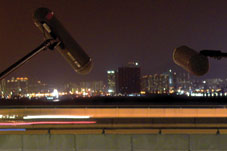
"_habitus" is an acousmatic piece based on an improvisional system created for a real-time performance in Hong Kong. Two microphones were set up to record the sounds from the patio of Habitus gallery, facing highways, tramways, Victoria Harbour, and a nearby heliport. These sounds constitute the only sound source for this work, which is an exploration of variations in an improvisional setting. Throughout this composition, the real-time aspect of the performance remains as the sound is processed without interrupting the sound continuum. The system created for the performance, and its particular sound source, served at composing a new acousmatic piece, which no longer focuses on the simultaneous perception of real and processed sounds in a physical space. There is a shift from the real physical aspect of the direct experience of the performance to a focus on the sounds themselves, and the creation of sound-image from the sounds of the city, in which the visual qualities of the performance can be perceived. The general structure of the piece is marked by a slow evolution from non-processed to abstract sounds, to end with those of the real environment. Within that framework, there are different movements exploring the possibilities of transformations of these sounds. The different sound events from the original soundscape, like cars, trams and buses passing by, slowly loose their indexical references through transformations, and become material for the creation of different sound objects, which evolves through variations introduced by the composer. The work aims at creating an acousmatic journey for the listener, through a possible transformation of their listening mode.
Born in France in 1973, Cédric Maridet has been living and working in Hong Kong since 1999 and is currently a full-time PhD candidate in media art at the School of Creative Media, City University of Hong Kong. He founded the Hong Kong based electronic music label "monème" in June 2004. He has participated in performances and exhibitions in Hong Kong and New York. His solo and collective works [a.k.a symposium 4H] have been released on a compilation, "M001" (monème, 2004). He was awarded Prize of Excellence in the Hong Kong Art Biennial 2005 for "Huangpu" (video). He recently released a new audio CD, "_habitus", based on a real-time performance that took place in Hong Kong in November 2005. He is currently developing a sound installation (I/O Flows) based on a real-time sound system, as part of his artist residency at the Hong Kong Visual Art Centre. His works focus on field recordings, the construction of altered sonorous spaces, and interactions between audio, video and architecture.
Pablo Marin
Catalogue : 2025Materia vibrante | Experimental film | 16mm | black and white | 6:45 | Argentina | 2024
Pablo Marin
Materia vibrante
Experimental film | 16mm | black and white | 6:45 | Argentina | 2024
In search of traces and imprints of an absence, this film examines the coexistence between nature and man-made structures or artifacts, to deliver a formal object of commemoration. An obscure celebration of the surface of a fractured and exhausted world, what could have been a city symphony evokes instead the feeling of a mausoleum for our present existence.
Pablo Marín is a filmmaker and writer. As an independent researcher and curator, he has presented programmes on Argentinean cinema in the United States, Canada, Spain, Austria, Finland and Switzerland. He has translated books by Jonas Mekas, Stan Brakhage and John Waters, among others, and his volume on Argentine experimental cinema, Una luz revelada. El cine experimental argentino, was published in both Argentina and Spain by La Vida Útil in 2022. His film Resistfilm (2014) won the best Avant-Garde Film at Filmadrid, and his latest, Trampa de luz (2021), was awarded the Principal Online Prize of the International Short Film Festival Oberhausen.
Natalia Marin Sancho
Catalogue : 2017New Madrid | Video | 4k | color and b&w | 9:0 | Spain | 2016
Natalia Marin Sancho
New Madrid
Video | 4k | color and b&w | 9:0 | Spain | 2016
New Madrid is an essay about a failed utopia and a failed copy in the shape of a journey throughout the eight cities of Madrid in the United States. As I was putting together the project “Árboles” (about urban planning as a tool for colonisation and self-colonisation) alongside the Los Hijos collective, I found out about New Mexico's Madrid. Later I would also find seven other places named the same way located in the states of Alabama, Colorado, Iowa, Missouri, Nebraska, New York and Maine. Developed in the context of a crisis, the piece had to be limited to that American country – considering that cities named like this can be found in several regions of the globe –, given that this was the last territory which made utopia possible, and that was conceived to enable new communal experiments which led to all kinds of religious and sociological experiments.
Natalia Marín Sancho, born in Zaragoza in 1982, is a video artist and teacher. In 2008, she founded the experimental film collective Los Hijos, together with Javier Fernández Vázquez and Luis López Carrasco. “Los materiales”, her first full-length film was awarded the Jean Vigo Prize for Best Director at the Punto de Vista International Festival in 2010 and also received a Special Mention from the FIDMarseille jury. Her work has been screened at various international festivals and at exhibition spaces such as the MUSAC, Guggenheim Bilbao, Centre Pompidou, Museo Nacional Centro de Arte Reina Sofía, and Anthology Film Archive. She has also participated in group exhibitions at the Tabakalera International Centre for Contemporary Culture in San Sebastián, the PhotoEspaña and the La Casa Encendida, amongst others. As a teacher, she is currently working for the Escuela Internacional de San Antonio de Baños (Cuba), the Círculo de Bellas Artes and the ECAM (The Madrid Film School).
Marine Marine De Contes
Catalogue : 2022Silabario | Documentary | 4k | color | 14:30 | France | 0
Marine Marine De Contes
Silabario
Documentary | 4k | color | 14:30 | France | 0
"An Island, a poem, a dream. Disappearance and reappearance of a whistled language, the Silbo. Silabario recounts the history and transmission of this miraculous patrimony from the island of La Gomera.
Filmmaker and editor who trained at ECAM (Madrid School of Cinema and Audiovisual), Marine de Contes works both in documentary and in fiction, her films and video installations address both ecological and social themes. Member of the French Academy of Fine Arts, after having been selected for an artist’s residence at Casa de Velázquez in 2019-2020 where she made the short film “Silabario” in the Spanish whistled language and developed her project for a feature film. In 2018 her previous film, “Les Proies” was awarded the Louis Macorelles prize at the Cinéma du Réel festival in Paris and received a special mention at the Linea d’Ombra festival in Salerne. The film has been shown in various cinemas, art centres and festivals (ICA, Lincoln Center, Viennale, Sheffield...)
Ivan Marino
Catalogue : 2006Five pictures of a Seated Woman | Experimental doc. | dv | color and b&w | 23:0 | Argentina, Spain | 2005

Ivan Marino
Five pictures of a Seated Woman
Experimental doc. | dv | color and b&w | 23:0 | Argentina, Spain | 2005
"This poetic documentary, a powerful reflection about time and death, retraces the 5 last years of the life of a woman. We can see her in everyday-life situations, knitting, eating, sleeping." International Festival of Electronic Video Art, Brazil
Iván Marino, a video director and multimedia artist, was born in Argentina in 1968. In his professional activity he was a docent at different national and international universities. In 1997, he was invited to the Filminstitut (HDK - Hochshule der Künste, Berlin) as a Visiting Scholar, to study the documentary form. From 1997 to 1998 he was a Visiting Scholar at the University of California at Los Angeles (Film and TV Department), where he specialized in Digital Art. In 1999 he received a grant from the MECADMedia Centre of Art and Design (Escuela Superior de Diseño, Universidad Ramón Llull) for media art research and production. Since then he lives in Barcelona. At the present time he is in charge of several courses of Electronic Art and Digital Design (ESDIUniversidad Ramón LLull). He also gives classes in the International Master program of Interactive Design Systems, and carries out docent collaborations with the Pompeu Fabra University in Barcelona (IUA). Iván Marino has also been in charge of seminars and continuing education training sessions at universities in Argentina (Universidad Nacional 3 de Febrero, Universidad Blas Pascal), in Colombia (Universidad Nacional de Cali, Universidad de Caldas), as well as other academic centres. During his professional career, he has created work for cinema, video and for interactive mediums, such as the Web or internet in general. His work has been exhibited in different international events and received prizes in the festivals of Hanover (International Film Festival, Germany, 1997), BHZ Brazil (Belo Horizonte, Brazil, 1995), Videobrasil (San Pablo, Brazil, 1997), Buenos Aires Film Festival (Sueños Cortos, Argentina, 2003), among others. He has received funding from the Rockefeller foundation, MacArthur (USA), Fundación Antorchas (Argentina), Goethe Institute (Berlin), and received a grant from the ZKM (Centre for Art and Media, Karlsruhe, Germany) and the University of California, Los Angeles (UCLA). source: la Caixa
Ryan Marino
Catalogue : 2025Half Light | Experimental film | 16mm | color | 10:0 | USA | 2023
Ryan Marino
Half Light
Experimental film | 16mm | color | 10:0 | USA | 2023
Shot over a period of three years in a single interior space, this film explores sensory perception through the textural surface of expired film stock, light and layered images. Ephemeral moments meld into voids of grain.?
Ryan Marino is an New York-based artist working with film, sound, and collage. His 16mm films have screened at a variety of film festivals and venues including: Anthology Film Archives, New York Film Festival, San Francisco International Film Festival, Milwaukee Underground Film Festival, Uplink (Tokyo), Venice Biennale, Fracto Experimental Film Encounter, Spectacle Theater,? and Pacific Film Archive. In addition to creating the soundtracks for his own films, his sound work includes original compositions and commissioned soundtracks for short films and theater productions. By day he works as an audiovisual archivist.