Catalogue > List by artist
Browse the entire list of Rencontre Internationales artists since 2004. Use the alphabetical filter to refine your search. update in progress
Fisnik Maxhuni
Catalogue : 2019La Vallée Heureuse | Experimental fiction | mp4 | color | 17:0 | Kosovo, Iran | 2017
Fisnik Maxhuni
La Vallée Heureuse
Experimental fiction | mp4 | color | 17:0 | Kosovo, Iran | 2017
Northern Iran. A young boy, equipped with his motorbike, travels through the cities, the mountains and the Caspian Sea on the search for a mythical stone supposed to bring happiness. Through his journey, he will cross the paths of those who, before him, have tried to find it as well. Through an intergenerational portrait of contemporary Iran, La Vallée Heureuse seeks to question the mythical and universal quest for happiness.
Born in 1989 in Kosovo, ex-Yugoslavia. Refugee and stateless in Switzerland until the acquirement of Swiss and Kosovan citizenships in 2005. During his studies in Bachelor in International Relations from the University of Geneva (2011) and Master in Geopolitics from King's College London (2014), he writes and directs his first "film objects" and is a member of the "London Film Society". During his stays in Japan (2012 as a diplomatic assistant at the Swiss Embassy in Tokyo), in Indonesia (2013) and in Bolivia (2014), he experiments further with film. Starts a Master in Film Studies at ECAL / HEAD (Switzerland) in 2014. He directs "Ministarstvo Sjecanja" in 2015, under the aegis of Béla Tarr in Sarajevo. In 2015, he takes part in the Baushtellë Artists Residence in Zürich, Belgrade and Prishtina during which he publishes a short anthropological novel on the perception of roots and origins in modern times. Graduates in 2016 with his film "Lost Exile", shot in Kosovo and presented in world premiere at the Locarno Film Festival where it is awarded a prize. He is invited to more than 30 festivals among others ; Clermont-Ferrand, Solothurn, Winterthur, Tirana, Lisbon, Prizren, New Delhi, Villeurbanne, Montréal, Den Haag, Montevideo, Los Angeles. With this film, he wins a dozen of awards. In 2016, he is invited to participate in Masterclasses for young talents organized as part of the Zurich Film Festival. In 2017, he founds Visceral Films. He produces and directs two films : "La Vallée Heureuse", short film co-produced and shot in Iran. The film is presented in Winterthur, Solothurn and as an international premiere at the Film Festival of Sao Paolo. Then, "Zvicra", long-feature documentary co-produced by the RTS (Radio Télévision Suisse) that questions the concept of "double identity". Currently, he is writing "The Land Within Me", his first fiction long-feature film. At the same time, he is working as a 2nd unit director for the new TV show of the RTS, "Helvetica". With "The Land Within Me", he is selected to participe in the Talents Sarajevo 2018 where he will be pitching the project, after pitching it as well at the Festival de Cannes 2018. On Culture and Tropics (2014) 12` Ministarstvo Sjecanja (2015) 15` Lost Exile (2016) 29` La Vallée Heureuse (2017) 18` Zvicra (2017) 70" The Land Within Me (2019) 110"
Moe Myat May Zarchi
Catalogue : 2023The Altar | Experimental film | digital | color and b&w | 10:10 | Myanmar | 2023
Moe Myat May Zarchi
The Altar
Experimental film | digital | color and b&w | 10:10 | Myanmar | 2023
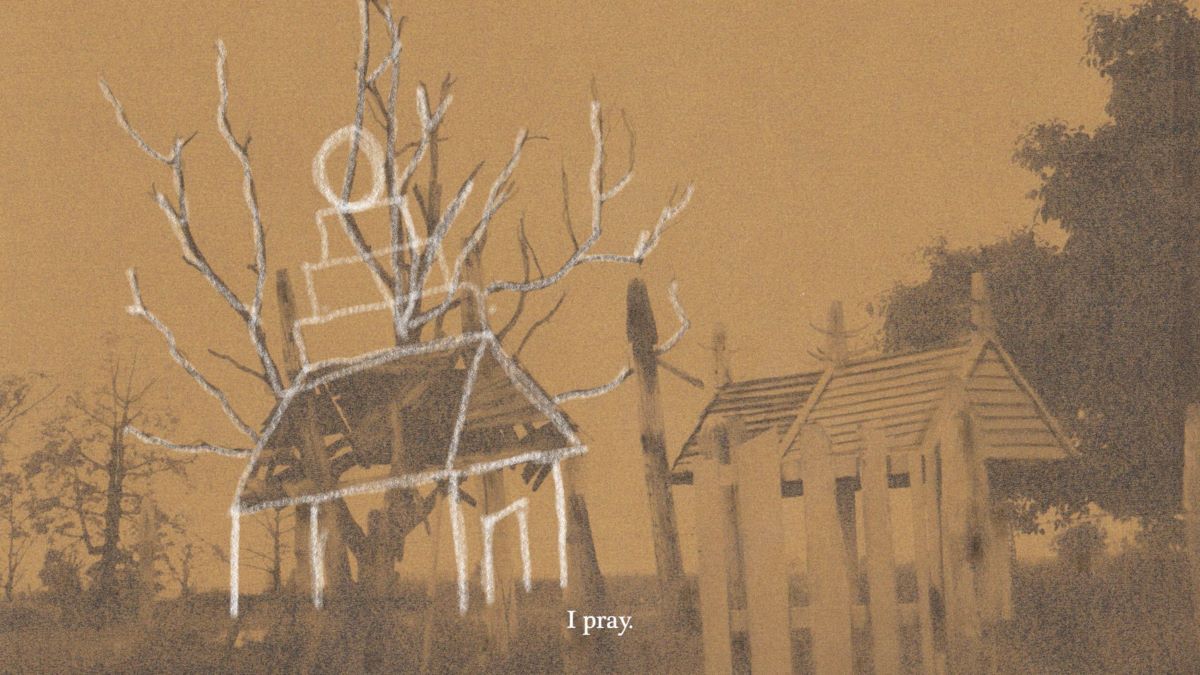
A buddhist fable-like story about the guilt of a childhood incident of killing an ant while washing hands in the sink. Animated through photographic sequences painted with golds and greys, the Zen-like visuals sweep into one another with whispering monologues and glitching noises reflecting the realms of cosmos, power, guilt, prayers, and existence.
Moe Myat May Zarchi (born in 1994, Myanmar) is a filmmaker, musician and a lens-based media artist. Her short films have been screened at International Short Film Festival Oberhausen, Vienna Shorts, Women Make Waves Int’l Film Festival and so on. Her films have won awards at Singapore International Short Film Festival (SGIFF), Bangkok Asean Film Festival (BAFF), UK Asian Film Festival and Vesoul International Film Festival of Asian Cinema (FICA). Her recent short film “The Altar” just won the Arte Award at Kurzfilm Hamburg in 2023. She was also nominated as a finalist in Julius Baer Next Generation Art Prize in the category Moving Image and was awarded Prince Clause seed awards for emerging artist. In most of her works, Moe loves to explore the metaphysical, identity, femininity and personal aspects in storytelling through innovative use of visuals and sound. She is also the founder of '3-ACT', a cinema magazine and a film education initiative, to support narrative storytelling in the film community in Myanmar. She also co-founded an interdisciplinary arts initiative called ‘MATTER audiovisual lab’ to interconnect innovative different forms of art and other disciplines.
Peter Maybury
Catalogue : 2026L’esprit de l’escalier | Experimental film | 4k | color | 5:50 | Ireland | 2025
Peter Maybury
L’esprit de l’escalier
Experimental film | 4k | color | 5:50 | Ireland | 2025
L’esprit de l’escalier, is the third in a trilogy of films surrounding Pálás, a cinema in Galway, Ireland, designed by Tom dePaor. Opening in 2018, the cinema closed to the public in February 2025, and I attended one of the last screenings at Pálás – Tsai Ming-Liang’s Goodbye Dragon Inn, itself a film about the closing of a cinema. I returned the following morning with thoughts of this in my head as I filmed the staircases throughout the building. These spaces are untempered, part indoor, part outdoor, while the cinemas with their plush red interiors are optimised for sound, temperature, and light. The title of my film refers to the expression (to think of the perfect reply too late) but moreover to the spirit of the staircase. Just like Goodbye Dragon Inn, so much life goes on in these spaces, where people, weather, light, and sound, intersect with, and even possess the movement or the stillness of the camera, the place itself becoming a film.
Peter Maybury is an Irish multidisciplinary artist. His practice-based research encompasses works as an artist, graphic designer, filmmaker, publisher, writer, editor, curator, musician, and educator. He is a graduate of Central Saint Martins, London, and a Doctoral Candidate at the Centre for Socially Engaged Practice-Based Research, TU Dublin. He has collaborated extensively with artists and institutions, editors and curators, on more than 200 art and architecture publications. Peter is a longstanding collaborator with Tom dePaor, making books, films, and works for exhibition. His film work includes On being there (2022/23, screened at Rencontre Internationale Paris/Berlin 2023/24), Landfall (2020), an hour-long dual-screen film installation, and with dePaor the Gall films Drape (2018), and A Study (2015) which was made for exhibition at ETH Zurich. Peter is author of Make Ready (2015), and co-author with dePaor of Reservoir (2010) and Of (2012).
Catalogue : 2023On Being There | Experimental film | 4k | color and b&w | 60:0 | Ireland | 2022
Peter Maybury
On Being There
Experimental film | 4k | color and b&w | 60:0 | Ireland | 2022
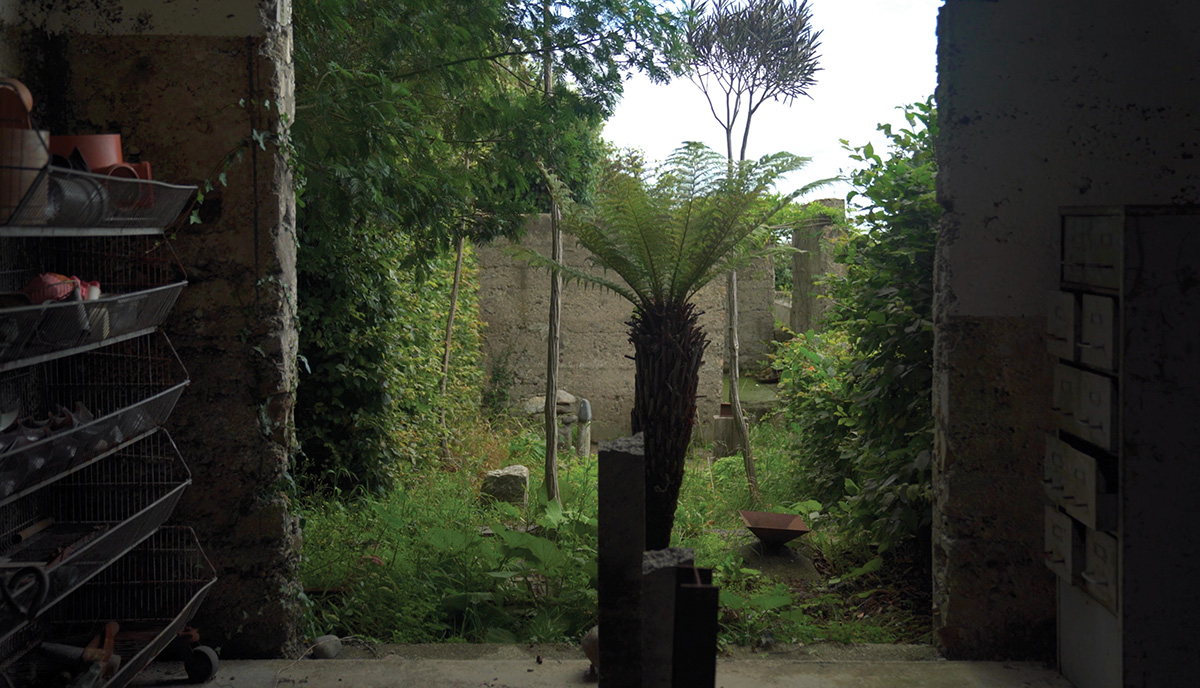
On being there is a filmic encounter with the material and outputs of the office of Tom dePaor, drawing on 30 years of practice. There is the place itself. There are notebooks, drawings, prints, scale models, 35mm slides, photographs, films, files, books, writing. A diversity of materials and media, evidencing significant technological changes in production and reproduction. This is the raw material. The film is a rerecording, or sampling of this material, where scale, media, and modes of presentation and realisation merge. The linear transition from drawing to model to built landscape and documentation is disrupted. The film explores the permeability of the image. Animated or activated through movement and operation, everything can be superimposed, overlaid, or cut into. An audio-visual encounter with place, within the space of the screen and the loudspeaker.
Peter Maybury is an Irish multidisciplinary artist. His practice-based research encompasses works as an artist, graphic designer, filmmaker, publisher, writer, editor, curator, musician, and educator. He is a graduate of Central Saint Martins, London, and is a Doctoral Candidate at the Centre for Socially Engaged Practice-Based Research, TU Dublin. He has collaborated extensively with artists and institutions, editors and curators, on more than 200 art and architecture publications. Peter is a longstanding collaborator with Tom dePaor, making books, films, and works for exhibition. His film work includes Landfall (2020), an hour-long dual-screen film installation, and with dePaor the Gall films Drape (2018), and A Study (2015) made for exhibition at ETH Zurich. Peter is author of Make Ready (2015), and co-author with dePaor of Reservoir (2010) and Of (2012).
Marian Mayland
Catalogue : 2025Outside | Experimental doc. | mov | color | 29:52 | Germany | 2023
Marian Mayland
Outside
Experimental doc. | mov | color | 29:52 | Germany | 2023
A curator, an archivist, an art dealer, a relative: in staged situations, four people discuss their relationship to an artist who, by means of a fictionalised biography, has pretended to be a Holocaust victim.
Maria Mayland (*1988) is a visual artist and filmmaker. She obtained her MFA from Basel’s Art Institute, taught by Chus Martínez, and took part in KKH Stockholm's postgraduate program Philosophy in the Context of Art, taught by Peter Osborne. Her short film works have been shown in various contexts across Europe. Screenings include International Short Film Festival Oberhausen, European Media Art Festival Osnabrück, IDFA Amsterdam, Hamburg International Short Film Festival, transmediale, Edinburgh Film Festival and Sharjah Film Platform. She won the German Short Film Award in 2022, the EMAF-Media Art Award of the German film critics association (VdFK) in 2021, and the award for the best entry in the NRW competition of the International Short Film Festival Oberhausen in 2018, as well as in 2022.
Catalogue : 2021Dunkelfeld | Experimental doc. | mp4 | color and b&w | 16:12 | Germany | 2020
Marian Mayland, LOHSE Patrick, HEYER Ole-Kristian
Dunkelfeld
Experimental doc. | mp4 | color and b&w | 16:12 | Germany | 2020
In August 1984 a house inhabited by migrant workers was burnt down in Duisburg, killing seven members of a family. While the police immediately ruled out racism as a reason, the survivors continue to doubt that it was a coincidence that their house was set on fire.
Ole-Kristian Heyer, born 1981, studied photography at the fadbk, Essen and geography at the Ruhr University Bochum. In his works, principles of human perception merge with functionalities of visual media. Patrick Lohse, born 1983, studied at the Folkwang UdK. Based on documentary strategies, his works question common narratives and thereby refer to underrepresented perspectives. Marian Mayland, born 1988, studied at art academies in Essen, Basel, Vienna and Stockholm. Has been working with various documentary narrative forms since 2015.
Catalogue : 2020Untitled (A Refusal of Leave to Land) | Experimental doc. | hdv | color | 28:20 | Germany | 2019
Marian Mayland
Untitled (A Refusal of Leave to Land)
Experimental doc. | hdv | color | 28:20 | Germany | 2019
untitled (a refusal of leave to land) is an essayistic short film on a prisoner of war camp from the second world war, the arms industry in the Ruhr area and the relation between individual and collective memory. Starting out with a childhood memory of finding a fossil in a bed of rocks of a former railroad track, the narration follows the connections between the former POW camp Stalag VI F in Bocholt and the Krupp company in Essen.
Marian Mayland was born in Bocholt, Germany, in 1988. Since 2013, after completing his studies in painting, Mayland has been working postconceptually with various media. He holds an MFA from Basel?s Art Institute and took part in KKH Stockholm?s postgraduate program Philosophy in the Context of Art, taught by Peter Osborne. His short film works have been shown in various contexts across Europe. Recent screenings include IDFA Amsterdam, Kasseler Dokfest, and Internationale Kurzfilmtage Oberhausen.
Marian Mayland, LOHSE Patrick, HEYER Ole-Kristian
Catalogue : 2025Outside | Experimental doc. | mov | color | 29:52 | Germany | 2023
Marian Mayland
Outside
Experimental doc. | mov | color | 29:52 | Germany | 2023
A curator, an archivist, an art dealer, a relative: in staged situations, four people discuss their relationship to an artist who, by means of a fictionalised biography, has pretended to be a Holocaust victim.
Maria Mayland (*1988) is a visual artist and filmmaker. She obtained her MFA from Basel’s Art Institute, taught by Chus Martínez, and took part in KKH Stockholm's postgraduate program Philosophy in the Context of Art, taught by Peter Osborne. Her short film works have been shown in various contexts across Europe. Screenings include International Short Film Festival Oberhausen, European Media Art Festival Osnabrück, IDFA Amsterdam, Hamburg International Short Film Festival, transmediale, Edinburgh Film Festival and Sharjah Film Platform. She won the German Short Film Award in 2022, the EMAF-Media Art Award of the German film critics association (VdFK) in 2021, and the award for the best entry in the NRW competition of the International Short Film Festival Oberhausen in 2018, as well as in 2022.
Catalogue : 2021Dunkelfeld | Experimental doc. | mp4 | color and b&w | 16:12 | Germany | 2020
Marian Mayland, LOHSE Patrick, HEYER Ole-Kristian
Dunkelfeld
Experimental doc. | mp4 | color and b&w | 16:12 | Germany | 2020
In August 1984 a house inhabited by migrant workers was burnt down in Duisburg, killing seven members of a family. While the police immediately ruled out racism as a reason, the survivors continue to doubt that it was a coincidence that their house was set on fire.
Ole-Kristian Heyer, born 1981, studied photography at the fadbk, Essen and geography at the Ruhr University Bochum. In his works, principles of human perception merge with functionalities of visual media. Patrick Lohse, born 1983, studied at the Folkwang UdK. Based on documentary strategies, his works question common narratives and thereby refer to underrepresented perspectives. Marian Mayland, born 1988, studied at art academies in Essen, Basel, Vienna and Stockholm. Has been working with various documentary narrative forms since 2015.
Catalogue : 2020Untitled (A Refusal of Leave to Land) | Experimental doc. | hdv | color | 28:20 | Germany | 2019
Marian Mayland
Untitled (A Refusal of Leave to Land)
Experimental doc. | hdv | color | 28:20 | Germany | 2019
untitled (a refusal of leave to land) is an essayistic short film on a prisoner of war camp from the second world war, the arms industry in the Ruhr area and the relation between individual and collective memory. Starting out with a childhood memory of finding a fossil in a bed of rocks of a former railroad track, the narration follows the connections between the former POW camp Stalag VI F in Bocholt and the Krupp company in Essen.
Marian Mayland was born in Bocholt, Germany, in 1988. Since 2013, after completing his studies in painting, Mayland has been working postconceptually with various media. He holds an MFA from Basel?s Art Institute and took part in KKH Stockholm?s postgraduate program Philosophy in the Context of Art, taught by Peter Osborne. His short film works have been shown in various contexts across Europe. Recent screenings include IDFA Amsterdam, Kasseler Dokfest, and Internationale Kurzfilmtage Oberhausen.
Iris Mayr
Catalogue : 2007Ars Electronica | 0 | 0 | | 0:0 | Austria | 2007

Iris Mayr
Ars Electronica
0 | 0 | | 0:0 | Austria | 2007
With its specific orientation and long-standing continuity it has displayed since 1979, Ars Electronica is an internationally unique platform for digital art and media culture consisting of the following four divisions: Ars Electronica ? Festival for Art, Technology and Society; Prix Ars Electronica ? International Competition for CyberArts; Ars Electronica Center ? Museum of the Future; and Ars Electronica Futurelab ? Laboratory for Future Innovations. The essence of the internationally renowned Ars Electronica Festival is interdisciplinarity and an open encounter of international experts from the arts and sciences with a broad audience of highly diverse backgrounds and interests. Annually since 1979, the Festival has featured a line-up of symposia, exhibitions, performances, and events designed to further an artistic and scientific confrontation with the social and cultural phenomena that are the consequences of technological change. As the world's premier cyberarts competition, the Prix Ars Electronica has been a forum for artistic creativity and innovation since 1987. It is the trend barometer in an ever-expanding and increasingly diversified world of media art. Thanks to its annually recurring nature, its international scope and the incredible variety of the works submitted for prize consideration, the enormous Prix Ars Electronica Archive provides a detailed look at the development of media art and a feel for its openness and diversity. The Ars Electronica Center opened in 1996 as a prototype of a "Museum of the Future". Its mission is to utilize interactive forms of mediation to facilitate the general public's encounter with virtual reality, digital networks, and modern media. A focus on issues at the interface of media art, new technologies and social developments characterize the Center's innovative exhibitions. The Futurelab is a model of a new kind of media art laboratory in which artistic and technological innovations engender reciprocal inspiration. The lab's teams bring together a wide variety of specialized skills; their approach is characterized by interdisciplinarity and international networking. The Futurelab's wide-ranging activities include designing and engineering exhibitions, creating artistic installations, as well as pursuing collaborative research with universities and joint ventures with private sector associates.
Iris Mayr was born in 1971 in Austria. She studied communication science and business administration in Linz, Salzburg, and Sevilla. In 2003/04 she was a research assistant and conducted tutorials at the University of Salzburg in the department of Audiovision/Digital Communication and the ICT&S Center. Since 1996 she has been a member of the Ars Electronica Center Linz (Festival Ars Electronica, Production and Curatorial Team). In 2006 she was co-curator with Lev Manovich, Yuko Hasegawa and Pili at the Media City_Seoul 2006 in Seoul, Korea. From 2004-2007 she was the producer of the Prix Ars Electronica ? International Competition for CyberArts, and a freelance cultural curator.
Tatiana Mazú, Tatiana Mazú
Elena Mazzi, Daniele Alef Grillo
Catalogue : 2018Pirolisi solare (Solar Pirolysi) | Video installation | hdv | black and white | 4:0 | Italy | 2017
Elena Mazzi, Daniele Alef Grillo
Pirolisi solare (Solar Pirolysi)
Video installation | hdv | black and white | 4:0 | Italy | 2017
The material grain of the film fixes the light that, by installing mirrors that have been protagonist of my previous work (Reflecting Venice, 2012-2014), strikes a cumulation of straw, transforming it into biomass, the energy resource of the future. A step forward in scientific research that quotes Archimedes` experiments in order to work with energy sources at the reach of everyone.
Elena Mazzi was born in 1984 in Reggio Emilia (Italy). She received her BFA in 2007 in History of Art from Siena University, and her MFA in 2011 in Visual Art from IUAV, Venice University. She was selected for an exchange program at Royal Academy of Art (Konsthogskolan) of Stockholm. Her works have been displayed in many solo and collective exhibitions, among others: Palazzo Fortuny in Venice, 16° Rome Quadriennal, GAM Turin, 14° Istanbul Biennale, 17° BJCEM Mediterranean Biennale, EGE-European Glass Experience, Fittja Pavilion at the 14° Architecture Venice Biennale, COP17 in Durban, Festival of Contemporary Art in Slovenia, Botkyrka Konsthall, Italian Institute of Culture in Brussels and Stockholm, XIV BBCC Expo in Venice, Bevilacqua La Masa Foundation. She attended different residency programs and workshops such as HIAP (FI), GuilmiArtProject (IT), Via Farini (IT), Foundation Botin (SP), Bevilacqua La Masa (IT), Future Farmers A.I.R. (USA), Fondazione Spinola Banna in Turin (IT), Dolomiti contemporanee (IT), Botkyrka Konsthall Air (SE). She is one of the finalists at Celeste Prize, Fabbri prize, Meru prize and Termoli prize and the winner of Thalie Art Foundation grant 2017, VISIO Young Talent Acquisition prize, Eneganart prize, Illy grant for Unidee, Pistoletto Foundation 2016, ntcm e l’arte 2016, m-cult media and technology program 2016, Special mention for Arte Patrimonio e diritti umani, Antworks award 2015, Sandretto Re Rebaudengo prize 2015, Lerici Foundation grant in 2012 and Movin’up Italian prize for young Italian artists abroad in 2011. In 2016-2017 she is tutor artist for Spinola Banna Fondation program in collaboration with GAM, Turin.
Corinne Mazzoli
Pablo Mazzolo
Pablo Mazzolo
Catalogue : 2020Ceniza Verde | Experimental doc. | 16mm | color | 10:26 | Argentina | 2019
Pablo Mazzolo
Ceniza Verde
Experimental doc. | 16mm | color | 10:26 | Argentina | 2019
The Henia/Kamiare aboriginals inhabited the current territory of the Sierras de Córdoba (Argentina) for at least 1600 years. In 1575, the resistance led by cacique Onga was cornered and defeated by the spanish conquering troops. After resisting the spanish in the Charalqueta mountain (named after the God of Joy), hundreds of Hênia-Kâmîare women, children and elders jumped off the top of the Colchoquí mountain in order to avoid being enslaved. The Charalqueta mountain was renamed as Colchiqui, (after the God of Fate and Sadness). This was the biggest collective suicide in the territory currently known as Argentina.
Pablo Mazzolo was born in Buenos Aires in 1976. He graduated in Image and Sound Design at University of Buenos Aires. His films have participated in festivals like Rotterdam film festival, New York Film Festival: Views from the Avant Garde, Ann Arbor film Festival, Edinburgh Film Festival, Videoex, Chicago Underground, among others. He was also invited to attend in various film performances and solo presentations in museums like Rufino Tamayo (Mexico), MALBA (BsAs, Arg), MassArt (Boston,USA), FAMU (Ptague, Cz Rep.), San Francisco cinematheque, Excentric (Barcelona), La Mostra (S8) a Coruña. His work has been prized in Ann Arbor, Media City, National Fund of Ars, The Bienal of Moving Image, BAFICI, among others.
Marko Mäetamm
Catalogue : 2011MUSE | Documentary | dv | color | 3:5 | Estonia | 2009
Marko MÄetamm
MUSE
Documentary | dv | color | 3:5 | Estonia | 2009
She is a sourse of my inspiration. She gives my life a meaning. I am part of her and she is part of me. We can`t live without each other because she gives ideas for my artistic creation.. She is my muse.
Born in 1965 in Viljandi, Estonia. Studied in Estonian Academy of Arts, MA 1995 Lives and works in Tallinn, Estonia. Works with a wide range of media including photography, sculpture, animations, painting and text. Mäetamm tells us the stories which happen behind the closed doors and pulled curtains of the intimate territory we called home. Mäetamm portrays the family as a little society -relaying through a dark humor the petty moments of daily life - and exploring the way our society manipulates the family dynamics through the macrocosms of economy, consumerism, and ?quality-of-life? standards. Inspired by his own private life and the recurrent feeling he could fail to preserve the balance in his existence, Mäetamm?s work explores the grey area where ambiguous feelings of being in control and being controlled merge. Marko Mäetamm has exhibited internationally and represented Estonia at the 52nd Venice Biennial in 2007. Contact: maetamm@yahoo.com HOMEPAGE: www.maetamm.net
Catalogue : 2009CAR RIDE | Animation | dv | color | 3:16 | Estonia | 2008
Marko MÄetamm
CAR RIDE
Animation | dv | color | 3:16 | Estonia | 2008
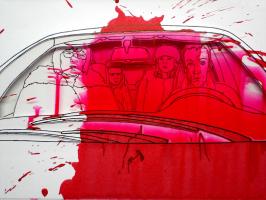
This work is about how something looks very often different from how it actually is and how something is so absolutely different from the way it looks. One beautiful Friday evening in early March I put my lovely wife and two wonderful kids in our little Honda Civic and we took a trip to visit my parents in South-Estonia...
I was born in a small town Nuia in South-Estonia. The idea to become an artist hit me suddenly and absolutely out of the blue when I was 18. I studied printmaking in Estonian Academy of Arts, graduated my BA in 1993 and MA in1995. I started exhibit when I was still a student. My first works were very printmaking-based. Then I moved to painting because I found it more direct. Then at one point text became very essential in my projects. And then following my ideas I took up moving image. At the moment I work very mixed-media-wise. I do photos and objects and animations, I paint and I produce texts and I mix it all together in my installations. In 2007 I had a great opportunity to represent Estonia in Venice Biennale with the project ?Loser?s Paradise? and it had a strong influence to my artistic career.
Catalogue : 2008FAMILY | Animation | dv | color | 4:9 | Estonia | 2007
Marko MÄetamm
FAMILY
Animation | dv | color | 4:9 | Estonia | 2007
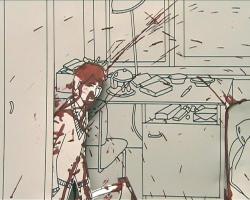
About FAMILY There is an axe-man, running around the flat after quite presumably his wife and two children. The wife and children are trying to hide behind the sofa or a bed or a cupboard, or under the blanket, but the axe-man always finds them and then something happens. And every time after that the axe-man is more and more covered with blood. And the wife and two children are more and more well. And it never ends.
Brigid Mccaffrey
Catalogue : 2025Sanctuary Station | Experimental doc. | 16mm | black and white | 69:0 | USA | 2024

Brigid Mccaffrey
Sanctuary Station
Experimental doc. | 16mm | black and white | 69:0 | USA | 2024
Sanctuary Station traces a series of encounters with women and youth who have cultivated intrinsic attachments to the various life forms that inhabit the redwood forests and remote terrains of northwestern California. Oscillations between the desire for solitude and the need for collaboration recur through an album-like progression of personal stories and actions. These encounters are framed through the poems of Mary Norbert Körte (1934-2022), an ex-nun who built her own cabin deep in the forest, adjacent to a former logging railroad. Körte’s life and work bear witness to the daily phenomena of internal and external experience. Depictions of ongoing forest defense movements, collective and personal rites of mourning, and intimate everyday routines evoke cycles of life unfolding within this intricately interwoven environment.
Brigid McCaffrey is a Los Angeles-based artist and filmmaker whose work documents environments and people in states of flux. Her films explore extremes of autonomy and coexistence experienced by individuals who have distinct relationships with the land. Often taking shape as nuanced portraits, the films respond to the physical and emotional changes of their subjects while fusing representations of self and place. She has exhibited at venues such as the Hammer Museum, the Museum of Contemporary Art in Los Angeles, the Harvard Film Archive, the New York Film Festival - Projections, the Rotterdam International Film Festival, and the Whitechapel Gallery in London, among others. Her work was presented by Ballroom Marfa for the 2015 edition of Artists’ Film International and she was a featured artist at the 2016 Flaherty Seminar. McCaffrey was named a Guggenheim fellow in Film & Video in 2019.
Anthony Mccall
Catalogue : 2010You and I | 0 | 0 | | 0:0 | USA | 2010
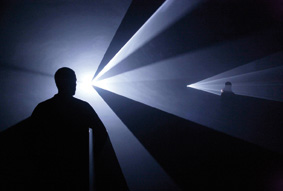
Anthony Mccall
You and I
0 | 0 | | 0:0 | USA | 2010
Anthony Mccall
Catalogue : 2007Line Describing a Cone | Experimental film | 16mm | black and white | 30:0 | France, USA | 1973
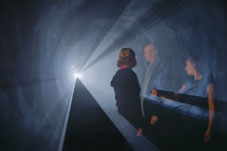
Anthony Mccall
Line Describing a Cone
Experimental film | 16mm | black and white | 30:0 | France, USA | 1973
To the conventional perspective and illusionist space that cinema brings down on painting, McCall's films substitute a projective space that brings it back to sculpture. From then on the film is no longer this projected image that digs a fictitious depth in the wall's surface but a field actually constituted that blends with the event itself. It is in this way that the cut up luminous beams in Anthony McCall's smoke, developing the plastic properties of the film, pass the frontiers of the history of cinema to meet up the minimalist propositions of sculpture of the 70's and inscribes itself beside the geometric structures of Robert Morris, Saul Le Witt, and Carl Andre, the coloured fields of Dan Flavin, or the coloured tight cotton threads in Fred Sandback spaces. At the beginning of this century, after a silence of twenty years and as the presentations of Solid Light Films multiplied in the USA as in Europe, Anthony McCall inaugurated a new series of works no longer developed with traditional support, but rather numeric support, the computer allowing him to conceive complex traces and to explore plastic properties of undulating lines. Simultaneously the substitution of traditional smoke machines by sprays producing a water vapour with a more uniform texture at the largest scale allowed McCall to demultiply the size of his pieces from then on.
Steven Mccarthy
Catalogue : 2007Commercial rhetoric art project | Experimental video | dv | color | 7:30 | USA | 2005
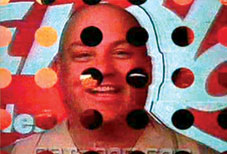
Steven Mccarthy
Commercial rhetoric art project
Experimental video | dv | color | 7:30 | USA | 2005
"Commercial Rhetoric Art Project" uses the visual material aimed at domestic markets to create a body of work that re-contextualizes it into a social, political, and economic statement. By dismantling and re-arranging the commercial messages meant to seduce us as consumers, the project causes viewers to question the rhetoric that attempts to colonize our homes. Strategies of collage, juxtaposition, satire, and parody serve to invert the dominant tide of advertising propaganda entering our private spaces. A series of collages created from junk mail, assemblages of food and product packaging, reconfigured branded apparel, digitally remixed television commercials, web sites, and email 'spam' ? "Commercial Rhetoric Art Project" uses any uninvited advertising as its fodder. Some of the artefacts are purely aesthetic, some critique consumer culture, and others hint at an alternative functionality. Over 100 television commercials were recorded, edited, and remixed into seven short digital videos. These compilations range from 30 to 90 seconds in length, and employ different visual montages and narrative structures. Recurring themes of sexual desire, family drama, product fetishization, food hedonism, and authority figure persuasion are extracted for ridicule.
Steven McCarthy has an MFA in Design from Stanford University, a hybrid program between the Departments of Art and Mechanical Engineering, and a BFA in Sculpture and Drawing from Bradley University. He is currently an Associate Professor of Graphic Design at the University of Minnesota, Twin Cities campus. His current creative investigations are concerned with telling stories and providing interactive experiences in the digital and actual environments. However his primary concern is with the human condition. Steven?s self-written graphic design work has been published in Graphics Poster, the American Institute of Graphic Arts annual, and in "Provocative Graphics: The Power of the Unexpected" in Graphic Design. His artists? books appear in numerous collections including the Museum of Modern Art, the Banff Centre in Canada, the Sackner Archive of Visual and Concrete Poetry, and the Houghton Library at Harvard University. His interactive works have been performed/exhibited internationally, with recent showings at VideoFormes, France, FILE 2003, 2004 & 2006 (the International Festival of Electronic Language), Sao Paulo, and the 2005 Images Festival, Toronto. Recent design conference presentations have included Declarations, Montréal (2001), Mind the Map, Istanbul (2002), Hidden Typography, London (2003), Politics of Design, Belfast (2004), New Views, London (2005) and Wonderground, Lisbon (2006). Steven has also published peer-reviewed articles in academic journals.
Tiona Nekkia Mcclodden
Catalogue : 2021I prayed to the wrong god for you | Multimedia installation | mp4 | color | 0:0 | USA | 2019
Tiona Nekkia Mcclodden
I prayed to the wrong god for you
Multimedia installation | mp4 | color | 0:0 | USA | 2019
Tiona Nekkia McClodden’s I prayed to the wrong god for you. combines video and sculptural elements in a highly personal ritual dedicated to Shango, a deity or Orisha within the Afro-Cuban religion Santería/Lucumí whose origins can be traced to the Yoruba people of Nigeria. In this project McClodden merges her spiritual requirements as a priestess of Ogun and artistic work to repair a period of personal exhaustion and to confront the relationship between Christianity and colonialism that was imposed on the artist’s ancestors: enslaved Africans, Black southerners. To begin this project McClodden cut down a cedar fir tree (a hybrid wood, distinct from the pure cedar traditionally associated with Shango) and carved six tools from cedar fir. Traveling with these objects across the United States, Cuba, and Nigeria, the artist engaged in ritual with Shango, employing the helmet on view here as a ceremonial witness. The videos, which chart the labor and time of this undertaking, offer an account of diasporic devotion and the significance of objects as storytellers.
Tiona Nekkia McClodden [she/her] is a visual artist, filmmaker, and curator whose work often employs a citational practice exploring and critiquing issues at the intersections of race, gender, sexuality and social commentary. Her interdisciplinary approach traverses documentary film, experimental video, sculpture, and sound installations. McClodden has exhibited and screened work at the Institute of Contemporary Art-Philadelphia, the Museum of Modern Art (New York); the Whitney Museum; MOCA LA; MCA Chicago; MoMA PS1; among others. She has recently been awarded the 2019 Bucksbaum Award - McClodden was chosen from among the seventy-five artists whose works were presented in the 2019 Whitney Biennial. McClodden has been awarded the 2019 Guggenheim Fellowship in Fine Arts, the 2018–19 Keith Haring Fellowship in Art and Activism, the 2017 Louis Comfort Tiffany Foundation Award and the 2016 Pew Fellowship in the Arts in Philadelphia, PA, among other awards. McClodden curated the traveling exhibitions A Recollection. + Predicated. featured within Julius Eastman: That Which is Fundamental, and more recently There Are No Shadows Here: The Perfect Moment at 30. She lives and works in North Philadelphia, PA.
Cal Mccormack
Catalogue : 2022Agony to Ecstasy | Experimental doc. | mp4 | color and b&w | 12:50 | United Kingdom | 2020
Cal Mccormack
Agony to Ecstasy
Experimental doc. | mp4 | color and b&w | 12:50 | United Kingdom | 2020
‘Agony to Ecstasy’ looks at the scope of the socio-addictive condition within Scottish people. It focuses on the relationship between pain and pleasure, between stress and relief and between entrapment and escape. The film in many ways, is a dissection of two spaces – euphoric clubbing and silent Scottish nature, offering a perspective on our need for salvation within both. Neurologically, there is very little difference between the brain addicted to something, as to when falling in love. As a result, the film fluctuates between these neurological and personal perspectives on addiction and connection – where their conflating and often paradoxical relationship are juxtaposed. The film is made with reflection as its key focus. Made during the middle of the first lockdown, it uses the collective state of withdrawal and loneliness to observe realities within clubs. A slow-motion strobe follows the film throughout, as a visual deconstruction of the joy, yet ghostly inhibition of the people in the shots. Vulnerability was key in Dej’s recollections – his words occupy the emotional worlds of mental health, stigma and the ecstasy of clubbing, without having a particular stance or opinion. Ultimately 'Agony to Ecstasy' looks beyond fixed stereotypes of addicts, and into the dependencies, shame and love between Scottish people.
Cal Mac is a visual artist working and living in Glasgow. Working between sculpture print and video, he explores themes of belonging and addiction through sociological, scientific and visual dialogues. His work often looks at clubbing and natural environments, to unravel truths about our current condition and need for connection. His work has been screened at Atlas Arts (skye), The Royal Scottish Academy (Edinburgh), Limerick Institute of Technology, and online for Lift off Festival, and Film and Video Umbrella. Following his first commission from Film and Video Umbrella in 2020, Mac has done residencies at Cove Park and Edinburgh Sculpture Workshop. In 2021 Mac was shortlisted for the Royal Scottish Academy Morton Award.
Olivia Mcgilchrist
Catalogue : 2014Ernestine and me | Multimedia installation | dv | color | 10:0 | Jamaica | 2012
Olivia Mcgilchrist
Ernestine and me
Multimedia installation | dv | color | 10:0 | Jamaica | 2012
In Ernestine and me (2012) my alter-ego ?Whitey? presents herself as a cultural object to a range of contemporary Jamaicans, exposing their varied reactions to this forced encounter. This experimental video offers a double take on contemporary Jamaican life for a returning white female of part- Jamaican origin; with no living Jamaican relatives remaining, and very little information about my Jamaican heritage. Ernestine was my black great-grandmother, which I only discovered two years ago in a family photograph found at my late grandfather?s house upon my return to the island.
100 word bioraphy Born in Kingston (Jamaica) in 1981 to a French mother and a Jamaican father and educated in France and the U.K., I moved back to Jamaica in 2011 after completing a Photography M.A. at the London College of Communication in 2010. Since this sudden return, I have indulged my alter-ego Whitey in her appropriation of this space of utter difference; Jamaica; by exploring trans-location and physical expressions of emotional states in the search for my cultural identity. My practice has incorporated my body, remapping it within the tropical picturesque through photographic tableaux, performances and multi-layered videos.
Dayna Mcleod
Catalogue : 2025FoUBARthes: Death of the Author | Experimental video | hdv | color | 3:4 | Canada | 2024
Dayna Mcleod
FoUBARthes: Death of the Author
Experimental video | hdv | color | 3:4 | Canada | 2024
Media performance artist Dayna McLeod asked ChatGPT to write an increasingly snarky and heated dialogue between Roland Barthes and Michel Foucault about The Death of the Author, inspired by Barthes' famous essay. This script is performed by AI actors of the theorists, with Dayna’s AI doppelgänger, DaynAI, acting as host to their debate.
Dayna McLeod is a queer performance-based media artist. Her work often uses humour and capitalizes on exploiting the body’s social and material conditions. Her video and performance work have been presented at the Impakt Festival in Utrecht Netherlands, the Mardi Gras Festival in Darlinghurst Australia, MIX Brasil Festival Of Sexual Diversity in São Paulo Brazil, the Modern Art Museum in Warsaw Poland, Le Centre d’art contemporain in Paris, the PHI Centre, OFFTA, and Rendez-vous du cinéma québécois in Montreal, the Summerworks Theatre Festival in Toronto, Sporobole in Sherbrooke, and Performatorium, Queer City Cinema’s performance festival in Regina. www.daynarama.com
Ross Meckfessel
Catalogue : 2025Spark From a Falling Star | Experimental film | 16mm | color | 21:0 | USA | 2023
Ross Meckfessel
Spark From a Falling Star
Experimental film | 16mm | color | 21:0 | USA | 2023
In Spark From a Falling Star, an odd, unseen alien presence arrives, one that, beyond the usual fondness for abduction, transforms people into objects, public spaces to private real estate. At home in a world of windows and reflections, it floats unmoored through the real and virtual alike. While the world is devoured in its never-ending thirst for conquest, every zone becomes imprinted by the arrival. Where, finally, are you going to run?
Ross Meckfessel is an artist and filmmaker who works primarily in Super 8 and 16mm film. His films often emphasize materiality and poetic structures while depicting the condition of modern life through an exploration of apocalyptic obsession, contemporary ennui, and the technological landscape. His work has screened internationally and throughout the United States including in Toronto International Film Festival, New York Film Festival, Open City Documentary Festival, San Francisco Cinematheque’s CROSSROADS Film Festival, Hong Kong International Film Festival, Media City Film Festival, and Curtas Vila Do Conde among others.
Catalogue : 2022Estuary | Experimental film | 16mm | color | 11:30 | USA | 2021
Ross Meckfessel
Estuary
Experimental film | 16mm | color | 11:30 | USA | 2021
When you question the very nature of your physical reality it becomes much easier to see the cracks in the system. Estuary charts the emotional landscape of a time in flux. Inspired by the proliferation of computer generated social media influencers and the growing desire to document and manipulate every square inch of our external and internal landscapes, the film considers the ramifications of a world where all aspects of life are curated and malleable. As time goes on all lines blur into vector dots.
Ross Meckfessel is an artist and filmmaker who works primarily in Super 8 and 16mm film. His films often emphasize materiality and poetic structures while depicting the condition of modern life through an exploration of apocalyptic obsession, contemporary ennui, and the technological landscape. His work has screened internationally and throughout the United States including in Toronto International Film Festival, New York Film Festival, San Francisco Cinematheque’s CROSSROADS Film Festival, Internationales Kurzfilm Festival Hamburg, Sheffield Doc/Fest, and Curtas Vila Do Conde among others.
Catalogue : 2019The Air of the Earth in Your Lungs | Experimental film | 16mm | color | 11:0 | USA | 2018
Ross Meckfessel
The Air of the Earth in Your Lungs
Experimental film | 16mm | color | 11:0 | USA | 2018
Drones and GoPros survey the land while users roam digital forests, oceans, and lakes. Those clouds look compressed. That tree looks pixelated. A landscape film for the 21st century.
Ross Meckfessel is an artist and filmmaker who works primarily in Super 8 and 16mm film. His films often emphasize materiality and poetic structures while depicting the condition of modern life through apocalyptic obsession, contemporary ennui, and the technological landscape. His work has screened internationally and throughout the United States including Projections at the New York Film Festival, Wavelengths at Toronto International Film Festival, San Francisco Cinematheque's CROSSROADS Film Festival, Internationales Kurzfilm Festival Hamburg, Antimatter [Media Art], Iowa City International Documentary Film Festival, and The Artifact Small Format Film Festival where he was awarded best 16mm film.