Catalogue > List by artist
Browse the entire list of Rencontre Internationales artists since 2004. Use the alphabetical filter to refine your search. update in progress
Stuart Pound
Catalogue : 2007Birdsong Marimba | Experimental video | dv | color and b&w | 7:5 | United Kingdom | 2005

Stuart Pound
Birdsong Marimba
Experimental video | dv | color and b&w | 7:5 | United Kingdom | 2005
In the aftermath of an impossible to reverse decision, a political debate is plunged into an ambient world of photo shoots, marimba and birdsong.
Stuart Pound has a background in film-making and computing, which digital video brought together. He started film-making in 1970 as a member of the London Film-makers Co-op and subsequently taught film-making at Nottingham Trent University until 1979. His work has been shown at various festivals, including several in London, as well as via the internet.
Catalogue : 2006Tehran Trace | Art vidéo | dv | color | 7:25 | United Kingdom | 2005
Stuart Pound
Tehran Trace
Art vidéo | dv | color | 7:25 | United Kingdom | 2005
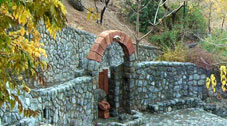
Tehran Trace takes the same motion path slowly and silently across four still photographs; the foyer of the Hotel Laleh, the Mirror Hall of the Golestan Palace, a stone arch towards the north of the city, and a bazaar with a view of mountains. Each "trace" begins close up, curves away from its opening subject and ends with the original image fully framed.
Stuart Pound has a background in film-making and computing and digital video brought the two together. He started film-making in 1970 as a member of the London Film-makers Co-op and subsequently taught film-making at Nottingham Trent University until 1979. His work has been shown at festivals in London and elsewhere as well as via the internet Past screenings include at MoMA (Paris),Tate Modern, Impakt Festival Utrecht, London Film Festival, Split International Festival of New Film, VIPER (Basel), International Media Art Biennale Wroclaw, Vidéoformes Clermont-Ferrand , Media Forum, Moscow International Film Festival , prog:ME, Centro Cultural Telemar, Rio de Janeiro, KunstFilmBiennale Köln, Microwave International Media Art Festival, Hong Kong
Schahram Poursoudmand, Yoann Trellu
Catalogue : 2020Schmutziges Licht (Lichtphon Art-Avant X) | Multimedia performance | hdv | color and b&w | 7:35 | Germany | 2018
Schahram Poursoudmand, Yoann Trellu
Schmutziges Licht (Lichtphon Art-Avant X)
Multimedia performance | hdv | color and b&w | 7:35 | Germany | 2018
Schmutziges Licht (Lichtphon Art-Avant X) An abstract, poetic visual-sound-drama The visual, tonal union and view of transcendent embodiment. A symbiosis of micro-coded, floating light-dust particles, interconnected in cracked soundscapes, layered sound cells, residual impulses and dissecting short-time cuts in noise structures. A self-born symbiotic being - alive through dissolution and constant change in time - Metamorphoses - Schmutziges Licht (Lichtphon Art-Avant X) is transformation in the beauty of decay and nonexistence. In the change of sight and hearing, reality and the levels of being resonate. Form and formlessness become inseparable. The unknown emerges, moves, penetrates into the observer, into us - becomes conscious and existent - Inner perception is infinite - Schmutziges Licht (Lichtphon Art-Avant X) is a multi-layered light-image-sound-vision. An artistic position and poetic exploration of the perception of artificial light and the unknown in the incarnate - of selfhood in an eternally lasting word in silence. On the technical side, the music consists of several hundred audio tracks with thousands of individual sounds. The visual level is based on a self-developed software particle system. There are hundreds of thousands coded pixel points, cross- linked lines and inner networked connections. Micro-audio clips, multi-level, time-independent organic soundscapes and digital visual light codes. Schmutziges Licht (Lichtphon Art-Avant X) is a complex visual sound correlation. Abstract, mysterious, filigree, powerful and subtle at the same time. A German-French co-production by the experimental artists Schahram Poursoudmand (DE) and Yoann Trellu (FR). Note: Schmutziges Licht (Lichtphon Art-Avant X) is created and produced to be played loud and projected in high quality. Please listen to it loud or via headphones. ...the night becomes the day - Light Overload - Schmutziges Licht (Dirty light) is artificial light. Excessive use of artificial light and its misuse (light pollution) on humans and the environment. Fatal consequences through the artificially constructed and manipulated lightening of the night by humans...
Schahram Poursoudmand Music & Sound Art, Composer, Visual Imagist, Poet Schahram Poursoudmand is a German composer, music & sound artist, visual imagist and poet. He creates extraordinary music, sound and visual art of a unique kind. In the avant-garde projects LICHTPHON, ONEVERYMOON, LICHTSCHREI, SHINE and ART-AVANT, he explores and realizes his artistic visions of music, sound, visual image and video art in existential poetry. The creative discovery of beauty through disintegration, dissolution, transformation, recreation and the representation of being and beyond in the transition from existence to non-existence is the essential approach and destination in his artistic passion. Music, sound, image and moving picture is stretched and condensed in form, time and space. Tonal and visual entities, sections and details, become disintegrated through dissolution in themselves and creates new structures, unknown realities and avant-garde elements by further deformation, in the beauty of decomposition. Existence, time, duality, deconstruction, humanism, transcendence, the infinite moment, the unknown, and recreation are some of the themes in his works. Schahram Poursoudmand creates unreal worlds of music, sound, visual art and poetry of strange beauty with unique aesthetics and expression. A surreal and bizarre mystery in music and visual art. „The fascination of renewal after the dissolution. The discovery and changing of time and time states. The artistic deconstruction, the diving into deep micro- and nanostructured soundworlds, as well as the representation of beauty in the creation of existence in nonexistence and new realities are the themes that stirs and fascinates me. Not the clearly audible and visible - but the secret behind the veil.“ * ...another world...an unknown place...an unknown time... * ::::::::::::::::::::::::: ::::::::::::::::::::::::: Yoann Trellu French video artist and software developer based in Berlin. Starts working with live video projections in 1999, Nantes, France. Moves to Berlin in 2003 and starts working with choreographers, creating media environment for stage productions. Yoann Trellu works internationally on numerous stage productions as well as developing his own projects through collaborations with musicians and dancers. His work is mostly abstract and stems from his early photographic work, using the camera and digital tools to alter reality, to extend details and moments into their own world. He considers the computer as a collaborator, able to suggest and create artistic elements. Using controlled randomness and probability is an important aspect of his practice, giving rules, limitations and (unlimited) variations on which to build further.
Yvan Pousset
Catalogue : 2013ANNA ET ROBBIE | Video | dv | color | 1:30 | France | 2012
Yvan Pousset
ANNA ET ROBBIE
Video | dv | color | 1:30 | France | 2012
Un personnage en gros-plan fait face à un paysage sauvage, se dessinant au fur et à mesure derrière lui. Des spasmes le submergeront de plus en plus, jusqu`à le projeter dans la matière des lieux. La condition d`Anna et Robbie n`en est pas moins banale qu`ils sont denses et périssables.
Formé aux Beaux-Arts de 1999 à 2005, mes réalisations questionnent le corps et ses pratiques dans des installations-vidéo et vidéos expérimentales. Vidéaste indépendant, je confronte mon travail de recherche à d`autres disciplines artistiques (théâtre, musique, danse), ainsi qu`au contact de populations diverses (écoles, démarche participative, instituts d`études) et dans la volonté de lier création plastique et citoyenneté.
Catalogue : 2012Solanus ad solana | Experimental video | dv | color | 1:11 | France | 2011
Yvan Pousset
Solanus ad solana
Experimental video | dv | color | 1:11 | France | 2011
An on-board camera films in low-angle-shot and against the light a man putting up a struggle, fitted with his arm/tool.
Trained at the Beaux-Arts of Paris from 1999 to 2005, my works question the body and its practises in installation videos and experimental videos. As an independent video director, I confront my research to other artistic fields (theater, music, dance) as well as to the contact of various populations (schools, participative processes, studies institutes) and with the will to link plastic creation and citizenship.
Catalogue : 20079°N | Experimental video | dv | color | 4:30 | France | 2006
Yvan Pousset
9°N
Experimental video | dv | color | 4:30 | France | 2006
The video opens with a character dressed in red, roaming a forest, searching for something in a quest that started before the beginning of the film. Like a contemporary Sisyphus, the character goes on with his task without respite, blind to the eye staring at him. The density of the forest sits between a long-distance perception of the character and an enclosing proximity due to the distinctness of the sounds when he moves (branches cracking, breathing, etc). The window scans the forest area around the character who appears to be a fixed spot on the projection surface. This space, this distance created between his outlying perception and his sonorous presence (as well as the one of the shooting device), allows the uncertainties of an image and its author (the one who is filming) to appear, the latter seemingly more lost in his filming intentions than the protagonist who, like Sisyphus, accepts his fate. Destructuring and dislocating each of the elements that make up an illusion could be a way to put the viewer back in his real-time position.
Yvan Pousset was born in 1977 in Rennes, France. After general artistic studies, he followed them up at Beaux-Arts d'Angers as a sculptor, and four years ago started to express himself through video work. All of his work in this medium is centred on the search of a materiality in the vibration of the pixels.
Txuspo Poyo
Catalogue : 2021Love Needs Time to Kill | Experimental fiction | 4k | color and b&w | 21:28 | Spain | 2020
Txuspo Poyo
Love Needs Time to Kill
Experimental fiction | 4k | color and b&w | 21:28 | Spain | 2020
The impetus to think how this project has been pulled to start from the end, is a symptom of the crisis of historical experience. As the seminaries in the Basque Country began to close, their pedagogical methods have been reduced to the imagination of several generations. "LOVE NEEDS TIME TO KILL" is about the emptiness distilled by the loss of what’s natural and cultural. Over recent decades Franciscan seminaries, along with those of other Orders, have been closing down across the Basque Country. With their closing, comes the loss of a pedagogy that has been a fundamental pillar in the education and identity of the Basque Country. Part of the pedagogical approach was to have large collections of plant and animal specimens, collected from missions in the American, African, and Asian colonies. This research project connects the identity of the diaspora in the missions and their forgotten pedagogical approach to the construction of an exotic and colonial imaginary. On the stage of a small theater in one of the closed seminaries, we have recreated a Baroque still-life scene from the 17th century. The still-life becomes a form of barricade, a gesture of struggle and resistance, in which the inert yet expressive bodies of the animals assert a sense of destiny and uncertainty that has accompanied us from the Romantic era through to present day.
Txuspo Poyo ( Alsasua, Navarra) holds a BA in Fine Arts from the University of the Basque Country (UPV-EHU). In 2001 he completed an ISCP residency sponsored by Foundation Marcelino Botín and also studied at the CADA center of New York University. In 2006 he received funding from the Vegap Foundation and The Valencia Art Foundation for his Delay Glass project, and the same year won the Prize Gure Artea of the Basque Government. In 2008, he was awarded first prize at the 10th Unión Fenosa International Exhibition. In 2015 he received the Multiverso grand funding from The BBVA Foundation for La Engaña tunnel project and 2018 from Huarte contemporary Art Center and the Navarra Government for Izaro project. In 2019 he received funding from the Vegap Foundation. He has taken part in the Madrid Region’s 15th Image Symposium, and has been an invited speaker on master’s programs at the University of Cuenca and the University Of Basque Country UPV-EHU. He has held solo exhibitions in venues such as BBVA Foundation, Madrid, Artium Museum in Vitoria, Centre d’Art La Panera in Lleida, the Costa Rica Museum of Contemporary Art and Design and the Montcada Gallery of La Caixa foundation in Barcelona. His group exhibitions include Geopolíticas de la animación showing at the CAAC in Seville and MARCO in Vigo; Les Rencontres Internationales Paris/Madrid/Berlin; the 2nd Angola Triennial; the FILE in São Paulo; Incógnitas at the Guggenheim Museum Bilbao; Cine y casi cine at the Reina Sofía Museum in Madrid; Multitude at the Artist Space Gallery in New York, and Sandretto Re Rebaudengo Foundation, in Guarene-Torino, Italy.
Catalogue : 2018Expediente: Tunel de la Engaña (File: La Enagaña Tunnel) | Video installation | hdv | color and b&w | 46:2 | Spain | 2016
Txuspo Poyo
Expediente: Tunel de la Engaña (File: La Enagaña Tunnel)
Video installation | hdv | color and b&w | 46:2 | Spain | 2016
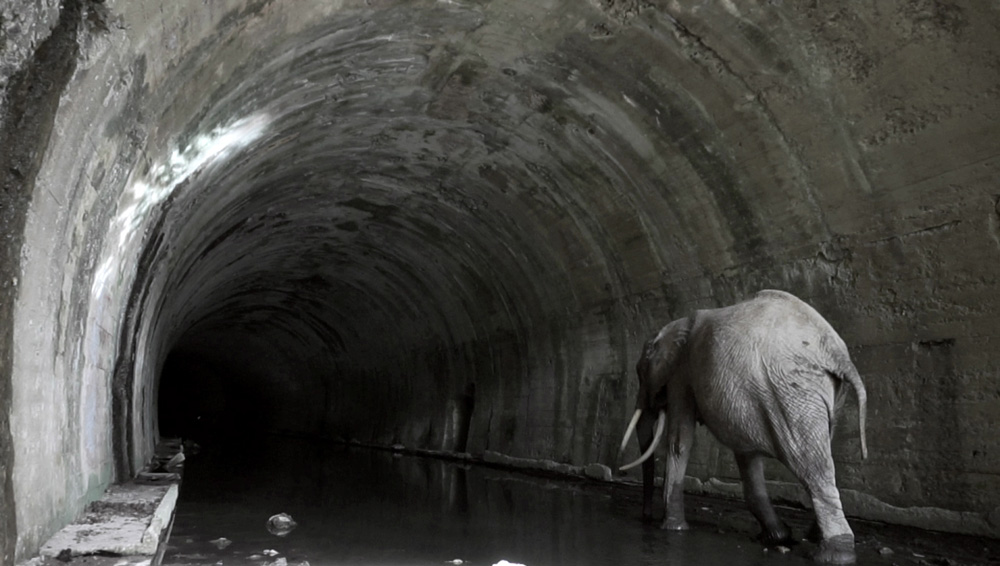
This project is an attempt at a residual image of the construction of the La Engaña tunnel. It is a fabric made from the threads of various intertwined stories expressed in fragments of memory, identity and history, inviting re-readings of an unfinished tale somewhere between fact and fiction. The La Engaña tunnel, with its 6,976 m length, was at the time the longest tunnel ever built in the Iberian Peninsula. This giant railway infrastructure lies between Burgos and Cantabria, and was the last stretch of an ambitious project to create a train link between the city of Santander and the Mediterranean coast. In 1941, the office in charge of public works deployed squads of political prisoners to the area. There they began building worker’s settlements, together with other laborers from all over Spain. The tunnel was completed in 1961, but the project was put on hold until 1985 when the government decided to abandon it. Inside the room, one screen shows the historic trepanning of a mountain and its interior bracing, rivalling in proficiency with a team of operatives who hollow out a pachyderm before mounting its inner frame. On the other screen, an elephant advances through the ruined remains of platforms, a station and the former worker’s homes before ending up inside the tunnel. The animal’s state connects with the accounts of survivors in terms of physicality, emotional charge and feelings of grief. On both screens, the actions of digging and emptying draw on the poems Digging by Seamus Heaney and The Hollow Men by T. S. Eliot, as if each were stationed Metaphorically at one of the tunnel’s extremes. A third screen in the hall depicts a recent action performed at the southern mouth of the La Engaña tunnel, now sealed off by a wall. A worker is engaged in restoring the missing letter « E ». Lodged inside the new « E » is a time capsule with the spoken testimonies of survivors who worked at both ends of the tunnel. This tunnel is a deep hole in the body of history, the inside of a belly emptied ofits organs, a cave, a dark abyss, a wound, but also the door that leads us to theunknown and an entrance to advance from, in spite of the warning.
Txuspo Poyo (1963, Alsasua, Navarra) holds a BA in Fine Arts from the University of the Basque Country (UPV). In 2001 he completed an ISCP residency sponsored by Fundación Marcelino Botín and also studied at the CADA center of New York University. In 2006 he received funding from Fundación Arte y Derecho and Fundación de las Artes de Valencia for his Delay Glass project, and the same year won the Premio Gure Artea of the Basque Government. In 2008, he was awarded first prize at the 10th Unión Fenosa International Exhibition. He has taken part in the Madrid Region’s 15th Image Symposium, and has been an invited speaker on master’s programs at the University of Cuenca and the UPV. He has held solo exhibitions in venues such as Museo Artium in Vitoria, Centre d’Art la Panera in Lleida, the Costa Rica Museum of Contemporary Art and Design and the Montcada Gallery of Fundació la Caixa in Barcelona. His group exhibitions include Geopolíticas de la animación showing at the CAAC in Seville and MARCO in Vigo; Les Rencontres Internationales Paris/Madrid/Berlin; the 2nd Angola Triennial; the FILE in São Paulo; Incógnitas at the Guggenheim Museum Bilbao; Cine y casi cine at the Reina Sofía in Madrid; Multitude at the Artist Space gallery in New York, and Fundación Sandretto Re Rebaudengo, in Guarene Turin, Italy.
Catalogue : 2011U.N(INVERSE) | Animation | dv | color | 19:0 | Spain | 2010
Txuspo Poyo
U.N(INVERSE)
Animation | dv | color | 19:0 | Spain | 2010
U.N(Inverse) is a project that delves into mechanisms of historical complexity from tracks of fragmentation as questions of interpretation, narration and fiction that has surrounded the construction of the United Nations, specifically the architectural complex of the New York headquarters. Constant changes of reference models have taken me to the crossroads between the idealism of the moment and the symbolism, the architecture and the cinema, sharing the limelight at a time of collapse. In terms of architecture, the decongestion and suspension proposed by Le Corbusier compared to the ideological vacuum of Wallace (the architect in vogue at that time), the backdrop of the cinema in the middle of the Cold War and as now the UNO is surrounded by Hollywood stars to promote themselves abroad; in this way Peter Pan?s Tinkerbell is the new ambassadress of the United Nations.
Txuspo Poyo was born in Alsasua-Navarra, Spain. He studied in Basque Country University(Bilbao), Where he received his B.F.A. He then spent two years in Toronto-Canada with a grand to continue education. After that he moved 1991 to New York City with a grand fron Basque Country where is living and sharing place with Bilbao. 2001 he was awarded a grant from Marcelino Botin Fundation for a ISCP residential program NY and CADA at the New York University. 2005 he got a grand from Bilboarte Fundation. 2006 he got a grand from Arte y Derecho, Madrid and he was a Gure Artea awarded, Basque Country. 2007 He got a residentian at FAAP, Sao Paulo, Brasil. Where he show at File Festival, Sao Paulo. 2008 he was awarded the first price at the international Union Fenosa competition, Spain. Txuspo has participated in the XV simposion of the study of the image, Madrid. 2010 invited artist in a master talk at the Cuenca University. Spain.
Catalogue : 2008DELAY GLASS | Animation | dv | color | 8:30 | Spain | 2007
Txuspo Poyo
DELAY GLASS
Animation | dv | color | 8:30 | Spain | 2007
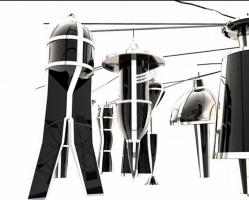
Delay Glass 2007 video animation 3d 8¨30´. Color. Stereo Bilbao Delay Glass refers to the unfinish The Large Glass by Marcel Duchamp in a simulation where scientiphic, technological, mechanistic and erotic constributions aquiere a rotating and onanistic movement of the different artifacts, interacting between fact and fiction.?
Txuspo Poyo was born in Alsasua-Navarra, Spain. He studied in Basque Country University(Bilbao), Where he received his B:F:A. He then spent two years in Toronto-Canada with a grand to continue education. After that he moved 1991 to New York City with a grand fron Basque Country where is living and sharing place with Bilbao. 2001 he was awarded a grant from Marcelino Botin Fundation for a ISCP residential program NY and CADA at the New York University. 2005 he got a grand from Bilboarte Fundation. 2006 he got a grand from Arte y Derecho, Madrid and he was a Gure Artea awarded, Basque Country. 2007 He got a residential at FAAP, Sao Paulo, Brasil. Where he show at File Festival, Sao Paulo.
Marlies Pöschl
Catalogue : 2025Vivo Vision | VR 360 video | mp4 | color | 34:30 | Austria | 2024
Marlies PÖschl
Vivo Vision
VR 360 video | mp4 | color | 34:30 | Austria | 2024
The young Swiss economist Hans travels to Thailand with his mum to visit his grandmother in “Vita Bona”, a care home for European seniors. The facility has changed its name and is hard to find at first. When they finally arrive, it is completely different from what they expected: a perfectly styled wellness retreat for young people. While Hans indulges in the beauty of the place, Daniela wanders through the labyrinthine complex in search of her mother and observes strange occurrences. Where are the senior citizens? What is the manager Mrs. Vasall hiding behind her charming smile? This conceptual VR film is a dystopian parable about the outsourcing of care work, as produced by our neo-colonialist globalized economic system. “Vivo Vision” refers to a way of seeing that Ms. Vasall, the manager of the resort, has invented. Wellness retreat and retirement home are present in the same place, but without interfering with each other. While the young people practice yoga poses by the pool, the seniors and workers have been relocated to another, invisible level. “Vivo Vision” is a view of the world in which everything that is considered unproductive in a capitalist logic has become invisible.
MARLIES POESCHL is an artist, filmmaker, curator and educator. She is currently based in Vienna (AT), where she teaches at the Academy of Fine Arts Vienna, but has previously worked in France, Iran, Thailand and China. Shifting between artistic, curatorial and educational approaches, Pöschl is interested in art as a form of knowledge production. She understands filmmaking as social practice and often collaborates with actors from outside the art world in search for polyphonic narrations and open-ended dramaturgies. Since 2018 Pöschl has focused on ways in which societies of the global north respond to the ‘care crisis’. Pöschl has received various prizes for her work: in 2022 she was granted the state scholarship for media art, in 2021 the Young Artist’s Award (City of Vienna). Her films and installations have been shown in several solo presentations, a.o. Kunstverein Ludwigshafen, DE (2022), Salzburger Kunstverein, AT (2021), CAC Brétigny, (2018) and MUSA, Vienna, AT (2016). She has participated in biennales and film festivals such as the Vienna Biennale for Change (AT), Antimatter media art festival (CA), Edinburgh International Film Festival (GB), Cinema Verité (IR), Diagonale (AT) and others. Her work is distributed by VTape and The Golden Pixel Cooperative.
Lucia Prancha
Catalogue : 2026CHARLES | Experimental doc. | hdv | black and white | 2:38 | Portugal, USA | 2025
Lucia Prancha
CHARLES
Experimental doc. | hdv | black and white | 2:38 | Portugal, USA | 2025
Do you remember the scene in Killer of Sheep (1978) where the kids are playing on abandoned railroad tracks? The scene is set in the Watts neighborhood in California. Director Charles Burnett took the artist Lúcia Prancha to several filming locations from his works around Los Angeles.
Lúcia Prancha (1985, Lisboa) is an artist who lives and works in Barcelona. Lúcia graduated in Painting from FBAUL (2009, PT) and obtained her Masters in Arts from CalArts–California Institute of the Arts (2015, USA). Her work was exhibited at Pavilhão Branco, Museu da Cidade, Lisbon; 19 Crac de Montbéliard; Centro de Arte Oliva; Sesc-Pompeia, Sao Paulo; LACA – Los Angeles Contemporary Archives; Hordaland Kunstsenter, Bergen; Serralves Foundation, Porto; Galeria Dynamo, Porto; Galeria Leme, São Paulo; Berardo Museum and São Paulo Biennial. Her videos were screened at the Cinemateca Portuguesa; INTERSECCIÓN, Coruña; Curtas Vila do Conde; Rencontres Internationales Nouveau Cinéma et Art Contemporain de Paris and, Haus der Kulturen der Welt, Berlin. Currently, she is part of "El vértigo de las imágenes", XVIII Bienal Internacional de Fotografía–Fotonoviembre at TEA–Tenerife Espacio de las Artes and Centro de Fotografía Isla de Tenerife, ES. From September to November, she will be in artistic residency at the Cité Internationale des Arts in Paris.
Catalogue : 2021CASA DO SOL | Experimental video | hdv | color | 12:0 | Portugal, Brazil | 2020
Lucia Prancha
CASA DO SOL
Experimental video | hdv | color | 12:0 | Portugal, Brazil | 2020
CASA DO SOL explores the work and legacy of Brazilian writer Hilda Hilst (1930-2004). Often described as the Marquis de Sade of Brazil, her astonishing work takes up mysticism, insanity, embodiment, eroticism, and female sexual liberation. Hilst is one of the most important Portuguese language authors of the twentieth century. Nevertheless, her work is virtually unknown in our community. CASA DO SOL, translated from the Portuguese “House of the Sun” is the name of Hilst’s home. During her lifetime, her residence was an important gathering site for writers, artists and intellectuals. Today, CASA DO SOL holds her archive, and hosts an intimate residency program which allows writers and artists to breathe in the compound’s earthy magic. Prancha’s video, CASA DO SOL, was shot on location at Hilst’s house and gardens during summer of 2019 and uses the text of one of Hilst’s short stories. This experimental video explores sexuality and the colonial through the political and poetic militancy of Hilst’s writing.
Lúcia Prancha (1985, Portugal) obtained her MFA from CalArts (USA) in 2015, after completing BA studies in Lisbon (PT, 2009) and MA in São Paulo (BR, 2012). Lúcia Prancha explores the tensions between aesthetics, perception and politics, often by rethinking specific historical and social sites through sculpture, video and printed matter. Her work has been exhibited at LACA–Los Angeles Contemporary Archive, Los Angeles, USA, Hordaland Kunstsenter, Bergen, NO, Serralves Foundation, Porto, PT; Galeria Leme, Sao Paulo, Brazil and Museu Berardo, Lisbon, Portugal. In 2016, her film SEBASTIAN, THE GHOST was screened at Les Rencontres Internationales Nouveau Cinéma et Art Contemporain in Paris and, at Haus der Kulturen der Welt, Berlin; and the 24th Curtas Vila do Conde – International Film Festival, Portugal. In 2017, Prancha was in residency at the Jan van Eyck Akademie in Maastricht, NDC. During the Spring of 2020, Lúcia is a Visiting Artist Faculty at CalArts–California Institute of the Arts.
Catalogue : 2016Sebastião, O Fantasma | Fiction | hdv | color | 14:57 | Portugal, USA | 2014
Lucia Prancha
Sebastião, O Fantasma
Fiction | hdv | color | 14:57 | Portugal, USA | 2014
Sebastian of Portugal disappeared in the battle of Alcácer Quibir and is often referred to as The Desired by the Portuguese. The people of Lençóis believe that the ghost of Sebastian of Portugal haunts their Brazilian island. Some see themselves as direct descendants of the king. They also believe that every first Friday of every month king Sebastian visits the beach in full armour and on his horse, and that a subterranean ouroboros will swallow the island some day. A group of people who inhabit the island of Lençóis on the Northeast of Brazil and their interest in the myth of D. Sebastião I (Sebastian of Portugal 1554-1578).
Lúcia Prancha (1985, Lisbon / Portugal) received a MFA from CalArts - California Institute for the Arts (2015). Lúcia explores the tensions between aesthetics, perception and politics rethinking historical and social episodes through installation, video and sculpture. Her work has been exhibited at the Serralves Foundation, Oporto, Portugal; Galeria Leme, Sao Paulo, Brazil and Galeria Baginski, Lisbon, Portugal. In 2013, she was the recipient of a two-year Calouste Gulbenkian Foundation and the Luso-American Foundation for Development (FLAD) Scholarship. Presently practicing in Los Angeles.
Sorayos Prapapan
Catalogue : 2021Digital Funeral: Beta Version | Experimental film | dcp | color | 5:24 | Thailand | 2020
Sorayos Prapapan
Digital Funeral: Beta Version
Experimental film | dcp | color | 5:24 | Thailand | 2020
One of my dream is to organize my own funeral.
Sorayos PRAPAPAN (1986, Thailand) is an independent filmmaker, He has directed several short films which won awards in his home country and were shown in many international film festivals including Venice,Locarno,Rotterdam and Clermont-Ferrand.
Catalogue : 2014Boonrerm | Fiction | hdcam | color | 16:35 | Thailand | 2013
Sorayos Prapapan
Boonrerm
Fiction | hdcam | color | 16:35 | Thailand | 2013
Boonrerm is a housemaid.Every day she received a weird order.
Sorayos Prapapan is a part of thai independent filmmaker. He graduated from Department of Film and Photography Thammasat University Thailand in 2009 He began his career working as Production Assistant for Uncle Boonmee Who Can Recall His Past Lives (2010 Palme D`Or Winner Festival De Cannes) Now he working as sound recordist,foley artist and sometimes sound designer for thai independent film such as 36 (2012 New Current Award Busan Winner) and just graduated from Asian Film Academy 2013. Beside that he directed his own short such as Noumena Scene,Boonrerm and Long Live the Kim.
Katja Pratschke, Gusztáv Hámos
Catalogue : 2023In Limbo | Experimental doc. | 4k | color and b&w | 31:42 | Germany | 2022
Katja Pratschke, Gusztáv Hámos
In Limbo
Experimental doc. | 4k | color and b&w | 31:42 | Germany | 2022
IN LIMBO is about a young man who flees from Hungary to West Berlin during the Cold War. Kiesling's story begins with his conscription into the people's army for military service. Ever since he realised that the state – in which he lives – claims ownership of him, his relationship with reality, with real freedom, has changed dramatically. He decides to reset his identity.
As media artists and artistic researchers, Gusztáv Hámos and Katja Pratschke have been working together on the theory and practice of intermedial arts for 20 years. Thus, their artistic practice includes video, film, photography, interactive and site-specific installations, VR work, as well as the curation of exhibitions, symposia, film series, workshops, and publications. They are founding members of the Concrete Narrative Society e.V. and members of the top_OS collective.
Catalogue : 2020Cities (Territories & Occupation) | Experimental doc. | 4k | color and b&w | 29:50 | Germany | 2019
Katja Pratschke, Gusztáv Hámos
Cities (Territories & Occupation)
Experimental doc. | 4k | color and b&w | 29:50 | Germany | 2019
Cities (Territories & Occupation) is about "the city" divided into districts, neighborhoods, zones and domains, marked by inner-city borderlines. The film investigates how cities emerge and change through inclusion and exclusion, migration, decay, destruction, demolition, relocation, displacement. Urban territories, districts are characterized by different social processes, business relationships, power relations, private affairs. We wonder how urban territories are formed and why they change? Who controls the city or how do the inhabitants create free spaces? Who owns the city?
Gusztáv Hámos, born in Budapest, lives in Berlin, is a media artist, curator and author. His oeuvre includes video, film, photography and installation and has been exhibited at Documenta, Biennale Venice, ZKM Karlsruhe, Ludwig Muzeum Budapest. His videos and films have been shown at Tate Modern London, SFMOMA, Videobrasil Sao Paulo, Palais de Tokyo Paris, Ernst Muzeum Budapest and Art Basel Miami. His work is in the Collections of The Museum of Modern Art NY, Centre Georges Pompidou Paris, Múzeum Ludwig Budapest, NBK Berlin and ZKM Karlsruhe. Katja Pratschke, is a media artist, curator and since 2006 has organised photofilm seasons with Gusztáv Hámos with whom she has collaborated since 1998. Her films and installations have been shown at Ludwig Muzeum Budapest, Akademie der Künste Berlin, IndieLisboa and the 63th Mostra Internazionale d’Arte Cinematografica di Venezia. She has received various awards and grants: german short film award, travel grant of the Hessische Kulturstiftung, Artist-in-Residence Istanbul, Dhaka, Venice and Kolkata.
Catalogue : 2013Cities | Experimental fiction | 35mm | color and b&w | 27:0 | Germany | 2012
Katja Pratschke, Gusztáv Hámos
Cities
Experimental fiction | 35mm | color and b&w | 27:0 | Germany | 2012
The theme of the film HIDDEN CITIES is personal urban perceptions, which we call »the city«. The city, as a living organism, reflecting social processes and interactions, economic relations, political conditions and private matters. In the city, human memories, desires and tragedies find expression in the form of designations and marks engraved in house walls and paving slabs. But what the city really is under this thick layer of signs, what it contains or conceals, is what we are researching in the HIDDEN CITIES project. The source material for the film are 9 sequential photo works created by Gusztáv Hámos between 1975 and 2010. Each of these »city perceptions« depicts essential situations of urban experiences containing human and inhuman acts in a compact form. The cities in which the photo sequences have been made are Berlin, Budapest and New York ? places with a traumatised past: Wars, dictatorships, terrorist catastrophes.
Gusztáv Hámos, born in Budapest, lives in Berlin. He is an artist, curator and author. His artistic work includes video, film, photography and installation and has been exhibited at Documenta, Biennale Venedig, ZKM Karlsruhe, Ludwig Muzeum Budapest. His videos and films were shown a.o. at Tate Modern London, Rencontres Internationales, 63th Mostra Interernazionale d?arte cinematografica di Venezia, Section Corto Cortissimo, SFMOMA, YBCA San Francisco. His work is included in the Collections of MOMA NY, Centre Georges Pompidou Paris, NBK Berlin, ZKM Karlsruhe, Kunstsammlung NRW, Ludwig Museum Budapest, C3 Budapest, Saint Gervai SIV, Geneve. Katja Pratschke is an artist, curator and since 2006 she has organised photofilm seasons with Thomas Tode and Gusztáv Hámos with whom she has collaborated since 1998. Her artistic projects include: Natural Born Digital (1998); Fremdkörper/Transposed Bodies (film, installation, book, 2001/2003); Rien ne vas plus (film, installation, 2005); Fiasko (split screen film 2010, book 2012), Cities (Verborgene Städte) (film, installation, book 2012). Her films were shown a.o. at Tate Modern London, Rencontres Internationales Paris/Berlin/Madrid, Triennale der Photographie Hamburg, 63th Mostra Interernazionale d?arte cinematografica di Venezia, Sektion Corto Cortissimo. She is co-editor of the publication Viva Fotofilm bewegt/unbewegt, Schüren 2010, and co-founder of the Concrete Narrative Society e.V.
Sandra Prechtel, Francois ROSSIER
Catalogue : 2006ND - Deutsches Neuland | Documentary | dv | color | 64:45 | Germany | 2004
Sandra Prechtel, Francois ROSSIER
ND - Deutsches Neuland
Documentary | dv | color | 64:45 | Germany | 2004
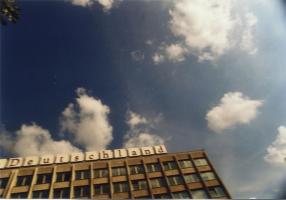
Portrait d'un drôle de bâtiment situé à Berlin Est, et dans lequel la RDA continue à exister, 15 ans après la chute du Mur. Ce qui fut le siège de la rédaction du journal officiel de RDA, Neues Deutschland, est devenu un biotope unique, où d'éternels citoyens de RDA et des artistes branchés de la scène culturelle berlinoise cohabitent. Synopsis résumé 15 ans après la chute du Mur, il existe un lieu à Berlin où la RDA semble poursuivre son existence: un immense immeuble de béton sur le toit duquel on peut lire en grandes lettres "Neues Deutschland" (la nouvelle Allemagne)- le titre orgueilleux de ce qui fut le journal officiel du régime. Un biotope unique s'est créé à l'intérieur: quelques citoyens impérissables de RDA tiennent ici désespérément leur position, un ilôt de résistance en plein territoire ennemi. Mais de jeunes artistes ont aussi découvert le charme des pièces défraîchies. Dans les couloirs éclairés aux néons, on perçoit les basses de la musique électro, quand ce n'est pas un pianiste new yorkais qui joue des sonates de Schubert. Et puis il y a encore les anciens collaborateurs du journal, qui errent dans les vieux locaux, à la recherche d'une RDA avec laquelle ils pourraient enfin faire la paix. Un lieu symbolique pour cette nouvelle Allemagne dans laquelle on ne peut encore tirer de trait définitif sous le passé. Synopsis Dans la Rue de la Commune de Paris, dans la partie Est de la ville, derrière les voies ferrées de la Ostbahnhof, on trouve tel un navire échoué le bâtiment massif qui fut autrefois le palais des media de RDA. Sur le toit, les lettres de néon éteintes depuis longtemps forment encore les mots NEUES DEUTSCHLAND. Pendant des décennies, ce fut le quartier général de l'organe officiel de la RDA qui diffusait quotidiennement son flot de paroles idéologiques. A l'intérieur, le temps semble s'être arrêté. Un portiers des temps anciens règne sur le foyer, le passé continue à exister: dans l'odeur de linoleum, le monte-charges immobile, les corridors interminables éclairés par la lumière tremblotante des tubes néons. Au rez-de-chaussée, c'est le domaine de Walter Grenzebach, dernier collaborateur du journal présent dans les lieux, toujours chargé des "relations publiques". Walter vit au jour le jour le déclin de son empire. Au deuxième étage, une clique de jeunes créteurs s'est appropriée les bureaux de la direction, autrefois sévèrement surveillés. Dans les couloirs, on entend maintenant de la musique, dans la grande salle de rédaction, un certain "Herr Schneider" vend du matériel pour DJs. Un des bureaux est devenu un studio de films d'animation. La réalisatrice, Katrin Rothe, a longtemps hésité avant de s'installer là. Les esprits du passé sont trop présents pour elle, toutes ces silhouettes grises qui ont rendu la vie en RDA insupportable. Mais c'est ici qu'elle développe maintenant un sentiment d'appartenance _ au pays disparu de son enfance. Ce qui pour les uns est une location branchée, où l'on peut laisser libre cours à sa créativité derrière les murs joliment décrépis d'un régime disparu, est pour les anciens collaborateurs le lieu où s'effectue toujours, 15 ans après, un douloureux travail de mémoire. Ils sont loin d'avoir fait la paix avec cet Etat, s'en prennent à eux-mêmes et au rôle qu'ils ont joué. Le film documentaire est le portrait d'un étrange "entre-deux", où il ne reste de la RDA que des fins de série et des néons jaunes qui éclairent ceux qui se sont construit leurs petits "empires" dans les espaces devenus vacants. Ca n'est plus "Neues Deutschland", mais "Deutsches Neuland", un nouveau territoire allemand indéfinissable, un lieu symbolique pour un pays dont le passé est loin d'avoir été surmonté. Un des lieux menacés de "rénovation" et ainsi condamnés à disparaître bientôt, où pourtant l'histoire est palpable dans la concomitance du passé et du présent.
Sandra Prechtel Réalisatrice / auteur Sandra Prechtel est née le 25 janvier 1969 à Munich. Elle a étudié les lettres et le cinéma, ainsi que les sciences politiques à Munich, Londres et Berlin. En 1997, à l'issue de ses études, elle a commencé une carrière journalistique par un séjour de plusieurs mois à Moscou, où elle a travaillé pour la Süddeutsche Zeitung. Depuis, elle a collaboré à de nombreux magazines dans le domaine des media. Sandra Prechtel a commencé à être assistante à la réalisation depuis ses études: Zwischen Himmel und Erde (court-métrage de Solveig Klassen, DFFB 1993), ou encore Frost (fiction de Fred Kelemen, 1996). ND-Deutsches Neuland est son premier moyen-métrage. François Rossier Né en 1961 à Vevey (Suisse), François Rossier est diplômé depuis 1983 de l'Ecole de théâtre Dimitri. De 1984 à 1986, il a été assistant de Roy Bosier à l'académie d'été pour le mouvement et l'expression corporelle, l'acrobatie et l'improvisation, à Vienne. De 1992 à 1994, il a étudié la réalisation à l'International Film School de Londres. Cameraman et assistant réalisateur, François Rossier a également réalisé plusieurs films. Quatre de ses courts métrages ont connu un accueil très favorable dans les festvals internationaux où ils ont été présentés: Liquid Assets (1993), 35 mm, NB, 8 min.; Skazka (1997), 35 mm, couleur, 24 min.; Château de sable(1999), 35 mm, 9 min.; Petits Gestes (2002). Il a récemment terminé son premier long documentaire. "Ailleurs si j'y suis" est un portrait du maire de Calcutta. ND-Deutsches Neuland est sa deuxième réalisation documentaire.
Sara Preibsch, n/a
Catalogue : 2008The Beekeeper | Experimental film | 35mm | color | 17:48 | Sweden | 2007
Sara Preibsch, n/a
The Beekeeper
Experimental film | 35mm | color | 17:48 | Sweden | 2007
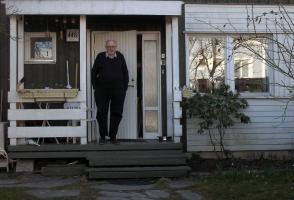
Synopsis: The Beekeeper The Beekeeper explores the elisions of memory by observing the ordered life of a beehive through the eyes of a professional beekeeper. Combining three principal modes of narration: conversation, music and moving image, this film recalls a dreamy landscape haunted by the absent presence of fleeting memories. Taking the subject of film as its starting point, the story, which develops through the conversation, is informal and open ended. Helmut Preibsch, a beekeeper and former pilot in the Luftwaffe, who immigrated to Sweden with his family after the end of WW II, tells the story of how, towards the end of the war, he found a large container of chocolate in a ditch. He stuffed his pockets with as much of this chocolate as he possibly could and then cleverly traded his find for the things he thought he would need. Helmut?s story is at this point juxtaposed with a black and white, still image of him as a young man, though this cannot be verified, as the composition does not allow his face to be seen. Following the sequence described above we see Helmut sat at a table with his side/back to the camera. After a pause he begins to talk about how he managed to get a job and immigrate to Sweden by acquiring a false certificate as a weaver. This is followed by several shots of Helmut sitting in an armchair whilst strong shadows are cast across his face and the music brings a sense of anticipation. The next sequence begins with a close up of a swarm of bees, this is accompanied by a subtle sound of bees, which grows stronger and eventually transforms into a playful flute sound. At this point the image changes to a black and white still of a field of daisies. Helmut continues to tell his story of how he managed to flee from the part of Germany, which was occupied by Russian forces, into the mountains of the Austrian Alps, a region that was under American control. By using a plank to lodge himself under a train carriage and in this way transport him self for part of his journey, he explains that his escape from the destiny of becoming a Russian prisoner was narrow. Following this sequence Helmut talks about the way in which institutions have often used bees and beehives as an example of a type of insect that has created a form of an ideal society. The camera then pans across Helmut?s overcrowded room and following this the next sequence begins with an image of bees and beehives. Helmut is now talking about what happened to the German Air Force towards the end of the war and this is followed by a long sequence without narration showing Helmut in his protective beekeeper outfit; he carefully opens the lid to inspect one of his hives and blows smoke into it to tranquilize the bees. In the next sequence Helmut has moved forward in time and is now talking about his and his family?s experience as immigrants in Sweden at the end of the 1940, he tells the story of a drunken doctor who threatened to send them to Russia, of how the family got Typhoid fever and how they came back to hear the children in the village chant fucking dirty Germans whilst throwing stones at them. The film ends with a shot of the whole family flickering and turning into red as the last bit of film is transported through the camera.
Biography: Sara Preibsch Sara Preibsch makes 16mm films and photographs that engage with the grand narrative of history from a distinctly personal perspective. Adapting a slow pace and a contemplative mood, Preibsch?s work brings into play invented and meandering narratives subtly revealed through the relation between titles, imagery and sound. Whilst always privileging the act of creating new ensembles, her work also reveals a desire to narrate forgotten pasts, to put the present into context without carrying the burden of history as if the most profound limitation. Preibsch?s work is a play of metaphors, a search for ambiguity and multiple meanings and her pieces are left deliberately open. Earlier black and white film pieces such as Journey to Stockholm, 2000 and Late Birds, 2003 are inspired by the simple act of daydreaming, thoughts emerging whilst travelling from one place to another as experienced by a passenger looking through a bus/ train window respectively. Whilst the landscape in Journey to Stockholm is sparse and repetitive, Late Birds depicts the planned city at night as a dizzy non-stop phantasmagoric replay of light, recalling a strange and oneiric sequence from an early film noir piece. As in the case of her earlier works, Preibsch?s first colour film Shoreham Works, 2005 takes its inspiration from feature film rather then from the experimental and avant-garde tradition. Shoreham Works explores the relation between a certain sense of beauty and foreboding found at the site of a derelict cement factory in Upper Beeding, UK. The eerie and abandoned beauty of this film brings places like the Zone from Tarkovsky?s Stalker to mind. In her photographic piece Hultsbruk ready-maids, 2005, Preibsch shot a series of 1950?s German magazine covers which she found stuck to a wall in the house where her Austrian / German grandparents lived after they immigrated to Sweden in the late 1940?s. Intrigued by these images, which had been placed there by her grandfather almost 50 years previously, Preibsch begun inventing a contemporary narration drawn from deep within this collection of apparently uncritical images. Photographed from oblique angles the women in these portraits appear melodramatic and strangely artificial in a sense, which recalls the staging of a Douglas Sirk film. In her most recent film The Beekeeper, 2007 Preibsch explores the uncomfortable past of her grandfather, a pilot in the Luftwaffe who since this has become an ardent Beekeeper. Using conversation, moving image and music to tell a story, the Beekeeper represents an important step towards producing what may traditionally be seen as a narrative or documentary film. Born in Stockholm, Sweden in 1973, Sara Preibsch now lives in London where she studied Fine Art and later Cultural Studies. She has exhibited her work extensively in the UK and abroad and recent Exhibitions and screenings include: They do things differently there, London 2007, Siberia Film Nights, London 2006 and Video Club, Brighton 2006. In 2005 Preibsch completed a residency at Akademie Schloss Solitude, the Akademie also co-published her first monograph Hultsbruk Ready-maids, 2005 in conjunction with her first solo exhibition in Germany the same year. An exhibition of Preibsch?s new work is scheduled at Akademie Schloss Solitude for 2008. Preibsch?s work has been published in the magazine Camera Austria and more recently in Checkpoint Charley, 2006, the catalogue for the 4th Berlin Biennial. Edited by: Maurizio Cattelan, Massimiliano Gioni and Ali Subotnick. Her film Late Bird, of 2003 is part of a forthcoming series of artists? films to be published by filmarmalade. Sara Preibsch?s work is represented by the Video Art Gallery, London, where her work is also scheduled to be screened in the autumn of 2007.
Anggun Priambodo
Catalogue : 2007Gosip Pakar | Documentary | dv | color | 25:49 | Indonesia | 2005
Anggun Priambodo
Gosip Pakar
Documentary | dv | color | 25:49 | Indonesia | 2005
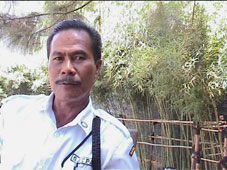
Anggun Priambodo's video makes a parody of TV program, which are very popular and mostly seen by Indonesian spectators, namely the celebrity gossip show. He thinks the program too much exaggerated, too deceitful, too ordinary, and even too political because it opens up the private lives of many people to the public. The artist made his own very similar program by involving ordinary people who are mostly unknown. He also made interviews that reveal their unknown private lives. Sometimes it is not clear whether they are really telling the truth or just lying.
Born in 1978, Anggun Priambodo currently lives in Cinere, Indonesia, where he mainly produces music videos, but also works in the area of artistic photo and video. Some of his videos has been shown on the program "Have we met?" organized by 'The Japan Foundation', Japan, January 2005, and in "Ok Video, Kuala Lumpur" in the framework of the "Jakarta Video Festival" program, Malaysia, November 2006.
Seth Price
Catalogue : 2007Digital Video Effect: Editions | Experimental video | dv | color | 12:0 | USA | 2006
Seth Price
Digital Video Effect: Editions
Experimental video | dv | color | 12:0 | USA | 2006
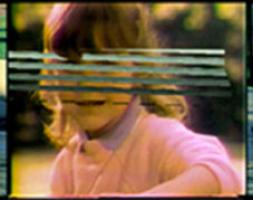
"Digital Video Effect: Editions", was created and released into distribution as one work in a solo exhibition that Seth Price held simultaneously at Friedrich Petzel Gallery, Reena Spaulings Fine Art, and Electronic Arts Intermix in New York in September 2006. The video serves as a sampler of Price's editioned videos to date, all of which have been sold through galleries. Here fragments of sound and image from the editions have been brought together, forming a montage that provides access to these publicly unavailable artworks. Price juxtaposes disparate authors, editing strategies, and histories, yielding a work in the essay-film tradition that communicates an inquiring, critical sensibility.
Seth Price's multi-disciplinary art practice has gained an international following. In conceptual works that include video, sculpture, sound, and written texts, Price engages in strategies of appropriation, recirculation, and packaging to consider issues of cultural production, the distribution of information, and the role of ideology. Shifting and manipulating the detritus of commodity culture, his projects have included early sampler-based academic music, anonymous internet-circulated video, and art historical imagery. Investigating the cultures generated and re-circulated by mass media technologies and information systems, Price ultimately questions the production and dissemination of art and meaning itself. Price is a member of the Continuous Project collective, which since 2003 has reprinted and disseminated seminal art texts and magazines, including the first issue of Avalanche in 1970. "Dispersion", Price's well-circulated, illustrated manifesto on art, media, reproduction, and distribution systems, was designed in 2001/02 for the catalogue of the Ljubljana Biennial of Graphic Art, and later published as an artist's book.
Mauridi Primo
Catalogue : 2023Mawe | Experimental film | mov | color | 12:20 | Congo (RDC) | 2022
Mauridi Primo
Mawe
Experimental film | mov | color | 12:20 | Congo (RDC) | 2022
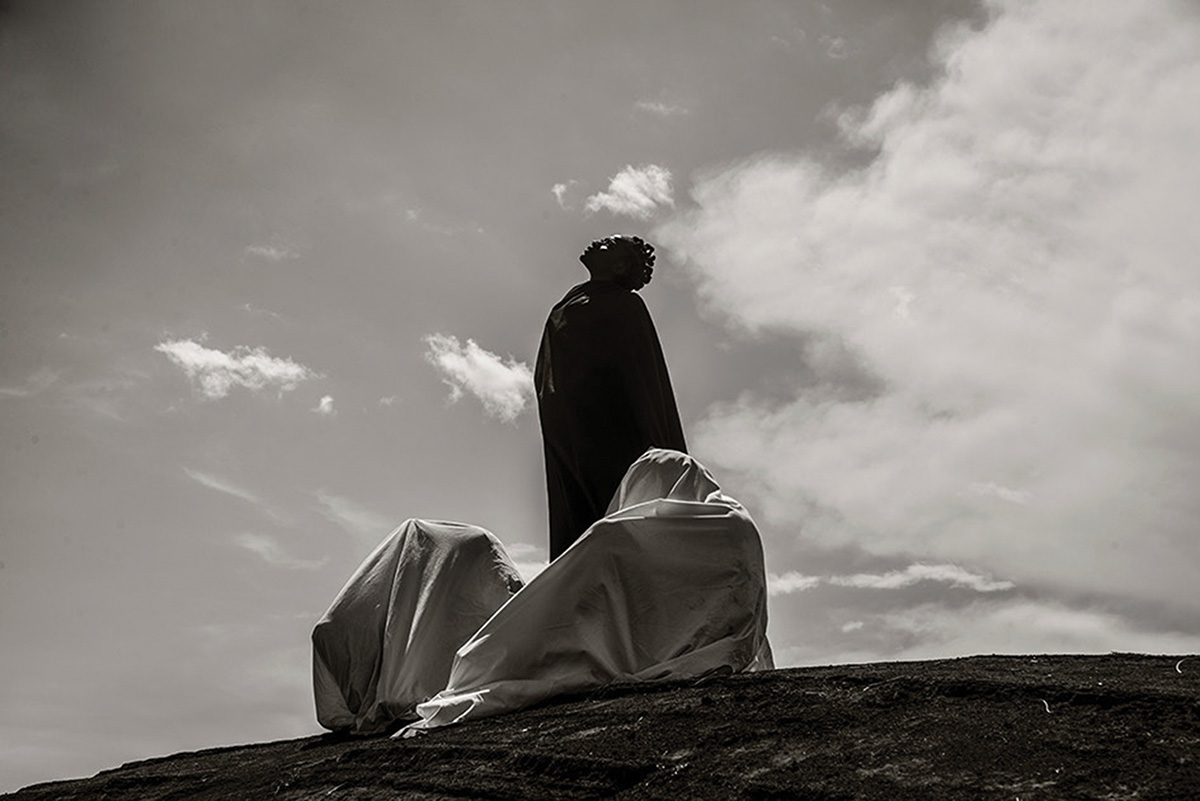
Grâce à un rituel de réveil, Nyabhingi la déesse de l’abondance s’élève du Liangombe souffle Mazuku. Elle doit guérir Goma(Rd Congo) de la destruction et rétablir l’écologie balance. Avec ses guerriers, Ils sont témoins de la désolation causée par l’arrogance industrielle qui a profané la terre, invoquant la fureur de Lingombe, l’esprit de discipline qui corrige tous les torts. Lingombe crache du feu et Mahindule (lave) pour avertir le peuple de ses transgressions.
Mauridi Primo est un photographe et cinéaste originaire de Goma (RDC Congo). Comme un jeune artiste qu’il a fait son apprentissage pendant plusieurs années au centre culturel Yole Africa!, sous la supervision pédagogique et artistique de la cinéaste et activiste Petna Ndaliko Katondolo. il a participé IXes Jeux de la francophonie avec sa réalisation nommer (Mobembo). il a été avec son film Bila Mask au Festival film Congo in Harlem, et cette même année, il a remporté l’Académie Canon VII bourse. En avril 2022, il participe à la rencontre numérique internationale La Rencontre Internationale des Arts Numériques et Visuels à Abidjan.
Hannah Leonie Prinzler
Catalogue : 2006Wege [paths] | Experimental video | 0 | color | 4:27 | Germany, Australia | 2004
Hannah Leonie Prinzler
Wege [paths]
Experimental video | 0 | color | 4:27 | Germany, Australia | 2004
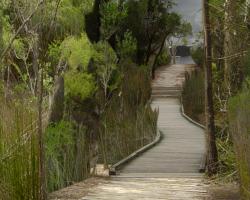
Hannah Leonie Prinzler?s work »Wege [paths]« investigates the relation of the real and the virtual in touristic landscapes. The paths and the camera offer an organised way of navigating through the landscape but deny any form of deviation from it. Emphasized by the ?flat 3D? montage technique the landscape is revealed as a mere scenery, existing only from the perspective of the path. Thus the ambivalence of the term?sight? is disclosed as something both ?real? but only existing for and from a spectator?s view.
Hannah Leonie Prinzler was born in Berlin in 1980. Since 2000 she has been studying Media Arts at the Bauhaus University in Weimar, Germany, and at the College of Fine Arts in Sydney, Australia (2003/04), with a focus on sound and video installation. Her works have been exhibited at the »backup_festival« Weimar 2001, the »European Media ArtsFestival« Osnabrück 2002, the »Inventionen Festival für Neue Musik« Berlin 2002, the »Viper Festival Basel« 2004, »sonar festival« Barcelona 2005 and other events.
Nada Prlja
Catalogue : 2013Give 'em Hell | Experimental doc. | hdv | color | 4:40 | Macedonia, United Kingdom | 2010
Nada Prlja
Give 'em Hell
Experimental doc. | hdv | color | 4:40 | Macedonia, United Kingdom | 2010
The banner slogans represented in the video are: Stop the deportation, We are all foreigners, Stop war against Immigrants, Stop criminalising Immigrants, No worker is Illegal and Rights for foreigners. During the course of several days, the artist positioned protest banners on the streets of London and secretly recorded the unfolding scene with a hidden camera from the opposite side of the street. The video ?Give ?em Hell? shows a spontaneous action by a group of youngsters, who express their anger toward and mistrust of immigrants, by smashing the series of protest banners, the texts and slogans of which support immigration and the notion of equal human rights for all. The disturbing, violent scene in ?Give ?em Hell? is slowed-down and accompanied with music by Ludwig van Beethoven, as a reference to the aestheticised violence of science fiction film ?A Clockwork Orange? by Stanley Kubrick?s. Kubrick claims that ?A Clockwork Orange? achieves to represent a possible reality and it is not only a fiction (science fiction). Taking this as its point of departure, ?Give ?Em Hell? questions the representation of the violence in a manner similar to the way in which Kubrick addresses this issue.
Born in Sarajevo, Bosnia and Hercegovina. Lived in Skopje, Macedonia, since 1998 lives and works in London, UK. She received an MPhil research degree from the Royal College of Arts, London, after graduating from the Academy of Fine Arts in Skopje. Prlja is an artist whose work deals with the complex situations of inequality and injustice in societies, ranging from political to economic issues. Using different media, her projects are multi-layered, site or condition-specific. She works mainly in installation, video, public art projects. She took part in following Biennales: 7th Berlin Biennale, Berlin; Manifesta 8, Murcia(2010) and Printmaking Biennale, Ljubljana(2009). Selected group exhibitions: Dorsky gallery, NY(2012); INIVA Institute of International Art, London(2010); David Roberts Art Foundation, London(2009); Tina B-Prague Contemporary Art Festival, Prague(2008); Hong-Gah National Museum, Taipei(2008), etc. Selected solo exhibitions: FUTURA, Prague(2013), National Gallery of Macedonia, Skopje(2013/2007), Lakeside Kunstrum, Klagenfurt(2010), ORF FUNKHAUS, Vienna(2009), MC Gallery, Zagreb(2009), The Museum of City, Vzigalica, Ljubljana(2009), Museum of Contemporary Art, Skopje(2008), etc. Selected public presentations: ICA, London; INIVA, London; Tate Modern, London; University of Aberdeen, UK; Goldsmith University, London, etc. Prlja lectures in Metropolitan University in London, since 2004, she is Board Member of Open Space - Open System, Vienna, Austria.
Danilo Prnjat, /
Catalogue : 2009Lilly Project | Video installation | dv | color | 7:18 | Serbia | 2007
Danilo Prnjat, /
Lilly Project
Video installation | dv | color | 7:18 | Serbia | 2007
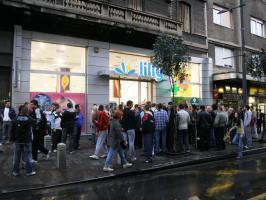
Dominant principles of establishment, when it comes to public space in our environment, represent the space mostly scheduled for specific gender only. Starting with separated public toilet premises to betting places, large beauty shops and saloons? Entering post socialistic era and losing of formed national identity have brought comeback of traditional values of patriarchal system in which all relationships are placed in special hierarchy. That state is additionally enhanced by arrival of large corporate systems (capitalism) which logic of permanent market expansion erased this hierarchy to some extent but contributed its additional alienation. Lilly Project represents an action in which at one point 200 man performed unannounced guerilla invasion into the largest beauty shop in Belgrade- Lilly. This literal and not metaphoric performance of ?patriarchal?, ?male? behavior- which is based on assumption that He has the right to occupy any space or person by all means, with or without permission (standpoint that is mostly unique to individuals raised as man)- exists as an example of pure form of protest by which the distance that suspends normal, utilitarian and social process is marked. On the other hand, the fact that performers of the action agreed to participate in project on condition to be paid - carrying out of particular behavior that in our surrounding can be seen as sexually ?wrong?- indicates exclusively material determination of acceptable behavior limits and mechanism to determine some of the most vital human identity aspects (such as sexual) in capitalistic society. Author
CV: 2001-2006 Faculty of Fine Arts, Novi Sad, Serbia. 2007-2008 Interdisciplinary Master Studies ? Theory of Art and Media, University of Arts in Belgrade, Serbia. SELECTED GROUP EXHIBITIONS/PROJECT: 2008 THE LAND OF HUMAN RIGHTS, Rotor, Contemporary Art Association, Grac, Austria. 49. OCTOBER SALON (curated by Bojana Pejić), Museum of 25.May, Belgrade, Serbia. 13. BIENNIAL OF CONTEMPORARY ARTS, Pančevo, Serbia. POLITICS OF CONTEMPORARY ARTS (curated by Stefano Romano), Stacion Center for Contemporary Art, Prishtina, Republic of Kosova. AKTO_3 FESTIVAL FOR CONTEMPORARY ARTS, Bitola, FY Republic of Macedonia. INTRUDE: ART & LIFE 366 (curated by Shen Qibin), Zendai Museum of Modern Art, Shanghai, China. 13. BIENNIAL PUGLIA 2008, Puglia, Italy. CONTROL AND RESISTANCE ON THE STREET (curated by Marko Miletić and Srđan Prodanović), Kontext gallery, Belgrade, Serbia. RECAPITULATION ... (curated by Susana Vuksanović), Museum of Contemporary Arts, Novi Sad, Serbia. K - R ART SHOW, Kelly Reedy Art Studio, Singapore, Singapore. 2007 PARALAX, Festival of New Visual Tendencies- Film/Video/New Media Art (curated by Maja Cirić), Dom omladine, Belgrade, Serbia. DIFFERENCE, Galleria d`arte Cortina, Rome, Italy. MEDIA ART BIENNIIAL OCTOPUS (curated by Biba Vicković), Belgrade, Serbia. MANGELOS ? Young Visual Artist Award, finalist exhibition, Kontext gallery, Belgrade, Serbia. RE_SET: (02) (curated by Jelena Radić), Contemporary Art Gallery, Pančevo, Serbia. LILYHIP-BODY & CONSUMPTION, (curated by Sanja Kojić-Mladenov), Museum of Contemporary Art, Novi Sad, Serbia. 2006 TRE_BA, Mazhaus Mestna Galeria, Pilsen, Czech Republic. www.EGOart.sk/ web exhibition. PERSPEKTIVE V, Art klinika gallery, Novi Sad/ Remont gallery, Belgrade/Museum of Srem, Sremska Mitrovica, Serbia. KEF, Festival of Short Electronic Forms, Cultural centre REX, Belgrade, Serbia. STREET ART, Art klinika gallery, Novi Sad, Serbia. SARTFEST-Student Art Festival, Museum of Contemporary Art, Novi Sad, Serbia. RE_SET:(01) (curated by Jelena Radić), Context gallery/DEZ.org, Belgrade, Serbia. OUTSIDE PROJECT, La Corte, Galleria di Arte Contemporanea, Florence, Italy. 02-2006, Art Academy, Matica srpska gallery, Novi Sad, Serbia. CITY-ARTISTIC STAGE, free and alternative spaces (curated by Svetlana Mladenov), Novi Sad, Serbia N.A.F.06, Serbia gallery, Ni? / Belgrade, Serbia. APRIL MEETINGS ? AS 06 / Video modules, SKC gallery, Belgrade, Serbia. 34. NOVI SAD?S SALON, Vojvodina bank gallery, Novi Sad, Serbia. 2005 VIDEOMEDEJA 05, International video festival, Museum of Contemporary Art, Novi Sad, Serbia. YOUTH PHOTO, Ljubljana, Slovenia. 2004 RP ? Real presense 04 (curated by Biljana Tomić i Dobrila Denegri), Museum 25th May, Belgrade, Serbia. SOLO SETS/EXHIBITIONS: 2008 TEMPO PROJECT, performance, Srbija. WILD BEAUTY MODELS, digital print project, Most gallery, Podgorica, Montenegro. 2007 LILLY PROJECT, performance, Mangelos Art Award Finalists, Belgrade, Serbia. HARMONY, mixmedia project, Novi Sad, Serbia. SENTIMENTAL ACTION, photography exhibition, SKC gallery, Kragujevac, Serbia. 2006 BEAUTIFUL DEATH /with A.Fafulić/, performance, Multimedia centre Led Art/Art klinika gallery, Novi Sad, Serbia. PERFECT LOVER, performance, SACI ? Studio Art Centre International, Florence, Italy. RED, performance, Red Square, Moscow, Russia. VIDEO-PERFORMANCES 2005/06, Art klinika gallery, Novi Sad, Serbia. 2005 BODY III, photography exhibition (with R. Koler and S. Junačkov), Ankh gallery, Novi Sad, Serbia. VIEW, performance-installation/site-specific, Central Square, Novi Sad, Serbia. PHOTOGRAPHIES 2005, photography exhibition, gallery BUNKER, SKC gallery, Novi Sad, Serbia. BODY II, photography exhibition (with R. Koler and S. Junačkov), Faculty Of Humanitas ? Central Area, Pesc, Hungary. BODY I, photography exhibition (with R. Koler and S. Junačkov), SKC gallery, Belgrade, Serbia. AWARDS: 2007 Mangelos ? Young Visual Artist Award, the best young artist in Serbia, finalist. 2006 Eurobank EFG Award for exceptional achievements, Belgrade, Serbia. Little Prince, Annual prize for exceptional art Achievements Art Academy and Foundation Little Prince (Italy), Fine Art Academy, Novi Sad, Serbia. Perspective V ? Prize for sculpting, Multimedia center Led Art, Novi Sad, Serbia. Annual Art Academy prize for sculpting, Novi Sad, Serbia. 2004 Annual prize for drawing in second year of study at Art Academy, Novi Sad, Serbia. 2002 Francophone Society Award (II),Trebinje/Banja Luka, Bosnia & Herzegovina. Art Academy Award for graphics, Trebinje, Bosnia & Herzegovina.
Sejma Prodanovic
Catalogue : 2011Masks | Video | dv | color | 0:40 | Serbia | 2010

Sejma Prodanovic
Masks
Video | dv | color | 0:40 | Serbia | 2010
Work is made by photo-montage and digital manipulation of images and quotations from numerous sources and formally reminds to an old newspaper. Modernistic representations of myths and utopias are here converted into a present context. Layered meanings shape a nonlinear narrative, reflecting upon popular culture, consumerism and globalization.
Graduated in painting at Academy of Fine Arts in Belgrade in 2004.
Theo Prodromidis
Catalogue : 2015Towards the Bank of the Future | Experimental fiction | hdv | color | 7:38 | Greece | 2013
Theo Prodromidis
Towards the Bank of the Future
Experimental fiction | hdv | color | 7:38 | Greece | 2013
"Towards the Bank of the Future" observes and engages with two conceptual axes. The first axis derives from the analysis of Aristotle in the Nicomachean Ethics, where Aristotle presents the problematic of a definition of the "work of man". In the same way that Aristotle sets the work of man in motion, this form of a life that is activated by the operation of Logos, Cavafys repositions life, or a form of life at least, in the sphere of History, a history of action, an action beyond a simple livelihood (ζῆν). At this exact point, the work focuses on the second axis, on the concept of historicity, thus the specific position and use of History in the work of Cavafys. The poet frequently narrates in his works, of a man who is historically located either in the classical or the modern times.The above element is the one that transforms the work of Cavafys to a significant moment of modernity in poetry. The displaced historicity of the form, where the atemporal collides with the historical.
Theo Prodromidis born in Thessaloniki in 1979, lives and works in Athens, Greece. He studied Contemporary Media Practice at the University of Westminster and was awarded an MFA in Fine Art at Goldsmiths in 2007, in London, UK. His work has been exhibited in galleries, museums and institutions such as the 4h Athens Biennale, Athens, Greece, ReMap, Athens, Greece, Athens & Epidaurus Festival, Athens, Greece, Kunsthalle Athena, Athens, Greece, Ileana Tounta Art Centre, Athens, Greece, Werkleitz zentrum für medienkunst, Halle, Germany, Contour Mechelen, Brussels, Belgium, State Museum of Contemporary Art, Thessaloniki, Greece, Tramway, Glascow, Scotland, Centre Pompidou, Paris, France, Fondazione Merz, Torino, Italy, the 1st Thessaloniki Biennale, Thessaloniki, Greece, Museum of Cinema, Thessaloniki, Greece, Macedonian Museum of Contemporary Art, Thessaloniki, Greece i.a. He has been awarded with European Media Artists Award (EMARE), 2008 and Onassis Foundation Award, 2006. His work is in public and private collections in Greece, UK and Italy.
Theo Prodromidis
Catalogue : 2016Towards the production of Dialogues On The Market Of Bronze and Other Precious Materials | Experimental fiction | 0 | color | 16:0 | Greece | 2013
Theo Prodromidis
Towards the production of Dialogues On The Market Of Bronze and Other Precious Materials
Experimental fiction | 0 | color | 16:0 | Greece | 2013
The video installation “Towards the production of Dialogues On The Market Of Bronze and Other Precious Materials” has as a starting point of reference Bertolt Brecht’s The Messingkauf Dialogues, a theoretical work in a dialectical form that dates back to 1939 and was written in four different versions in a period of four years but remained incomplete. The work situates a reinterpreted version of Brecht’s work, connected to the socio-economic circumstances regarding contemporary society and the implications that these may cause, in the structures of a monetary policy, and its reverberations in the cultural sphere. Based on Brecht’s four nights’ structure the artist aims to provoke correlations regarding two structures, the structure of politics and the structure of finance using their architectural form and specificities as a visual starting point. The work motivates the viewer to contemplate all the above elements in a manner that the aesthetic experience of viewing it produces a platform for the critical engagement of the spectator with the socio-political signifiers that are presented. Theo Prodromidis’s video installation has a specific social context, to collective and private experiences as a consequence of politico-economic and political-cultural locations that are densified in a narrativized, critical and poetic process. Katerina Nikou, co-curator of AGORA text for the guidebook of AGORA, 4th Athens Biennale, Greece
Theo Prodromidis born in Thessaloniki in 1979, lives and works in Athens, Greece. He studied Contemporary Media Practice at the University of Westminster and was awarded an MFA in Fine Art at Goldsmiths in 2007, in London, UK. His work has been exhibited in galleries, museums and festivals such as Stavros Niarchos Foundation Cultural Centre, 5th Thessaloniki Biennale, 4th Athens Biennale, Athens & Epidaurus Festival, Kunsthalle Athena, Ileana Tounta Art Centre, Werkleitz zentrum für medienkunst, Contour Mechelen, State Museum of Contemporary Art, Tramway, Glascow, Centre Pompidou, Fondazione Merz, Museum of Cinema, Thessaloniki, Macedonian Museum of Contemporary Art i.a. He has been awarded with European Media Artists Award (EMARE), 2008 and Onassis Foundation Award, 2006.
Theo Prodromidis
Catalogue : 2008SERENADE TO SPECTACLE | Experimental fiction | 16mm | | 6:15 | United Kingdom | 2006
Theo Prodromidis
SERENADE TO SPECTACLE
Experimental fiction | 16mm | | 6:15 | United Kingdom | 2006
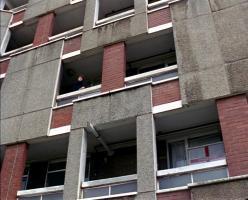
Serenade to Spectacle is a documentation, shot on 16mm film, of a performance of three members of Vincent Vincent and the Villains and the lead singer of A Human to Gemma Arterton, shot on location at the George Loveless House in East London on the 1st of June 2006. The main elements of the film, thus the architectural space of the event and its location, and the performers and their actions are observed through a structural methodolodgy. This structure, both in terms of duration and representation, allows the introduction of this narrative act into the sociohistorical space of the building. The investment in upsetting the normal operations of this building by a set of emerging musicians and an actress through the romantic act of the serenade doesn?t only confine in a disruption of the everyday aesthetic experience of this typical early 60?s social housing block of flats, by introducing an action bound with Mediterranean traditions and mythical love stories in hostile social situations. The name of the building stands as a monument to George Loveless, a historical figure from the tradition of British trade unionism, similarly the choice of the bands and the actress refer to popular music and cinematic moments of the 60?s bound to revolutionary moments in both fields.
Theo Prodromidis was born in Thessaloniki, Greece in 1979. Studied Media Art at the University of Westminster and was awarded an MFA in Fine Art at Goldsmiths in 2007, in London, UK, where he lives and works. He has been a guest lecturer in Art at various institutions in the UK and since 2004 at the University College for the Creative Arts and has been awarded the Onassis Foundation award. He has recently participated in group exhibitions such as Heterotopias, 1st Thessaloniki Biennale of Contemporary Art, curated by Jan-Erik Lundstrom, Catherine David and Maria Tsantsanoglou, State Museum of Contemporary Art, Thessaloniki, Greece, (2007) National Review for the Live Arts ,Tramway, Glascow, Scotland (2007) We`ve lost the hearts and minds..., E:vent Gallery, London, UK (2006), Strange Screen IV, Museum of Cinema, Thessaloniki, Greece (2006), Images of Violence, Violence of Images, The Young Artists? Biennale, Bucharest, Romania (2004), Experiments in Moving Image: A retrospective of works from the 60?s to now, The Old Lumiere Cinema, London, UK, (2004), amongst others.
Sergei Prokofiev
Catalogue : 2023Fireworks on the Swamp | Video | 0 | color | 6:40 | Russia | 2020
Sergei Prokofiev
Fireworks on the Swamp
Video | 0 | color | 6:40 | Russia | 2020
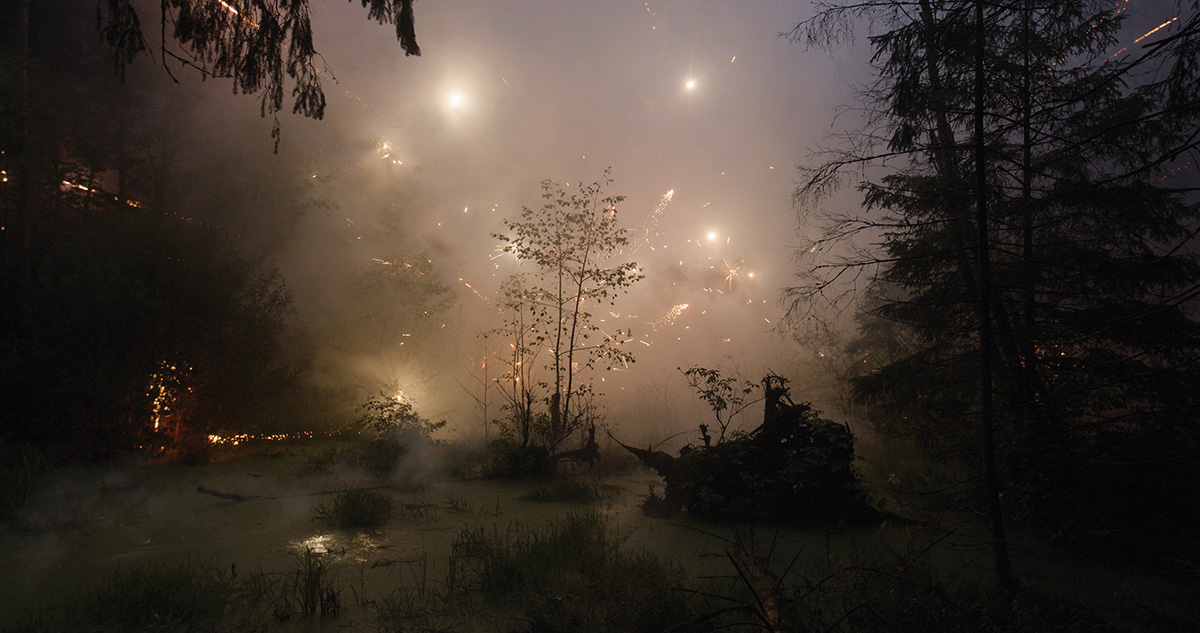
- Why do you want to blow fireworks on a swamp? - Well, I want it to happen in reality. There was fireworks on the swamp, that's for sure. The intensity of what is happening is so high that the consciousness does not have time to deconstruct the image of this event. Once the smoke dissipates, we can talk about interpretation field. But this is not so important, because it consists only of versions of reality and their totality does not give us a complete picture. It is important to live directly in the experience, where absolute reality can be revealed.
Born in 1983 in Moscow, Russia. Lives and works in Paris, France. In 2011 he graduated from the School of Contemporary Art "Free Workshops'' at MMOMA, Moscow. From 2011 to 2016, he co-founded and participated in the non-profit contemporary art site «It is not here», Moscow. In 2013 he won a competition to create a light installation "New Media Night" in Nikola-Lenivec, Russia. In 2013 he graduated from the Institute of Contemporary Art (ICA), Moscow. In 2014 he became a finalist in the international competition "Center - Periphery", Italy. From 2016 to 2020, he was a member of the Elektrozavod gallery team, Moscow. In 2021, he received the Second prize of “Zverev Art Prize”, Moscow. In 2022 he received the Charlottenborg Spring Exhibition Solo Award, Denmark. In mid-2022 he became an artist in exile because of his stance against Russia's full-scale military invasion of Ukraine. He is a participant and curator of exhibitions in Russia, Italy, Austria, Sweden, Hungary, Poland, Norway and Denmark. His current work includes graphics, sculpture, installations, performance and video. The works are in private collections and collections of the Luciano Benetton Foundation (Italy), the Sphere Foundation (Russia), the State Tretyakov Gallery (Russia) and Uppsala Art Museum (Sweden).