Catalogue > List by artist
Browse the entire list of Rencontre Internationales artists since 2004. Use the alphabetical filter to refine your search. update in progress
Michael Bell-smith
Foued Bellali
Catalogue : 2006rue du Nord | Documentary | dv | color | 50:30 | Belgium | 2003
Foued Bellali
rue du Nord
Documentary | dv | color | 50:30 | Belgium | 2003
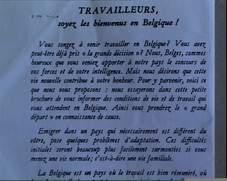
Testimony of immigrants of the first generation: North African men and women in cross sight with a Polish sight and a catholic priest fro Belgium. Life of immigration under personal tale form.
First film by Foued Bellali, Katty de Boeck, Nadia Remy. Filmmaking and editing by Foued Bellali, Katty De Boeck, Nadia Remy. Camera and sound by Yael André, Foued Bellali, Katty De Boeck, Nadia Remy. Production: Vow. 2004 Length: 54 min. Form: miniDV Also available in beta SP and DVD (soon). Subtitle: original version with French subtitle. Text transcription in French available. Subtitle in English available soon (DVD).
Bernard Bellefroid
Catalogue : 2007Rwanda, les collines parlent | Documentary | dv | color | 50:0 | Belgium | 2005
Bernard Bellefroid
Rwanda, les collines parlent
Documentary | dv | color | 50:0 | Belgium | 2005
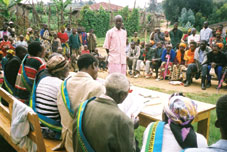
Eleven years after the genocide, the film follows the survivors and torturers before and after the first Gacaca trials during which they find each other face to face. There's Obede, accused of having killed children, and whose request for pardon is simply a cynical release strategy. There's also Gahutu, who has "no remorse" and who, facing his judges, speaks of "snakes" in reference to those being exterminated. And finally, there's François, forced to kill his own brother in order to survive and who is now trying to make it up with his sister-in-law. Through these three stories, the film weaves a portrait of a society at war against the still present ideology of genocide.
Born in Belgium in 1978, Bernard Bellefroid followed two years of undergraduate studies in journalism. In 2003, he graduated from the National Film School of Belgium (INSAS). "Rwanda, the hills are talking" is his first documentary film. At the moment, he is preparing his first feature film "The Regatta", produced by Jean-Pierre and Luc Dardenne and selected by the "Atelier du festival du film de Cannes" 2006.
Luca Bellino
Catalogue : 2006Mate y moneda | Documentary | dv | color | 52:0 | Italy | 2004
Luca Bellino
Mate y moneda
Documentary | dv | color | 52:0 | Italy | 2004
"Between 1870 and 1955 millions of Italians migrated to Argentina. On the 21st of December 2001, Argentina suddenly fell into chaos. Within the context of the 2003 elections, the movie retells the story of migration between these two countries, the story of a shattered dream. Memories and present time yearnings mix, connecting the trip of those who decided to travel back to the path their ancestors took ..."
Piero Messina was born in Sicilia (Caltagirone) in 1981, and is about to complete his thesis in Film and Video studies at the DAMS Roma Tre university (in Arts, music and theater). At age 16, he directed his first short movie which was awarded with the special prize from the Jury at Libere Visione. He successively directed "Ben Adam" and ten comic video clips "Melies e caramelle". In 1999 he produced and directed with Fabio Cillia the amateur full-length movie "Una Vista non basta", which was shown at the Politeama in Caltagirone. After that he made a documentary "Due esempi di sviluppo" and the advertisement spot of AVIS (Italian association of Blood donation). At age 22, he directs "Stidda ca curri", which is rewarded with the best short movie award at the 5Oth Taormina film fest, the "Giglio D'Argento at the 55th Valdarno Festival, the special distinction at Fano's International Festival and Arcipelago Festival (Roma), best image at the 28th International Meeting Henri Langlois and is selected for the 12th biennial of European and Mediterranean young artists (bjcem). Besides, he has under his belt musical creations, soundtracks of his own movies as well as these of Luca Bellino's movie "Mate y moneda" and "Due Sigarette", a short movie produced by the Fandango"Due Sigarette". He is currently preparing a short movie inspired by a poem written by Cesare Pavese.
Remi Belliveau
Catalogue : 2026L'Empremier live at Beaubassin | Experimental doc. | 16mm | color | 62:26 | Canada | 2023
Remi Belliveau
L'Empremier live at Beaubassin
Experimental doc. | 16mm | color | 62:26 | Canada | 2023
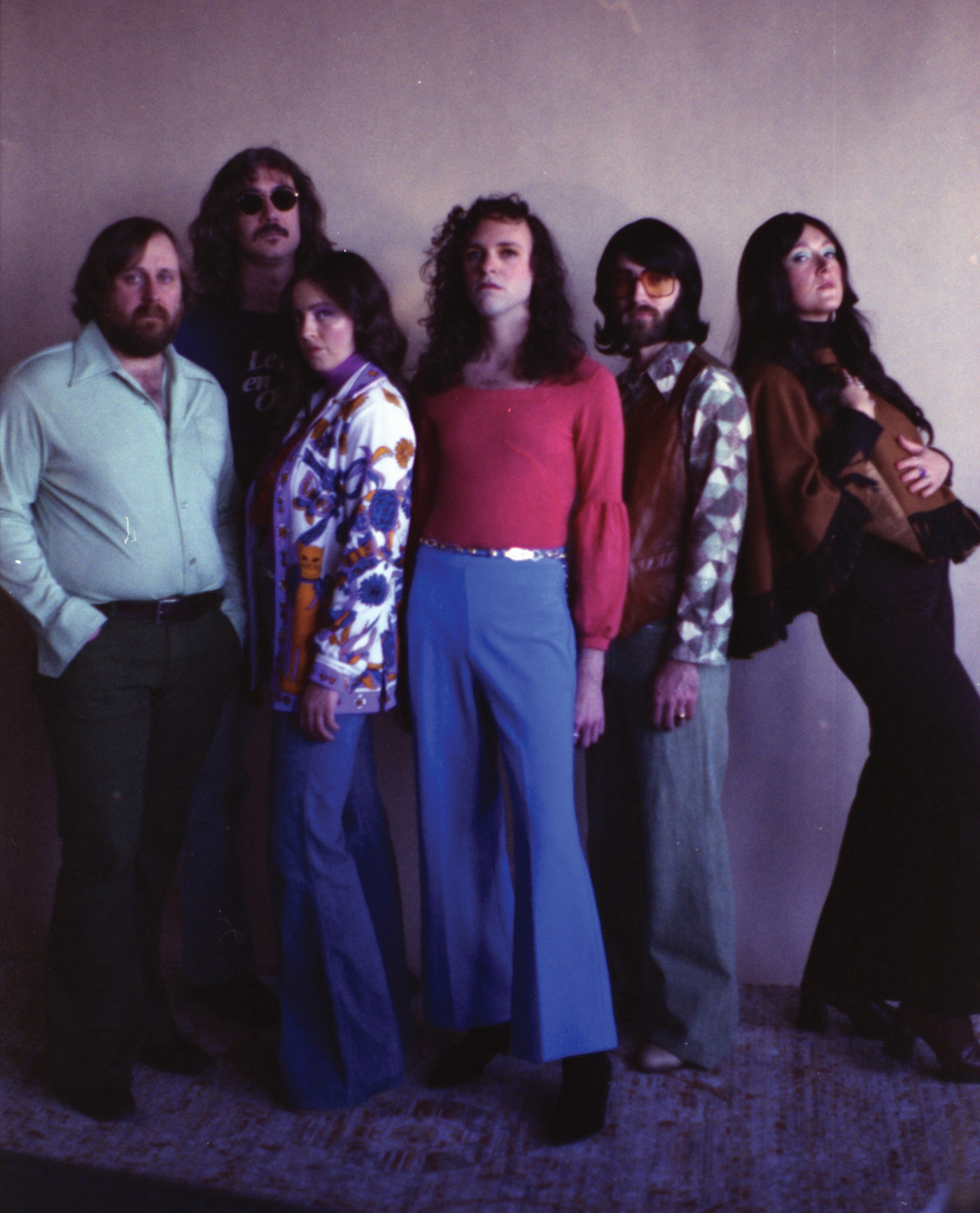
L’Empremier live at Beaubassin (1970) est une œuvre vidéo qui prend la forme d’un long métrage pastiche du film Live at Pompeii (1972, 1974) d’Adrian Maben ou? l’on voit le groupe mythique Pink Floyd jouer dans l’amphithéâtre vide de cette fameuse île détruite par l’éruption volcanique du Mont Vésuve. À Beaubassin, les ruines du Fort Beauséjour – situées a? la frontière entre le Nouveau-Brunswick et la Nouvelle-Écosse – servent d’amphithéâtre dans lequel les esprits du passe? (ceux des ancêtres acadien·ne·s, condamne?·e·s ici, en 1755, a? la déportation et a? des années d’errance) sont convoqués comme spectateur·ice·s fantomatiques. Adoptant le décor de l’e?te? 1970, Live at Beaubassin met en scène un·e chansonnie?r·e acadien·ne fictive – Joan Dularge – alors qu’iel approche la décennie tumultueuse des années 1970, pre?occupe?·e par l’actualité? LGBT[Q2IA+] au lendemain des Stonewall riots (28 juin 1969) et motive?·e par sa condition de personne nouvellement trans-out. Lors de séquences documentaires encore tournées a? l’image de Live at Pompeii (version de 1974), on a l’occasion de voir le processus de création de de Joan et son groupe L’Empremier, alors que ses membres – surtout la chanteuse principale – ont le regard tourne? résolument vers le futur, aux prises avec des enjeux d’actualité : « Jouez-vous de la musique acadienne ? » « Est-ce que la langue est un enjeu avec votre producteur anglophone ? » « Est-ce que l'acadiennete? est une forme de queerness ? »
Rémi Belliveau est un·e artiste, musicien·ne et auteurice interdisciplinaire acadien·ne originaire de Belliveau-Village (vallée de Memramcook, Nouveau-Brunswick), un hameau acadien situé sur Mi’kma’ki, le territoire ancestral non cédé du peuple Mi’kmaq. Son travail artistique s’attache à déconstruire et reprogrammer les fondements, les structures et les imaginaires de la culture acadienne à laquelle iel appartient dans le but de cultiver des capacités d’(auto)analyse et de sens critique, notamment en ce qui concerne la relation entre acadienneté et transitude. Récemment, iel a été deux fois en lice au Prix Sobey pour les arts (finaliste Atlantique en 2021, liste préliminaire Atlantique en 2024), lauréat·e du Prix Claudine et Stephen Bronfman (2022), lauréat·e du programme MOMENTA X RBC (2023), lauréat·e des Ateliers Montréalais de la Fonderie Darling (2023-2026), lauréat·e de la bourse Periculum pour le discours sur l’art (2024) et finaliste au Prix en art actuel du Musée national des beaux-arts du Québec (2025) où iel a gagné prix du public.
Neil Beloufa
Catalogue : 2008Kempinski | Experimental video | dv | color | 15:0 | France, Mali | 2007
Neil Beloufa
Kempinski
Experimental video | dv | color | 15:0 | France, Mali | 2007
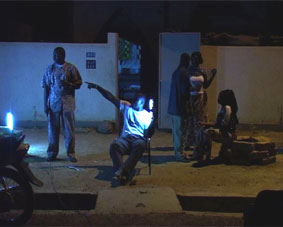
Welcome to Kempinski, The people of this mystical and animist place introduce it to us. "Today we have a space station. We will soon launch space ships and a few satellites that will allow us to have much more informations about the other stations and other stars. " The video has no script and the screenplay is caused by a specific game rule.
Neil Beloufa was born on 1985 in Paris. He is student in the Beaux-Arts and in the Art Decoratifs of Paris. He is in scholar exchange in Cooper Union in New York. In 2008 he ll be in CalArts in Los Angeles.
Neil Beloufa
Catalogue : 2015TONIGHT AND THE PEOPLE | Experimental fiction | hdv | color | 81:0 | France, USA | 2013
Neil Beloufa
TONIGHT AND THE PEOPLE
Experimental fiction | hdv | color | 81:0 | France, USA | 2013
In a wannabe Hollywood-like scenery, cowboys, gang-members, activists, hippies and rebel-teenagers craft a philosophical tale that recycles the strongest stereotypes of our time. In this world where documentary and Sci-Fi collide, class warfare meets extra- terrestrial invasion.
Neil Beloufa (1985, Paris) studied at the Ecole Nationale Supérieure des Beaux- Arts (ENSBA) and the Ecole Nationale Supérieure des Arts Décoratifs (ENSAD) in Paris, and in Le Fresnoy - National Studio for Contemporary Arts. He received several awards, notably the Prix Videoforme of Clermont Ferrand 2009, the Grand Prix IndieLisboa 2009, the Arte Award for a European Short the Jury Price at the Oberhausen Film Festival in 2011. His work was shown in many solo exhibitions in Frankfurt, Los Angeles, Paris and New York, and selected for numerous group exhibitions and projects since 2007. His films were screened in international festivals for video and documentary. In 2012, he was awarded the Audi Talent Awards for his feature-film project TONIGHT AND THE PEOPLE, which premiered at FID Marseille in 2013. That same year, he was awarded the prix Meurice for his next film project. He lives in Paris.
Louidgi Beltrame
Catalogue : 2018El Brujo | Experimental film | 4k | color | 17:29 | France, Peru | 2016
Louidgi Beltrame
El Brujo
Experimental film | 4k | color | 17:29 | France, Peru | 2016
El Brujo, which means "The Sorcerer" in Spanish, is also the name of a Mochica archeological site. It is on this Peruvian beach that Louidgi Beltrame shot a part of his movie. The curandero (shaman) José Levis Picón Saguma is performing a re-enactment of François Truffaut’s 400 blows (1959) last sequence. In that sequence, the young hero, Antoine Doinel, interpreted at the time by iconic ?nouvelle-vague? actor Jean-Pierre Léaud, is running away in direction of the ocean. Right performing a Mesa - a psycho-active San-Pedro cactus related traditional healing ceremony - José Levis Picón Saguma is taking care of the vacant space left into the cinematographic apparatus by the actor whom was sick at the time of the shooting and thus was forced to remain in France. Feeling better soon after this magical operation, Jean-Pierre Léaud has been shot drifting through the streets of Paris, following a trajectory which is superimposing his memories from the 400 blows original shooting with his own "Nouvelle-Vague" subjective history. Through these transpositions, Beltrame orchestrates a series of shifts, with a migration of characters, patterns and eras. The geometric lines of the pyramids and excavations of the Peruvian landscape are echoed in the structure of the film?s editing, with tracking and panoramic shots, and are highlighted by the synthetic modular music of the track Triangle (1979) by Jacno.
Louidgi Beltrame was born in 1971 in Marseille and now lives in Paris. He studied at the Ecole supérieur d’art et de design Marseille-Mediterranée, the Fresnoy - Studio national des arts contemporains, and la Villa Arson in Nice. Beltrame is a growing artist in the contemporary art scene and has won the SAM prize for contemporary art in 2014. His work is based on documenting modes of human organization throughout the history of the 20th century. He travels to sites defined by a paradigmatic relation to modernity: Hiroshima, Rio de Janeiro, Brasilia, Chandigarh, Tchernobyl or the mining colony of Gunkanjima, over the sea off Nagasaki. His films - based on the recording of reality and the constitution of an archive - appeal to fiction as a possible way to consider History. The artist has exhibited in many places, namely at the Palais de tokyo (2006/2016), the Centre d’Art Contemporain de Chelles (2010), The Musée d’Art moderne et contemporain, Strasbourg (2008), the Pinchuk Art Center, Kiev (2007), l’Atelier de Jeu de Paume, Paris (2006), the Musée d’art conemporain de Val-de-Marne, France (2005), the Centre Georges Pompidou, Paris (2005).
Catalogue : 2015the walking tree | Experimental doc. | 16mm | color | 35:0 | France | 2014
Louidgi Beltrame
the walking tree
Experimental doc. | 16mm | color | 35:0 | France | 2014
Louidgi Beltrame films in 16 mm a large banyan tree in the botanical gardens in Calcutta. This tree, whose distinctive feature is the way it spreads rhizome-like over several hundred yards, is approached like a forest of clones, a metaphysical space where histories re-surface: the history of the invention and parallel development of photography and telegraphy in the context of colonized India, Linnaeus’ dream according to Foucault, reminiscences of the films of Ritwik Ghatak and Satyajit Ray, where reality and fiction met.
Catalogue : 2011gunkanjima | Experimental doc. | dv | color | 33:0 | France | 2010
Louidgi Beltrame
gunkanjima
Experimental doc. | dv | color | 33:0 | France | 2010
Située au large de Nagasaki au Japon, l?île de Gunkanjima est une colonie minière abandonnée depuis 1974. Objet d?une expérimentation urbaine verticale, extrême, et non planifiée, l?île rassemble aujourd?hui les vestiges archéologiques de l?architecture moderne japonaise. Ces formes vides, filmées comme des sculptures monumentales, sont néanmoins habitées par des histoires stratifiées - celles des conditions de production, des idéologies qui ont motivé ces chantiers et des hommes qui les ont bâti et exploités.
Louidgi Beltrame est un artiste français. Né à Marseille, il vit et travaille actuellement à Paris. Son travail se développe autour de la déconstruction des structures narratives et formelles du cinéma, considéré comme un médium avec sa syntaxe spécifique, mais également comme une force politique qui a influencé les développements du siècle passé, et qui constitue également une documentation de l?architecture moderniste et de ses vestiges. Le travail de Louidgi Beltrame est exposé dans des galeries, des musées et présenté dans des festivals de cinéma en France et à l?étranger, notamment au Musée d?Art Moderne et Contemporain de Strasbourg ; à Paris au Musée du Jeu de Paume, à la Fondation Ricard, au Palais de Tokyo, au centre d?art Le Plateau, au Centre Georges Pompidou. Ses films ont été diffusés au FID Marseille (festival international du documentaire), au festival international du film de Rotterdam, au festival du film de Locarno, à la Fondation Funarte de Rio de Janeiro, à LOOP, Barcelone ; au Japon à la Echigo Tsumari Art Triennal, à Niagata et à l?Hiroshima Art Document.
Catalogue : 2009Brasilia/Chandigarh | Experimental doc. | dv | color | 27:0 | France | 2008
Louidgi Beltrame
Brasilia/Chandigarh
Experimental doc. | dv | color | 27:0 | France | 2008
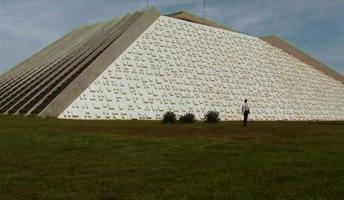
Two architects hoped to build the ideal city: Oscar Niemeyer created Brasilia in the middle of the Brazilian mato (savanna); Corbusier went to India to build Chandigarh. Both cities raise above the landscape, like two futuristic memoranda of concrete, monuments to their builders, those rare inhabitants who are given to us. The film is bases on the respective geometrics of Brasilia and Chandigarh, while the dialogue takes place between the two cities.
Louidgi Beltrame, screen writer and artist, was born in Marseille in 1971. He presented his work at the Workshop of the Play of Palm, the Palais de Tokyo and the Museum Andre Malraux in Le Havre as well as the Festival of Film of Locarno and the International Documentary Festival of Marseille.
Marcel Beltrán, Marcel Beltrán
Catalogue : 2022La opción cero | Experimental doc. | 4k | color | 80:0 | Cuba | 2020
Marcel BeltrÁn, Marcel Beltrán
La opción cero
Experimental doc. | 4k | color | 80:0 | Cuba | 2020
A group of Cuban migrants use their mobile phones to record and transmit through social networks intimate moments of their passage through the jungle, gathering more than 100 hours of experiences. Immobilized in a makeshift camp by Cáritas in Panama City, the difficult passage through the Darien Jungle comes to life on their devices. In this migratory limbo, Cuban director Marcel Beltrán films the passing of the hours in the camp and gains access to this shocking archive.
Marcel Beltrán (b. 1985, Moa, Cuba) is a film director and producer currently living and working in São Paulo, Brazil. He is the founder of Mediocielo Films, a consultant for international development projects and a facilitator of sustainability practices within the arts, exploring environmentally and ecologically-focused issues. Beltrán’s work combines image degradation, memory and life experience creating a dialogue between the poetic and political / the intimate and public. Marcel has wrote, directed and produced “La música de las esferas” (2018) premiere at 35 MIFF and "La opción cero" (2020), a feature documentary with world premiere at IDFA, Hot Docs and DOC NYC, receiving, among other awards, Best International Feature Film at Miradasdoc (Spain), FIDBA (Argentina). His previous films were selected in film festivals around the world, such as MoMA Documentary Fortnight (New York), Busan International Short Film Festival, Documenta Madrid, DOK Leipzig, AmDocs (Palm Springs), Malaga, Biarritz, SANFIC (Santiago de Chile), Festival Latino (São Paulo), BIFF (Bogota), Havana Festival, among others.
Amber Bemak, Minax, Madsen
Catalogue : 2021Two Sons and a River of Blood | Experimental film | mov | color | 10:23 | USA, Mexico | 2020
Amber Bemak, Minax, Madsen
Two Sons and a River of Blood
Experimental film | mov | color | 10:23 | USA, Mexico | 2020
A queer woman is pregnant. The self-made family unit of two dykes and a trans man imagine a kind of erotic magic that will allow for procreation based solely on desire. Together they enact a public sex ritual to symbolize their hopefulness for multiplicity, acknowledging their cyborg bodies as technological interventions. When the queer woman miscarries her child, the three begin to build their own mythic understanding of where bodies live when they are not inside us. They create a story to trace movement of the non-body, from a hole, to a river, to a room. Images of an imaginary white room, an ikea-esque torture chamber of stillness, haunt them. As a parallel emerges between the pregnant body and the trans body, the techno-sex act becomes the key and a pyramid becomes the portal to access this other world of non-bodied existence.
Minax works in documentary and hybrid filmmaking formats. Madsen is a recipient of the Samuel Edes Prize for Emerging Artists (2017), the Tribeca Film Institute's All-Access Fellowship (2019), the Sundance Institute's Documentary Production Fund (2019), and the Bay Area Video Coalition’s Media-maker Fellowship (2020). Bemak is a filmmaker, artist, and educator. Her work is based in experimental and documentary film. Her award-winning work has been shown at venues including the Brooklyn Museum’s Elizabeth A. Sackler Center for Feminist Art, Museo Tamayo, and SculptureCenter, as well as Oberhausen, DocLisboa, Ann Arbor, Morelia, and the European Media Art Festival.
Catalogue : 2018Borderhole | Video | hdv | color | 14:0 | USA, Mexico | 2017
Amber Bemak, Amber Bemak, Nadia Granados
Borderhole
Video | hdv | color | 14:0 | USA, Mexico | 2017
Borderhole takes place on a mythical border area between Colombia and the United States. We investigate the relationship between North and South America through the lens of the American Dream and the illumination of multiple tensions in and around the border. The piece explores imperialism, globalization through pop music, gender mutation in an international context, and the choreography of women’s bodies in relation to sociopolitical and ecosystems.
Nadia Granados is originally from Bogotá, and currently based in Mexico City. Her work explores the relationships between traditional pornography and violence and is both performative and technological, art and activism, and a mix of cabaret, intervention, and streaming video. In all of her work, she uses her body to detonate, opening up new pathways of action and shift consciences. Among the many awards she has received are the Franklin Furnace Fund, the 3rd Visual Arts Biennial Bogotá Prize, and the FONCA award for Colombia-Mexico artist residencies. Her work has been presented extensively and internationally. Amber Bemak teaches filmmaking at Southern Methodist University in Dallas, Texas, and her creative work is based in experimental and documentary film, as well as performance art. Amber’s work focuses on themes of Buddhist culture, performative explorations of the body in relation to greater political systems, and cross-cultural encounters in the context of globalization. Her feature and short films have played in numerous festivals internationally, and have been seen at venues including the Brooklyn Museum’s Elizabeth A. Sackler Center for Feminist Art, SculptureCenter, and Oberhausen Film Festival. She has taught film theory and practice in India, Nepal, Kenya, Mexico, and the United States.
Amber Bemak, Amber Bemak, Nadia Granados
Catalogue : 2021Two Sons and a River of Blood | Experimental film | mov | color | 10:23 | USA, Mexico | 2020
Amber Bemak, Minax, Madsen
Two Sons and a River of Blood
Experimental film | mov | color | 10:23 | USA, Mexico | 2020
A queer woman is pregnant. The self-made family unit of two dykes and a trans man imagine a kind of erotic magic that will allow for procreation based solely on desire. Together they enact a public sex ritual to symbolize their hopefulness for multiplicity, acknowledging their cyborg bodies as technological interventions. When the queer woman miscarries her child, the three begin to build their own mythic understanding of where bodies live when they are not inside us. They create a story to trace movement of the non-body, from a hole, to a river, to a room. Images of an imaginary white room, an ikea-esque torture chamber of stillness, haunt them. As a parallel emerges between the pregnant body and the trans body, the techno-sex act becomes the key and a pyramid becomes the portal to access this other world of non-bodied existence.
Minax works in documentary and hybrid filmmaking formats. Madsen is a recipient of the Samuel Edes Prize for Emerging Artists (2017), the Tribeca Film Institute's All-Access Fellowship (2019), the Sundance Institute's Documentary Production Fund (2019), and the Bay Area Video Coalition’s Media-maker Fellowship (2020). Bemak is a filmmaker, artist, and educator. Her work is based in experimental and documentary film. Her award-winning work has been shown at venues including the Brooklyn Museum’s Elizabeth A. Sackler Center for Feminist Art, Museo Tamayo, and SculptureCenter, as well as Oberhausen, DocLisboa, Ann Arbor, Morelia, and the European Media Art Festival.
Catalogue : 2018Borderhole | Video | hdv | color | 14:0 | USA, Mexico | 2017
Amber Bemak, Amber Bemak, Nadia Granados
Borderhole
Video | hdv | color | 14:0 | USA, Mexico | 2017
Borderhole takes place on a mythical border area between Colombia and the United States. We investigate the relationship between North and South America through the lens of the American Dream and the illumination of multiple tensions in and around the border. The piece explores imperialism, globalization through pop music, gender mutation in an international context, and the choreography of women’s bodies in relation to sociopolitical and ecosystems.
Nadia Granados is originally from Bogotá, and currently based in Mexico City. Her work explores the relationships between traditional pornography and violence and is both performative and technological, art and activism, and a mix of cabaret, intervention, and streaming video. In all of her work, she uses her body to detonate, opening up new pathways of action and shift consciences. Among the many awards she has received are the Franklin Furnace Fund, the 3rd Visual Arts Biennial Bogotá Prize, and the FONCA award for Colombia-Mexico artist residencies. Her work has been presented extensively and internationally. Amber Bemak teaches filmmaking at Southern Methodist University in Dallas, Texas, and her creative work is based in experimental and documentary film, as well as performance art. Amber’s work focuses on themes of Buddhist culture, performative explorations of the body in relation to greater political systems, and cross-cultural encounters in the context of globalization. Her feature and short films have played in numerous festivals internationally, and have been seen at venues including the Brooklyn Museum’s Elizabeth A. Sackler Center for Feminist Art, SculptureCenter, and Oberhausen Film Festival. She has taught film theory and practice in India, Nepal, Kenya, Mexico, and the United States.
Jonathan Ben Efrat, Jonathan Ben Efart
Catalogue : 2009Shesh Komot Le'Gehenom | Documentary | betaSP | color | 52:0 | Israel | 2008
Jonathan Ben Efrat, Jonathan Ben Efart
Shesh Komot Le'Gehenom
Documentary | betaSP | color | 52:0 | Israel | 2008
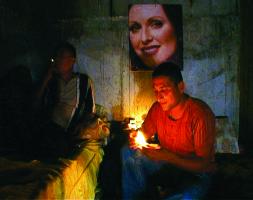
Geha Junction, one of the busiest in the Tel Aviv area, hundreds of Palestinians live underground. Young and old, they slip into Israel to find work and bring a small wage home. Their hiding place is in the underground parking garage of an abandoned, unfinished shopping mall, hidden from view despite its location. They pass most nights of the week here, six floors below ground. One of the mall``s residents is Jalal who puts up with this hell in order to save money for his wedding while Nisrin, his fiancé, is waiting for him to finish the roof of their new house at Salem in the West Bank. From the darkness emerge still darker forms and ghostly voices. Under subhuman conditions, the men try to preserve their humanity. "In the dark", says Jalal, "the only thing left is to think about is love".
2008: script and directed, Six floors to hell (52min) full length film about "The Mall". won the best editing award at the Docaviv international FF 2008. won the RAI3 award at the CMCA Prize Turin Italy 2008. Leipzig FF 2008. Doclisboa FF 2008 Med FF Rome 2008 2005: script and directed, "The Mall" (12min) a short documentary commissioned by the World Health Organization; it shows the living conditions of Palestinian workers who defy checkpoints and roadblocks in order to find jobs in Israel. Israel?s documentary channel (Channel YES DOCO) Festivals: cinema du reel (Paris 07) Rotterdam (07) documenta (Madrid 07) Oxdox (Oxford 07) Doclisboa (Lisbon 07) won special MENTION for best short documentary 2003: wrote and directed,"Breaking Walls" (50min) documentary; it studies the connection between art and labor rights. At El Festival de Cine de Granada, ?Breaking Walls? won first prize for Integral Realization. Israel?s documentary channel (Channel 8) Labor film festivals: Sun Francisco Laborfest 2005 Ankara Labor film festival 2006 Seoul Labor film festival 2006 Globale06 film festival Berlin 2006
Yosr Ben Messaoud
Catalogue : 2026Envol | Video | hdv | color | 4:12 | Tunisia, France | 2024
Yosr Ben Messaoud
Envol
Video | hdv | color | 4:12 | Tunisia, France | 2024
In the dim light, the hand emerges like a fragment of presence, suspended between appearance and disappearance. It becomes a sensitive territory, brushed by a silent intimacy, unfolding like an open landscape, a place that welcomes what passes through without ever fully allowing itself to be grasped. The video then becomes a space of slowing down, where the gaze encounters a partial yet inhabited presence, crossed by a world in motion.
Yosr Ben Messaoud is a visual artist working between France and Tunisia. She is currently studying at the École des Beaux-Arts de Paris, after completing a degree in contemporary art and the humanities at the University of Vincennes. Her work includes video, photography, drawing, and installations, as well as hybrid forms that move between these different modes of expression. The variety of operative forms conveys an aesthetics of openness and suspension, where one is called upon to become a bridge, to welcome alterity in order to allow a new form of communion to emerge. In her practice, she examines questions related to the displacement of narratives and their survival, beginning from the intimate, through the creation of dispositifs conceived both as systems of reception, containers of experience, and circuits of narration—structures that become inhabited by what surrounds them. The axes shift incessantly between lived experience and affective facts, collected images and those that persist, the intimate and the collective voice, in order to reflect on the human condition—understood not as humanity at the centre of the world, but as part of its sensitive order, material, and social
Haim Ben Shitrit
Catalogue : 2007No Johny no | Experimental video | dv | color and b&w | 3:36 | Israel | 2006
Haim Ben Shitrit
No Johny no
Experimental video | dv | color and b&w | 3:36 | Israel | 2006
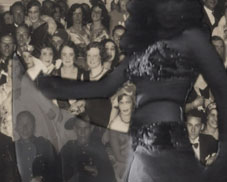
"Anonymous soldiers", the anthem of the "Shtern gang", an anti- British extreme Jewish Underground which operated in the forties, translated to French with spelling mistakes. The text is being recited by a man and a woman, the father and mother of the artist, who are not familiar with the text and who are trying to please their son who has come for a visit. The recitation is interrupted by their corrections of the spelling, by the mother insisting on giving her son something to eat, and other sounds and oriental rhythms. The sound is orchestrated to characters camouflaged by desert landscapes digitally sculpted onto their faces. "no johny no" is a virtual belly dance, with a dreamy French-Arab, for English soldiers from a family photo album.
Born in Jerusalem, Haim Ben Shitrit studied with Christian Boltonsky at the Academy of Fine Arts in Paris. He graduated with distinction from the Bezalel Academy of Art and Design in Jerusalem. Over the years he has been awarded grants from the Manet-Katz Foundation, America-Israel Fund, and the Pollock-Krasner Foundation New York. His video installations and projects have been exhibited in Israel, France, England, Belgium, and Canada. Ben Shitrit is currently the director of the art department at the Israel Arts and Science Academy in Jerusalem.
Younes Ben Slimane
Catalogue : 2026Images de Tunisie | Experimental doc. | mov | color and b&w | 14:39 | Tunisia | 2025

Younes Ben Slimane
Images de Tunisie
Experimental doc. | mov | color and b&w | 14:39 | Tunisia | 2025
Images de Tunisie reclaims and recontextualizes archival footage from 1940s newsreels produced by Les Actualités Françaises, and combines it with new footage filmed at the same vernacular architecture sites in the Berber villages of southern Tunisia. These 1940s black-and-white documentaries were created to serve French propaganda in and about the colonised countries of North Africa, including Tunisia. Ben Slimane explains: ‘The title of the film comes from the ethnographic documentary filmed by Georges Barrois, Images de Tunisie (1946), which interested me because of its ability to create images and shape narratives. I went back to the sites presented in the archive films to reappropriate the scenes from a personal point of view, using a hand-held camera to explore the ruined sites. " The film functions as a counter-ethnography. Navigating between archive documents and personal images, an interaction unfolds. This interaction becomes the keystone of the film, transforming it into a commentary on the evolution of the medium of cinema, illustrating its ability to redefine narratives.
Younès Ben Slimane is a Tunisian visual artist and filmmaker. He graduated in architecture from the National School of Architecture and Urbanism in Tunis before completing postgraduate studies at Le Fresnoy – Studio National des Arts Contemporains (FR). His work has been showcased at the Mucem in Marseille (FR), the Biennale de l’Art Africain Contemporain in Dakar (SN), the Museum of Contemporary Art in Skopje (MK), the Institut du Monde Arabe in Paris (FR), the Beirut Art Center (LB), ETH Zurich – gta exhibitions in Zurich (CH), the Versailles Architecture Biennale in Versailles (FR), the Art Explora Museum Boat, and the Wexner Center for the Arts in Ohio (US), the Zaha Hadid Foundation in London (UK) and the Galeria de Arte Cinemática in Vila do Conde (PT). His films have been selected for international festivals including the Locarno Film Festival (CH),CPH:DOX (DK), Black Star Film Festival (US), DokuFest (XK), EXiS Seoul, (KR) and Prismatic Ground New York (US), among others. He has received numerous awards, including Loop Barcelona Award (2022, ES). His work is part of art collections, including the Museum of Contemporary Art of Barcelona (MACBA) Print and Kadist Paris–San Francisco.
Younès Ben Slimane
Catalogue : 2023We Knew How Beautiful They Were, These Islands | Experimental doc. | hdcam | color | 20:0 | Tunisia, France | 2022
Younès Ben Slimane
We Knew How Beautiful They Were, These Islands
Experimental doc. | hdcam | color | 20:0 | Tunisia, France | 2022
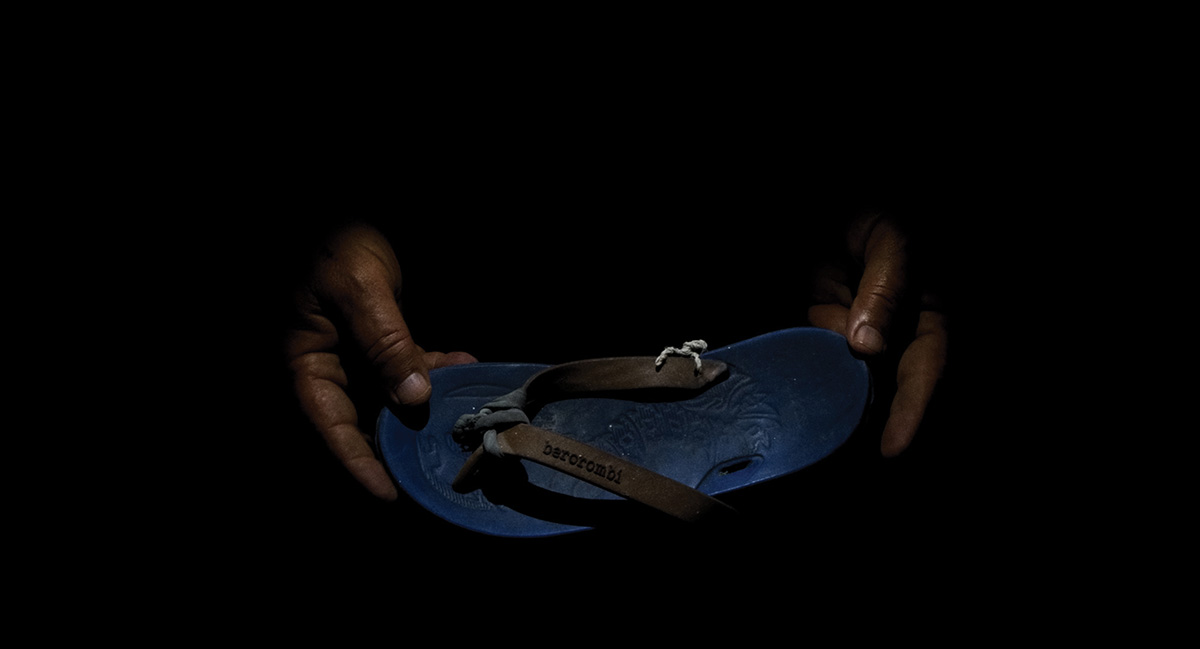
A lone figure digs a grave in the dead of night. With no dialogue – and no sound other than the wind, the crackling of a fire and the scrape of a shovel against dry earth – we are confronted with a dark and mysterious, possibly cursed, universe where every object seems haunted by a meaning we barely sense, but which seem to confirm our anxieties. The head of an old doll, a comb, a lipstick. Relics whose silent language speaks of the end of their former owners. At sea, in the desert. Younes Ben Slimane’s disturbingly beautiful and melancholic imagery is bathed in darkness and in a golden chiaroscuro, lit only by the stars and the lone grave diggers’ headlamps.
Younes Ben Slimane: Tunisian artist and filmmaker, graduated from Le Fresnoy - Studio national des arts contemporains in 2022. His films have been selected in international festivals such as Locarno Film Festival, CPH:DOX, DokuFest, Festival dei Popoli. His work is part of the collections of art institutions and museums including the Institute of Contemporary Art, Villeurbanne/Rhône-Alpes (IAC), France and the Museum of Contemporary Art of Barcelona, MACBA - Barcelona, Spain.
Oren Ben Yosef
Catalogue : 2006Of once held joy... | Création sonore | 0 | color | 4:42 | Israel | 2003
Oren Ben Yosef
Of once held joy...
Création sonore | 0 | color | 4:42 | Israel | 2003
"...of once held joy" is the final part of an audio work called "WAKE". After about 45 minutes of a wake ceremony, this song comes to celebrate something that is truly lost now. It tells about a war and how the person who sings this song lost in it. The song itself is already buried under layers of noise and decay which now take over the song itself on a musical level.
MORTALMANIFEST is a sound project working around different aspects of the sublime/divine. Thus trying to give noise music more value than its usually related nihilistic behaviour. Coming from a small but kicking noise scene in Israel, I have performed with several other noise artist and participated in several radio shows. On a global level, I have released several tracks on compilation albums in the USA and was featured in two festivals in Canada and Wales.
Anat Ben-david
Anat Ben-david
Catalogue : 2023The Promise Of Meat | Experimental video | hdcam | color | 10:52 | United Kingdom | 2021
Anat Ben-david
The Promise Of Meat
Experimental video | hdcam | color | 10:52 | United Kingdom | 2021
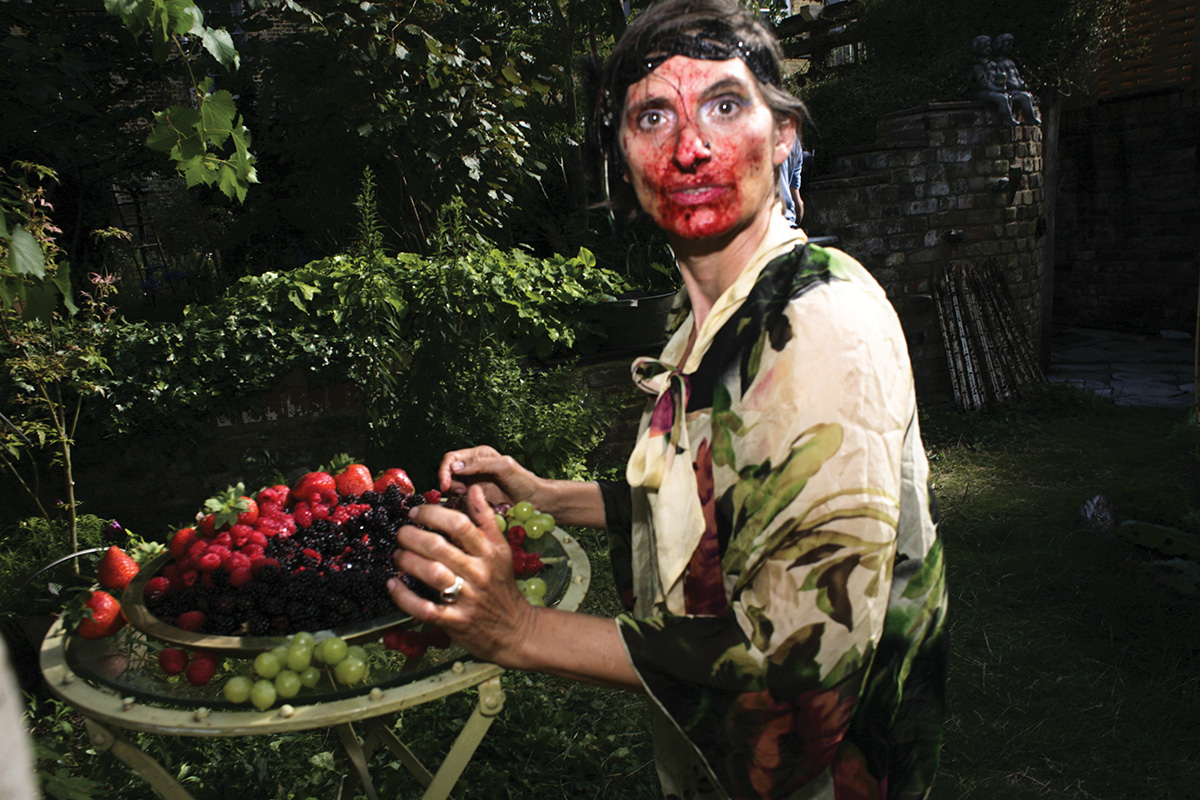
The Promise of Meat song- composed and performed By Anat Ben-David with Anna Dennis by vocally improvising fragments from William Golding’s Lord of the Flies. Beginning as a narrative song (using Golding’s descriptive scenes of the jungle), it gradually degenerates into eloquent chaos, the slow tribal thud evoking the atmosphere of ritual sacrifice. The promise of meat video featuring: Anat Ben-David, Anna Dennis and Cinematographer: Lily Grimes, elevates the carnal, visceral and unreasonable beauty of the human psych in the age of Data-centric threat to humanity.
Dr Anat Ben-David explores the freedom of live improvisation combined with traditional methods of musical composition. Anat’s approach to time-based work is founded in composition. Her background in experimental theatre (the school of Visual Theatre, Jerusalem) and as a member of electro–punk band and art collective Chicks On Speed, has led to projects such as Kairos OperaArt (commissioned for the opening of the new wing of Victoria and Albert Museum), where live electronic processing meets classical instrumentation in a fusion of different musical genres. In her doctoral research Oscillation and Disturbance in the OpeRaArt (Kingston University, 2015), artist and musician Anat Ben David coined the term ‘OpeRaArt’ to explain her rearrangements of sound-text into musical compositions. Ben-David recent collaborations include Lina Lapelyte (winner of Venice Golden-Lion prize, 2019), opera singer Anna Dennis, poet Richard Scott, Vocalist Sharon Gal, violinist Angharad Davies and more. Anna Dennis Described by the Times as a “delectable soprano and a serene, ever-sentient presence”, Anna is especially noted for her work in Modern and Baroque repertoire. Previous opera stages include ROH, ENO, La Scala, Göttingen and Aldeburgh. Concert work includes Berlin Philharmonie, Lincoln Center, Royal Albert Hall, Gulbenkian Lisbon, and Sydney Opera House.
Yasmina Benabderrahmane
Catalogue : 2023Rokh | Experimental film | super8 | black and white | 14:2 | France, Qatar | 2023
Yasmina Benabderrahmane
Rokh
Experimental film | super8 | black and white | 14:2 | France, Qatar | 2023
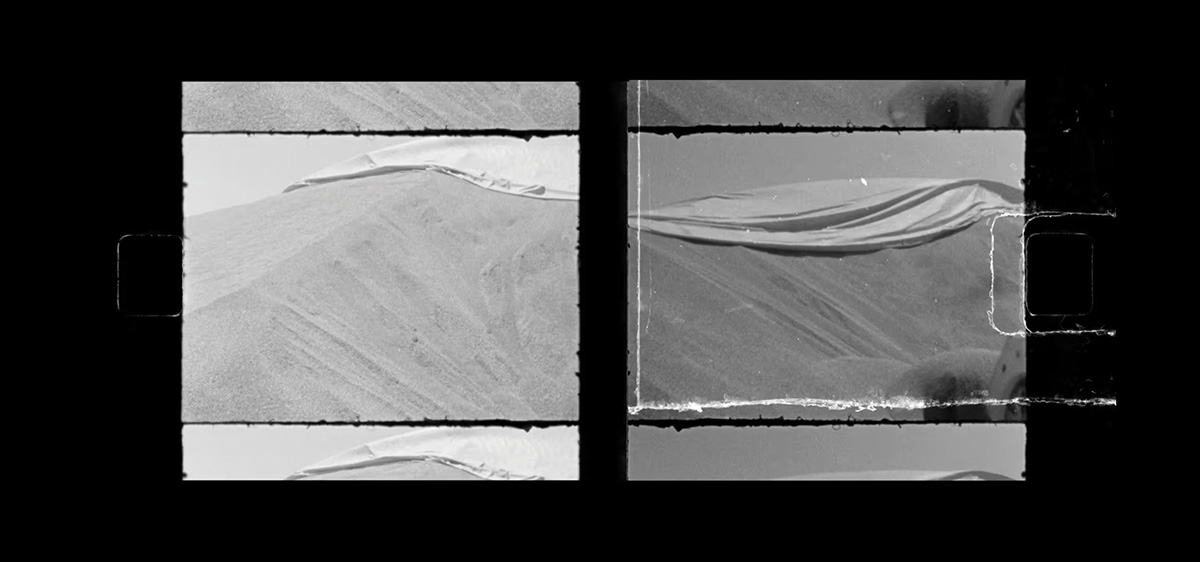
Rokh is a metaphorical portrait of the flour mill in its current state as the ‘granary of the country’. Rokh (the mythological bird of prey) relates to poet Farid ud-Din Attar’s ‘Conference of the Birds’, to the quest of the mythical Simorgh, who appears in so many Arabic, Indian and Persian tales. Rokh is an attempt to capture something of the disappearing, mutating mill. It references the history and the present day of a land in mutation by means of a collection of traditional gestures: from the arrival of the ship importing the grain from Asia to the grain being sorted, stored and reworked, studied and tasted. Dreamlike and repetitive mechanisms transport us into a hypnotic visual and sonic trance echoing the migration of humans through the movements, passages and transit of birds. The building is seen as a nest or a living organism producing grain that feeds. There is a transient movement toward the demolition of the building, a fall of rubble and reconstruction. I see this film project as an allegory of nesting, waiting for the next journey or flight, a dreamlike journey in a concrete body revealed by the caressing light, the power of heat, the visitation of the sun from day to night, an eternal cycle insulating the film like a skin marked with iron.
Yasmina Benabderrahmane graduated from the École Nationale Supérieure des Beaux-Arts de Paris in 2009 and from Le Fresnoy - Studio national des arts contemporains de Tourcoing - in 2015. She works experimentally with silver film and photography. Yasmina is interested in the fragment and focuses her gaze as close as possible to the material, right down to the invisible. She creates bodies of still, moving and sound images. Her work, halfway between documentary and filmed diary, takes several forms: from the simple image to the film to the multimedia installation. In 2018, Yasmina won the Solveig-Anspach Short Film Prize for her film La renardière. In 2019, she won the Révélation Photographie - Lauréate du Prix LE BAL de la Jeune Création with ADAGP. In 2021, she won the national photographic commission "Regards du Grand Paris - Année 6" (CNAP - Ateliers Médicis). Her work is exhibited internationally and is included in private and public collections. Yasmina Benabderrahmane is a resident at Villa Medici in the 2022-2023 year, where she is conducting research for the feature-length film project Carne Vale, lotta lavora come un fascista.
Samy Benammar, Mohamad Awad
Catalogue : 2026Adieu Ugarit | Documentary | 16mm | black and white | 15:45 | Canada | 2024
Samy Benammar, Mohamad Awad
Adieu Ugarit
Documentary | 16mm | black and white | 15:45 | Canada | 2024
In 2012, Mohamed had seen his best friend shot dead by an armed militia on the outskirts of Damascus, Syria; the blood spilled in the lake contaminated his memory. Ten years on, the reflections on the Laurentian waters revive Mohamed's trauma. I ask him if he'd like to dredge up the memories, repair the pain by retreating for a few days to the most distressing calm he can find. He talks about death, immigration and anger. We wonder how and why we should recount this story.
Samy Benammar is a filmmaker, photographer, and art critic based between Montreal and Marseille. Drawing from his Algerian roots and working-class upbringing, his work blends a reflective documentary approach with tactile experimentation. He seeks a form of visual reconciliation while underscoring the irreparable fractures left by fantasies of the past. Often hovering on the edge of disappearance, his images explore the tension between physical and imagined space, between memory, identity, and stone. He has served on the editorial boards of Hors Champ, 24 images, and Panorama-cinéma, and is currently pursuing a PhD on colonial photography in the Aurès region of Algeria.