Catalogue > List by artist
Browse the entire list of Rencontre Internationales artists since 2004. Use the alphabetical filter to refine your search. update in progress
Geoffrey Badel
Catalogue : 2025Akousma Part III | Experimental fiction | hdv | color | 18:30 | France | 2023
Geoffrey Badel
Akousma Part III
Experimental fiction | hdv | color | 18:30 | France | 2023
After missing a long-awaited call, a woman wakes up alone in an empty space. Through gesture and sound, she performs a strange ritual in the hope of an answer that would help her escape her haunting. In the form of a somnambulic experience, Akousma offers an incursion into the cranial cavity of a body on the prowl, trapped between the world of the living and dead. This first short film by young visual artist Geoffrey Badel features choreographer Mathilde Monnier, giving ghosts a chance to return.
Born in 1994 in Montélimar (France) Lives and works in Montpellier (France) Geoffrey Badel is an artist who explores silent worlds through immersive installations in the form of drawings, films, installations and performances. He situates his work in surrealistic environments, endowing them with magical and analeptic attributes, with an approach that seeks to transform situations. A 2017 graduate of the Ecole Supérieure des Beaux-Arts de Montpellier, Geoffrey Badel won the Drawing Room's Bourse Jeune Création MAIF that same year. He is taking part in the Saison 6 post-graduate program, created in 2018 by MO.CO. structured into three residency periods: Cochin (India), Venice (Italy) and Istanbul (Turkey). Alongside these experiences, in France and abroad, he works in schools and medical-social establishments to offer workshops and pass on his practice. Since 2024, following on from his research into language, he has been involved with the deaf community, with the aim of contributing to accessibility in art. From 2022 to 2024, his recent solo and group exhibitions include: the MO.CO. in Montpellier, the FRAC - Occitanie in Montpellier, the Musée d'art contemporain in Sérignan, the Fondation Bullukian in Lyon, the Atelier Blanc in Villefranche-de-Rouergue, the 67ème Salon de Montrouge and the Centre Pompidou in Metz.
Howool Baek
Catalogue : 2025BETWEEN_ in VR | Virtual/Augmented/eXtended Rea | 0 | color | 19:30 | Korea, South, Germany | 2023
Howool Baek
BETWEEN_ in VR
Virtual/Augmented/eXtended Rea | 0 | color | 19:30 | Korea, South, Germany | 2023
“Can we imagine the universe from which we ourselves come as something physical, but at the same time as something virtual?” To portray the social circumstances of our contemporary society, characterised by a hybrid state of physicality and virtuality, choreographer Howool Baek combines body movement with technology. In “BETWEEN_in VR”, an imaginary and deeply 'immersive' universe emerges in which our body parts such as the hands, feet or navel lead us into an unfamiliar world. Using the overwhelming 360° VR spatial experience, we discover a new type of in-between space that merges the solid boundaries between the physical and the virtual, the body and the data, the analog and the digital, and the viewer and the performer.
Choreographer Howool Baek works on discovering individual body fragments without a face and proposing a different perspective of the body by deconstructing and transforming the body. Through breaking stereotypes about the body, she wants the audience to see society from a different perspective. Lately she has expanded her stage concept towards the digital space, carrying out new artistic experiments to transplant her choreographic method to the digital stage. Her first directed film Foreign body (2022) won the Best Film at Minimalen Short Film Festival - Multiplie Dance Film (Norway) in 2024. And VR film BETWEEN (2023) was awarded the Best Virtual Reality at Digital Media Fest (Italy) in 2023.
Ruth Baettig
Catalogue : 2007Running by numbers | Experimental video | dv | color | 8:30 | Switzerland, Netherlands | 2005
Ruth Baettig
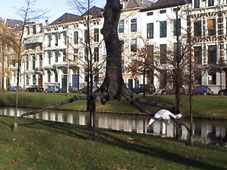
Running by numbers
Experimental video | dv | color | 8:30 | Switzerland, Netherlands | 2005
A person dressed in white runs breathlessly around in Rotterdam. She scrambles up sculptures by well known artists that are staged all over the city and bring to mind a fitness course.
Ruth Baettig was born in Mauensee/Lucerne, Switzerland, in 1964. She splits her time living and working in both Paris and Lucerne. From 1992-1996 she was registered in the Médias Mictes workshops at "l?école supérieure d?arts visuels" in Geneva. In 1999 she obtained a post-graduate degree from the Kunsthochschule in Cologne before registering in the Research Program of Ensba in Paris in 2000. Since 1995 she has participated in numerous video and plastic art exhibitions in Germany, Switzerland, Belgium, France, Brazil, Lebanon, and Armenia. She just recently published "Vagabonde", which can be found in art libraries in Paris.
Catalogue : 2006Sunday-Walk | Art vidéo | dv | color | 5:5 | Switzerland | 2005
Ruth Baettig
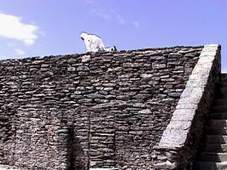
Sunday-Walk
Art vidéo | dv | color | 5:5 | Switzerland | 2005
A white person walks, stands poised, roams around, slips, jumps, climbs, and runs wild and aimlessly along the sculptures of the Alps in ruins. Out there, she passes casual hikers and other week-end tourists. Upset and baffled, the viewer sees the white person walk away. The video was shot in the Swiss mountains across the Italian border. The various components, including a mountain vista, an art figure, and movements, set up a comically absurd picture.
Born April 7th, 1964, 1992-96 Ecole Supérieure d'Art Visuel, Atelier Medias-Mixtes Silvie & Cherif Defraoui, Genf, Switzerland 1997-2000 Postgraduate studies at the Kunsthochschule fur Medien" in Cologne, Germany 2000-2002 Research Program, Ecole Nationale des Beaux-Arts, Paris, France
Georgy Bagdasarov, Alexandra Moralesova
Catalogue : 2023Pro(s)thetic Dialogues | Experimental doc. | mp4 | color | 21:39 | Armenia, Czech Republic | 2022
Georgy Bagdasarov, Alexandra Morales
Pro(s)thetic Dialogues
Experimental doc. | mp4 | color | 21:39 | Armenia, Czech Republic | 2022
Pro(s)thetic dialogues is more like a recording of a theatre performance playing out on a computer desktop. Here the human operator creates the conditions for exploring the performativity of a philosophical zombie pieced together from neural networks. The operator/stage technician merely directs the flow of mathematical operations pretending thought and creates a space in which the philosophical discourses are dissolved
Since 2013 Alexandra Moralesova and Georgy Bagdasarov form a filming and experimenting duo Labodoble. We run an artistic and curatorial platform under the same name. We mainly focus on photo-chemical experimental film processes but we are interested in other kinds of media practices. We like to question media and to reshape the relation of machine-operator into machine-performer. We merge technical skills with media theory and philosophy. We do films, performances, installations and workshops.
Catalogue : 2016Rhus Typhina | Experimental film | 16mm | black and white | 2:44 | Armenia, Czech Republic | 2014
Georgy Bagdasarov, Alexandra Moralesova
Rhus Typhina
Experimental film | 16mm | black and white | 2:44 | Armenia, Czech Republic | 2014
One of the series of labodoble experiment of the natural(organic) film developers. The structure of the film is based on the chemical formula of the Rhus Typhina`s developer. The main protagonist of the film is a species of flowering plant in the family Anacardiaceae which leaves and berries have been mixed with tobacco and other herbs and smoked by Native American tribes. We tried to apply the properties of the Rhus Typhina in the photochemistry. The film catches the research, experiments, harvesting and preparation of the film developer in which latter original negative was developed. The nonlinear structure of the chemical formula as well as nonlinear research of the process reflected in a order of the frames. There is no post-production except sound all editing work is made while film was loaded in camera before chemical development.
Alexandra Moralesová was born in 1989 to Czech mother and Argentinian father. She studied at the Centre of Audiovisual Studies at The Film faculty of the Academy of Performing Arts in Prague (FAMU). Beyond the inspiration by the practices of experimental film, she`s mainly interested in remediation of found footage and found objects. Through various ways of viewing it, those objects represent for her its own possibility of de/construction in order to cross the frontier between analog and digital media and so disrupt the spectacle and alternate existing narratives. It`s been several years that she explores the post-production tools as for example the editing table or film viewers. The output of her works is often a performance, film screening or installation. Georgy Bagdasarov was born in Armenian family in 1978 to the sounds of rockets taking off into space from Kazakhstan. He never boarded any of those rockets and spent all his life living in various locations throughout Eurasia. Now he lives and works in Prague. His work explores the space between analog and digital, and merges them together. His works are created under strong influence of structural films, cooking recipes and syntax of computer codes. He combines different media: digital and film stock as well as music and food.
Georgy Bagdasarov, Alexandra Morales
Catalogue : 2023Pro(s)thetic Dialogues | Experimental doc. | mp4 | color | 21:39 | Armenia, Czech Republic | 2022
Georgy Bagdasarov, Alexandra Morales
Pro(s)thetic Dialogues
Experimental doc. | mp4 | color | 21:39 | Armenia, Czech Republic | 2022
Pro(s)thetic dialogues is more like a recording of a theatre performance playing out on a computer desktop. Here the human operator creates the conditions for exploring the performativity of a philosophical zombie pieced together from neural networks. The operator/stage technician merely directs the flow of mathematical operations pretending thought and creates a space in which the philosophical discourses are dissolved
Since 2013 Alexandra Moralesova and Georgy Bagdasarov form a filming and experimenting duo Labodoble. We run an artistic and curatorial platform under the same name. We mainly focus on photo-chemical experimental film processes but we are interested in other kinds of media practices. We like to question media and to reshape the relation of machine-operator into machine-performer. We merge technical skills with media theory and philosophy. We do films, performances, installations and workshops.
Catalogue : 2016Rhus Typhina | Experimental film | 16mm | black and white | 2:44 | Armenia, Czech Republic | 2014
Georgy Bagdasarov, Alexandra Moralesova
Rhus Typhina
Experimental film | 16mm | black and white | 2:44 | Armenia, Czech Republic | 2014
One of the series of labodoble experiment of the natural(organic) film developers. The structure of the film is based on the chemical formula of the Rhus Typhina`s developer. The main protagonist of the film is a species of flowering plant in the family Anacardiaceae which leaves and berries have been mixed with tobacco and other herbs and smoked by Native American tribes. We tried to apply the properties of the Rhus Typhina in the photochemistry. The film catches the research, experiments, harvesting and preparation of the film developer in which latter original negative was developed. The nonlinear structure of the chemical formula as well as nonlinear research of the process reflected in a order of the frames. There is no post-production except sound all editing work is made while film was loaded in camera before chemical development.
Alexandra Moralesová was born in 1989 to Czech mother and Argentinian father. She studied at the Centre of Audiovisual Studies at The Film faculty of the Academy of Performing Arts in Prague (FAMU). Beyond the inspiration by the practices of experimental film, she`s mainly interested in remediation of found footage and found objects. Through various ways of viewing it, those objects represent for her its own possibility of de/construction in order to cross the frontier between analog and digital media and so disrupt the spectacle and alternate existing narratives. It`s been several years that she explores the post-production tools as for example the editing table or film viewers. The output of her works is often a performance, film screening or installation. Georgy Bagdasarov was born in Armenian family in 1978 to the sounds of rockets taking off into space from Kazakhstan. He never boarded any of those rockets and spent all his life living in various locations throughout Eurasia. Now he lives and works in Prague. His work explores the space between analog and digital, and merges them together. His works are created under strong influence of structural films, cooking recipes and syntax of computer codes. He combines different media: digital and film stock as well as music and food.
Jeremy Bailey
Catalogue : 2007Full Effect | Experimental video | dv | color | 2:0 | USA, Canada | 2005
Jeremy Bailey
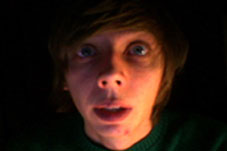
Full Effect
Experimental video | dv | color | 2:0 | USA, Canada | 2005
Cheap effects cannot make a melodramatic performer feel any better.
Jeremy Bailey is currently pursuing his MFA in Video Art at Syracuse University in Syracuse NY. His work is often technologically grounded and fundamentally concerned with authorship and authenticity. He is also video programmer for SPARKVIDEO, a successful video series at Spark Contemporary Art Space in Syracuse.
Bridget Ann Baker
Catalogue : 2014The Remains of the Father | Experimental video | hdv | color | 24:0 | South Africa, Italy | 2012
Bridget Ann Baker
The Remains of the Father
Experimental video | hdv | color | 24:0 | South Africa, Italy | 2012
The Remains of the Father: Fragments of a Trilogy (Transhumance) is an experimental film and installation. It considers marginally remembered Italian colonial history in Eritrea and Ethiopia between 1930 and 1941. An Eritrean researcher Lula Teclehaimanot discovers an archive of non-official ethnographic literature collected by a Bolognese couple Giovanni Ellero and Maria Pia Pezzoli who had worked for the ?Ministry of Italian Africa? in Eritrea and Ethiopia during that period. Lula has been tasked by the municipality of Asmara to translate from Amharic into Tigryna: A contribution to the birth of the colonial style, an unpublished manuscript written by Ellero promoting the rationale of a modernist Ethiopian architectural vernacular. While she works Lula listens to a radio interview conducted in Italian, Tigryna and Amharic about the contemporary relevance of proverbs in Eritrean and Ethiopian societies. Set within a single room of a derelict house in Bologna which had been built for retired fascist army officials, is also the imagined office of Ellero. Many of the documents laying about the office; Eritrean and Ethiopian proverbs, hand drawn maps, and family emblems and curiously amongst these are the traces of her own family history, collated by Ellero before she was born.
Bridget Baker is an artist from South Africa. She is based in London and Cape Town. Baker?s work is situated at the intersection of documentary and myth creation, forming a series of complex visual fragments realized through film making, installation and documented re-stagings. Baker`s practice and visual language, while based on in-depth research, is often speculative and nomadic, seldom offering a finite position on events or histories. Her work has been exhibited extensively but also at The Museum of African Art (NYC), MAMbo (Bologna, Italy) Centro des Artes Contemporanea (Burgos, Spain), Palazzo delle Papesse (Siena, Italy), Neue Berliner Kunstverein (Berlin), the 2nd Johannesburg Biennale (Cape Town), Bow Arts Centre (London), Glasgow Film Festival (Scotland), Dak?art 2012 (Senegal), Wapping Project (London), South African National Gallery (Cape Town), the South Africa National Arts Festival (Grahamstown, South Africa), and the Oberhausen Short Film Festival (Germany).
Ruxandra Balaci
Catalogue : 2007National Contemporary Art Museum | 0 | 0 | | 0:0 | Romania | 2007
Ruxandra Balaci
National Contemporary Art Museum
0 | 0 | | 0:0 | Romania | 2007
Inaugurated at the end of 2004 in Bucharest, Romania, the MNAC (National Museum of Contemporary Art) occupies 16000 square metres of the E4 wing in the Parliamentary Palace, the second biggest building in the world after the Pentagon. Also known under the nicknames "palace of the people" and "Ceausescu's palace", the Parliamentary Palace is a genuine pornographic projection of power, a megalomaniac erection. A place marked by a totalitarian history, the Palace, after having welcomed the Romanian Parliament and an international conference centre, it now welcomes a space dedicated to the dynamic of ideas and artistic dialogue. The MNAC is an ambitious project, a project trapped by the Romanian situation, unstable and always close to regression. It is a gigantic contemporary art museum, the biggest of Eastern Europe; innovating and avant-garde, it has to succeed in making a link between a "provincial" population, who remains to be educated, and its ambitious programming. The MNAC is the fruit of the obstinacy of the scope of two Romanian personalities: Mihai Oroveanu, the museum's Chief Executive who carried the project for more than ten years, and Ruxandra Balaci, his Scientific and Artistic Director. Today the museum's board of directors is made up of a genuine international dream team where reside Ami Barak, Curator and President of the International Association of Curators of Contemporary Art; Rene Block, Director of the Kassel Kunsthalle Fridericianum; Nicolas Bourriaud, Co-Director of Palais de Tokyo, Paris; Heiner Holtappels, Director of the Netherlands Media Art Institute ? Montevideo/TBA in Amsterdam; Anders Kreuger, Independent Curator and former Director of the Nordic Institute for Contemporary Art in Stockholm; Enrico Lunghi, Director of Casino Luxembourg, Forum d'Art Contemporain in Luxembourg; and Catherine Millet, Director of Artpress. The MNAC is a living, pliable, polemic space, animated by a web of intellectuals in which the East and the West are partners, a lab open to research in the visual field.
Critic and commissioner of the exhibition, Ruxandra Balaci directed the Gallery Gad in Bucharest, Rumania. Today she is co-editor of the review Artelier, and the deputy manager as well as the Artistic and Scientific Director of the Bucharest National Museum of Contemporary Art (MNAC).
Ben Balcom
Catalogue : 2023Looking Backward | Experimental doc. | 16mm | color and b&w | 10:0 | USA | 2022
Ben Balcom
Looking Backward
Experimental doc. | 16mm | color and b&w | 10:0 | USA | 2022
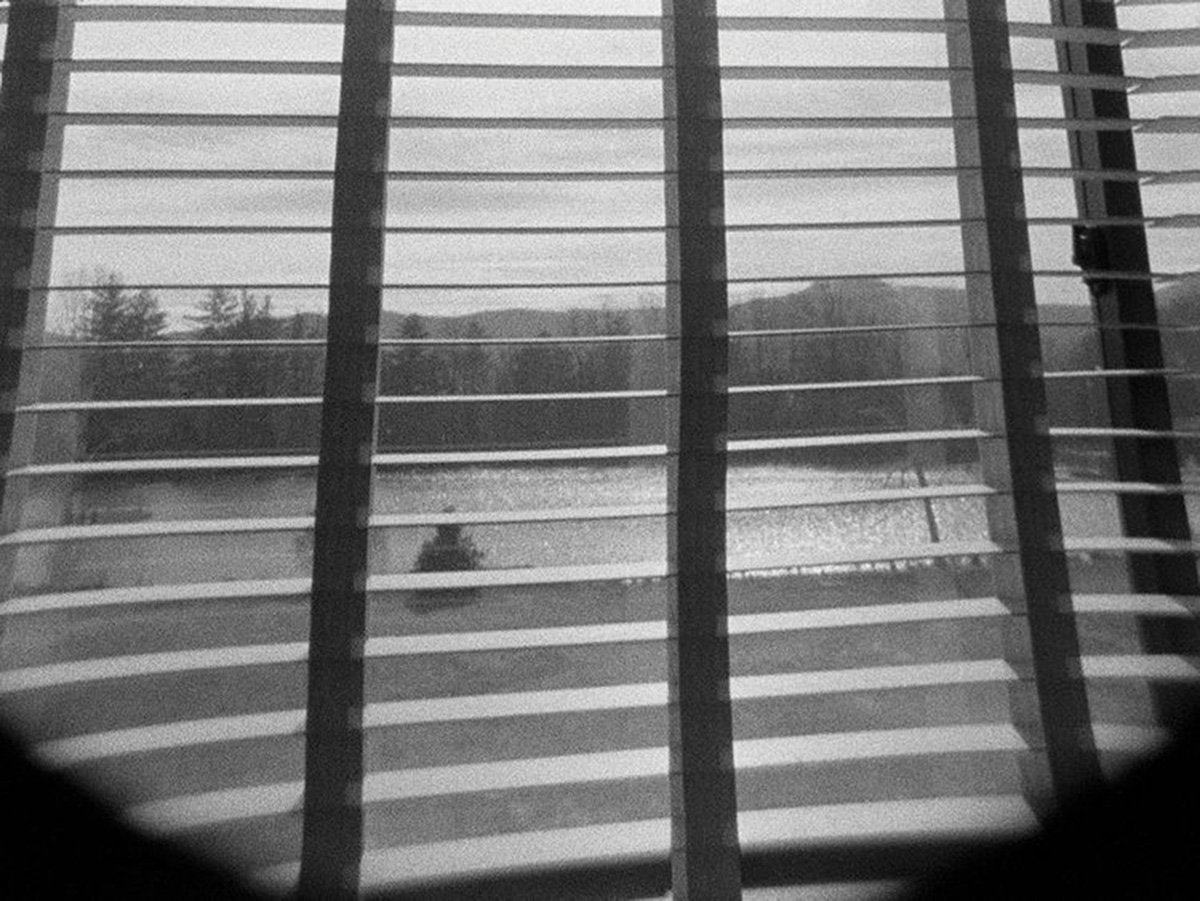
Filmed on the former grounds of Black Mountain College, Looking Backward is a brief elegy to the legacy of a utopian college and other impossible projects.
Ben Balcom is a filmmaker and educator currently living and working in Milwaukee, Wisconsin. He is an assistant professor at the University of Wisconsin-Milwaukee and is the co-founder and programmer of Microlights Cinema, an artist-run microcinema which has been operating since 2013 and has hosted artists from around the world. Recently, his films have taken a lyrical approach to documenting the spaces and legacies of now-defunct experimental schools. Prior to that he made a series of introspective landscape films that engaged with Milwaukee’s progressive political past and contemporary anxieties about the future. Earlier films used abstraction to explore the tensions between perception and communication, with a reflexive attention on the medium itself. These films have been exhibited around the world at venues and festivals such as The Museum of Moving Image, European Media Arts Festival, International Film Festival Rotterdam, IndieLisboa, Media City Film Festival, Alchemy Film, and Slamdance. The films have received awards at Onion City Film Festival, Athens International Film & Video Festival, and Ann Arbor Film Festival. Recently, Balcom was a fellow at the Center for 21st Century Studies at UW-Milwaukee.
Benjamin Balcom
Catalogue : 2026The Phalanx | Experimental doc. | 16mm | color | 13:30 | USA | 2025
Benjamin Balcom
The Phalanx
Experimental doc. | 16mm | color | 13:30 | USA | 2025
Letters from the Ceresco community trace the fragility of harmony, the dream of life in association, the frictions that give way to fracture. Members of the phalanx drift apart, lingering in private corners, suspended in speculative time.
Ben is a filmmaker and educator based in Milwaukee, Wisconsin, where he is a professor of Film, Video, Animation, and New Genres at the University of Wisconsin–Milwaukee. His most recent films explore the histories and afterlives of radical social ideals and communal living. These projects combine archival research and various modes of filmmaking to reflect on alternative ways of living. Drawing from speculative fiction, critical theory, and utopian poetics, his work often revisits the sites of now-defunct experimental schools and intentional communities, using cinema as a space for both research and imagination. Featuring landscapes both real and imagined, these films engage collective memory while speculating on futures beyond the limits of capitalism. Earlier in his practice, Balcom worked with abstraction, introspection, and formal experimentation, exploring the tensions between perception and communication, and probing the materiality of film itself. These threads continue to inform his evolving approach to nonfiction and poetic cinema. Balcom’s films have screened internationally at venues and festivals including the Museum of the Moving Image, International Film Festival Rotterdam, European Media Arts Festival, IndieLisboa, Media City Film Festival, and Ann Arbor Film Festival. He has received awards from Onion City, Athens International Film + Video Festival, and Ann Arbor. In 2023, he was a research fellow at the Center for 21st Century Studies. He also co-founded Microlights Cinema, a microcinema that ran from 2013 to 2023, dedicated to bringing experimental film and video art to audiences in Milwaukee.
Nicholas Baldas
Catalogue : 2025Loverboy | XR expérimental | | color | 12:5 | Greece, Australia | 2022
Nicholas Baldas
Loverboy
XR expérimental | | color | 12:5 | Greece, Australia | 2022
Inspired by the story of British serial killer Dennis Nilsen, Loverboy operates as a meditation on the dark side of human intimacy. The project’s approach rejects moral simplifications, offering a narrative that is less a linear story than an immersive dissection of isolation and obsession. Recurring dialogues, eerie distortions, and environmental shifts that envelope the viewer in a claustrophobic cycle of increasingly fractured reality. Designed to linger like an emotional imprint, Loverboy challenges viewers to exit the refuge of orderly modern life and confront the fragility of human empathy and connection.
Nicholas Baldas is a writer, director, and producer whose creative work utilises cutting-edge technology to explore the prohibited boundaries of human experience through psychological immersion. The Heraclitian principle "life is flux" is the only constant in his creative pursuits, his collaborator Michael Plumb is a writer, filmmaker and performer. He has a Phd in Econometrics from University of Oxford. His creative focus is on the art of storytelling, drawing on his background in academia and public policy to explore questions about society and humankind. Michael is fascinated by exploring different media - old and new - to bring stories to life and reach new audiences.
Steven Ball
Catalogue : 2006The War on Television | Experimental video | dv | color | 5:37 | United Kingdom | 2004
Steven Ball
The War on Television
Experimental video | dv | color | 5:37 | United Kingdom | 2004
The War on Television is made almost entirely from images derived from interference fractured digital television broadcasts. These are randomly processed and manipulated through layers of scratch techniques exaggerating the stuttering fragmentation. The pristine digital veneer, the authority and reliability of the always-on 24 hour news channel becomes abstracted, fucked over in the flow of jarring noise and stammering incoherence. A celebration of digital anti-aesthetics, excess and entropic fallibility.
Steven Ball has worked in film, video, sound and installation since the early 1980s. In the late 1980s he accidently migrated to Melbourne Australia. There he continued his practice making a number of film, video and sound and installation works, as well as being engaged in various arts activist, curatorial, administrative, teaching and writing activities. Since returning to the UK in 2000 he has worked predominantly with digital video, producing a series of works which, among other things, are particularly concerned with digital material processes and spatial representation. He is currently Research Fellow at the AHRB British Artists` Film and Video Study Collection, Central Saint Martins College of Art and Design in London.
Sammy Baloji
Catalogue : 2025Aequare. The Future that Never Was | Experimental doc. | 4k | color | 21:0 | Congo (RDC), Belgium | 2024
Sammy Baloji
Aequare. The Future that Never Was
Experimental doc. | 4k | color | 21:0 | Congo (RDC), Belgium | 2024
Aequare. The future that never was by Sammy Baloji, 2023, 21’04 The film swings between archival film clips dating from 1943 and 1957, sourced from INEAC’s colonial propaganda, and 21st century captures of the same Yangambi premises, like a pendulum that never moves time forwards. An acronym for the former National Institute for the Agronomic Study of the Belgian Congo, its post-colonial successor, the Institut national pour l’Etude et la Recherche Agronomique (INERA), is on film so suffused with past, colonial “coordinate systems” that the present looks inert and at a standstill, as if held hostage by frames of knowledge that refuse to abdicate. Decades after decolonization, that persistent hold is made explicit by an imposing and intact map of the Belgian Congo hung high on the wall, and by all the remaining rusty machines, labelled test tubes and rotting reports and specimens, dusty instruments of measure, and laboratories. Against the crumbling of these infrastructures, a devoted population of Congolese clerks seem to assist the preservation of the collected data and methods, in a choreography of gestures that the montage reveals to be inherited from the colonial decades. Amidst images of farmers burning trees to make the charcoal sold at surrounding markets, or those of clerks’ motivational posts proudly professing the exactitude of their pursuit, the atavism of colonial ecology seems apparent. Excerpt from: Sandrine Colard, FROM THE EQUATOR, I HAVE SEEN THE FUTURE
Since 2005, Sammy Baloji has been exploring the memory and history of the Democratic Republic of Congo. His work is an ongoing research on the cultural, architectural and industrial heritage of the Katanga region, as well as questioning the impact of the Belgian colonization. He touches upon a variety of media to translate his research into artefacts. His use of photographic archives allows him to manipulate time and space, comparing ancient colonial narratives with contemporary economic imperialism. His video works, installations, sculptures, andphotographic series highlight how identities are shaped, transformed, perverted and reinvented. His critical view of contemporary societies is a warning about how cultural cliches continue to shape collective memories and thus allow social and political power games to continue to dictate human behavior. His recent personal exhibitions include: Sammy Baloji, Goldsmiths CCA, London (2024), Unextractable: Sammy Baloji invites, Kunsthalle Mainz, Mainz (2024), Style Congo: Heritage & Heresy, CIVA, Brussels (2023), K(C)ongo, Fragments of Interlaced Dialogues. Subversive Classifications, Palazzo Pitti, Florence (2022) He has recently participated in the 35th Bienal de Sao Paulo (2023), the Architecture Biennale of Venice (2023), the 15th Sharjah Biennial (2023), the Sydney Biennial (2020), documenta 14 (Kassel/Athens, 2017) Sammy Baloji co-founded in 2008 the Rencontres Picha/Biennale de Lubumbashi. In September 2019 Sammy Baloji started a PhD in Artistic Research titled “Contemporary Kasala and Lukasa: towards a Reconfiguration of Identity and Geopolitics” at Sint Lucas Antwerpen.
Tanatchai Bandasak
Catalogue : 2011Air Cowboy | Experimental video | dv | color | 2:55 | Thailand | 2010
Tanatchai Bandasak
Air Cowboy
Experimental video | dv | color | 2:55 | Thailand | 2010
Along the highway, herds of cows are often seen in a rice field. Some standing still and some grazing. At times we see them through the windshield, loaded onto the back of a running truck. This work is a collective of those reduced images and sounds looking as if they are in a controlled atmosphere.
Tanatchai Bandasak, Born in 1984, in Bangkok; lives and works in Paris and UdonThani. BA Film and Photography; Thammasat University Bangkok Thailand, currently in the final year at École Nationale Supérieure D`ARTS Paris-Cergy, France.
Myrthe Baptist
Catalogue : 2020Caresse | Video | hdv | color | 6:40 | Belgium | 2019
Myrthe Baptist
Caresse
Video | hdv | color | 6:40 | Belgium | 2019
The camera leads our gaze closely across the surface of photographs. Small details of different moments become part of a movement: the searching, caressing gesture of filming. Projected on two adjoined screens, the images move together, towards each other and away again. The gaze becomes tactile, connecting what is seemingly separated by time, by distance and by the borders of the photographic image.
Myrthe Baptist (BE, 1994) is an artist and filmmaker based in Brussels. She works mainly with moving image, often starting from photographs, notes, letters and archival material. She has obtained a Master of Fine Arts at KASK School of Arts in Ghent.
Francisco Baquerizo Racines
Catalogue : 2026La Quema (del Planeta “B”) | Video | 4k | color | 20:50 | Ecuador | 2025
Francisco Baquerizo Racines
La Quema (del Planeta “B”)
Video | 4k | color | 20:50 | Ecuador | 2025
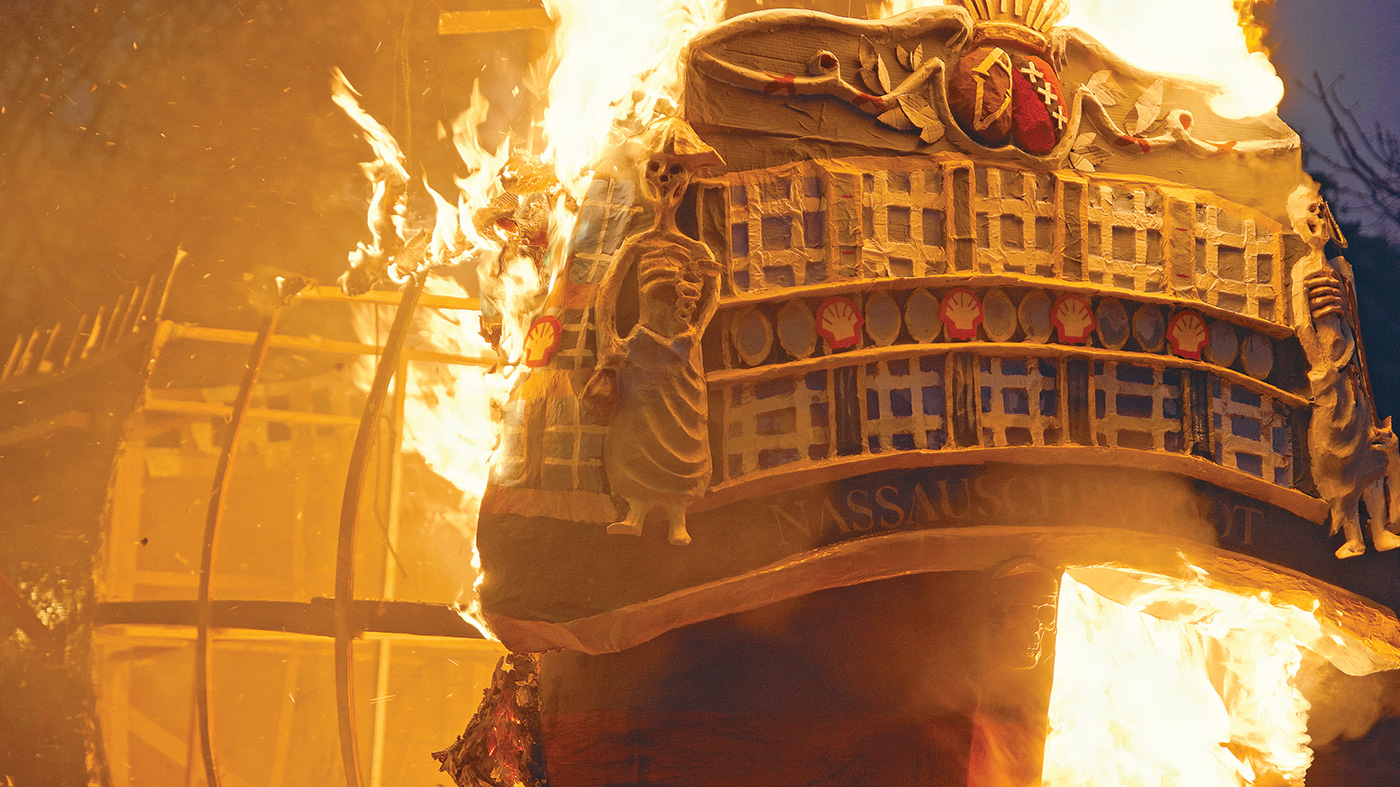
La Quema (del Planeta “B”) is a video installation that reflects on the 1624 burning and sacking of Guayaquil by the Nassau Fleet through the lens of Ecuador’s current vernacular practices—most notably año viejo, a popular custom in which effigies are collectively burned during New Year’s celebrations. This mestizo ritual resists linear narratives, offering instead an Andean zig-zag perspective on renewal through repetition. The crafting of these effigies embodies Guayaquil’s vibrant popular culture and capitalist-driven desires, while paradoxically creating space for (political) protest. In a context where sustaining artistic practices remains precarious, this tradition has also given rise to informal economies. Artists Joshua Jurado and Diego Cuesta—both based in southern Guayaquil—were invited to construct a año viejo in the shape of a galleon, inspired by the Dutch East India Company (VOC) vessel Amsterdam. Paraded through the city before being set alight, the sculpture marked 400 years since the original event, confronting historical cycles through collective action and vernacular symbolism. Filmed during one of Guayaquil’s recent peaks in violence—tied to extractivist legacies—the project brings together two temporal perspectives shaped by the same hegemonic system. La Quema (del Planeta “B”) stands as a pointed question to that very system—one that has shaped our bodies, ethics, and desires in service of capital.
Francisco Baquerizo-Racines (b. 1993, Quito, Ecuador) Currently living and working in the Netherlands. Baquerizo-Racines holds an MA in Fine Arts from HKU University of the Arts Utrecht (2022) and a BA in Visual Arts from PUCE (2017). His work has been shown across Ecuador, South America, and the Netherlands, with projects held in the MACBA archive and supported by the Mondriaan Fonds. In 2025, his film installation La Quema (del Planeta “B”) premiered at the 54th International Film Festival Rotterdam (IFFR).
Saulius Baradinskas
Catalogue : 2021Golden Minutes | Fiction | 16mm | color | 10:0 | Lithuania | 2019
Saulius Baradinskas
Golden Minutes
Fiction | 16mm | color | 10:0 | Lithuania | 2019
Driven to the edge by a huge debt and his impending divorce, a poetic accountant decides to kill himself but is rescued by a heart attack.
Saulius Baradinskas (born on September 19, 1990) is a film, commercial & music video director from Vilnius, Lithuania. ?Saulius is noticed for directing music videos that already got recognition in the Baltic states. In 2018 annual music video awards Saulius was selected as a best director of the year and won best music video award for directing.
Christian Barani, reynard guillaume
Catalogue : 2022je me suis enfui | Experimental doc. | mov | color | 83:0 | France, Ethiopia | 2021
Christian Barani
je me suis enfui
Experimental doc. | mov | color | 83:0 | France, Ethiopia | 2021
One day Arthur Rimbaud left the world of culture, tired, disappointed and angry. He does not understand, he does not admit the conventions, the lack of courage, the lack of investment of the art world. "Real life is absent," said Arthur Rimbaud. So he leaves, he leaves for an elsewhere that is less a place than an anarchic tension. He looks for chance, the unknown, the encounter, the unexpected. He now wants to practice poetry since nobody can understand his poetry. Arthur Rimbaud lived the last ten years of his life in Harar, a holy city in Ethiopia (1880-1891). In 2005, I left for Harar. Every day I walk, I get lost. I don't look for anything because there is nothing to look for. I film a contemporary Harar. In 2020, I decided to make a film out of these sequences.
Christian Barani's work takes the form of a committed realist poetry. Engaged in an improvised otherness, never sought after. His body, often lost in space, allows him to show a certain state of the world. He walks, crosses, observes, feels, analyses, meets, films. He loses himself, he drifts to find, to provoke and to create a necessary and essential link to the production of an image. He walks for long hours until he is exhausted, until he reaches the end of himself. Drifting puts him in danger. A physical and mental danger that allows, that authorises the filming of the other in his difficulty of life, in his quest for survival, in his struggle. Only at this price is it possible to welcome them. The image comes as a consequence. The forms that emerge from these experiences have no a priori. They are often diverse and take the form of film, film installation, reading projection, photographic notes and texts. They are created from the material captured and are often conceived according to the spaces in which they are exhibited.
Catalogue : 2020Lac Assal | Experimental doc. | hdv | color | 15:12 | France, Djibouti | 2019
Christian Barani
Lac Assal
Experimental doc. | hdv | color | 15:12 | France, Djibouti | 2019
In the rift valley of Djibouti, in the black of volcanic rocks, men are waiting. In this desert, a few years before, the production of salt organized life. Since the competition has won. On the shores of Lake Assal, resistance fighters go in search of salt concretions hoping to sell them to the few tourists who would come to contemplate the blue of the lake.
Christian Barani was born in 1959, lives in Paris. He builds a practice that combines the field of documentary with that of Visual Arts. His research is based on a performative device that engages a body/camera walking in space. It defines a rule of the game that composes with chance and improvisation and generates images without a priori. He filmed where political and social violence oppressed, drawing a portrait of the defeated over time.
Catalogue : 2019Dans la fumée d'une peau | Experimental doc. | hdv | color | 12:30 | France, South Africa | 2018
Christian Barani
Dans la fumée d'une peau
Experimental doc. | hdv | color | 12:30 | France, South Africa | 2018
Catalogue : 2018des êtres de poussière | Experimental doc. | hdv | color | 18:0 | France, Nepal | 2018
Christian Barani
des êtres de poussière
Experimental doc. | hdv | color | 18:0 | France, Nepal | 2018
A starting point : In Upper Mustang, a very old story is told in the village of Ghemi. Despite the courage and the fighting of the villagers, every night, the demon Balmo and her spirits destroy the houses of the village. Exhausted, they decide to ask the help of a monk, the guru Rimpoche who meditated in the valley. Rimpoche then leaves his meditation and agrees to fight the demon. For seven nights the fight was monstrous. But Rimpoche won the battle. Today in the Nepalese country, the fight against the spirits that are constantly destroying the country continues. Despite a Maoist revolution that resulted in democracy, the abolition of the monarchy, the writing of a new constitution, the equality of man and woman ... the country is still a victim of destructive spirits and the Nepali people continue without stop the fight
Christian Barani is born in 1959 and lives in Paris. He ends his studies with a master?s degree in science economic in the Faculty of Nice. In the 90s, the arrival of the format DV pushes aside its relation in the images and allows him to acquire a freedom of creation and production. He builds a practice which associates the field of the documentary with the Visual Arts. Over a period of 10 years, he films in Kazakhstan with G. Reynard the social transformations of this country of Ex Union Soviétique, he films in Nepal during the Maoist revolution, in Namibia, in Ethiopia, in Cyprus, in Dubai, in the Lebanon ... His process of realization sets up a performative device which is going to generate images without in priori. It is about experience committing a body / camera walking in the space. He defines a rules of the game which composes with the coincidence and the improvisation. No preliminary scenario. Everything takes place in an instant. Never a sequence is twice shot. What is void and void. In the term of the experience, a material of images and sounds is collected. He will take various forms according to the project to come and from places of exhibition : movie in room, movie deployed in the space of exhibition, installation, performance ? He realize in parallel numerous commissioned works for museums as the House Arthur Rimbaud in Charleville-Mézières, the Royal Institute of the Natural sciences of Brussels, the Center of Culture of Rennes, Agora : biennial event of Architecture of Bordeaux, Mons Mémorial Museum in Belgium, The Museum of Confluences in Lyon, The City of the architecture and the heritage of Paris ? From 1990 till 2006, he creates to the National School of Industrial Design, the department Images in Movement, the unit of Experiment Images and Sound (Xis- with Jeff Guess, Extensions - dynamics of writings with Frédéric dumond. In 2000, he cofounds, with Véronique Barani and Sabine Massenet, a structure of distribution of videos artists " estceunebonnenouvelle " which is going to include more than hundred international artists and a collection understanding more than 500 movies
Catalogue : 2015Prolégomène à la lumière | Experimental doc. | dv | color | 7:0 | France, Kazakhstan | 2013
Christian Barani
Prolégomène à la lumière
Experimental doc. | dv | color | 7:0 | France, Kazakhstan | 2013
KAZAKHSTAN. Mine de Kouzembaïev dans les steppes de Karaganda. Durant l'époque soviétique, les mineurs bénéficiaient d’un très grand respect de la part du régime et de la population. Ce statut était dû aux nombreux sacrifices subis pour la construction du pays. Depuis la chute du mur, une société libérale est apparue. Avec lui, l’individualisme, le chômage et la crise. Les mines ferment les unes après les autres. Sur 28 mines présentent dans la région, seules 8 sont encore en service. Dans la mine du héros Kouzembaëv, dans cet instant qui précède la descente dans le noir, seule la lumière persiste pour honorer ces corps.
Christian Barani est né en 1959. Il construit une pratique qui associe le champ du documentaire à celui des Arts Visuels. Dans le processus de réalisation, il est question d’expérience engageant un corps/caméra marchant dans l’espace. Pour filmer, il se définit une règle du jeu qui compose avec le hasard et l’improvisation. Pas de scénario préalable. La marche est utilisée comme un vecteur de rencontres. Tout se joue dans l’instant. Au terme de l’expérience, un matériau est récolté. Il prendra différentes formes en fonction du projet à venir, des lieux d’exposition : film, installation, performance…
Catalogue : 2012My Dubaï Life | Experimental doc. | 0 | color | 60:0 | France | 2011
Christian Barani
My Dubaï Life
Experimental doc. | 0 | color | 60:0 | France | 2011
In his work, Christian Barani questions and deconstructs the documentary's codes. It is not question of representation of the reality nor fiction but the experience. By summoning the walking and the drift, he involves another process of creation which generates a representation without a priori. He plays with fate and improvisation. No sequence is recorded twice. On the occasion of an exhibition entitled "Manifesto about the invisible cities", Olivier Marboeuf suggests to Christian Barani to direct a "drift" in Dubaï. This approach, appropriate for the artist, consists in walking in landscapes and cities. In this case, Dubaï is a town where nothing is thought for the moving body, a town built for and by the influx. It's a question of walking to get lost in these fiction spaces, and to build from the fate.
Christian Barani, born 1959, works and lives in Paris. He starts working with video in 1990, and founds the Moving Image department at the Nationale Supérieure school of Industrial Creation where he's been teaching for 17 years. In 2000, he co-founded a structure of artists' videos broadcasting, "estceunebonnenouvelle" bringing together a hundred of international artists and a collection made up of 500 movies. Inlaying, link to painting and poetry make up the axis of research of his first videos. Since 1997, his work questions and deconstructs the codes of documentary, through an experience engaging a body/camera in space, not a documentary nor a fiction. He directs linear movies, art installations, performances... His work has been shown in numerous festivals, museums and art centers in Europe, notably at the Centre Pompidou, at the Jeu de Paume, at the Lieu Unique in Nantes, at the MUSAC Museo de Arte Contemporaneo de Castilla y Leon, at the National Museum Reina Sofia.
Catalogue : 2009kazakhstan, naissance d'une nation | Experimental doc. | dv | color | 64:0 | France, Kazakhstan | 2008
Christian Barani, reynard guillaume
kazakhstan, naissance d'une nation
Experimental doc. | dv | color | 64:0 | France, Kazakhstan | 2008
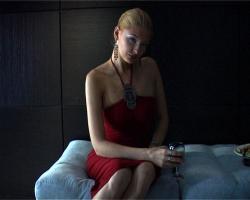
In 1998, seven years after the independence of the country, autocratic president Kazakh Noursoultan Nazarbaiev decides to move the capital of Almaty to Astana, the barren plains of the north. Vertiginous towers of glass rise above ground, financed by oil exports. A presidential speech in 1997 on the future of Kazakhstan opens the film, praising the ?three social levels, the rich, the middle class and the poor?, and the infinite promises of the market. Christian Barani and Guillaume Reynard see the birth of a new social level, in the standardized tinsel and foil of richness. Attempting to represent ?the fiction which in each scene seems to have preceded reality?, until a change of scene by writer Darejan Omirbaev, they also venture backstage, a hut on a site of a recently expropriated maisonnette. A portrait of a melancholic person and poetic globalization through the ex-Soviet oligarchy, in full expansion.
Christian Barani, on his artistic path, researches into the fields of realization, diffusion and transmission. As a video maker, he decided as from 1997 to participate in the area of documentaries with ethical and political stakes. This research is based on a film which offers a plan turning a performance into a fragmented narration. Guillaume Reynard is an illustrator in Paris. He collaborates with several publishers and publishes in various newspapers (Le Monde, Libération?). Without falling under a strict or anecdotic image, his work, fact of figurative drawings, explore the bond which links human beings with places, beings with objects.
Catalogue : 2007Entre-temps | Experimental doc. | dv | color | 31:30 | France, Nepal | 2006
Christian Barani
Entre-temps
Experimental doc. | dv | color | 31:30 | France, Nepal | 2006
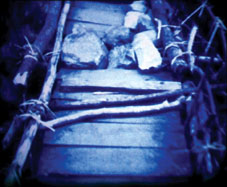
A march in the valley that bypasses the Manaslau. The ghostly but genuine presence of the Maoists prevents the artist from filming during the first few days. Then the militaries disappear and the image can exist. A super8 camera captures the time of the march during which the mind slides, is fragmented, loops, is moved, and the video camera records the unfolding of time.
Christian Barani's conception of his artistic carreer is that of a go-between, crossing the realms of direction, diffusion, and transmission. As a video artist, he decided in 1997 to enter the documentary sphere for ethic and political stakes, and for other stakes linked to the representation of the human being in his daily actions. This research is based on a filming apparatus that transforms the shot into a performative act. The narration develops in fragments. Christian Barani's videos are presented in Europe and abroad. He regularly collaborates for the Arte research workshop. As a teacher, from 1990 to 2006, he directed the video studio at the Ecole Nationale Supérieure de Création Industrielle of Paris, as well as workshops, conferences, and did research in experimental forms of educating. In the area of diffusion, he co-founded an association for the diffusion of artists' videos, 'Est-ce une bonne nouvelle'. These programs/diffusions are presented in France and throughout the world.
Catalogue : 2006Windhoek | Documentary | dv | color | 32:0 | France | 2005
Christian Barani
Windhoek
Documentary | dv | color | 32:0 | France | 2005
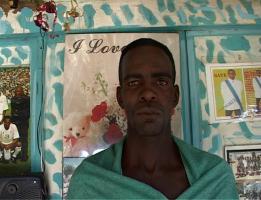
The wandering produces an attitude, a form and makes an other city appear. The crossing of the city becomes an art performance which result is the plastic form, documentary form. The territory is represented as an experience. Each frame is shot only once. The improvisation structure and the shooting desire. The intuition makes the recording trigger pulled but with no idea of the result. Shooting becomes a performative act where the meeting with the other becomes a representation stalk. To represent this suspended moment where the instinctive relation is created, is accepted, or even refused. In this wandering, I invent a journey; I discover secret territories and adapt myself to the context. The journey includes both physical geography and my psychic relation to space and people. This drift form appears during the editing of singular ambiances linked to the urban landscapes crossed and people met. It creates an urban collage.
Christian Barani is positioning in his artistic career, as a bystander investing directing, diffusion and transmission domains. As a videaste, he decides from 1997 to intervene in the documentary sphere for ethic and politic stakes linked to the human being representation in its daily behaviour. This research is based on a shooting procedure that gives to the frame a performative act status and to narration to develop under fragment form. These videos are presented in Europe and abroad. He often collaborate with the Arte research workshop. As a teacher, he manages since 1990 the video studio at the Ecole Nationale Supérieure de Creation Industrielle of Paris, realizes workshops, conferences and research for experimental educational forms. In the diffusion domain, he cofounded an ssociation of artist?s videos ?est-ce une bonne nouvelle?. These programmations/diffusions are presented in France and abroad.
Christian Barani
Catalogue : 2022je me suis enfui | Experimental doc. | mov | color | 83:0 | France, Ethiopia | 2021
Christian Barani
je me suis enfui
Experimental doc. | mov | color | 83:0 | France, Ethiopia | 2021
One day Arthur Rimbaud left the world of culture, tired, disappointed and angry. He does not understand, he does not admit the conventions, the lack of courage, the lack of investment of the art world. "Real life is absent," said Arthur Rimbaud. So he leaves, he leaves for an elsewhere that is less a place than an anarchic tension. He looks for chance, the unknown, the encounter, the unexpected. He now wants to practice poetry since nobody can understand his poetry. Arthur Rimbaud lived the last ten years of his life in Harar, a holy city in Ethiopia (1880-1891). In 2005, I left for Harar. Every day I walk, I get lost. I don't look for anything because there is nothing to look for. I film a contemporary Harar. In 2020, I decided to make a film out of these sequences.
Christian Barani's work takes the form of a committed realist poetry. Engaged in an improvised otherness, never sought after. His body, often lost in space, allows him to show a certain state of the world. He walks, crosses, observes, feels, analyses, meets, films. He loses himself, he drifts to find, to provoke and to create a necessary and essential link to the production of an image. He walks for long hours until he is exhausted, until he reaches the end of himself. Drifting puts him in danger. A physical and mental danger that allows, that authorises the filming of the other in his difficulty of life, in his quest for survival, in his struggle. Only at this price is it possible to welcome them. The image comes as a consequence. The forms that emerge from these experiences have no a priori. They are often diverse and take the form of film, film installation, reading projection, photographic notes and texts. They are created from the material captured and are often conceived according to the spaces in which they are exhibited.
Catalogue : 2020Lac Assal | Experimental doc. | hdv | color | 15:12 | France, Djibouti | 2019
Christian Barani
Lac Assal
Experimental doc. | hdv | color | 15:12 | France, Djibouti | 2019
In the rift valley of Djibouti, in the black of volcanic rocks, men are waiting. In this desert, a few years before, the production of salt organized life. Since the competition has won. On the shores of Lake Assal, resistance fighters go in search of salt concretions hoping to sell them to the few tourists who would come to contemplate the blue of the lake.
Christian Barani was born in 1959, lives in Paris. He builds a practice that combines the field of documentary with that of Visual Arts. His research is based on a performative device that engages a body/camera walking in space. It defines a rule of the game that composes with chance and improvisation and generates images without a priori. He filmed where political and social violence oppressed, drawing a portrait of the defeated over time.
Catalogue : 2019Dans la fumée d'une peau | Experimental doc. | hdv | color | 12:30 | France, South Africa | 2018
Christian Barani
Dans la fumée d'une peau
Experimental doc. | hdv | color | 12:30 | France, South Africa | 2018
Catalogue : 2018des êtres de poussière | Experimental doc. | hdv | color | 18:0 | France, Nepal | 2018
Christian Barani
des êtres de poussière
Experimental doc. | hdv | color | 18:0 | France, Nepal | 2018
A starting point : In Upper Mustang, a very old story is told in the village of Ghemi. Despite the courage and the fighting of the villagers, every night, the demon Balmo and her spirits destroy the houses of the village. Exhausted, they decide to ask the help of a monk, the guru Rimpoche who meditated in the valley. Rimpoche then leaves his meditation and agrees to fight the demon. For seven nights the fight was monstrous. But Rimpoche won the battle. Today in the Nepalese country, the fight against the spirits that are constantly destroying the country continues. Despite a Maoist revolution that resulted in democracy, the abolition of the monarchy, the writing of a new constitution, the equality of man and woman ... the country is still a victim of destructive spirits and the Nepali people continue without stop the fight
Christian Barani is born in 1959 and lives in Paris. He ends his studies with a master?s degree in science economic in the Faculty of Nice. In the 90s, the arrival of the format DV pushes aside its relation in the images and allows him to acquire a freedom of creation and production. He builds a practice which associates the field of the documentary with the Visual Arts. Over a period of 10 years, he films in Kazakhstan with G. Reynard the social transformations of this country of Ex Union Soviétique, he films in Nepal during the Maoist revolution, in Namibia, in Ethiopia, in Cyprus, in Dubai, in the Lebanon ... His process of realization sets up a performative device which is going to generate images without in priori. It is about experience committing a body / camera walking in the space. He defines a rules of the game which composes with the coincidence and the improvisation. No preliminary scenario. Everything takes place in an instant. Never a sequence is twice shot. What is void and void. In the term of the experience, a material of images and sounds is collected. He will take various forms according to the project to come and from places of exhibition : movie in room, movie deployed in the space of exhibition, installation, performance ? He realize in parallel numerous commissioned works for museums as the House Arthur Rimbaud in Charleville-Mézières, the Royal Institute of the Natural sciences of Brussels, the Center of Culture of Rennes, Agora : biennial event of Architecture of Bordeaux, Mons Mémorial Museum in Belgium, The Museum of Confluences in Lyon, The City of the architecture and the heritage of Paris ? From 1990 till 2006, he creates to the National School of Industrial Design, the department Images in Movement, the unit of Experiment Images and Sound (Xis- with Jeff Guess, Extensions - dynamics of writings with Frédéric dumond. In 2000, he cofounds, with Véronique Barani and Sabine Massenet, a structure of distribution of videos artists " estceunebonnenouvelle " which is going to include more than hundred international artists and a collection understanding more than 500 movies
Catalogue : 2015Prolégomène à la lumière | Experimental doc. | dv | color | 7:0 | France, Kazakhstan | 2013
Christian Barani
Prolégomène à la lumière
Experimental doc. | dv | color | 7:0 | France, Kazakhstan | 2013
KAZAKHSTAN. Mine de Kouzembaïev dans les steppes de Karaganda. Durant l'époque soviétique, les mineurs bénéficiaient d’un très grand respect de la part du régime et de la population. Ce statut était dû aux nombreux sacrifices subis pour la construction du pays. Depuis la chute du mur, une société libérale est apparue. Avec lui, l’individualisme, le chômage et la crise. Les mines ferment les unes après les autres. Sur 28 mines présentent dans la région, seules 8 sont encore en service. Dans la mine du héros Kouzembaëv, dans cet instant qui précède la descente dans le noir, seule la lumière persiste pour honorer ces corps.
Christian Barani est né en 1959. Il construit une pratique qui associe le champ du documentaire à celui des Arts Visuels. Dans le processus de réalisation, il est question d’expérience engageant un corps/caméra marchant dans l’espace. Pour filmer, il se définit une règle du jeu qui compose avec le hasard et l’improvisation. Pas de scénario préalable. La marche est utilisée comme un vecteur de rencontres. Tout se joue dans l’instant. Au terme de l’expérience, un matériau est récolté. Il prendra différentes formes en fonction du projet à venir, des lieux d’exposition : film, installation, performance…
Catalogue : 2012My Dubaï Life | Experimental doc. | 0 | color | 60:0 | France | 2011
Christian Barani
My Dubaï Life
Experimental doc. | 0 | color | 60:0 | France | 2011
In his work, Christian Barani questions and deconstructs the documentary's codes. It is not question of representation of the reality nor fiction but the experience. By summoning the walking and the drift, he involves another process of creation which generates a representation without a priori. He plays with fate and improvisation. No sequence is recorded twice. On the occasion of an exhibition entitled "Manifesto about the invisible cities", Olivier Marboeuf suggests to Christian Barani to direct a "drift" in Dubaï. This approach, appropriate for the artist, consists in walking in landscapes and cities. In this case, Dubaï is a town where nothing is thought for the moving body, a town built for and by the influx. It's a question of walking to get lost in these fiction spaces, and to build from the fate.
Christian Barani, born 1959, works and lives in Paris. He starts working with video in 1990, and founds the Moving Image department at the Nationale Supérieure school of Industrial Creation where he's been teaching for 17 years. In 2000, he co-founded a structure of artists' videos broadcasting, "estceunebonnenouvelle" bringing together a hundred of international artists and a collection made up of 500 movies. Inlaying, link to painting and poetry make up the axis of research of his first videos. Since 1997, his work questions and deconstructs the codes of documentary, through an experience engaging a body/camera in space, not a documentary nor a fiction. He directs linear movies, art installations, performances... His work has been shown in numerous festivals, museums and art centers in Europe, notably at the Centre Pompidou, at the Jeu de Paume, at the Lieu Unique in Nantes, at the MUSAC Museo de Arte Contemporaneo de Castilla y Leon, at the National Museum Reina Sofia.
Catalogue : 2009kazakhstan, naissance d'une nation | Experimental doc. | dv | color | 64:0 | France, Kazakhstan | 2008
Christian Barani, reynard guillaume
kazakhstan, naissance d'une nation
Experimental doc. | dv | color | 64:0 | France, Kazakhstan | 2008
In 1998, seven years after the independence of the country, autocratic president Kazakh Noursoultan Nazarbaiev decides to move the capital of Almaty to Astana, the barren plains of the north. Vertiginous towers of glass rise above ground, financed by oil exports. A presidential speech in 1997 on the future of Kazakhstan opens the film, praising the ?three social levels, the rich, the middle class and the poor?, and the infinite promises of the market. Christian Barani and Guillaume Reynard see the birth of a new social level, in the standardized tinsel and foil of richness. Attempting to represent ?the fiction which in each scene seems to have preceded reality?, until a change of scene by writer Darejan Omirbaev, they also venture backstage, a hut on a site of a recently expropriated maisonnette. A portrait of a melancholic person and poetic globalization through the ex-Soviet oligarchy, in full expansion.
Christian Barani, on his artistic path, researches into the fields of realization, diffusion and transmission. As a video maker, he decided as from 1997 to participate in the area of documentaries with ethical and political stakes. This research is based on a film which offers a plan turning a performance into a fragmented narration. Guillaume Reynard is an illustrator in Paris. He collaborates with several publishers and publishes in various newspapers (Le Monde, Libération?). Without falling under a strict or anecdotic image, his work, fact of figurative drawings, explore the bond which links human beings with places, beings with objects.
Catalogue : 2007Entre-temps | Experimental doc. | dv | color | 31:30 | France, Nepal | 2006
Christian Barani
Entre-temps
Experimental doc. | dv | color | 31:30 | France, Nepal | 2006
A march in the valley that bypasses the Manaslau. The ghostly but genuine presence of the Maoists prevents the artist from filming during the first few days. Then the militaries disappear and the image can exist. A super8 camera captures the time of the march during which the mind slides, is fragmented, loops, is moved, and the video camera records the unfolding of time.
Christian Barani's conception of his artistic carreer is that of a go-between, crossing the realms of direction, diffusion, and transmission. As a video artist, he decided in 1997 to enter the documentary sphere for ethic and political stakes, and for other stakes linked to the representation of the human being in his daily actions. This research is based on a filming apparatus that transforms the shot into a performative act. The narration develops in fragments. Christian Barani's videos are presented in Europe and abroad. He regularly collaborates for the Arte research workshop. As a teacher, from 1990 to 2006, he directed the video studio at the Ecole Nationale Supérieure de Création Industrielle of Paris, as well as workshops, conferences, and did research in experimental forms of educating. In the area of diffusion, he co-founded an association for the diffusion of artists' videos, 'Est-ce une bonne nouvelle'. These programs/diffusions are presented in France and throughout the world.
Catalogue : 2006Windhoek | Documentary | dv | color | 32:0 | France | 2005
Christian Barani
Windhoek
Documentary | dv | color | 32:0 | France | 2005
The wandering produces an attitude, a form and makes an other city appear. The crossing of the city becomes an art performance which result is the plastic form, documentary form. The territory is represented as an experience. Each frame is shot only once. The improvisation structure and the shooting desire. The intuition makes the recording trigger pulled but with no idea of the result. Shooting becomes a performative act where the meeting with the other becomes a representation stalk. To represent this suspended moment where the instinctive relation is created, is accepted, or even refused. In this wandering, I invent a journey; I discover secret territories and adapt myself to the context. The journey includes both physical geography and my psychic relation to space and people. This drift form appears during the editing of singular ambiances linked to the urban landscapes crossed and people met. It creates an urban collage.
Christian Barani is positioning in his artistic career, as a bystander investing directing, diffusion and transmission domains. As a videaste, he decides from 1997 to intervene in the documentary sphere for ethic and politic stakes linked to the human being representation in its daily behaviour. This research is based on a shooting procedure that gives to the frame a performative act status and to narration to develop under fragment form. These videos are presented in Europe and abroad. He often collaborate with the Arte research workshop. As a teacher, he manages since 1990 the video studio at the Ecole Nationale Supérieure de Creation Industrielle of Paris, realizes workshops, conferences and research for experimental educational forms. In the diffusion domain, he cofounded an ssociation of artist?s videos ?est-ce une bonne nouvelle?. These programmations/diffusions are presented in France and abroad.
Anna Baranowski, Vlad Br?teanu
Catalogue : 2025Fill In The Blanks | Experimental film | 4k | color | 11:5 | Romania, Germany | 2022
Anna Baranowski, Vlad Br?teanu
Fill In The Blanks
Experimental film | 4k | color | 11:5 | Romania, Germany | 2022
Anna Baranowski and Vlad Br?teanu’s collaborative piece invites the audience to experience an intimate hypnotic induction. By making use of the hypnotic methodologies of relaxation - the sound of the sea and the soft human voice; images from the seaside, and the notions of rest and recovery that vacation recalls - the artist’s voices smoothly induce into the visitors’s consciousness local stories and realities of global warming, massive migration and economic challenges inflicted by global politics and mass tourism from Radhima, Vlora, a small village at the tip of the Albanian Riviera.
Anna Baranowski was born in Bytom, Poland in 1983. Today she lives secluded in a small village surrounded by the forests of East Germany and works on her art. In 2012, she received her diploma in media art with distinction from the Academy of Visual Arts in Leipzig. After her studies, she took part in numerous exhibitions in Germany and abroad, such as the Berlin Biennale „Forget Fear“ in 2012. She has received grants, such as the Stiftung Kunstfonds working scholarship in 2018, and in recent years has been invited to various artist residencies, such as the Greater Columbus Arts Council in Columbus, USA, to develop new artistic works. Anna Baranowski looks at historical legacies in contemporary everyday life and reflects on collective psychological phenomena of human behaviour. In the field of experimental and documentary film, she focuses on direct cinema. She always uses documentary material in her works. In addition to her own cinematic images, composed in detail, the use of archival material is a central element of her experimental films. In doing so, she uses a wide variety of sources, such as amateur recordings, NASA or military footage. By taking them out of their original context, her works release new meanings. With documentary images that depict the real world, Anna Baranowski tells fictitious stories that are irritating and contrary to obvious expectations, which is precisely why they have an inner meaning and for this very reason trigger processes - the viewer is thrown back on himself and is confronted with his own feelings. Vlad Br?teanu, born in Bac?u, in the former Socialist Republic of Romania (RSR) in 1986, currently lives and works in Berlin, Germany. Br?teanu holds a M.A. in Photography and Moving Image and a B.A. in Graphics from the National University of Arts in Bucharest. In 2016 he studied Philosophy in the Context of Contemporary Art at the Royal Institute of Art in Stockholm. His background in graphics forms the base for theoretical and conceptual considerations in which photography functions as a primary medium. Sound/hypnotic inductions, found objects, and public interventions that use playful semiotics of imagery are found in his current practice. Navigating the boundaries between public and private spaces, and finding signifiers for (in)visibility are translated into works that raise questions on precarity, fragility and stability in neoliberal societies. Research into the concept of plasticity and the effects of language are central in his artistic practice. Vlad is the co-founder of Template, an artist initiative and exhibition project that started in Bucharest in 2018 and is an alumnus of WHW Akademija in Zagreb in 2020.
Théodora Barat
Catalogue : 2012On anything at all except the dark pavement | Video | hdv | color | 5:0 | France | 2011
Théodora Barat
On anything at all except the dark pavement
Video | hdv | color | 5:0 | France | 2011
Or anything at all except the dark pavement is a tracking shot by night shot in 16mm at a Franco-Belgian border. A plan sequence in two parts. First a guarded advance into the city. An opening in the night, with neon lights as guides. The city, already vague, fades away. Obscurity follows but the lights prevent it from taking over. They redraw the contours, announcing other ?skylines?. Little by little the actions take over, isolated details from films, memories of journeys, a tribute to nocturnal outings and to roadside architecture. A fantasized vision of roadside lanscape.
Theodora Barat studied at Nantes school of art. « Fed » by trips to United States and American cinema of the fifties, her work made for installation and specially video installation. She realised in 2008 Froissée (Crumpled), the first of a serie dealing with Film Noir and its city?s representation. Underwold (2009) and Projection Frontale (Head-on Projection, 2009) will follow. This year, she direct her first film, a plan sequence in 16mm, shown both as installation and film.